torque DODGE RAM SRT-10 2006 Service Repair Manual
[x] Cancel search | Manufacturer: DODGE, Model Year: 2006, Model line: RAM SRT-10, Model: DODGE RAM SRT-10 2006Pages: 5267, PDF Size: 68.7 MB
Page 3070 of 5267
4. Separate the torque converter from the transmission.
INSTALLATION
NOTE: Check converter hub and drive notches for sharp edges, burrs, scratches, or nicks. Polish the hub
and notches with 320/400 grit paper or crocus cloth if necessary. The hub must be smooth to avoid dam-
aging the pump seal at installation.
1. Lubricate oil pump seal lip with transmission fluid.
2. Place torque converter in position on transmission.
CAUTION: Do not damage oil pump seal or bush-
ing while inserting torqueconverterintothefront
of the transmission.
3. Align torque converter to oil pump seal opening.
4. Insert torque converter hub into oil pump.
5. While pushing torque converter inward, rotate con-
verter until converter is fully seated in the oil pump
gears.
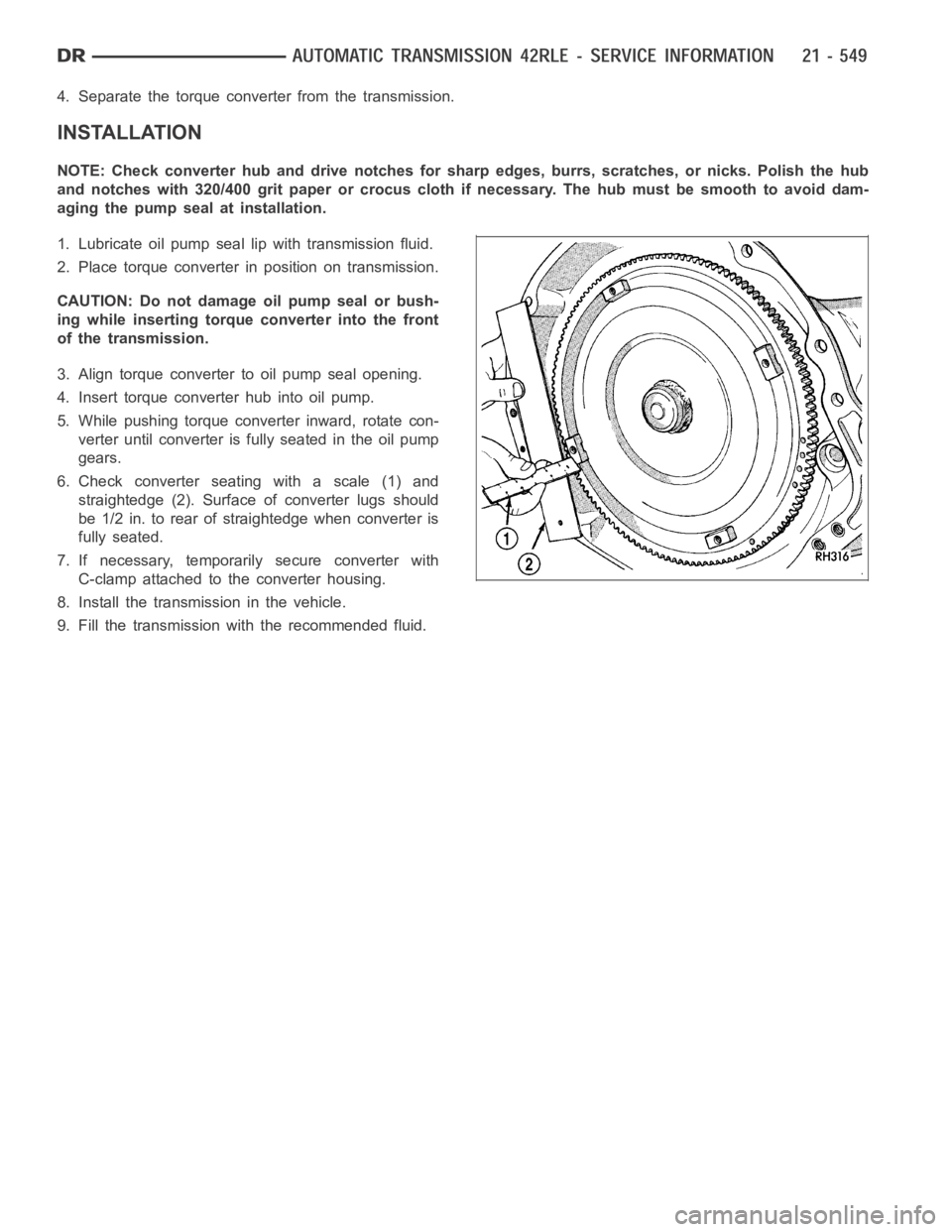
6. Check converter seating with a scale (1) and
straightedge (2). Surface of converter lugs should
be 1/2 in. to rear of straightedge when converter is
fully seated.
7. If necessary, temporarily secure converter with
C-clamp attached to the converter housing.
8. Install the transmission in the vehicle.
9. Fill the transmission with the recommended fluid.
Page 3076 of 5267
INSTALLATION
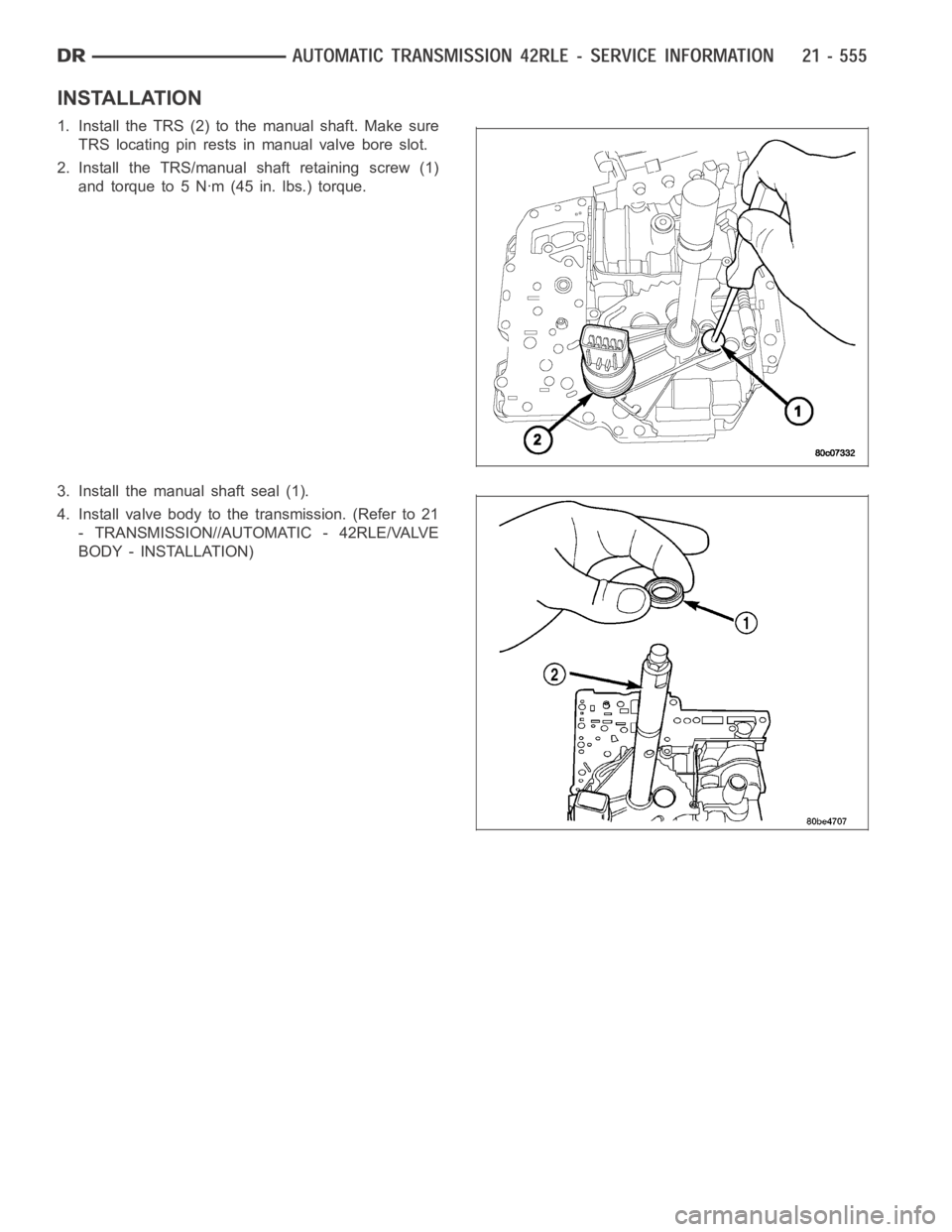
1. Install the TRS (2) to the manual shaft. Make sure
TRS locating pin rests in manual valve bore slot.
2. Install the TRS/manual shaft retaining screw (1)
and torque to 5 Nꞏm (45 in. lbs.) torque.
3. Install the manual shaft seal (1).
4. Install valve body to the transmission. (Refer to 21
- TRANSMISSION//AUTOMATIC - 42RLE/VALVE
BODY - INSTALLATION)
Page 3078 of 5267
BODY-VALVE
DESCRIPTION
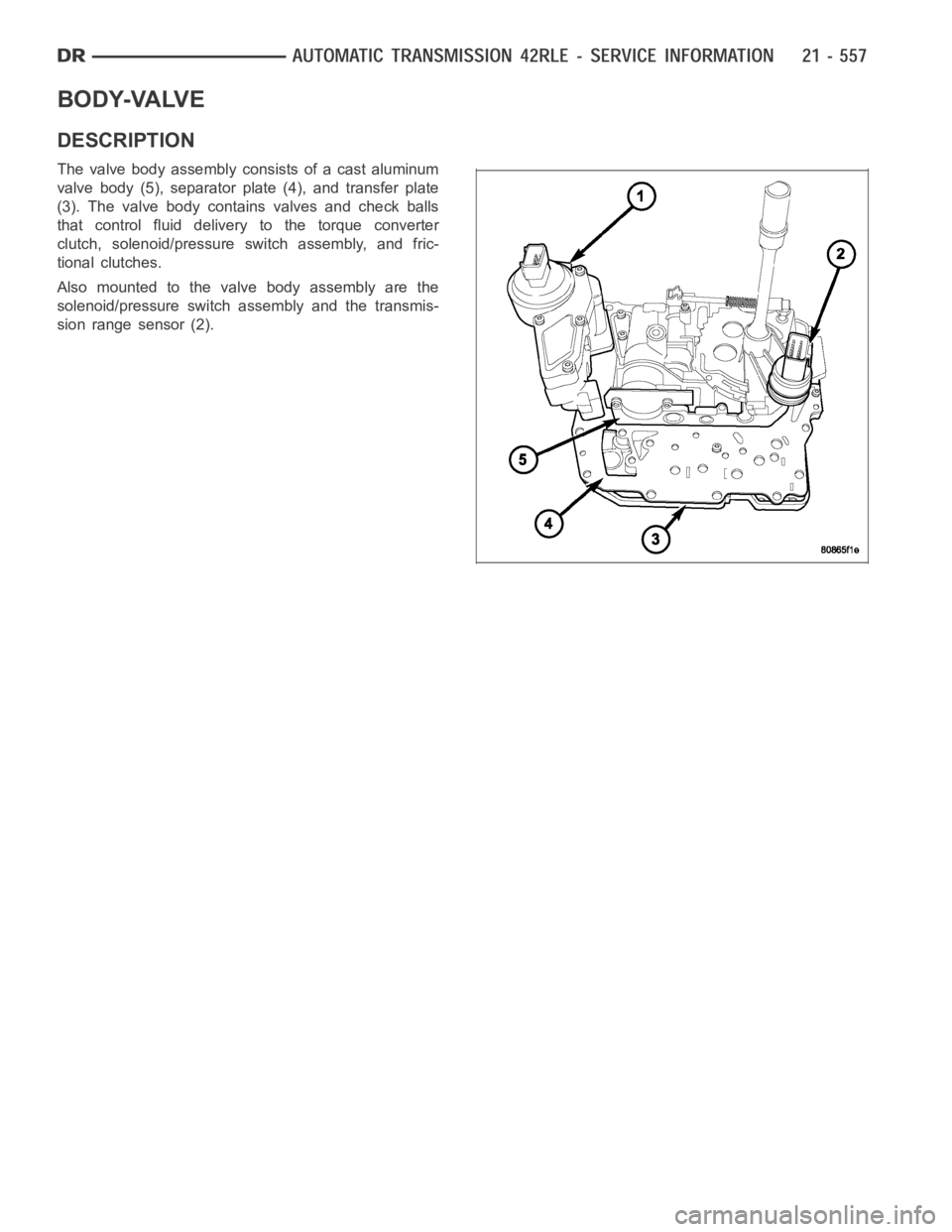
The valve body assembly consists of a cast aluminum
valve body (5), separator plate (4), and transfer plate
(3). The valve body contains valves and check balls
that control fluid delivery to the torque converter
clutch, solenoid/pressure switch assembly, and fric-
tional clutches.
Also mounted to the valve body assembly are the
solenoid/pressure switch assembly and the transmis-
sion range sensor (2).
Page 3079 of 5267
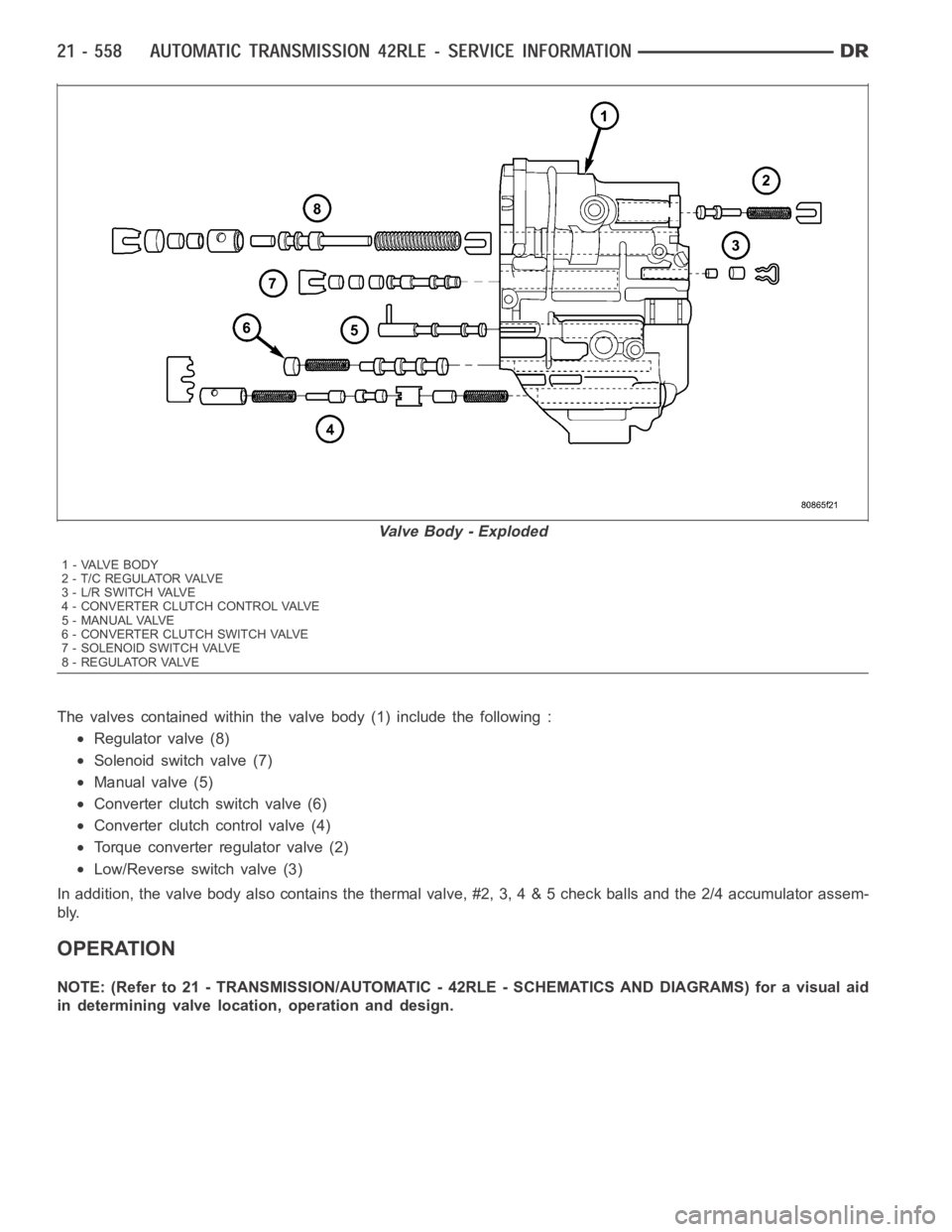
The valves contained within the valve body (1) include the following :
Regulator valve (8)
Solenoid switch valve (7)
Manual valve (5)
Converter clutch switch valve (6)
Converter clutch control valve (4)
Torque converter regulator valve (2)
Low/Reverse switch valve (3)
In addition, the valve body also contains the thermal valve, #2, 3, 4 & 5 check balls and the 2/4 accumulator assem-
bly.
OPERATION
NOTE: (Refer to 21 - TRANSMISSION/AUTOMATIC - 42RLE - SCHEMATICS AND DIAGRAMS) for a visual aid
in determining valve location, operation and design.
Valve Body - Exploded
1-VALVEBODY
2 - T / C R E G U L AT O R VA LV E
3-L/RSWITCHVALVE
4 - CONVERTER CLUTCH CONTROL VALVE
5 - MANUAL VALVE
6 - CONVERTER CLUTCH SWITCH VALVE
7 - SOLENOID SWITCH VALVE
8 - REGULATOR VALVE
Page 3080 of 5267
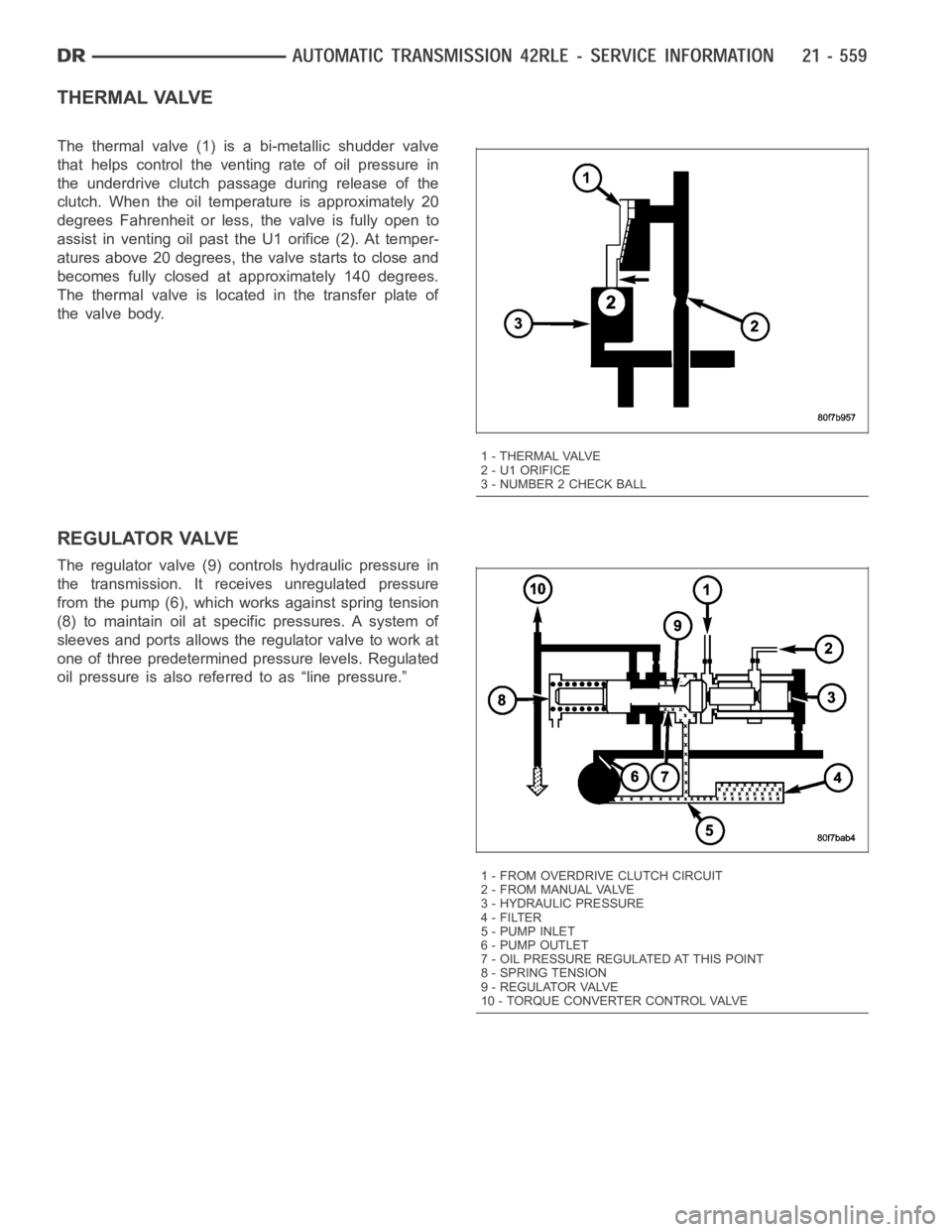
THERMAL VALVE
The thermal valve (1) is a bi-metallic shudder valve
that helps control the venting rate of oil pressure in
the underdrive clutch passage during release of the
clutch. When the oil temperature is approximately 20
degrees Fahrenheit or less, the valve is fully open to
assist in venting oil past the U1 orifice (2). At temper-
atures above 20 degrees, the valve starts to close and
becomes fully closed at approximately 140 degrees.
The thermal valve is located in the transfer plate of
the valve body.
REGULATOR VALVE
The regulator valve (9) controls hydraulic pressure in
the transmission. It receives unregulated pressure
from the pump (6), which works against spring tension
(8) to maintain oil at specific pressures. A system of
sleeves and ports allows the regulator valve to work at
one of three predetermined pressure levels. Regulated
oil pressure is also referred to as “line pressure.”
1 - THERMAL VALVE
2 - U1 ORIFICE
3 - NUMBER 2 CHECK BALL
1 - FROM OVERDRIVE CLUTCH CIRCUIT
2 - FROM MANUAL VALVE
3 - HYDRAULIC PRESSURE
4-FILTER
5-PUMPINLET
6 - PUMP OUTLET
7 - OIL PRESSURE REGULATED AT THIS POINT
8 - SPRING TENSION
9 - REGULATOR VALVE
10 - TORQUE CONVERTER CONTROL VALVE
Page 3082 of 5267
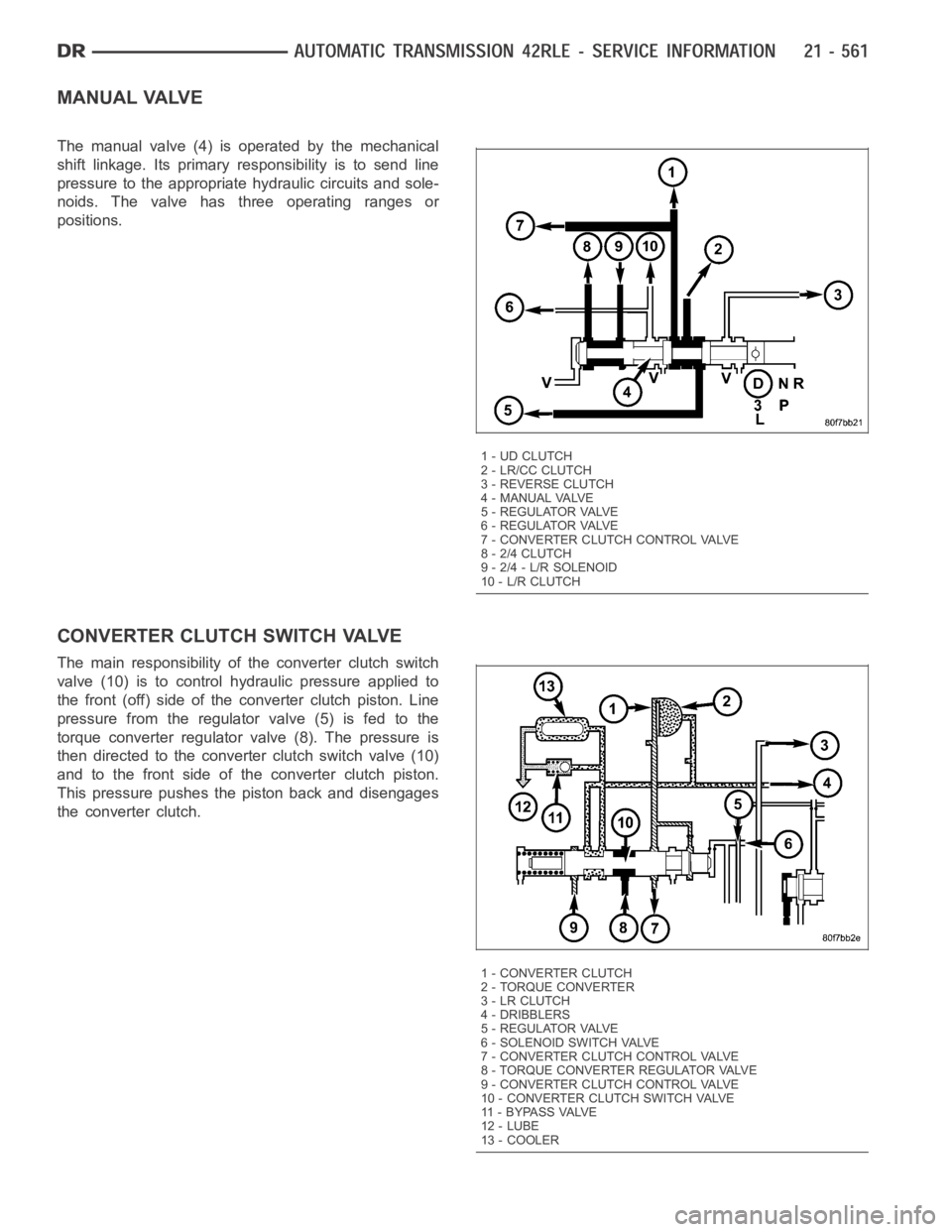
MANUAL VALVE
The manual valve (4) is operated by the mechanical
shift linkage. Its primary responsibility is to send line
pressure to the appropriate hydraulic circuits and sole-
noids. The valve has three operating ranges or
positions.
CONVERTER CLUTCH SWITCH VALVE
The main responsibility of the converter clutch switch
valve (10) is to control hydraulic pressure applied to
the front (off) side of the converter clutch piston. Line
pressure from the regulator valve (5) is fed to the
torque converter regulator valve (8). The pressure is
then directed to the converter clutch switch valve (10)
and to the front side of the converter clutch piston.
This pressure pushes the piston back and disengages
the converter clutch.
1 - UD CLUTCH
2 - LR/CC CLUTCH
3 - REVERSE CLUTCH
4 - MANUAL VALVE
5 - REGULATOR VALVE
6 - REGULATOR VALVE
7 - CONVERTER CLUTCH CONTROL VALVE
8 - 2/4 CLUTCH
9 - 2/4 - L/R SOLENOID
10 - L/R CLUTCH
1 - CONVERTER CLUTCH
2 - TORQUE CONVERTER
3 - LR CLUTCH
4 - DRIBBLERS
5 - REGULATOR VALVE
6-SOLENOIDSWITCHVALVE
7 - CONVERTER CLUTCH CONTROL VALVE
8 - TORQUE CONVERTER REGULATOR VALVE
9 - CONVERTER CLUTCH CONTROL VALVE
10 - CONVERTER CLUTCH SWITCH VALVE
11 - B Y PA S S VA LV E
12 - LUBE
13 - COOLER
Page 3083 of 5267
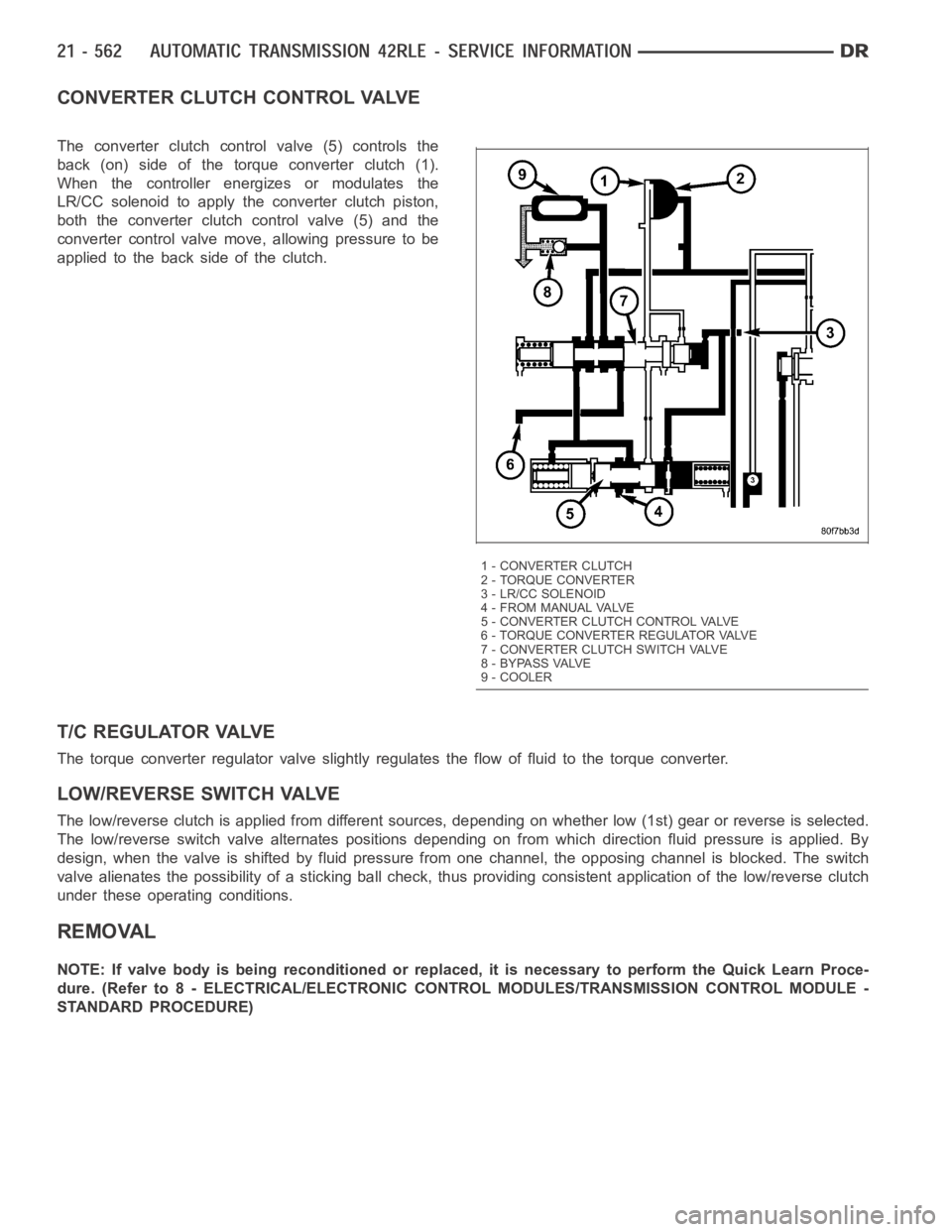
CONVERTER CLUTCH CONTROL VALVE
The converter clutch control valve (5) controls the
back (on) side of the torque converter clutch (1).
When the controller energizes or modulates the
LR/CC solenoid to apply the converter clutch piston,
both the converter clutch control valve (5) and the
converter control valve move, allowing pressure to be
applied to the back side of the clutch.
T/C REGULATOR VALVE
The torque converter regulator valve slightly regulates the flow of fluidto the torque converter.
LOW/REVERSE SWITCH VALVE
The low/reverse clutch is applied from different sources, depending on whether low (1st) gear or reverse is selected.
The low/reverse switch valve alternates positions depending on from which direction fluid pressure is applied. By
design, when the valve is shifted by fluid pressure from one channel, the opposing channel is blocked. The switch
valve alienates the possibility of a sticking ball check, thus providing consistent application of the low/reverse clutch
under these operating conditions.
REMOVAL
NOTE: If valve body is being reconditioned or replaced, it is necessary to perform the Quick Learn Proce-
dure. (Refer to 8 - ELECTRICAL/ELECTRONIC CONTROL MODULES/TRANSMISSIONCONTROL MODULE -
STANDARD PROCEDURE)
1 - CONVERTER CLUTCH
2 - TORQUE CONVERTER
3 - LR/CC SOLENOID
4 - FROM MANUAL VALVE
5 - CONVERTER CLUTCH CONTROL VALVE
6 - TORQUE CONVERTER REGULATOR VALVE
7 - CONVERTER CLUTCH SWITCH VALVE
8 - BYPASS VALVE
9 - COOLER
Page 3094 of 5267
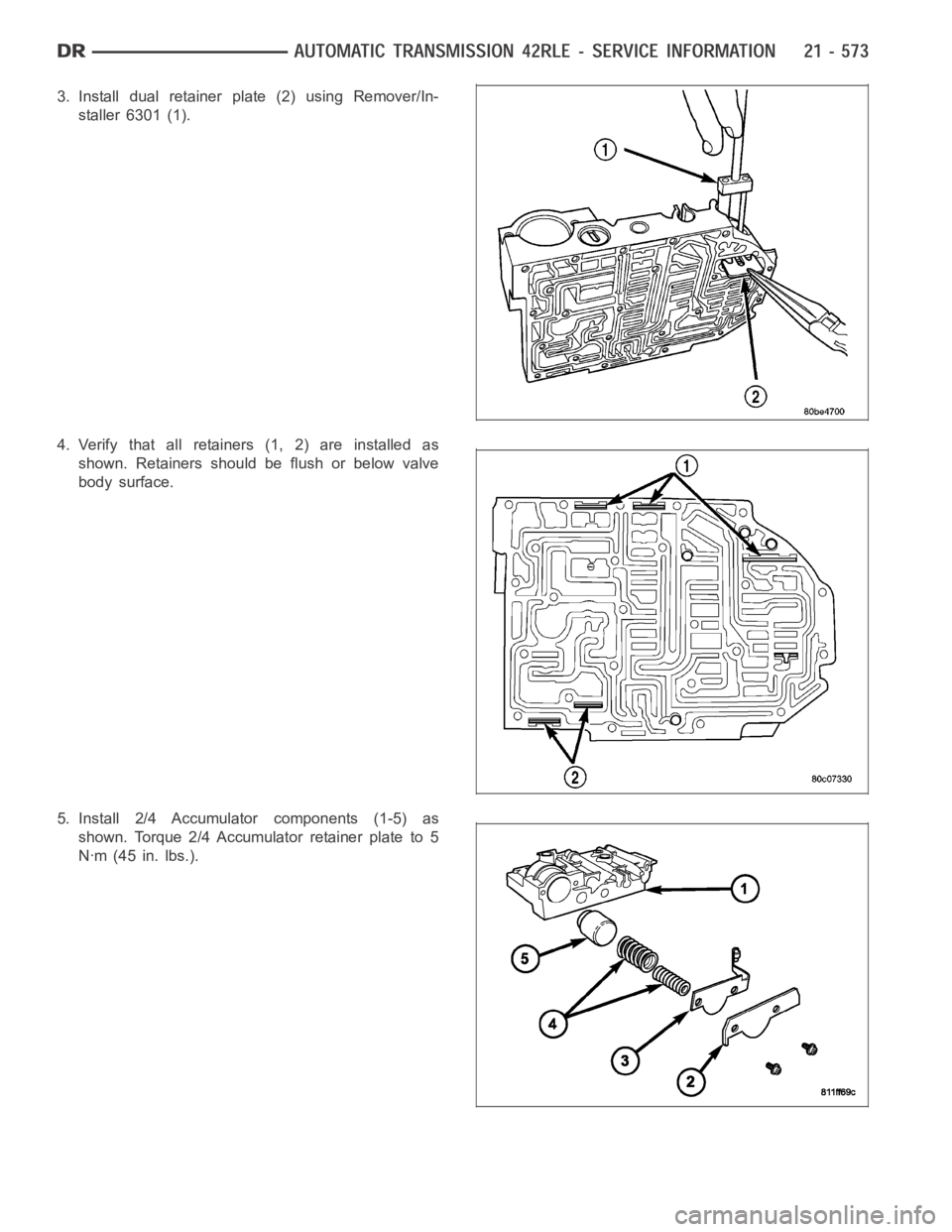
3. Install dual retainer plate (2) using Remover/In-
staller 6301 (1).
4. Verify that all retainers (1, 2) are installed as
shown. Retainers should be flush or below valve
body surface.
5. Install 2/4 Accumulator components (1-5) as
shown. Torque 2/4 Accumulator retainer plate to 5
Nꞏm (45 in. lbs.).
Page 3097 of 5267
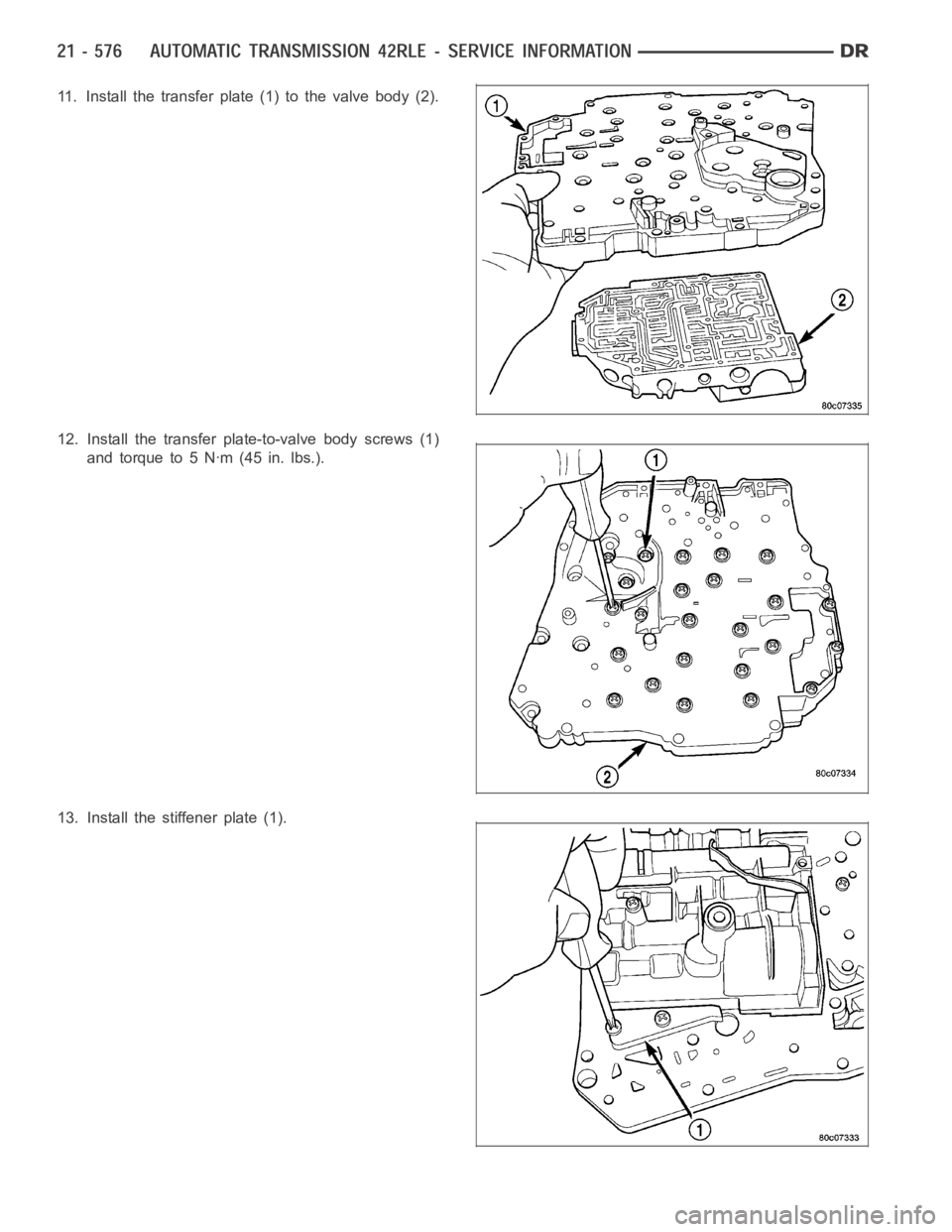
11. Install the transfer plate (1) to the valve body (2).
12. Install the transfer plate-to-valve body screws (1)
andtorqueto5Nꞏm(45in.lbs.).
13. Install the stiffener plate (1).
Page 3098 of 5267
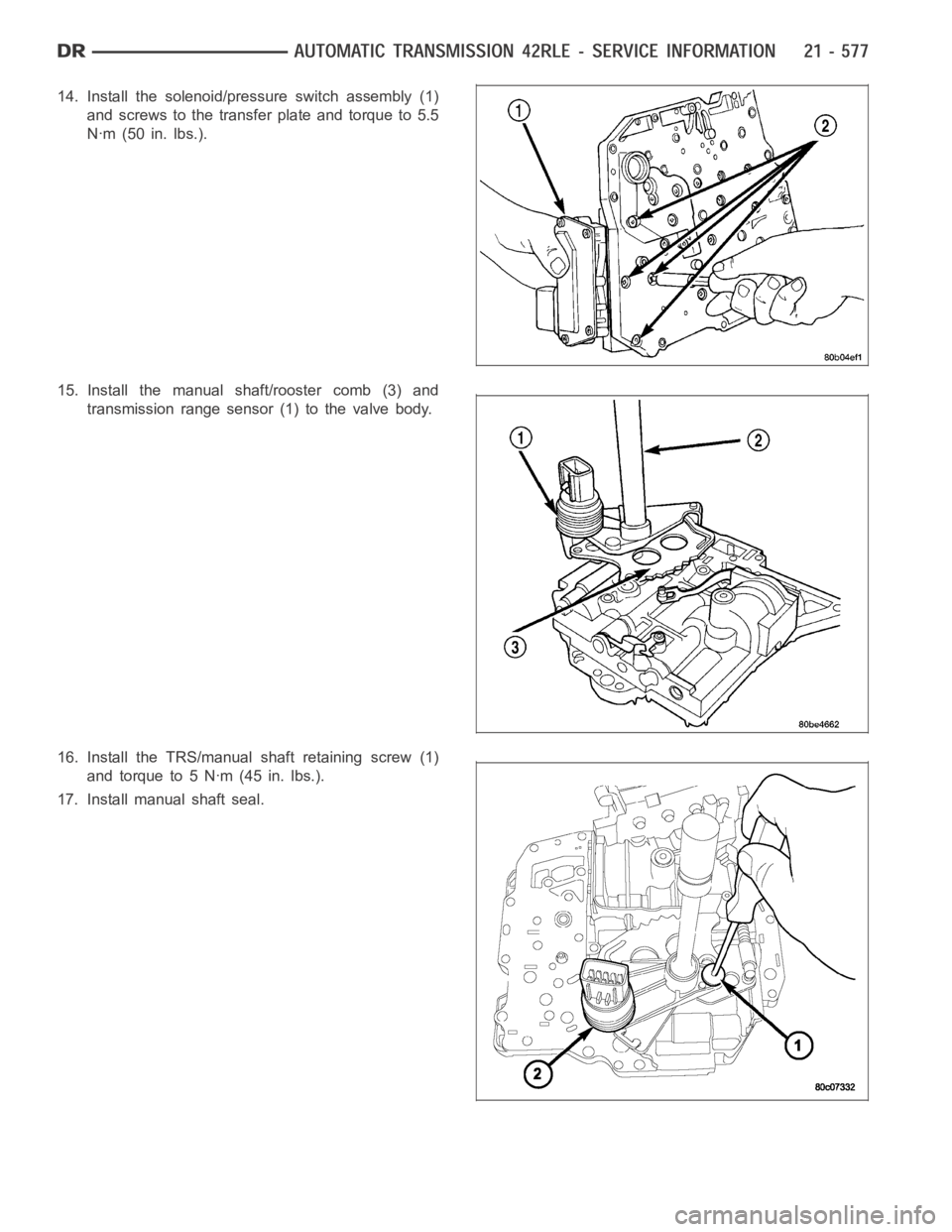
14. Install the solenoid/pressure switch assembly (1)
and screws to the transfer plate and torque to 5.5
Nꞏm (50 in. lbs.).
15. Install the manual shaft/rooster comb (3) and
transmission range sensor (1) to the valve body.
16. Install the TRS/manual shaft retaining screw (1)
andtorqueto5Nꞏm(45in.lbs.).
17. Install manual shaft seal.