lock FIAT BARCHETTA 2003 1.G Owners Manual
[x] Cancel search | Manufacturer: FIAT, Model Year: 2003, Model line: BARCHETTA, Model: FIAT BARCHETTA 2003 1.GPages: 170, PDF Size: 3.55 MB
Page 8 of 170
7
DASHBOARD
The presence and position of the instruments and warning and indicator lights may vary according to the version of the car.
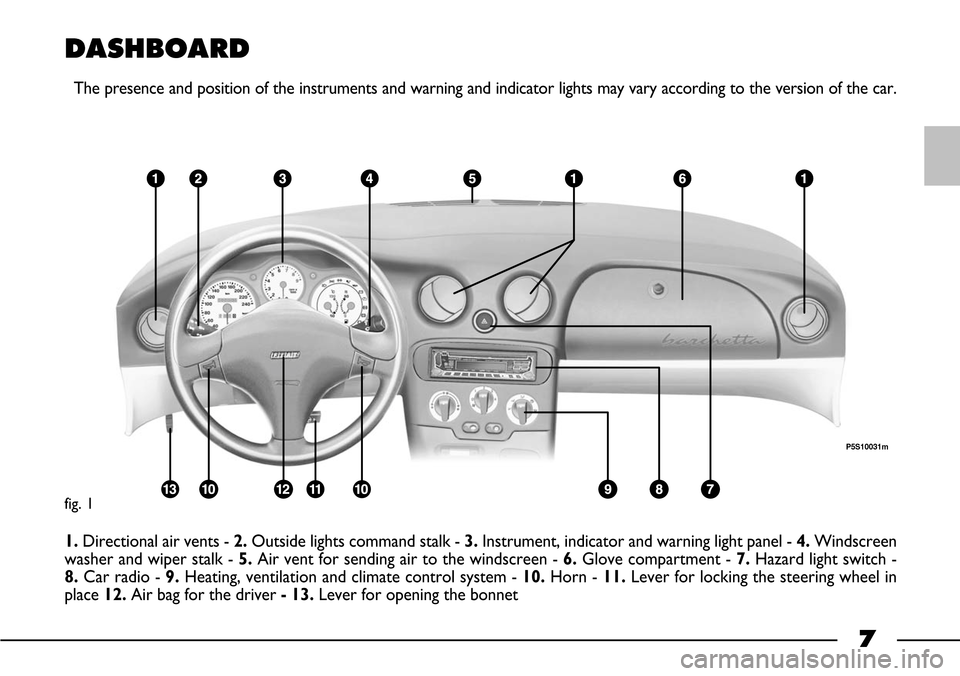
1.Directional air vents -2.Outside lights command stalk - 3.Instrument, indicator and warning light panel - 4.Windscreen
washer and wiper stalk -5.Air vent for sending air to the windscreen - 6. Glove compartment -7.Hazard light switch -
8. Car radio - 9. Heating, ventilation and climate control system - 10.Horn - 11.Lever for locking the steering wheel in
place 12. Air bag for the driver - 13.Lever for opening the bonnet
fig. 1
P5S10031m
Page 12 of 170
11
fig. 4
P5S00624m
THE FIAT
CODE SYSTEM
To further protect your car from at-
tempted theft, it has been fitted with
an electronic engine immobiliser sys-
tem called Fiat CODE which is auto-
matically activated when the ignition
key is removed. The ignition keys, in
fact, are fitted with an electronic de-
vice that transmits a coded signal to
the Fiat CODE unit: only if this signal
is recognised can the engine be start-
ed. The coded signal is the password
with which the control unit recognis-
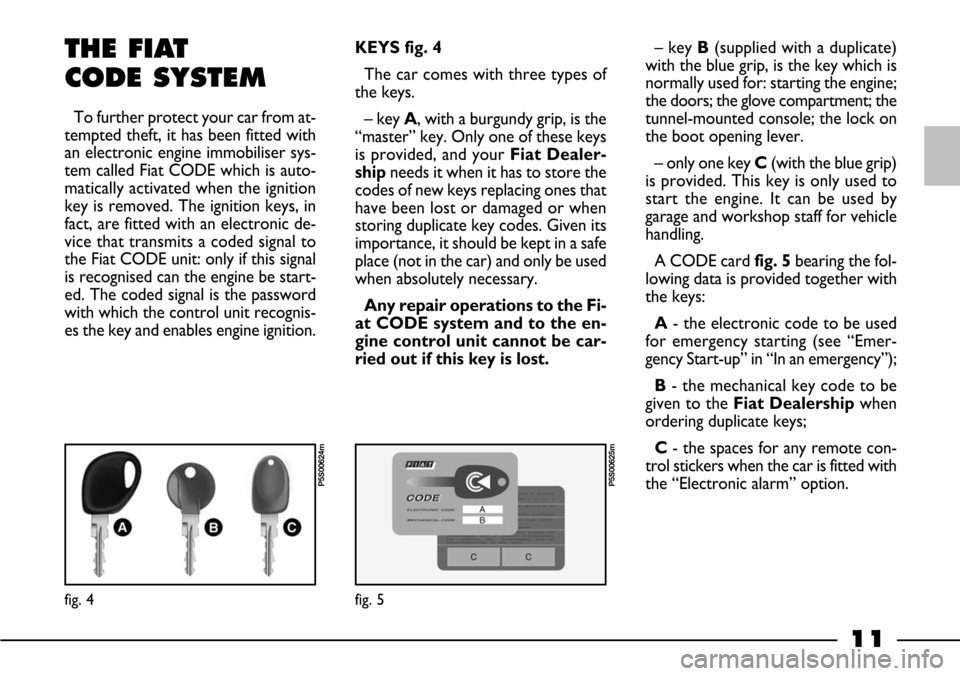
es the key and enables engine ignition. KEYS fig. 4
The car comes with three types of
the keys.
– key A, with a burgundy grip, is the
“master” key. Only one of these keys
is provided, and your Fiat Dealer-
ship needs it when it has to store the
codes of new keys replacing ones that
have been lost or damaged or when
storing duplicate key codes. Given its
importance, it should be kept in a safe
place (not in the car) and only be used
when absolutely necessary.
Any repair operations to the Fi-
at CODE system and to the en-
gine control unit cannot be car-
ried out if this key is lost.– key B(supplied with a duplicate)
with the blue grip, is the key which is
normally used for: starting the engine;
the doors; the glove compartment; the
tunnel-mounted console; the lock on
the boot opening lever.
– only one key C(with the blue grip)
is provided. This key is only used to
start the engine. It can be used by
garage and workshop staff for vehicle
handling.
A CODE card fig. 5bearing the fol-
lowing data is provided together with
the keys:
A- the electronic code to be used
for emergency starting (see “Emer-
gency Start-up” in “In an emergency”);
B- the mechanical key code to be
given to the Fiat Dealershipwhen
ordering duplicate keys;
C- the spaces for any remote con-
trol stickers when the car is fitted with
the “Electronic alarm” option.
fig. 5
P5S00625m
Page 13 of 170
12
U.K. Vehicle onlyAt the behest of
the motor Insurance Companies he
CODE card for the emergency start-
ing and replacement of keys are not
provided. If you need assistance please
contact your nearest Fiat Dealer-
ship, or telephone Free Phone
0800717000.
The code numbers given on the
CODE card and the key with the bur-
gundy grip should be kept in a safe
place.
You should always keep the elec-
tronic code written on the CODE
card on you in case you need to per-
form an emergency startup.”
OPERATION
Each time you remove the ignition
key from theSTOPor PARKposi-
tion, the protection system blocks the
engine.
When the key is turned to MARat
engine startup:
1) If the code is recognised, the
warning lamp ¢on the instrument
panel will flash briefly; this means that
the protection system has recognisedthe key code and disabled the engine
immobiliser; turn the key toAVVto
start.
2)If the code is not recognised, the
warning lamp ¢will remain lit to-
gether with the warning lamp
U.
Should this happen, turn the key back
to STOPand then to MAR; if the en-
gine remains immobilised, try using the
other keys supplied with the car.
If you are still unable to start the en-
gine, use the emergency starting pro-
cedure (see “In an emergency”), and
take your car immediately to the near-
est Fiat Dealership.
When travelling with the ignition key
on MAR:
1)If the warning lamp ¢lights up
while the car is moving, it means that
the system is running a self-diagnosis
(e.g. due to a voltage drop). The first
time you stop you can test the system
as follows: switch the engine off by
turning the ignition key to STOP,
then turn the key back to MAR: the
warning lamp ¢will light up and
should go out in the space of about
one second. If the warning lamp fails to go out,
leave the key at STOPfor more than
30 seconds and repeat the procedure
described previously. If the problem
persists, contact your nearest Fiat
Dealership.
2)If the warning lamp ¢flashes it
means that the car is not protected by
the immobiliser. Contact your Fiat
Dealershipimmediately and get them
to store the codes of all the keys in the
memory.
The electronic compo-
nents inside the key may
be damaged if the key is
subjected to sharp knocks.
IMPORTANT Each key given with
the car has its own code, different
from all the others, which must be
stored in the memory of the system’s
control unit.
Page 14 of 170
13
DUPLICATING KEYS
If you ask for extra keys, remember
that all the keys, both the new ones
and those you already possess, must
be stored in the memory (up to a
maximum of 7). Go directly to your
nearest Fiat Dealership, taking with
you the key with the burgundy grip, all
the other keys in your possession and
the CODE card.
The codes of any keys that are not
available when the new storage pro-
cedure is carried out will be deleted
from the memory to prevent any lost
or stolen keys being used to start the
car.OPERATION
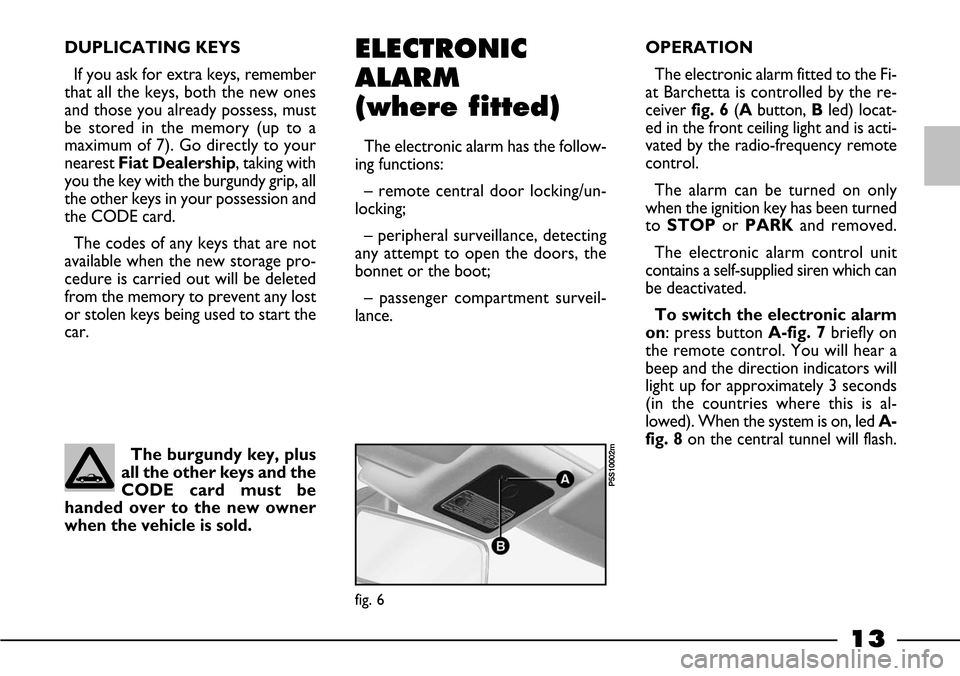
The electronic alarm fitted to the Fi-
at Barchetta is controlled by the re-
ceiver fig. 6(Abutton, Bled) locat-
ed in the front ceiling light and is acti-
vated by the radio-frequency remote
control.
The alarm can be turned on only
when the ignition key has been turned
toSTOPor PARKand removed.
The electronic alarm control unit
contains a self-supplied siren which can
be deactivated.
To switch the electronic alarm
on: press button A-fig. 7briefly on
the remote control. You will hear a
beep and the direction indicators will
light up for approximately 3 seconds
(in the countries where this is al-
lowed). When the system is on, led A-
fig. 8on the central tunnel will flash.ELECTRONIC
ALARM
(where fitted)
The electronic alarm has the follow-
ing functions:
– remote central door locking/un-
locking;
– peripheral surveillance, detecting
any attempt to open the doors, the
bonnet or the boot;
– passenger compartment surveil-
lance.
The burgundy key, plus
all the other keys and the
CODE card must be
handed over to the new owner
when the vehicle is sold.
fig. 6
P5S10002m
Page 17 of 170
The car alarm absorbs
electricity. If you plan on
not using the car for
more than a month, you are ad-
vised to switch the system off
with the remote control and to
turn the emergency key to the
“OFF” position.
16
WHEN THE ALARM
GOES OFF
When the car alarm is activated, the
electronic alarm will be set off if:
1)One of the doors, the bonnet or
the boot are opened.
2)The battery is disconnected or the
electronic alarm power supply cables
are cut.
3) When something enters the pas-
senger compartment.
4)The outside of the car is knocked.
5)The key is turned to MAR.
A siren sounds for approximately 26
seconds (for a maximum of 3 cycles
and 5-second pauses if the condition
persists) when the electronic alarm is
triggered. The direction indicators
flash (in countries where this is al-
lowed) for approximately 5 minutes.
Once the conditions cease, the sys-
tem will continue its normal surveil-
lance function.To stop the electronic alarm, press
the remote control button. If this does
not work, turn the alarm off by turn-
ing the emergency key toOFF(see
next paragraph “How to turn the
alarm”).
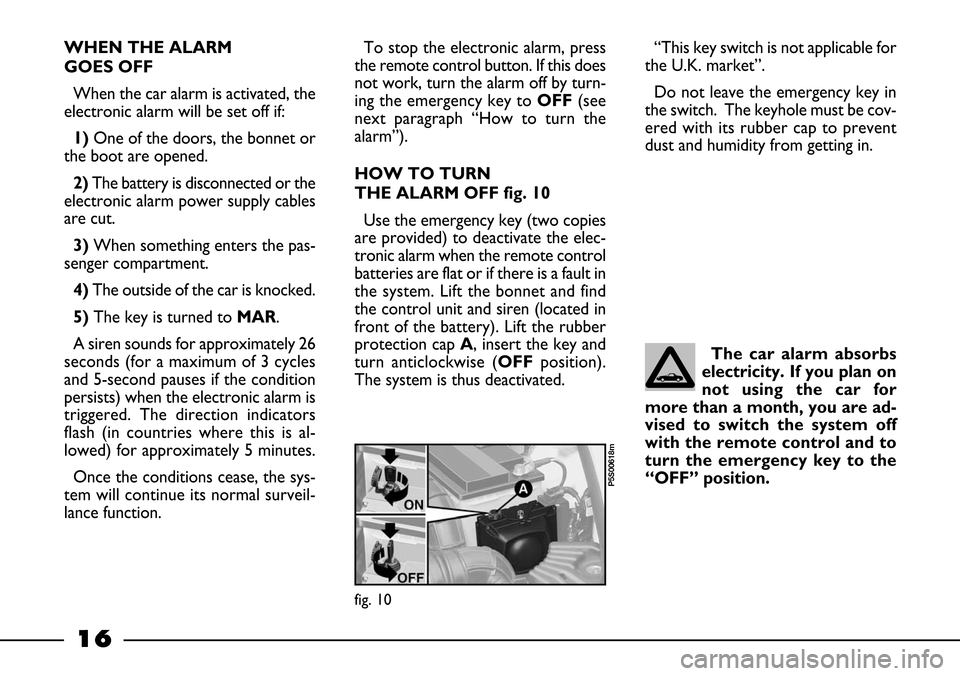
HOW TO TURN
THE ALARM OFF fig. 10
Use the emergency key (two copies
are provided) to deactivate the elec-
tronic alarm when the remote control
batteries are flat or if there is a fault in
the system. Lift the bonnet and find
the control unit and siren (located in
front of the battery). Lift the rubber
protection cap A, insert the key and
turn anticlockwise (OFFposition).
The system is thus deactivated.“This key switch is not applicable for
the U.K. market”.
Do not leave the emergency key in
the switch. The keyhole must be cov-
ered with its rubber cap to prevent
dust and humidity from getting in.
fig. 10
P5S00618m
Page 18 of 170
17
HOW TO KNOW IF
THE ALARM HAS GONE OFF
If the car alarm was triggered while
you were away, led A-fig. 8on the
central tunnel will flash to identify the
reason for it:
Light on: remote control battery
flat.
1 flash: right door.
2 flashes: left door.
5 flashes: passenger compartment
sensors (movement inside the pas-
senger compartment).6 flashes: bonnet.
7 flashes: boot.
8 flashes: ignition tampered with.
9 flashes: alarm power supply cables
cut.
10 flashes: at least three different
causes.
The led will go out when the ignition
key is turned toMARor after 2 min-
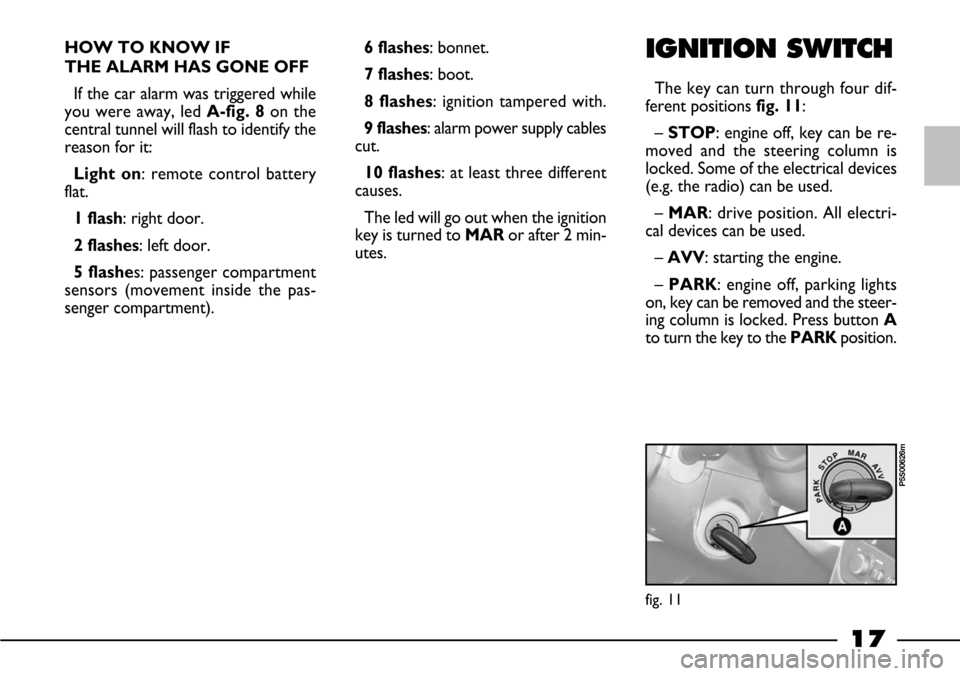
utes.IGNITION SWITCH
The key can turn through four dif-
ferent positions fig. 11:
– STOP: engine off, key can be re-
moved and the steering column is
locked. Some of the electrical devices
(e.g. the radio) can be used.
– MAR: drive position. All electri-
cal devices can be used.
– AVV: starting the engine.
– PARK: engine off, parking lights
on, key can be removed and the steer-
ing column is locked. Press button A
to turn the key to the PARKposition.
fig. 11
P5S00626m
Page 19 of 170
18
If the ignition switch has
been tampered with (e.g.
someone has tried to steal your
car), get a Fiat Dealership to make
sure it is still functioning properly
before you start driving again.
WARNING
Always remove the ignition
key when you get out of the
car. This will prevent anyone from
accidentally working the controls.
Remember to apply the handbrake
and, if the car is pointing uphill, first
gear. Put the car into reverse if it
is pointing downhill. Never leave
children in the car by themselves.
WARNING
STEERING COLUMN LOCK
To engage the lock: remove the
ignition key from either theSTOP or
PARKposition, and turn the steering
wheel until it locks.
To release: move the steering
wheel slightly as you are turning the
ignition key to MAR.INDIVIDUAL
SETTINGS
All seat adjustments must
be made when the car is
stationary.
WARNING
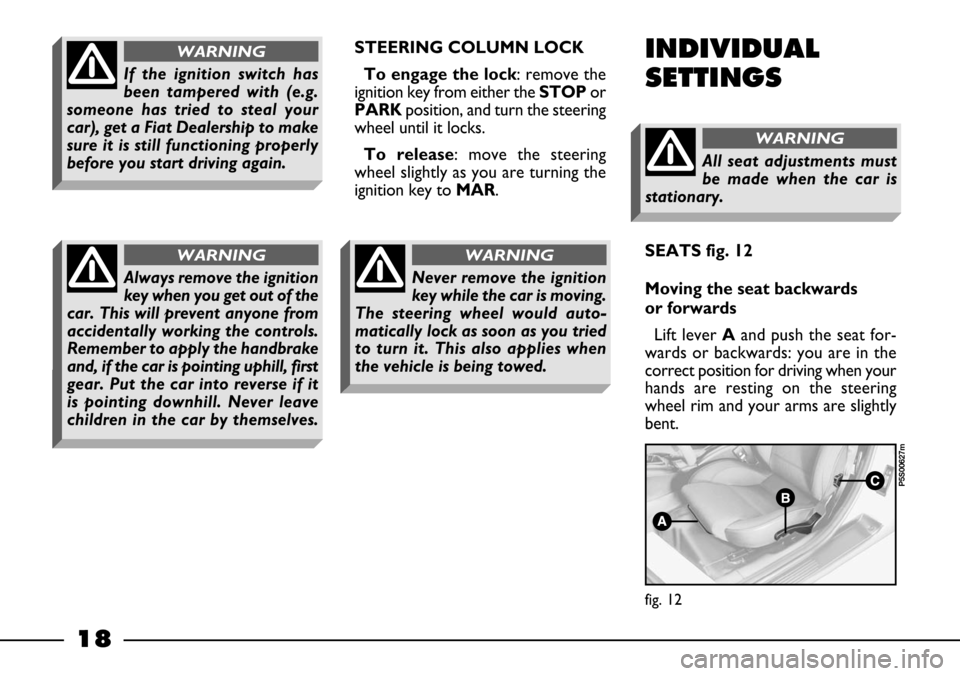
SEATS fig. 12
Moving the seat backwards
or forwards
Lift lever Aand push the seat for-
wards or backwards: you are in the
correct position for driving when your
hands are resting on the steering
wheel rim and your arms are slightly
bent.
fig. 12
P5S00627m
Never remove the ignition
key while the car is moving.
The steering wheel would auto-
matically lock as soon as you tried
to turn it. This also applies when
the vehicle is being towed.
WARNING
Page 20 of 170
19
Once you have let go of the lever,
check the seat is firmly locked in the
runners by trying to move it back and
forth. Failure to lock the seat in place
could result in the seat moving unex-
pectedly with obvious dangerous con-
sequences.
Adjusting the reclining seat back
Lift lever Band tilt the back into the
position required. After releasing the
lever, check that the back is locked
properly into position by trying to tilt
it backwards and forwards.
Tipping the seat back forwards
To make it easier to get at the hood
housing, the front seats can be tipped
forwards
To tip the seat back, turn knob Cto-
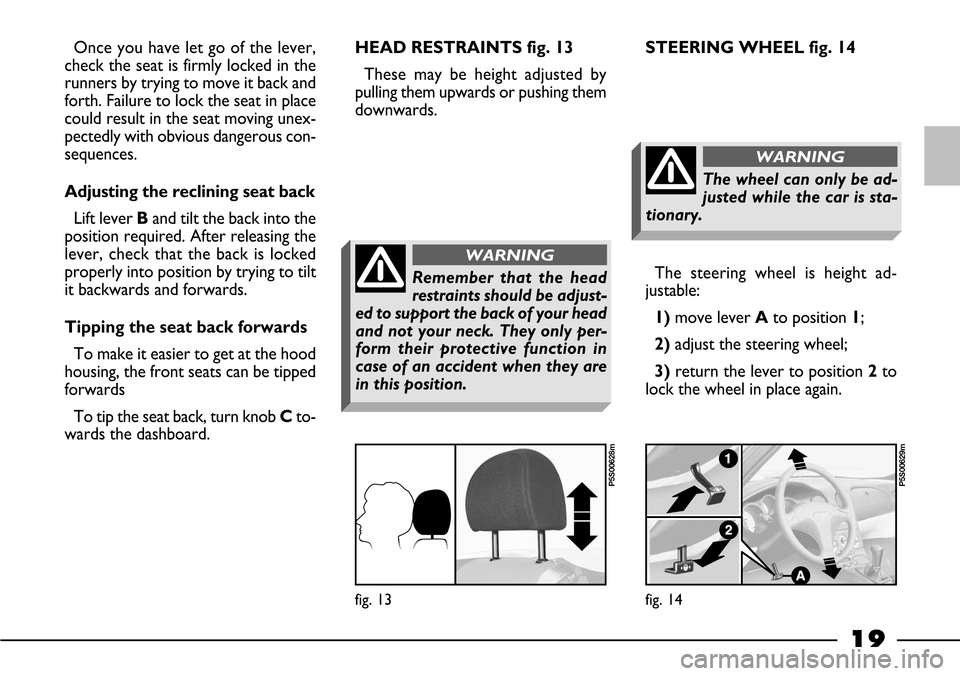
wards the dashboard.HEAD RESTRAINTS fig. 13
These may be height adjusted by
pulling them upwards or pushing them
downwards.STEERING WHEEL fig. 14
The wheel can only be ad-
justed while the car is sta-
tionary.
WARNING
The steering wheel is height ad-
justable:
1)move lever Ato position 1;
2) adjust the steering wheel;
3) return the lever to position2to
lock the wheel in place again.
fig. 13
P5S00628m
fig. 14
P5S00629m
Remember that the head
restraints should be adjust-
ed to support the back of your head
and not your neck. They only per-
form their protective function in
case of an accident when they are
in this position.
WARNING
Page 22 of 170
21
SEAT BELTS
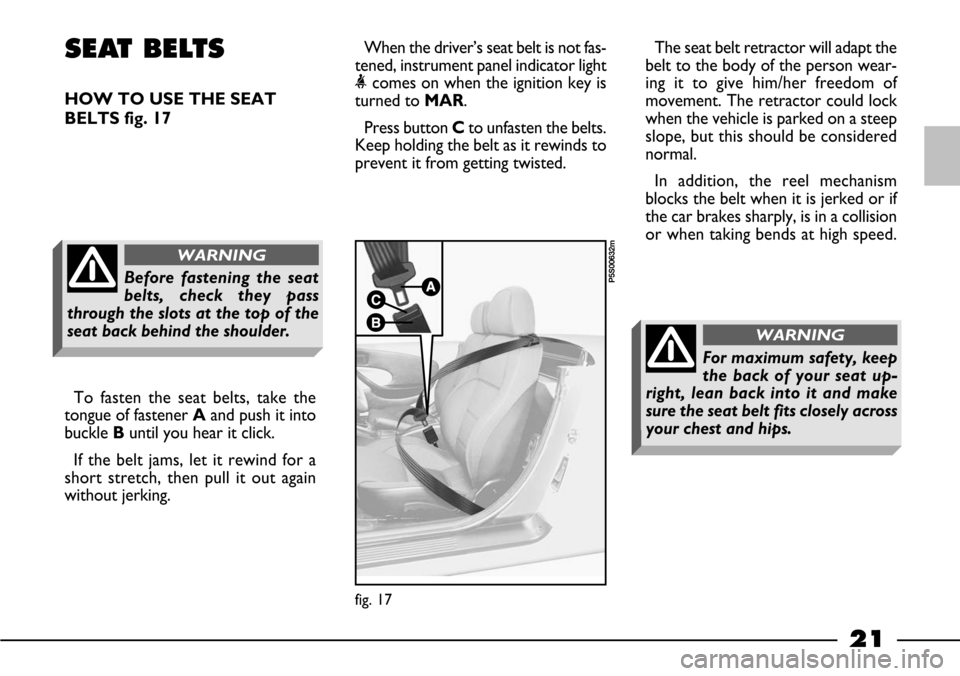
HOW TO USE THE SEAT
BELTS fig. 17When the driver’s seat belt is not fas-
tened, instrument panel indicator light
Press button Cto unfasten the belts.
Keep holding the belt as it rewinds to
prevent it from getting twisted.The seat belt retractor will adapt the
belt to the body of the person wear-
ing it to give him/her freedom of
movement. The retractor could lock
when the vehicle is parked on a steep
slope, but this should be considered
normal.
In addition, the reel mechanism
blocks the belt when it is jerked or if
the car brakes sharply, is in a collision
or when taking bends at high speed.
To fasten the seat belts, take the
tongue of fastener Aand push it into
buckle Buntil you hear it click.
If the belt jams, let it rewind for a
short stretch, then pull it out again
without jerking.
Before fastening the seat
belts, check they pass
through the slots at the top of the
seat back behind the shoulder.
WARNING
For maximum safety, keep
the back of your seat up-
right, lean back into it and make
sure the seat belt fits closely across
your chest and hips.
WARNING
fig. 17
P5S00632m
Page 28 of 170
27
PRETENSIONERS
To render the protective action of
the seat belts even more effective, Fi-
at barchetta is fitted with pretension-
ers. These devices “feel” that a violent
collision is in progress via a sensor, and
pull back a few inches of webbing. In
this way the pretensioner ensures that
the belt is adhering perfectly to the
body before the belt begins to hold
back the wearer. When the preten-
sioner has been triggered the retrac-
tor will lock. The seat belt cannot be
drawn back up even when guiding it
manually.
When the pretensioner is triggered
as small amount of smoke will be pro-
duced. This smoke is not harmful and
does not indicate the principle of fire.The pretensioner does not require
any maintenance or lubrication. Any
modification of its original state inval-
idates its efficiency. If, as the result of
exceptional natural occurrences
(floods, sea storms etc.), the device is
soaked through with water and mud,
it must be replaced.
The pretensioner will give maximum
protection when the seat belt adheres
snugly to the wearer’s chest and hips.
Operations involving
banging, vibrations or
heating (exceeding 100°C
for a maximum of 6 hours) in the
area around the pretensioner
may trigger or damage the de-
vice. Vibrations from rough road
surfaces or accidental jolting
caused by mounting pavements
etc. do not have any effect on the
pretensioner. If, however, you
need any assistance, go to a Fiat
Dealership.
The pretensioner can only
be used once. After a colli-
sion that has triggered it, have it re-
placed at a Fiat Dealership. The de-
vice will last for 10 years from the
date of production given on the ad-
hesive label: the pretensioner must
be replaced when this date is
reached.
WARNING
Pretensioners do not re-
quire lubrication or main-
tenance. Under no circumstances
should the components of the pre-
tensioner be tampered with as this
could affect the correct operation
of these devices. If any interven-
tions are necessary, contact your Fi-
at Dealership.
WARNING