light FORD MUSTANG 1969 Volume One Chassis
[x] Cancel search | Manufacturer: FORD, Model Year: 1969, Model line: MUSTANG, Model: FORD MUSTANG 1969Pages: 413, PDF Size: 75.81 MB
Page 144 of 413
03-07-06
Ford Design Non-Integral Power Steering System
03-07-06
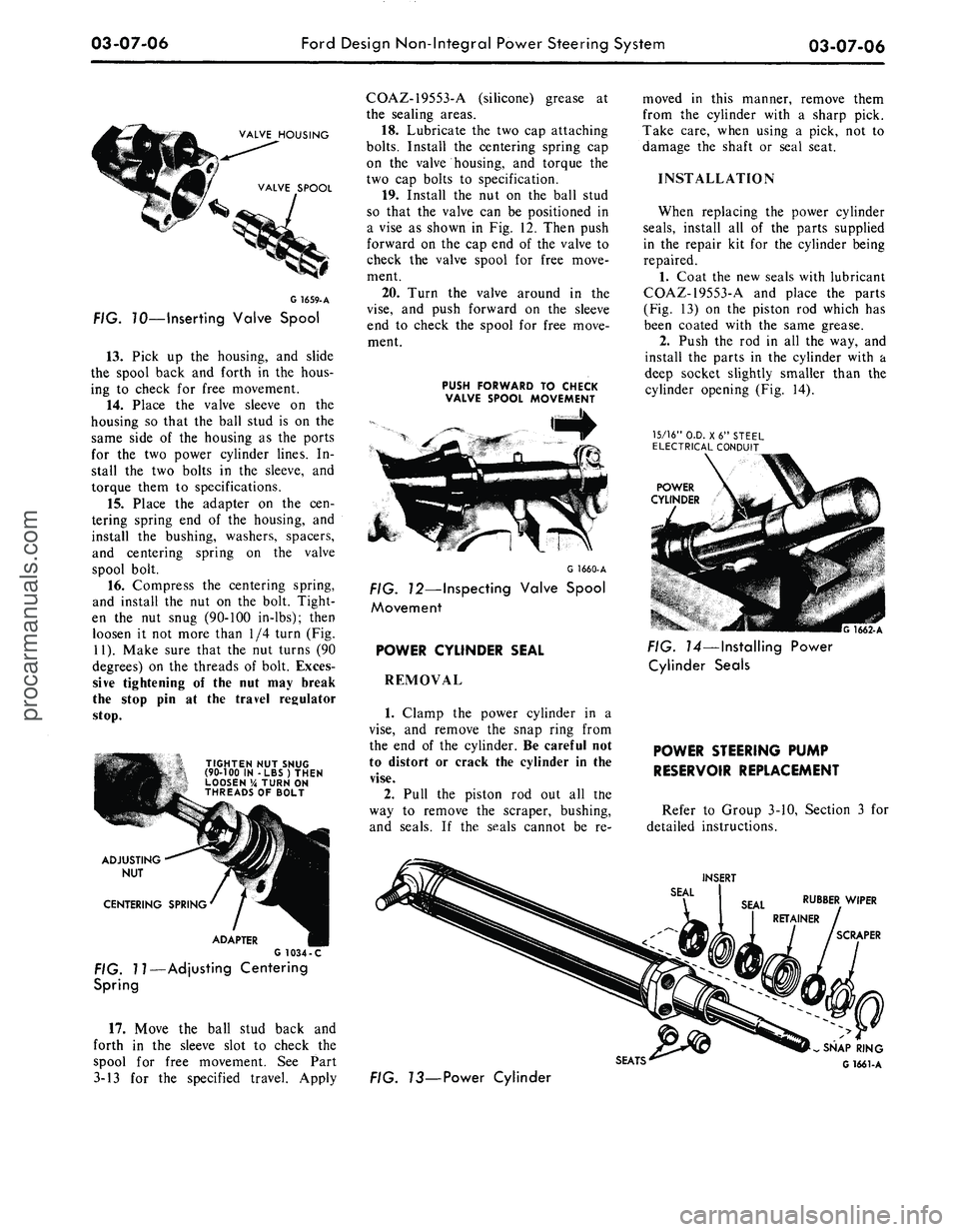
VALVE HOUSING
VALVE SPOOL
G
1659-
A
FIG. 70—Inserting Valve Spool
13.
Pick up the housing, and slide
the spool back and forth in the hous-
ing to check for free movement.
14.
Place the valve sleeve on the
housing so that the ball stud is on the
same side of the housing as the ports
for the two power cylinder lines. In-
stall the two bolts in the sleeve, and
torque them to specifications.
15.
Place the adapter on the cen-
tering spring end of the housing, and
install the bushing, washers, spacers,
and centering spring on the valve
spool bolt.
16.
Compress the centering spring,
and install the nut on the bolt. Tight-
en the nut snug (90-100 in-lbs); then
loosen it not more than 1/4 turn (Fig.
11).
Make sure that the nut turns (90
degrees) on the threads of bolt. Exces-
sive tightening of the nut may break
the stop pin at the travel regulator
stop.
TIGHTEN NUT SNUG
(90-100 IN -LBS) THEN
LOOSEN % TURN ON
THREADS OF BOLT
ADJUSTING
NUT
CENTERING SPRING
ADAPTER
G 1034 -C
FIG. 11—Adjusting Centering
Spring
17.
Move the ball stud back and
forth in the sleeve slot to check the
spool for free movement. See Part
3-13 for the specified travel. Apply
COAZ-19553-A (silicone) grease at
the sealing areas.
18.
Lubricate the two cap attaching
bolts.
Install the centering spring cap
on the valve housing, and torque the
two cap bolts to specification.
19.
Install the nut on the ball stud
so that the valve can be positioned in
a vise as shown in Fig. 12. Then push
forward on the cap end of the valve to
check the valve spool for free move-
ment.
20.
Turn the valve around in the
vise,
and push forward on the sleeve
end to check the spool for free move-
ment.
PUSH FORWARD TO CHECK
VALVE SPOOL MOVEMENT
G 1660-A
FIG. 12—Inspecting Valve Spool
Movement
POWER CYLINDER SEAL
REMOVAL
1.
Clamp the power cylinder in a
vise,
and remove the snap ring from
the end of the cylinder. Be careful not
to distort or crack the cylinder in the
vise.
2.
Pull the piston rod out all the
way to remove the scraper, bushing,
and seals. If the seals cannot be re-
moved in this manner, remove them
from the cylinder with a sharp pick.
Take care, when using a pick, not to
damage the shaft or seal seat.
INSTALLATION
When replacing the power cylinder
seals,
install all of the parts supplied
in the repair kit for the cylinder being
repaired.
1.
Coat the new seals with lubricant
COAZ-19553-A and place the parts
(Fig. 13) on the piston rod which has
been coated with the same grease.
2.
Push the rod in all the way, and
install the parts in the cylinder with a
deep socket slightly smaller than the
cylinder opening (Fig. 14).
15/16"
O.D. X6" STEEL
ELECTRICAL CONDUIT
POWER
CYLINDER
G 1662-A
FIG. 14—Installing Power
Cylinder Seals
POWER STEERING PUMP
RESERVOIR REPLACEMENT
Refer to Group 3-10, Section 3 for
detailed instructions.
INSERT
RUBBER WIPER
SCRAPER
SEATS'
FIG. 73—Power Cylinder
SNAP RING
G 1661-Aprocarmanuals.com
Page 145 of 413
03-08-01
Ford Design Integral Power Steering Gear
03-08-01
PART
3-8
Ford Design Integral Power
Steering Gear
COMPONENT INDEX
STEERING GEAR
Adjustments
Cleaning
and
Inspection
(See
Part 03-01)
Description
Disassembly
and
Assembly
Overhaul
Removal
and
Installation
VALVE CENTERING SHIM
Removal
and
Installation
VALVE SPOOL CENTERING CHECK
MODEL APPLICATION
All Models
Ford
08-02
08-01
08-05
08-06
08-03
08-03
08-02
Mercury
08-02
08-01
08-05
08-06
08-03
08-03
08-02
Meteor
08-02
08-01
08-05
08-06
08-03
08-03
08-02
Cougar
N/A
N/A
N/A
N/A
N/A
N/A
N/A
Fairlane
N/A
N/A
N/A
N/A
N/A
N/A
N/A
Falcon
N/A
N/A
N/A
N/A
N/A
N/A
N/A
Montego
N/A
N/A
N/A
N/A
N/A
N/A
N/A
Mustang
N/A
N/A
N/A
N/A
N/A
N/A
N/A
Lincoln-
Continental
08-02
08-01
08-05
08-06
08-03
08-03
08-02
Thunderbird
08-02
08-01
08-05
08-06
08-03
08-03
08-02
Continental-
Mark
III
08-02
08-01
08-05
08-06
08-03
08-03
08-02
DESCRIPTION
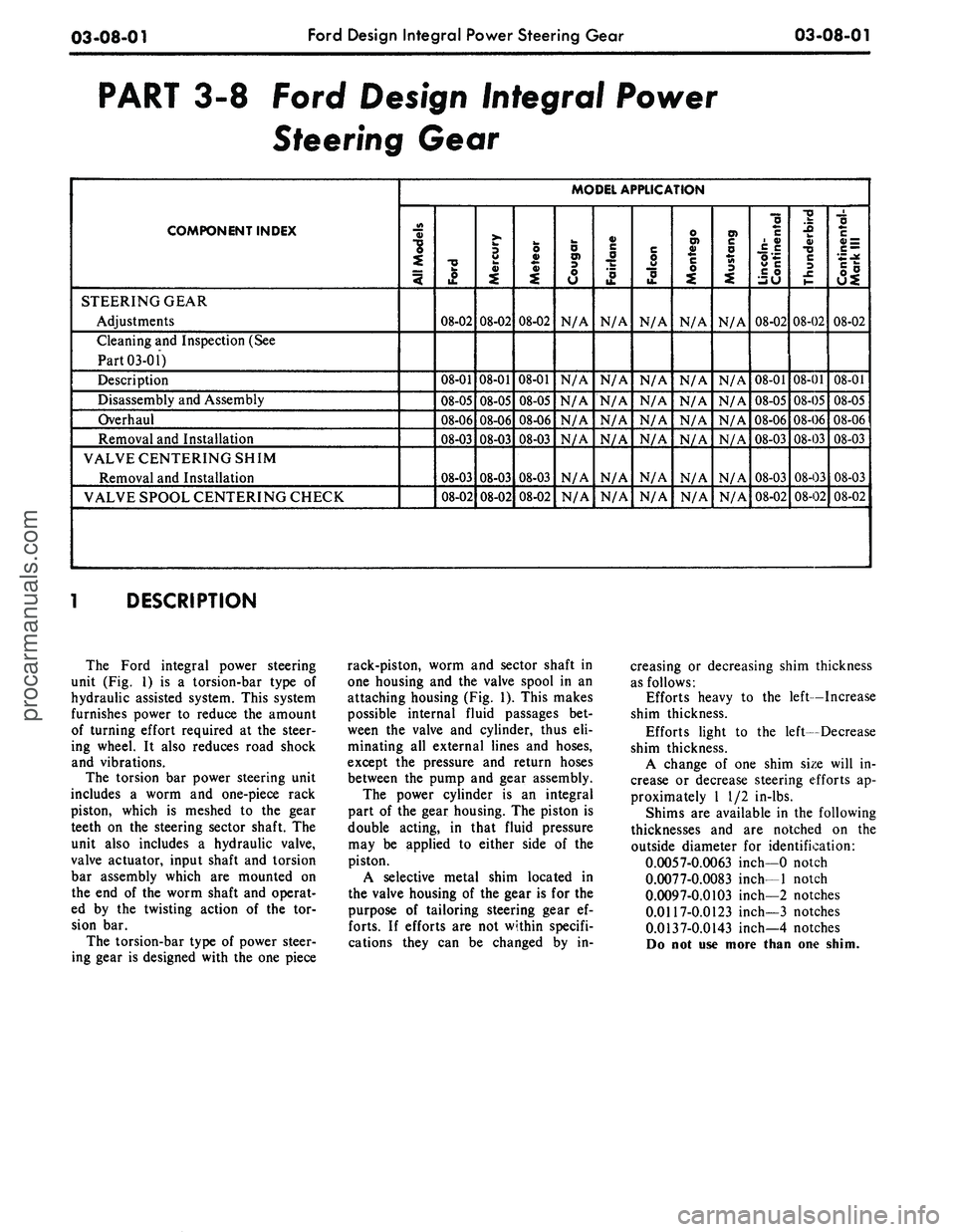
The Ford integral power steering
unit
(Fig. 1) is a
torsion-bar type
of
hydraulic assisted system. This system
furnishes power
to
reduce
the
amount
of turning effort required
at the
steer-
ing wheel.
It
also reduces road shock
and vibrations.
The torsion
bar
power steering unit
includes
a
worm
and
one-piece rack
piston, which
is
meshed
to the
gear
teeth
on the
steering sector shaft.
The
unit also includes
a
hydraulic valve,
valve actuator, input shaft
and
torsion
bar assembly which
are
mounted
on
the
end of the
worm shaft
and
operat-
ed
by the
twisting action
of the tor-
sion
bar.
The torsion-bar type
of
power steer-
ing gear
is
designed with
the one
piece
rack-piston, worm
and
sector shaft
in
one housing
and the
valve spool
in an
attaching housing
(Fig. 1).
This makes
possible internal fluid passages
bet-
ween
the
valve
and
cylinder, thus
eli-
minating
all
external lines
and
hoses,
except
the
pressure
and
return hoses
between
the
pump
and
gear assembly.
The power cylinder
is an
integral
part
of the
gear housing.
The
piston
is
double acting,
in
that fluid pressure
may
be
applied
to
either side
of the
piston.
A selective metal shim located
in
the valve housing
of the
gear
is for the
purpose
of
tailoring steering gear
ef-
forts.
If
efforts
are not
within specifi-
cations they
can be
changed
by in-
creasing
or
decreasing shim thickness
as follows:
Efforts heavy
to the
left—Increase
shim thickness.
Efforts light
to the
left—Decrease
shim thickness.
A change
of one
shim size will
in-
crease
or
decrease steering efforts
ap-
proximately
1 1/2
in-lbs.
Shims
are
available
in the
following
thicknesses
and are
notched
on the
outside diameter
for
identification:
0.0057-0.0063 inch—0 notch
0.0077-0.0083 inch—1 notch
0.0097-0.0103 inch—2 notches
0.0117-0.0123 inch—3 notches
0.0137-0.0143 inch—4 notches
Do
not use
more than
one
shim.
procarmanuals.com
Page 146 of 413
03-08-02
Ford Design Integral Power Steering Gear
03-08-02
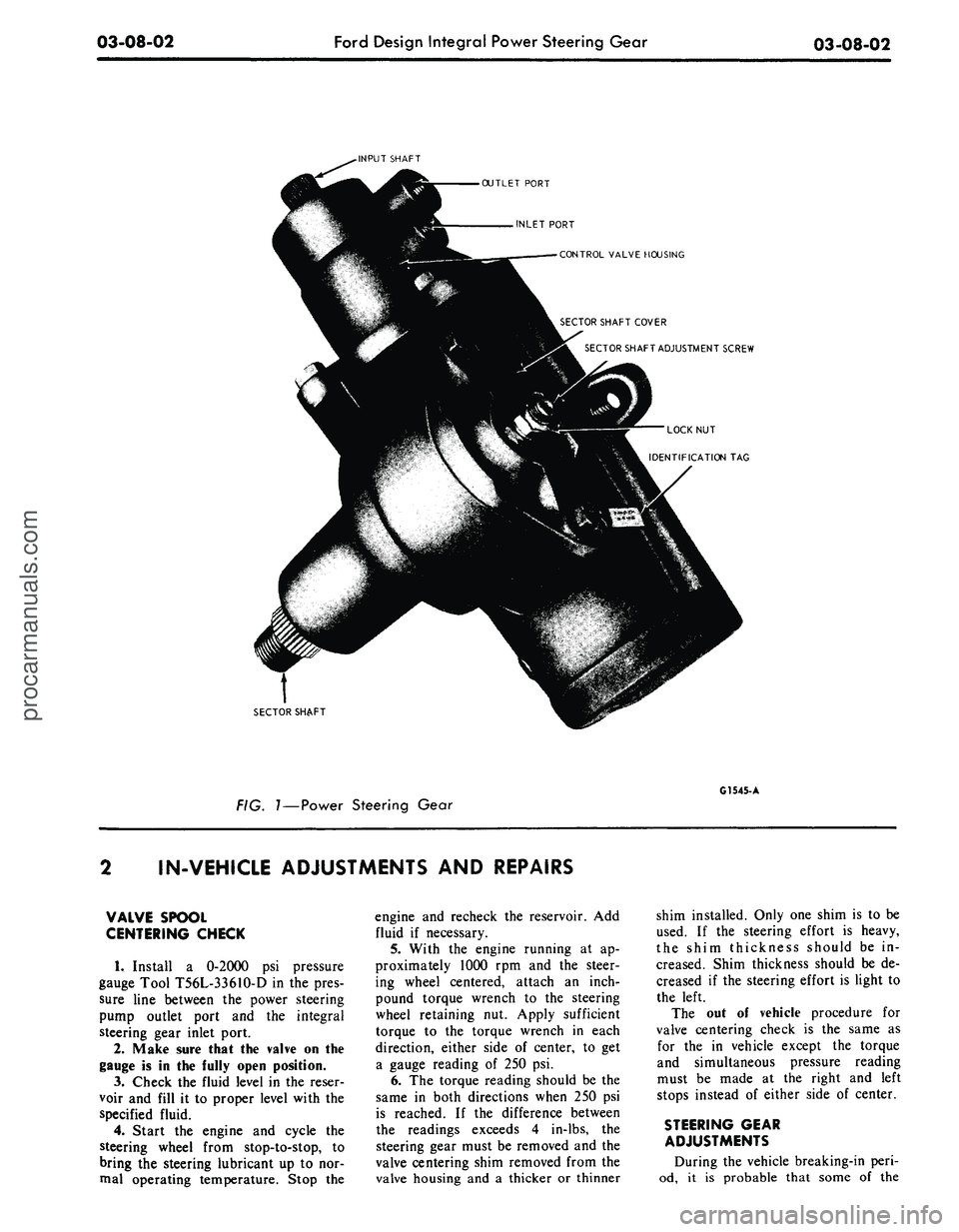
-INPUT SHAFT
OUTLET PORT
INLET PORT
CONTROL VALVE HOUSING
SECTOR SHAFT COVER
SECTOR SHAFT ADJUSTMENT SCREW
LOCK NUT
IDENTIFICATION TAG
SECTOR SHAFT
FIG.
1—Power
Steering Gear
G1545- A
IN-VEH1CLE ADJUSTMENTS AND REPAIRS
VALVE SPOOL
CENTERING CHECK
1.
Install a 0-2000 psi pressure
gauge Tool T56L-33610-D in the pres-
sure line between the power steering
pump outlet port and the integral
steering gear inlet port.
2.
Make sure that the valve on the
gauge is in the fully open position.
3.
Check the fluid level in the reser-
voir and fill it to proper level with the
specified fluid.
4.
Start the engine and cycle the
steering wheel from stop-to-stop, to
bring the steering lubricant up to nor-
mal operating temperature. Stop the
engine and recheck the reservoir. Add
fluid if necessary.
5.
With the engine running at ap-
proximately 1000 rpm and the steer-
ing wheel centered, attach an inch-
pound torque wrench to the steering
wheel retaining nut. Apply sufficient
torque to the torque wrench in each
direction, either side of center, to get
a gauge reading of 250 psi.
6. The torque reading should be the
same in both directions when 250 psi
is reached. If the difference between
the readings exceeds 4 in-lbs, the
steering gear must be removed and the
valve centering shim removed from the
valve housing and a thicker or thinner
shim installed. Only one shim is to be
used. If the steering effort is heavy,
the shim thickness should be in-
creased. Shim thickness should be de-
creased if the steering effort is light to
the left.
The out of vehicle procedure for
valve centering check is the same as
for the in vehicle except the torque
and simultaneous pressure reading
must be made at the right and left
stops instead of either side of center.
STEERING GEAR
ADJUSTMENTS
During the vehicle breaking-in peri-
od, it is probable that some of theprocarmanuals.com
Page 150 of 413
03-08-06
Ford Design Integral Power Steering Gear
03-08-06
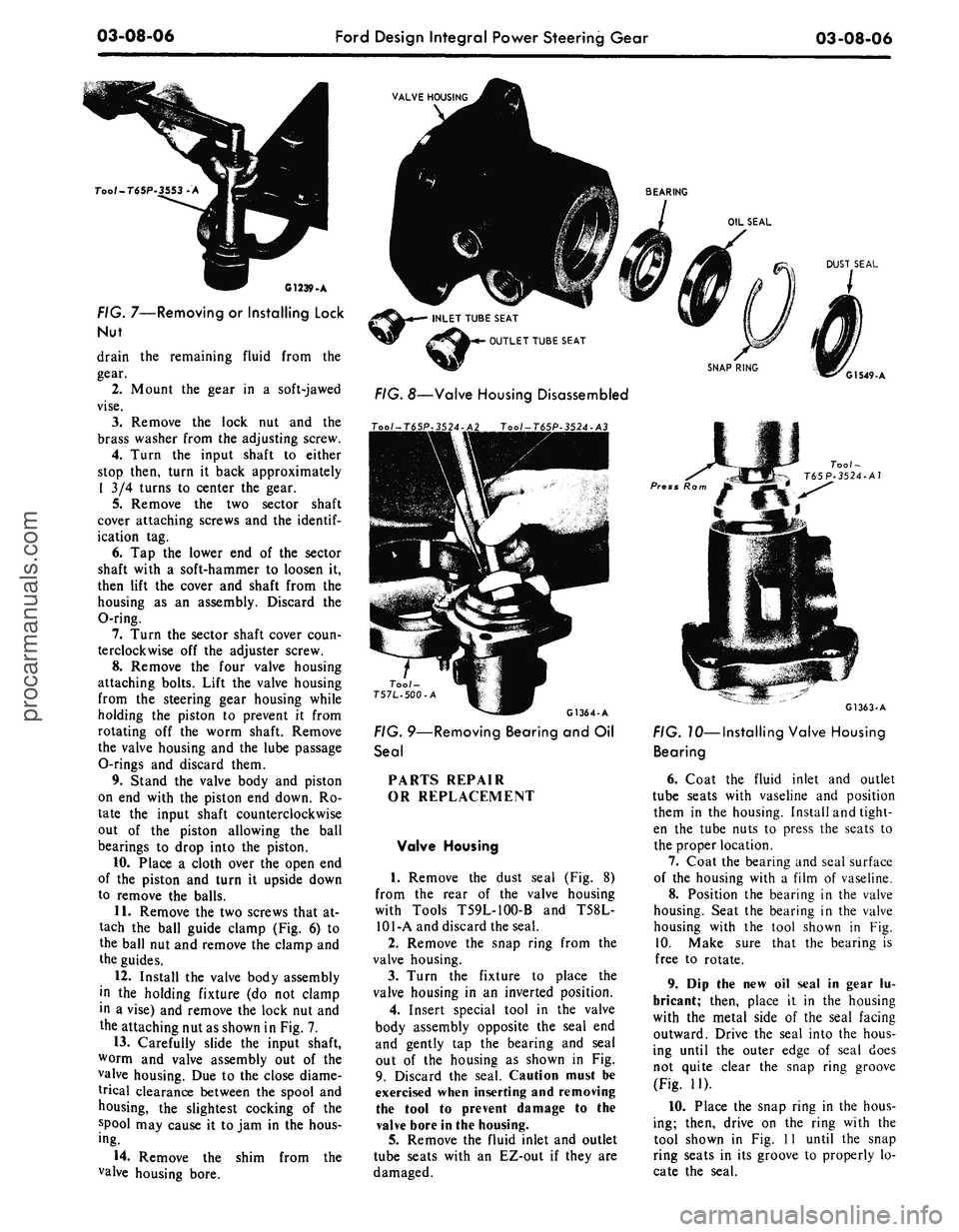
VALVE HOUSING
7W-T65P
C1239 -A
FIG. 7—Removing or Installing Lock
Nut
drain the remaining fluid from the
gear.
2.
Mount the gear in a soft-jawed
vise.
3.
Remove the lock nut and the
brass washer from the adjusting screw.
4.
Turn the input shaft to either
stop then, turn it back approximately
1 3/4 turns to center the gear.
5.
Remove the two sector shaft
cover attaching screws and the
identif-
ication tag.
6. Tap the lower end of the sector
shaft with a soft-hammer to loosen it,
then lift the cover and shaft from the
housing as an assembly. Discard the
O-ring.
7.
Turn the sector shaft cover coun-
terclockwise off the adjuster screw.
8. Remove the four valve housing
attaching bolts. Lift the valve housing
from the steering gear housing while
holding the piston to prevent it from
rotating off the worm shaft. Remove
the valve housing and the lube passage
O-rings and discard them.
9. Stand the valve body and piston
on end with the piston end down. Ro-
tate the input shaft counterclockwise
out of the piston allowing the ball
bearings to drop into the piston.
10.
Place a cloth over the open end
of the piston and turn it upside down
to remove the balls.
11.
Remove the two screws that at-
tach the ball guide clamp (Fig. 6) to
the ball nut and remove the clamp and
the guides.
12.
Install the valve body assembly
in the holding fixture (do not clamp
in a vise) and remove the lock nut and
the attaching nut as shown in Fig. 7.
13.
Carefully slide the input shaft,
worm and valve assembly out of the
valve housing. Due to the close diame-
trical clearance between the spool and
housing, the slightest cocking of the
spool may cause it to jam in the hous-
ing.
14.
Remove the shim from the
valve housing bore.
OIL SEAL
INLET TUBE SEAT
OUTLET TUBE SEAT
DUST SEAL
G1549-A
FIG.
8—Valve Housing Disassembled
Too/-T<
Tool-
T57L-500-A ,^^^
G1364-A
FIG. 9—Removing Bearing and Oil
Seal
PARTS REPAIR
OR REPLACEMENT
Valve Housing
1.
Remove the dust seal (Fig. 8)
from the rear of the valve housing
with Tools T59L-100-B and T58L-
101-A and discard the seal.
2.
Remove the snap ring from the
valve housing.
3.
Turn the fixture to place the
valve housing in an inverted position.
4.
Insert special tool in the valve
body assembly opposite the seal end
and gently tap the bearing and seal
out of the housing as shown in Fig.
9. Discard the seal. Caution must be
exercised when inserting and removing
the tool to prevent damage to the
valve bore in the housing.
5.
Remove the fluid inlet and outlet
tube seats with an EZ-out if they are
damaged.
Press Ra
Tool-
T65P-3524-A7
G1363-A
FIG. 10—Installing Valve Housing
Bearing
6. Coat the fluid inlet and outlet
tube seats with vaseline and position
them in the housing. Install and tight-
en the tube nuts to press the seats to
the proper location.
7.
Coat the bearing and seal surface
of the housing with a film of vaseline.
8. Position the bearing in the valve
housing. Seat the bearing in the valve
housing with the tool shown in Fig.
10.
Make sure that the bearing is
free to rotate.
9. Dip the new oil seal in gear lu-
bricant; then, place it in the housing
with the metal side of the seal facing
outward. Drive the seal into the hous-
ing until the outer edge of seal does
not quite clear the snap ring groove
(Fig. 11).
10.
Place the snap ring in the hous-
ing; then, drive on the ring with the
tool shown in Fig. 11 until the snap
ring seats in its groove to properly lo-
cate the seal.procarmanuals.com
Page 151 of 413
03-08-07
Ford Design Integral Power Steering Gear
03-08-07
Press Ram
Tool-
T65P.3524-A1
G1362-A
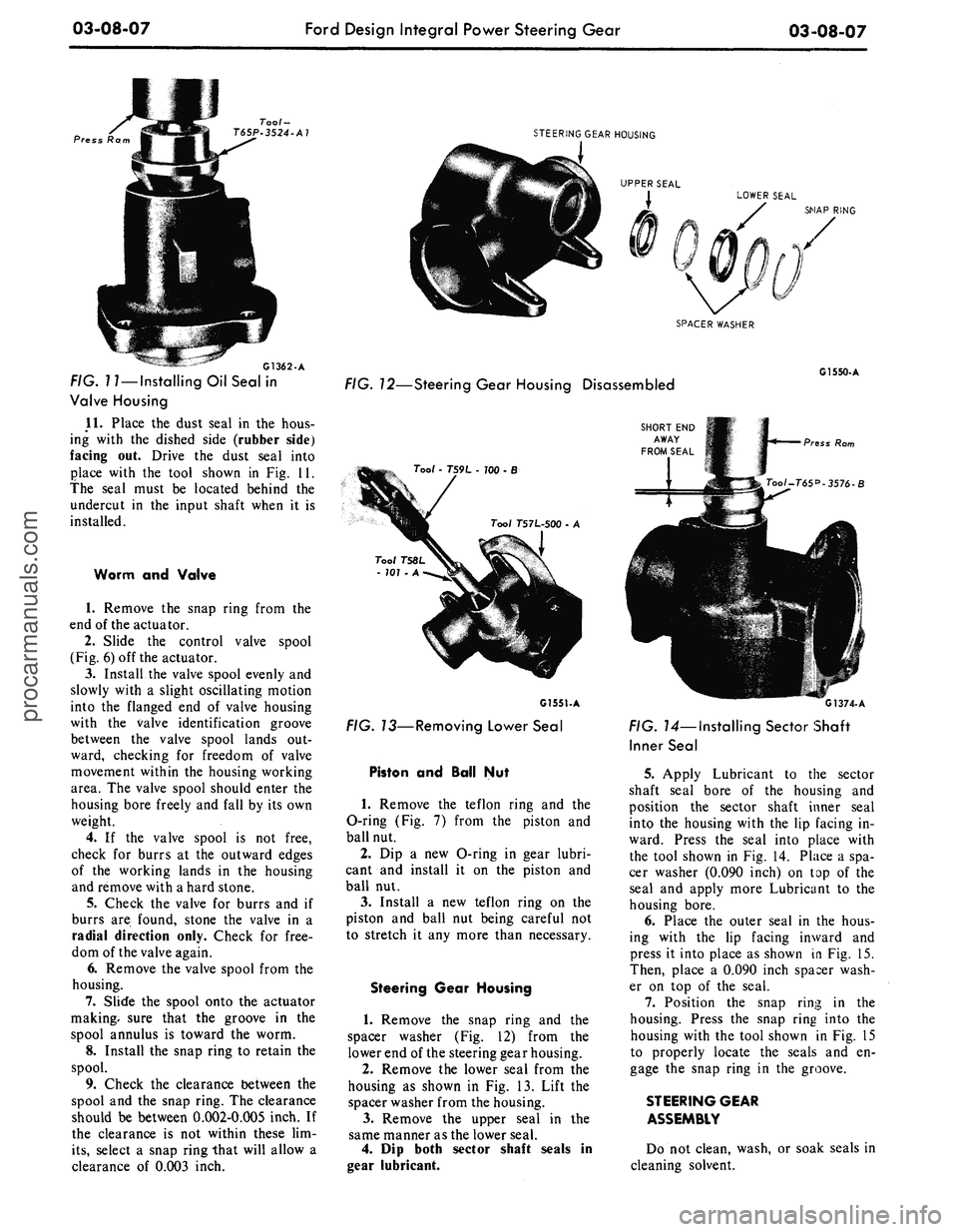
FIG.
17—Installing
Oil Seal in
Valve Housing
11.
Place the dust seal in the hous-
ing with the dished side (rubber side)
facing out. Drive the dust seal into
place with the tool shown in Fig. 11.
the seal must be located behind the
undercut in the input shaft when it is
installed.
Worm and Valve
1.
Remove the snap ring from the
end of the actuator.
2.
Slide the control valve spool
(Fig. 6) off the actuator.
3.
Install the valve spool evenly and
slowly with a slight oscillating motion
into the flanged end of valve housing
with the Valve identification groove
between the valve spool lands out-
ward, checking for freedom of valve
movement within the housing working
area. The valve spool should enter the
housing bore freely and fall by its own
weight.
4.
If the valve spool is not free,
check for burrs at the outward edges
of the working lands in the housing
and remove with a hard stone.
5.
Check the valve for burrs and if
burrs are found, stone the valve in a
radial direction only. Check for free-
dom of the valve again.
6. Remove the valve spool from the
housing.
7.
Slide the spool onto the actuator
making, sure that the groove in the
spool annulus is toward the worm.
8. Install the snap ring to retain the
spool.
9. Check the clearance between the
spool and the snap ring. The clearance
should be between 0.002-0.005 inch. If
the clearance is not within these lim-
its,
select a snap ring that will allow a
clearance of 0.003 inch.
STEERING GEAR HOUSING
J
UPPER SEAL
I LOWER SEAL
SNAP RING
SPACER WASHER
FIG. 12—Steering Gear Housing Disassembled
Tool - T59L - 100-B
Tool T57L-500 - A
G1551-A
FIG. 13—Removing Lower Seal
Piston and Ball Nut
1.
Remove the teflon ring and the
O-ring (Fig. 7) from the piston and
ball nut.
2.
Dip a new O-ring in gear lubri-
cant and install it on the piston and
ball nut.
3.
Install a new teflon ring on the
piston and ball nut being careful not
to stretch it any more than necessary.
Steering Gear Housing
1.
Remove the snap ring and the
spacer washer (Fig. 12) from the
lower end of the steering gear housing.
2.
Remove the lower seal from the
housing as shown in Fig. 13. Lift the
spacer washer from the housing.
3.
Remove the upper seal in the
same manner as the lower seal.
4.
Dip both sector shaft seals in
gear lubricant.
SHORT END
AWAY
FROM SEAL
G1550-A
Press Rom
G1374-A
FIG. 14—Installing Sector Shaft
Inner Seal
5. Apply Lubricant to the sector
shaft seal bore of the housing and
position the sector shaft inner seal
into the housing with the lip facing in-
ward. Press the seal into place with
the tool shown in Fig. 14. Place a spa-
cer washer (0.090 inch) on top of the
seal and apply more Lubricant to the
housing bore.
6. Place the outer seal in the hous-
ing with the lip facing inward and
press it into place as shown in Fig. 15.
Then, place a 0.090 inch spacer wash-
er on top of the seal.
7.
Position the snap ring in the
housing. Press the snap ring into the
housing with the tool shown in Fig. 15
to properly locate the seals and en-
gage the snap ring in the groove.
STEERING GEAR
ASSEMBLY
Do not clean, wash, or soak seals in
cleaning solvent.procarmanuals.com
Page 158 of 413
03-09-06
Saginaw Design Integral Power Steering Gear
03-09-06
ADJUSTER
PLUG
DUST
SEAL
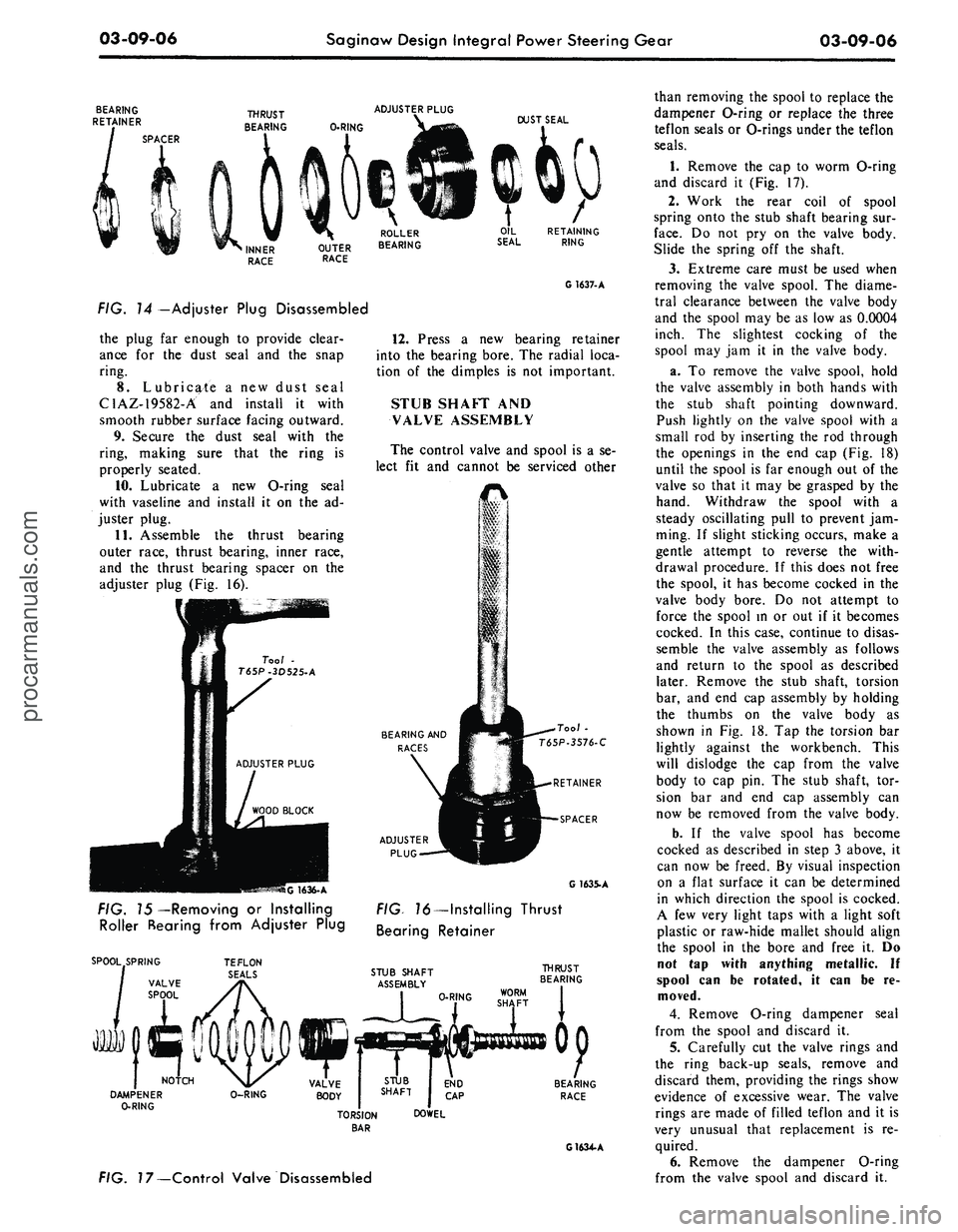
FIG. 14 —Adjuster Plug Disassembled
the plug far enough to provide clear-
ance for the dust seal and the snap
ring.
8. Lubricate a new dust seal
C1AZ-19582-A and install it with
smooth rubber surface facing outward.
9. Secure the dust seal with the
ring, making sure that the ring is
properly seated.
10.
Lubricate a new O-ring seal
with vaseline and install it on the ad-
juster plug.
11.
Assemble the thrust bearing
outer race, thrust bearing, inner race,
and the thrust bearing spacer on the
adjuster plug (Fig. 16).
OIL
RETAINING
SEAL
RING
G
1637-A
12.
Press a new bearing retainer
into the bearing bore. The radial loca-
tion of the dimples is not important.
STUB SHAFT AND
VALVE ASSEMBLY
The control valve and spool is a se-
lect fit and cannot be serviced other
BEARING
AND
RACES
1636-A
FIG. 15 —Removing or Installing
Roller Rearing from Adjuster Plug
G
1635-A
FIG.
76
—Installing Thrust
Bearing Retainer
SPOOL
SPRING
DOWEL
BEARING
RACE
G1634-A
FIG. 77—Control Valve Disassembled
than removing the spool to replace the
dampener O-ring or replace the three
teflon seals or O-rings under the teflon
seals.
1.
Remove the cap to worm O-ring
and discard it (Fig. 17).
2.
Work the rear coil of spool
spring onto the stub shaft bearing sur-
face.
Do not pry on the valve body.
Slide the spring off the shaft.
3.
Extreme care must be used when
removing the valve spool. The diame-
tral clearance between the valve body
and the spool may be as low as 0.0004
inch. The slightest cocking of the
spool may jam it in the valve body.
a. To remove the valve spool, hold
the valve assembly in both hands with
the stub shaft pointing downward.
Push lightly on the valve spool with a
small rod by inserting the rod through
the openings in the end cap (Fig. 18)
until the spool is far enough out of the
valve so that it may be grasped by the
hand. Withdraw the spool with a
steady oscillating pull to prevent jam-
ming. If slight sticking occurs, make a
gentle attempt to reverse the with-
drawal procedure. If this does not free
the spool, it has become cocked in the
valve body bore. Do not attempt to
force the spool in or out if it becomes
cocked. In this case, continue to disas-
semble the valve assembly as follows
and return to the spool as described
later. Remove the stub shaft, torsion
bar, and end cap assembly by holding
the thumbs on the valve body as
shown in Fig. 18. Tap the torsion bar
lightly against the workbench. This
will dislodge the cap from the valve
body to cap pin. The stub shaft, tor-
sion bar and end cap assembly can
now be removed from the valve body.
b.
If the valve spool has become
cocked as described in step 3 above, it
can now be freed. By visual inspection
on a flat surface it can be determined
in which direction the spool is cocked.
A few very light taps with a light soft
plastic or raw-hide mallet should align
the spool in the bore and free it. Do
not tap with anything metallic. If
spool can be rotated, it can be re-
moved.
4.
Remove O-ring dampener seal
from the spool and discard it.
5.
Carefully cut the valve rings and
the ring back-up seals, remove and
discard them, providing the rings show
evidence of excessive wear. The valve
rings are made of filled teflon and it is
very unusual that replacement is re-
quired.
6. Remove the dampener O-ring
from the valve spool and discard it.procarmanuals.com
Page 159 of 413
03-09-07
Saginaw Design Integral Power Steering Gear
03-09-07
VALVE SPOOL
DAMP EN
ERO-RING
TORSION BAR
G 1633-A
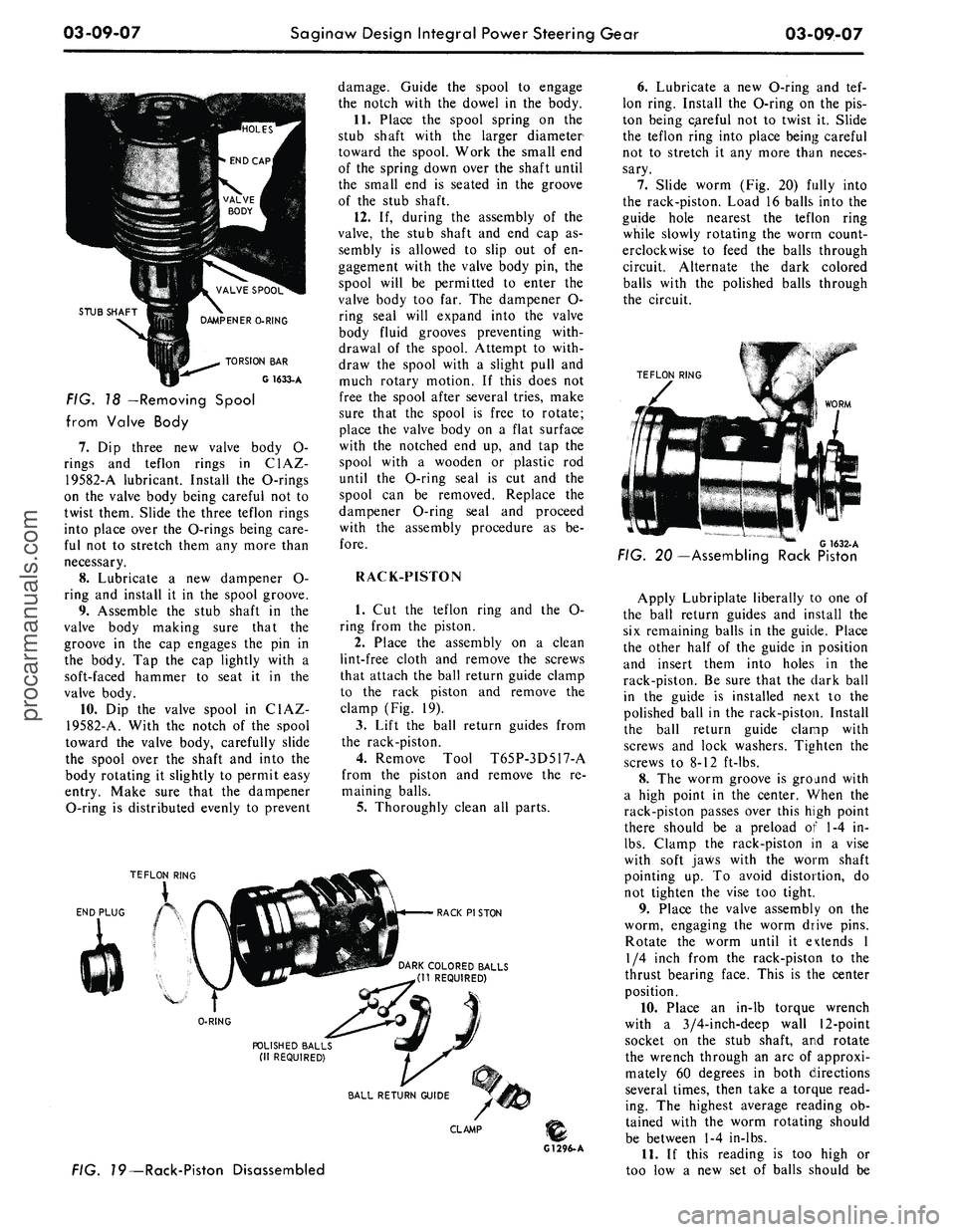
FIG. 18 —Removing Spool
from Valve Body
7.
Dip three new valve body O-
rings and teflon rings in C1AZ-
19582-A lubricant. Install the O-rings
on the valve body being careful not to
twist them. Slide the three teflon rings
into place over the O-rings being care-
ful not to stretch them any more than
necessary.
8. Lubricate a new dampener O-
ring and install it in the spool groove.
9. Assemble the stub shaft in the
valve body making sure that the
groove in the cap engages the pin in
the body. Tap the cap lightly with a
soft-faced hammer to seat it in the
valve body.
10.
Dip the valve spool in C1AZ-
19582-A. With the notch of the spool
toward the valve body, carefully slide
the spooi over the shaft and into the
body rotating it slightly to permit easy
entry. Make sure that the dampener
O-ring is distributed evenly to prevent
TEFLON RING
damage. Guide the spool to engage
the notch with the dowel in the body.
11.
Place the spool spring on the
stub shaft with the larger diameter
toward the spool. Work the small end
of the spring down over the shaft until
the small end is seated in the groove
of the stub shaft.
12.
If, during the assembly of the
valve, the stub shaft and end cap as-
sembly is allowed to slip out of en-
gagement with the valve body pin, the
spool will be permitted to enter the
valve body too far. The dampener O-
ring seal will expand into the valve
body fluid grooves preventing with-
drawal of the spool. Attempt to with-
draw the spool with a slight pull and
much rotary motion. If this does not
free the spool after several tries, make
sure that the spool is free to rotate;
place the valve body on a flat surface
with the notched end up, and tap the
spool with a wooden or plastic rod
until the O-ring seal is cut and the
spool can be removed. Replace the
dampener O-ring seal and proceed
with the assembly procedure as be-
fore.
RACK-PISTON
1.
Cut the teflon ring and the O-
ring from the piston.
2.
Place the assembly on a clean
lint-free cloth and remove the screws
that attach the ball return guide clamp
to the rack piston and remove the
clamp (Fig. 19).
3.
Lift the ball return guides from
the rack-piston.
4.
Remove Tool T65P-3D517-A
from the piston and remove the re-
maining balls.
5.
Thoroughly clean all parts.
END PLUG
RACK PI STON
DARK COLORED BALLS
(11 REQUIRED)
V
0-RING
POLISHED BALLS
(II REQUIRED)
BALL RETURN GUIDE
CLAMP
B
G1296. A
6. Lubricate a new O-ring and tef-
lon ring. Install the O-ring on the pis-
ton being qareful not to twist it. Slide
the teflon ring into place being careful
not to stretch it any more than neces-
sary.
7.
Slide worm (Fig. 20) fully into
the rack-piston. Load 16 balls into the
guide hole nearest the teflon ring
while slowly rotating the worm count-
erclockwise to feed the balls through
circuit. Alternate the dark colored
balls with the polished balls through
the circuit.
TEFLON RING
FIG. 19—Rack-Piston Disassembled
G 1632-A
FIG. 20—Assembling Rack Piston
Apply Lubriplate liberally to one of
the ball return guides and install the
six remaining balls in the guide. Place
the other half of the guide in position
and insert them into holes in the
rack-piston. Be sure that the dark ball
in the guide is installed next to the
polished ball in the rack-piston. Install
the ball return guide clamp with
screws and lock washers. Tighten the
screws to 8-12 ft-lbs.
8. The worm groove is ground with
a high point in the center. V/hen the
rack-piston passes over this high point
there should be a preload of 1-4 in-
lbs.
Clamp the rack-piston in a vise
with soft jaws with the worm shaft
pointing up. To avoid distortion, do
not tighten the vise too tight.
9. Place the valve assembly on the
worm, engaging the worm drive pins.
Rotate the worm until it extends 1
1/4 inch from the rack-piston to the
thrust bearing face. This is the center
position.
10.
Place an in-lb torque wrench
with a 3/4-inch-deep wall 12-point
socket on the stub shaft, and rotate
the wrench through an arc of approxi-
mately 60 degrees in both directions
several times, then take a torque read-
ing. The highest average reading ob-
tained with the worm rotating should
be between 1-4 in-lbs.
11.
If this reading is too high or
too low a new set of balls should beprocarmanuals.com
Page 161 of 413
03-09-09
Saginaw Design Integral Power Steering Gear
03-09-09
Tool • T65P-3D517-A
LOCK NUT
ADJUSTER PLUG
G1628-A
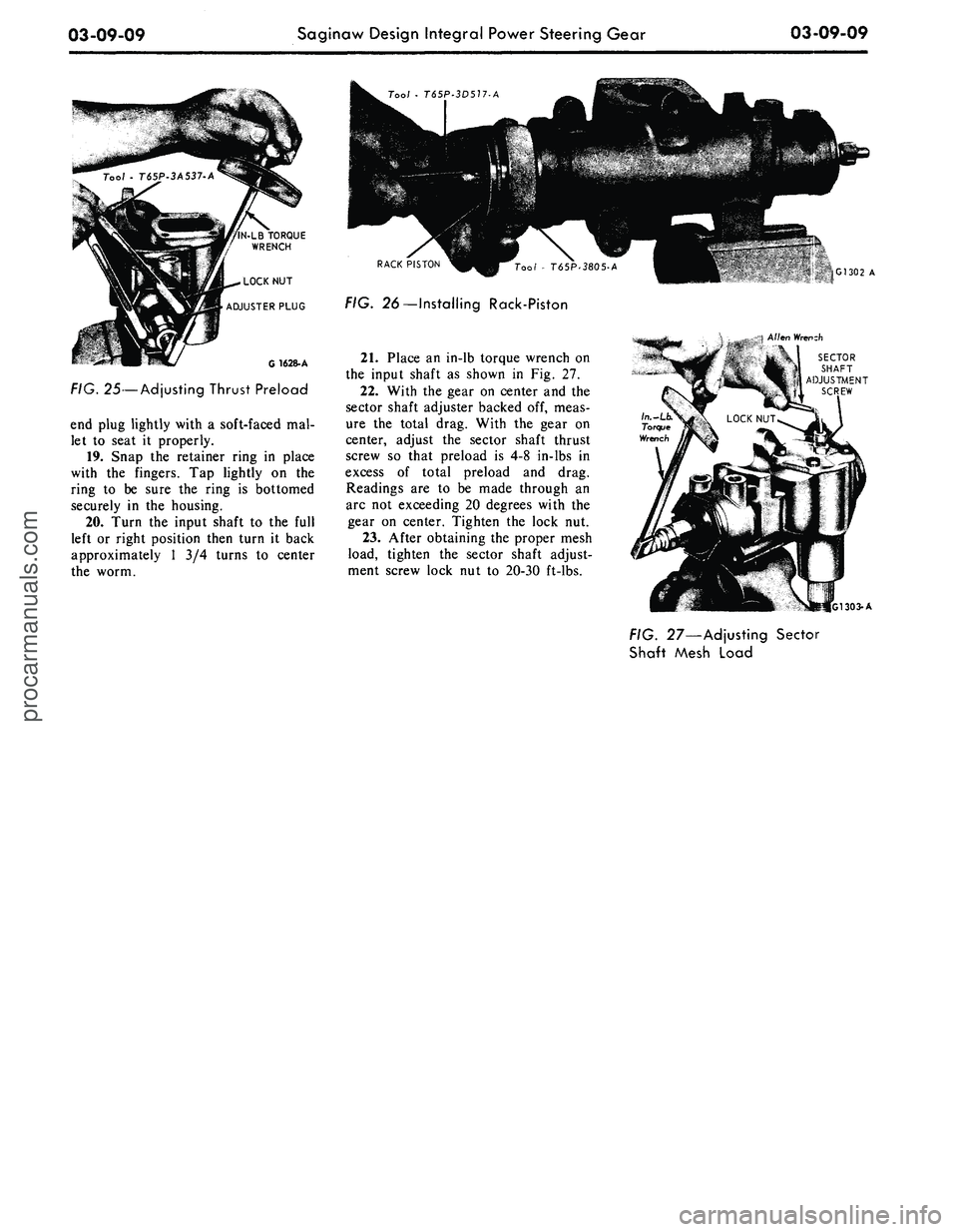
FIG. 25
—
Adjusting Thrust Preload
end plug lightly with
a
soft-faced mal-
let
to
seat
it
properly.
19.
Snap
the
retainer ring
in
place
with
the
fingers.
Tap
lightly
on the
ring
to be
sure
the
ring
is
bottomed
securely
in the
housing.
20.
Turn
the
input shaft
to the
full
left
or
right position then turn
it
back
approximately
1 3/4
turns
to
center
the worm.
RACK PISTON
Tool - T65P.3805-A
FIG. 26—Installing Rack-Piston
21.
Place
an
in-lb torque wrench
on
the input shaft
as
shown
in Fig. 27.
22.
With
the
gear
on
center
and the
sector shaft adjuster backed
off,
meas-
ure
the
total drag. With
the
gear
on
center, adjust
the
sector shaft thrust
screw
so
that preload
is 4-8
in-lbs
in
excess
of
total preload
and
drag.
Readings
are to be
made through
an
arc
not
exceeding
20
degrees with
the
gear
on
center. Tighten
the
lock
nut.
23.
After obtaining
the
proper mesh
load, tighten
the
sector shaft adjust-
ment screw lock
nut to
20-30 ft-lbs.
jG1302
A
G1303-A
FIG. 27—Adjusting Sector
Shaft Mesh Loadprocarmanuals.com
Page 167 of 413
03-10-06
Ford-Thompson Power Steering Pump
03-10-06
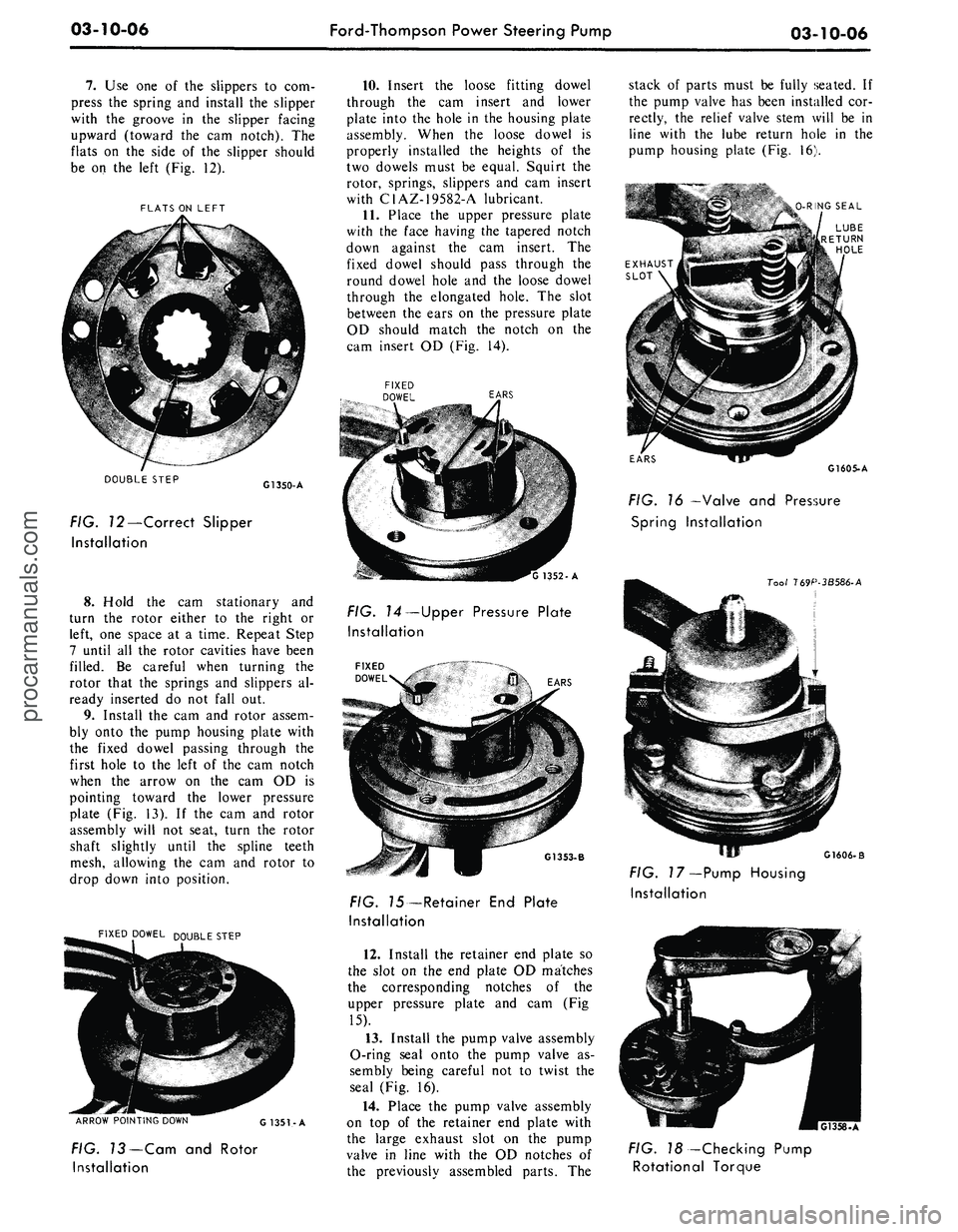
7.
Use one of the slippers to com-
press the spring and install the slipper
with the groove in the slipper facing
upward (toward the cam notch). The
flats on the side of the slipper should
be on the left (Fig. 12).
FLATS ON LEFT
DOUBLE STEP
G1350-A
FIG. 72—Correct Slipper
Installation
8. Hold the cam stationary and
turn the rotor either to the right or
left, one space at a time. Repeat Step
7 until all the rotor cavities have been
filled. Be careful when turning the
rotor that the springs and slippers al-
ready inserted do not fall out.
9. Install the cam and rotor assem-
bly onto the pump housing plate with
the fixed dowel passing through the
first hole to the left of the cam notch
when the arrow on the cam OD is
pointing toward the lower pressure
plate (Fig. 13). If the cam and rotor
assembly will not seat, turn the rotor
shaft slightly until the spline teeth
mesh, allowing the cam and rotor to
drop down into position.
FIXED DOWEL D0|JBLE STEP
ARROW POINTING DOWN
G 1351-A
FIG. 13—Cam and Rotor
Installation
10.
Insert the loose fitting dowel
through the cam insert and lower
plate into the hole in the housing plate
assembly. When the loose dowel is
properly installed the heights of the
two dowels must be equal. Squirt the
rotor, springs, slippers and cam insert
with C1AZ-19582-A lubricant.
11.
Place the upper pressure plate
with the face having the tapered notch
down against the cam insert. The
fixed dowel should pass through the
round dowel hole and the loose dowel
through the elongated hole. The slot
between the ears on the pressure plate
OD should match the notch on the
cam insert OD (Fig. 14).
EARS
'G 1352-A
FIG. 74—Upper Pressure Plate
Installation
\ EARS
G1353-B
FIG. 75—Retainer End Plate
Installation
12.
Install the retainer end plate so
the slot on the end plate OD matches
the corresponding notches of the
upper pressure plate and cam (Fig
15).
13.
Install the pump valve assembly
O-ring seal onto the pump valve as-
sembly being careful not to twist the
seal (Fig. 16).
14.
Place the pump valve assembly
on top of the retainer end plate with
the large exhaust slot on the pump
valve in line with the OD notches of
the previously assembled parts. The
stack of parts must be fully seated. If
the pump valve has been installed cor-
rectly, the relief valve stem will be in
line with the lube return hole in the
pump housing plate (Fig. 16).
O-RING SEAL
EARS
G1605-A
FIG. 16 —Valve and Pressure
Spring Installation
Tool 169P-3B586-A
G1606-B
FIG. 17—Pump Housing
Installation
FIG. 18 -Checking Pump
Rotational Torqueprocarmanuals.com
Page 168 of 413
03-10-07
Ford-Thompson Power Steering Pump
03-10-07
15.
Place small amounts of vaseline
on the pump housing plate to hold the
cover gasket in place. Install the gas-
ket on the pump housing plate.
16.
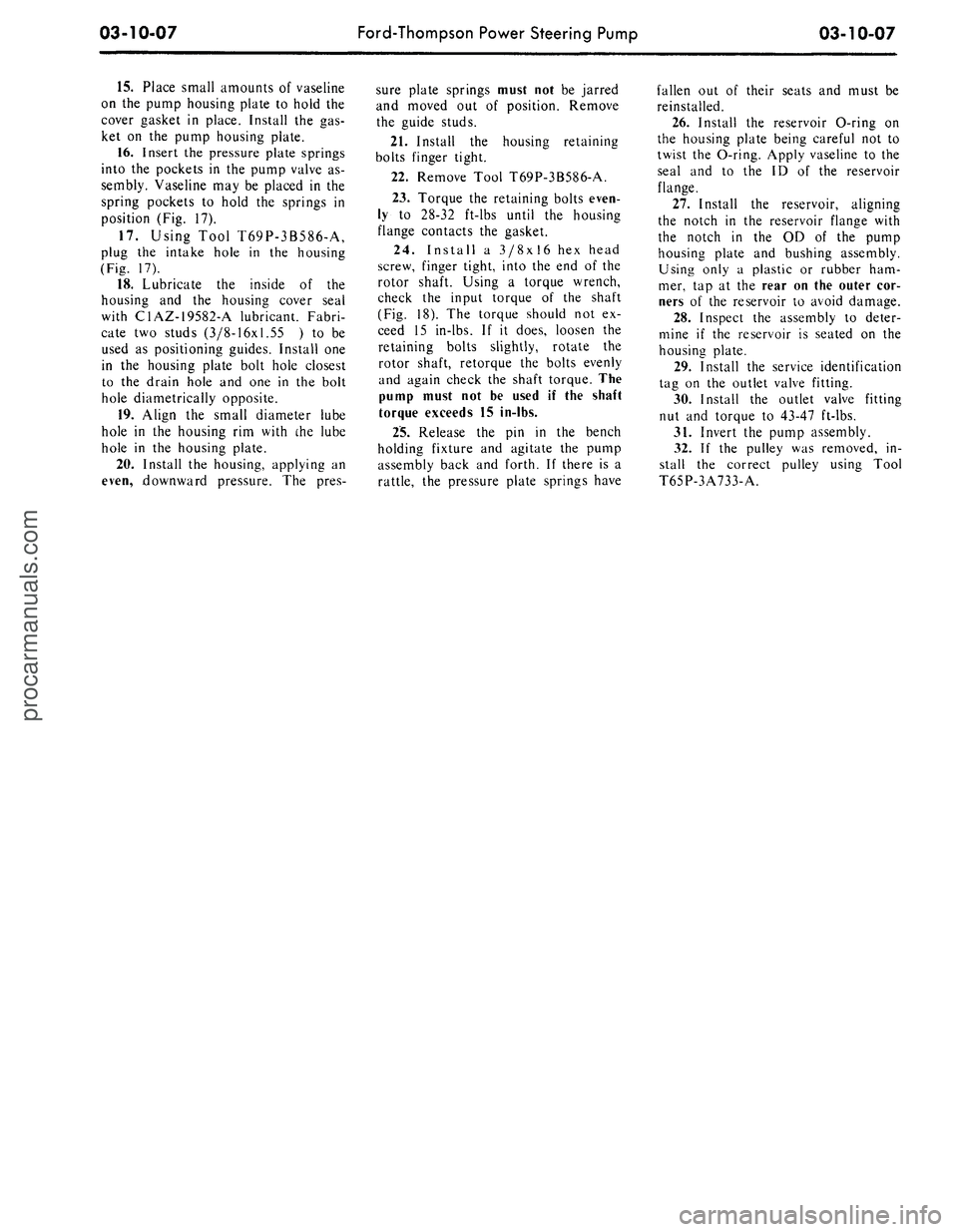
Insert the pressure plate springs
into the pockets in the pump valve as-
sembly. Vaseline may be placed in the
spring pockets to hold the springs in
position (Fig. 17).
17.
Using Tool T69P-3B586-A,
plug the intake hole in the housing
(Fig. 17).
18.
Lubricate the inside of the
housing and the housing cover seal
with C1AZ-19582-A lubricant. Fabri-
cate two studs (3/8-16x1.55 ) to be
used as positioning guides. Install one
in the housing plate bolt hole closest
to the drain hole and one in the bolt
hole diametrically opposite.
19.
Align the small diameter lube
hole in the housing rim with the lube
hole in the housing plate.
20.
Install the housing, applying an
even, downward pressure. The pres-
sure plate springs must not be jarred
and moved out of position. Remove
the guide studs.
21.
Install the housing retaining
bolts finger tight.
22.
Remove Tool T69P-3B586-A.
23.
Torque the retaining bolts even-
ly to 28-32 ft-lbs until the housing
flange contacts the gasket.
24.
Install a 3/8x16 hex head
screw, finger tight, into the end of the
rotor shaft. Using a torque wrench,
check the input torque of the shaft
(Fig. 18). The torque should not ex-
ceed 15 in-lbs. If it does, loosen the
retaining bolts slightly, rotate the
rotor shaft, retorque the bolts evenly
and again check the shaft torque. The
pump must not be used if the shaft
torque exceeds 15 in-lbs.
25.
Release the pin in the bench
holding fixture and agitate the pump
assembly back and forth. If there is a
rattle, the pressure plate springs have
fallen out of their seats and must be
reinstalled.
26.
Install the reservoir O-ring on
the housing plate being careful not to
twist the O-ring. Apply vaseline to the
seal and to the ID of the reservoir
flange.
27.
Install the reservoir, aligning
the notch in the reservoir flange with
the notch in the OD of the pump
housing plate and bushing assembly.
Using only a plastic or rubber ham-
mer, tap at the rear on the outer cor-
ners of the reservoir to avoid damage.
28.
Inspect the assembly to deter-
mine if the reservoir is seated on the
housing plate.
29.
Install the service identification
tag on the outlet valve fitting.
30.
Install the outlet valve fitting
nut and torque to 43-47 ft-lbs.
31.
Invert the pump assembly.
32.
If the pulley was removed, in-
stall the correct pulley using Tool
T65P-3A733-A.procarmanuals.com