steering FORD MUSTANG 1969 Volume One Chassis
[x] Cancel search | Manufacturer: FORD, Model Year: 1969, Model line: MUSTANG, Model: FORD MUSTANG 1969Pages: 413, PDF Size: 75.81 MB
Page 147 of 413
03-08-03
Ford Design Integral Power Steering Gear
03-08-03
factory adjustments will change. These
changes in adjustment do not neces-
sarily affect the satisfactory operation
of the steering gear assembly, and
therefore ordinarily do not require
readjustment unless there is excessive
lash or other malfunctioning.
ADJUSTMENT IN
VEHICLE
The only adjustment which can be
performed is the total over center
position load, to eliminate excessive
lash between the sector and rack
teeth.
1.
Disconnect the pitman arm from
the sector shaft.
2.
Disconnect the fluid return line
at the reservoir, at the same time cap
the reservoir return line pipe.
3.
Place the end of the return line
in a clean container and cycle the
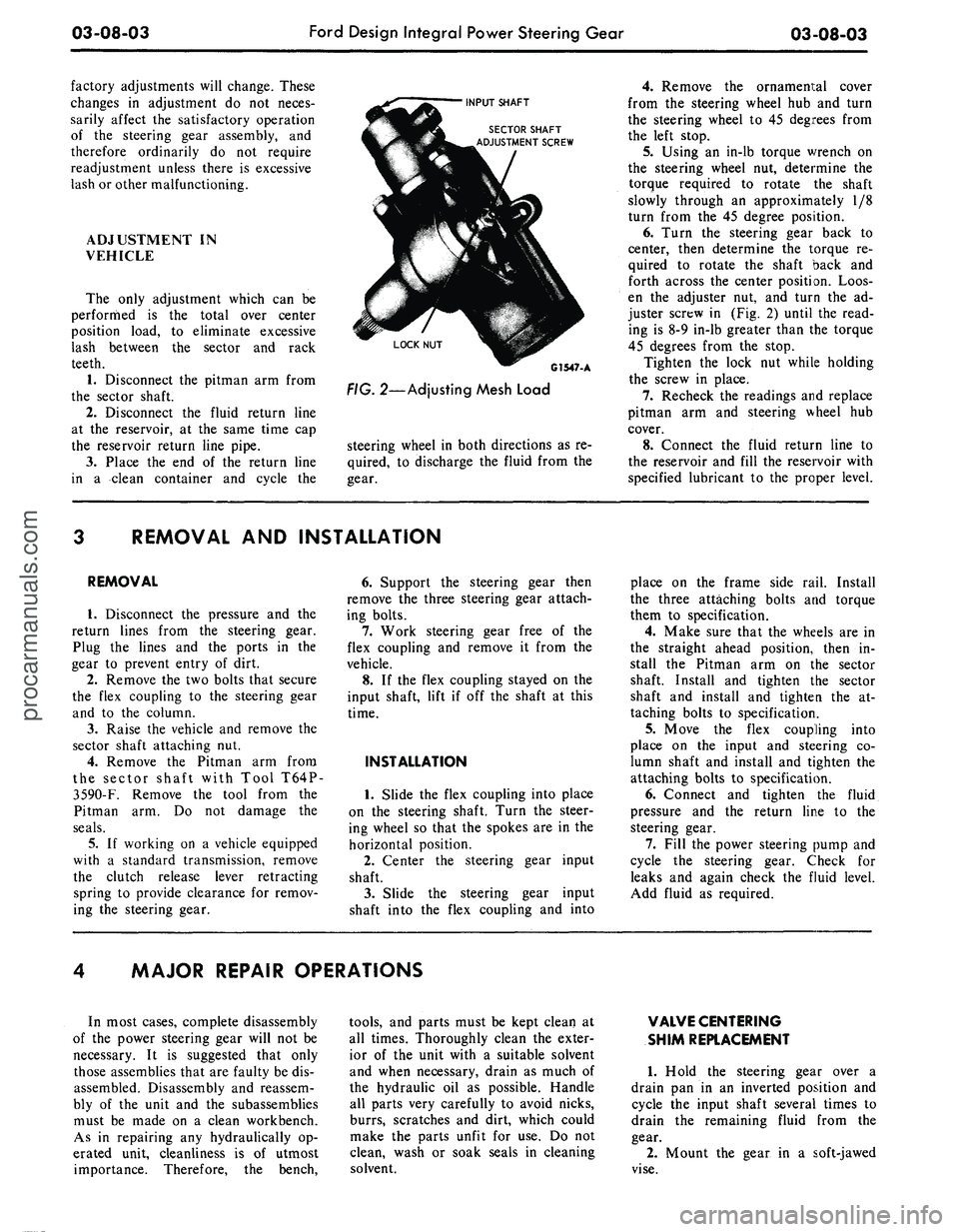
INPUT SHAFT
SECTOR SHAFT
ADJUSTMENT SCREW
C1547- A
FIG.
2—Adjusting Mesh Load
steering wheel in both directions as re-
quired, to discharge the fluid from the
gear.
4.
Remove the ornamental cover
from the steering wheel hub and turn
the steering wheel to 45 degrees from
the left stop.
5.
Using an in-lb torque wrench on
the steering wheel nut, determine the
torque required to rotate the shaft
slowly through an approximately 1/8
turn from the 45 degree position.
6. Turn the steering gear back to
center, then determine the torque re-
quired to rotate the shaft back and
forth across the center position. Loos-
en the adjuster nut, and turn the ad-
juster screw in (Fig. 2) until the read-
ing is 8-9 in-lb greater than the torque
45 degrees from the stop.
Tighten the lock nut while holding
the screw in place.
7.
Recheck the readings and replace
pitman arm and steering wheel hub
cover.
8. Connect the fluid return line to
the reservoir and fill the reservoir with
specified lubricant to the proper level.
REMOVAL AND INSTALLATION
REMOVAL
1.
Disconnect the pressure and the
return lines from the steering gear.
Plug the lines and the ports in the
gear to prevent entry of dirt.
2.
Remove the two bolts that secure
the flex coupling to the steering gear
and to the column.
3.
Raise the vehicle and remove the
sector shaft attaching nut.
4.
Remove the Pitman arm from
the sector shaft with Tool T64P-
3590-F.
Remove the tool from the
Pitman arm. Do not damage the
seals.
5.
If working on a vehicle equipped
with a standard transmission, remove
the clutch release lever retracting
spring to provide clearance for remov-
ing the steering gear.
6. Support the steering gear then
remove the three steering gear attach-
ing bolts.
7.
Work steering gear free of the
flex coupling and remove it from the
vehicle.
8. If the flex coupling stayed on the
input shaft, lift if off the shaft at this
time.
INSTALLATION
1.
Slide the flex coupling into place
on the steering shaft. Turn the steer-
ing wheel so that the spokes are in the
horizontal position.
2.
Center the steering gear input
shaft.
3.
Slide the steering gear input
shaft into the flex coupling and into
place on the frame side rail. Install
the three attaching bolts and torque
them to specification.
4.
Make sure that the wheels are in
the straight ahead position, then in-
stall the Pitman arm on the sector
shaft. Install and tighten the sector
shaft and install and tighten the at-
taching bolts to specification.
5.
Move the flex coupling into
place on the input and steering co-
lumn shaft and install and tighten the
attaching bolts to specification.
6. Connect and tighten the fluid
pressure and the return line to the
steering gear.
7.
Fill the power steering pump and
cycle the steering gear. Check for
leaks and again check the fluid level.
Add fluid as required.
MAJOR REPAIR OPERATIONS
In most cases, complete disassembly
of the power steering gear will not be
necessary. It is suggested that only
those assemblies that are faulty be dis-
assembled. Disassembly and reassem-
bly of the unit and the subassemblies
must be made on a clean workbench.
As in repairing any hydraulically op-
erated unit, cleanliness is of utmost
importance. Therefore, the bench,
tools,
and parts must be kept clean at
all times. Thoroughly clean the exter-
ior of the unit with a suitable solvent
and when necessary, drain as much of
the hydraulic oil as possible. Handle
all parts very carefully to avoid nicks,
burrs,
scratches and dirt, which could
make the parts unfit for use. Do not
clean, wash or soak seals in cleaning
solvent.
VALVE CENTERING
SHIM REPLACEMENT
1.
Hold the steering gear over a
drain pan in an inverted position and
cycle the input shaft several times to
drain the remaining fluid from the
gear.
2.
Mount the gear in a soft-jawed
vise.procarmanuals.com
Page 148 of 413
03-08-04
Ford Design Integral Power Steering Gear
03-08-04
3.
Turn the input shaft to either
stop then, turn it back approximately
1 3/4 turns to center the gear.
4.
Remove the two sector shaft
cover attaching screws and the
identif-
ication tag.
5.
Tap the lower end of the sector
shaft with a soft-faced hammer to
loosen it, then lift the cover and shaft
from the housing as an assembly. Dis-
card the O-ring.
6. Remove the four valve housing
attaching bolts. Lift the valve housing
from the steering gear housing while
holding the piston to prevent it from
rotating off the worm shaft.
7.
Remove the valve housing and
the lube passage O-ring and discard
them.
8. Place the valve housing, worm
and piston assembly in the bench
mounted holding fixture Tool T57L-
500-A with the piston on the top.
9. Rotate the piston upward (back
off) 3 1/2 turns.
10.
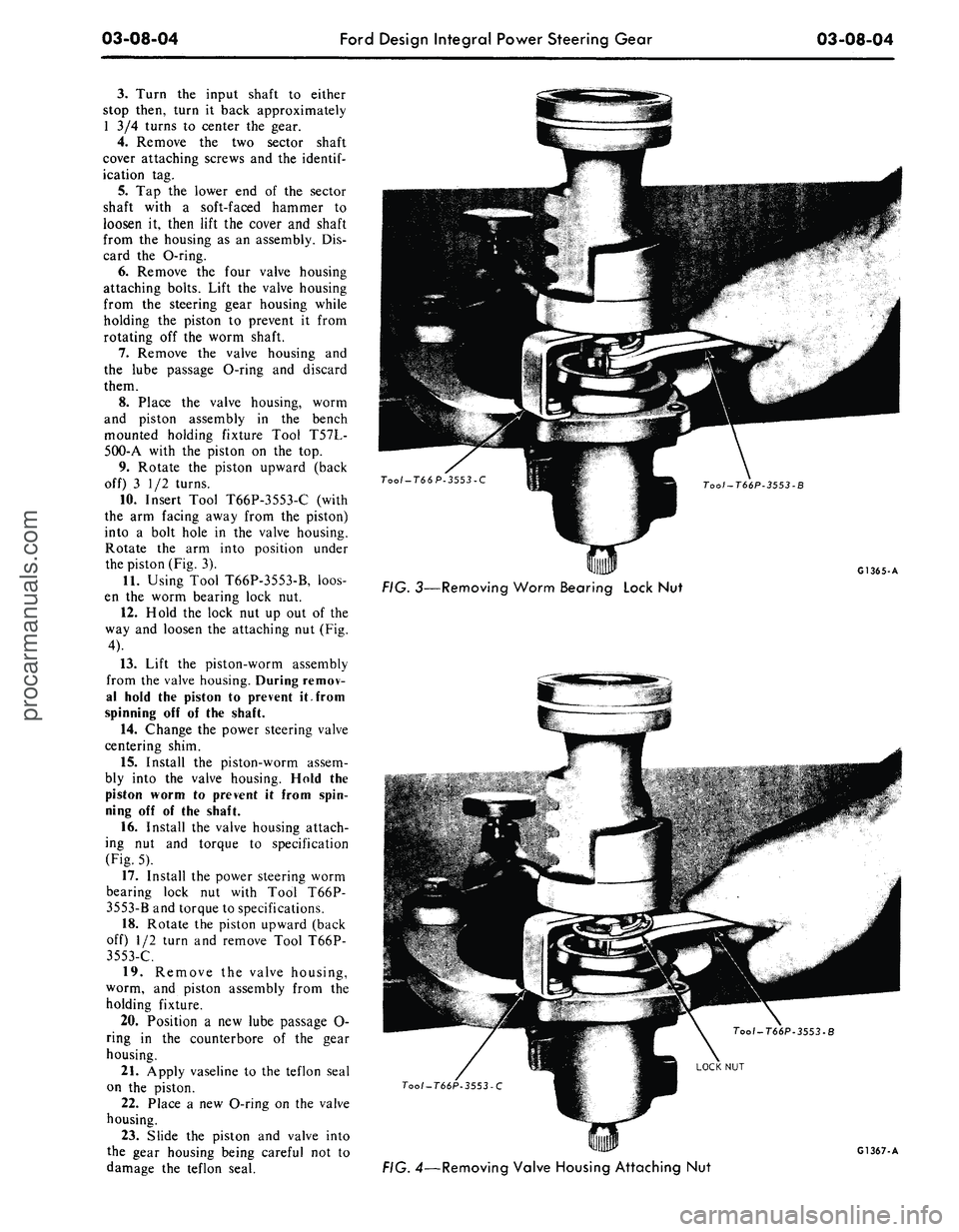
Insert Tool T66P-3553-C (with
the arm facing away from the piston)
into a bolt hole in the valve housing.
Rotate the arm into position under
the piston (Fig. 3).
11.
Using Tool T66P-3553-B, loos-
en the worm bearing lock nut.
12.
Hold the lock nut up out of the
way and loosen the attaching nut (Fig.
4).
13.
Lift the piston-worm assembly
from the valve housing. During remov-
al hold the piston to prevent it.from
spinning off of the shaft.
14.
Change the power steering valve
centering shim.
15.
Install the piston-worm assem-
bly into the valve housing. Hold the
piston worm to prevent it from spin-
ning off of the shaft.
16.
Install the valve housing attach-
ing nut and torque to specification
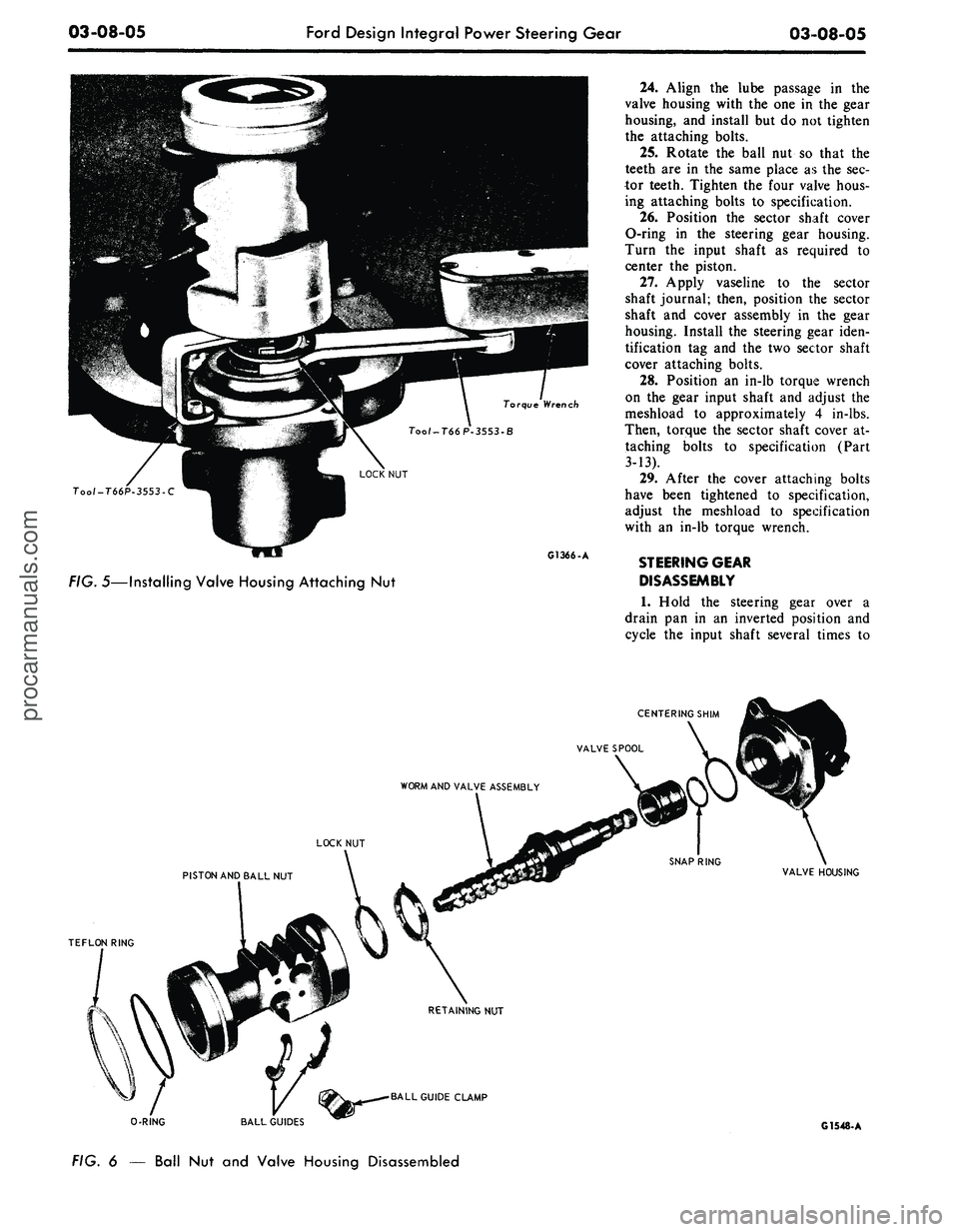
(Fig. 5).
17.
Install the power steering worm
bearing lock nut with Tool T66P-
3553-B and torque to specifications.
18.
Rotate the piston upward (back
off) 1/2 turn and remove Tool T66P-
3553-C.
19.
Remove the valve housing,
worm, and piston assembly from the
holding fixture.
20.
Position a new lube passage O-
ring in the counterbore of the gear
housing.
21.
Apply vaseline to the teflon seal
on the piston.
22.
Place a new O-ring on the valve
housing.
23.
Slide the piston and valve into
the gear housing being careful not to
damage the teflon seal.
G1365-A
FIG. 3—Removing Worm Bearing Lock Nut
Tool-T66P-3553-C
G1367-A
FIG. 4—Removing Valve Housing Attaching Nutprocarmanuals.com
Page 149 of 413
03-08-05
Ford Design Integral Power Steering Gear
03-08-05
rque Wrench
Tool-T66P-3553-C
G1366-A
FIG.
5—Installing Valve Housing Attaching
Nut
24.
Align
the
lube passage
in the
valve housing with
the
one
in
the gear
housing,
and
install but
do
not tighten
the attaching bolts.
25.
Rotate
the
ball
nut so
that
the
teeth
are in the
same place
as
the sec-
tor teeth. Tighten
the
four valve hous-
ing attaching bolts
to
specification.
26.
Position
the
sector shaft cover
O-ring
in the
steering gear housing.
Turn
the
input shaft
as
required
to
center
the
piston.
27.
Apply vaseline
to the
sector
shaft journal; then, position
the
sector
shaft
and
cover assembly
in
the
gear
housing. Install
the
steering gear iden-
tification
tag and the
two sector shaft
cover attaching bolts.
28.
Position
an
in-lb torque wrench
on
the
gear input shaft
and
adjust
the
meshload
to
approximately
4
in-lbs.
Then, torque the sector shaft cover
at-
taching bolts
to
specification (Part
3-13).
29.
After
the
cover attaching bolts
have been tightened
to
specification,
adjust
the
meshload
to
specification
with
an
in-lb torque wrench.
STEERING GEAR
DISASSEMBLY
1.
Hold
the
steering gear over
a
drain
pan
in an
inverted position
and
cycle
the
input shaft several times
to
CENTERING SHIM
WORM AND VALVE ASSEMBLY
LOCK NUT
PISTON AND BALL NUT
VALVE HOUSING
TEFLON RING
•BALL GUIDE CLAMP
0-RING
BALL GUIDES
G1548-A
FIG.
6 —
Ball
Nut and
Valve Housing Disassembledprocarmanuals.com
Page 150 of 413
03-08-06
Ford Design Integral Power Steering Gear
03-08-06
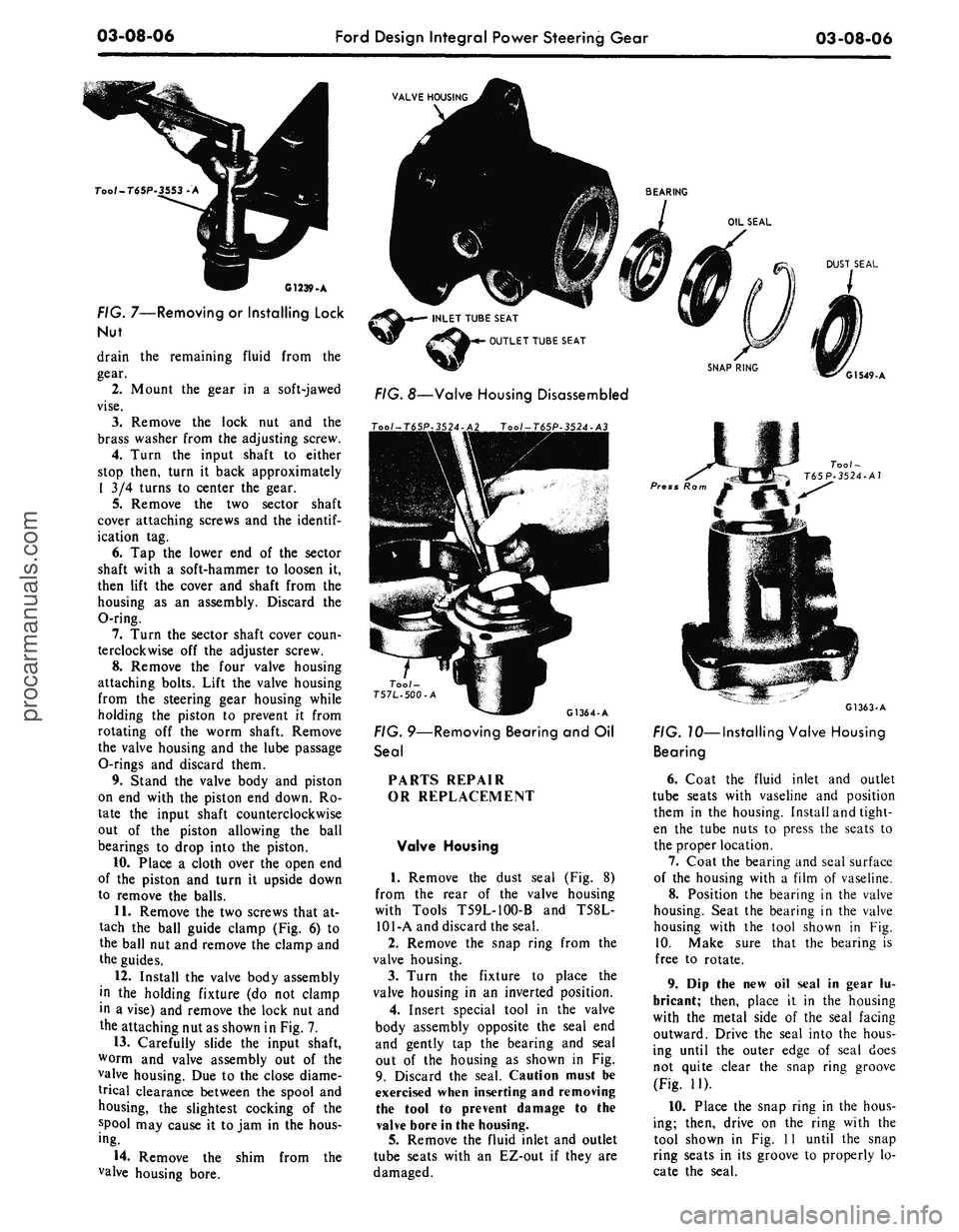
VALVE HOUSING
7W-T65P
C1239 -A
FIG. 7—Removing or Installing Lock
Nut
drain the remaining fluid from the
gear.
2.
Mount the gear in a soft-jawed
vise.
3.
Remove the lock nut and the
brass washer from the adjusting screw.
4.
Turn the input shaft to either
stop then, turn it back approximately
1 3/4 turns to center the gear.
5.
Remove the two sector shaft
cover attaching screws and the
identif-
ication tag.
6. Tap the lower end of the sector
shaft with a soft-hammer to loosen it,
then lift the cover and shaft from the
housing as an assembly. Discard the
O-ring.
7.
Turn the sector shaft cover coun-
terclockwise off the adjuster screw.
8. Remove the four valve housing
attaching bolts. Lift the valve housing
from the steering gear housing while
holding the piston to prevent it from
rotating off the worm shaft. Remove
the valve housing and the lube passage
O-rings and discard them.
9. Stand the valve body and piston
on end with the piston end down. Ro-
tate the input shaft counterclockwise
out of the piston allowing the ball
bearings to drop into the piston.
10.
Place a cloth over the open end
of the piston and turn it upside down
to remove the balls.
11.
Remove the two screws that at-
tach the ball guide clamp (Fig. 6) to
the ball nut and remove the clamp and
the guides.
12.
Install the valve body assembly
in the holding fixture (do not clamp
in a vise) and remove the lock nut and
the attaching nut as shown in Fig. 7.
13.
Carefully slide the input shaft,
worm and valve assembly out of the
valve housing. Due to the close diame-
trical clearance between the spool and
housing, the slightest cocking of the
spool may cause it to jam in the hous-
ing.
14.
Remove the shim from the
valve housing bore.
OIL SEAL
INLET TUBE SEAT
OUTLET TUBE SEAT
DUST SEAL
G1549-A
FIG.
8—Valve Housing Disassembled
Too/-T<
Tool-
T57L-500-A ,^^^
G1364-A
FIG. 9—Removing Bearing and Oil
Seal
PARTS REPAIR
OR REPLACEMENT
Valve Housing
1.
Remove the dust seal (Fig. 8)
from the rear of the valve housing
with Tools T59L-100-B and T58L-
101-A and discard the seal.
2.
Remove the snap ring from the
valve housing.
3.
Turn the fixture to place the
valve housing in an inverted position.
4.
Insert special tool in the valve
body assembly opposite the seal end
and gently tap the bearing and seal
out of the housing as shown in Fig.
9. Discard the seal. Caution must be
exercised when inserting and removing
the tool to prevent damage to the
valve bore in the housing.
5.
Remove the fluid inlet and outlet
tube seats with an EZ-out if they are
damaged.
Press Ra
Tool-
T65P-3524-A7
G1363-A
FIG. 10—Installing Valve Housing
Bearing
6. Coat the fluid inlet and outlet
tube seats with vaseline and position
them in the housing. Install and tight-
en the tube nuts to press the seats to
the proper location.
7.
Coat the bearing and seal surface
of the housing with a film of vaseline.
8. Position the bearing in the valve
housing. Seat the bearing in the valve
housing with the tool shown in Fig.
10.
Make sure that the bearing is
free to rotate.
9. Dip the new oil seal in gear lu-
bricant; then, place it in the housing
with the metal side of the seal facing
outward. Drive the seal into the hous-
ing until the outer edge of seal does
not quite clear the snap ring groove
(Fig. 11).
10.
Place the snap ring in the hous-
ing; then, drive on the ring with the
tool shown in Fig. 11 until the snap
ring seats in its groove to properly lo-
cate the seal.procarmanuals.com
Page 151 of 413
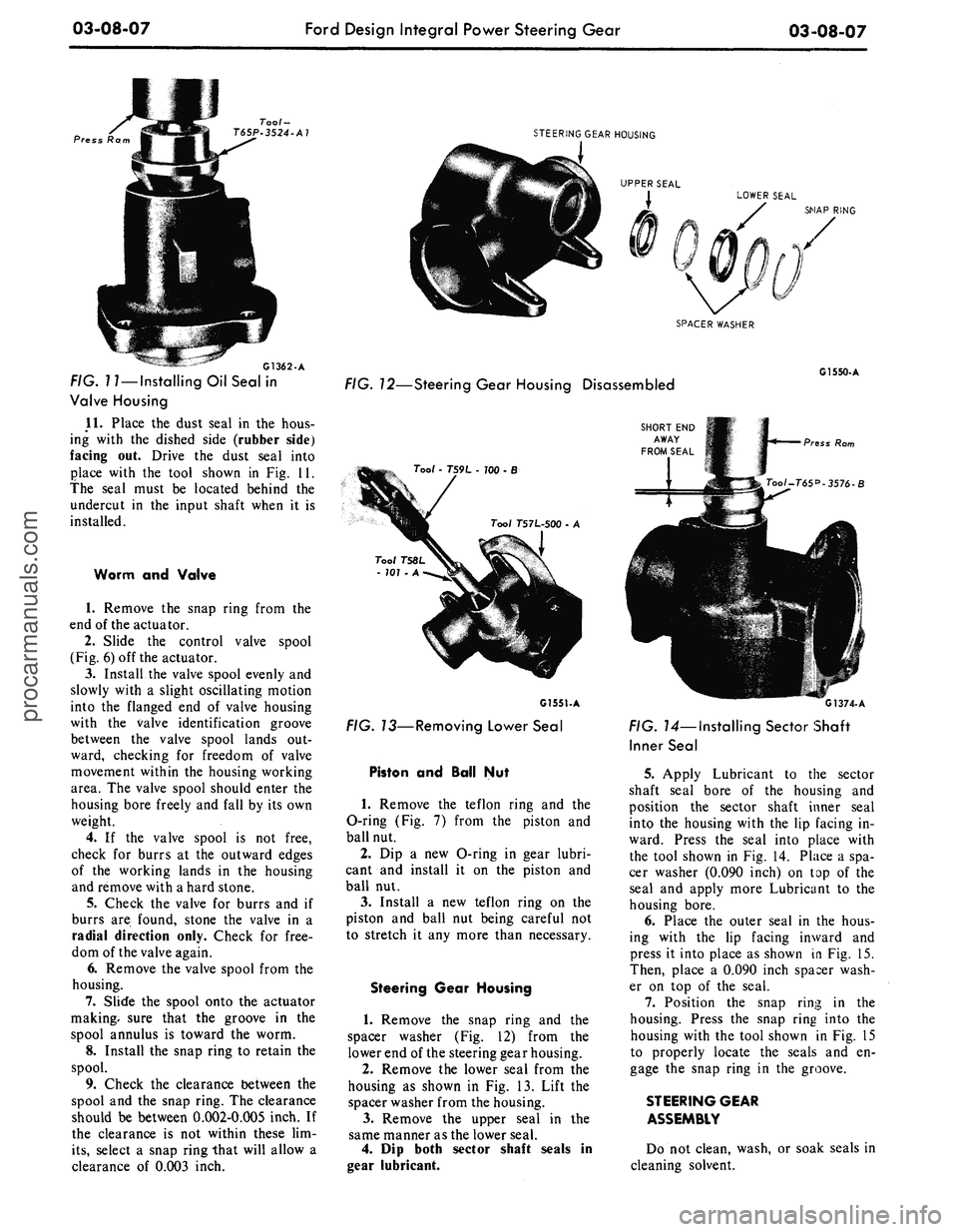
03-08-07
Ford Design Integral Power Steering Gear
03-08-07
Press Ram
Tool-
T65P.3524-A1
G1362-A
FIG.
17—Installing
Oil Seal in
Valve Housing
11.
Place the dust seal in the hous-
ing with the dished side (rubber side)
facing out. Drive the dust seal into
place with the tool shown in Fig. 11.
the seal must be located behind the
undercut in the input shaft when it is
installed.
Worm and Valve
1.
Remove the snap ring from the
end of the actuator.
2.
Slide the control valve spool
(Fig. 6) off the actuator.
3.
Install the valve spool evenly and
slowly with a slight oscillating motion
into the flanged end of valve housing
with the Valve identification groove
between the valve spool lands out-
ward, checking for freedom of valve
movement within the housing working
area. The valve spool should enter the
housing bore freely and fall by its own
weight.
4.
If the valve spool is not free,
check for burrs at the outward edges
of the working lands in the housing
and remove with a hard stone.
5.
Check the valve for burrs and if
burrs are found, stone the valve in a
radial direction only. Check for free-
dom of the valve again.
6. Remove the valve spool from the
housing.
7.
Slide the spool onto the actuator
making, sure that the groove in the
spool annulus is toward the worm.
8. Install the snap ring to retain the
spool.
9. Check the clearance between the
spool and the snap ring. The clearance
should be between 0.002-0.005 inch. If
the clearance is not within these lim-
its,
select a snap ring that will allow a
clearance of 0.003 inch.
STEERING GEAR HOUSING
J
UPPER SEAL
I LOWER SEAL
SNAP RING
SPACER WASHER
FIG. 12—Steering Gear Housing Disassembled
Tool - T59L - 100-B
Tool T57L-500 - A
G1551-A
FIG. 13—Removing Lower Seal
Piston and Ball Nut
1.
Remove the teflon ring and the
O-ring (Fig. 7) from the piston and
ball nut.
2.
Dip a new O-ring in gear lubri-
cant and install it on the piston and
ball nut.
3.
Install a new teflon ring on the
piston and ball nut being careful not
to stretch it any more than necessary.
Steering Gear Housing
1.
Remove the snap ring and the
spacer washer (Fig. 12) from the
lower end of the steering gear housing.
2.
Remove the lower seal from the
housing as shown in Fig. 13. Lift the
spacer washer from the housing.
3.
Remove the upper seal in the
same manner as the lower seal.
4.
Dip both sector shaft seals in
gear lubricant.
SHORT END
AWAY
FROM SEAL
G1550-A
Press Rom
G1374-A
FIG. 14—Installing Sector Shaft
Inner Seal
5. Apply Lubricant to the sector
shaft seal bore of the housing and
position the sector shaft inner seal
into the housing with the lip facing in-
ward. Press the seal into place with
the tool shown in Fig. 14. Place a spa-
cer washer (0.090 inch) on top of the
seal and apply more Lubricant to the
housing bore.
6. Place the outer seal in the hous-
ing with the lip facing inward and
press it into place as shown in Fig. 15.
Then, place a 0.090 inch spacer wash-
er on top of the seal.
7.
Position the snap ring in the
housing. Press the snap ring into the
housing with the tool shown in Fig. 15
to properly locate the seals and en-
gage the snap ring in the groove.
STEERING GEAR
ASSEMBLY
Do not clean, wash, or soak seals in
cleaning solvent.procarmanuals.com
Page 152 of 413
03-08-08
Ford Design Integral Power Steering Gear
03-08-08
LONG END
AWAY FROM
SEAL
Press Ram
G1375-A
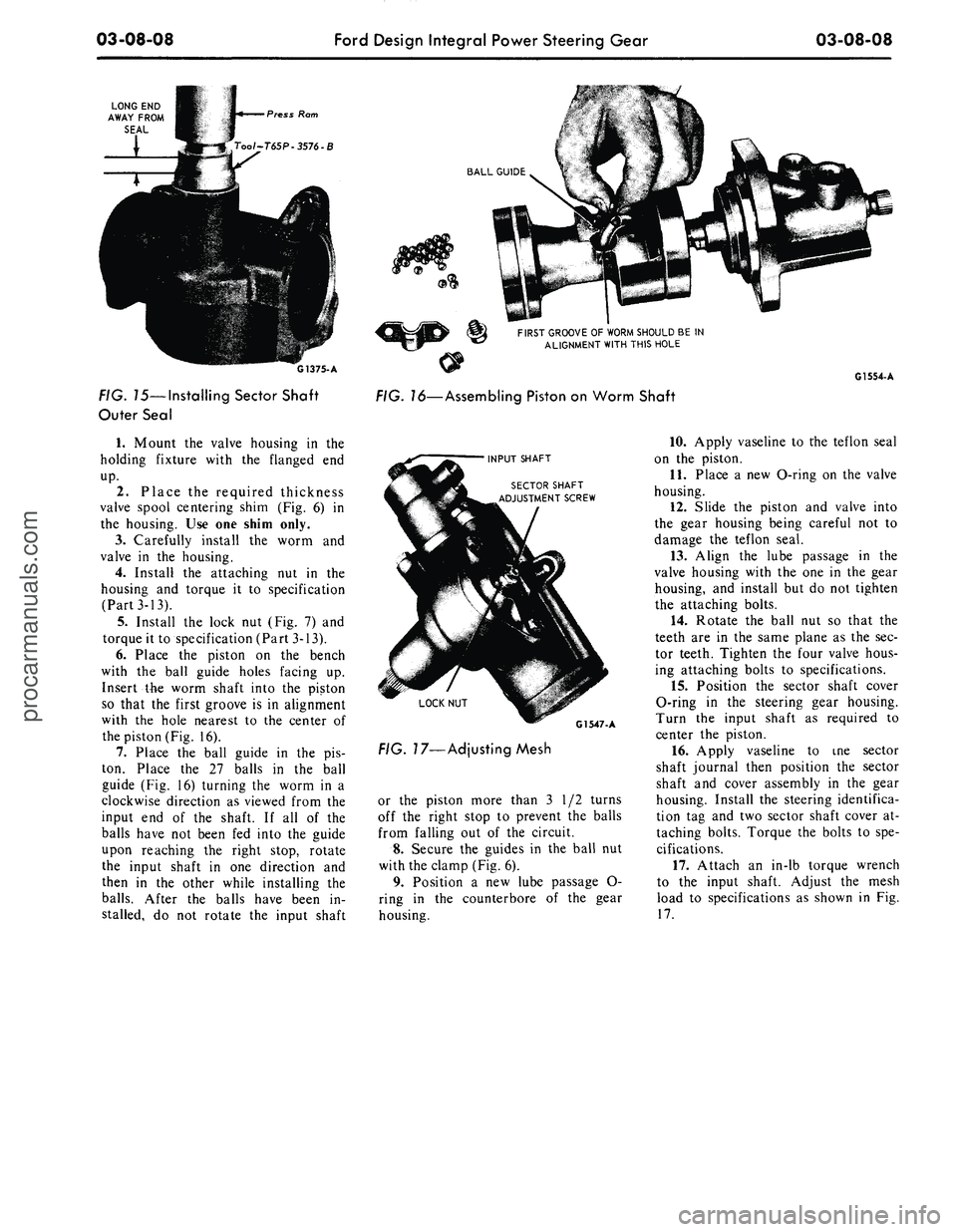
FIG. 15— Installing Sector Shaft
Outer Seal
1.
Mount the valve housing in the
holding fixture with the flanged end
up.
2.
Place the required thickness
valve spool centering shim (Fig. 6) in
the housing. Use one shim only.
3.
Carefully install the worm and
valve in the housing.
4.
Install the attaching nut in the
housing and torque it to specification
(Part 3-13).
5.
Install the lock nut (Fig. 7) and
torque it to specification (Part 3-13).
6. Place the piston on the bench
with the ball guide holes facing up.
Insert 44ie worm shaft into the piston
so that the first groove is in alignment
with the hole nearest to the center of
the piston (Fig. 16).
7.
Place the ball guide in the pis-
ton. Place the 27 balls in the ball
guide (Fig. 16) turning the worm in a
clockwise direction as viewed from the
input end of the shaft. If all of the
balls have not been fed into the guide
upon reaching the right stop, rotate
the input shaft in one direction and
then in the other while installing the
balls.
After the balls have been in-
stalled, do not rotate the input shaft
FIRST GROOVE OF WORM SHOULD BE IN
ALIGNMENT WITH THIS HOLE
G1554-A
FIG. 16—Assembling Piston on Worm Shaft
INPUT SHAFT
SECTOR
SHAFT
ADJUSTMENT
SCREW
G1547-A
FIG. 77—Adjusting Mesh
or the piston more than 3 1/2 turns
off the right stop to prevent the balls
from falling out of the circuit.
8. Secure the guides in the ball nut
with the clamp (Fig. 6).
9. Position a new lube passage O-
ring in the counterbore of the gear
housing.
10.
Apply vaseline to the teflon seal
on the piston.
11.
Place a new O-ring on the valve
housing.
12.
Slide the piston and valve into
the gear housing being careful not to
damage the teflon seal.
13.
Align the lube passage in the
valve housing with the one in the gear
housing, and install but do not tighten
the attaching bolts.
14.
Rotate the ball nut so that the
teeth are in the same plane as the sec-
tor teeth. Tighten the four valve hous-
ing attaching bolts to specifications.
15.
Position the sector shaft cover
O-ring in the steering gear housing.
Turn the input shaft as required to
center the piston.
16.
Apply vaseline to me sector
shaft journal then position the sector
shaft and cover assembly in the gear
housing. Install the steering identifica-
tion tag and two sector shaft cover at-
taching bolts. Torque the bolts to spe-
cifications.
17.
Attach an in-lb torque wrench
to the input shaft. Adjust the mesh
load to specifications as shown in Fig.
17.procarmanuals.com
Page 153 of 413
03-09-01
Saginaw Design Integral Power Steering Gear
03-09-01
PART 3-9 Saginaw Design
Integral Power Steering Gear
COMPONENT INDEX
STEERING GEAR
Cleaning and Inspection (See Page 03-01)
Description
Disassembly and Assembly
Mesh Load Adjustment
Removal and Installation
Overhaul
MODEL APPLICATION
All
Models
Ford
09-01
09-03
09-01
09-02
09-04
Mercury
N/A
N/A
N/A
N/A
N/A
N/A
Meteor
N/A
N/A
N/A
N/A
N/A
N/A
Cougar
N/A
N/A
N/A
N/A
N/A
N/A
Fairlane
N/A
N/A
N/A
N/A
N/A
N/A
Falcon
N/A
N/A
N/A
N/A
N/A
N/A
Montego
N/A
N/A
N/A
N/A
N/A
N/A
Mustang
N/A
N/A
N/A
N/A
N/A
N/A
Lincoln-
Continental
N/A
N/A
N/A
N/A
N/A
N/A
Thunderbird
N/A
N/A
N/A
N/A
N/\
N/A
Continental-
Mark III
N/A
N/A
N/A
N/A
N/A
N/A
A page number indicates that the item is for the vehicle listed at the head of the column.
N/A indicates that the item is not applicable to the vehicle listed.
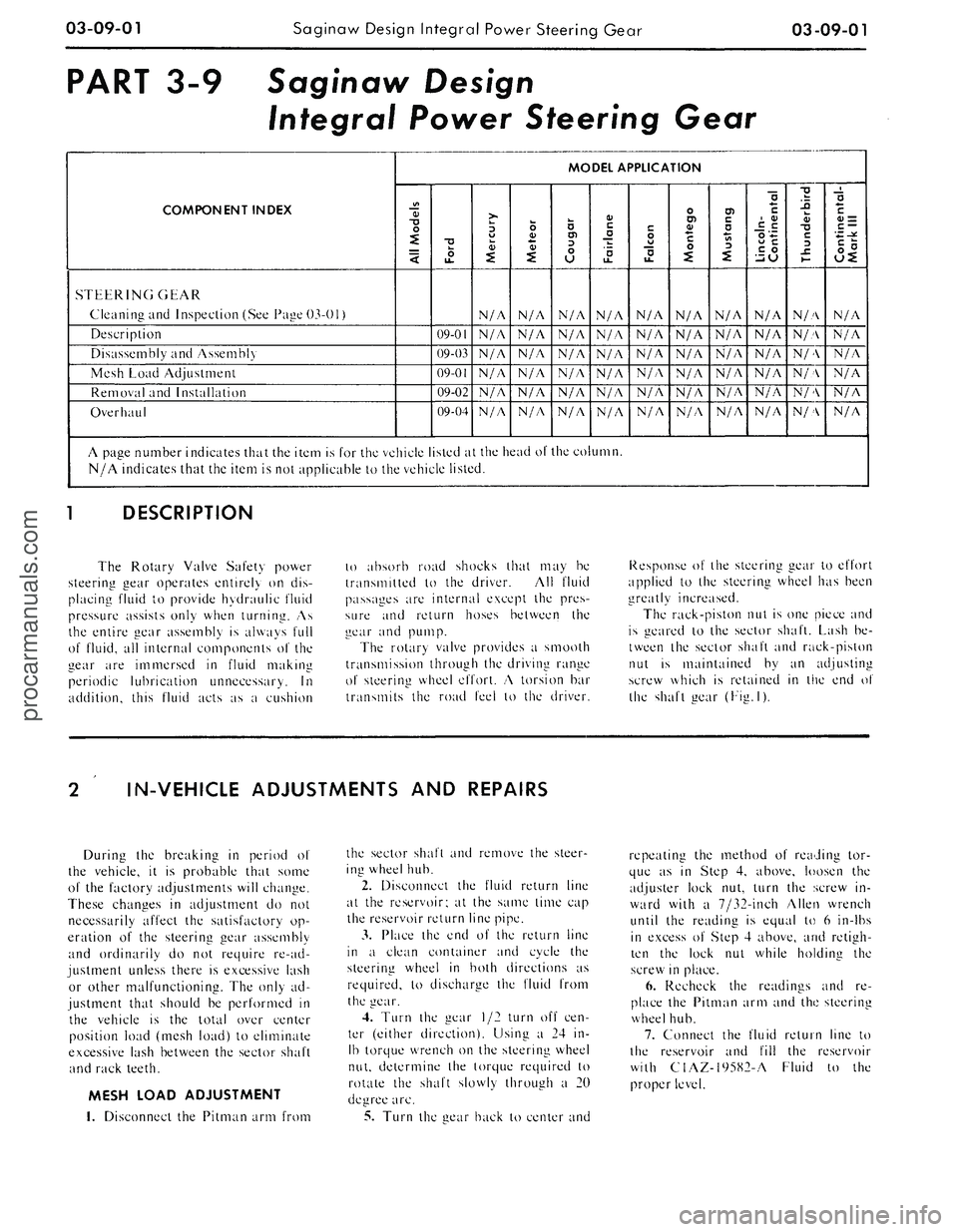
DESCRIPTION
The Rotary Valve Safety power
steering gear operates entirely on dis-
placing fluid to provide hydraulic fluid
pressure assists only when turning. As
the entire gear assembly is always full
of fluid, all internal components of the
gear are immersed in fluid making
periodic lubrication unnecessary. In
addition, this fluid acts as a cushion
to absorb road shocks that may be
transmitted to the driver. All fluid
passages are internal except the pres-
sure and return hoses between the
gear and pump.
The rotary valve provides a smooth
transmission through the driving range
of steering wheel effort. A torsion bar
transmits the road feel to the driver.
Response of the steering gear to effort
applied to the steering wheel has been
greatly increased.
The rack-piston nut is one piece and
is geared to the sector shaft. Lash be-
tween the sector shaft and rack-piston
nut is maintained by an adjusting
screw which is retained in the end o\'
the shaft uear (Eiiz.l).
IN-VEHICLE ADJUSTMENTS AND REPAIRS
During the breaking in period of
the vehicle, it is probable that some
of the factory adjustments will change.
These changes in adjustment do not
necessarily affect the satisfactory op-
eration of the steering gear assembly
and ordinarily do not require re-ad-
justment unless there is excessive lash
or other malfunctioning. The only ad-
justment that should be performed in
the vehicle is the total over center
position load (mesh load) to eliminate
excessive lash between the sector shaft
and rack teeth.
MESH LOAD ADJUSTMENT
1.
Disconnect the Pitman arm from
the sector shaft and remove the steer-
ing wheel hub.
2.
Disconnect the fluid return line
at the reservoir; at the same time cap
the reservoir return line pipe.
3.
Place the end of the return line
in a clean container and cycle the
steering wheel in both directions as
required, to discharge the fluid from
the gear.
4.
Turn the gear 1/2 turn off cen-
ter (either direction). Using a 24 in-
lb torque wrench on the steering wheel
nut, determine the torque required to
rotate the shaft slowly through a 20
degree arc.
5.
Turn the sear back to center and
repeating the method of reading tor-
que as in Step 4, above, loosen the
adjuster lock nut, turn the screw in-
ward with a 7/32-inch Allen wrench
until the reading is equal to 6 in-lbs
in excess of Step 4 above, and retigh-
ten the lock nut while holding the
screw in place.
6. Recheck the readings and re-
place the Pitman arm and the steering
wheel hub.
7.
Connect the fluid return line to
the reservoir and fill the reservoir
with C1AZ-I9582-A Fluid to the
proper level.
procarmanuals.com
Page 154 of 413
03-09-02
Saginaw Design Integral Power Steering Gear
03-09-02
WORM
ADJUSTER PLUG
TORSION BAR
STUB SHAFT
SEAL
NEEDLE BEARINGS
TEFLON RING
TEFLON SEALS
SECTOR SHAFT
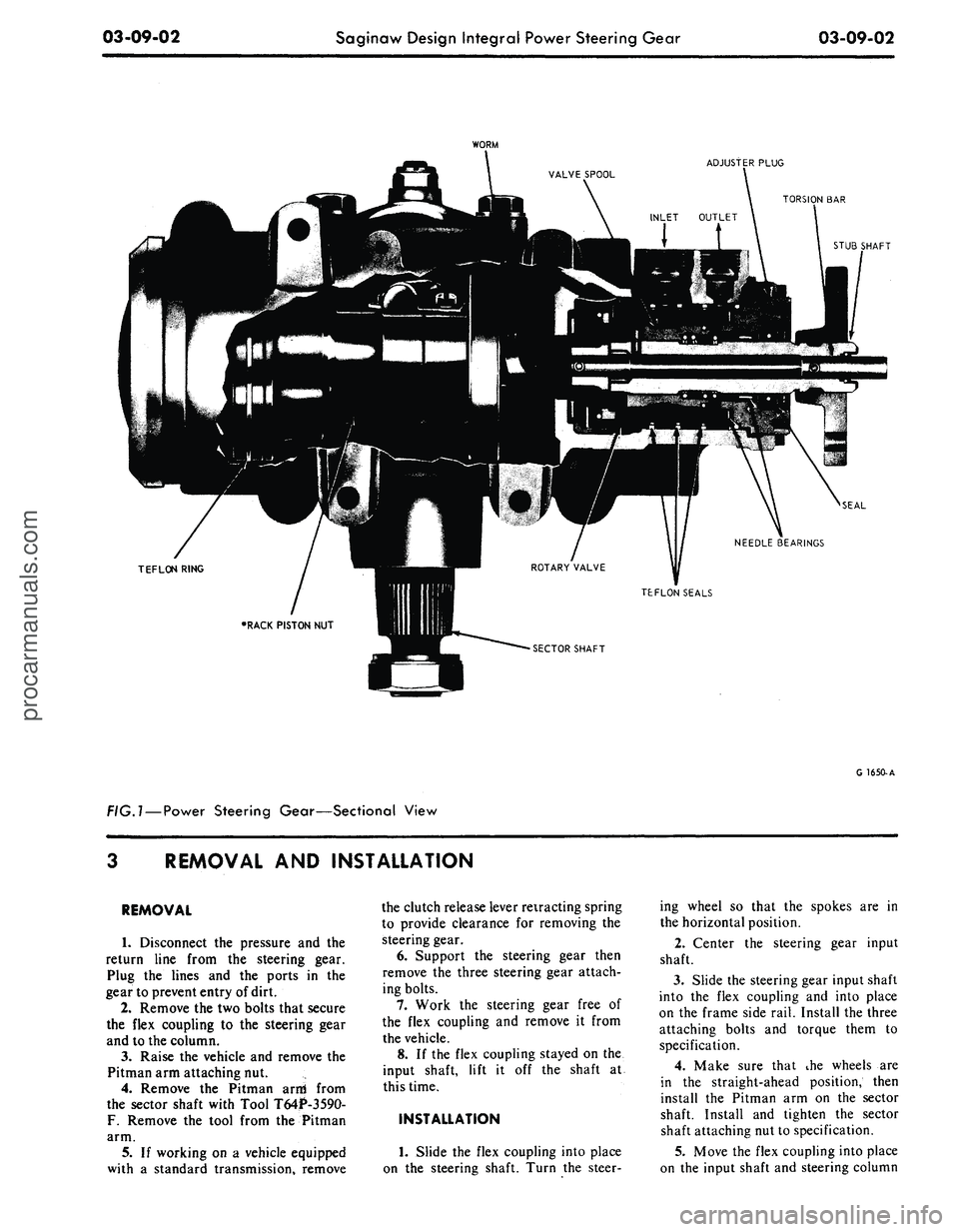
FIG.l —
Power
Steering Gear—Sectional View
G 1650-A
REMOVAL
AND
INSTALLATION
REMOVAL
1.
Disconnect
the
pressure
and the
return line from
the
steering gear.
Plug
the
lines
and the
ports
in the
gear to prevent entry of dirt.
2.
Remove the two bolts that secure
the flex coupling
to the
steering gear
and
to
the column.
3.
Raise
the
vehicle
and
remove
the
Pitman arm attaching nut.
4.
Remove
the
Pitman arni from
the sector shaft with Tool T64P-3590-
F.
Remove
the
tool from
the
Pitman
arm.
5.
If
working
on a
vehicle equipped
with
a
standard transmission, remove
the clutch release lever retracting spring
to provide clearance
for
removing
the
steering gear.
6. Support
the
steering gear then
remove
the
three steering gear attach-
ing bolts.
7.
Work
the
steering gear free
of
the flex coupling
and
remove
it
from
the vehicle.
8.
If
the flex coupling stayed
on the
input shaft, lift
it off the
shaft
at
this time.
INSTALLATION
1.
Slide
the
flex coupling into place
on
the
steering shaft. Turn
the
steer-
ing wheel
so
that
the
spokes
are in
the horizontal position.
2.
Center
the
steering gear input
shaft.
3.
Slide the steering gear input shaft
into
the
flex coupling
and
into place
on
the
frame side rail. Install the three
attaching bolts
and
torque them
to
specification.
4.
Make sure that
ihe
wheels
are
in
the
straight-ahead position, then
install
the
Pitman
arm on the
sector
shaft. Install
and
tighten
the
sector
shaft attaching nut to specification.
5.
Move the flex coupling into place
on
the
input shaft
and
steering columnprocarmanuals.com
Page 155 of 413
03-09-03
Saginaw Design Integral Power Steering Gear
03-09-03
shaft and install and tighten the attach-
ing bolts to specification.
6. Connect and tighten the fluid
pressure and the return line to the
steering gear.
7. Fill the power steering pump and
cycle the steering gear. Check for
leaks.
Check the reservoir fluid level
again and add as required.
MAJOR REPAIR OPERATIONS
Disassembly and reassembly of the
unit and the subassemblies must be
made on a clean workbench. As in re-
pairing any hyldraulically operated
unit, cleanliness is of tftfiiost impor-
tance. Therefore, the bench, tools, and
parts must be kept clean at all times.
Thoroughly clean the exterior of the
gear with a suitable solvent and, when
necessary, drain as much of the hy-
draulic fluid from the gear as possible.
DISASSEMBLY INTO
SUB-ASSEMBLIES
1,
Mount the steering gear in a
vise.
(Fig..
2\
2.
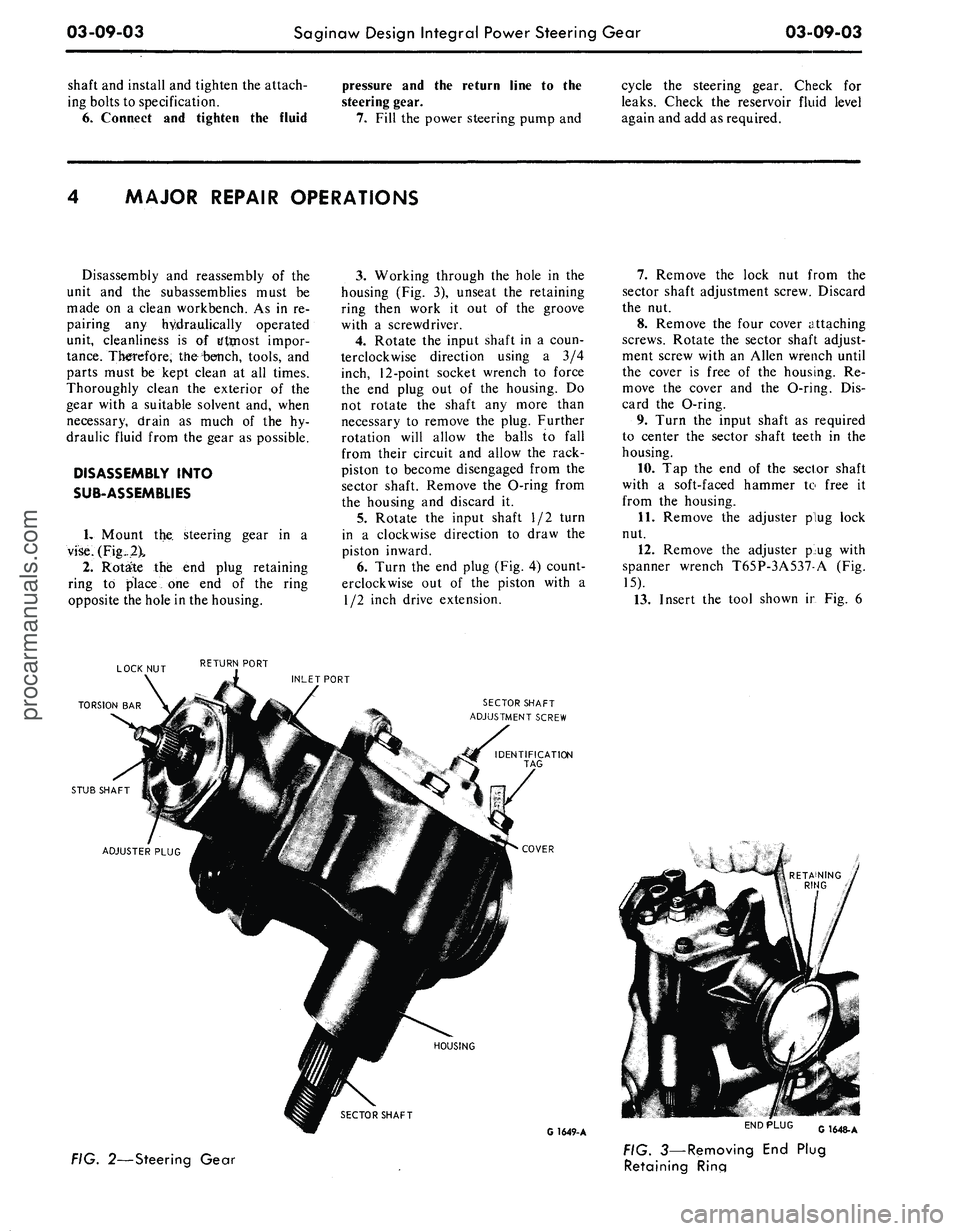
Rotate the end plug retaining
ring to place one end of the ring
opposite the hole in the housing.
3.
Working through the hole in the
housing (Fig. 3), unseat the retaining
ring then work it out of the groove
with a screwdriver.
4.
Rotate the input shaft in a coun-
terclockwise direction using a 3/4
inch, 12-point socket wrench to force
the end plug out of the housing. Do
not rotate the shaft any more than
necessary to remove the plug. Further
rotation will allow the balls to fall
from their circuit and allow the rack-
piston to become disengaged from the
sector shaft. Remove the O-ring from
the housing and discard it.
5.
Rotate the input shaft 1/2 turn
in a clockwise direction to draw the
piston inward.
6. Turn the end plug (Fig. 4) count-
erclockwise out of the piston with a
1/2 inch drive extension.
7.
Remove the lock nut from the
sector shaft adjustment screw. Discard
the nut.
8. Remove the four cover attaching
screws. Rotate the sector shaft adjust-
ment screw with an Allen wrench until
the cover is free of the housing. Re-
move the cover and the O-ring. Dis-
card the O-ring.
9. Turn the input shaft as required
to center the sector shaft teeth in the
housing.
10.
Tap the end of the sector shaft
with a soft-faced hammer to free it
from the housing.
11.
Remove the adjuster plug lock
nut.
12.
Remove the adjuster p>ug with
spanner wrench T65P-3A537-A (Fig.
15).
13.
Insert the tool shown ir Fig. 6
LOCK NUT RETUF™ P0RT
INLET PORT
TORSION BAR
STUB SHAFT
SECTOR SHAFT
ADJUSTMENT SCREW
ADJUSTER PLUG
HOUSING
SECTOR SHAFT
G
1649-
A
FIG. 2—Steering Gear
END PLUG
G1648-A
FIG. 3—Removing End Plug
Retaining Rinaprocarmanuals.com
Page 156 of 413
03-09-04
Saginaw Design Integral Power Steering Gear
03-09-04
CLAMP
BALL
RETURN GUIDE
TEFLON
RINGS (3)
VALVE
SPOOL
0-RING SPOOL
SEAL
INLET
PORT SEAT
CHECK
VALVE
RETURN
PORT
SEAT
SPRING
STUB
SHAFT
ASSEMBLY
TEFLON
RING
RACK-PISTON
END PLUG
O-RING
HOUSING
END PLUG
RETAINING
RING
FLEXIBLE
COUPLING
'BEARING
LOCK
NUT
GROUND
STRAP
RETAINING
RING
DUST
SEAL
OIL
SEAL
ADJUSTER
PLUG
O-RING SEAL
THRUST
BEARING
SPACER
BEARING
RETAINER
SPOOL
SPRING
RETAINING
RING
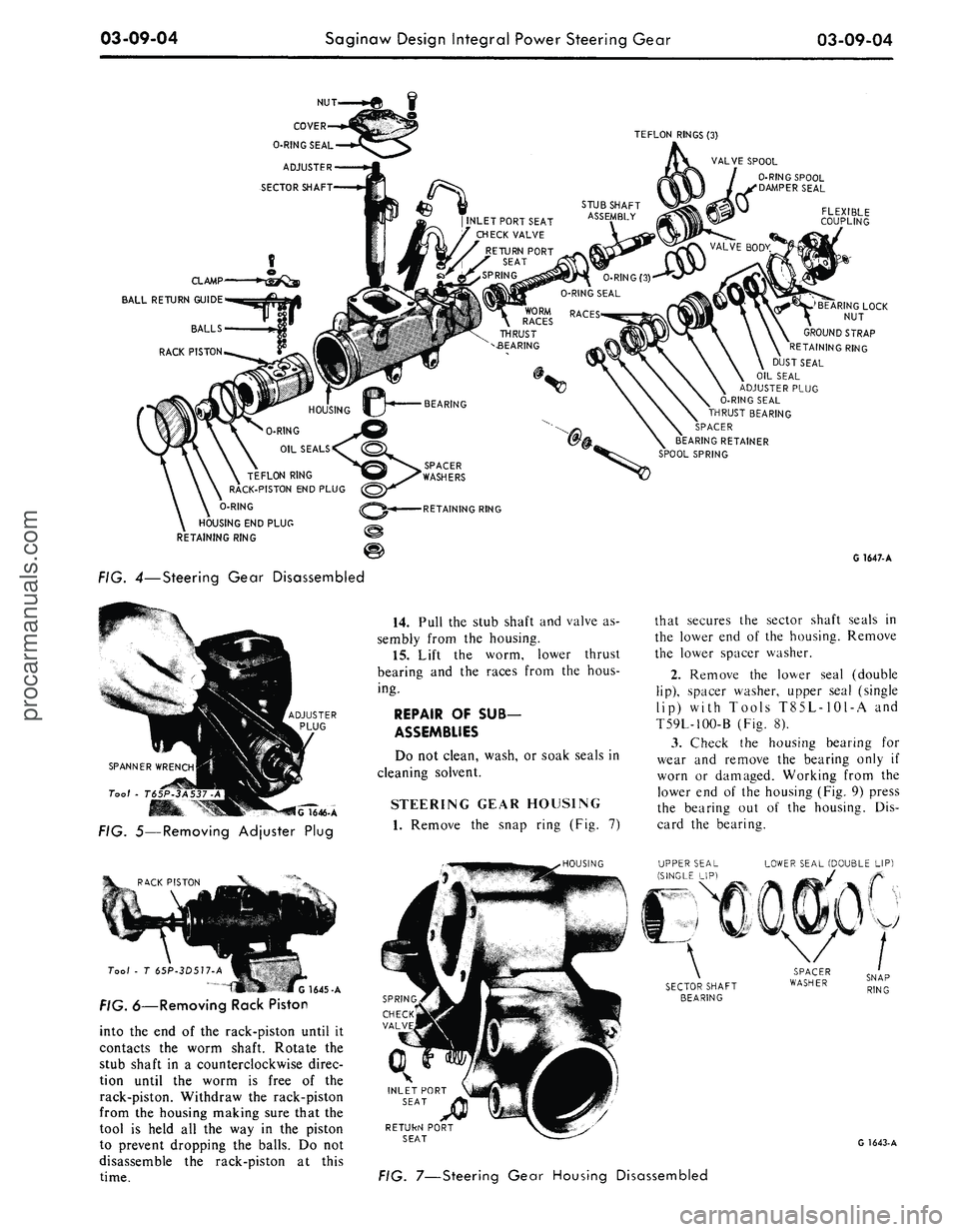
FIG. 4—Steering Gear Disassembled
SPANNER
WRENCH
Tool - T65P-
lG
1646-A
FIG. 5—Removing Adjuster Plug
14.
Pull the stub shaft and valve as-
sembly from the housing.
15.
Lift the worm, lower thrust
bearing and the races from the hous-
ing.
REPAIR
OF SUB-
ASSEMBLIES
Do not clean, wash, or soak seals in
cleaning solvent.
STEERING GEAR HOUSING
1.
Remove the snap ring (Fig. 7)
G
1647-A
that secures the sector shaft seals in
the lower end of the housing. Remove
the lower spacer washer.
2.
Remove the lower seal (double
lip),
spacer washer, upper seal (single
lip) with Tools T85L-1O1-A and
T59L-100-B (Fig. 8).
3.
Check the housing bearing for
wear and remove the bearing only if
worn or damaged. Working from the
lower end of the housing (Fig. 9) press
the bearing out of the housing. Dis-
card the bearing.
.HOUSING
LOWER
SEAL (DOUBLE LIP)
Tool
- T 65P-3D517-A
G
1645-A
FIG. 6—Removing Rack Piston
into the end of the rack-piston until it
contacts the worm shaft. Rotate the
stub shaft in a counterclockwise direc-
tion until the worm is free of the
rack-piston. Withdraw the rack-piston
from the housing making sure that the
tool is held all the way in the piston
to prevent dropping the balls. Do not
disassemble the rack-piston at this
time.
SNAP
RING
INLET
PORT
SEAT
RETUkN
PORT
SEAT
G
1643-A
FIG. 7—Steering Gear Housing Disassembledprocarmanuals.com