engine ISUZU KB P190 2007 Workshop Repair Manual
[x] Cancel search | Manufacturer: ISUZU, Model Year: 2007, Model line: KB P190, Model: ISUZU KB P190 2007Pages: 6020, PDF Size: 70.23 MB
Page 1924 of 6020

ENGINE CONTROL SYSTEM (4JK1/4JJ1) 6E-307
51. Turn OFF the ignition.
2. Remove the metal bus bar from the glow plugs.
3. Measure resistance of each glow plug between the glow plug terminals and a known
good ground. Make sure to record all
measurements and take them quickly as to
not allow engine temperature changes
between measurements.
Are the resistances within the specified value each
other? 1
Ω
System OK Go to Step 16
6 1. Turn OFF the ignition.
2. Replace the glow relay with the starter relay or replace with a known good relay.
3. Turn ON the ignition, with the engine OFF.
4. Connect a test lamp between the metal bus bar (glow plug power supply E-49 connector)
and a known good ground.
5. Perform the Glow Relay Control with a scan tool.
6. Command the relay ON while observing the test lamp.
Does the test lamp turn ON only when commanded
ON? —
Go to Step 14 Go to Step 7
7 Inspect the Glow (60A) slow blow fuse in the
engine room fuse block.
Is the Glow (60A) slow blow fuse open? —
Go to Step 8 Go to Step 9
8 Replace the Glow (60A) slow blow fuse. If the slow
blow fuse continues to open, repair the short to
ground on a circuit fed by the slow blow fuse or
check for a shorted attached component.
Did you complete the repair? —
Go to Step 17
—
91. Turn OFF the ignition.
2. Remove the glow relay.
3. Probe the battery voltage feed circuit of the relay (pin 4 of X-5) with a test lamp that is
connected to a known good ground.
Does the test lamp illuminate? —
Go to Step 10 Go to Step 11
10 1. Probe the voltage supply circuit of glow plugs
(pin 1 of X-5) with a test lamp that is
connected to a known good ground.
2. Turn ON the ignition, with the engine OFF.
Does the test lamp illuminate? —
Go to Step 13 Go to Step 12
11 Repair the open circuit or high resistance between
the Glow (60A) slow blow fuse and the glow relay
(pin 4 of X-5).
Did you complete the repair? —
Go to Step 17
—
12Repair the open circuit or high resistance between
the glow relay (pin 1 of X-5) and the glow plugs (E-
49 terminal).
Did you complete the repair? —
Go to Step 17
—
Step Action Value(s)Yes No
BACK TO CHAPTER INDEX
TO MODEL INDEX
ISUZU KB P190 2007
Page 1925 of 6020

6E-308 ENGINE CONTROL SYSTEM (4JK1/4JJ1)
Circuit/ System Testing Glow Control System Check (2 of 2)
13Important
: The glow plugs may be burnt out if the
battery voltage supply circuit is shorted to a voltage
source.
Repair the short to battery or ignition voltage
between the glow relay (pin 1 of X-5) and the glow
plugs (E-49 terminal).
Did you complete the repair? —
Go to Step 17
—
141. Remove the glow relay.
2. Inspect for an intermittent and for poor connection on each glow relay terminal.
3. Repair the connection(s) as necessary.
Did you find and correct the condition? —
Go to Step 17 Go to Step 15
15 Replace the glow relay.
Did you complete the replacement? —
Go to Step 17
—
16Replace the appropriate glow plug.
Did you complete the replacement? —
Go to Step 17—
171. Reconnect all previously disconnected
components, relay, fuse or harness
connector(s).
2. Turn OFF the ignition for 30 seconds.
3. Turn ON the ignition, with the engine OFF.
4. Connect a test lamp between the metal bus bar (glow plug power supply E-49 connector)
and a known good ground.
5. Perform the Glow Relay Control with a scan tool.
6. Command the relay ON while observing the test lamp.
Does the test lamp turn ON only when commanded
ON? —
Go to Step 5 Go to Step 2
Step
Action Value(s)Yes No
Step Action Value(s)Yes No
1 1. Turn OFF the ignition.
2. Inspect the Meter (10A) fuse in cabin fuse block.
Is the Meter (10A) fuse open? —
Go to Step 2 Go to Step 3
2 Replace the Meter (10A) fuse. If the fuse continues
to open, repair the short to ground on one of the
circuits that is fed by the Meter (10A) fuse or
replace the shorted attached component.
Did you complete the repair? —
Go to Step 14
—
31. Turn OFF the ignition.
2. Disconnect the ECM J-2 (C-58) harness connector.
3. Turn ON the ignition, with the engine OFF.
Is the glow indicator lamp OFF? —
Go to Step 4 Go to Step 10
BACK TO CHAPTER INDEX
TO MODEL INDEX
ISUZU KB P190 2007
Page 1926 of 6020

ENGINE CONTROL SYSTEM (4JK1/4JJ1) 6E-309
41. Remove the Meter (10A) fuse that supplies
voltage to the glow indicator lamp.
2. Turn ON the ignition, with the engine OFF.
3. Measure the voltage from the glow indicator lamp control circuit in the ECM harness
connector (pin 51 of C-58) to a known good
ground.
Is the voltage less than the specified value? 1 volt
Go to Step 5 Go to Step 11
5 1. Turn OFF the ignition.
2. Reinstall the Meter (10A) fuse.
3. Turn ON the ignition, with the engine OFF.
4. Connect a 3-amp fused jumper wire between the ECM harness connector (pin 51 of C-58)
and a known good ground.
Is the glow indicator lamp illuminated? —
Go to Step 9 Go to Step 6
6 1. Turn OFF the ignition.
2. Remove the IP cluster.
3. Connect a test lamp between the ignition voltage feed circuit of the IP cluster harness
connector (pin 8 of B-24) and a known good
ground.
Turn ON the ignition, with the engine OFF.
Does the test lamp illuminate? —
Go to Step 7 Go to Step 12
7 1. Test the control circuit between the ECM (pin
51 of C-58) and the IP cluster (pin 35 of B-23)
for an open circuit or high resistance.
2. Repair the circuit(s) as necessary.
Did you find and correct the condition? —
Go to Step 15 Go to Step 8
8 1. Inspect for an intermittent and for poor
connections at the harness connector of the
IP cluster (pin 35 of B-23 and pin 8 of B-24).
2. Repair the connection(s) as necessary.
Did you find and correct the condition? —
Go to Step 15 Go to Step 13
9 1. Inspect for an intermittent and for a poor
connection at the harness connector of the
ECM (pin 51 of C-58).
2. Repair the connection(s) as necessary.
Did you find and correct the condition? —
Go to Step 15 Go to Step 14
10 Repair the short to ground between the ECM (pin
51 of C-58) and the IP cluster (pin 35 or of B-23).
Did you complete the repair? —
Go to Step 15
—
11Repair the short to battery or ignition voltage
between the ECM (pin 51 of C-58) and the IP
cluster (pin 35 of B-23).
Did you complete the repair? —
Go to Step 15
—
12Repair the open circuit or high resistance on
ignition the voltage feed circuit the Meter (10A) fuse
and the IP cluster (pin 8 of B-24).
Did you complete the repair? —
Go to Step 15
—
Step Action Value(s)Yes No
BACK TO CHAPTER INDEX
TO MODEL INDEX
ISUZU KB P190 2007
Page 1927 of 6020
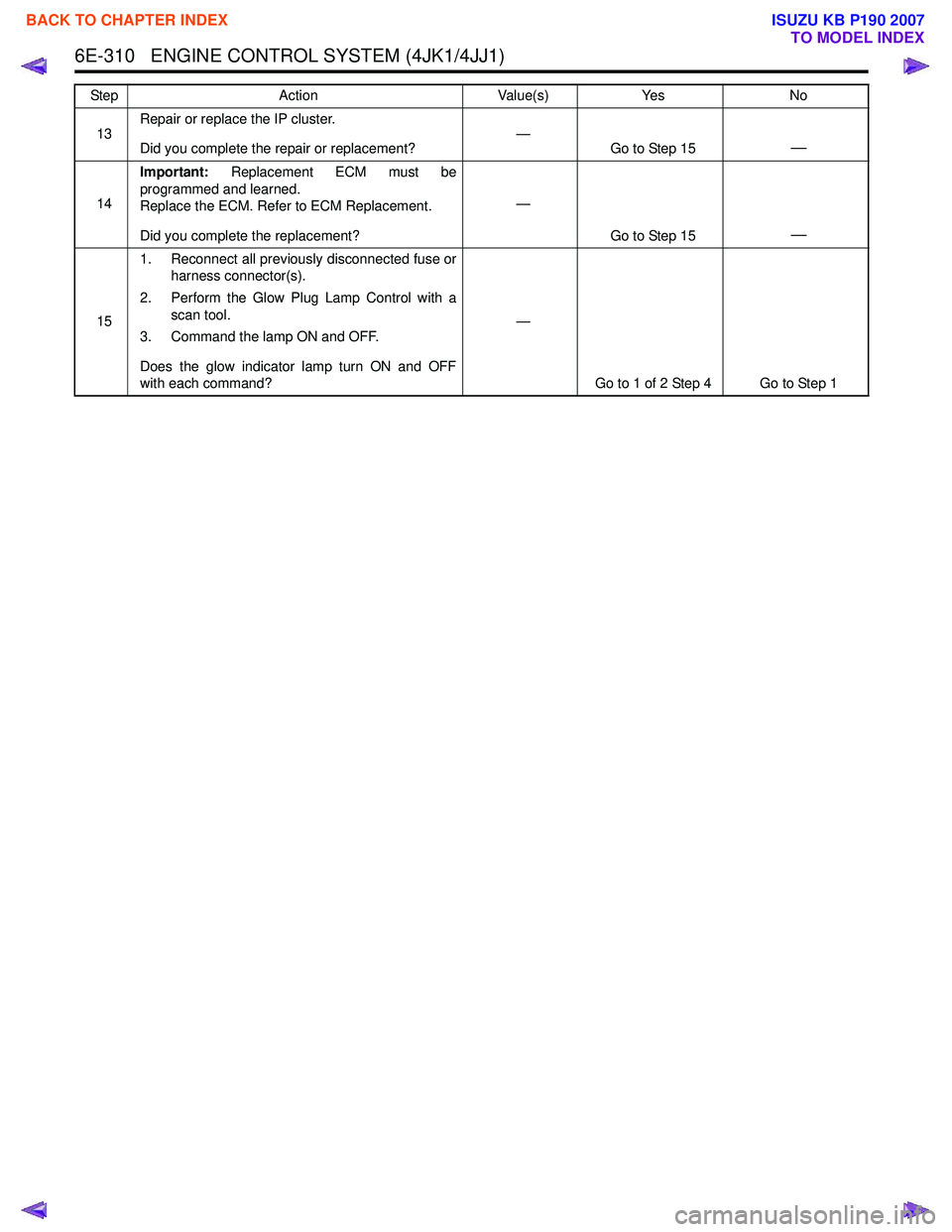
6E-310 ENGINE CONTROL SYSTEM (4JK1/4JJ1)
13Repair or replace the IP cluster.
Did you complete the repair or replacement? —
Go to Step 15—
14Important:
Replacement ECM must be
programmed and learned.
Replace the ECM. Refer to ECM Replacement.
Did you complete the replacement? —
Go to Step 15
—
151. Reconnect all previously disconnected fuse or
harness connector(s).
2. Perform the Glow Plug Lamp Control with a scan tool.
3. Command the lamp ON and OFF.
Does the glow indicator lamp turn ON and OFF
with each command? —
Go to 1 of 2 Step 4 Go to Step 1
Step
Action Value(s)Yes No
BACK TO CHAPTER INDEX
TO MODEL INDEX
ISUZU KB P190 2007
Page 1928 of 6020

ENGINE CONTROL SYSTEM (4JK1/4JJ1) 6E-311
In-Tank Fuel Pump System Check
Description
The ECM controls the fuel pump relay, which supplies
power to the fuel pump in the fuel tank. The ECM
commands the fuel pump relay ON for a certain length
of time at ignition switch is ON with the engine OFF.
During the engine is running it is continuity commanded
ON.
In-tank Fuel Pump Control Operation • The battery voltage is more than 9 volts. • The ignition switch is ON.
• The fuel pump is commanded ON for 12 seconds at ignition switch is ON with the engine OFF.
• The fuel pump is continuously ON while engine is running.
Schematic Reference: Engine Controls Schematics
Connector End View Reference: Engine Controls
Connector End Views or ECM Connector End Views
Circuit/ System Testing In-Tank Fuel Pump System Check
Step Action Value(s)Yes No
1 Did you perform the Diagnostic System Check -
Engine Controls? —
Go to Step 2 Go to Diagnostic
System Check -
Engine Controls
2 1. Install a scan tool.
2. Turn OFF the ignition for 30 seconds.
3. Turn ON the ignition for 20 seconds, then start the engine.
4. Monitor the DTC Information with a scan tool.
Is DTC P0231 or P0232 set? —
Refer to Applicable DTC Go to Step 3
3 1. Turn OFF the ignition for 30 seconds.
2. Remove the fuel filler cap.
3. Turn ON the ignition, with the engine OFF.
Is the fuel pump operating sound heard from the
fuel filler? —
Go to Step 4 Go to Step 7
4 Does the fuel pump operating sound stop after
approximately 12 seconds passed? —
Go to Step 21 Go to Step 5
5 1. Turn OFF the ignition for 30 seconds.
2. Replace the fuel pump relay with the head light relay or replace with a known good relay.
3. Turn ON the ignition, with the engine OFF.
Does the fuel pump operating sound stop after
approximately 12 seconds passed? —
Go to Step 20 Go to Step 6
6 Repair the short to battery or ignition voltage
between the fuel pump relay (pin 2 of X-13) and the
fuel pump (pin 1 of F-2).
Did you complete the repair? —
Go to Step 25
—
71. Turn OFF the ignition for 30 seconds.
2. Replace the fuel pump relay with the head light relay or replace with a known good relay.
3. Turn ON the ignition, with the engine OFF.
Is the fuel pump operating sound heard from the
fuel filler? —
Go to Step 17 Go to Step 8
8 Inspect the Fuel Pump (10A) fuse in the engine
room fuse block.
Is the Fuel Pump (10A) fuse open? —
Go to Step 9 Go to Step 10
BACK TO CHAPTER INDEX
TO MODEL INDEX
ISUZU KB P190 2007
Page 1929 of 6020

6E-312 ENGINE CONTROL SYSTEM (4JK1/4JJ1)
9Replace the Fuel Pump (10A) fuse. If the fuse
continues to open, repair the short to ground on a
circuit fed by the fuse or check for a shorted
attached component.
Did you complete the repair? —
Go to Step 25
—
101. Turn OFF the ignition.
2. Remove the fuel pump relay.
3. Probe the battery voltage feed circuit of the relay (pin 1 of X-13) with a test lamp that is
connected to a known good ground.
Does the test lamp illuminate? —
Go to Step 12 Go to Step 11
11 Repair the open circuit or high resistance between
the Fuel Pump (10A) fuse and the fuel pump relay
(pin 1 of X-13).
Did you complete the repair? —
Go to Step 25
—
121. Reconnect the fuel pump relay.
2. Disconnect the fuel pump resistor harness connector.
3. Measure the resistance across the fuel pump resistor.
Is the resistance within the specified value? 2.2 to 2.7
Ω
Go to Step 13 Go to Step 23
13 1. Connect a test lamp between the fuel pump
side voltage feed circuit on the resistor
harness (pin 1 of C-157) and a known good
ground.
2. Turn ON the ignition, with the engine OFF.
Does the test lamp illuminate for approximately 12
seconds then go out? —
Go to Step 14 Go to Step 15
14 Connect a test lamp between the ground circuit on
the resistor harness (pin 2 of C-157) and battery
voltage.
Does the test lamp illuminate? —
Go to Step 18 Go to Step 16
15 1. Test the fuel pump circuit between the fuel
pump (pins 1 and 4 of F-2) and the fuel pump
relay (pin 2 of X-13) or the fuel pump resistor
(pin 1 of C-157) for an open circuit or high
resistance.
2. Repair the circuit(s) as necessary.
Did you find and correct the condition? —
Go to Step 25 Go to Step 19
16 Repair the open circuit or high resistance between
the fuel pump resistor (pin 2 of C-57) and the body
ground terminal (C-109). Clean or tighten ground
as necessary.
Did you complete the repair? —
Go to Step 25
—
171. Remove the fuel pump relay.
2. Inspect for an intermittent and for poor connection on each relay terminal.
3. Repair the connection(s) as necessary.
Did you find and correct the condition? —
Go to Step 25 Go to Step 20
Step
Action Value(s)Yes No
BACK TO CHAPTER INDEX
TO MODEL INDEX
ISUZU KB P190 2007
Page 1930 of 6020

ENGINE CONTROL SYSTEM (4JK1/4JJ1) 6E-313
181. Inspect for an intermittent, poor connections
and corrosion at the harness connector of the
fuel pump resistor (pins 1 and 2 of C-57).
2. Repair the connection(s) as necessary.
Did you find and correct the condition? —
Go to Step 25
—
191. Inspect for an intermittent, for poor
connections and corrosion at the harness
connector of the fuel pump (pins 1 and 4 of F-
2).
2. Repair the connection(s) as necessary.
Did you find and correct the condition? —
Go to Step 25 Go to Step 24
20 Replace the fuel pump relay.
Did you complete the replacement? —
Go to Step 25
—
211. Make sure the fuel amount in the fuel tank.
Refill adequate fuel as necessary.
2. Check the fuel system connections between the fuel tank and the fuel supply pump for
tightness and all fuel hoses for cuts, kinks,
cracks and for the use of proper clamps.
Repair or replace as necessary.
3. Turn OFF the ignition.
4. Disconnect the fuel hose that connects to the fuel filter inlet side. In order to measure the
discharged fuel amount, put the hose into a
bottle or a container with a scale. (The inlet of
a bottle or a container must be larger than the
diameter of hose.)
5. Turn ON the ignition for 20 seconds, with the engine OFF.
6. Turn OFF the ignition for 10 seconds.
7. Perform 5 and 6 three times. The accumulated fuel of three ignition cycles must be more than
300cc. (Normal amount is more than 100cc
per one ignition cycle.)
Is enough amount of fuel discharged? —
System OK Go to Step 22
22 1. Remove the fuel pump from the fuel tank.
Refer to Fuel Gauge Unit in the Fuel System
section.
2. Inspect the fuel pump for any type of restriction or damage on the fuel pipes.
3. Repair or replace as necessary.
Did you find and correct the condition? —
Go to Step 25 Go to Step 24
23 Replace the fuel pump resistor.
Did you complete the replacement? —
Go to Step 25
—
24Replace the fuel pump. Refer to Fuel Gauge Unit in
the Fuel System section.
Did you complete the replacement? —
Go to Step 25
—
25Reconnect all previously disconnected
components, fuse, relay or harness connector(s).
Did you complete the action? —
Go to Step 3
—
Step Action Value(s)Yes No
BACK TO CHAPTER INDEX
TO MODEL INDEX
ISUZU KB P190 2007
Page 1931 of 6020

6E-314 ENGINE CONTROL SYSTEM (4JK1/4JJ1)
Cruise Control System Check
Description
The cruise control system consists of the ECM, the
cruise main switch, set/ coast switch, resume/ accel.
switch and cancel switch. The cruise control keeps the
vehicle speed at a driver's set speed. When the cruise
main switch is turned ON, signal is provided to the
ECM and the cruise main indicator lamp on the switch
will light up. When the cruise set/ coast switch is turned
ON, the switch signal is provided to the ECM and the
vehicle speed is set. The vehicle speed is increased or
decreased if the set/ coast switch or the resume/ accel.
switch is turned ON. When the cruise cancel switch is
applied, the switch signal is provided to the ECM and
the cruise control system is inactive.
Condition for Running the Cruise Control • The vehicle speed is between approximately 40 km/h (24 MPH) to 175 km/h (105 MPH).
• The engine speed is less than 4500 PRM.
• The cruise main switch is ON.
1. Function of "SET"
If the set/ coast switch is pressed and released while
condition for running the cruise control are satisfied, the
ECM memorize and maintain the vehicle speed at that
time.
2. Function of "COAST"
If the set/ coast switch is pressed while the cruise
control system is operating, the vehicle speed is
decreased. Then, when the set/ coast switch is
released, the vehicle will maintain the vehicle speed at
that time.
3. Function of "RESUME"
If the resume/ accel. switch is applied while the cruise
control system is operating and the ECM memorizes
the vehicle speed, the vehicle speed is returned to the
vehicle speed memorized by the ECM.
4. Function of "ACCEL"
If the resume/ accel. switch is applied while the cruise
control system is operating, the vehicle speed is
increased. Then, when the resume/ accel. switch is
released, the vehicle will maintain the vehicle speed at
that time.
5. Function of "TAP UP"
If the resume/ accel. switch is tapped (momentarily
applied) while the cruise control system is operating,
the vehicle speed is increased 1 km/h (0.6 MPH) at a
time. 6. Function of "TAP DOWN"
If the set/ coast switch is tapped while the cruise control
system is operating, the vehicle speed is decreased 1
km/h (0.6 MPH).
7. Function of Temporary Acceleration
If the accelerator pedal is pressed while the cruise
control system is operating, the vehicle speed is
increased.
8. Function of Temporary Cancellation
The cruise control is canceled temporarily if any of the
following condition is met:
• The cruise cancel switch is applied.
• The brake pedal is depressed.
• The clutch pedal is depressed (M/T).
• The selector lever position is not D, 3, 2 or L (A/T).
• The cruise set/ coast switch and resume/ accel. switch are ON at the same time.
• The actual vehicle speed becomes less than approximately 35 km/h (22 MPH).
• The actual vehicle speed is more than 40 km/h (24 MPH) over the set speed, or more than 10 km/h (6
MPH) over the set speed for longer than 3
minutes.
• The actual vehicle speed is more than 70 km/h (42 MPH) below the set speed, or more than 10 km/h
(6 MPH) below the set speed for 3 minutes.
By applying the resume/ accel. switch, the vehicle
speed is returned to the vehicle speed memorized by
the ECM (resume function) if within the condition for
running the cruise control are satisfied.
9. Function of Complete Cancellation
The cruise control is canceled completely if any of the
following condition is met:
• The cruise main switch is OFF.
• The ignition switch is OFF.
• The vehicle is once stopped.
• The DTCs relating to the cruise control system inhibits are set.
Schematic Reference: Engine Controls Schematics
Connector End View Reference: Engine Controls
Connector End Views or ECM Connector End Views
Circuit/ System Testing Cruise Control System Check (1 of 2)
Step Action Value(s)Yes No
1 Did you perform the Diagnostic System Check -
Engine Controls? —
Go to Step 2 Go to Diagnostic
System Check -
Engine Controls
BACK TO CHAPTER INDEX
TO MODEL INDEX
ISUZU KB P190 2007
Page 1932 of 6020
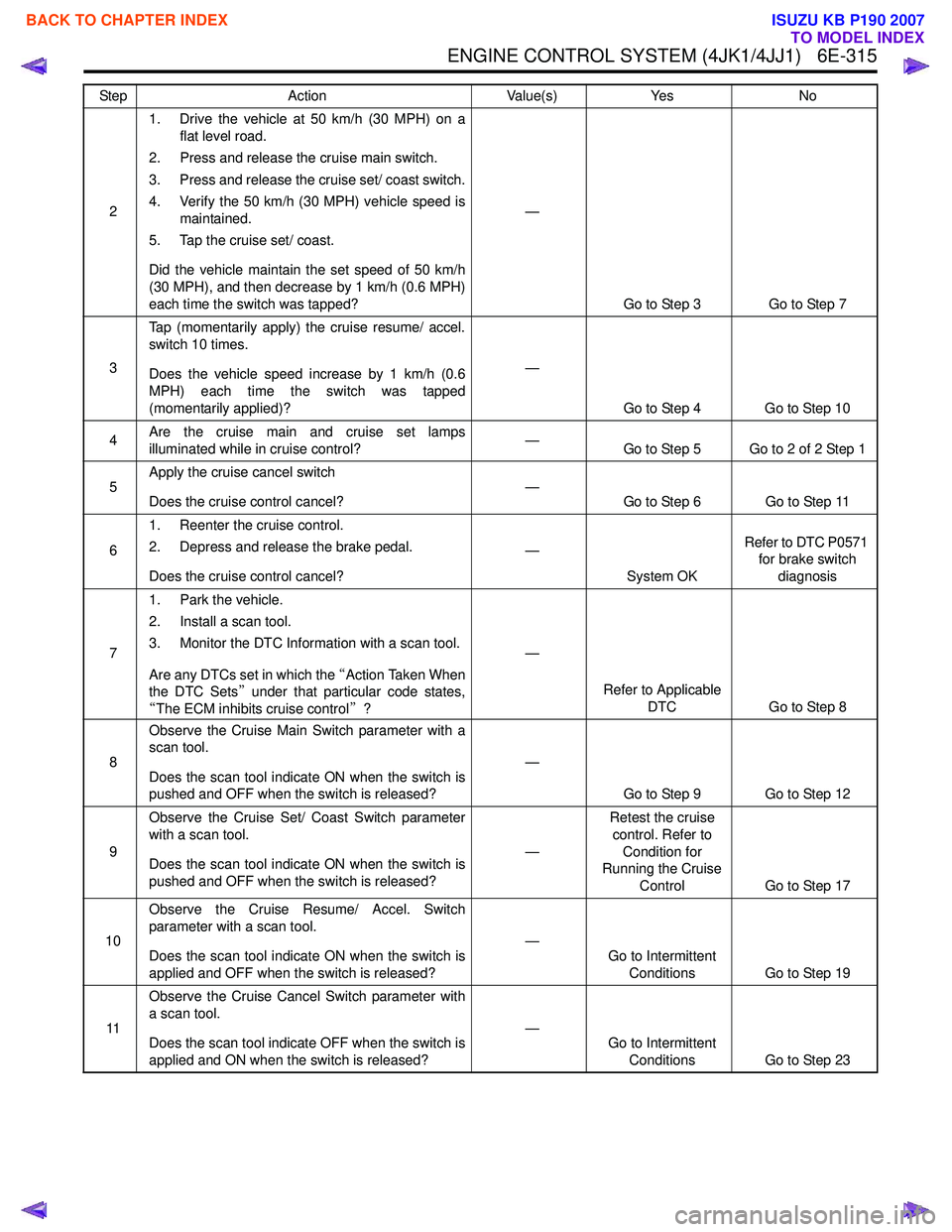
ENGINE CONTROL SYSTEM (4JK1/4JJ1) 6E-315
21. Drive the vehicle at 50 km/h (30 MPH) on a
flat level road.
2. Press and release the cruise main switch.
3. Press and release the cruise set/ coast switch.
4. Verify the 50 km/h (30 MPH) vehicle speed is maintained.
5. Tap the cruise set/ coast.
Did the vehicle maintain the set speed of 50 km/h
(30 MPH), and then decrease by 1 km/h (0.6 MPH)
each time the switch was tapped? —
Go to Step 3 Go to Step 7
3 Tap (momentarily apply) the cruise resume/ accel.
switch 10 times.
Does the vehicle speed increase by 1 km/h (0.6
MPH) each time the switch was tapped
(momentarily applied)? —
Go to Step 4 Go to Step 10
4 Are the cruise main and cruise set lamps
illuminated while in cruise control? —
Go to Step 5 Go to 2 of 2 Step 1
5 Apply the cruise cancel switch
Does the cruise control cancel? —
Go to Step 6 Go to Step 11
6 1. Reenter the cruise control.
2. Depress and release the brake pedal.
Does the cruise control cancel? —
System OK Refer to DTC P0571
for brake switch
diagnosis
7 1. Park the vehicle.
2. Install a scan tool.
3. Monitor the DTC Information with a scan tool.
Are any DTCs set in which the “Action Taken When
the DTC Sets ” under that particular code states,
“ The ECM inhibits cruise control ”? —
Refer to Applicable DTC Go to Step 8
8 Observe the Cruise Main Switch parameter with a
scan tool.
Does the scan tool indicate ON when the switch is
pushed and OFF when the switch is released? —
Go to Step 9 Go to Step 12
9 Observe the Cruise Set/ Coast Switch parameter
with a scan tool.
Does the scan tool indicate ON when the switch is
pushed and OFF when the switch is released? —Retest the cruise
control. Refer to Condition for
Running the Cruise
Control Go to Step 17
10 Observe the Cruise Resume/ Accel. Switch
parameter with a scan tool.
Does the scan tool indicate ON when the switch is
applied and OFF when the switch is released? —
Go to Intermittent
Conditions Go to Step 19
11 Observe the Cruise Cancel Switch parameter with
a scan tool.
Does the scan tool indicate OFF when the switch is
applied and ON when the switch is released? —
Go to Intermittent
Conditions Go to Step 23
Step
Action Value(s)Yes No
BACK TO CHAPTER INDEX
TO MODEL INDEX
ISUZU KB P190 2007
Page 1933 of 6020

6E-316 ENGINE CONTROL SYSTEM (4JK1/4JJ1)
121. Turn OFF the ignition.
2. Disconnect the cruise main switch harness connector. (Remove the switch from the IP
bezel as necessary)
3. Turn ON the ignition, with the engine OFF.
4. Connect a test lamp between the ignition voltage feed circuit of the cruise main switch
harness (pin 4 of B-56) and a known good
ground.
Does the test lamp illuminate? —
Go to Step 13 Go to Step 14
13 Observe the Cruise Main Switch parameter with a
scan tool while momentarily jumping 3-amp fused
jumper wire across the cruise main switch harness
connector between pins 3 and 4 of the B-67.
Does the scan tool indicate ON when the circuit is
jumpered and OFF when the circuit is not
jumpered? —
Go to Step 16 Go to Step 15
14 Repair the open circuit or high resistance between
the Engine (10A) fuse and the cruise main switch
(pin 4 of B-67).
Did you complete the repair? —
Go to Step 28
—
151. Test the signal circuit between the ECM (pin
14 of C-58) and the cruise main switch (pin 3
of B-67) for an open circuit or high resistance.
2. Repair the circuit(s) as necessary.
Did you find and correct the condition? —
Go to Step 28 Go to Step 22
16 1. Inspect for an intermittent and for poor
connections at the harness connector of the
cruise main switch (pins 3 and 4 of B-67).
2. Repair the connection(s) as necessary.
Did you find and correct the condition? —
Go to Step 28 Go to Step 25
17 1. Turn OFF the ignition.
2. Disconnect the combination switch harness connector (B-59). (Remove the IP cluster
lower cover as necessary)
3. Turn ON the ignition, with the engine OFF.
4. Observe the Cruise Set Switch parameter with a scan tool while momentarily jumping 3-amp
fused jumper wire across the combination
switch harness connector (male side) between
pins 11 and 12 of B-59.
Does the scan tool indicate ON when the circuit is
jumpered and OFF when the circuit is not
jumpered? —
Go to Step 21 Go to Step 18
18 1. Test the signal circuit between the ECM (pin
30 of C-58) and the combination switch (pin
12 of B-59) for an open circuit or high
resistance.
2. Repair the circuit(s) as necessary.
Did you find and correct the condition? —
Go to Step 28 Go to Step 22
Step
Action Value(s)Yes No
BACK TO CHAPTER INDEX
TO MODEL INDEX
ISUZU KB P190 2007