fuel type ISUZU KB P190 2007 Workshop Repair Manual
[x] Cancel search | Manufacturer: ISUZU, Model Year: 2007, Model line: KB P190, Model: ISUZU KB P190 2007Pages: 6020, PDF Size: 70.23 MB
Page 2288 of 6020

6E–118 ENGINE DRIVEABILITY AND EMISSIONSP1167 D Fuel Supply System Rich During
Deceleration Fuel Cutoff 1. No DTC relating to MAP sensor, TPS,
EVAP purge, ECT sensor, CKP sensor,
VSS, injector control circuit and ignition
control circuit.
2. O
2 sensor bank 1 output voltage is more
than 550mV in deceleration fuel cutoff
mode. No fail-safe function.
O
2 sensor output voltage is below 550mV. 1. Sensor harness open or short to ground
circuit.
2. O
2 sensor malfunction.
3. MAF sensor output is incorrect.
4. Air intake line malfunction.
5. IAC valve malfunction.
6. Low fuel pressure.
7. Injector malfunction.
8. EVAP purge solenoid valve malfunction.
9. Ignition system malfunction.
10. Spark plug malfunction. 11. ECM malfunction. J2-6/
J2-21
P1171 D Fuel Supply System Lean During Power Enrichment 1. No DTC relating to MAP sensor, TPS,
EVAP purge, ECT sensor, CKP sensor,
VSS, injector control circuit and ignition
control circuit.
2. Engine coolant temperature is more than 60deg. C.
3. Mass air flow is below 13.5m/s.
4. O
2 sensor bank 1 output voltage is below
350mV in power enrichment mode. No fail-safe function.
O
2 sensor output voltage is more than
350mV. 1. Sensor harness open or short to ground
circuit.
2. O
2 sensor malfunction.
3. MAF sensor output is incorrect.
4. Air intake line malfunction.
5. IAC valve malfunction.
6. Low fuel pressure.
7. Injector malfunction.
8. ECM malfunction. J2-6/
J2-21
P1625 B ECM System Reset ECM reset has occurred other than “On ”. Engine control disabled. Memory are is OK. 1. Electrical interference.
2. Magnetic interference.
3. ECM malfunction. -
P1626 - Immobilizer No Signal No response from immobilizer control unit. 1. Engine does not start.
2. Check engine lamp flash.No recovery.
1. ECM and immobilizer control unit
communication circuit open circuit, short to
ground circuit or short to voltage circuit.
2. ECM malfunction.
3. Immobilizer control unit malfunction.
4. Transponder key malfunction. J2-23/
J2-32
P1631 - Immobilizer Wrong Signal Received response is not correct. 1. ECM malfunction.
2. Immobilizer control unit malfunction.
3. Transponder key malfunction. -
P1648 - Wrong Security Code Entered Received incorrect security code. 1. ECM malfunction.
2. Immobilizer control unit malfunction.
3. Transponder key malfunction. -
P1649 - Immobilizer Function Not Programmed Immobilizer function is not programmed in the ECM. ECM malfunction.
-
P1693 B Tachometer Output Low Voltage Tacho output circuit short to ground circuit. No fail-safe function. Tacho output circuit is correct condition. 1. Tacho output circuit short to ground circuit.
2. Poor connector connection.
3. ECM malfunction. J2-25
Code Type
DTC Name DTC Setting Condition Fail-Safe (Back Up)Recovery Condition Related Failure PartsRelated
ECM
Pin No.
BACK TO CHAPTER INDEX
TO MODEL INDEX
ISUZU KB P190 2007
Page 2313 of 6020

ENGINE DRIVEABILITY AND EMISSIONS 6E–143
DIAGNOSTIC TROUBLE CODE (DTC) P0122 THROTTLE POSITION SENSOR LOW INPUT
Condition for setting the DTC and action taken when the DTC sets
Circuit Description
The throttle position sensor circuit provides a signal
voltage that changes relative to throttle blade angle. The
signal voltage will vary from below 1 volt at closed
throttle to about 4 volts at wide open throttle (WOT).
The TPS signal is used by the engine control module
(ECM) for fuel control and most of the ECM-controlled
outputs. If the ECM detect a continuous short to ground
in the TPS or circuit, then a code P0122 will set.
Diagnostic Aids
• Poor connection at ECM - Inspect harness connectors for backed-out terminals, improper
mating, broken locks, improperly formed or damaged
terminals, and poor terminal-to-wire connection.
• Damaged harness - Inspect the wiring harness for damage, short to ground, short to battery positive,
and open circuit. If the harness appears to be OK,
observe the throttle position display on the Tech 2
while moving connectors and wiring harnesses
related to the TPS. A change in the display will
indicate the location of the fault.
Code Type DTC Name DTC Setting Condition Fail-Safe (Back Up)
P0122 A Throttle Position Sensor Low Input TPS output voltage is below 0.14V. The ECM uses 0% condition as substitute.
BACK TO CHAPTER INDEX
TO MODEL INDEX
ISUZU KB P190 2007
Page 2317 of 6020

ENGINE DRIVEABILITY AND EMISSIONS 6E–147
DIAGNOSTIC TROUBLE CODE (DTC) P0123 THROTTLE POSITION SENSOR HIGH INPUT
Condition for setting the DTC and action taken when the DTC sets
Circuit Description
The throttle position sensor circuit provides a voltage
signal that changes relative to throttle blade angle. The
signal voltage will vary from below 1 volt at closed
throttle to about 4 volts at wide open throttle (WOT).
The TPS is used by the engine control module (ECM)
for fuel control and most of the ECM-controlled outputs.
If the ECM detect a continuous short voltage in the TPS
or circuit, then a code P0123 will set.
Diagnostic Aids
Check for the following conditions:
• Poor connection at ECM - Inspect harness connectors for backed-out terminals, improper
mating, broken locks, improperly formed or damaged
terminals, and poor terminal-to-wire connection.
• If these codes are also set, it could indicate a problem with the 5 Volt reference circuit or
components itself.
• Damaged harness - Inspect the wiring harness for damage, short to ground, short to battery positive and
open circuit. If the harness appears to be OK,
observe the Throttle Position sensor display on the
Tech 2 while moving connectors and wiring
harnesses related to the TP sensor. A change in the
display will indicate the location of the fault.
Code Type DTC Name DTC Setting Condition Fail-Safe (Back Up)
P0123 A Throttle Position Sensor High Input TPS output voltage is more than 4.9V. The ECM uses 0% condition as substitute.
BACK TO CHAPTER INDEX
TO MODEL INDEX
ISUZU KB P190 2007
Page 2321 of 6020

ENGINE DRIVEABILITY AND EMISSIONS 6E–151
DIAGNOSTIC TROUBLE CODE (DTC) P0131 O2 SENSOR CIRCUIT LOW
VOLTAGE (BANK 1 SENSOR 1)
Condition for setting the DTC and action taken when the DTC sets
Circuit Description
The engine control module (ECM) supplies a bias
voltage of about 450 mV between the heated oxygen
sensor (HO2S) signal and low circuits. The oxygen
sensor varies the voltage within a range of about 1000
mV when the exhaust is rich, down through about 10
mV when exhaust is lean. The ECM constantly monitors
the HO2S signal during “Closed Loop” operation and
compensates for a rich or lean condition by decreasing
or increasing injector pulse width as necessary. If the Bank 1 HO2S 1 voltage remains excessively low for an
extended period of time, Diagnostic Trouble Code
P0131 will be set.
Diagnostic Aids
Check for the following conditions:
• Heated oxygen sensor wiring - The sensor pigtail may be routed incorrectly and/or contacting the
exhaust system. Also, check for shorts to ground,
shorts to battery positive and open circuits.
Code Type DTC Name DTC Setting Condition Fail-Safe (Back Up)
P0131 A O
2 SensorCircuit Low Voltage (Bank 1
Sensor 1) 1. No DTC relating to MAP sensor, TPS,
EVAP purge, ECT sensor, CKP sensor,
VSS, injector control circuit and ignition
control circuit.
2. Engine coolant temperature is more than 60 deg. C.
3. O
2 sensor bank 1 output voltage is below
50mV in “Closed Loop” condition. “Open Loop” fuel control.
BACK TO CHAPTER INDEX
TO MODEL INDEX
ISUZU KB P190 2007
Page 2325 of 6020

ENGINE DRIVEABILITY AND EMISSIONS 6E–155
DIAGNOSTIC TROUBLE CODE (DTC) P0132 O2 SENSOR CIRCUIT HIGH
VOLTAGE (BANK 1 SENSOR 1)
Condition for setting the DTC and action taken when the DTC sets
Circuit Description
The engine control module (ECM) supplies a bias
voltage of about 450 mV between the heated oxygen
sensor (HO2S) signal and low circuits. The oxygen
sensor varies the voltage within a range of about 1000
mV when the exhaust is rich, down through about 10
mV when exhaust is lean. The ECM constantly monitors
the HO2S signal during “Closed Loop” operation and
compensates for a rich or lean condition by decreasing
or increasing injector pulse width as necessary. If the Bank 1 HO2S 1 voltage remains excessively high for an
extended period of time, Diagnostic Trouble Code
P0132 will be set.
Diagnostic Aids
Check the following items:
• Fuel pressure - The system will go rich if pressure is too high. The ECM can compensate for some
increase. However, if fuel pressure is too high, a
Diagnostic Trouble Code P0132 may be set. Refer to
Code Type DTC Name DTC Setting Condition Fail-Safe (Back Up)
P0132 A O
2 Sensor Circuit High Voltage (Bank 1
Sensor 1) 1. No DTC relating to MAP sensor, TPS,
EVAP purge, ECT sensor, CKP sensor,
VSS, injector control circuit and ignition
control circuit.
2. Engine coolant temperature is more than 60 deg. C.
3. O
2 sensor bank 1 output voltage is more
than 952mV in “Closed Loop” condition. “Open Loop” fuel control.
BACK TO CHAPTER INDEX
TO MODEL INDEX
ISUZU KB P190 2007
Page 2329 of 6020

ENGINE DRIVEABILITY AND EMISSIONS 6E–159
DIAGNOSTIC TROUBLE CODE (DTC) P0134 O2 SENSOR NO ACTIVITY
DEFECTED (BANK 1 SENSOR 1)
Condition for setting the DTC and action taken when the DTC sets
Circuit Description
The engine control module (ECM) supplies a bias
voltage of about 450 mV between the heated oxygen
sensor (HO2S) high and low circuits. The oxygen
sensor varies the voltage within a range of about 1000
mV when the exhaust is rich, down through about 10
mV when exhaust is lean. The ECM constantly monitors
the HO2S signal during “Closed Loop” operation and compensates for a rich or lean condition by decreasing
or increasing injector pulse width as necessary. If the
Bank 1 HO2S 1 voltage remains at or near the 450 mV
bias for an extended period of time, Diagnostic Trouble
Code P0134 will be set, indicating an open sensor
signal or sensor low circuit.
Code Type DTC Name DTC Setting Condition Fail-Safe (Back Up)
P0134 A O
2 Sensor Circuit No Activity Detected
(Bank 1 Sensor 1) 1. No DTC relating to MAP sensor, TPS,
EVAP purge, ECT sensor, CKP sensor,
VSS, injector control circuit and ignition
control circuit.
2. Engine coolant temperature is more than 60 deg.C.
3. Engine run time is longer than 40 seconds.
4. Mass air flow is more than 7g/s.
5. O
2 sensor bank 1 output voltage is
between 300mV and 600mV. “Open Loop” fuel control.
BACK TO CHAPTER INDEX
TO MODEL INDEX
ISUZU KB P190 2007
Page 2333 of 6020
ENGINE DRIVEABILITY AND EMISSIONS 6E–163
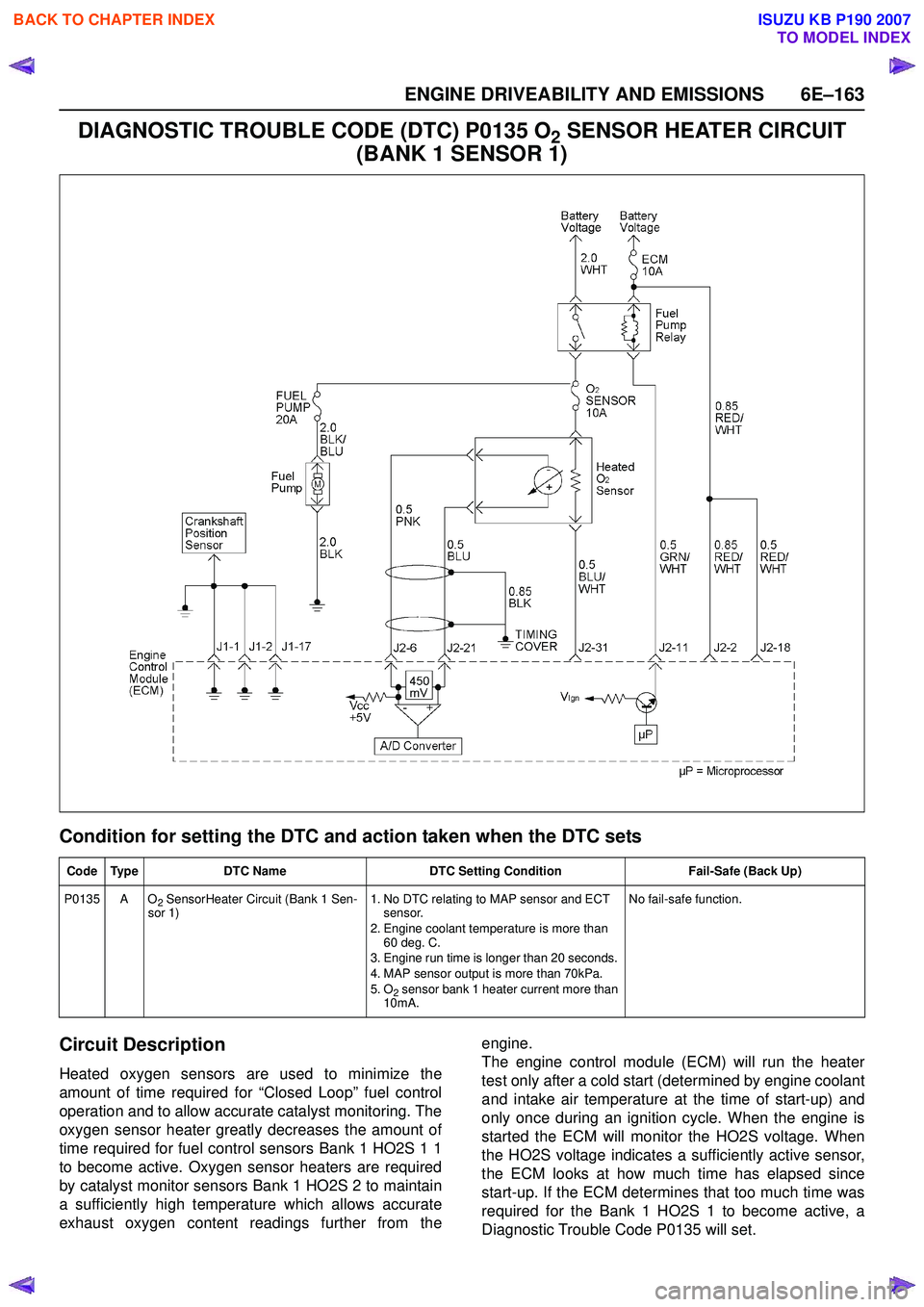
DIAGNOSTIC TROUBLE CODE (DTC) P0135 O2 SENSOR HEATER CIRCUIT
(BANK 1 SENSOR 1)
Condition for setting the DTC and action taken when the DTC sets
Circuit Description
Heated oxygen sensors are used to minimize the
amount of time required for “Closed Loop” fuel control
operation and to allow accurate catalyst monitoring. The
oxygen sensor heater greatly decreases the amount of
time required for fuel control sensors Bank 1 HO2S 1 1
to become active. Oxygen sensor heaters are required
by catalyst monitor sensors Bank 1 HO2S 2 to maintain
a sufficiently high temperature which allows accurate
exhaust oxygen content readings further from the engine.
The engine control module (ECM) will run the heater
test only after a cold start (determined by engine coolant
and intake air temperature at the time of start-up) and
only once during an ignition cycle. When the engine is
started the ECM will monitor the HO2S voltage. When
the HO2S voltage indicates a sufficiently active sensor,
the ECM looks at how much time has elapsed since
start-up. If the ECM determines that too much time was
required for the Bank 1 HO2S 1 to become active, a
Diagnostic Trouble Code P0135 will set.
Code Type DTC Name DTC Setting Condition Fail-Safe (Back Up)
P0135 A O
2 SensorHeater Circuit (Bank 1 Sen-
sor 1) 1. No DTC relating to MAP sensor and ECT
sensor.
2. Engine coolant temperature is more than 60 deg. C.
3. Engine run time is longer than 20 seconds.
4. MAP sensor output is more than 70kPa.
5. O
2 sensor bank 1 heater current more than
10mA. No fail-safe function.
BACK TO CHAPTER INDEX
TO MODEL INDEX
ISUZU KB P190 2007
Page 2381 of 6020

ENGINE DRIVEABILITY AND EMISSIONS 6E–211
DIAGNOSTIC TROUBLE CODE (DTC) P1167 FUEL SUPPLY SYSTEM RICH DURING DECELERATION FUEL CUT OFF
Condition for setting the DTC and action taken when the DTC sets
Circuit Description
The engine control module (ECM) internal circuitry can
identify if the vehicle fuel system is capable of supplying
adequate amounts of fuel during deceleration (fuel cut
off). The ECM monitors the voltage of the oxygen
sensor during fuel cut off. When a fuel cut off mode of
operation is requested during “Closed Loop” operation
(by deceleration), the ECM will provide more fuel to the
engine. Under these conditions the ECM should detect
a “lean” condition (low oxygen sensor voltage). If this “lean” exhaust is not detected at this time, a Diagnostic
Trouble Code P1167 will set.
Diagnostic Aids
Check the following items:
• Fuel pressure - The system will go rich if pressure is too high. The ECM can compensate for some
increase. However, if fuel pressure is too high, a
Diagnostic Trouble Code P1167 may be set. Refer to
Fuel System Diagnosis .
Code Type DTC Name DTC Setting Condition Fail-Safe (Back Up)
P1167 D Fuel Supply System Rich During Deceleration Fuel Cutoff 1. No DTC relating to MAP sensor, TPS,
EVAP purge, ECT sensor, CKP sensor,
VSS, injector control circuit and ignition
control circuit.
2. O
2 sensor bank 1 output voltage is more
than 550mV in deceleration fuel cutoff
mode. No fail-safe function.
BACK TO CHAPTER INDEX
TO MODEL INDEX
ISUZU KB P190 2007
Page 2384 of 6020

6E–214 ENGINE DRIVEABILITY AND EMISSIONS
DIAGNOSTIC TROUBLE CODE (DTC) P1171 FUEL SUPPLY SYSTEM LEAN DURING POWER ENRICHMENT
Condition for setting the DTC and action taken when the DTC sets
Circuit Description
The engine control module (ECM) internal circuitry can
identify if the vehicle fuel system is capable of supplying
adequate amounts of fuel during heavy acceleration
(power enrichment). The ECM monitors the voltage of
the oxygen sensor during power enrichment. When a
power enrichment mode of operation is requested
during “Closed Loop” operation (by heavy acceleration), the ECM will provide more fuel to the engine. Under
these conditions the ECM should detect a “rich”
condition (high oxygen sensor voltage). If this “rich”
exhaust is not detected at this time, a Diagnostic
Trouble Code P1171 will set. A plugged fuel filter or
restricted fuel line can prevent adequate amounts of fuel
from being supplied during power enrichment mode.
Code Type DTC Name DTC Setting Condition Fail-Safe (Back Up)
P1171 D Fuel Supply System Lean During Power Enrichment 1. No DTC relating to MAP sensor, TPS,
EVAP purge, ECT sensor, CKP sensor,
VSS, injector control circuit and ignition
control circuit.
2. Engine coolant temperature is more than 60 deg. C.
3. Mass air flow is below 13.5m/s.
4. O
2 sensor bank 1 output voltage is below
350mV in power enrichment mode. No fail-safe function.
BACK TO CHAPTER INDEX
TO MODEL INDEX
ISUZU KB P190 2007
Page 2428 of 6020
6E–258 ENGINE DRIVEABILITY AND EMISSIONS
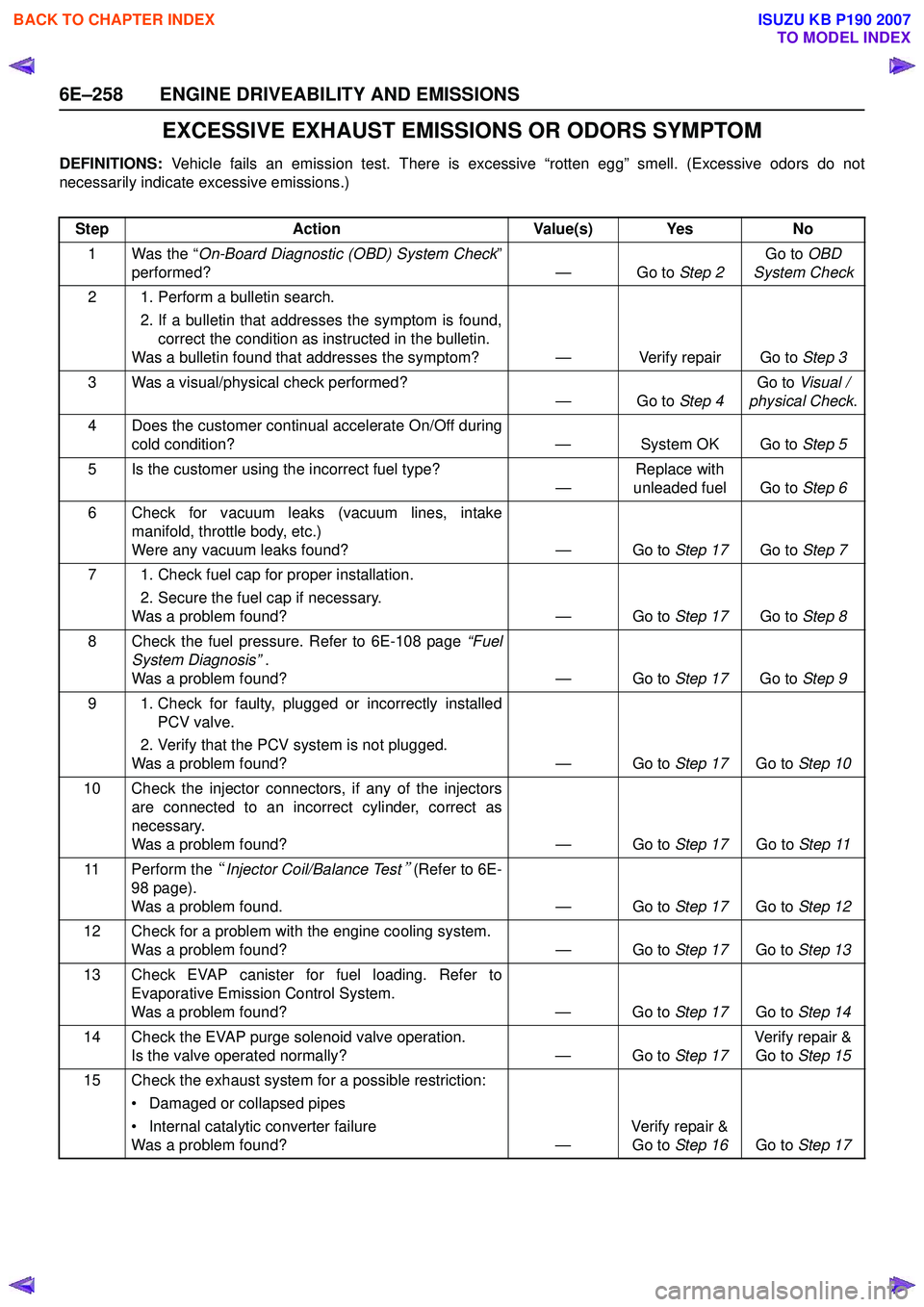
EXCESSIVE EXHAUST EMISSIONS OR ODORS SYMPTOM
DEFINITIONS: Vehicle fails an emission test. There is excessive “rotten egg” smell. (Excessive odors do not
necessarily indicate excessive emissions.)
Step Action Value(s) Yes No
1 Was the “ On-Board Diagnostic (OBD) System Check ”
performed? — Go to Step 2Go to
OBD
System Check
2 1. Perform a bulletin search. 2. If a bulletin that addresses the symptom is found,correct the condition as instructed in the bulletin.
Was a bulletin found that addresses the symptom? — Verify repair Go to Step 3
3 Was a visual/physical check performed? —Go to Step 4Go to
Visual /
physical Check .
4 Does the customer continual accelerate On/Off during cold condition? — System OK Go to Step 5
5 Is the customer using the incorrect fuel type? —Replace with
unleaded fuel Go to Step 6
6 Check for vacuum leaks (vacuum lines, intake manifold, throttle body, etc.)
Were any vacuum leaks found? — Go to Step 17Go to Step 7
7 1. Check fuel cap for proper installation. 2. Secure the fuel cap if necessary.
Was a problem found? — Go to Step 17Go to Step 8
8 Check the fuel pressure. Refer to 6E-108 page “Fuel
System Diagnosis” .
Was a problem found? — Go to Step 17Go to Step 9
9 1. Check for faulty, plugged or incorrectly installed PCV valve.
2. Verify that the PCV system is not plugged.
Was a problem found? — Go to Step 17Go to Step 10
10 Check the injector connectors, if any of the injectors are connected to an incorrect cylinder, correct as
necessary.
Was a problem found? — Go to Step 17Go to Step 11
11 Perform the “Injector Coil/Balance Test
” (Refer to 6E-
98 page).
Was a problem found. — Go to Step 17Go to Step 12
12 Check for a problem with the engine cooling system. Was a problem found? — Go to Step 17Go to Step 13
13 Check EVAP canister for fuel loading. Refer to Evaporative Emission Control System.
Was a problem found? — Go to Step 17Go to Step 14
14 Check the EVAP purge solenoid valve operation. Is the valve operated normally? — Go to Step 17Verify repair &
Go to Step 15
15 Check the exhaust system for a possible restriction: • Damaged or collapsed pipes
• Internal catalytic converter failure
Was a problem found? —Verify repair &
Go to Step 16 Go to Step 17
BACK TO CHAPTER INDEX
TO MODEL INDEX
ISUZU KB P190 2007