charging ISUZU KB P190 2007 Workshop User Guide
[x] Cancel search | Manufacturer: ISUZU, Model Year: 2007, Model line: KB P190, Model: ISUZU KB P190 2007Pages: 6020, PDF Size: 70.23 MB
Page 125 of 6020
HEATER AND AIR CONDITIONING 1-91
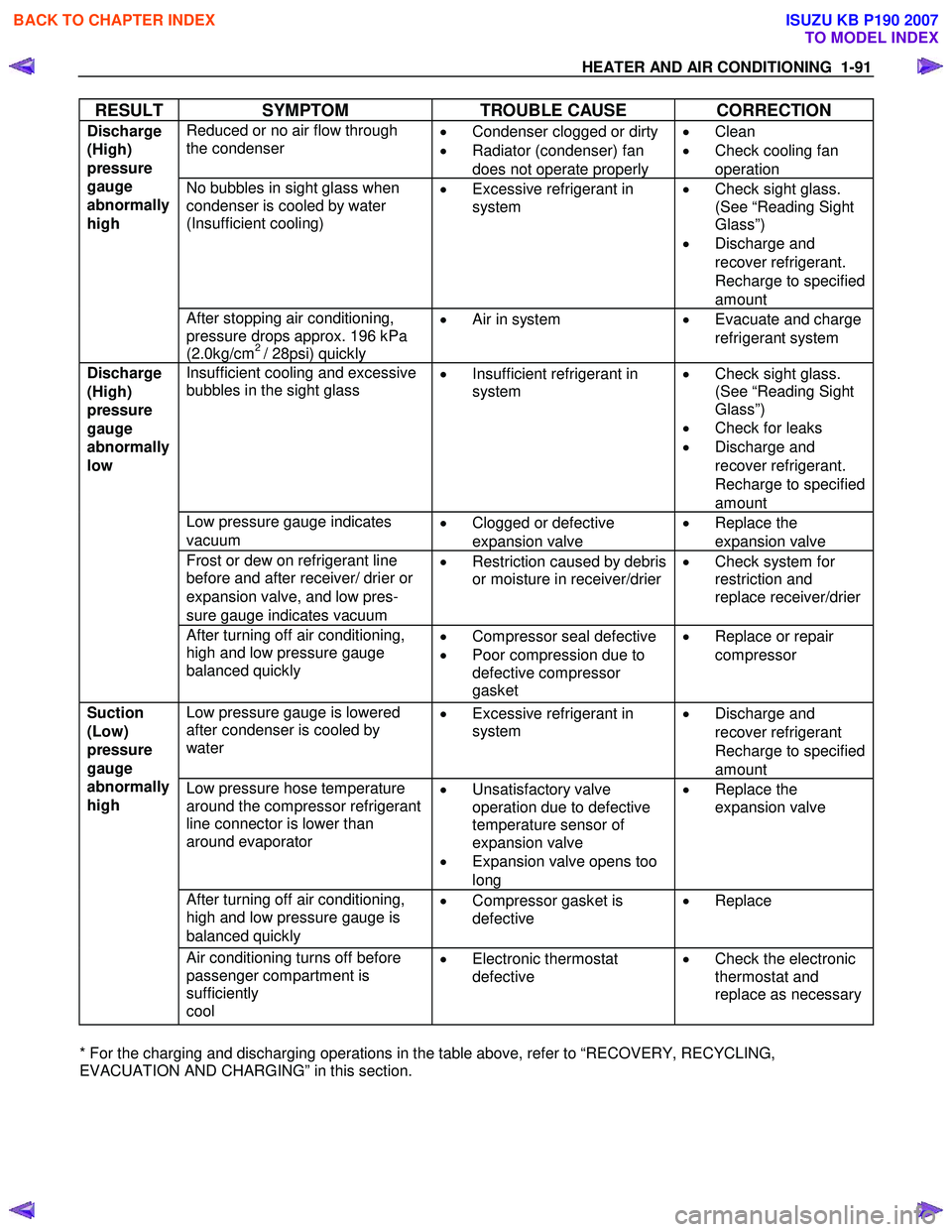
RESULT SYMPTOM TROUBLE CAUSE CORRECTION
Reduced or no air flow through
the condenser
•
Condenser clogged or dirty
• Radiator (condenser) fan
does not operate properly •
Clean
• Check cooling fan
operation
No bubbles in sight glass when
condenser is cooled by water
(Insufficient cooling)
•
Excessive refrigerant in
system
•
Check sight glass.
(See “Reading Sight
Glass”)
• Discharge and
recover refrigerant.
Recharge to specified
amount
Discharge
(High)
pressure
gauge
abnormally
high
After stopping air conditioning,
pressure drops approx. 196 kPa
(2.0kg/cm
2 / 28psi) quickly •
Air in system
•
Evacuate and charge
refrigerant system
Insufficient cooling and excessive
bubbles in the sight glass
•
Insufficient refrigerant in
system
•
Check sight glass.
(See “Reading Sight
Glass”)
• Check for leaks
• Discharge and
recover refrigerant.
Recharge to specified
amount
Low pressure gauge indicates
vacuum •
Clogged or defective
expansion valve •
Replace the
expansion valve
Frost or dew on refrigerant line
before and after receiver/ drier or
expansion valve, and low pres-
sure gauge indicates vacuum •
Restriction caused by debris
or moisture in receiver/drier
•
Check system for
restriction and
replace receiver/drier
Discharge
(High)
pressure
gauge
abnormally
low
After turning off air conditioning,
high and low pressure gauge
balanced quickly
•
Compressor seal defective
• Poor compression due to
defective compressor
gasket •
Replace or repair
compressor
Low pressure gauge is lowered
after condenser is cooled by
water
•
Excessive refrigerant in
system
•
Discharge and
recover refrigerant
Recharge to specified
amount
Low pressure hose temperature
around the compressor refrigerant
line connector is lower than
around evaporator
•
Unsatisfactory valve
operation due to defective
temperature sensor of
expansion valve
• Expansion valve opens too
long •
Replace the
expansion valve
After turning off air conditioning,
high and low pressure gauge is
balanced quickly •
Compressor gasket is
defective
•
Replace
Suction
(Low)
pressure
gauge
abnormally
high
Air conditioning turns off before
passenger compartment is
sufficiently
cool •
Electronic thermostat
defective
•
Check the electronic
thermostat and
replace as necessary
* For the charging and discharging operations in the table above, refer to “RECOVERY, RECYCLING,
EVACUATION AND CHARGING” in this section.
BACK TO CHAPTER INDEX
TO MODEL INDEX
ISUZU KB P190 2007
Page 786 of 6020
TROUBLESHOOTING 6 – 1
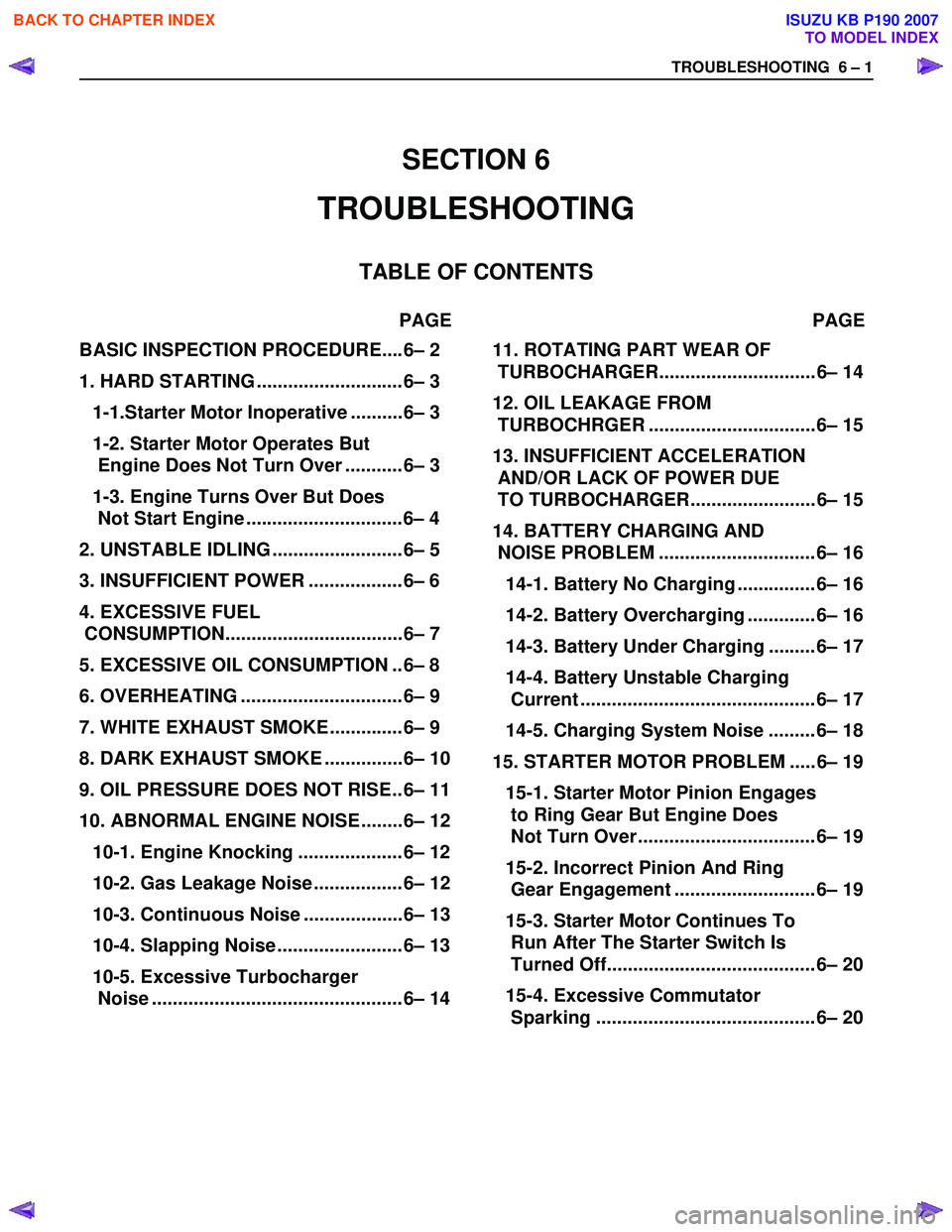
BASIC INSPECTION PROCEDURE....6– 2
1. HARD STARTING ............................6– 3
1-1.Starter Motor Inoperative ..........6– 3
1-2. Starter Motor Operates But
Engine Does Not Turn Over ...........6– 3
1-3. Engine Turns Over But Does
Not Start Engine ..............................6– 4
2. UNSTABLE IDLING .........................6– 5
3. INSUFFICIENT POWER ..................6– 6
4. EXCESSIVE FUEL
CONSUMPTION..................................6– 7
5. EXCESSIVE OIL CONSUMPTION ..6– 8
6. OVERHEATING ...............................6– 9
7. WHITE EXHAUST SMOKE..............6– 9
8. DARK EXHAUST SMOKE ...............6– 10
9. OIL PRESSURE DOES NOT RISE..6– 11
10. ABNORMAL ENGINE NOISE ........6– 12
10-1. Engine Knocking ....................6– 12
10-2. Gas Leakage Noise .................6– 12
10-3. Continuous Noise ...................6– 13
10-4. Slapping Noise ........................6– 13
10-5. Excessive Turbocharger
Noise ................................................6– 14
11. ROTATING PART WEAR OF
TURBOCHARGER.............................. 6– 14
12. OIL LEAKAGE FROM
TURBOCHRGER ................................ 6– 15
13. INSUFFICIENT ACCELERATION
AND/OR LACK OF POWER DUE
TO TURBOCHARGER........................ 6– 15
14. BATTERY CHARGING AND
NOISE PROBLEM .............................. 6– 16
14-1. Battery No Charging ............... 6– 16
14-2. Battery Overcharging ............. 6– 16
14-3. Battery Under Charging ......... 6– 17
14-4. Battery Unstable Charging
Current ............................................. 6– 17
14-5. Charging System Noise ......... 6– 18
15. STARTER MOTOR PROBLEM ..... 6– 19
15-1. Starter Motor Pinion Engages
to Ring Gear But Engine Does
Not Turn Over .................................. 6– 19
15-2. Incorrect Pinion And Ring
Gear Engagement ........................... 6– 19
15-3. Starter Motor Continues To
Run After The Starter Switch Is
Turned Off........................................ 6– 20
15-4. Excessive Commutator
Sparking .......................................... 6– 20
SECTION 6
TROUBLESHOOTING
TABLE OF CONTENTS
PAGE PAGE
BACK TO CHAPTER INDEX
TO MODEL INDEX
ISUZU KB P190 2007
Page 801 of 6020

6 – 16 TROUBLESHOOTING
14. Battery Charging and Noise Problem
Visual/physical check the following items before diagnosis.
The drive belt tension.
The battery terminals connection condition.
The ground connection condition.
The generator and the battery fastener condition.
The battery fluid level and specific gravity.
14-1 Battery No Charging
Step Action Value(s) Yes No
1 Was “Visual/Physical Check" performed.
—
Go to Step 2 Go to
visual/physical check
2 Inspect the brush contact condition on the generator.
Was there poor contact between the brush and the
slip ring? —
Repair or
replace the
brush and/or the slip ring. Go to Step 3
3 Inspect the stator coil on the generator.
Was there an open circuit or the scorching on the
stator coil? —
Replace the stator coil. Go to Step 4
4 Inspect the rotor coil on the generator.
Was there an open circuit or the scorching on the
rotor coil? —
Replace the rotor coil. Go to Step 5
5 Inspect the rectifier on the generator.
Was the rectifier defective? —
Replace the
rectifier Go to Step 6
6 Inspect the IC regulator.
Was the IC regulator defective? —
Replace the IC
regulator. Go to Step 7
7 Are any DTC stored? — Go to indicated
DTC. Solved
14-2 Battery Overcharging
Step Action Value(s) Yes No
1 Was “Visual/Physical Check" performed.
—
Go to Step 2 Go to
visual/physical check
2 Inspect the terminal circuit.
Were the B and F terminals shorted? —
Repair the
short circuit. Go to Step 3
3 Check the regulating voltage.
Was the IC regulator voltage excessive? —
Replace the IC
regulator. Go to Step 4
4 Are any DTC stored? — Go to indicated
DTC. Solved
BACK TO CHAPTER INDEX
TO MODEL INDEX
ISUZU KB P190 2007
Page 802 of 6020
TROUBLESHOOTING 6 – 17
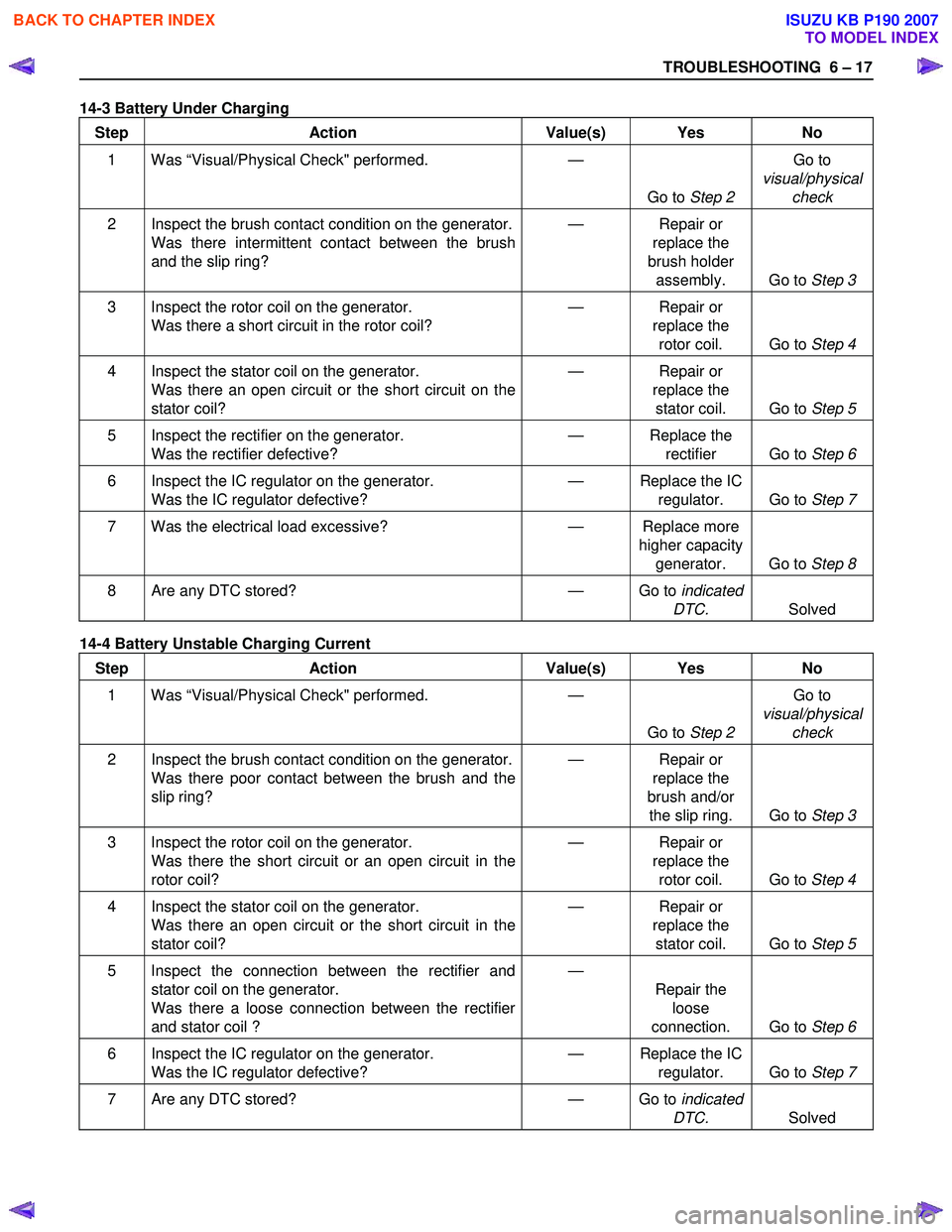
14-3 Battery Under Charging
Step Action Value(s) Yes No
1 Was “Visual/Physical Check" performed.
—
Go to Step 2 Go to
visual/physical check
2 Inspect the brush contact condition on the generator.
Was there intermittent contact between the brush
and the slip ring? —
Repair or
replace the
brush holder assembly. Go to Step 3
3 Inspect the rotor coil on the generator.
Was there a short circuit in the rotor coil? —
Repair or
replace the rotor coil. Go to Step 4
4 Inspect the stator coil on the generator.
Was there an open circuit or the short circuit on the
stator coil? —
Repair or
replace the stator coil. Go to Step 5
5 Inspect the rectifier on the generator.
Was the rectifier defective? —
Replace the
rectifier Go to Step 6
6 Inspect the IC regulator on the generator.
Was the IC regulator defective? —
Replace the IC
regulator. Go to Step 7
7 Was the electrical load excessive? — Replace more
higher capacity generator. Go to Step 8
8 Are any DTC stored? — Go to indicated
DTC. Solved
14-4 Battery Unstable Charging Current
Step Action Value(s) Yes No
1 Was “Visual/Physical Check" performed.
—
Go to Step 2 Go to
visual/physical check
2 Inspect the brush contact condition on the generator.
Was there poor contact between the brush and the
slip ring? —
Repair or
replace the
brush and/or the slip ring. Go to Step 3
3 Inspect the rotor coil on the generator.
Was there the short circuit or an open circuit in the
rotor coil? —
Repair or
replace the rotor coil. Go to Step 4
4 Inspect the stator coil on the generator.
Was there an open circuit or the short circuit in the
stator coil? —
Repair or
replace the stator coil. Go to Step 5
5 Inspect the connection between the rectifier and
stator coil on the generator.
Was there a loose connection between the rectifier
and stator coil ? —
Repair the loose
connection. Go to Step 6
6 Inspect the IC regulator on the generator.
Was the IC regulator defective? —
Replace the IC
regulator. Go to Step 7
7 Are any DTC stored? — Go to indicated
DTC. Solved
BACK TO CHAPTER INDEX
TO MODEL INDEX
ISUZU KB P190 2007
Page 803 of 6020
6 – 18 TROUBLESHOOTING
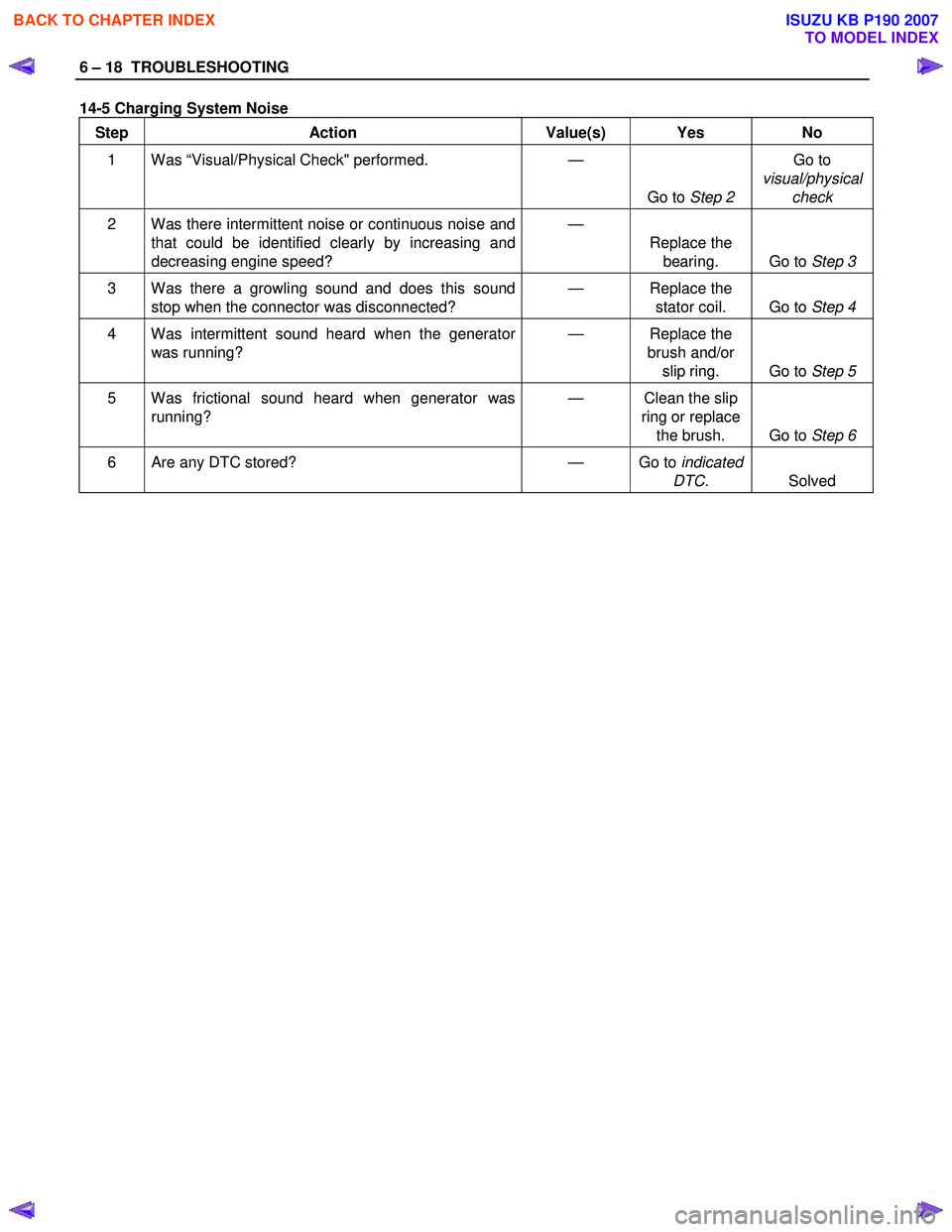
14-5 Charging System Noise Step Action Value(s) Yes No
1 Was “Visual/Physical Check" performed.
—
Go to Step 2 Go to
visual/physical check
2 Was there intermittent noise or continuous noise and
that could be identified clearly by increasing and
decreasing engine speed? —
Replace the bearing. Go to Step 3
3 Was there a growling sound and does this sound
stop when the connector was disconnected? —
Replace the
stator coil. Go to Step 4
4 Was intermittent sound heard when the generator
was running? —
Replace the
brush and/or slip ring. Go to Step 5
5 Was frictional sound heard when generator was
running? —
Clean the slip
ring or replace the brush. Go to Step 6
6 Are any DTC stored? — Go to indicated
DTC. Solved
BACK TO CHAPTER INDEX
TO MODEL INDEX
ISUZU KB P190 2007
Page 1004 of 6020
ENGINE ELECTRICAL 6D – 3
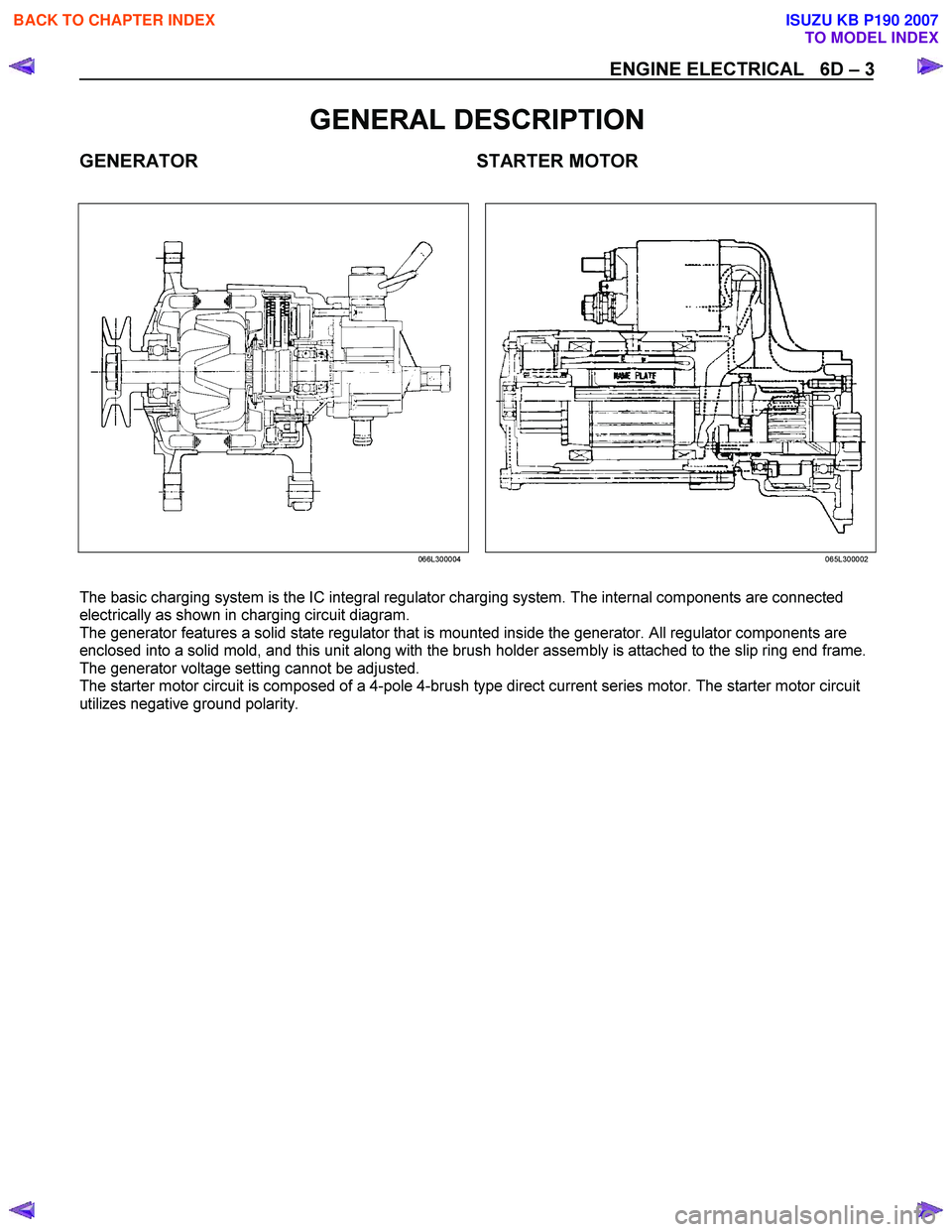
GENERAL DESCRIPTION
GENERATOR STARTER MOTOR
066L300004 065L300002
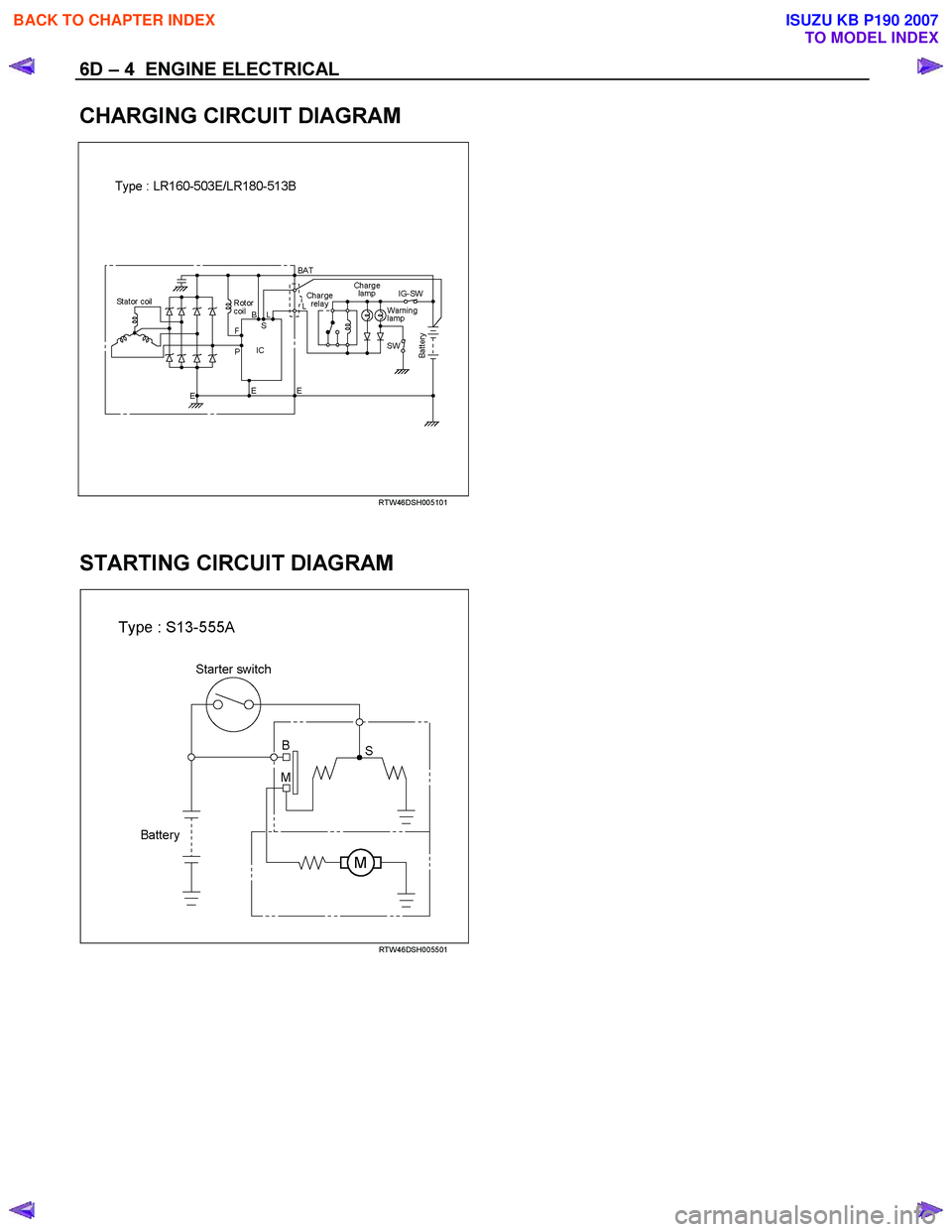
The basic charging system is the IC integral regulator charging system. The internal components are connected
electrically as shown in charging circuit diagram.
The generator features a solid state regulator that is mounted inside the generator. All regulator components are
enclosed into a solid mold, and this unit along with the brush holder assembly is attached to the slip ring end frame.
The generator voltage setting cannot be adjusted.
The starter motor circuit is composed of a 4-pole 4-brush type direct current series motor. The starter motor circuit
utilizes negative ground polarity.
BACK TO CHAPTER INDEX
TO MODEL INDEX
ISUZU KB P190 2007
Page 1005 of 6020
6D – 4 ENGINE ELECTRICAL
CHARGING CIRCUIT DIAGRAM
RTW46DSH005101
STARTING CIRCUIT DIAGRAM
RTW46DSH005501
BACK TO CHAPTER INDEX
TO MODEL INDEX
ISUZU KB P190 2007
Page 1044 of 6020
6E-10 Engine Control System (4JH1)
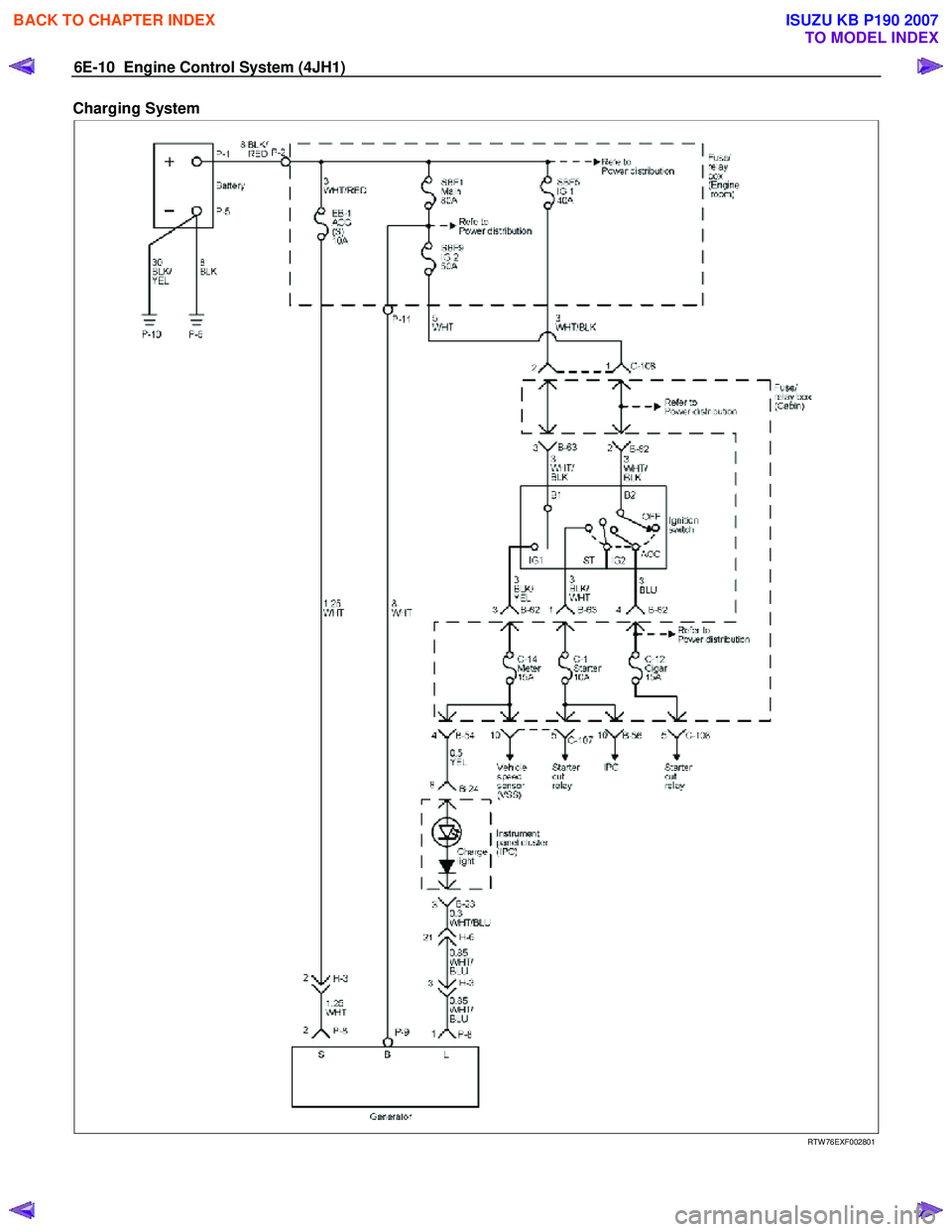
Charging System
RTW 76EXF002801
BACK TO CHAPTER INDEX
TO MODEL INDEX
ISUZU KB P190 2007
Page 1092 of 6020
6E-58 Engine Control System (4JH1)
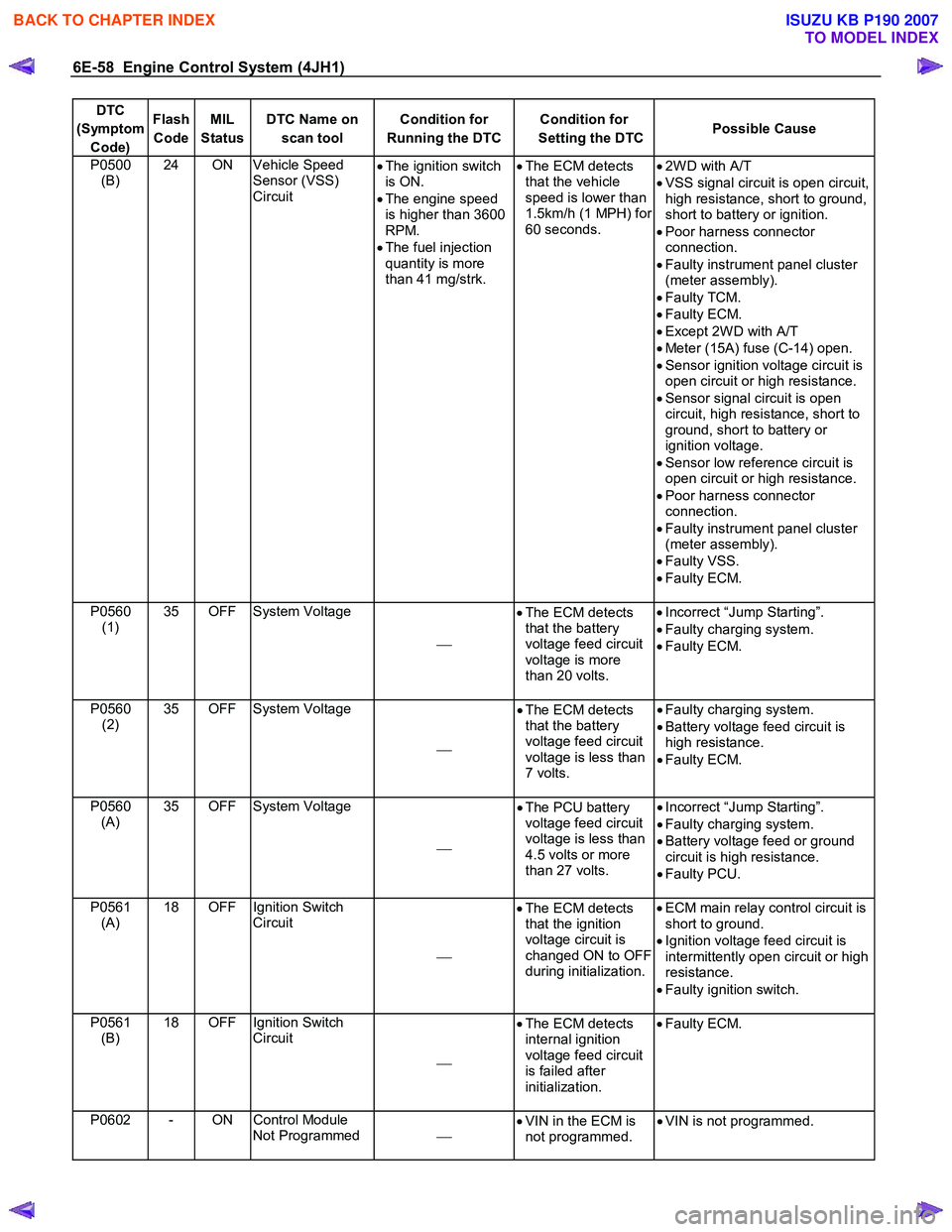
DTC
(Symptom Code) Flash
Code MIL
Status DTC Name on
scan tool Condition for
Running the DTC Condition for
Setting the DTC Possible Cause
P0500
(B) 24 ON Vehicle Speed
Sensor (VSS)
Circuit
•
The ignition switch
is ON.
• The engine speed
is higher than 3600
RPM.
• The fuel injection
quantity is more
than 41 mg/strk.
•
The ECM detects
that the vehicle
speed is lower than
1.5km/h (1 MPH) for
60 seconds.
•
2W D with A/T
• VSS signal circuit is open circuit,
high resistance, short to ground,
short to battery or ignition.
• Poor harness connector
connection.
• Faulty instrument panel cluster
(meter assembly).
• Faulty TCM.
• Faulty ECM.
• Except 2W D with A/T
• Meter (15A) fuse (C-14) open.
• Sensor ignition voltage circuit is
open circuit or high resistance.
• Sensor signal circuit is open
circuit, high resistance, short to
ground, short to battery or
ignition voltage.
• Sensor low reference circuit is
open circuit or high resistance.
• Poor harness connector
connection.
• Faulty instrument panel cluster
(meter assembly).
• Faulty VSS.
• Faulty ECM.
P0560 (1) 35 OFF System Voltage
•
The ECM detects
that the battery
voltage feed circuit
voltage is more
than 20 volts.
•
Incorrect “Jump Starting”.
• Faulty charging system.
• Faulty ECM.
P0560 (2) 35 OFF System Voltage
•
The ECM detects
that the battery
voltage feed circuit
voltage is less than
7 volts.
•
Faulty charging system.
• Battery voltage feed circuit is
high resistance.
• Faulty ECM.
P0560 (A) 35 OFF System Voltage
•
The PCU battery
voltage feed circuit
voltage is less than
4.5 volts or more
than 27 volts.
•
Incorrect “Jump Starting”.
• Faulty charging system.
• Battery voltage feed or ground
circuit is high resistance.
• Faulty PCU.
P0561 (A) 18 OFF Ignition Switch
Circuit
•
The ECM detects
that the ignition
voltage circuit is
changed ON to OFF
during initialization.
•
ECM main relay control circuit is
short to ground.
• Ignition voltage feed circuit is
intermittently open circuit or high
resistance.
• Faulty ignition switch.
P0561 (B) 18 OFF Ignition Switch
Circuit
•
The ECM detects
internal ignition
voltage feed circuit
is failed after
initialization.
•
Faulty ECM.
P0602 - ON Control Module
Not Programmed
•
VIN in the ECM is
not programmed. •
VIN is not programmed.
BACK TO CHAPTER INDEX
TO MODEL INDEX
ISUZU KB P190 2007
Page 1200 of 6020

6E-166 Engine Control System (4JH1)
DTC P0560 (Symptom Code 1) (Flash Code 35)
Circuit Description
The engine control module (ECM) monitors the system
voltage on the ECM main relay load supply voltage
terminal to make sure that the voltage stays within the
proper range. If the ECM detects an excessively high
system voltage, this DTC will set.
Condition for Setting the DTC
• The ECM detects that the battery voltage feed
circuit voltage is more than 20 volts.
Action Taken When the DTC Sets
• The ECM does not illuminate the malfunction
indicator lamp (MIL) when the diagnostic runs and
fails.
Condition for Clearing the DTC • A history DTC clears after 40 consecutive driving
cycles without a fault. Or clear with the scan tool.
Diagnostic Aids
• A charging system problem may set this DTC.
• Jump starting the vehicle or a battery charger may
have set this DTC.
DTC P0560 (Symptom Code 1) (Flash Code 35)
Schematic Reference: Engine Controls Schematics &
Starting and Charging Schematics
Step Action Value(s) Yes No
1 Did you perform the Diagnostic System Check-
Engine Controls?
Go to Step 2 Go to Diagnostic
System Check-
Engine Controls
2 1. Install the scan tool. 2. Turn OFF the ignition for 30 seconds.
3. Start the engine.
4. Monitor the Diagnostic Trouble Code (DTC) Information with the scan tool.
Does the DTC fail this ignition?
Go to Step 3 Go to Diagnostic
Aids
3 W as the vehicle recently jump started from 24 volts system?
Go to Step 8 Go to Step 4
4 1. Start the engine and let idle for 30 seconds.
2. Observe the System Voltage parameter with the scan tool.
Is the System Voltage parameter less than the
specified value? 16 volts
Go to Diagnostic Aids Go to Step 5
5 Test the charging system. Refer to Diagnosis of The Charging System in the Charging System Section.
Did you find a charging system problem?
Go to Step 6 Go to Step 7
6 Repair the charging system. Refer to Diagnosis of The Charging System in the Charging System
Section.
Did you complete the repair?
Go to Step 8
7 Important: Replacement ECM must be
programmed.
Replace the ECM. Refer to Engine Control Module
(ECM) Replacement in this section.
Did you complete the replacement?
Go to Step 8
8 1. Reconnect all previously disconnected harness
connector(s).
2. Clear the DTCs with the scan tool.
3. Turn OFF the ignition for 30 seconds.
4. Start the engine.
5. Observe the System Voltage parameter with the scan tool.
Is the System Voltage parameter less than the
specified value? 16 volts
Go to Step 9 Go to Step 5
9 Observe the DTC Information with the scan tool. Are there any DTCs that you have not diagnosed? Go to Diagnostic
Trouble Code (DTC) List System OK
BACK TO CHAPTER INDEX
TO MODEL INDEX
ISUZU KB P190 2007