fuel type ISUZU KB P190 2007 Workshop Workshop Manual
[x] Cancel search | Manufacturer: ISUZU, Model Year: 2007, Model line: KB P190, Model: ISUZU KB P190 2007Pages: 6020, PDF Size: 70.23 MB
Page 1715 of 6020
6E-98 ENGINE CONTROL SYSTEM (4JK1/4JJ1)
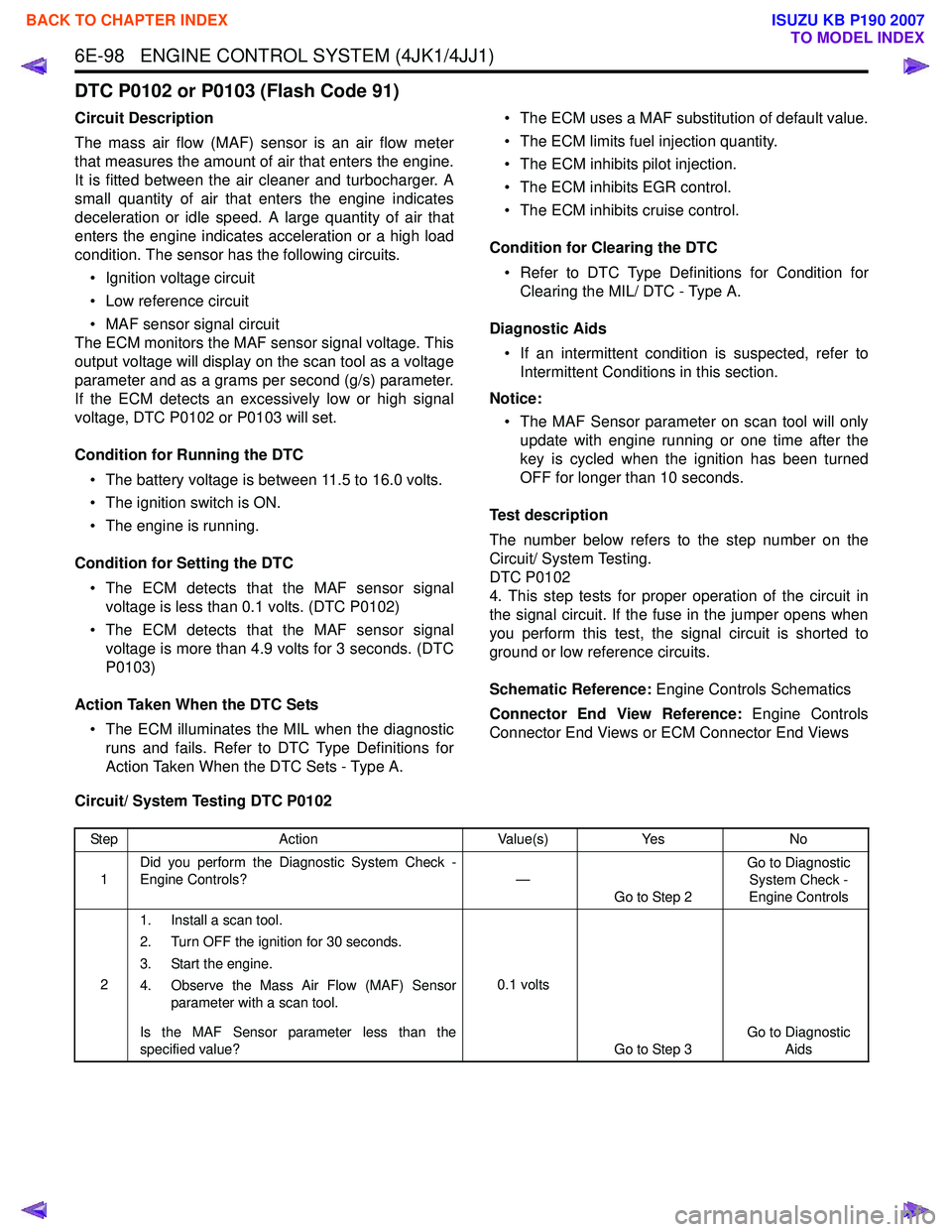
DTC P0102 or P0103 (Flash Code 91)
Circuit Description
The mass air flow (MAF) sensor is an air flow meter
that measures the amount of air that enters the engine.
It is fitted between the air cleaner and turbocharger. A
small quantity of air that enters the engine indicates
deceleration or idle speed. A large quantity of air that
enters the engine indicates acceleration or a high load
condition. The sensor has the following circuits.
• Ignition voltage circuit
• Low reference circuit
• MAF sensor signal circuit
The ECM monitors the MAF sensor signal voltage. This
output voltage will display on the scan tool as a voltage
parameter and as a grams per second (g/s) parameter.
If the ECM detects an excessively low or high signal
voltage, DTC P0102 or P0103 will set.
Condition for Running the DTC • The battery voltage is between 11.5 to 16.0 volts.
• The ignition switch is ON.
• The engine is running.
Condition for Setting the DTC • The ECM detects that the MAF sensor signal voltage is less than 0.1 volts. (DTC P0102)
• The ECM detects that the MAF sensor signal voltage is more than 4.9 volts for 3 seconds. (DTC
P0103)
Action Taken When the DTC Sets • The ECM illuminates the MIL when the diagnostic runs and fails. Refer to DTC Type Definitions for
Action Taken When the DTC Sets - Type A. • The ECM uses a MAF substitution of default value.
• The ECM limits fuel injection quantity.
• The ECM inhibits pilot injection.
• The ECM inhibits EGR control.
• The ECM inhibits cruise control.
Condition for Clearing the DTC • Refer to DTC Type Definitions for Condition for Clearing the MIL/ DTC - Type A.
Diagnostic Aids • If an intermittent condition is suspected, refer to Intermittent Conditions in this section.
Notice: • The MAF Sensor parameter on scan tool will only update with engine running or one time after the
key is cycled when the ignition has been turned
OFF for longer than 10 seconds.
Test description
The number below refers to the step number on the
Circuit/ System Testing.
DTC P0102
4. This step tests for proper operation of the circuit in
the signal circuit. If the fuse in the jumper opens when
you perform this test, the signal circuit is shorted to
ground or low reference circuits.
Schematic Reference: Engine Controls Schematics
Connector End View Reference: Engine Controls
Connector End Views or ECM Connector End Views
Circuit/ System Testing DTC P0102
Step Action Value(s)Yes No
1 Did you perform the Diagnostic System Check -
Engine Controls? —
Go to Step 2 Go to Diagnostic
System Check -
Engine Controls
2 1. Install a scan tool.
2. Turn OFF the ignition for 30 seconds.
3. Start the engine.
4. Observe the Mass Air Flow (MAF) Sensor parameter with a scan tool.
Is the MAF Sensor parameter less than the
specified value? 0.1 volts
Go to Step 3 Go to Diagnostic
Aids
BACK TO CHAPTER INDEX
TO MODEL INDEX
ISUZU KB P190 2007
Page 1719 of 6020
6E-102 ENGINE CONTROL SYSTEM (4JK1/4JJ1)
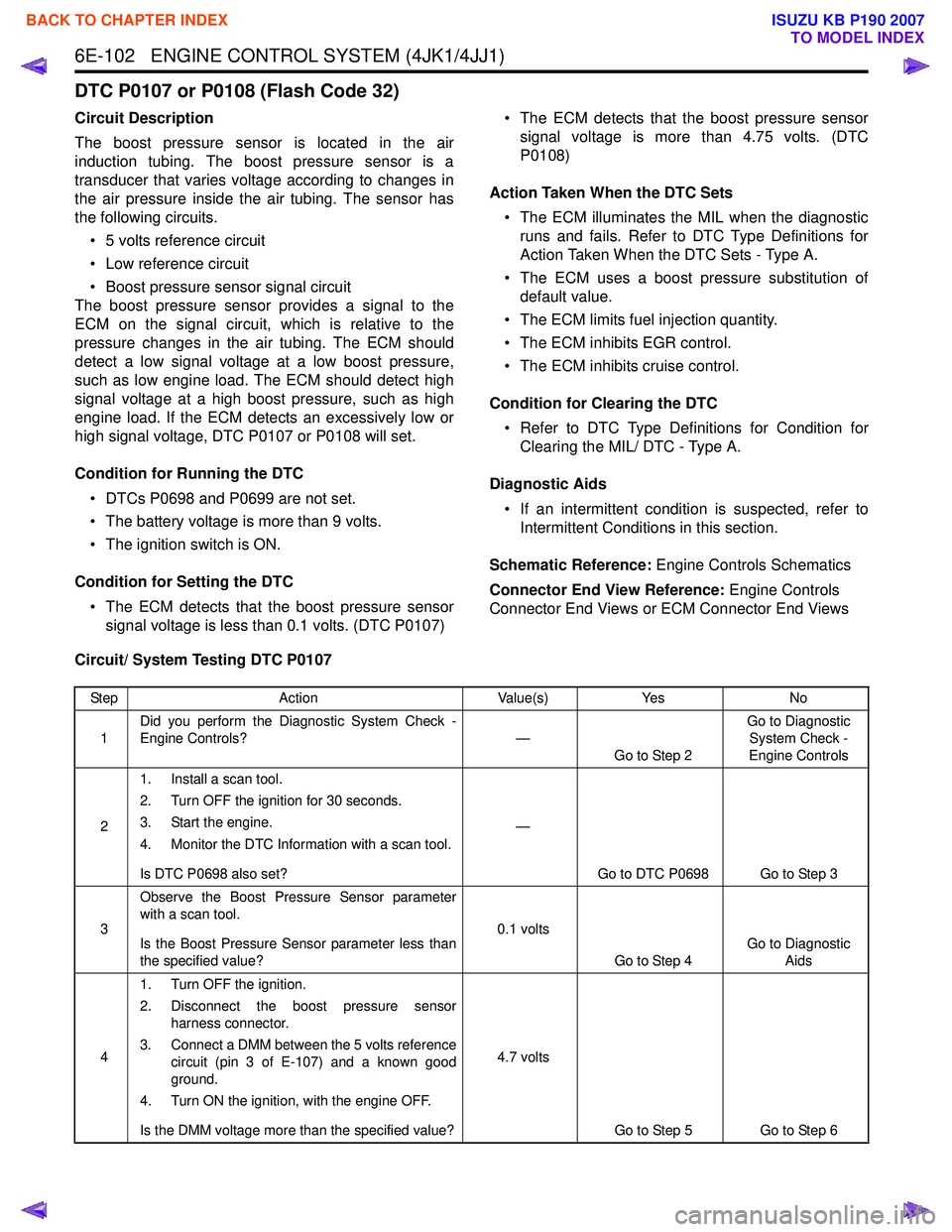
DTC P0107 or P0108 (Flash Code 32)
Circuit Description
The boost pressure sensor is located in the air
induction tubing. The boost pressure sensor is a
transducer that varies voltage according to changes in
the air pressure inside the air tubing. The sensor has
the following circuits.
• 5 volts reference circuit
• Low reference circuit
• Boost pressure sensor signal circuit
The boost pressure sensor provides a signal to the
ECM on the signal circuit, which is relative to the
pressure changes in the air tubing. The ECM should
detect a low signal voltage at a low boost pressure,
such as low engine load. The ECM should detect high
signal voltage at a high boost pressure, such as high
engine load. If the ECM detects an excessively low or
high signal voltage, DTC P0107 or P0108 will set.
Condition for Running the DTC • DTCs P0698 and P0699 are not set.
• The battery voltage is more than 9 volts.
• The ignition switch is ON.
Condition for Setting the DTC • The ECM detects that the boost pressure sensor signal voltage is less than 0.1 volts. (DTC P0107) • The ECM detects that the boost pressure sensor
signal voltage is more than 4.75 volts. (DTC
P0108)
Action Taken When the DTC Sets • The ECM illuminates the MIL when the diagnostic runs and fails. Refer to DTC Type Definitions for
Action Taken When the DTC Sets - Type A.
• The ECM uses a boost pressure substitution of default value.
• The ECM limits fuel injection quantity.
• The ECM inhibits EGR control.
• The ECM inhibits cruise control.
Condition for Clearing the DTC • Refer to DTC Type Definitions for Condition for Clearing the MIL/ DTC - Type A.
Diagnostic Aids • If an intermittent condition is suspected, refer to Intermittent Conditions in this section.
Schematic Reference: Engine Controls Schematics
Connector End View Reference: Engine Controls
Connector End Views or ECM Connector End Views
Circuit/ System Testing DTC P0107
Step Action Value(s)Yes No
1 Did you perform the Diagnostic System Check -
Engine Controls? —
Go to Step 2 Go to Diagnostic
System Check -
Engine Controls
2 1. Install a scan tool.
2. Turn OFF the ignition for 30 seconds.
3. Start the engine.
4. Monitor the DTC Information with a scan tool.
Is DTC P0698 also set? —
Go to DTC P0698 Go to Step 3
3 Observe the Boost Pressure Sensor parameter
with a scan tool.
Is the Boost Pressure Sensor parameter less than
the specified value? 0.1 volts
Go to Step 4 Go to Diagnostic
Aids
4 1. Turn OFF the ignition.
2. Disconnect the boost pressure sensor harness connector.
3. Connect a DMM between the 5 volts reference circuit (pin 3 of E-107) and a known good
ground.
4. Turn ON the ignition, with the engine OFF.
Is the DMM voltage more than the specified value? 4.7 volts
Go to Step 5 Go to Step 6
BACK TO CHAPTER INDEX
TO MODEL INDEX
ISUZU KB P190 2007
Page 1723 of 6020

6E-106 ENGINE CONTROL SYSTEM (4JK1/4JJ1)
DTC P0112 or P0113 (Flash Code 22)
Circuit Description
The intake air temperature (IAT) sensor is fitted
between the air cleaner and turbocharger. It is internal
to the mass air flow (MAF) sensor. The IAT sensor is a
variable resistor and it measures the temperature of the
air entering the engine. The sensor has a signal circuit
and a low reference circuit. The ECM supplies 5 volts to
the signal circuit and a ground for the low reference
circuit. When the IAT sensor is cold, the sensor
resistance is high. When the air temperature increases,
the sensor resistance decreases. With high sensor
resistance, the ECM detects a high voltage on the
signal circuit. With lower sensor resistance, the ECM
detects a lower voltage on the signal circuit. If the ECM
detects an excessively low or high signal voltage, DTC
P0112 or P0113 will set.
Condition for Running the DTC • The battery voltage is more than 9 volts.
• The ignition switch is ON.
• The engine run time is longer than 3 minutes. (DTC P0113)
Condition for Setting the DTC • The ECM detects that the IAT sensor signal voltage is less than 0.1 volts for 3 seconds. (DTC
P0112) • The ECM detects that the IAT sensor signal
voltage is more than 4.75 volts for 3 seconds.
(DTC P0113)
Action Taken When the DTC Sets • The ECM illuminates the MIL when the diagnostic runs and fails. Refer to DTC Type Definitions for
Action Taken When the DTC Sets - Type A.
• The ECM uses an IAT substitution of default value.
• The ECM limits fuel injection quantity.
• The ECM inhibits EGR control.
• The ECM inhibits cruise control.
Condition for Clearing the DTC • Refer to DTC Type Definitions for Condition for Clearing the MIL/ DTC - Type A.
Diagnostic Aids • If an intermittent condition is suspected, refer to Intermittent Conditions in this section.
• Use the Temperature vs. Resistance table to test the IAT sensor at various temperature levels to
evaluate the possibility of a skewed sensor. A
skewed sensor could result in poor driveability
concerns.
Schematic Reference: Engine Controls Schematics
Connector End View Reference: Engine Controls
Connector End Views or ECM Connector End Views
Circuit/ System Testing DTC P0112
Step Action Value(s)Yes No
1 Did you perform the Diagnostic System Check -
Engine Controls? —
Go to Step 2 Go to Diagnostic
System Check -
Engine Controls
2 1. Install a scan tool.
2. Turn OFF the ignition for 30 seconds.
3. Turn ON the ignition, with the engine OFF.
4. Observe the Intake Air Temperature (IAT) Sensor parameter with a scan tool.
Is the IAT Sensor parameter less than the specified
value? 0.1 volts
Go to Step 3 Go to Diagnostic
Aids
3 1. Turn OFF the ignition.
2. Disconnect the mass air flow/ intake air temperature (MAF/ IAT) sensor harness
connector.
3. Turn ON the ignition, with the engine OFF.
Is the IAT Sensor parameter more than the
specified value? 4.7 volts
Go to Step 5 Go to Step 4
BACK TO CHAPTER INDEX
TO MODEL INDEX
ISUZU KB P190 2007
Page 1727 of 6020
6E-110 ENGINE CONTROL SYSTEM (4JK1/4JJ1)
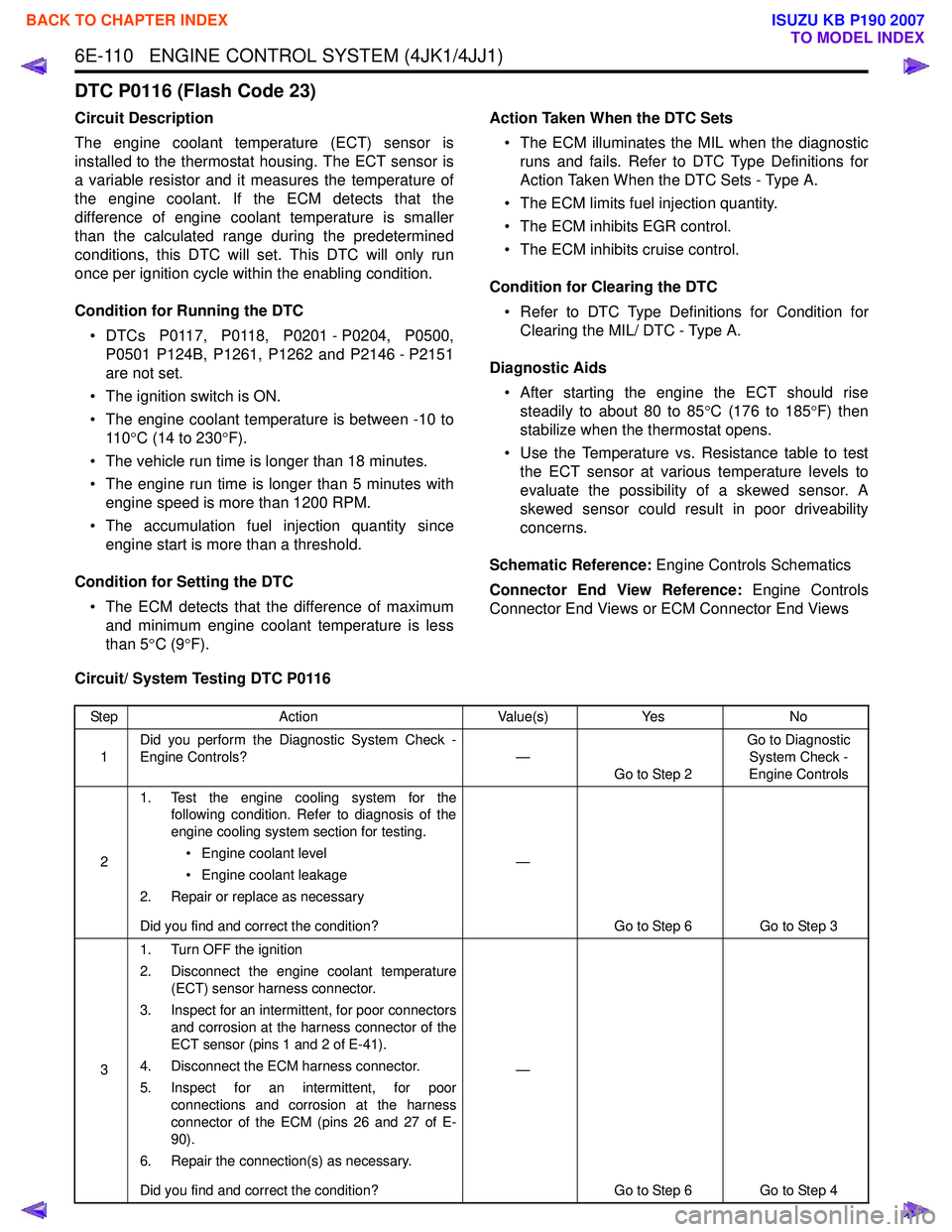
DTC P0116 (Flash Code 23)
Circuit Description
The engine coolant temperature (ECT) sensor is
installed to the thermostat housing. The ECT sensor is
a variable resistor and it measures the temperature of
the engine coolant. If the ECM detects that the
difference of engine coolant temperature is smaller
than the calculated range during the predetermined
conditions, this DTC will set. This DTC will only run
once per ignition cycle within the enabling condition.
Condition for Running the DTC • DTCs P0117, P0118, P0201 - P0204, P0500, P0501 P124B, P1261, P1262 and P2146 - P2151
are not set.
• The ignition switch is ON.
• The engine coolant temperature is between -10 to 11 0 °C (14 to 230 °F).
• The vehicle run time is longer than 18 minutes.
• The engine run time is longer than 5 minutes with engine speed is more than 1200 RPM.
• The accumulation fuel injection quantity since engine start is more than a threshold.
Condition for Setting the DTC • The ECM detects that the difference of maximum and minimum engine coolant temperature is less
than 5 °C (9 °F). Action Taken When the DTC Sets
• The ECM illuminates the MIL when the diagnostic runs and fails. Refer to DTC Type Definitions for
Action Taken When the DTC Sets - Type A.
• The ECM limits fuel injection quantity.
• The ECM inhibits EGR control.
• The ECM inhibits cruise control.
Condition for Clearing the DTC • Refer to DTC Type Definitions for Condition for Clearing the MIL/ DTC - Type A.
Diagnostic Aids • After starting the engine the ECT should rise steadily to about 80 to 85 °C (176 to 185 °F) then
stabilize when the thermostat opens.
• Use the Temperature vs. Resistance table to test the ECT sensor at various temperature levels to
evaluate the possibility of a skewed sensor. A
skewed sensor could result in poor driveability
concerns.
Schematic Reference: Engine Controls Schematics
Connector End View Reference: Engine Controls
Connector End Views or ECM Connector End Views
Circuit/ System Testing DTC P0116
Step Action Value(s)Yes No
1 Did you perform the Diagnostic System Check -
Engine Controls? —
Go to Step 2 Go to Diagnostic
System Check -
Engine Controls
2 1. Test the engine cooling system for the
following condition. Refer to diagnosis of the
engine cooling system section for testing.
• Engine coolant level
• Engine coolant leakage
2. Repair or replace as necessary
Did you find and correct the condition? —
Go to Step 6 Go to Step 3
3 1. Turn OFF the ignition
2. Disconnect the engine coolant temperature (ECT) sensor harness connector.
3. Inspect for an intermittent, for poor connectors and corrosion at the harness connector of the
ECT sensor (pins 1 and 2 of E-41).
4. Disconnect the ECM harness connector.
5. Inspect for an intermittent, for poor connections and corrosion at the harness
connector of the ECM (pins 26 and 27 of E-
90).
6. Repair the connection(s) as necessary.
Did you find and correct the condition? —
Go to Step 6 Go to Step 4
BACK TO CHAPTER INDEX
TO MODEL INDEX
ISUZU KB P190 2007
Page 1729 of 6020
6E-112 ENGINE CONTROL SYSTEM (4JK1/4JJ1)
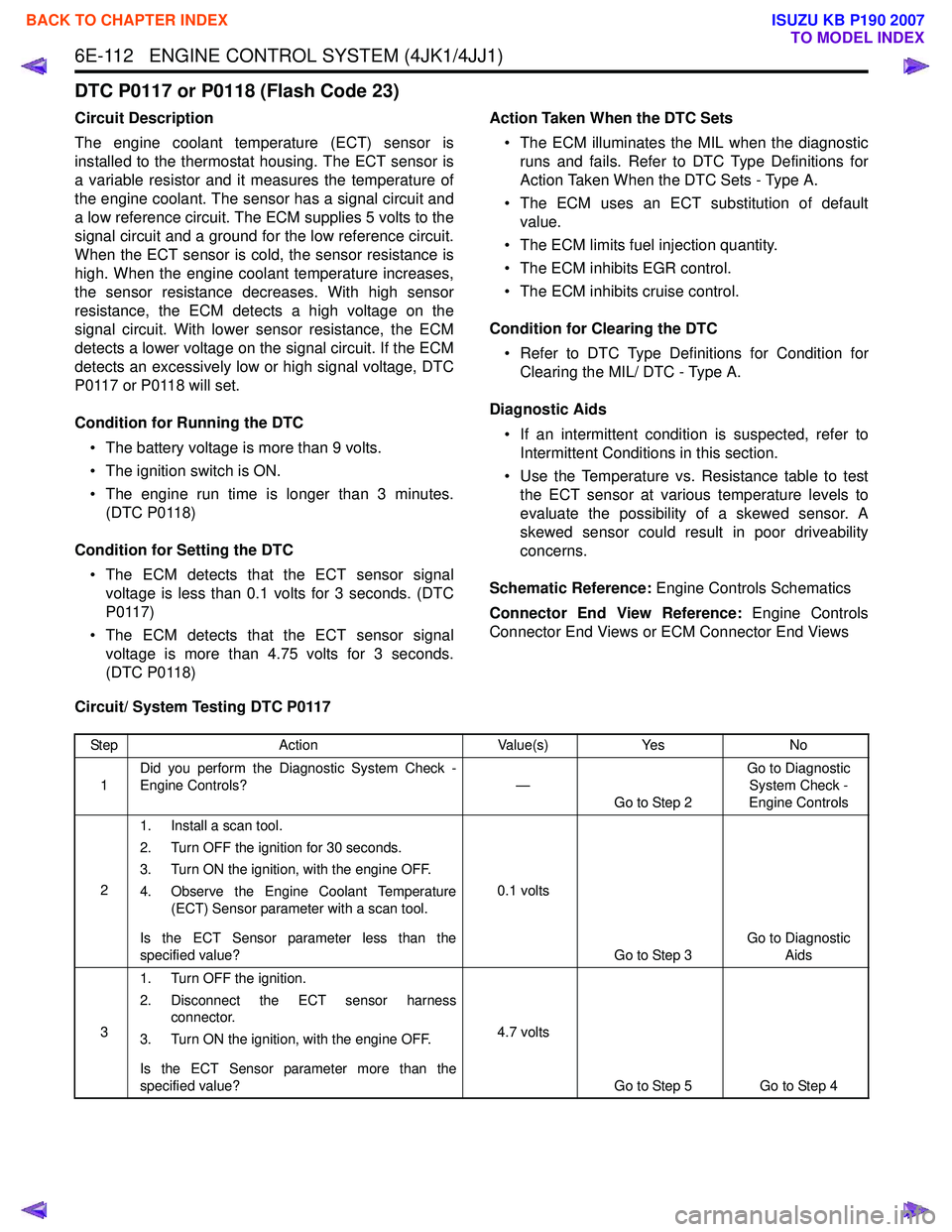
DTC P0117 or P0118 (Flash Code 23)
Circuit Description
The engine coolant temperature (ECT) sensor is
installed to the thermostat housing. The ECT sensor is
a variable resistor and it measures the temperature of
the engine coolant. The sensor has a signal circuit and
a low reference circuit. The ECM supplies 5 volts to the
signal circuit and a ground for the low reference circuit.
When the ECT sensor is cold, the sensor resistance is
high. When the engine coolant temperature increases,
the sensor resistance decreases. With high sensor
resistance, the ECM detects a high voltage on the
signal circuit. With lower sensor resistance, the ECM
detects a lower voltage on the signal circuit. If the ECM
detects an excessively low or high signal voltage, DTC
P0117 or P0118 will set.
Condition for Running the DTC • The battery voltage is more than 9 volts.
• The ignition switch is ON.
• The engine run time is longer than 3 minutes. (DTC P0118)
Condition for Setting the DTC • The ECM detects that the ECT sensor signal voltage is less than 0.1 volts for 3 seconds. (DTC
P0117)
• The ECM detects that the ECT sensor signal voltage is more than 4.75 volts for 3 seconds.
(DTC P0118) Action Taken When the DTC Sets
• The ECM illuminates the MIL when the diagnostic runs and fails. Refer to DTC Type Definitions for
Action Taken When the DTC Sets - Type A.
• The ECM uses an ECT substitution of default value.
• The ECM limits fuel injection quantity.
• The ECM inhibits EGR control.
• The ECM inhibits cruise control.
Condition for Clearing the DTC • Refer to DTC Type Definitions for Condition for Clearing the MIL/ DTC - Type A.
Diagnostic Aids • If an intermittent condition is suspected, refer to Intermittent Conditions in this section.
• Use the Temperature vs. Resistance table to test the ECT sensor at various temperature levels to
evaluate the possibility of a skewed sensor. A
skewed sensor could result in poor driveability
concerns.
Schematic Reference: Engine Controls Schematics
Connector End View Reference: Engine Controls
Connector End Views or ECM Connector End Views
Circuit/ System Testing DTC P0117
Step Action Value(s)Yes No
1 Did you perform the Diagnostic System Check -
Engine Controls? —
Go to Step 2 Go to Diagnostic
System Check -
Engine Controls
2 1. Install a scan tool.
2. Turn OFF the ignition for 30 seconds.
3. Turn ON the ignition, with the engine OFF.
4. Observe the Engine Coolant Temperature (ECT) Sensor parameter with a scan tool.
Is the ECT Sensor parameter less than the
specified value? 0.1 volts
Go to Step 3 Go to Diagnostic
Aids
3 1. Turn OFF the ignition.
2. Disconnect the ECT sensor harness connector.
3. Turn ON the ignition, with the engine OFF.
Is the ECT Sensor parameter more than the
specified value? 4.7 volts
Go to Step 5 Go to Step 4
BACK TO CHAPTER INDEX
TO MODEL INDEX
ISUZU KB P190 2007
Page 1737 of 6020

6E-120 ENGINE CONTROL SYSTEM (4JK1/4JJ1)
DTC P0182 or P0183 (Flash Code 211)
Circuit Description
The fuel temperature (FT) sensor is installed to the fuel
supply pump. The FT sensor is a variable resistor and it
measures the temperature of the fuel entering the fuel
supply pump. The sensor has a signal circuit and a low
reference circuit. The ECM supplies 5 volts to the
signal circuit and a ground for the low reference circuit.
When the FT sensor is cold, the sensor resistance is
high. When the fuel temperature increases, the sensor
resistance decreases. With high sensor resistance, the
ECM detects a high voltage on the signal circuit. With
lower sensor resistance, the ECM detects a lower
voltage on the signal circuit. If the ECM detects an
excessively low or high signal voltage, DTC P0182 or
P0183 will set.
Condition for Running the DTC • The battery voltage is more than 9 volts.
• The ignition switch is ON.
• The engine run time is longer than 3 minutes. (DTC P0183)
Condition for Setting the DTC • The ECM detects that the FT sensor signal voltage is less than 0.1 volts for 3 seconds. (DTC P0182)
• The ECM detects that the FT sensor signal voltage is more than 4.75 volts for 3 seconds. (DTC
P0183) Action Taken When the DTC Sets
• The ECM illuminates the MIL when the diagnostic runs and fails. Refer to DTC Type Definitions for
Action Taken When the DTC Sets - Type A.
• The ECM uses a FT substitution of default value.
• The ECM limits fuel injection quantity.
• The ECM inhibits pilot injection.
• The ECM inhibits cruise control.
Condition for Clearing the DTC • Refer to DTC Type Definitions for Condition for Clearing the MIL/ DTC - Type A.
Diagnostic Aids • Before starting a cold engine, FT sensor and engine coolant temperature (ECT) sensor
temperature should be relatively close to each
other.
• If an intermittent condition is suspected, refer to Intermittent Conditions in this section.
• Use the Temperature vs. Resistance table to test the FT sensor at various temperature levels to
evaluate the possibility of a skewed sensor. A
skewed sensor could result in poor driveability
concerns.
Schematic Reference: Engine Controls Schematics
Connector End View Reference: Engine Controls
Connector End Views or ECM Connector End Views
Circuit/ System Testing DTC P0182
Step Action Value(s)Yes No
1 Did you perform the Diagnostic System Check -
Engine Controls? —
Go to Step 2 Go to Diagnostic
System Check -
Engine Controls
2 1. Install a scan tool.
2. Turn OFF the ignition for 30 seconds.
3. Turn ON the ignition, with the engine OFF.
4. Observe the Fuel Temperature (FT) Sensor parameter with a scan tool.
Is the FT Sensor parameter less than the specified
value? 0.1 volts
Go to Step 3 Go to Diagnostic
Aids
3 1. Turn OFF the ignition.
2. Disconnect the FT sensor harness connector.
3. Turn ON the ignition, with the engine OFF.
Is the FT Sensor parameter more than the
specified value? 4.7 volts
Go to Step 5 Go to Step 4
BACK TO CHAPTER INDEX
TO MODEL INDEX
ISUZU KB P190 2007
Page 1741 of 6020

6E-124 ENGINE CONTROL SYSTEM (4JK1/4JJ1)
DTC P0192 or P0193 (Flash Code 245)
Circuit Description
The fuel rail pressure (FRP) sensor is installed to the
fuel rail and it detects the fuel pressure in the fuel rail,
converts the pressure into a voltage signal, and sends
the signal to the ECM. The sensor has the following
circuits.
• 5 volts reference circuit
• Low reference circuit
• FRP sensor signal circuit
The ECM monitors the FRP sensor signal voltage.
Higher fuel rail pressure provides higher signal voltage
while lower pressure provides lower signal voltage. The
ECM calculates actual fuel rail pressure (fuel pressure)
from the voltage signal and uses the result in fuel
injection control and other control tasks. If the ECM
detects an excessively low or high signal voltage, DTC
P0192 or P0193 will set.
Condition for Running the DTC • DTCs P0652 and P0653 are not set.
• The battery voltage is more than 9 volts.
• The ignition switch is ON.
Condition for Setting the DTC • The ECM detects that the FRP sensor signal voltage is less than 0.4 volts. (DTC P0192) • The ECM detects that the FRP sensor signal
voltage is more than 4.75 volts. (DTC P0193)
Action Taken When the DTC Sets • The ECM illuminates the MIL when the diagnostic runs and fails. Refer to DTC Type Definitions for
Action Taken When the DTC Sets - Type A.
• The ECM uses a FRP substitution of default value.
• The ECM limits fuel injection quantity.
• The ECM inhibits pilot injection.
• The ECM inhibits cruise control.
Condition for Clearing the DTC • Refer to DTC Type Definitions for Condition for Clearing the MIL/ DTC - Type A.
Diagnostic Aids • If an intermittent condition is suspected, refer to Intermittent Conditions in this section.
• Electromagnetic interference may affect intermittent condition.
Schematic Reference: Engine Controls Schematics
Connector End View Reference: Engine Controls
Connector End Views or ECM Connector End Views
Circuit/ System Testing DTC P0192
Step Action Value(s)Yes No
1 Did you perform the Diagnostic System Check -
Engine Controls? —
Go to Step 2 Go to Diagnostic
System Check -
Engine Controls
2 1. Install a scan tool.
2. Turn OFF the ignition for 30 seconds.
3. Start the engine.
4. Monitor the DTC Information with a scan tool.
Is DTC P0652 also set? —
Go to DTC P0652 Go to Step 3
3 Observe the Fuel Rail Pressure (FRP) Sensor
parameter with a scan tool.
Is the FRP Sensor parameter less than the
specified value? 0.4 volts
Go to Step 4 Go to Diagnostic
Aids
4 1. Turn OFF the ignition.
2. Disconnect the FRP sensor harness connector.
3. Turn ON the ignition, with the engine OFF.
Is the FRP Sensor parameter more than the
specified value? 4.7 volts
Go to Step 5 Go to Step 6
5 Connect a DMM between the 5 volts reference
circuit (pin 3 of E-48) and a known good ground.
Is the DMM voltage more than the specified value? 4.7 volts
Go to Step 8 Go to Step 7
BACK TO CHAPTER INDEX
TO MODEL INDEX
ISUZU KB P190 2007
Page 1745 of 6020

6E-128 ENGINE CONTROL SYSTEM (4JK1/4JJ1)
DTC P0201, P0202, P0203 or P0204 (Flash Code 271, 272, 273 or 274)
Circuit Description
The ECM calculates the optimum fuel injection ON time
using data sent from various engine sensors. The ECM
supplies a high voltage along with grounding the fuel
injector control circuit when it needs to energize the fuel
injector (turn it ON). If the fuel injector charge voltage
circuit or solenoid control circuit is open circuit, this
DTC will set. DTC P0201 - P0204 will set depending
upon which cylinder injector circuit failed.
Condition for Running the DTC • DTCs P2146, P2147 and P2148 are not set. (DTC P0201 or P0204)
• DTCs P2149, P2150 and P2151 are not set. (DTC P0203 or P0204)
• The battery voltage is more than 9 volts.
• The ignition switch is ON.
• The engine is running.
• The engine speed is lower than 2000RPM.
Condition for Setting the DTC • The ECM detects an open circuit on the fuel injector solenoid circuits. Action Taken When the DTC Sets
• The ECM illuminates the MIL when the diagnostic runs and fails. Refer to DTC Type Definitions for
Action Taken When the DTC Sets - Type A.
• The ECM inhibits cruise control.
Condition for Clearing the DTC • Refer to DTC Type Definitions for Condition for Clearing the MIL/ DTC - Type A.
Diagnostic Aids • If an intermittent condition is suspected, refer to Intermittent Conditions in this section.
Notice: • Each DTC agrees with engine cylinder order.
- P0201: Cylinder #1
- P0202: Cylinder #2
- P0203: Cylinder #3
- P0204: Cylinder #4
Schematic Reference: Engine Controls Schematics
Connector End View Reference: Engine Controls
Connector End Views or ECM Connector End Views
Circuit/ System Testing DTC P0201
Step Action Value(s)Yes No
1 Did you perform the Diagnostic System Check -
Engine Controls? —
Go to Step 2 Go to Diagnostic
System Check -
Engine Controls
2 1. Install a scan tool.
2. Turn OFF the ignition for 30 seconds.
3. Start the engine.
4. Monitor the DTC Information with a scan tool.
Does the DTC fail this ignition? —
Go to Step 3 Go to Diagnostic
Aids
3 1. Turn OFF the ignition.
2. Disconnect the cylinder #1 fuel injector harness connector.
3. Inspect for an intermittent and for poor connections at the harness connector (pins 1
and 2 of E-13).
4. Repair the connection(s) as necessary.
Did you find and correct the condition? —
Go to Step 11 Go to Step 4
4 Measure the resistance of cylinder #1 fuel injector
solenoid.
Is the resistance less the specified value? 2.0
Ω
Go to Step 5 Go to Step 9
BACK TO CHAPTER INDEX
TO MODEL INDEX
ISUZU KB P190 2007
Page 1754 of 6020

ENGINE CONTROL SYSTEM (4JK1/4JJ1) 6E-137
DTC P0219 (Flash Code 543)
Circuit Description
The crankshaft position (CKP) sensor is located on the
left-hand of the cylinder block rear and it is behind the
starter motor. The ECM calculates the engine speed
and exact position of the crankshaft based on the
signal pulse from the CKP sensor. If the ECM detects
an engine overrun condition, this DTC will set.
Condition for Setting the DTC • The ECM detects that the engine speed is more than 4900 RPM (4JK1 standard output) or 4700
RPM (4JK1 high output and 4JJ1).
Action Taken When the DTC Sets • The ECM illuminates the SVS lamp when the diagnostic runs and fails. Refer to DTC Type
Definitions for Action Taken When the DTC Sets -
Type C. (Euro 4 Specification)
• The ECM illuminates the MIL when the diagnostic runs and fails. Refer to DTC Type Definitions for
Action Taken When the DTC Sets - Type A.
(Except Euro 4 Specification)
• The ECM limits fuel injection quantity.
• The ECM inhibits pilot injection.
• The ECM inhibits cruise control. • The ECM stops engine running when the vehicle
speed is lower than 5 km/h (3 MPH) for 5 seconds.
The engine will run after the key is cycled when the
ignition has been tuned OFF for longer than 10
seconds.
Condition for Clearing the DTC • Refer to DTC Type Definitions for Condition for Clearing the SVS Lamp/ DTC - Type C. (Euro 4
Specification)
• Refer to DTC Type Definitions for Condition for Clearing the MIL/ DTC - Type A. (Except Euro 4
Specification)
Diagnostic Aids • Make sure the CKP sensor is tight and the teeth are not damaged.
• Electromagnetic interference in the CKP sensor circuits may set this DTC.
• The Total Engine Overspeed Events parameter on scan tool indicates number of overrun events.
Notice: • This DTC is caused by an engine overspeed condition, which was most likely caused by driver
error (i.e. downshifting a manual transmission on a
steep grade). Excessive engine overspeed may
damage internal engine components.
Circuit/ System Testing DTC P0219
Step Action Value(s)Yes No
1 Did you perform the Diagnostic System Check -
Engine Controls? —
Go to Step 2 Go to Diagnostic
System Check -
Engine Controls
2 Important:
If DTC P0335 or P0336 is set, diagnose
that DTC first.
1. Install a scan tool.
2. Start the engine.
3. Observe the Engine Speed parameter with a scan tool.
4. Accelerate the engine as necessary.
Does the Engine Speed parameter ever exceed the
specified value? 5000 RPM
Go to Step 4 Go to Step 3
3 Ask the driver if overrun is caused by gear slip-out,
shift error, down-slope driving, etc. If engine
overrun has experienced, the engine must be
inspected and repaired as necessary.
Did you complete the action? —
Go to Step 6
—
BACK TO CHAPTER INDEX
TO MODEL INDEX
ISUZU KB P190 2007
Page 1756 of 6020

ENGINE CONTROL SYSTEM (4JK1/4JJ1) 6E-139
DTC P0231 or P0232 (Flash Code 69)
Circuit Description
The ECM controls the fuel pump relay which supplies
power to the fuel pump in the fuel tank. The ECM
commands the fuel pump relay ON for a certain length
of time at ignition switch is ON with the engine OFF.
During the engine running it is continuously
commanded ON. If the ECM detects an improper
voltage level on the relay control circuit, DTC P0231 or
P0232 will set.
Condition for Running the DTC • The battery voltage is more than 9 volts.
• The ignition switch is ON.
Condition for Setting the DTC • The ECM detects a low voltage condition on the fuel pump relay control circuit for longer than 3
second when the relay is commanded OFF. (DTC
P0231)
• The ECM detects a high voltage condition on the fuel pump relay control circuit for longer than 3
second when the relay is commanded ON. (DTC
P0232)
Action Taken When the DTC Sets • The ECM illuminates the SVS lamp when the diagnostic runs and fails. Refer to DTC Type
Definitions for Action Taken When the DTC Sets -
Type C. (Euro 4 Specification) • The ECM illuminates the MIL when the diagnostic
runs and fails. Refer to DTC Type Definitions for
Action Taken When the DTC Sets - Type A.
(Except Euro 4 Specification)
• The ECM limits fuel injection quantity.
• The ECM inhibits cruise control.
Condition for Clearing the DTC • Refer to DTC Type Definitions for Condition for Clearing the SVS Lamp/ DTC - Type C. (Euro 4
Specification)
• Refer to DTC Type Definitions for Condition for Clearing the MIL/ DTC - Type A. (Except Euro 4
Specification)
Diagnostic Aids • If an intermittent condition is suspected, refer to Intermittent Conditions in this section.
Notice: • The fuel pump relay is commanded ON for 12 seconds at ignition switch is ON with the engine
OFF.
Schematic Reference: Engine Controls Schematics
Connector End View Reference: Engine Controls
Connector End Views or ECM Connector End Views
Circuit/ System Testing DTC P0231
Step Action Value(s)Yes No
1 Did you perform the Diagnostic System Check -
Engine Controls? —
Go to Step 2 Go to Diagnostic
System Check -
Engine Controls
2 1. Install a scan tool.
2. Turn OFF the ignition for 30 seconds.
3. Turn ON the ignition for 20 seconds while observing the DTC Information with a scan
tool.
Does the DTC fail this ignition? —
Go to Step 3 Go to Diagnostic
Aids
3 1. Turn OFF the ignition.
2. Replace the fuel pump relay with the head light relay or replace with a known good relay.
3. Turn ON the ignition for 20 seconds while observing the DTC Information with a scan
tool.
Does the DTC fail this ignition? —
Go to Step 4 Go to Step 7
BACK TO CHAPTER INDEX
TO MODEL INDEX
ISUZU KB P190 2007