Joint JAGUAR X308 1998 2.G Workshop Manual
[x] Cancel search | Manufacturer: JAGUAR, Model Year: 1998, Model line: X308, Model: JAGUAR X308 1998 2.GPages: 2490, PDF Size: 69.81 MB
Page 1674 of 2490
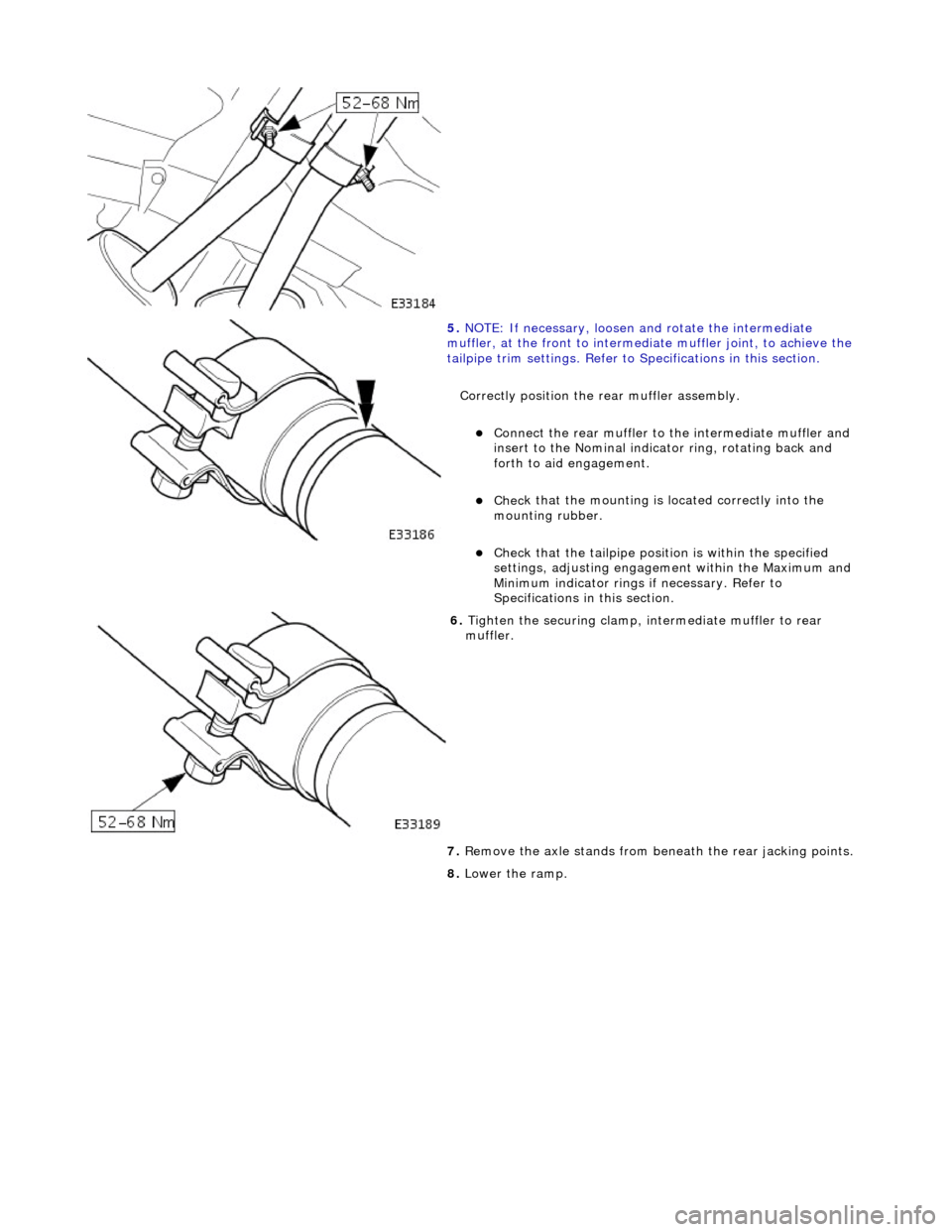
5.
NO TE
: If necessary, loosen and rotate the intermediate
muffler, at the front to intermediate muffler joint, to achieve the
tailpipe trim settings. Refer to Specifications in this section.
Correctly position the rear muffler assembly.
Connect the rear muffl
er to the intermediate muffler and
insert to the Nominal indicator ring, rotating back and
forth to aid engagement.
Chec k
that the mounting is located correctly into the
mounting rubber.
Chec k
that the tailpi
pe position is wi thin the specified
settings, adjusting engageme nt within the Maximum and
Minimum indicator rings if necessary. Refer to
Specifications in this section.
6. Tigh te
n the securing clamp, in
termediate muffler to rear
muffler.
7. Remove the axle stands from be neath the rear jacking points.
8. Lower the ramp.
Page 1675 of 2490
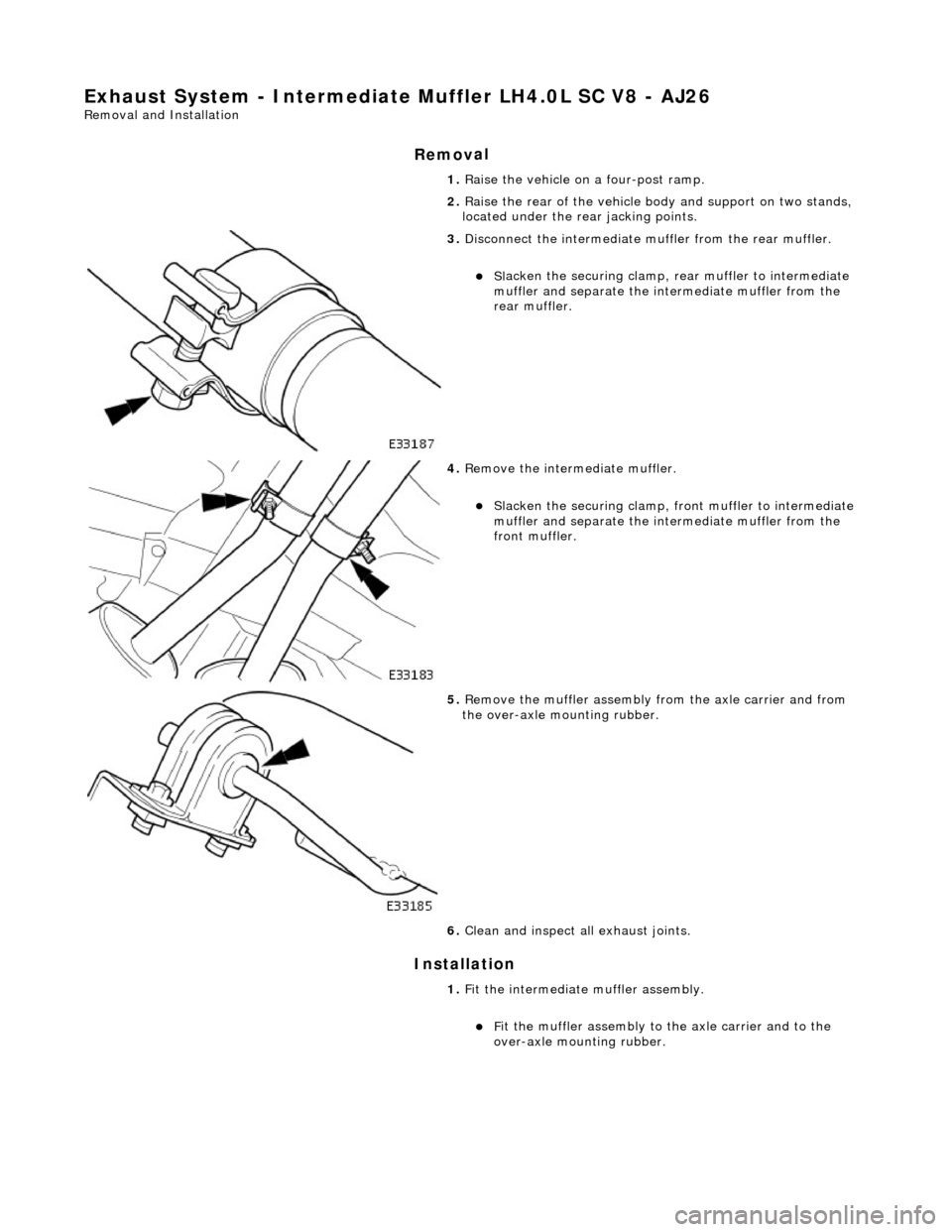
Exhaust System - Intermediate Muffler LH4
.0L SC V8 - AJ26
Re
moval and Installation
Remov
al
Installation
1. R
aise the vehicle on a four-post ramp.
2. Raise the rear of the vehicle bo dy and support on two stands,
located under the re ar jacking points.
3. Di
sconnect the intermediate
muffler from the rear muffler.
Sl
acken the securing clamp, re
ar muffler to intermediate
muffler and separate the in termediate muffler from the
rear muffler.
4. R
emove the intermediate muffler.
Sl
acken the securing clamp, front muffler to intermediate
muffler and separate the in termediate muffler from the
front muffler.
5. R
emove the muffler assembly
from the axle carrier and from
the over-axle mounting rubber.
6. Clean and inspect al l exhaust joints.
1. Fit the intermediate muffler assembly.
F
it the muffler assembly to the axle carrier and to the
over-axle mounting rubber.
Page 1676 of 2490
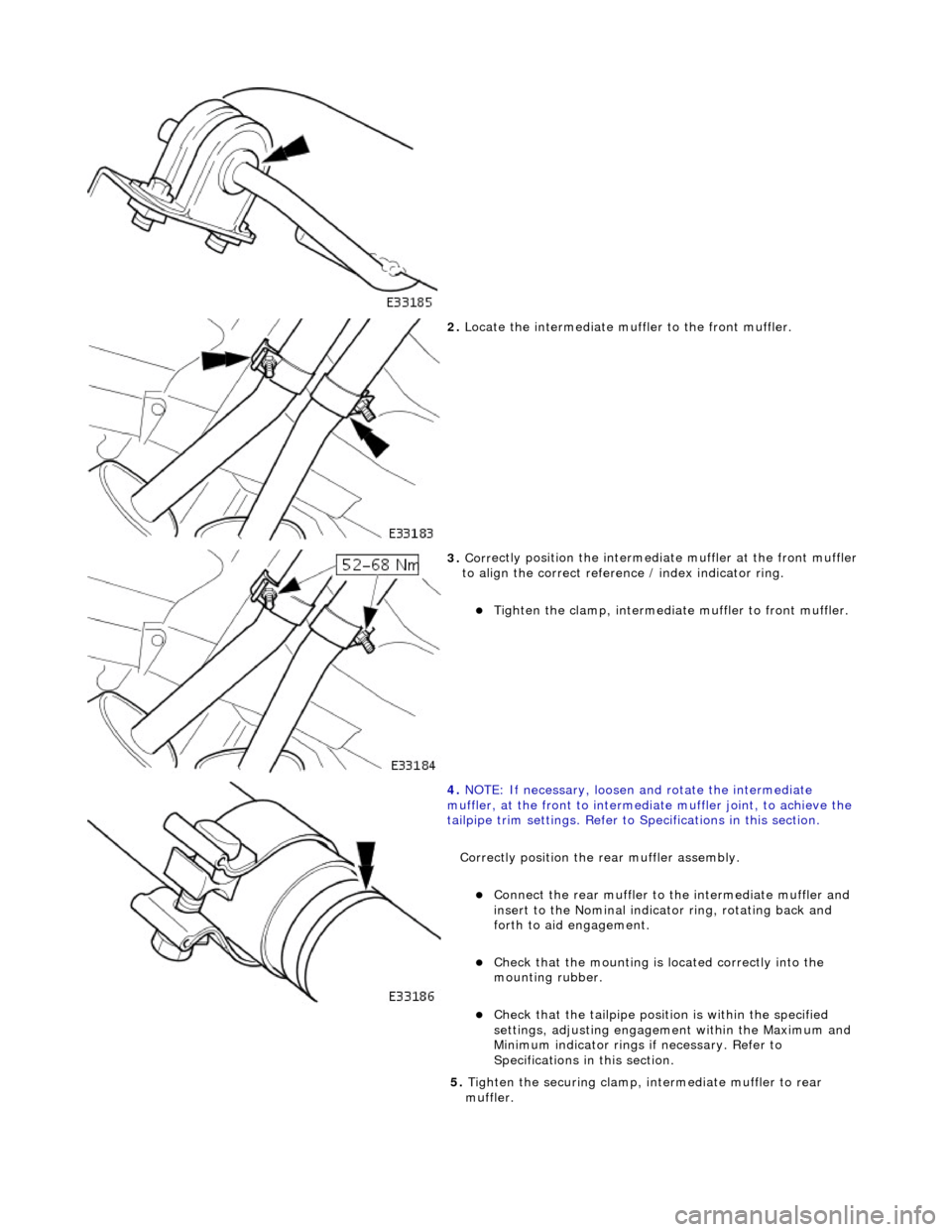
2. Locate the intermediate muffl er to the front muff
ler.
3. Cor r
ectly position the intermedia
te muffler at the front muffler
to align the correct refere nce / index indicator ring.
Tighte
n the clamp, intermediate
muffler to front muffler.
4. NO TE
: If necessary, loosen and rotate the intermediate
muffler, at the front to intermediate muffler joint, to achieve the
tailpipe trim settings. Refer to Specifications in this section.
Correctly position the rear muffler assembly.
Connect the rear muffl
er to the intermediate muffler and
insert to the Nominal indicator ring, rotating back and
forth to aid engagement.
Chec k
that the mounting is located correctly into the
mounting rubber.
Chec k
that the tailpi
pe position is wi thin the specified
settings, adjusting engageme nt within the Maximum and
Minimum indicator rings if necessary. Refer to
Specifications in this section.
5. Tighten the securing clamp, in termediate muffler to rear
muffler.
Page 1679 of 2490

I
nstallation
7.
Clean and inspect al l e
xhaust joints.
1. Fi
t the intermediate muffler assembly.
F
it the muffler assembly to the axle carrier and to the
over-axle mounting rubber.
2. Locate the intermedi
ate muffl
er to the front muffler.
3. Cor
rectly position the front muffl
er in the catalytic converters
to align the correct reference / index indicator ring..
Tigh
ten the clamps (left-hand
and right-hand sides), front
muffler to catalytic converters.
4. Correctly position the intermedia te muffler at the front muffler
to align the correct reference / index indicator ring..
Tigh
ten the clamp, intermediate
mufflers to front muffler.
Page 1680 of 2490
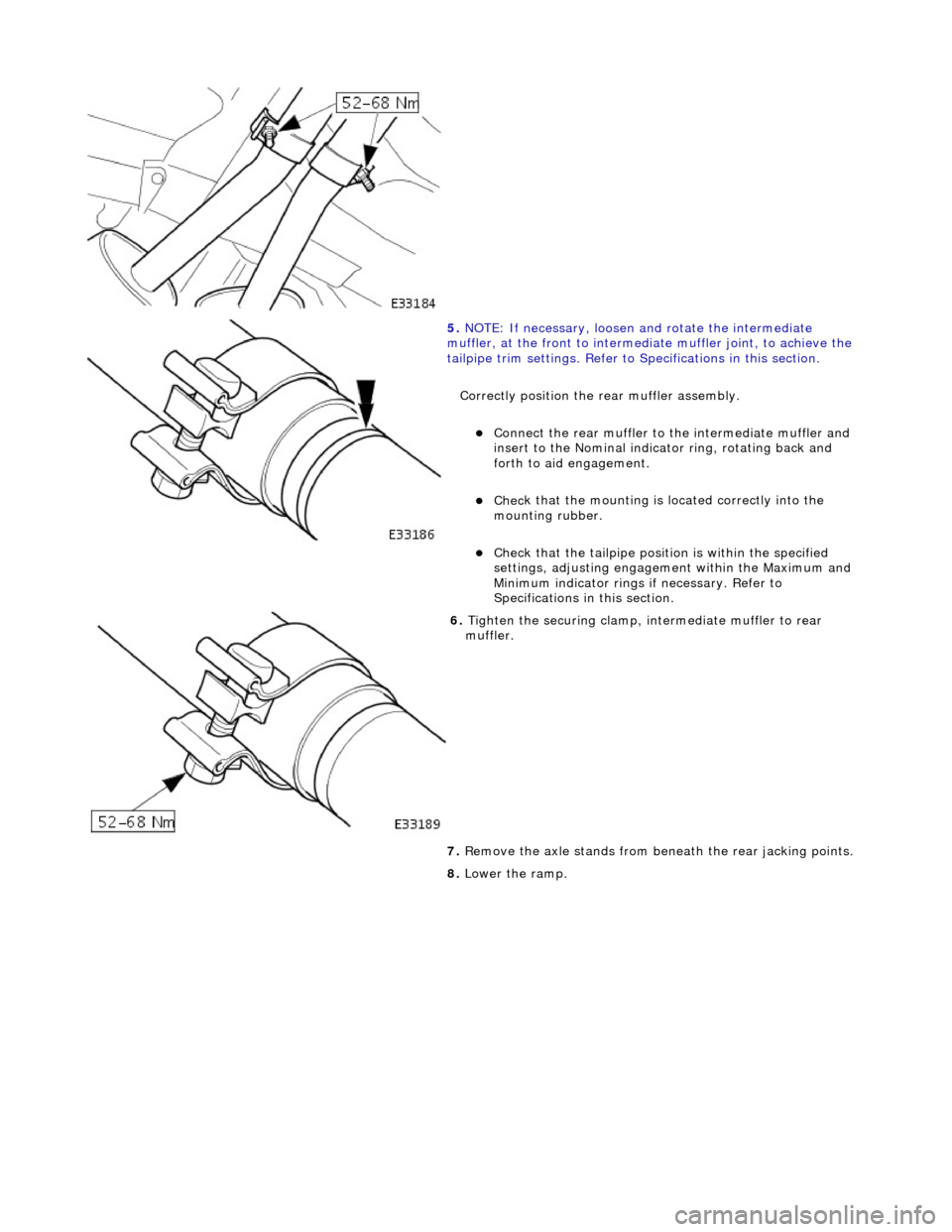
5.
NO TE
: If necessary, loosen and rotate the intermediate
muffler, at the front to intermediate muffler joint, to achieve the
tailpipe trim settings. Refer to Specifications in this section.
Correctly position the rear muffler assembly.
Connect the rear muffl
er to the intermediate muffler and
insert to the Nominal indicator ring, rotating back and
forth to aid engagement.
Chec k
that the mounting is located correctly into the
mounting rubber.
Chec k
that the tailpi
pe position is wi thin the specified
settings, adjusting engageme nt within the Maximum and
Minimum indicator rings if necessary. Refer to
Specifications in this section.
6. Tigh te
n the securing clamp, in
termediate muffler to rear
muffler.
7. Remove the axle stands from be neath the rear jacking points.
8. Lower the ramp.
Page 1681 of 2490

Exhaust System - Intermediate Muffler RH4
.0L SC V8 - AJ26
Re
moval and Installation
Remov
al
Installation
1. R
aise the vehicle on a four-post ramp.
2. Raise the rear of the vehicle bo dy and support on two stands,
located under the re ar jacking points.
3. Di
sconnect the intermediate
muffler from the rear muffler.
Sl
acken the securing clamp, re
ar muffler to intermediate
muffler and separate the in termediate muffler from the
rear muffler.
4. R
emove the intermediate muffler.
Sl
acken the securing clamp, front muffler to intermediate
muffler and separate the in termediate muffler from the
front muffler.
5. R
emove the muffler assembly
from the axle carrier and from
the over-axle mounting rubber.
6. Clean and inspect al l exhaust joints.
1. Fit the intermediate muffler assembly.
F
it the muffler assembly to the axle carrier and to the
over-axle mounting rubber.
Page 1682 of 2490

2. Locate the intermediate muffl er to the front muff
ler.
3. Cor r
ectly position the intermedia
te muffler at the front muffler
to align the correct refere nce / index indicator ring.
Tighte
n the clamp, intermediate
muffler to front muffler.
4. NO TE
: If necessary, loosen and rotate the intermediate
muffler, at the front to intermediate muffler joint, to achieve the
tailpipe trim settings. Refer to Specifications in this section.
Correctly position the rear muffler assembly.
Connect the rear muffl
er to the intermediate muffler and
insert to the Nominal indicator ring, rotating back and
forth to aid engagement.
Chec k
that the mounting is located correctly into the
mounting rubber.
Chec k
that the tailpi
pe position is wi thin the specified
settings, adjusting engageme nt within the Maximum and
Minimum indicator rings if necessary. Refer to
Specifications in this section.
5. Tighten the securing clamp, in termediate muffler to rear
muffler.
Page 1684 of 2490

Ex
haust System - Muff
ler and Tailpipe LH
Remo
val and Installation
Remov
a
l
Installation
1. Ra
ise the vehicle on a four-post ramp.
2. Slacken the securi
ng clamp, re
ar muffler to intermediate
muffler.
3. Re
move the rear muffler
and tailpipe assembly.
Separate the rear muffl er fr
om
the intermediate muffler.
Di
sengage the rear muffler mounting peg from the
mounting rubber.
R e
move the rear muffler asse
mbly. Rotate the assembly
back and forth to aid removal.
4. Clean the exhaust joints.
1. Fi
t the rear muffler and tailpipe assembly.
Connect
the rear muffl
er to the intermediate muffler and
insert to the Nominal indicator ring.
2. Position and align the rear mu ffler and tailpipe assembly.
Engage the peg with
the mounting rubber.
Chec
k
that the tailpi
pe position is wi thin the specified
settings, adjusting engageme nt within the Maximum and
Minimum indicator rings if necessary; refer to
Specifications in this section.
Page 1686 of 2490

Ex
haust System - Muff
ler and Tailpipe RH
Remo
val and Installation
Remov
a
l
Installation
1. Ra
ise the vehicle on a four-post ramp.
2. Slacken the securi
ng clamp, re
ar muffler to intermediate
muffler.
3. Re
move the rear muffler
and tailpipe assembly.
Separate the rear muffl er fr
om
the intermediate muffler.
Di
sengage the rear muffler mounting peg from the
mounting rubber.
R e
move the rear muffler asse
mbly. Rotate the assembly
back and forth to aid removal.
4. Clean the exhaust joints.
1. Fi
t the rear muffler and tailpipe assembly.
Connect
the rear muffl
er to the intermediate muffler and
insert to the Nominal indicator ring.
2. Position and align the rear mu ffler and tailpipe assembly.
Engage the peg with
the mounting rubber.
Chec
k
that the tailpi
pe position is wi thin the specified
settings, adjusting engageme nt within the Maximum and
Minimum indicator rings if necessary; refer to
Specifications in this section.
Page 1756 of 2490
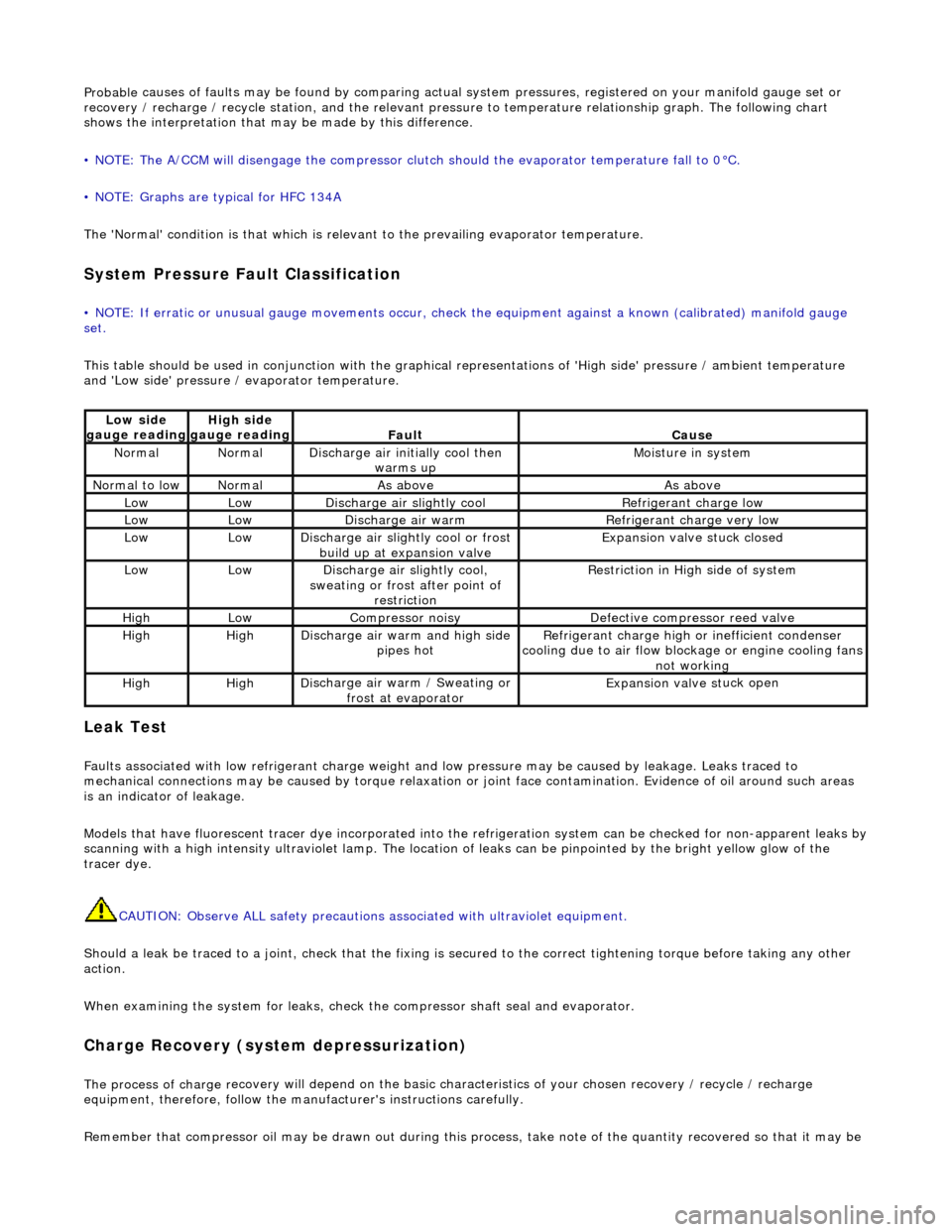
Probable
causes of faults may be found by comparing actual
system pressures, registered on your manifold gauge set or
recovery / recharge / recycle station, and the relevant pressure to temperature relationship graph. The following chart
shows the interpretation that ma y be made by this difference.
• NOTE: The A/CCM will disengage the compressor clutch should the evaporator temperature fall to 0°C.
• NOTE: Graphs are typical for HFC 134A
The 'Normal' condition is that which is relevant to the prevailing evaporator temperature.
System Pressure Fault Classification
• NOTE
: If erratic or unusual gauge move
ments occur, check the equipment against a known (calibrated) manifold gauge
set.
This table should be used in conjunction with the graphical representations of 'High side' pressure / ambient temperature
and 'Low side' pressure / evaporator temperature.
Leak
Test
F
a
ults associated with low re
frigerant charge weight and low pressure ma y be caused by leakage. Leaks traced to
mechanical connections may be caused by to rque relaxation or joint face contamination. Evidence of oil around such areas
is an indicator of leakage.
Models that have fluorescent tracer dye incorporated into the refrigeration system can be checke d for non-apparent leaks by
scanning with a high intensity ultraviolet lamp. The location of leaks can be pinpointed by the bright yellow glow of the
tracer dye.
CAUTION: Observe ALL safety precautions associated with ultraviolet equipment.
Should a leak be traced to a joint, check that the fixing is secured to the correct tightening torque before taking any other
action.
When examining the system for leaks, chec k the compressor shaft seal and evaporator.
Charge Re
covery (system depressurization)
The process of
charge r
ecovery will depe
nd on the basic characteristics of your chosen recovery / recycle / recharge
equipment, therefore, follow the manu facturer's instructions carefully.
Remember that compressor oil may be drawn out during this process, take note of the quantity recovered so that it may be
Lo
w side
gauge reading
High s i
de
gauge reading
Fau l
t
Cause
No
r
mal
No
r
mal
Di
sc
harge air initially cool then
warms up
Mois
ture in system
N
ormal
to low
No
r
mal
As aboveAs above
LowLowD
i
scharge air slightly cool
Ref
r
igerant charge low
LowLowDi
scharge air warm
Refr
igerant charge very low
LowLowDi
scharge air slightly cool or frost
build up at expansion valve
Expansion valve st
uck closed
LowLowDi
scharge air slightly cool,
sweating or frost after point of restriction
Restri
ction in High side of system
HighLowCompressor noisyDe
fe
ctive compressor reed valve
HighHighD
i
scharge air warm and high side
pipes hot
Refri
gerant charge high or inefficient condenser
cooling due to air flow blockage or engine cooling fans
not working
HighHighD i
scharge air warm / Sweating or
frost at evaporator
Expans ion valve st
uck open