fuel JAGUAR XJ6 1994 2.G User Guide
[x] Cancel search | Manufacturer: JAGUAR, Model Year: 1994, Model line: XJ6, Model: JAGUAR XJ6 1994 2.GPages: 521, PDF Size: 17.35 MB
Page 21 of 521
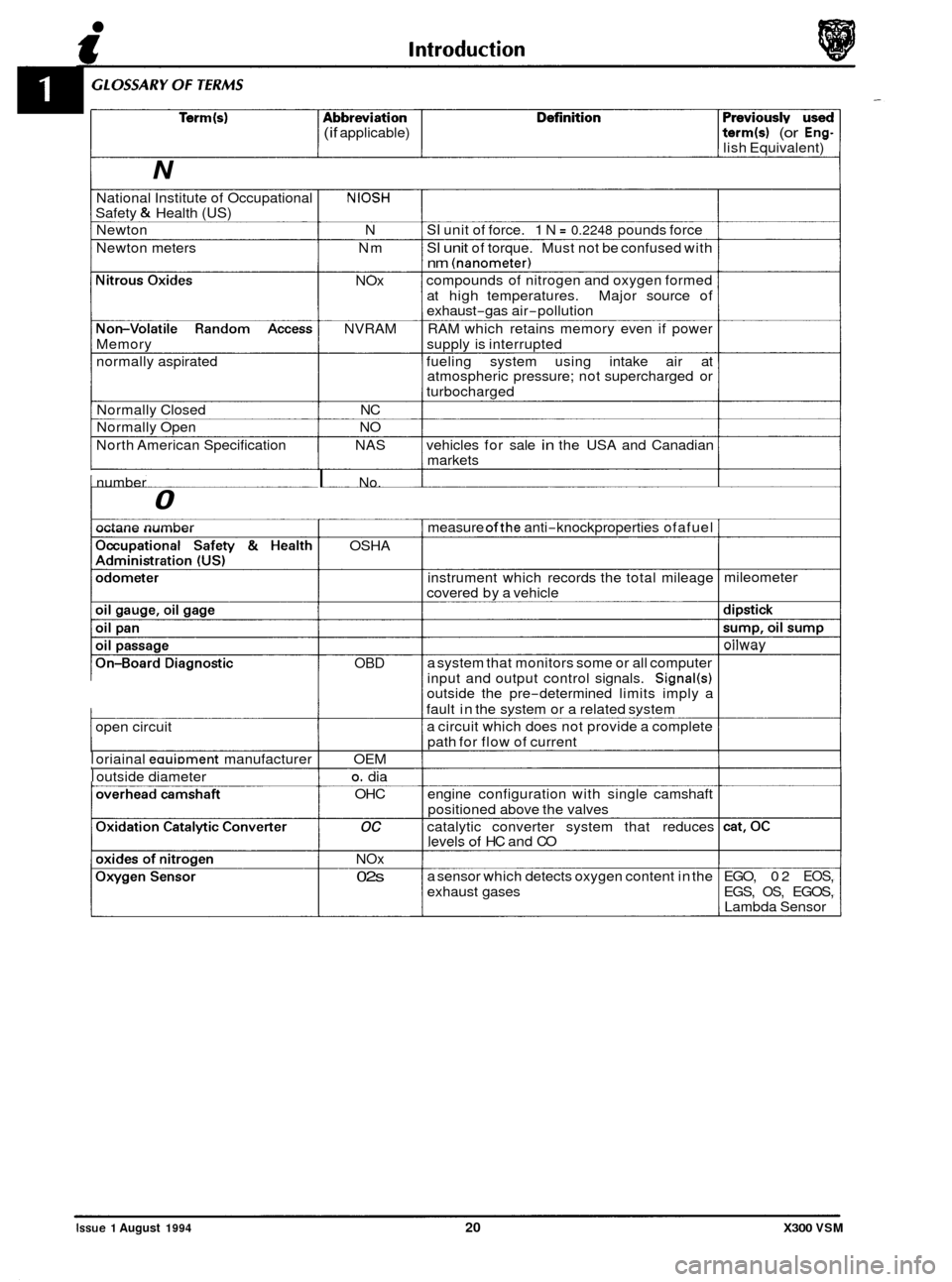
(if applicable) term(s) (or Eng- lish Equivalent)
N
National Institute of Occupational NIOSH Safety & Health (US)
Newton N SI unit of force. 1 N = 0.2248 pounds force
Newton meters Nm
SI unit of torque. Must not be confused with nm (nanometer)
compounds of nitrogen and oxygen formed
at high temperatures. Major source of
exhaust
-gas air-pollution
RAM which retains memory even if power
N
Ox
NVRAM
Memory supply is interrupted
normally aspirated fueling system using intake air at
atmospheric pressure; not supercharged or
turbocharged
Normally Closed NC
Normally Open NO
North American Specification NAS vehicles for sale
in the USA and Canadian
markets
0
I number I No.
octane number
I
I open circuit
I oriainal eauiDment manufacturer
I outside diameter OSHA
OBD
OEM
0. dia
OHC
oc
N Ox
02s
measure ofthe anti-knockproperties ofafuel
instrument which records the total mileage
covered by a vehicle
a system that monitors some or all computer
input and output control signals.
Signal(s) outside the pre-determined limits imply a
fault in the svstem or a related svstem
a circuit which does not provide a complete
path for flow of current
engine configuration with single camshaft
positioned above the valves
catalytic converter system that reduces
levels
of HC and CO
a sensor which detects oxygen content in the
exhaust gases mileometer
oilwav
EGO,
02 EOS,
EGS, OS, EGOS,
Lambda Sensor
Issue 1 August 1994 20 X300 VSM
Page 22 of 521
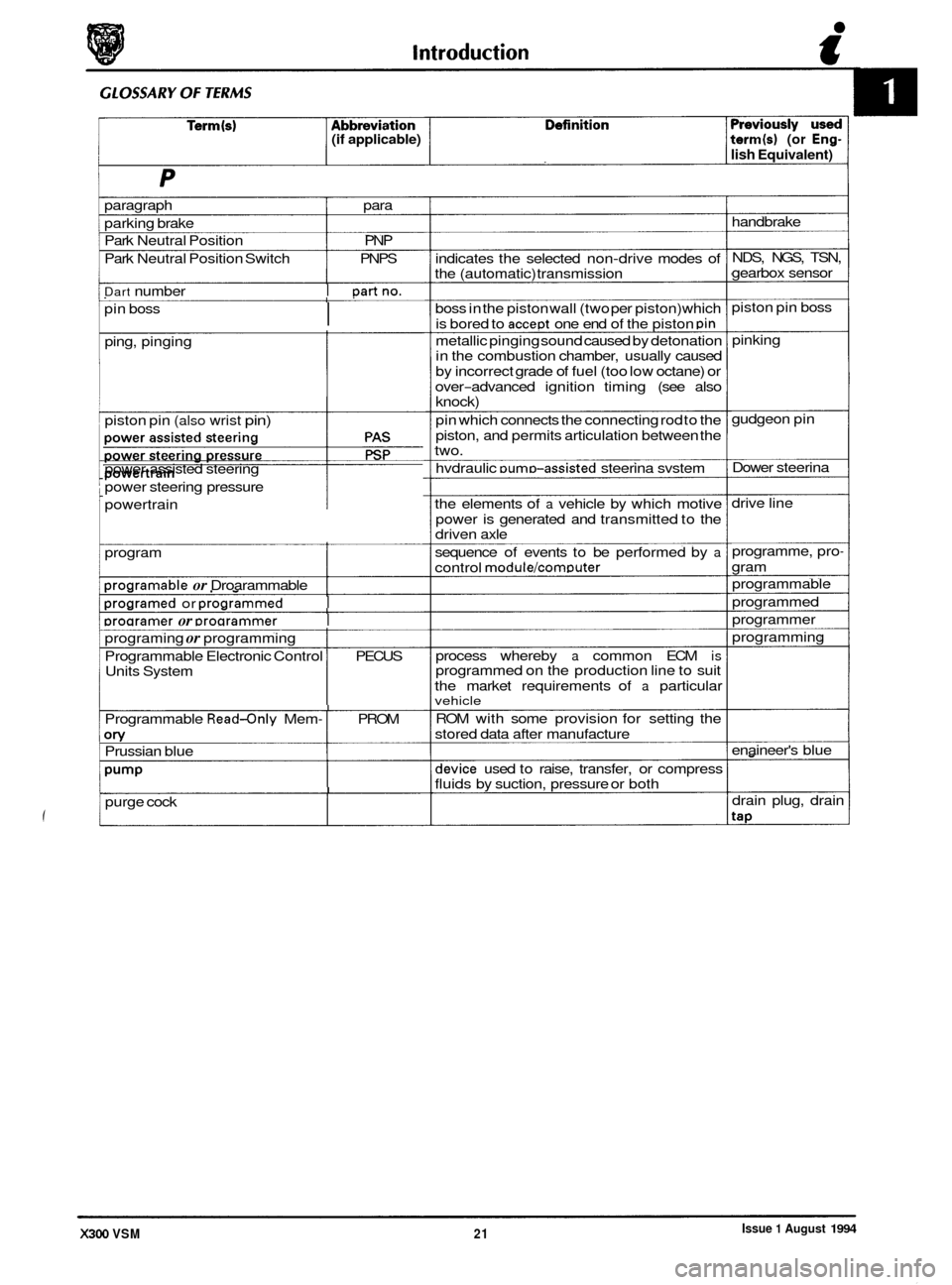
(if applicable) term(s) (or Eng-
lish Equivalent)
paragraph para
parking brake
Park Neutral Position PNP
Park Neutral Position Switch PNPS
Dart number I Dartno.
I pin boss
ping, pinging
piston pin
(also wrist pin)
power assisted steering
power steering pressure
. powertrain
program
Droaramable or Droarammable I
Droaramed or Droarammed I
Droaramer or Droarammer I
programing or programming
Programmable Electronic Control
I PECUS
Units System
I Programmable Read-only Mem- I PROM
on/ Prussian blue
Pump
purge cock I
indicates the selected non-drive modes of
the (automatic) transmission
boss in the piston wall (two per piston) which
is bored to
accept one end of the piston pin
metallic pinging sound caused by detonation
in the combustion chamber, usually caused
by incorrect grade of fuel (too low octane) or
over
-advanced ignition timing (see also knock)
pin which connects the connecting rod to the
piston, and permits articulation between the
two.
hvdraulic
DumD-assisted steerina svstem
the elements of
a vehicle by which motive
power is generated and transmitted to the
driven axle
sequence of events to be performed by
a
control module/comDuter
process whereby a common ECM is programmed on the production line to suit
the market requirements of
a particular vehicle
ROM with some provision for setting the
stored data after manufacture
device used to raise, transfer, or compress
fluids by suction, pressure or both handbrake
NDS, NGS, TSN,
gearbox sensor
piston pin boss
pinking
gudgeon pin
Dower steerina
drive line
programme, pro
-
gram
programmable
programmed
programmer
programming
enaineer's blue
drain plug, drain
tap
Issue 1 August 1994 X300 VSM 21
Page 27 of 521
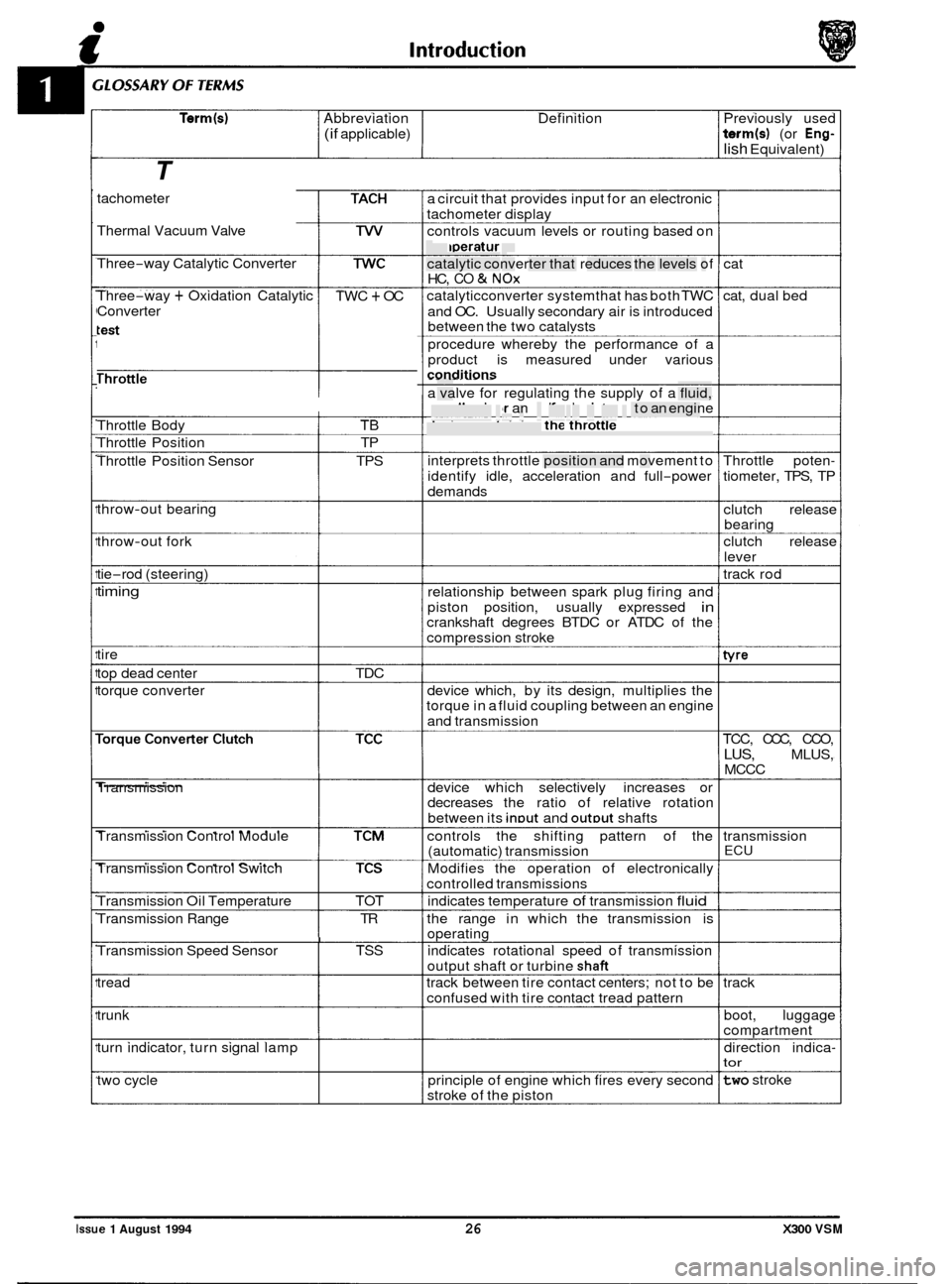
Term(s) Abbreviation Definition Previously used
(if applicable) term(s) (or Eng-
lish Equivalent)
T
tachometer
Thermal Vacuum Valve
Three
-way Catalytic Converter
Three
-way + Oxidation Catalytic
Converter TWC + OC
Throttle
------I
Throttle Body TB
Throttle Position TP
Throttle Position Sensor TPS
throw
-out bearing
throw
-out fork
tie
-rod (steering)
timing
tire
top dead center TDC
torque converter
Transmission
Transmission Control Module
Transmission Control Switch
Transmission Oil Temperature TOT
Transmission Range TR
I Transmission Speed Sensor TSS
tread
trunk
turn indicator, turn signal lamp
two cycle a
circuit that provides input for an electronic
tachometer display
controls vacuum levels or routing based on
temperature
catalytic converter that reduces the levels of
HC,
CO & NOx
catalyticconverter systemthat has both TWC
and OC. Usually secondary air is introduced
between the two catalvsts
procedure whereby the performance of a
product is measured under various
conditions - - . -. . . - . . -
a valve for regulating the supply of a fluid,
usually air or an aidfuel mixture, to an engine
device containing the throttle
interprets throttle position and movement to
identify idle, acceleration and full
-power
demands
relationship between spark plug firing and
piston position, usually expressed
in crankshaft degrees BTDC or ATDC of the
compression stroke
device which, by its design, multiplies the
torque in a fluid coupling between an engine
and transmission
device which selectively increases or
decreases the ratio of relative rotation
between its
inDut and outDut shafts
controls the shifting pattern of the
(automatic) transmission
Modifies the operation of electronically
controlled transmissions
indicates temperature
of transmission fluid
the range in which the transmission is
operating
indicates rotational speed of transmission
output shaft or turbine
shaft
track between tire contact centers; not to be
confused with tire contact tread pattern
principle of engine which fires every second
stroke of the piston cat
cat, dual bed
Throttle poten
-
tiometer, TPS, TP
clutch release
bearing
clutch release
lever
track rod
tvre
TCC, CCC, CCO,
LUS, MLUS,
MCCC
transmission
ECU
track boot, luggage
compartment
direction indica
- tor
two stroke
Issue 1 August 1994 26 X300 VSM
Page 43 of 521
Engine (AJ16)
3.1.2 ENGlNE/ TRANSMlSSlON UN/& RENEW
SRO 12.41.02/20
The engine/transmission unit on the AJ 16 normally aspirated and supercharged engined vehicles are fitted ontothree
engine mounting/bracket assemblies. The two front engine mountings for the 3.2/4.0 liter normally aspirated and the
4.0 liter supercharged engined vehicles are identical. They are fitted to the front crossmember on either side of the
engine bay. Rubber to metal
engine/transmission rear mounts used for both engine types, are secured to a support
bracket which traverses the two body underframe longitudinal members. For access to remove the engine carry out the following procedures:
WARNING: WHEN WORKING WlTHlN THE ENGINE COMPARTMENT, KEEP CLEAR OF THE RADIATOR COOLING
FANS AS THEY COULD START WITHOUT WARNING EVEN IF THE ENGINE IS NOT RUNNING.
. Remove the hood, see SRO 76.16.01, section 13
. Remove the air cleaner assembly.
. Depressurize the fuel system, see SRO 19.50.02, section 5.1.
Disconnect the battery.
. In line with the relevant SRO's and sections, remove all appropriate obstructing parts, including their fixing and
. Disconnect all mechanical and isolate all electrical linkages leading to and from the engine.
. De-gas the airconditioning system, see section 14, Charge Recovery (System depressurization).
mounting
arrangements.
CAUTION : Do not vent refrigerant directly to the atmosphere and always use Jaguar approved recovery/recycle/re- charge equipment.
. Drain the engine oil, see 3.1.3 this section.
. Drain the coolant, see SRO 26.10.01, section 4.1.
WARNING: DO NOT REMOVE THE HEADER TANK PRESSURE CAP WHILE THE ENGINE IS HOT. IF THE CAP MUST
BE REMOVED, PROTECT THE HANDS AGAINST ESCAPING STEAM AND SLOWLY TURN THE CAP ANTI- CLOCKWISE UNTILTHE EXCESS PRESSURE CAN ESCAPE. LEAVETHE CAP IN THIS POSITION UNTIL ALL
STEAM AND PRESSURE HAS ESCAPED AND THEN REMOVE THE CAP COMPLETELY.
Before lifting the complete engine/transmission unit with an engine hoist from the engine bay, ensure that two engine
lifting brackets (tool 18G. 1465) are secured equally spaced to the inlet manifold studs. The engine lifting brackets
should be positioned towards the front and the rear of the assembly. Ensure the front of the vehicle is jacked
up secure- ly on stands when removing the assembly.
e
0
0
X300 VSM Issue 1 August 1994 2
Page 49 of 521
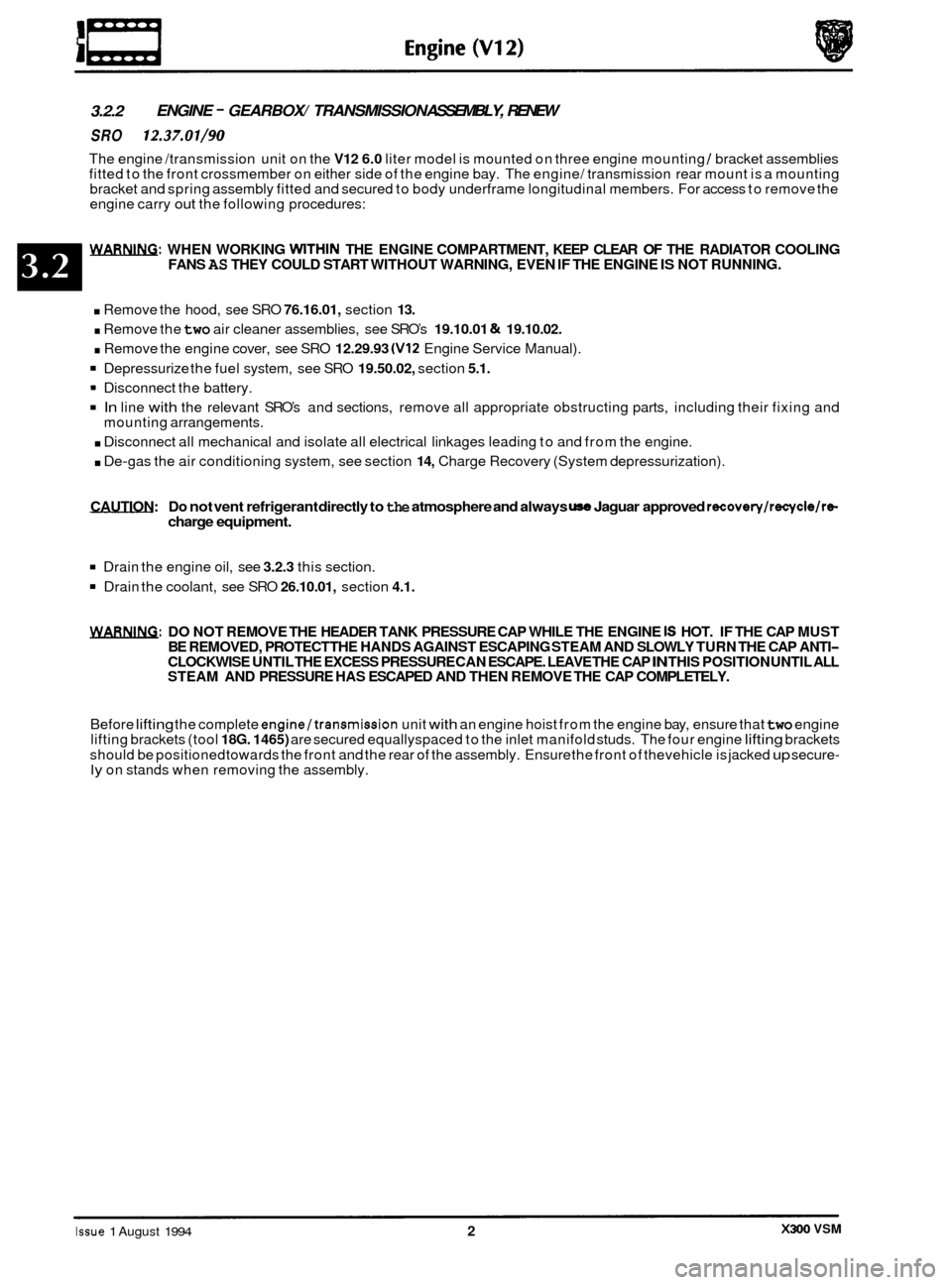
3.2.2 ENGINE - GEARBOX/ TRANSMISSION
ASSEMBLY, RENEW
SRO 12.37.01/90
The engine /transmission unit on the V12 6.0 liter model is mounted on three engine mounting / bracket assemblies
fitted to the front crossmember on either side of the engine bay. The engine/ transmission rear mount is a mounting
bracket and spring assembly fitted and secured to body underframe longitudinal members. For access to remove the
engine carry
out the following procedures:
WARNING: WHEN WORKING WITHIN THE ENGINE COMPARTMENT, KEEP CLEAR OF THE RADIATOR COOLING
FANS AS THEY COULD START WITHOUT WARNING, EVEN IF THE ENGINE IS NOT RUNNING.
. Remove the hood, see SRO 76.16.01, section 13.
. Remove the two air cleaner assemblies, see SRO’s 19.10.01 & 19.10.02.
. Remove the engine cover, see SRO 12.29.93 (V12 Engine Service Manual).
Depressurize the fuel system, see SRO 19.50.02, section 5.1.
In line with the relevant SRO’s and sections, remove all appropriate obstructing parts, including their fixing and
. Disconnect all mechanical and isolate all electrical linkages leading to and from the engine.
. De-gas the air conditioning system, see section 14, Charge Recovery (System depressurization).
Disconnect
the battery.
mounting arrangements.
CAUTION: Do
not vent refrigerant directly to the atmosphere and always use Jaguar approved recovery/recycle/ra charge equipment.
Drain the engine oil, see 3.2.3 this section.
Drain the coolant, see SRO 26.10.01, section 4.1.
WARNING: DO NOT REMOVE THE HEADER TANK PRESSURE CAP WHILE THE ENGINE IS HOT. IF THE CAP MUST
BE REMOVED, PROTECT THE HANDS AGAINST ESCAPING STEAM AND SLOWLY TURN THE CAP ANTI- CLOCKWISE UNTIL THE EXCESS PRESSURE CAN ESCAPE. LEAVE THE CAP IN THIS POSITION UNTIL ALL
STEAM AND PRESSURE HAS ESCAPED AND THEN REMOVE THE CAP COMPLETELY.
Before
lifting the complete engine/transmission unit with an engine hoist from the engine bay, ensure that two engine
lifting brackets (tool 18G. 1465) are secured equallyspaced to the inlet manifold studs. The four engine lifting brackets
should be positioned towards the front and the rear of the assembly. Ensure the front of thevehicle is jacked
up secure- ly on stands when removing the assembly.
X300 VSM Issue 1 August 1994 2
Page 61 of 521
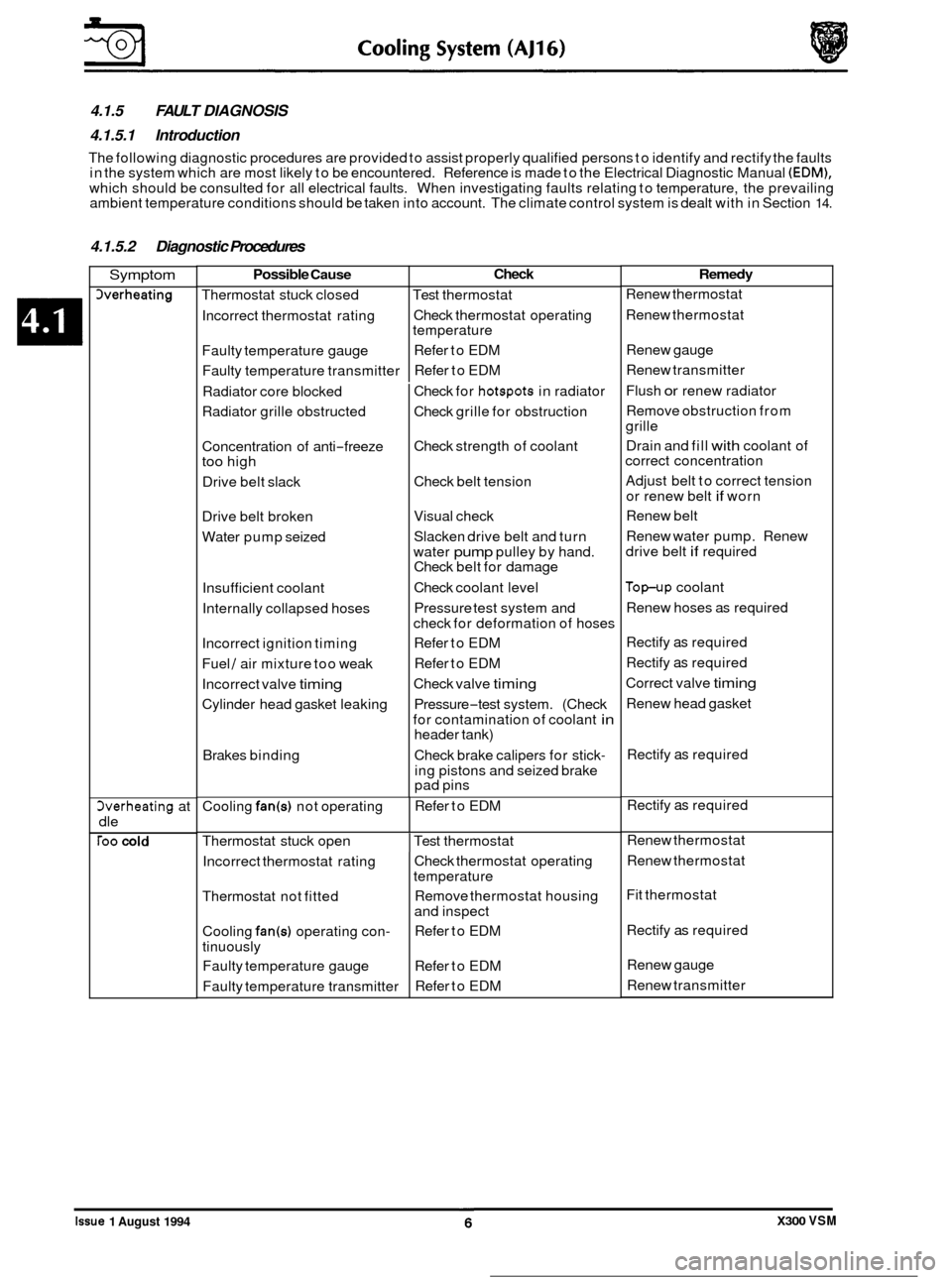
4.1.5 FAULT DIAGNOSIS
4.1.5.1 Introduction
The following diagnostic procedures are provided to assist properly qualified persons to identify and rectify the faults
in the system which are most likely to be encountered. Reference is made to the Electrical Diagnostic Manual (EDM),
which should be consulted for all electrical faults. When investigating faults relating to temperature, the prevailing
ambient temperature conditions should be taken into account. The climate control system is dealt with in Section 14.
Possible Cause
Thermostat stuck closed
Incorrect thermostat rating
Faulty temperature gauge
Faulty temperature transmitter
4.1.5.2 Diagnostic Procedures
Check
Test thermostat
Check thermostat operating
temperature
Refer to EDM
Refer to EDM
Symptom
herheating
Cooling fan(s) not operating 3verheating at
dle
roo cold
Refer to EDM
Incorrect thermostat rating
Thermostat not fitted
Cooling
fan(s) operating con-
tinuously Faulty temperature gauge
Faulty temperature transmitter
Radiator
core blocked
Radiator grille obstructed
Check thermostat operating
temperature
Remove thermostat housing
and inspect
Refer to EDM
Refer to EDM
Refer to EDM
Concentration of
anti
-freeze too high
Drive belt slack
Drive belt broken
Water pump seized
Insufficient coolant
Internally collapsed hoses
Incorrect ignition timing
Fuel
/ air mixture too weak
Incorrect valve
timing
Cylinder head gasket leaking
Brakes binding Check
for
hotspots in radiator
Check grille for obstruction
Check strength of coolant
Check belt tension
Visual check
Slacken drive belt and turn
water
pump pulley by hand.
Check belt for damage
Check coolant level
Pressure test system and
check for deformation of hoses
Refer to EDM
Refer to EDM
Check valve
timing
Pressure-test system. (Check
for contamination of coolant
in header tank)
Check brake calipers for stick
-
ing pistons and seized brake
pad pins
Thermostat stuck open
I Test thermostat
Remedy
Renew thermostat
Renew thermostat
Renew gauge
Renew transmitter
Flush
or renew radiator
Remove obstruction from
grille
Drain and fill
with coolant of
correct concentration
Adjust belt to correct tension
or renew belt
if worn
Renew belt
Renew water pump. Renew
drive belt
if required
Top-up coolant
Renew hoses as required
Rectify
as required
Rectify
as required
Correct valve
timing
Renew head gasket
Rectify
as required
Rectify
as required
Renew thermostat
Renew thermostat
Fit thermostat
Rectify
as required
Renew gauge
Renew transmitter
0
e
0
0
Issue 1 August 1994 X300 VSM
Page 70 of 521
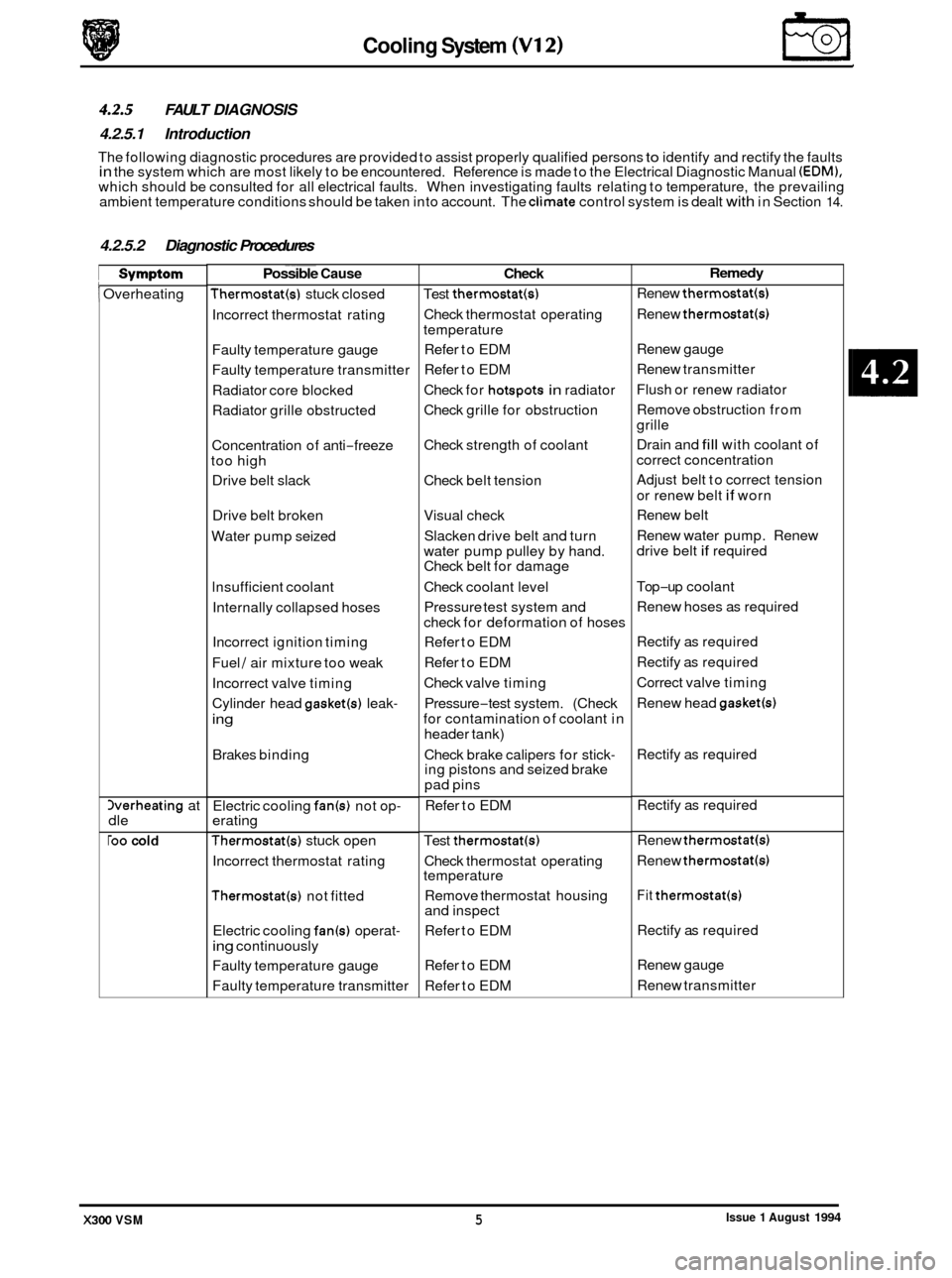
4.2.5.2 Diagnostic Procedures
1
I Symptom ..
Overheating
herheating at
dle
roo cold ~~~
Possible Cause
Thermostat(s) stuck
closed
Incorrect thermostat rating
Faulty temperature gauge
Faulty temperature transmitter
Radiator core blocked
Radiator grille obstructed
Concentration of anti
-freeze
too high
Drive belt slack
Drive belt broken
Water pump seized
lnsuff icient coolant
Internally collapsed hoses
Incorrect ignition timing
Fuel
/ air mixture too weak
Incorrect valve timing
Cylinder head
gasket(s) leak-
ing
Brakes binding
Electric cooling
fan(s) not op- erating
Thermostat(s) stuck open
Incorrect thermostat rating
Thermostatb) not fitted
Electric cooling
fan(s) operat-
ing continuously
Faulty temperature gauge
Faulty temperature transmitter
Check
Cooling System (V12)
4.2.5 FAULT DIAGNOSIS
4.2.5.1 Introduction
The following diagnostic procedures are provided to assist properly qualified persons to identify and rectify the faults in the system which are most likely to be encountered. Reference is made to the Electrical Diagnostic Manual (EDM), which should be consulted for all electrical faults. When investigating faults relating to temperature, the prevailing
ambient temperature conditions should be taken into account. The climate control system is dealt with in Section 14.
Test thermostat(s)
Check thermostat operating
temperature
Refer to EDM
Refer to EDM
Check for
hotspots in radiator
Check grille for obstruction
Check strength of coolant
Check belt tension
Visual check Slacken drive belt and turn
water pump pulley by hand.
Check belt for damage
Check coolant level
Pressure test system and
check for deformation of hoses
Refer to EDM
Refer to EDM
Check valve timing
Pressure
-test system. (Check
for contamination of coolant in
header tank)
Check brake calipers for stick
- ing pistons and seized brake
pad pins
..
Refer to EDM
Test
thermostat(4
Check thermostat operating
temperature
Remove thermostat housing
and inspect
Refer to EDM
Refer to EDM
Refer to EDM
Remedy
Renew thermostat(s)
Renew thermostat(s1
Renew gauge
Renew transmitter
Flush or renew radiator
Remove obstruction from
grille
Drain and
fill with coolant of
correct concentration
Adjust belt to correct tension
or renew belt
if worn
Renew belt
Renew water pump. Renew
drive belt
if required
Top
-up coolant
Renew hoses as required
Rectify as required
Rectify as required
Correct valve timing
Renew head
gasket(s)
Rectify as required
Rectify as required
Renew
thermostat(s1
Renew thermostatb)
Fit thermostat(s)
Rectify as required
Renew gauge
Renew transmitter
Issue 1 August 1994 X300 VSM 5
Page 72 of 521

SECTION CONTENTS
SutiSection Title SRO Page
I
i . .. . . . . . . . . . . . . . Preliminarypage.. . . . . . . . . . . .. . . . . . . . . .. . .. . . . . .. . . . . .. . . .. . . . . . . . . .. . . . . . . . . ... . . . . . i
5.1.1 . . . . . . . . . . . . . Fuel System layout . . . . . . . . . . . . . . . . . . . . . . . . . . . . . . . . . . . . . . . . . . . . . . . . . . . . . . . . . . . . . . . . . . . 1
5.1.2.. . . . . . . . . . . . &era1 Description . . . . . . . . . . . . . . . . . . . . . . . . . . . . . . . . . . . . . . . . . . . . . . . . . . . . . . . . . . . . . . . . . . 3
5.1.3 . . . . . . . . . . . . . Fuel Rail/ Pressure Regulator Valve/ Injectors
(Supercharged), Renew
. . . . . . . . . . . . . . . . . . . . . . . . . . . . . . . . . . . . . . . . . 18.10.01 18.10.02
19.45.11
19.60.13
............. 5
5.1.4
. . . . . . . . . . . . . Fuel Rail / Pressure Regulator Valve / Injectors
(Normally Aspirated), Renew . . . . . . . . . . . . . . . . . . . . . . . . . . . . . . . . . . . . 18.10.0 1
18.10.02
19.45 11
19.60.13 ............. 7
5.1.5 . . . . . . . . . . . . . Purge Control Valve (All Models), Renew . . . . . . . . . . . . . . . . . . . . . . . . . . 17.15.30 . . . . , . . . . . . . . 9
5.1.6 . . . . . . . . . . . . . Throttle Assembly (Supercharged), Renew . . . . . . . . . . . . . . . . . . . . . . . . . . 18.30.17 1 9.70.04
19.70.07 ............ 10
5.1.7. . . . . . . . . . . . . Idle Speed control Valve/ Gaskets (Supercharged), Renew . . . . . . . . . . . . 18.30.74
18.30.77 ............ 11
5.1.8. . . . . . . . . . . . . idle Speed Control Valve/ Gaskets (Normally Aspirated), Renew . . . . . . 18.30.74
18.30.77
............ 12
5.1.9.
. . . . . . . . . . . . Fuel Cut Off Inertia Switch (All Models), Renew.. . . . . . . . . . . , . . . . . . . . 18.30.35 . . . . . . . . . . . . 13
Page 74 of 521
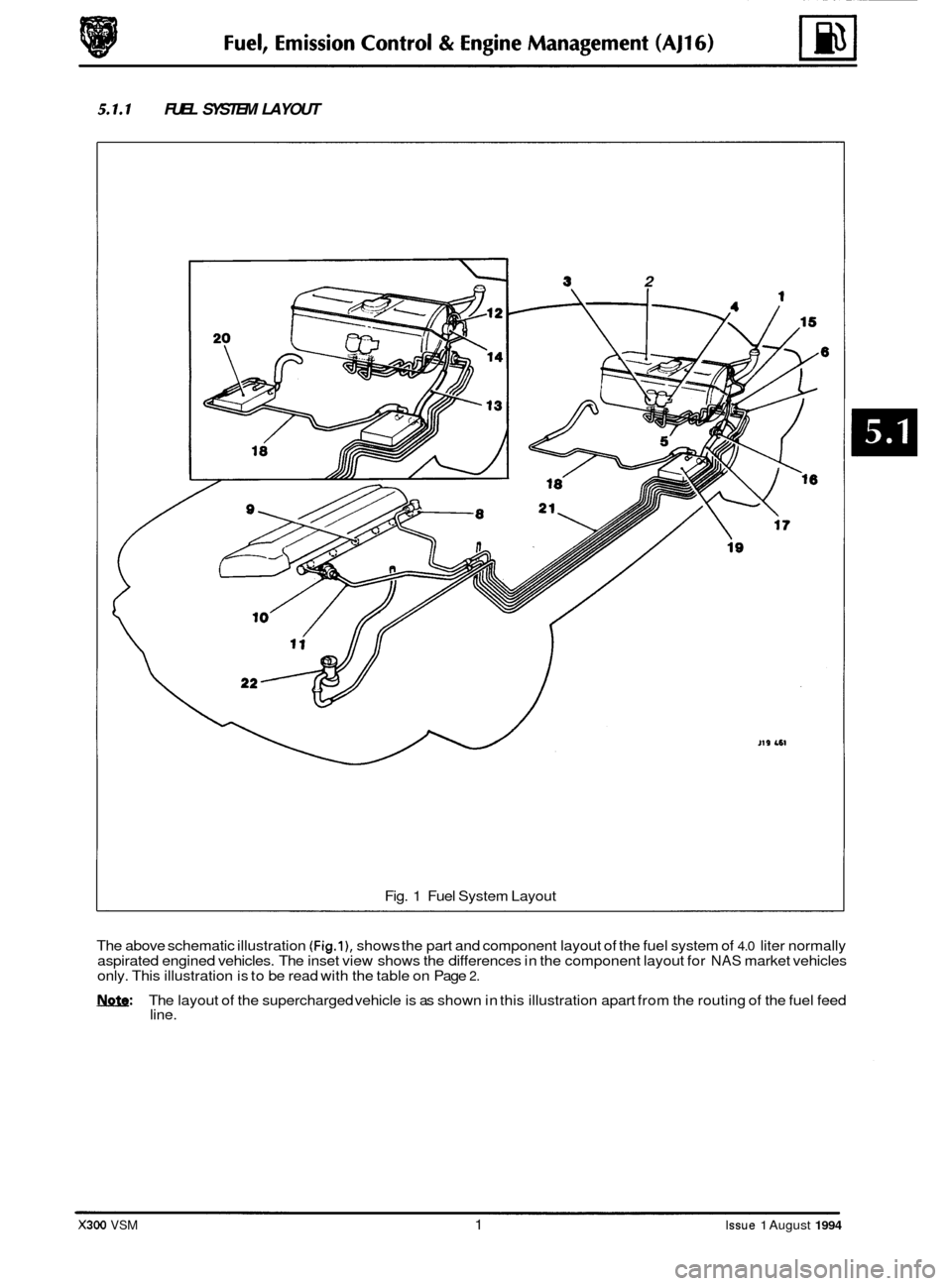
5.1.1 FUEL SYSTEM LAYOUT
0
9 2
Fig. 1 Fuel System Layout
The above schematic illustration
(Fig.l), shows the part and component layout of the fuel system of 4.0 liter normally
aspirated engined vehicles. The inset view shows the differences in the component layout for NAS market vehicles
only. This illustration is to be read with the table on Page 2.
M~Q: The layout of the supercharged vehicle is as shown in this illustration apart from the routing of the fuel feed
line.
X300 VSM 1 Issue 1 August 1994
Page 75 of 521
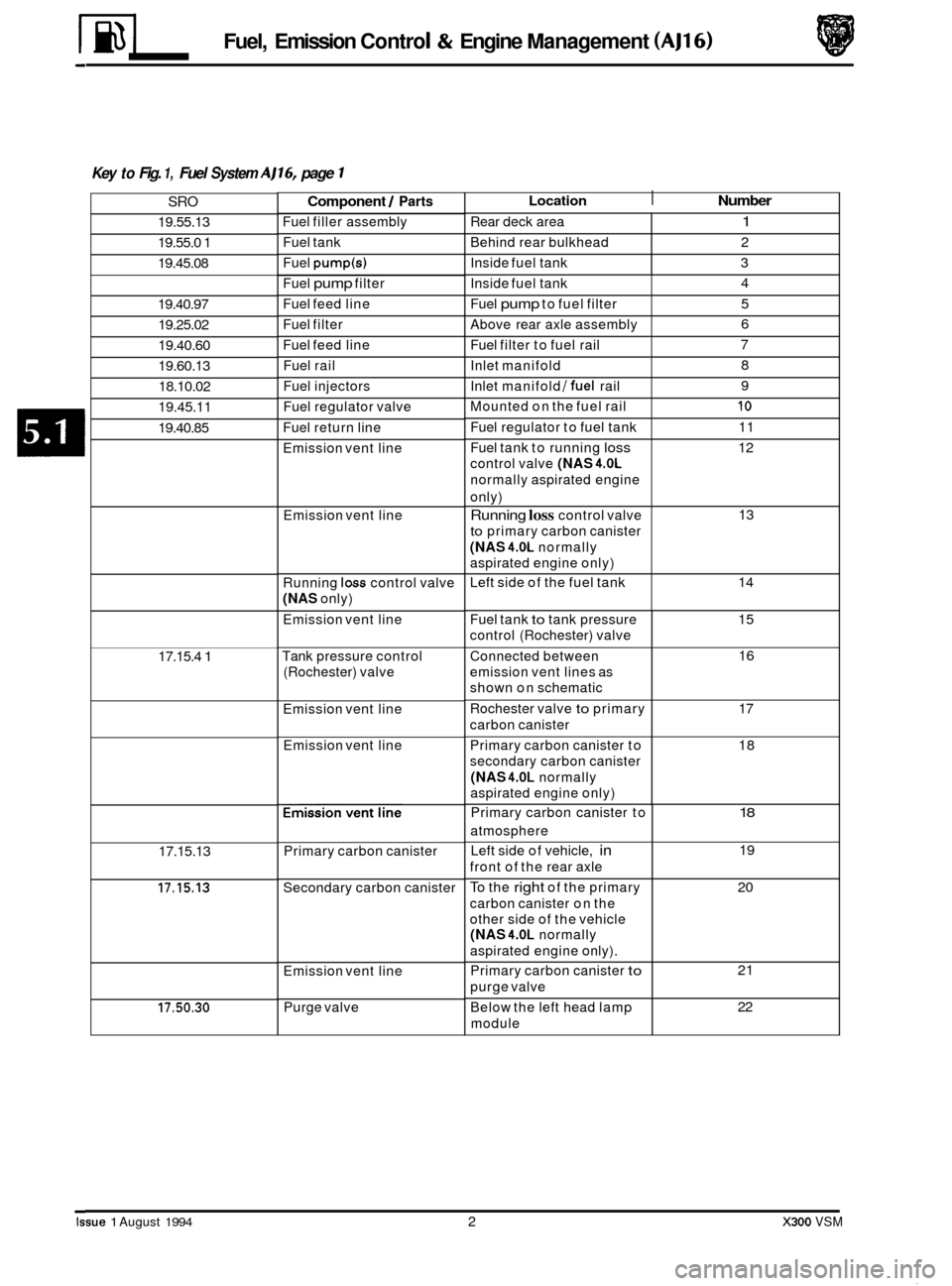
Rear deck area
Behind rear bulkhead
Inside fuel tank 1
2
3
Inside fuel tank
Fuel
pump to fuel filter
Above rear axle assembly
Fuel filter to fuel rail
Inlet manifold
Inlet manifold
/fuel rail
Mounted on the fuel rail
Fuel regulator to fuel tank
Fuel tank to running
loss
control valve (NAS 4.0L
normally aspirated engine
only)
Running loss control valve
to primary carbon canister
(NAS 4.0L normally
aspirated engine only)
Left side of the fuel tank
4
5
6
7 8
9
10
11
12
13
14
Fuel tank to tank pressure
control (Rochester) valve
Connected between
emission vent lines as
shown on schematic
Rochester valve
to primary
carbon canister
Primary carbon canister to
secondary carbon canister
(NAS 4.0L normally
aspirated engine only)
15
16
17
18
Primary carbon canister to
atmosphere
Left side of vehicle,
in
front of the rear axle
To the right of the primary
carbon canister on the
other side of the vehicle
(NAS 4.0L normally
aspirated engine only).
Primary carbon canister
to
purge valve
Below the left head lamp
module
18
19
20
21
22
m Fuel, Emission Contro & Engine Management (AJ16) - .
0
0
0
0
Key to Fig. 1, Fuel System AJ16, page 1
Location I Number Component / Parts
Fuel filler assembly
SRO
19.55.13
19.55.0 1
19.45.08
Fuel tank
Fuel
pump(s)
Fuel pump filter
Fuel feed line
Fuel filter
Fuel feed line
19.40.97
19.25.02
19.40.60
19.60.13 18.10.02
19.45.11
Fuel rail
Fuel injectors
Fuel regulator valve
19.40.85 Fuel return line
Emission vent line
Emission vent line
Running
loss control valve
(NAS only)
Emission vent line
Tank pressure control
(Rochester) valve
17.15.4 1
Emission vent line
Emission vent line
Emission vent line
Primary carbon canister
17.15.13
Secondary carbon canister 17.15.13
Emission vent line
Purge valve
17.50.30
Issue 1 August 1994 2 X300 VSM