KIA CARNIVAL 2007 Owner's Guide
CARNIVAL 2007
KIA
KIA
https://www.carmanualsonline.info/img/2/57045/w960_57045-0.png
KIA CARNIVAL 2007 Owner's Guide
Page 289 of 1575
2007 > 2.7L V6 GASOLINE >
INSPECTION
FUNCTION AND OPERATION PRICIPLE
Knocking is a phenomenon characterized by undesirable vibration and noise and can cause engine damage. Knock
Sensor (KS) senses engine knocking and the two sensors are installed inside the V- valley of the cylinder block. When
knocking occurs, the vibration from the cylinder block is applied as pressure to the piezoelectric element. At this time,
this sensor transfers the voltage signal higher than the specified value to the PCM and the PCM retards the ignition
timing. If the knocking disappears after retarding the ignition timing, the PCM will advance the ignition timing. This
sequential control can improve engine power, torque and fuel economy.
SPECIFICATION
Item Specification
Capacitance (pF) 950 ~ 1,350pF
WAVEFORM
Page 292 of 1575
2007 > 2.7L V6 GASOLINE >
INSPECTION
FUNCTION AND OPERATION PRICIPLE
Crankshaft Position Sensor (CKPS) detects the crankshaft position and is one of the most important sensors of the
engine control system. If there is no CKPS signal input, fuel is not supplied and the main relay does not operate. That
is, vehicle can't run without CKPS signal. This sensor is installed on transaxle housing and generates alternating
current by magnetic flux field which is made by the sensor and the target wheel when engine runs. The target wheel
consists of 58 slots and 2 missing slots on 360 CA (Crank Angle).
WAVEFORM
CIRCUIT DIAGRAM
Page 299 of 1575

2007 > 2.7L V6 GASOLINE >
INSPECTION
FUNCTION AND OPERATION PRICIPLE
Based on information from various sensors, the PCM measures the fuel injection amount. The fuel injector is a
solenoid- operated valve and the fuel injection amount is controlled by length of time that the fuel injector is held open.
The PCM controls each injector by grounding the control circuit. When the PCM energizes the injector by grounding
the control circuit, the circuit voltage should be low (theoretically 0V) and the fuel is injected. When the PCM de-
energizes the injector by opening control circuit, the fuel injector is closed and circuit voltage should momentarily peak.
If an injector connector is disconnected for more than 46 seconds while the engine runs, the PCM will determine
that the cylinder is misfiring and cut fuel supply. So be careful not to exceed 46 seconds. But the engine runs
normally in 10 seconds after turning the ignition key off.
SPECIFICATION
Item Specification
Coil Resistance (Ω) 13.8 ~ 15.2Ω at 20°C (68°F)
CIRCUIT DIAGRAM
Page 312 of 1575

MODE 1FORCED ENGINE
SHUTDOWN Engine stop algorithm procedure
a. Fatal PCM internal programming error
b. Faulty intake system or throttle body
MODE 2 FORCED IDLE &
POWER
MANAGEMENT Forced idle state controlled by
fuel quantity regulation and
ignition timing adjustment a.
ETC system can't control engine power
via throttle device
b. Disabled throttle control or broken throttle
position information
MODE 3 FORCED IDLE Forced idle state and no response
for accelerator activation a.
No information about the accelerator
position
a. Malfuctioning APS 1 and 2, faulty A/D
converter or internal controller
MODE 4 LIMIT
PERFORMANCE & POWER
MANAGEMENT Engine power is determined by
accelerator position and idle
power requirement (Limited
vehicle running)
a.
ETC system can't securely control engine
power
MODE 5 LIMIT
PERFORMANCE a.
Engine power varies with
accelerator position, but driver
perceives lack of engine
power.
b. MIL ON (Normal vehicle
running) a.
Not reliable accelerator position signal or
bad maximum power generation
a. Faulty APS, ignition voltage or internal
controller
MODE 6 NORMALNormal
COMPONENT INSPECTION
1.Connect a scantool on Diagnoisis Link Connector (DLC).
2. Start engine and check output voltages of TPS 1 and 2 at C.T and W.O.T.
Condition Output Voltage (V)
TPS 1 TPS 2
C.T 0.25 ~ 0.9V Min. 4.0V
W.O.T Min. 4.0V 0.25 ~ 0.9V
3. Turn ignition switch OFF and disconnect the scantool from the DLC.
4. Disconnect ETC module connector and measure resistance between ETC module terminals 4 and 1 (TPS 1).
5. Measure resistance between ETC module terminals 7 and 6 (TPS 2).
Specification: Refer to SPECIFICATION.
ETC MOTOR
1.Disconnect ETC module connector and measure resistance between ETC module terminals 5 and 8.
Page 314 of 1575
Page 316 of 1575
2007 > 2.7L V6 GASOLINE >
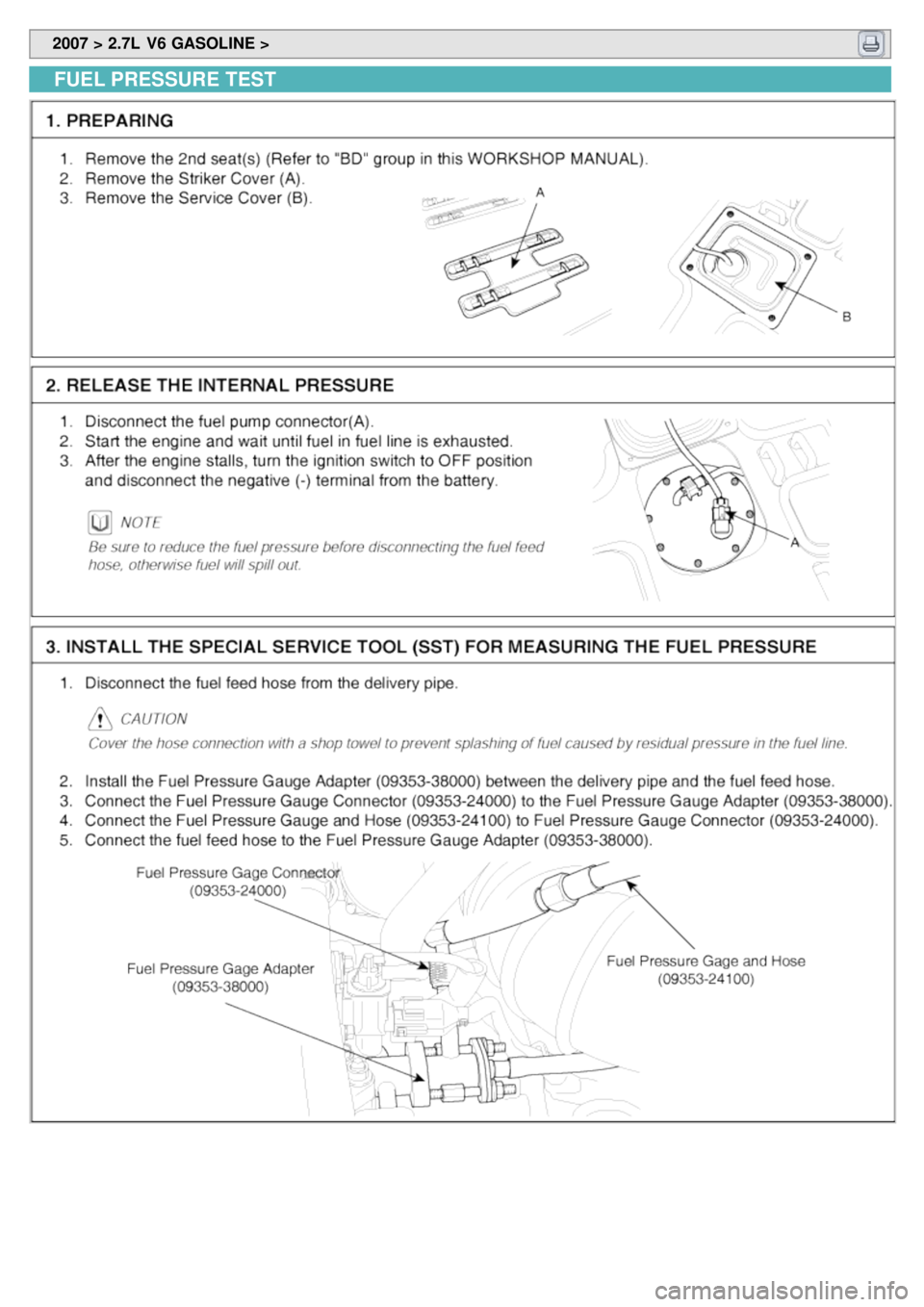
FUEL PRESSURE TEST
Page 319 of 1575
Page 320 of 1575
2007 > 2.7L V6 GASOLINE >
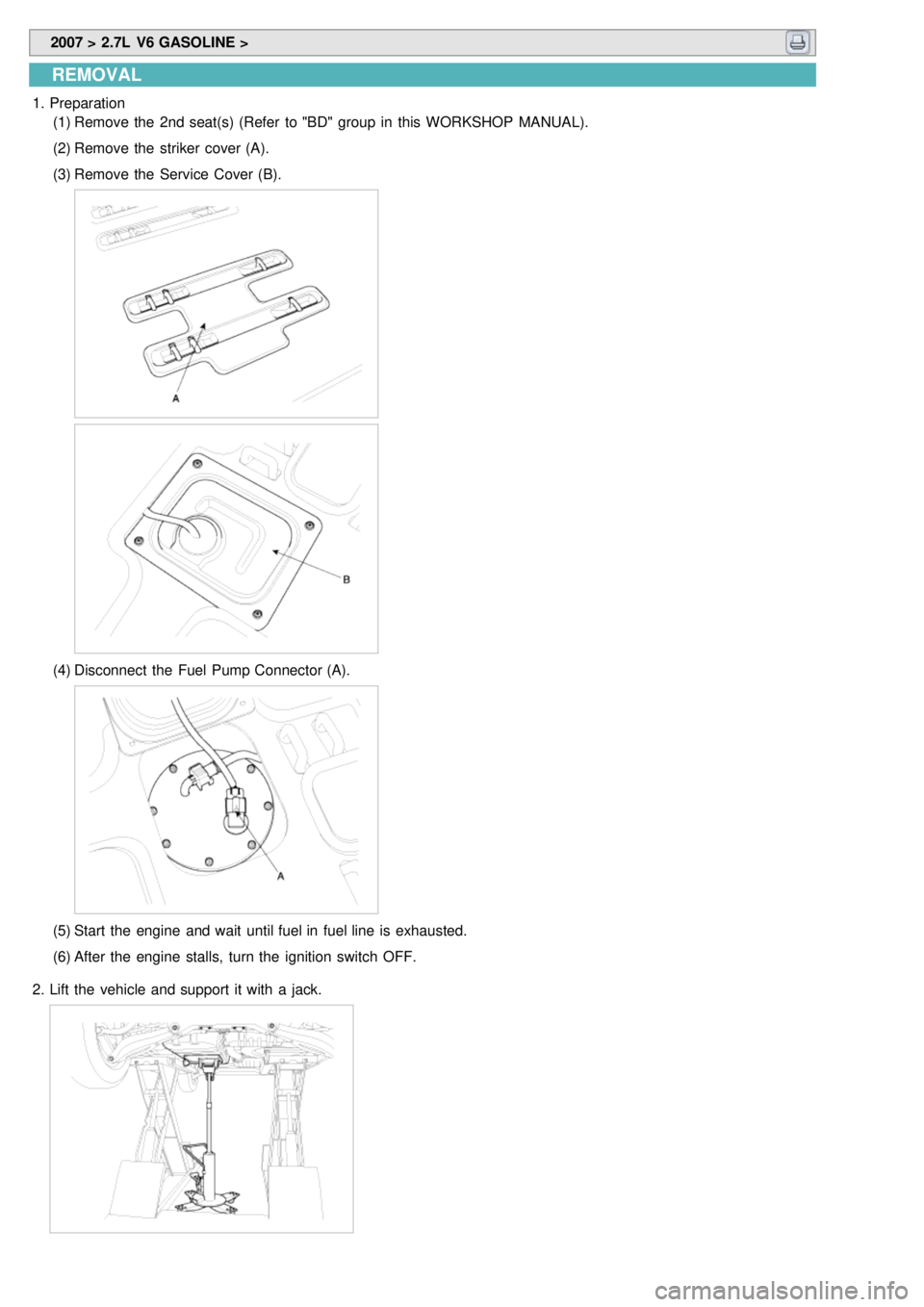
REMOVAL
1.Preparation
(1) Remove the 2nd seat(s) (Refer to "BD" group in this WORKSHOP MANUAL).
(2) Remove the striker cover (A).
(3) Remove the Service Cover (B).
(4)Disconnect the Fuel Pump Connector (A).
(5)Start the engine and wait until fuel in fuel line is exhausted.
(6) After the engine stalls, turn the ignition switch OFF.
2. Lift the vehicle and support it with a jack.
Page 321 of 1575
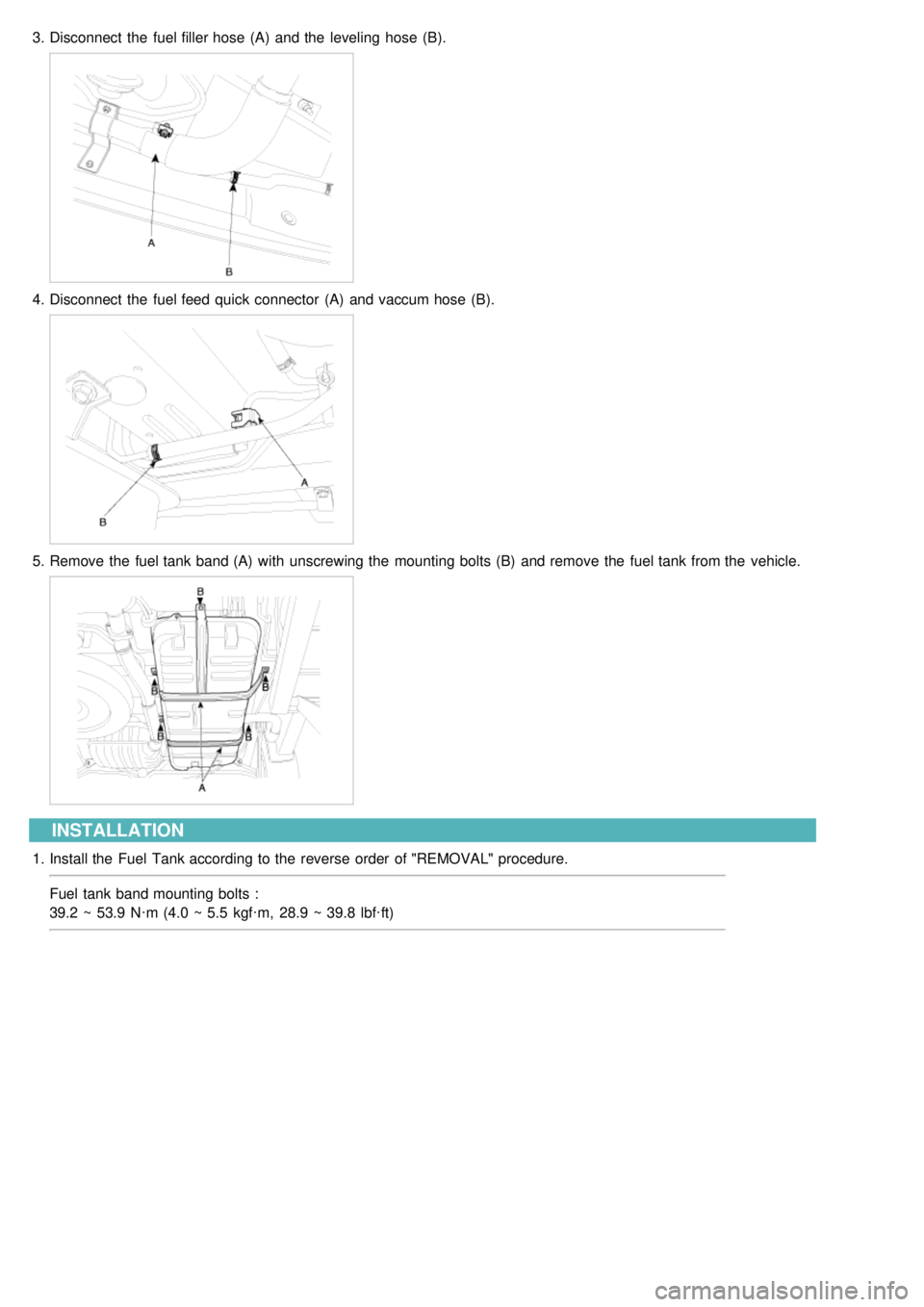
3.Disconnect the fuel filler hose (A) and the leveling hose (B).
4.Disconnect the fuel feed quick connector (A) and vaccum hose (B).
5.Remove the fuel tank band (A) with unscrewing the mounting bolts (B) and remove the fuel tank from the vehicle.
INSTALLATION
1.Install the Fuel Tank according to the reverse order of "REMOVAL" procedure.
Fuel tank band mounting bolts :
39.2 ~ 53.9 N·m (4.0 ~ 5.5 kgf·m, 28.9 ~ 39.8 lbf·ft)
Page 322 of 1575