fuel KIA CARNIVAL 2007 Service Manual
[x] Cancel search | Manufacturer: KIA, Model Year: 2007, Model line: CARNIVAL, Model: KIA CARNIVAL 2007Pages: 1575, PDF Size: 44.86 MB
Page 323 of 1575
2007 > 2.7L V6 GASOLINE >
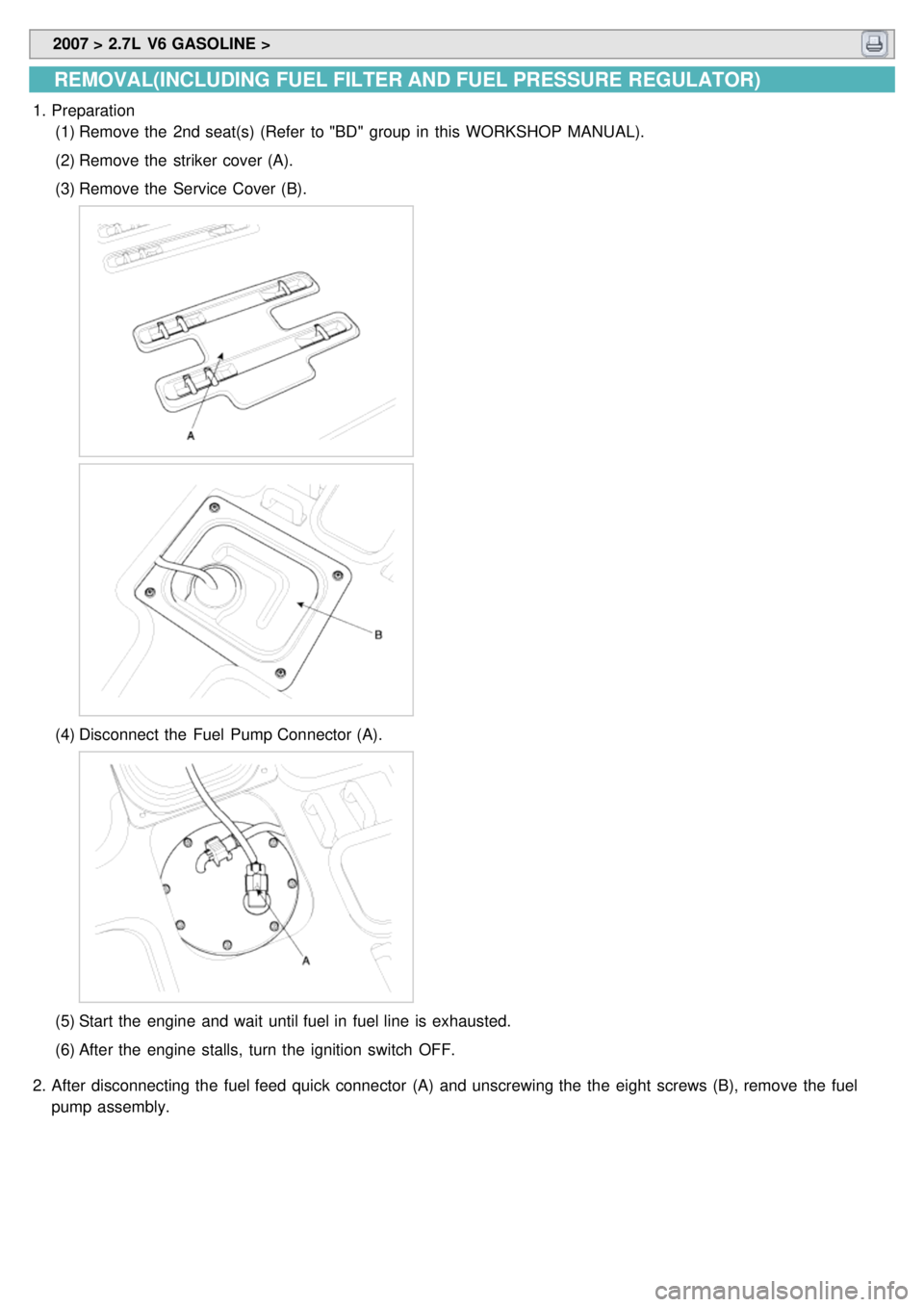
REMOVAL(INCLUDING FUEL FILTER AND FUEL PRESSURE REGULATOR)
1.Preparation
(1) Remove the 2nd seat(s) (Refer to "BD" group in this WORKSHOP MANUAL).
(2) Remove the striker cover (A).
(3) Remove the Service Cover (B).
(4)Disconnect the Fuel Pump Connector (A).
(5)Start the engine and wait until fuel in fuel line is exhausted.
(6) After the engine stalls, turn the ignition switch OFF.
2. After disconnecting the fuel feed quick connector (A) and unscrewing the the eight screws (B), remove the fuel
pump assembly.
Page 324 of 1575
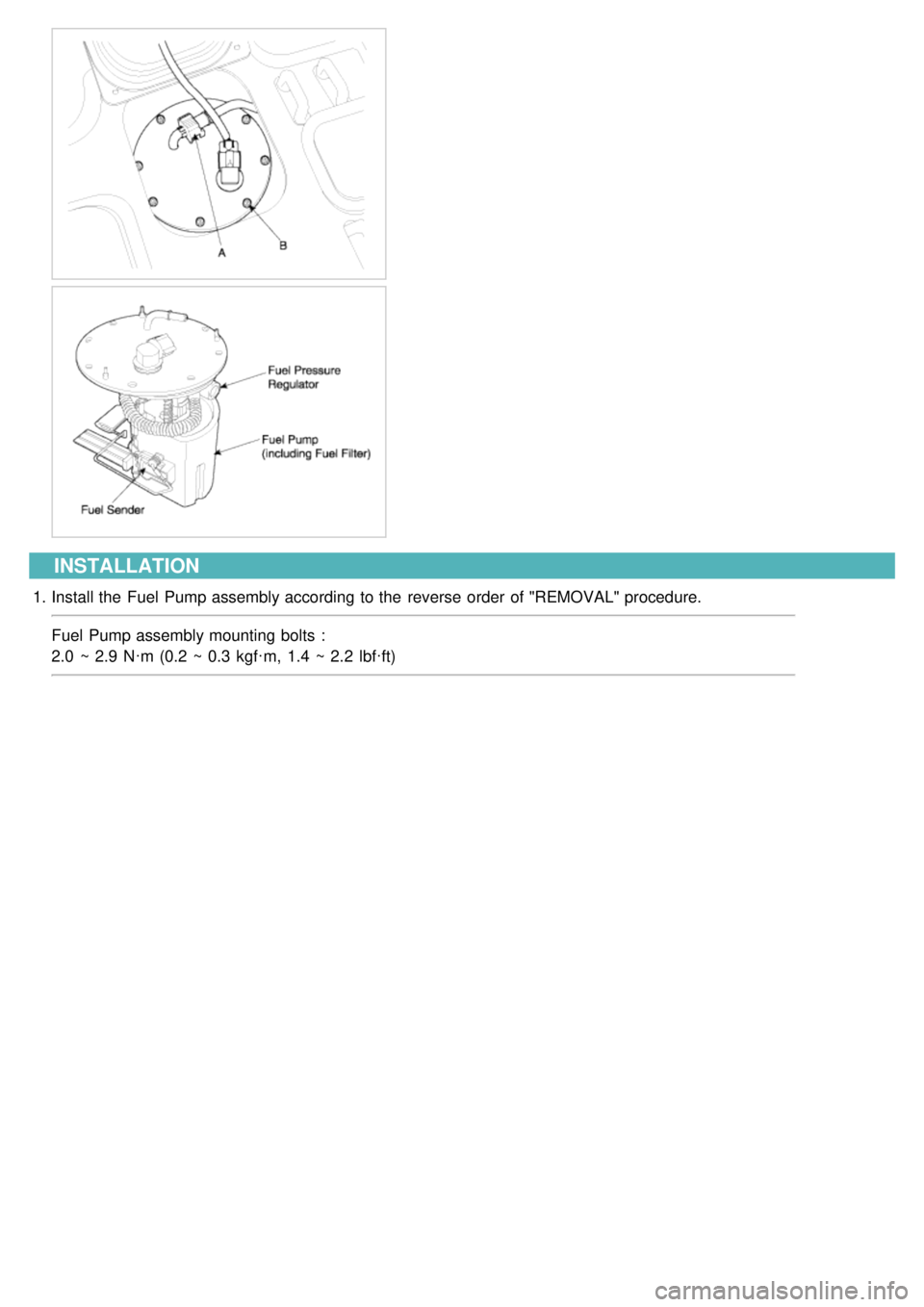
INSTALLATION
1.Install the Fuel Pump assembly according to the reverse order of "REMOVAL" procedure.
Fuel Pump assembly mounting bolts :
2.0 ~ 2.9 N·m (0.2 ~ 0.3 kgf·m, 1.4 ~ 2.2 lbf·ft)
Page 348 of 1575

2007 > 2.7L V6 GASOLINE >
Description
The automatic transmission is a combination of 3 - element 2 - phase 1 - stage torque converter and double shaft
electrocally - controlled unit which provides 4 speeds forward and 1 reverse. To improve the efficiency of power
transmission, the line pressure control was changed applying “Variable Force Solenoid (VFS) valve” on this model.
However, adopting VFS on this model, the line pressure is variably changed according to TPS and the vehicle speed,
this will enable more improved efficiency of power transmission and fuel consumption.
Characteristics
Some of the characteristics include:
▶Different power transfer
▶Different component layout
▶New shift logic(HIVEC) to improve shift feeling
▶Position of Valve Body
▶Variable shift pattern
▶Communication protocol and method
▶Step gate type shift lever.
Item Details
Weight Reduction 1. Aluminum oil pump
a. 2.3kg Approx
2. Pressed parts a. Retainer and hub of brakes and clutches
b. Carrier of planetary gear set
Better shift quality 1. Independent control of clutches and brakes enabled better control of
hydraulic pressure and skiped shifts (4 to 2, 3 to 1)
2. During N to D or N to R shift, feedback control adopted.
3. When starting from Creep condition, reduction of shock.(Creep condition is
controlled with 1st gear)
4. Solenoid valve frequency is increased for more accurate control. 35Hz to
61.3Hz except DCCSV that is 35Hz and VFS that is 600Hz.
5. HIVEC adoption for better shift feeling.
6. Variable shift pattern.
Increase in Power train efficiency 1. Fully Variable Line Pressure
2. VFS(Variable Force Solenoid)
- Manual shifting possible
- Step gate type shift lever
Page 584 of 1575

CHECKING POWER STEERING BELT TENSION
Refer to EM group(Timing system).
CHECKING POWER STEERING FLUID LEVEL
1.Position the vehicle on a level surface.
2. Start the engine. With the vehicle kept stationary, turn the steering wheel several times continuously to raise the
fluid temperature to 50- 60°C (122 - 140°F).
3. With the engine at idle, turn the steering wheel fully clockwise and counter- clockwise several times.
4. Make sure that there is no foaming or cloudiness in the reservoir fluid.
5. Stop the engine and check for any difference in fluid level between a stationary and a running engine.
a.If the fluid level varies 5 mm (0.2 in) or more, bleed the system again.
b. If the fluid level suddenly rises after stopping the engine, further bleeding is required.
c. Incomplete bleeding will produce a chattering sound in the pump and noise in the flow control valve, and
lead to decreased durability of the pump.
REPLACING POWER STEERING FLUID
1.Jack up the front wheels and support them with jackstands.
2. Disconnect the return hose from the oil reservoir and plug the oil reservoir.
3. Connect a vinyl hose to the disconnected return hose, and drain the oil into a container.
4. Remove the fuel pump fuse, then start the engine and wait for the engine to stall. Next, while operating the starting
motor intermittently, turn the steering wheel all the way to the left and then to the right several times to drain the
fluid.
5. Connect the return hoses, then fill the oil reservoir with the specified fluid.
6. Reinstall the fuel pump fuse.
7. Start the engine. Check for oil leakage.
8. Stop the engine.
9. Bleed the system.
Power steering fluid type : PSF - 3
Total quantity : Approx 1.1 liter
AIR BLEEDING
1.Remove the fuel pump fuse, then start the engine and wait for the engine to stall. Next, while operating the starting
motor intermittently (for 15 ~ 20 seconds), turn the steering wheel all the way to the left and then to the right five or
six times.
Page 585 of 1575
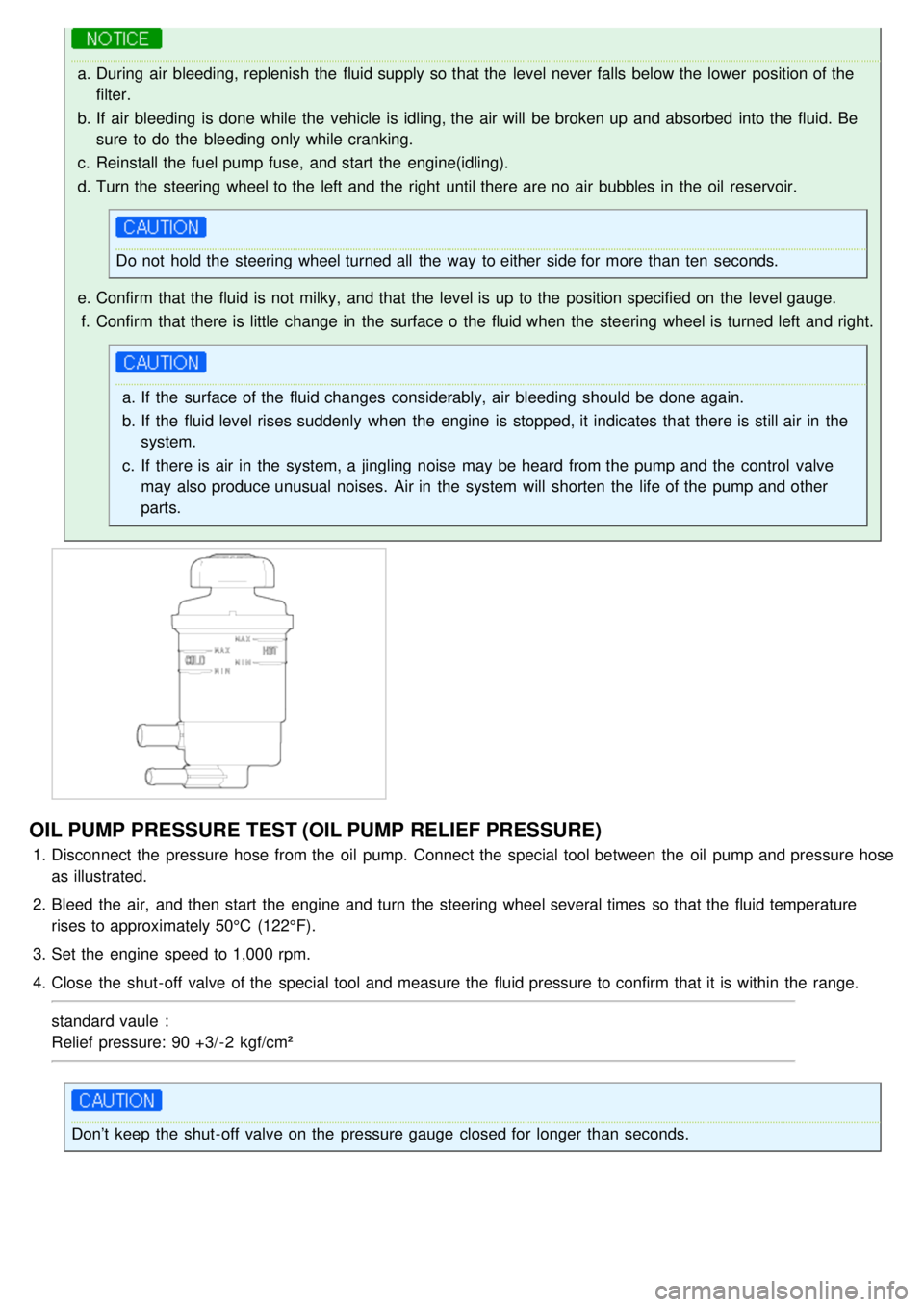
a.During air bleeding, replenish the fluid supply so that the level never falls below the lower position of the
filter.
b. If air bleeding is done while the vehicle is idling, the air will be broken up and absorbed into the fluid. Be
sure to do the bleeding only while cranking.
c. Reinstall the fuel pump fuse, and start the engine(idling).
d. Turn the steering wheel to the left and the right until there are no air bubbles in the oil reservoir.
Do not hold the steering wheel turned all the way to either side for more than ten seconds.
e. Confirm that the fluid is not milky, and that the level is up to the position specified on the level gauge.
f. Confirm that there is little change in the surface o the fluid when the steering wheel is turned left and right.
a. If the surface of the fluid changes considerably, air bleeding should be done again.
b. If the fluid level rises suddenly when the engine is stopped, it indicates that there is still air in the
system.
c. If there is air in the system, a jingling noise may be heard from the pump and the control valve
may also produce unusual noises. Air in the system will shorten the life of the pump and other
parts.
OIL PUMP PRESSURE TEST (OIL PUMP RELIEF PRESSURE)
1.Disconnect the pressure hose from the oil pump. Connect the special tool between the oil pump and pressure hose
as illustrated.
2. Bleed the air, and then start the engine and turn the steering wheel several times so that the fluid temperature
rises to approximately 50°C (122°F).
3. Set the engine speed to 1,000 rpm.
4. Close the shut- off valve of the special tool and measure the fluid pressure to confirm that it is within the range.
standard vaule :
Relief pressure: 90 +3/- 2 kgf/cm²
Don’t keep the shut- off valve on the pressure gauge closed for longer than seconds.
Page 726 of 1575
Fuel Fired Heater
Page 728 of 1575
2007 > 2.7L V6 GASOLINE >
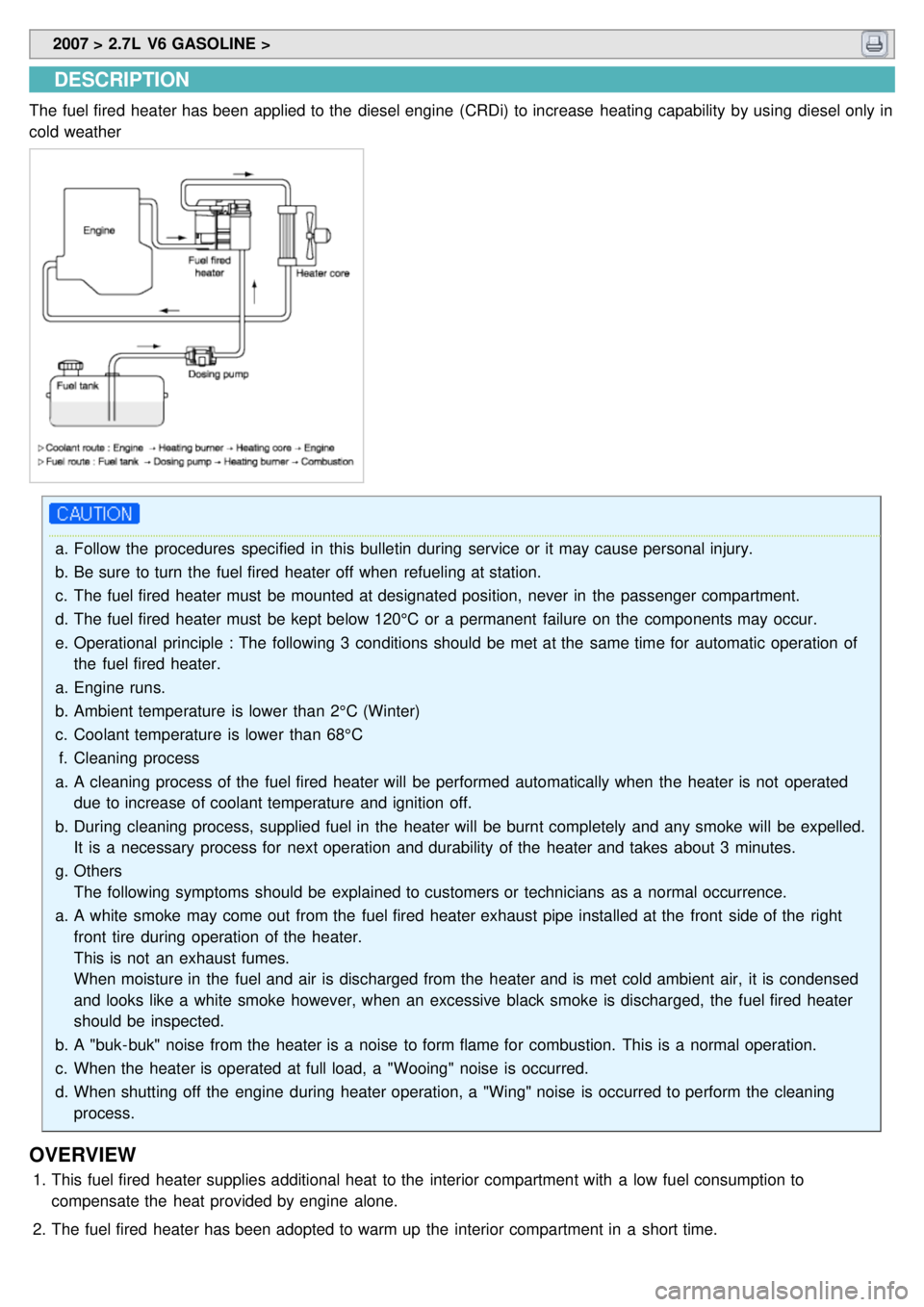
DESCRIPTION
The fuel fired heater has been applied to the diesel engine (CRDi) to increase heating capability by using diesel only in
cold weather
a.Follow the procedures specified in this bulletin during service or it may cause personal injury.
b. Be sure to turn the fuel fired heater off when refueling at station.
c. The fuel fired heater must be mounted at designated position, never in the passenger compartment.
d. The fuel fired heater must be kept below 120°C or a permanent failure on the components may occur.
e. Operational principle : The following 3 conditions should be met at the same time for automatic operation of
the fuel fired heater.
a. Engine runs.
b. Ambient temperature is lower than 2°C (Winter)
c. Coolant temperature is lower than 68°C
f. Cleaning process
a. A cleaning process of the fuel fired heater will be performed automatically when the heater is not operated
due to increase of coolant temperature and ignition off.
b. During cleaning process, supplied fuel in the heater will be burnt completely and any smoke will be expelled.
It is a necessary process for next operation and durability of the heater and takes about 3 minutes.
g. Others
The following symptoms should be explained to customers or technicians as a normal occurrence.
a. A white smoke may come out from the fuel fired heater exhaust pipe installed at the front side of the right
front tire during operation of the heater.
This is not an exhaust fumes.
When moisture in the fuel and air is discharged from the heater and is met cold ambient air, it is condensed
and looks like a white smoke however, when an excessive black smoke is discharged, the fuel fired heater
should be inspected.
b. A "buk- buk" noise from the heater is a noise to form flame for combustion. This is a normal operation.
c. When the heater is operated at full load, a "Wooing" noise is occurred.
d. When shutting off the engine during heater operation, a "Wing" noise is occurred to perform the cleaning
process.
OVERVIEW
1.This fuel fired heater supplies additional heat to the interior compartment with a low fuel consumption to
compensate the heat provided by engine alone.
2. The fuel fired heater has been adopted to warm up the interior compartment in a short time.
Page 729 of 1575

3.The two coolant temperature sensors are installed to the heater inner. The sensor valves determine heater
operation.
4. One of the temperature sensors functions to prevent the heater from overheating.
If the sensor temperature valve exceeds 125°C, the fuel will be cut and the heater will be deactivated by the
determination of the overheating of the heater.
The other temperature sensor determines the operation mode of the fuel fired heater.The temperature of this
sensor enables to activate the heater at full load(5kw) or half load(2.5kw).
• The coolant temperature shown on the above Figure is the value of the inner sensor and the actual coolant
temperature is higher about 5°C ~7°C than the above value.
OPERATION
Switch on/ Operation start
The fuel fired heater is operated when the coolant temperature is below 68°C and the ambient temperature is below
2°C after starting the engine.
At this time, the glow plug and combustion air fan are operated first and after 30 seconds, the dosing pump is
operated with stopping the combustion fan for 3 seconds.
After that, the operation of the fan increases continuously until it approaches to full load within 56 seconds. If fuel
supply reaches to full load the glow plug does not operate and the operation of the fan reaches to full load.
After that the glow plug monitors ignition condition as a flame sensor for 45 seconds.
The above operation procedure is done automatically and in case the ignition fails, the above operation will be done
again automatically.
If the condition of ignition failure sustains continuously, fuel supply and fan operation will be stopped and error codes
will be stored to find cause of failure.
Generally, the cause of ignition failure during combustion is caused by the automatic re- operation of the above
procedure.
Operation for heating
The fuel fired heater operates at full load when the coolant temperature is below 68°C and the ambient temperature is
below 2°C after starting the engine.
It operates at half load when the coolant temperature is 74°C and it operates at idle mode when the coolant
temperature is 78°C.
The fuel fired heater during the transformation process does a cleaning function from the half mode to the idle mode.
At idle mode, all components do not work.
The fuel fired heater operating at idle mode turns into the half load when the coolant temperature is 74°C. At this time,
if the coolant temperature drops again below 68°C, the heater operates with full load and turns into the idle mode if
the temperature is 78°C.
This serial operating process is performed automatically.
Key switch off / Operation stop
The fuel fired heater ECU stops the operation of the fuel pump and cuts fuel supply when shutting off the engine
during the heater operation.
The heater conducts cleaning operation at this time.
This is a process of burning the fuel completely supplied in the heater inner.
In this process, the glow plug and combustion air fan are operated.
Page 731 of 1575

2007 > 2.7L V6 GASOLINE >
INSPECTION
OPERATION TEST
Fuel-fired heater operation test by force using Hi-Scan
1. Start the engine.
2. Connect the Hi - Scan to the vehicle.
3. Select "SORENTO" and then select "FUEL FIRED HEATER".
4. Select "04. ACTUATION TEST" mode.
5. Select "PREFILLING + HEATING" to conduct the performance test after replacing the fuel fired heater system.
Fuel supply and heating will be initiated if the "F1 key STRT" is pressed.
However, a repair or replacement of the components related to the fuel line system in the fuel- fired heater were not
done, operate the component by force after selecting the appropriate item from the menu screen.
Do not operate the system by force with selecting the “ PREFILLING + HEATING ” option if no repair for the
fuel line relating components has been done.
This means the fuel is in the fuel line.If an excessive fuel is supplied, it may cause smoke and abnormal
"Banging" noise when the fuel is burned.
If the "F2 KEY STOP" is pressed, operation test is stopped.
For self - diagnosis test and sensors outputs during compulsory operation test, press "ESC KEY".
When a self - diagnosis test is completed, disconnect the self - diagnosis connector or press "F2 KEY STOP"
from the "PREFILLING + HEATING" menu to stop the compulsory operation.
In case of selecting the individual part (ex. Combustion air fan, water pump, ), press "ESC KEY" to stop the
test.
In case of selecting the "PREFILLING + HEATING" option, about 2 minutes are required to conduct cleaning
process after pressing the "F2 KEY STOP".
It is a normal process to burn the fuel left in the fuel line.
6. To conduct self diagnosis test, press "ESC" and then "01. DIAGNOSTIC TROUBLE CODES" option.
7.Select "02. CURRENT DATA" to view the current status of the components.
Page 732 of 1575
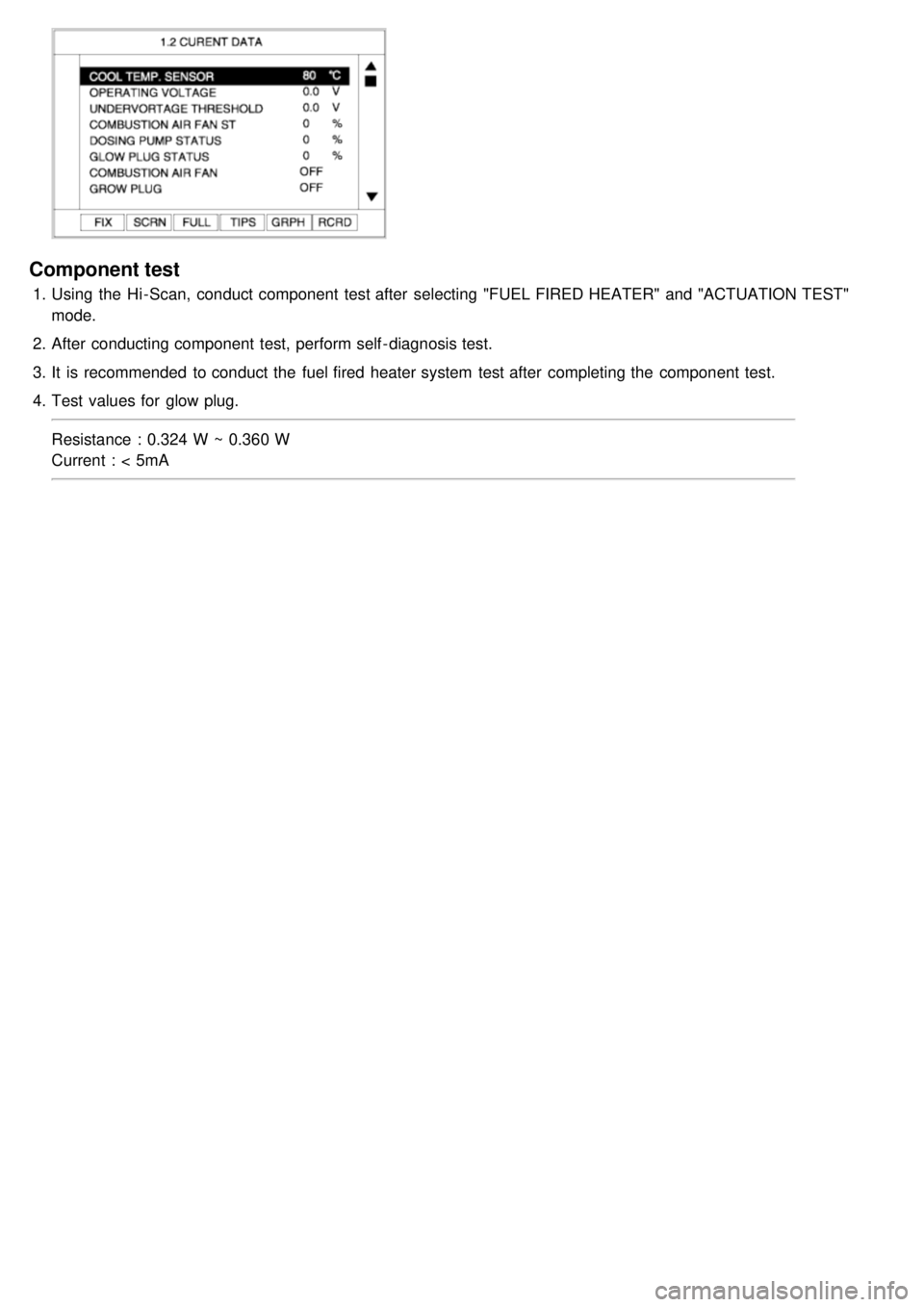
Component test
1.Using the Hi - Scan, conduct component test after selecting "FUEL FIRED HEATER" and "ACTUATION TEST"
mode.
2. After conducting component test, perform self - diagnosis test.
3. It is recommended to conduct the fuel fired heater system test after completing the component test.
4. Test values for glow plug.
Resistance : 0.324 W ~ 0.360 W
Current : < 5mA