brake sensor KIA SPORTAGE 2020 User Guide
[x] Cancel search | Manufacturer: KIA, Model Year: 2020, Model line: SPORTAGE, Model: KIA SPORTAGE 2020Pages: 624, PDF Size: 15.41 MB
Page 379 of 624
593
Driving your vehicle
Cancelled automatically
The driver's door is opened.
The shift lever is shifted to N(Neutral), R (Reverse) or P (Paking).
The EPB (electronic parking brake) is applied.
The vehicle speed is over 120 mph (190 km/h).
The ESC, ABS or TCS is operating.
The ESC is turned off.
The sensor or the cover is dirty or covered with foreign matter.
The vehicle is stopped for a certain period of time.
The driver starts driving by pushing the toggle switch up (RES+)/down
(SET-) or depressing the accelera-
tor pedal, after stopping the vehicle
with a vehicle stopped far away in
front.
The accelerator pedal is continu- ously depressed for long time.
When engine is stopped by ISG (Idle Stop and Go) mode.
The engine speed is in dangerous range. When the braking control is operat-
ed for Forward Collision-Avoidance
Assist(FCA).
The driver starts driving by pushing the toggle switch up (RES+)/down
(SET-) or depressing the accelera-
tor pedal, after the vehicle is
stopped by the Smart Cruise
Control system with no other vehi-
cle ahead.
The vehicle stops and goes repeat- edly for a long period of time.
The engine performance is abnor- mal. Each of these actions will cancel the
smart cruise control operation. (the
set speed and vehicle to vehicle dis-
tance on the LCD display will go off.)
If the smart cruise control is can-
celled automatically, the smart cruise
control will not resume even though
the RES+ or SET-lever is moved.
✽ ✽
NOTICE
If the smart cruise control is can-
celled, take your vehicle to an
authorized Kia dealer and have the
system checked.
Page 385 of 624
599
Driving your vehicle
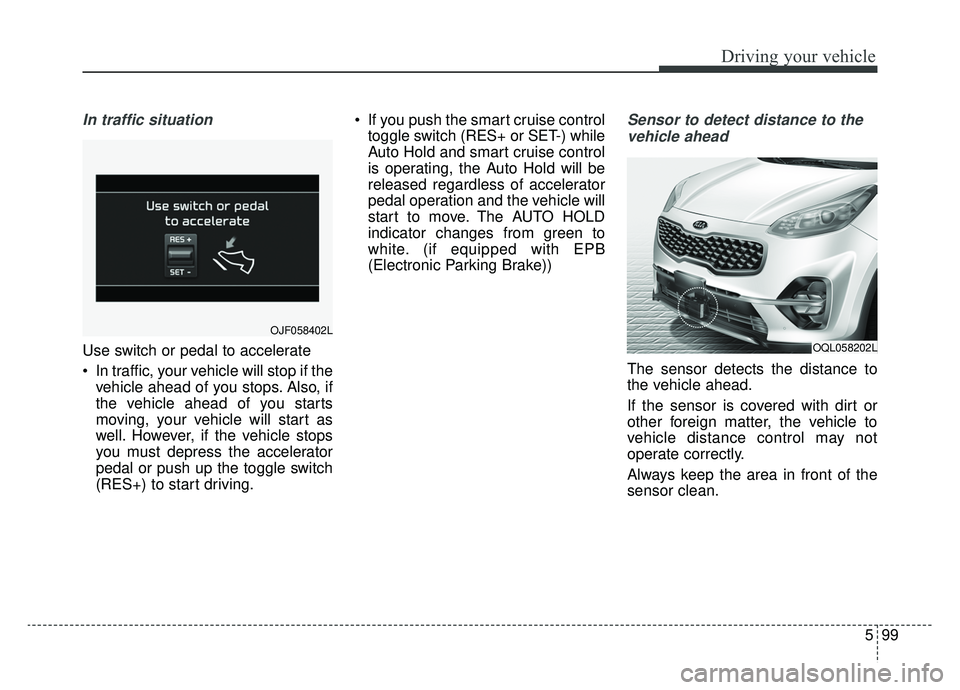
In traffic situation
Use switch or pedal to accelerate
In traffic, your vehicle will stop if thevehicle ahead of you stops. Also, if
the vehicle ahead of you starts
moving, your vehicle will start as
well. However, if the vehicle stops
you must depress the accelerator
pedal or push up the toggle switch
(RES+) to start driving. If you push the smart cruise control
toggle switch (RES+ or SET-) while
Auto Hold and smart cruise control
is operating, the Auto Hold will be
released regardless of accelerator
pedal operation and the vehicle will
start to move. The AUTO HOLD
indicator changes from green to
white. (if equipped with EPB
(Electronic Parking Brake))
Sensor to detect distance to the
vehicle ahead
The sensor detects the distance to
the vehicle ahead.
If the sensor is covered with dirt or
other foreign matter, the vehicle to
vehicle distance control may not
operate correctly.
Always keep the area in front of the
sensor clean.
OJF058402L
OQL058202L
Page 391 of 624
5105
Driving your vehicle
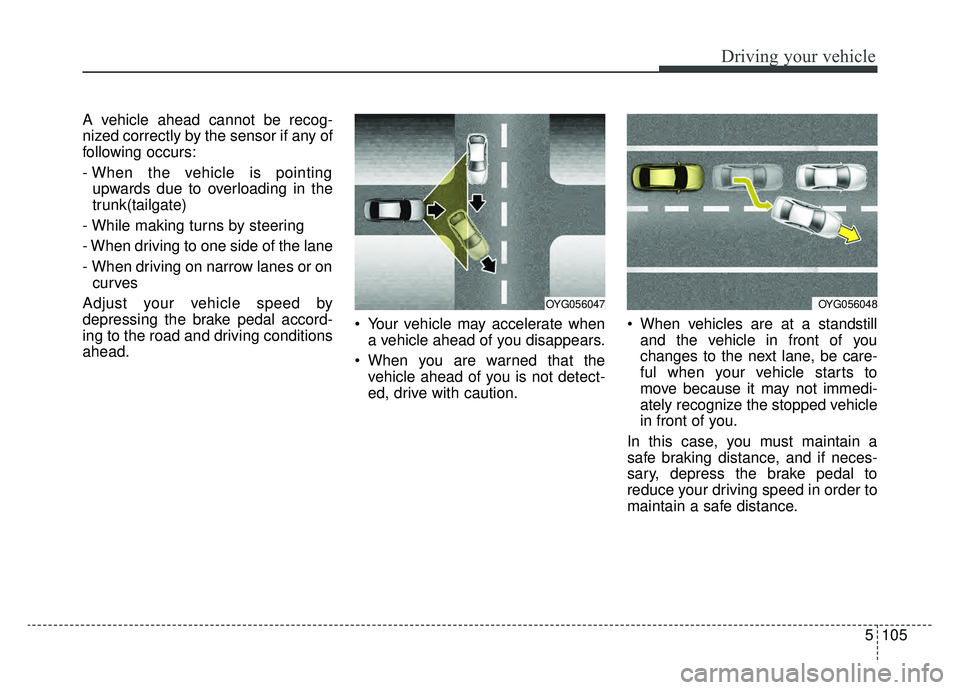
A vehicle ahead cannot be recog-
nized correctly by the sensor if any of
following occurs:
- When the vehicle is pointingupwards due to overloading in the
trunk(tailgate)
- While making turns by steering
- When driving to one side of the lane
- When driving on narrow lanes or on curves
Adjust your vehicle speed by
depressing the brake pedal accord-
ing to the road and driving conditions
ahead. Your vehicle may accelerate when
a vehicle ahead of you disappears.
When you are warned that the vehicle ahead of you is not detect-
ed, drive with caution. When vehicles are at a standstill
and the vehicle in front of you
changes to the next lane, be care-
ful when your vehicle starts to
move because it may not immedi-
ately recognize the stopped vehicle
in front of you.
In this case, you must maintain a
safe braking distance, and if neces-
sary, depress the brake pedal to
reduce your driving speed in order to
maintain a safe distance.
OYG056047OYG056048
Page 412 of 624
Driving your vehicle
126
5
If the vehicle detected by the sensors
approaches from the rear left/right
side of your vehicle, the warning
chime will sound, the warning light
on the outside rearview mirror will
blink and a message will appear on
the LCD display.
The warning will stop when:
- The vehicle moving at the rear
left/right side of your vehicle is not
in the detection range.
- The vehicle is right behind your vehicle.
- The vehicle is not driving towards your vehicle.
- The vehicle’s approaching speed is decreased.
WARNING
Drive safely even though thevehicle is equipped with a
Rear Cross-Traffic Collision
Warning (RCCW) System. Do
not solely rely on the system
but check your surrounding
when backing the vehicle up.
The RCCW system may not
detect every object alongside
the vehicle.
The driver is responsible for accurate brake control.
Always pay extreme caution while driving. The Rear Cross-
Traffic Collision Warning
System may not operate prop-
erly or unnecessarily operate
in accordance with your driv-
ing situations.
CAUTION
If the operating conditions of RCCW are satisfied, a warningis issued every time a vehiclecomes to the rear side, even ifyour vehicle is stopped (vehi-cle speed 0 mph (0 km/h)).
The system's warning may not operate properly if theleft/right of your vehicle's rearbumper is blocked by a vehi-cle or obstacle.
The driver should always use extreme caution while operat-ing the vehicle, whether or notthe warning light on the out-side rearview mirror illumi-nates or there is a warningalarm.
Playing the vehicle audio sys- tem at high volume may pre-vent occupants from hearingthe system's warning sounds.
The warning of the Rear Cross- Traffic Collision WarningSystem may not sound if warn-ing sounds from other systemsare activated.
Page 466 of 624
613
What to do in an emergency
You may not be able to identify a low
tire by simply looking at it. Always
use a good quality tire pressure
gauge to measure the tire's inflation
pressure. Please note that a tire that
is hot (from being driven) will have a
higher pressure measurement than a
tire that is cold (from sitting station-
ary for at least 3 hours and driven
less than 1 mile (1.6 km) during that
3 hour period).
Allow the tire to cool before measur-
ing the inflation pressure. Always be
sure the tire is cold before inflating to
the recommended pressure.
A cold tire means the vehicle has
been sitting for 3 hours and driven for
less than 1 mile (1.6 km) in that 3
hour period.
Never use tire sealant if your vehicle
is equipped with a Tire Pressure
Monitoring System. The liquid
sealant can damage the tire pres-
sure sensors. The TPMS cannot alert you to
severe and sudden tire damage
caused by external factors such as
nails or road debris.
If you feel any vehicle instability, immediately take your foot off the
accelerator, apply the brakes grad-
ually and with light force, and slow-
ly move to a safe position off the
road.✽ ✽ NOTICE - Protecting TPMS
Tampering with, modifying, or dis-
abling the Tire Pressure Monitoring
System (TPMS) components may
interfere with the system's ability to
warn the driver of low tire pressure
conditions and/or TPMS malfunc-
tions. Tampering with, modifying,
or disabling the Tire Pressure
Monitoring System (TPMS) compo-
nents may void the warranty for
that portion of the vehicle.
Page 615 of 624
I3
Index
Rear Cross-traffic Collision Warning (RCCW) ........5-124
Rear/side detecting sensors ......................................5-127
System setting and activation ..................................5-121
System setting and activation ..................................5-124
Brake fluid ....................................................................7-33\
Checking the brake fluid level ....................................7-33
Brake system..................................................................5-31 Anti-lock Brake System (ABS) ..................................5-45
Auto hold ....................................................................5-41\
Electronic Parking Brake (EPB) ................................5-34
Electronic Stability Control (ESC) ............................5-47
Good braking practices ..............................................5-53
Hill-start Assist Control (HAC) ..................................5-52
Parking brake – Foot type ..........................................5-33
Power brakes ..............................................................5-31
Vehicle Stability Management (VSM)........................5-51
Warning messages ......................................................5-43
Bulb wattage ....................................................................8-3
Checking fluid levels ....................................................7-26
Child restraint system (CRS) ........................................3-34 Children Always in the Rear ......................................3-34
Installing a Child Restraint System (CRS) ................3-38
Selecting a Child Restraint System (CRS) ................3-35
Clean air ......................................................................4-\
172 Climate control air filter ................................................7-38
Filter inspection ..........................................................7-38
Consumer assistance (U.S. only) ..................................8-13 Emergency roadside assistance ..................................8-13
Registering your vehicle in a foreign country ............8-15
Toll free consumer assistance ....................................8-13
Trip interruption ..........................................................8-14
Cruise Control system ..................................................5-84 To cancel cruise control, do one of the following ......5-86
To decrease the cruising speed ..................................5-86
To increase cruise control set speed ..........................5-85
To resume cruising speed at more than approximately 20 mph (30 km/h) ....................................................5-87
To set cruise control speed..........................................5-85
To temporarily accelerate with the cruise control on ..5-86
To turn cruise control off, do one of the following ....5-87
Declaration of Conformity ..........................................4-195 FCC ........................................................................\
..4-195
Defroster ......................................................................4-\
143 Rear window defroster ..............................................4-143
Dimensions ......................................................................8-\
2
Door locks......................................................................4-\
23 Child-protector rear door lock ....................................4-27
Impact sensing door unlock system ............................4-26
C
D
Page 617 of 624
I5
Index
Key operations ..............................................................4-5
Record your key number ..............................................4-5
Transmitter precautions ................................................4-7
Forward Collision-avoidance Assist (FCA) system camera type..................................................................5-54Brake operation ..........................................................5-58
FCA sensor (Front view camera)................................5-58
FCA warning message and system control ................5-56
Limitation of the system ............................................5-61
System malfunction ....................................................5-60
System setting and activation ....................................5-54
Forward Collision-avoidance Assist (FCA) system sensor fusion type (front radar+front view camera) ..............5-67Brake operation ..........................................................5-71
Downhill Brake Control (DBC)..................................5-81
FCA sensor (front radar + front view Ccamera) ........5-71
FCA warning message and system control ................5-69
Good braking practices ..............................................5-83
Limitation of the system ............................................5-75
System malfunction ....................................................5-74
System setting and activation ....................................5-67
Fuel filler lid ..................................................................4-48 Closing the fuel filler lid ............................................4-49
Opening the fuel filler lid ..........................................4-48
Fuel requirements ............................................................1-2 Do not use methanol ....................................................1-4
Fuel Additives ..............................................................1-4
Gasoline containing alcohol and methanol ..................1-3 Operation in foreign countries ......................................1-5
Fuses ........................................................................\
......7-61 Engine compartment fuse replacement ......................7-65
Fuse/relay panel description ......................................7-67
Inner panel fuse replacement ......................................7-63
Gross vehicle weight........................................................8-7\
Hood ........................................................................\
......4-46 Closing the hood ........................................................4-47
Opening the hood ........................................................4-46
How to use this manual ..................................................1-2
If the engine overheats ....................................................6-7
If the engine will not start ..............................................6-4 If engine doesn't turn over or turns over slowly ..........6-4
If engine turns over normally but does not start ..........6-4
If you have a flat tire (with spare tire) ..........................6-15 Changing tires ............................................................6-17
Jack and tools ..............................................................6-15
Removing and storing the spare tire ..........................6-16
H
G
I