wheel LAND ROVER FREELANDER 2001 Owners Manual
[x] Cancel search | Manufacturer: LAND ROVER, Model Year: 2001, Model line: FREELANDER, Model: LAND ROVER FREELANDER 2001Pages: 1007, PDF Size: 23.47 MB
Page 477 of 1007
DRIVESHAFTS
47-10 REPAIRS
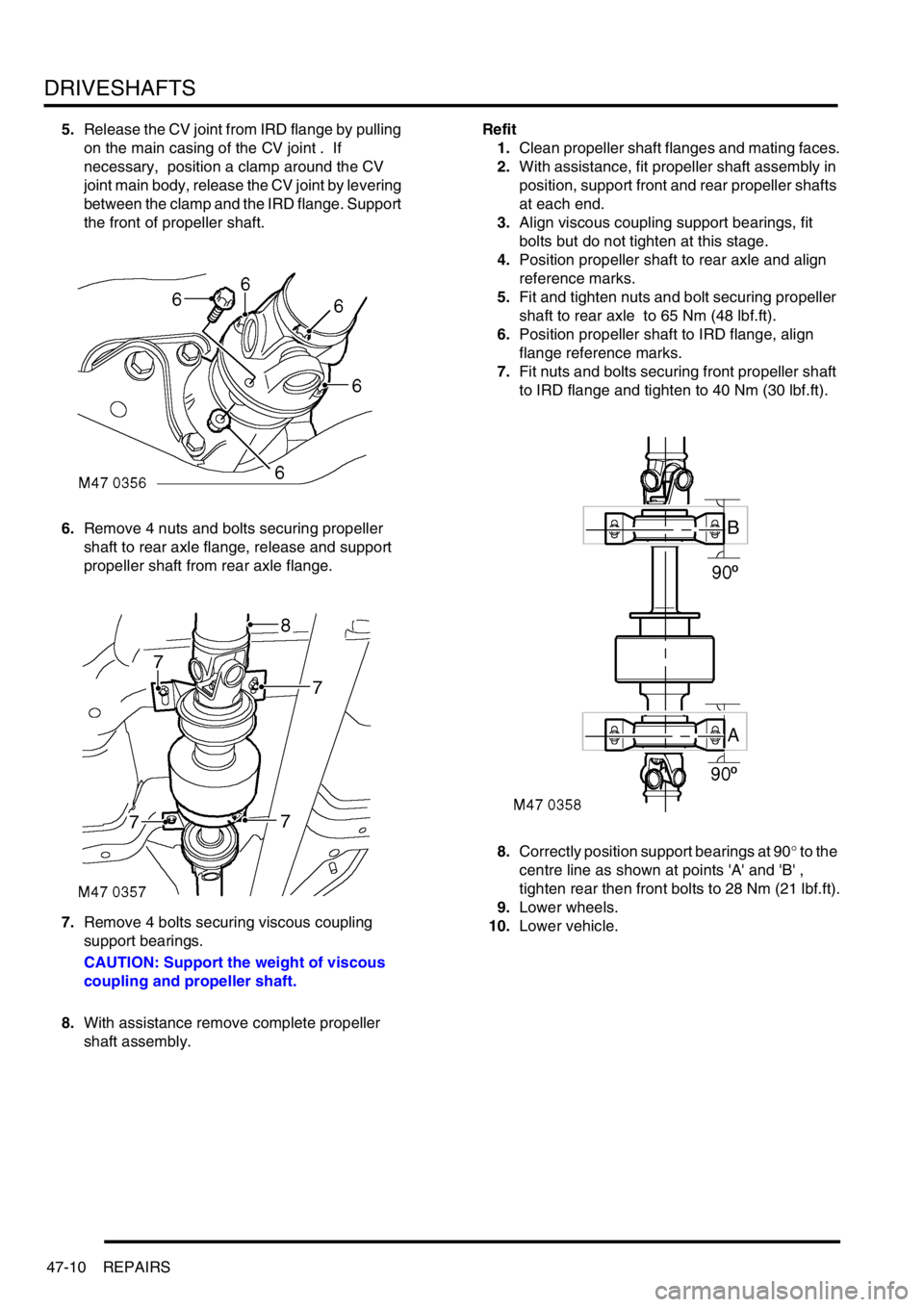
5.Release the CV joint from IRD flange by pulling
on the main casing of the CV joint . If
necessary, position a clamp around the CV
joint main body, release the CV joint by levering
between the clamp and the IRD flange. Support
the front of propeller shaft.
6.Remove 4 nuts and bolts securing propeller
shaft to rear axle flange, release and support
propeller shaft from rear axle flange.
7.Remove 4 bolts securing viscous coupling
support bearings.
CAUTION: Support the weight of viscous
coupling and propeller shaft.
8.With assistance remove complete propeller
shaft assembly.Refit
1.Clean propeller shaft flanges and mating faces.
2.With assistance, fit propeller shaft assembly in
position, support front and rear propeller shafts
at each end.
3.Align viscous coupling support bearings, fit
bolts but do not tighten at this stage.
4.Position propeller shaft to rear axle and align
reference marks.
5.Fit and tighten nuts and bolt securing propeller
shaft to rear axle to 65 Nm (48 lbf.ft).
6.Position propeller shaft to IRD flange, align
flange reference marks.
7.Fit nuts and bolts securing front propeller shaft
to IRD flange and tighten to 40 Nm (30 lbf.ft).
8.Correctly position support bearings at 90° to the
centre line as shown at points 'A' and 'B' ,
tighten rear then front bolts to 28 Nm (21 lbf.ft).
9.Lower wheels.
10.Lower vehicle.
Page 491 of 1007
REAR AXLE & FINAL DRIVE
51-6 REPAIRS
Refit
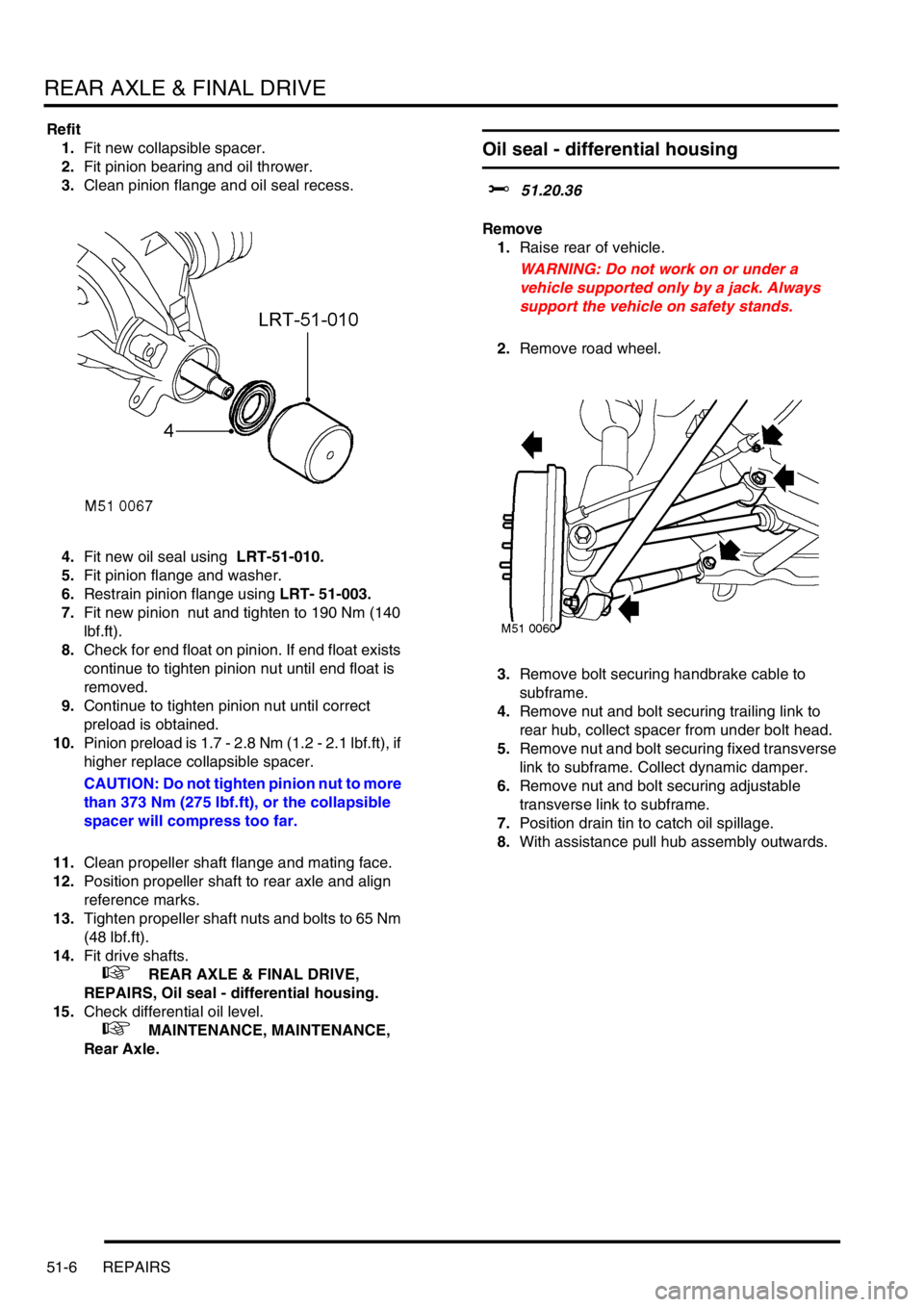
1.Fit new collapsible spacer.
2.Fit pinion bearing and oil thrower.
3.Clean pinion flange and oil seal recess.
4.Fit new oil seal using LRT-51-010.
5.Fit pinion flange and washer.
6.Restrain pinion flange using LRT- 51-003.
7.Fit new pinion nut and tighten to 190 Nm (140
lbf.ft).
8.Check for end float on pinion. If end float exists
continue to tighten pinion nut until end float is
removed.
9.Continue to tighten pinion nut until correct
preload is obtained.
10.Pinion preload is 1.7 - 2.8 Nm (1.2 - 2.1 lbf.ft), if
higher replace collapsible spacer.
CAUTION: Do not tighten pinion nut to more
than 373 Nm (275 lbf.ft), or the collapsible
spacer will compress too far.
11.Clean propeller shaft flange and mating face.
12.Position propeller shaft to rear axle and align
reference marks.
13.Tighten propeller shaft nuts and bolts to 65 Nm
(48 lbf.ft).
14.Fit drive shafts.
+ REAR AXLE & FINAL DRIVE,
REPAIRS, Oil seal - differential housing.
15.Check differential oil level.
+ MAINTENANCE, MAINTENANCE,
Rear Axle.
Oil seal - differential housing
$% 51.20.36
Remove
1.Raise rear of vehicle.
WARNING: Do not work on or under a
vehicle supported only by a jack. Always
support the vehicle on safety stands.
2.Remove road wheel.
3.Remove bolt securing handbrake cable to
subframe.
4.Remove nut and bolt securing trailing link to
rear hub, collect spacer from under bolt head.
5.Remove nut and bolt securing fixed transverse
link to subframe. Collect dynamic damper.
6.Remove nut and bolt securing adjustable
transverse link to subframe.
7.Position drain tin to catch oil spillage.
8.With assistance pull hub assembly outwards.
Page 492 of 1007
REAR AXLE & FINAL DRIVE
REPAIRS 51-7
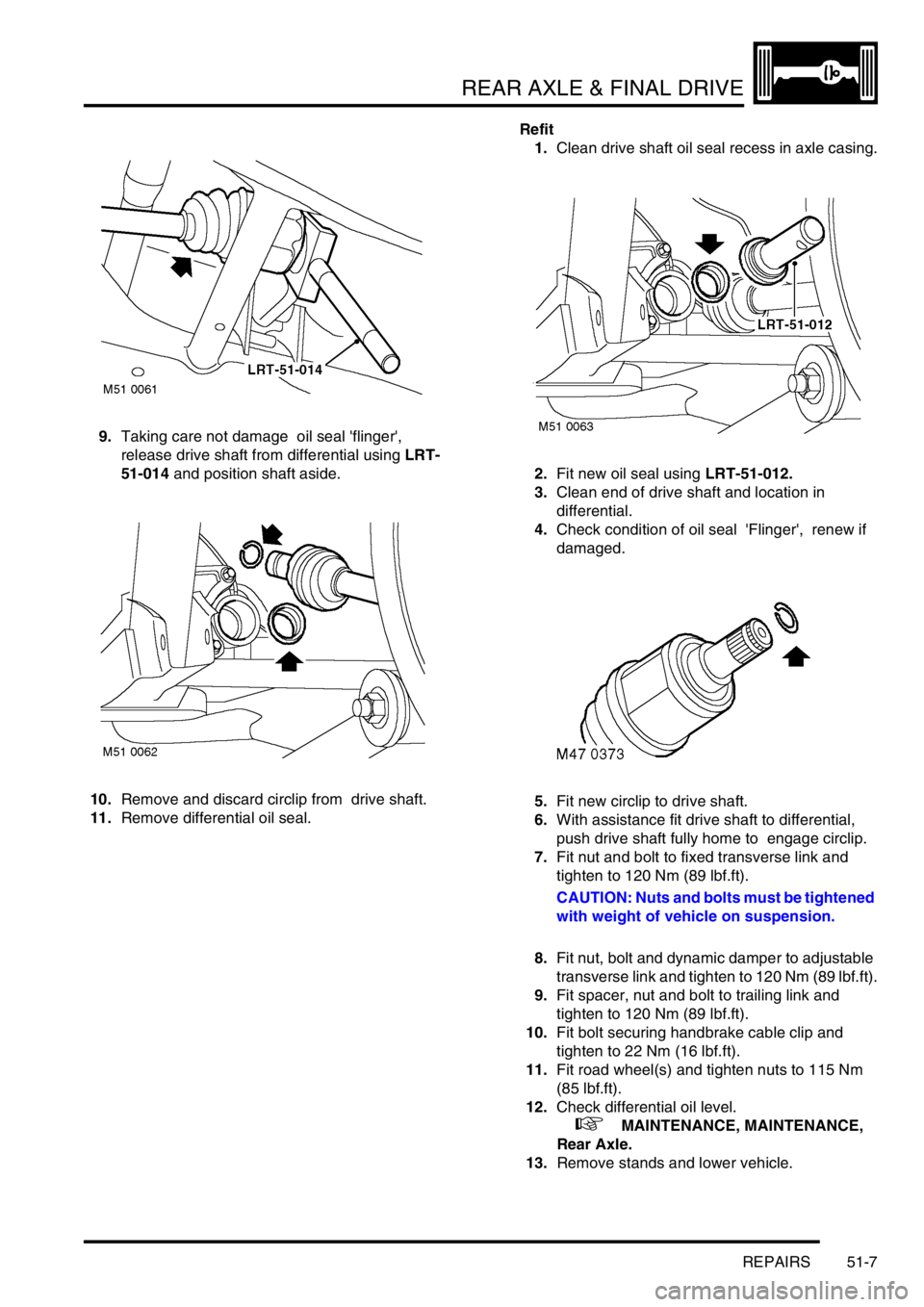
9.Taking care not damage oil seal 'flinger',
release drive shaft from differential using LRT-
51-014 and position shaft aside.
10.Remove and discard circlip from drive shaft.
11.Remove differential oil seal.Refit
1.Clean drive shaft oil seal recess in axle casing.
2.Fit new oil seal using LRT-51-012.
3.Clean end of drive shaft and location in
differential.
4.Check condition of oil seal 'Flinger', renew if
damaged.
5.Fit new circlip to drive shaft.
6.With assistance fit drive shaft to differential,
push drive shaft fully home to engage circlip.
7.Fit nut and bolt to fixed transverse link and
tighten to 120 Nm (89 lbf.ft).
CAUTION: Nuts and bolts must be tightened
with weight of vehicle on suspension.
8.Fit nut, bolt and dynamic damper to adjustable
transverse link and tighten to 120 Nm (89 lbf.ft).
9.Fit spacer, nut and bolt to trailing link and
tighten to 120 Nm (89 lbf.ft).
10.Fit bolt securing handbrake cable clip and
tighten to 22 Nm (16 lbf.ft).
11.Fit road wheel(s) and tighten nuts to 115 Nm
(85 lbf.ft).
12.Check differential oil level.
+ MAINTENANCE, MAINTENANCE,
Rear Axle.
13.Remove stands and lower vehicle.
Page 495 of 1007
STEERING
57-2 ADJUSTMENTS
Front wheel alignment - check & adjust
$% 57.65.01
Check
1.Ensure tyre pressures are correct and vehicle
is at kerbside weight.
2.Roll vehicle backwards and forwards to relieve
stresses in steering and suspension.
3.Ensure that wheel alignment equipment is
properly calibrated.
4.Check front wheel alignment is within
tolerance.
+ GENERAL DATA, Steering.
Adjust
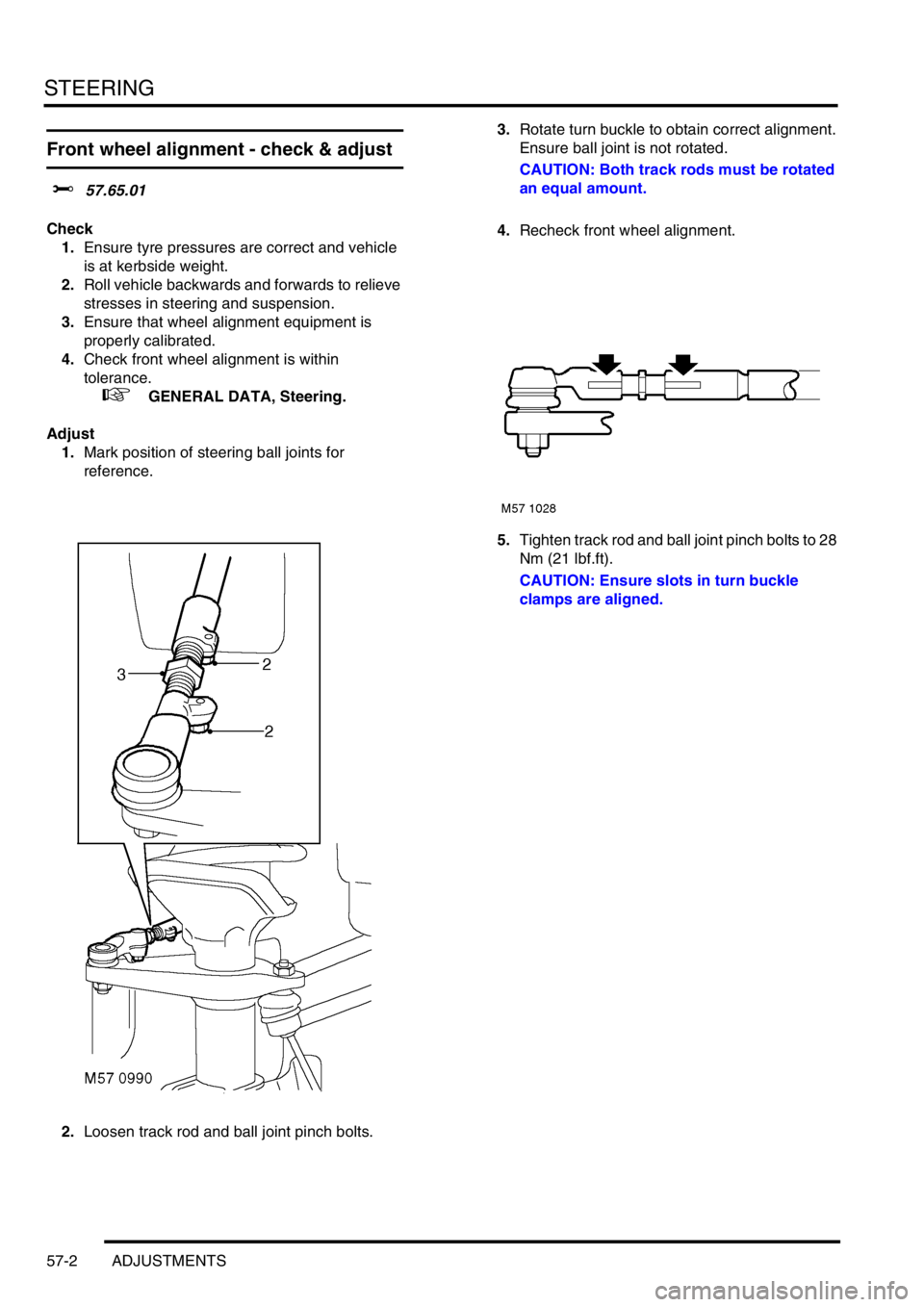
1.Mark position of steering ball joints for
reference.
2.Loosen track rod and ball joint pinch bolts.3.Rotate turn buckle to obtain correct alignment.
Ensure ball joint is not rotated.
CAUTION: Both track rods must be rotated
an equal amount.
4.Recheck front wheel alignment.
5.Tighten track rod and ball joint pinch bolts to 28
Nm (21 lbf.ft).
CAUTION: Ensure slots in turn buckle
clamps are aligned.
Page 496 of 1007
STEERING
ADJUSTMENTS 57-3
Alignment - rear wheel - check & adjust
$% 57.65.06
Check
1.Ensure tyre pressures are correct and vehicle
is at kerbside weight.
2.Roll vehicle backwards and forwards to relieve
stresses in steering and suspension.
3.Ensure that wheel alignment equipment is
properly calibrated.
4.Check front wheel alignment is within
tolerance.
+ GENERAL DATA, Steering.
5.Check rear wheel alignment is within tolerance.
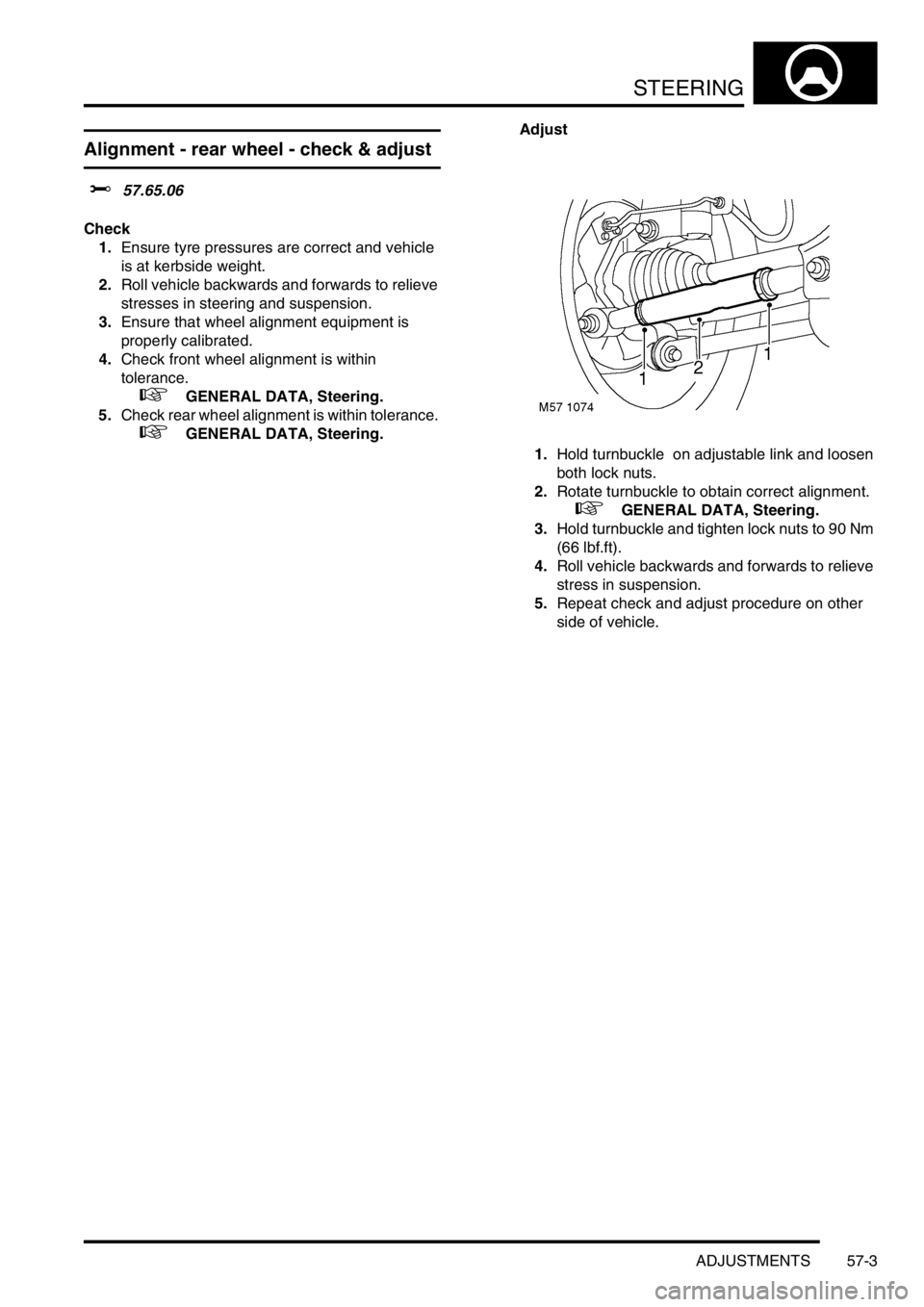
+ GENERAL DATA, Steering.Adjust
1.Hold turnbuckle on adjustable link and loosen
both lock nuts.
2.Rotate turnbuckle to obtain correct alignment.
+ GENERAL DATA, Steering.
3.Hold turnbuckle and tighten lock nuts to 90 Nm
(66 lbf.ft).
4.Roll vehicle backwards and forwards to relieve
stress in suspension.
5.Repeat check and adjust procedure on other
side of vehicle.
Page 497 of 1007
STEERING
57-4 ADJUSTMENTS
Power steering - pressure test
$% 57.90.10.01
Check
1.Position absorbent cloth to catch spillage.
2.Remove bolt securing PAS high pressure pipe
clip to PAS pump.
3.Loosen union securing high pressure pipe to
PAS pump and release pipe.
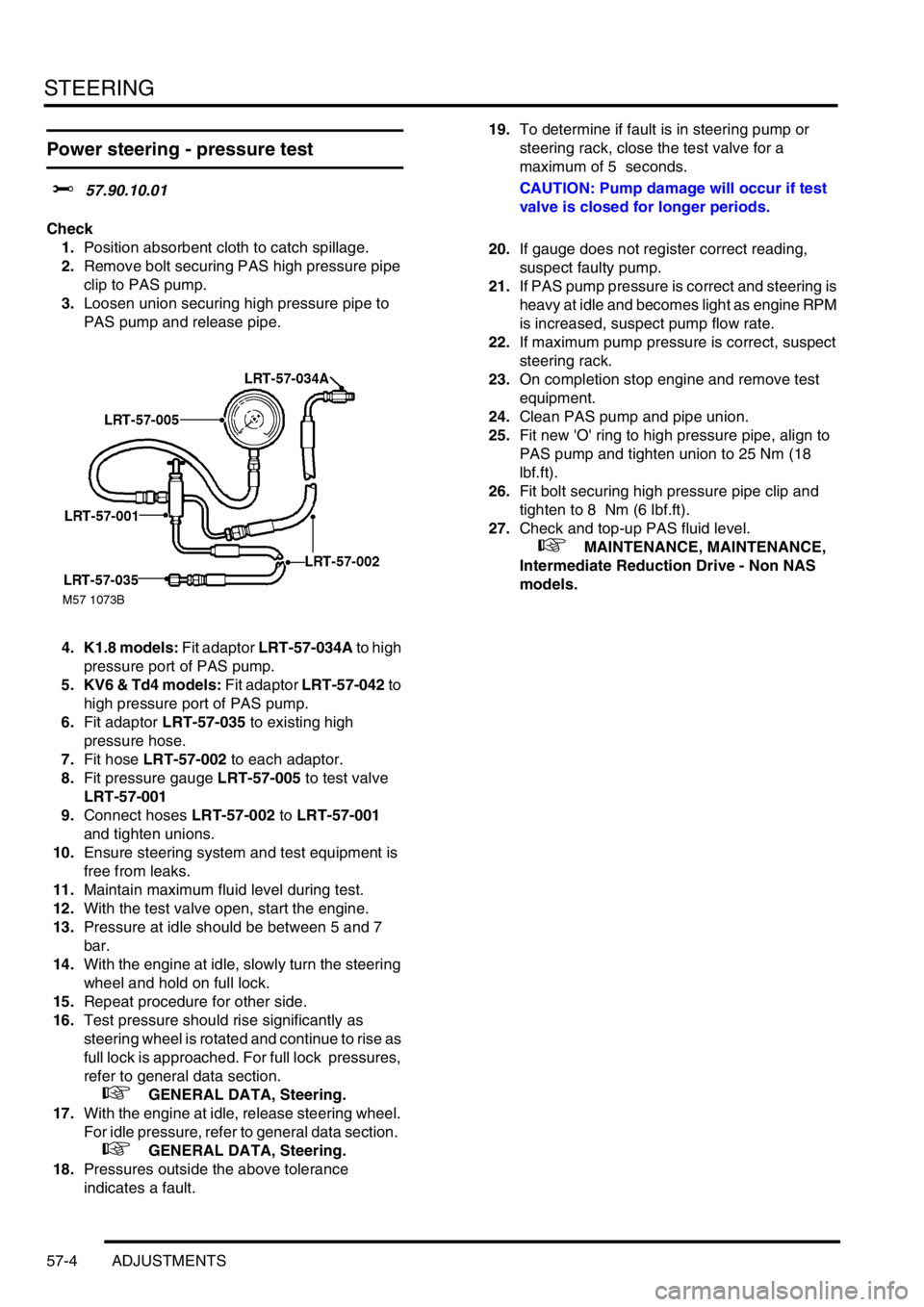
4. K1.8 models: Fit adaptor LRT-57-034A to high
pressure port of PAS pump.
5. KV6 & Td4 models: Fit adaptor LRT-57-042 to
high pressure port of PAS pump.
6.Fit adaptor LRT-57-035 to existing high
pressure hose.
7.Fit hose LRT-57-002 to each adaptor.
8.Fit pressure gauge LRT-57-005 to test valve
LRT-57-001
9.Connect hoses LRT-57-002 to LRT-57-001
and tighten unions.
10.Ensure steering system and test equipment is
free from leaks.
11.Maintain maximum fluid level during test.
12.With the test valve open, start the engine.
13.Pressure at idle should be between 5 and 7
bar.
14.With the engine at idle, slowly turn the steering
wheel and hold on full lock.
15.Repeat procedure for other side.
16.Test pressure should rise significantly as
steering wheel is rotated and continue to rise as
full lock is approached. For full lock pressures,
refer to general data section.
+ GENERAL DATA, Steering.
17.With the engine at idle, release steering wheel.
For idle pressure, refer to general data section.
+ GENERAL DATA, Steering.
18.Pressures outside the above tolerance
indicates a fault.19.To determine if fault is in steering pump or
steering rack, close the test valve for a
maximum of 5 seconds.
CAUTION: Pump damage will occur if test
valve is closed for longer periods.
20.If gauge does not register correct reading,
suspect faulty pump.
21.If PAS pump pressure is correct and steering is
heavy at idle and becomes light as engine RPM
is increased, suspect pump flow rate.
22.If maximum pump pressure is correct, suspect
steering rack.
23.On completion stop engine and remove test
equipment.
24.Clean PAS pump and pipe union.
25.Fit new 'O' ring to high pressure pipe, align to
PAS pump and tighten union to 25 Nm (18
lbf.ft).
26.Fit bolt securing high pressure pipe clip and
tighten to 8 Nm (6 lbf.ft).
27.Check and top-up PAS fluid level.
+ MAINTENANCE, MAINTENANCE,
Intermediate Reduction Drive - Non NAS
models.
Page 498 of 1007
STEERING
REPAIRS 57-5
REPAIRS
Power steering rack
$% 57.10.01
Remove
1.Raise front of vehicle.
WARNING: Do not work on or under a
vehicle supported only by a jack. Always
support the vehicle on safety stands.
2.Remove front road wheels.
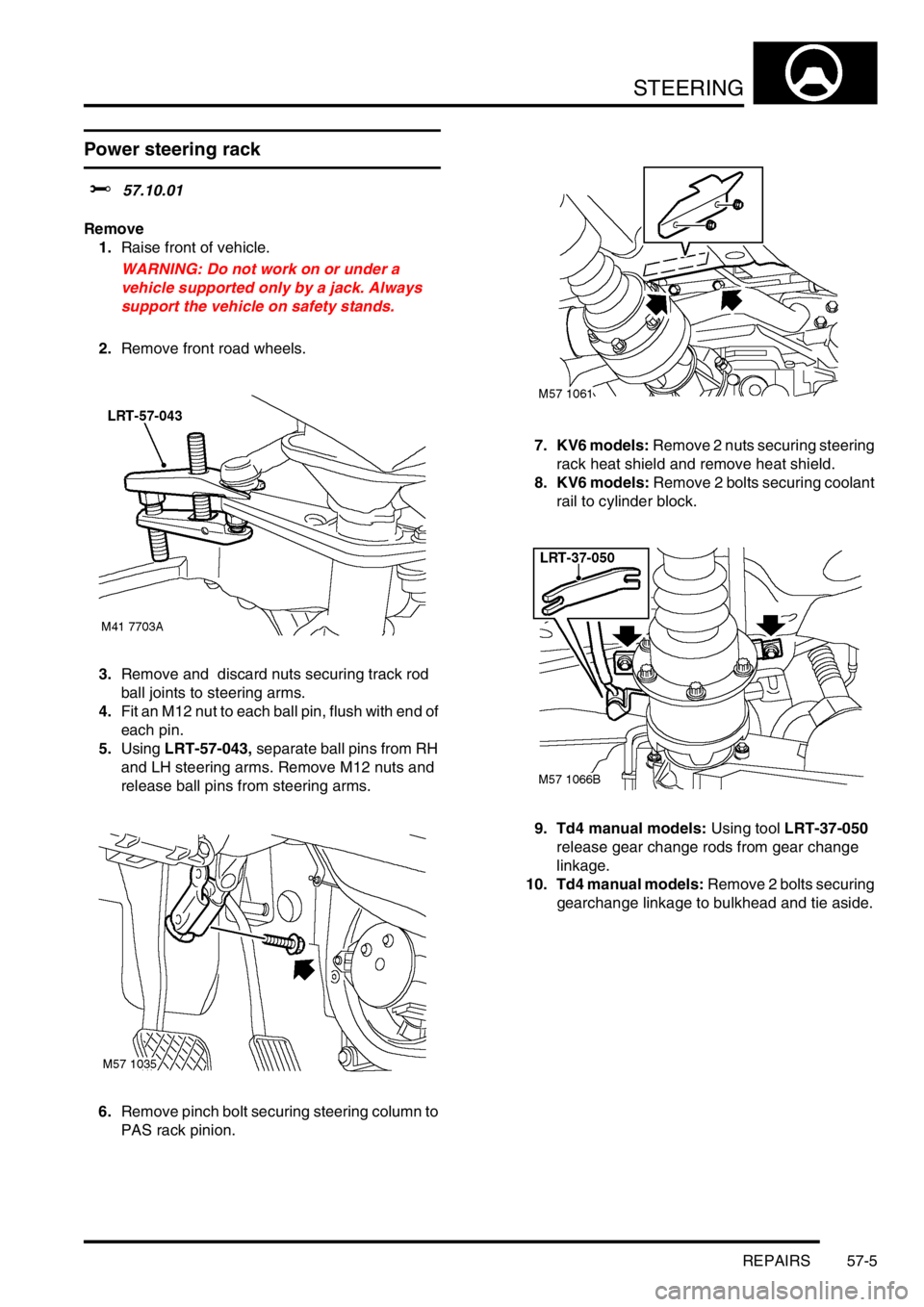
3.Remove and discard nuts securing track rod
ball joints to steering arms.
4.Fit an M12 nut to each ball pin, flush with end of
each pin.
5.Using LRT-57-043, separate ball pins from RH
and LH steering arms. Remove M12 nuts and
release ball pins from steering arms.
6.Remove pinch bolt securing steering column to
PAS rack pinion.7. KV6 models: Remove 2 nuts securing steering
rack heat shield and remove heat shield.
8. KV6 models: Remove 2 bolts securing coolant
rail to cylinder block.
9. Td4 manual models: Using tool LRT-37-050
release gear change rods from gear change
linkage.
10. Td4 manual models: Remove 2 bolts securing
gearchange linkage to bulkhead and tie aside.
Page 500 of 1007
STEERING
REPAIRS 57-7
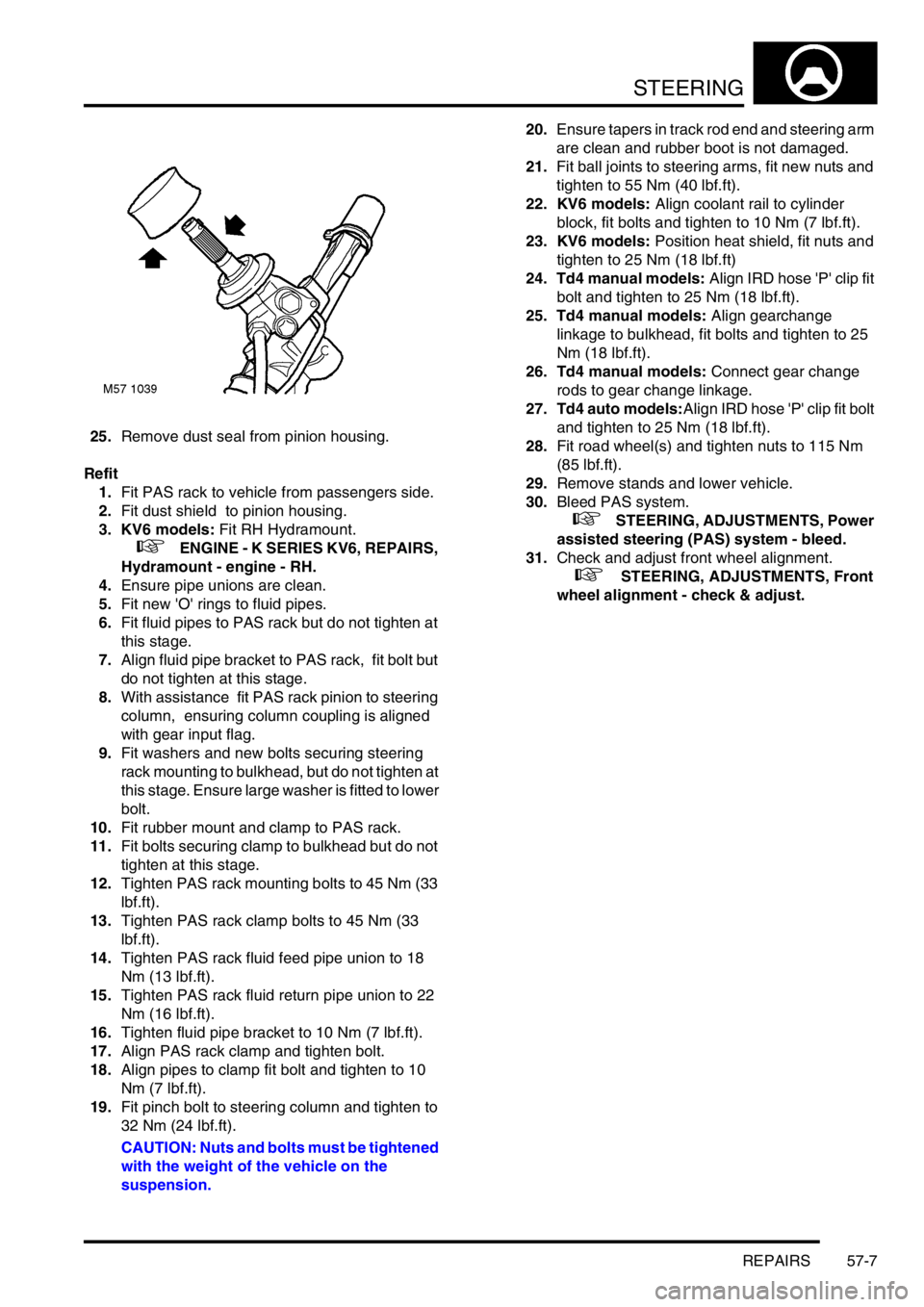
25.Remove dust seal from pinion housing.
Refit
1.Fit PAS rack to vehicle from passengers side.
2.Fit dust shield to pinion housing.
3. KV6 models: Fit RH Hydramount.
+ ENGINE - K SERIES KV6, REPAIRS,
Hydramount - engine - RH.
4.Ensure pipe unions are clean.
5.Fit new 'O' rings to fluid pipes.
6.Fit fluid pipes to PAS rack but do not tighten at
this stage.
7.Align fluid pipe bracket to PAS rack, fit bolt but
do not tighten at this stage.
8.With assistance fit PAS rack pinion to steering
column, ensuring column coupling is aligned
with gear input flag.
9.Fit washers and new bolts securing steering
rack mounting to bulkhead, but do not tighten at
this stage. Ensure large washer is fitted to lower
bolt.
10.Fit rubber mount and clamp to PAS rack.
11.Fit bolts securing clamp to bulkhead but do not
tighten at this stage.
12.Tighten PAS rack mounting bolts to 45 Nm (33
lbf.ft).
13.Tighten PAS rack clamp bolts to 45 Nm (33
lbf.ft).
14.Tighten PAS rack fluid feed pipe union to 18
Nm (13 lbf.ft).
15.Tighten PAS rack fluid return pipe union to 22
Nm (16 lbf.ft).
16.Tighten fluid pipe bracket to 10 Nm (7 lbf.ft).
17.Align PAS rack clamp and tighten bolt.
18.Align pipes to clamp fit bolt and tighten to 10
Nm (7 lbf.ft).
19.Fit pinch bolt to steering column and tighten to
32 Nm (24 lbf.ft).
CAUTION: Nuts and bolts must be tightened
with the weight of the vehicle on the
suspension.20.Ensure tapers in track rod end and steering arm
are clean and rubber boot is not damaged.
21.Fit ball joints to steering arms, fit new nuts and
tighten to 55 Nm (40 lbf.ft).
22. KV6 models: Align coolant rail to cylinder
block, fit bolts and tighten to 10 Nm (7 lbf.ft).
23. KV6 models: Position heat shield, fit nuts and
tighten to 25 Nm (18 lbf.ft)
24. Td4 manual models: Align IRD hose 'P' clip fit
bolt and tighten to 25 Nm (18 lbf.ft).
25. Td4 manual models: Align gearchange
linkage to bulkhead, fit bolts and tighten to 25
Nm (18 lbf.ft).
26. Td4 manual models: Connect gear change
rods to gear change linkage.
27. Td4 auto models:Align IRD hose 'P' clip fit bolt
and tighten to 25 Nm (18 lbf.ft).
28.Fit road wheel(s) and tighten nuts to 115 Nm
(85 lbf.ft).
29.Remove stands and lower vehicle.
30.Bleed PAS system.
+ STEERING, ADJUSTMENTS, Power
assisted steering (PAS) system - bleed.
31.Check and adjust front wheel alignment.
+ STEERING, ADJUSTMENTS, Front
wheel alignment - check & adjust.
Page 516 of 1007
STEERING
REPAIRS 57-23
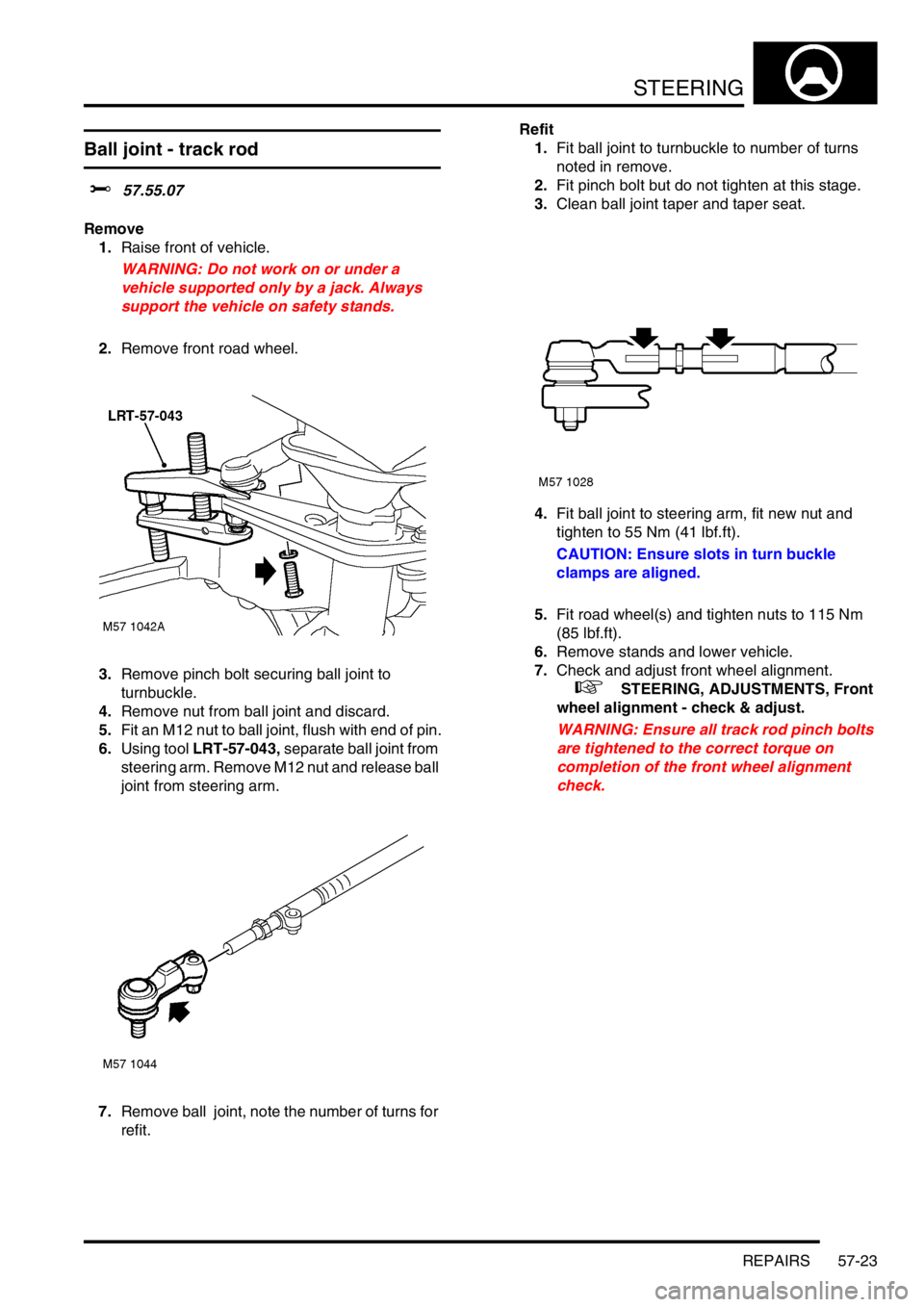
Ball joint - track rod
$% 57.55.07
Remove
1.Raise front of vehicle.
WARNING: Do not work on or under a
vehicle supported only by a jack. Always
support the vehicle on safety stands.
2.Remove front road wheel.
3.Remove pinch bolt securing ball joint to
turnbuckle.
4.Remove nut from ball joint and discard.
5.Fit an M12 nut to ball joint, flush with end of pin.
6.Using tool LRT-57-043, separate ball joint from
steering arm. Remove M12 nut and release ball
joint from steering arm.
7.Remove ball joint, note the number of turns for
refit.Refit
1.Fit ball joint to turnbuckle to number of turns
noted in remove.
2.Fit pinch bolt but do not tighten at this stage.
3.Clean ball joint taper and taper seat.
4.Fit ball joint to steering arm, fit new nut and
tighten to 55 Nm (41 lbf.ft).
CAUTION: Ensure slots in turn buckle
clamps are aligned.
5.Fit road wheel(s) and tighten nuts to 115 Nm
(85 lbf.ft).
6.Remove stands and lower vehicle.
7.Check and adjust front wheel alignment.
+ STEERING, ADJUSTMENTS, Front
wheel alignment - check & adjust.
WARNING: Ensure all track rod pinch bolts
are tightened to the correct torque on
completion of the front wheel alignment
check.
Page 517 of 1007
STEERING
57-24 REPAIRS
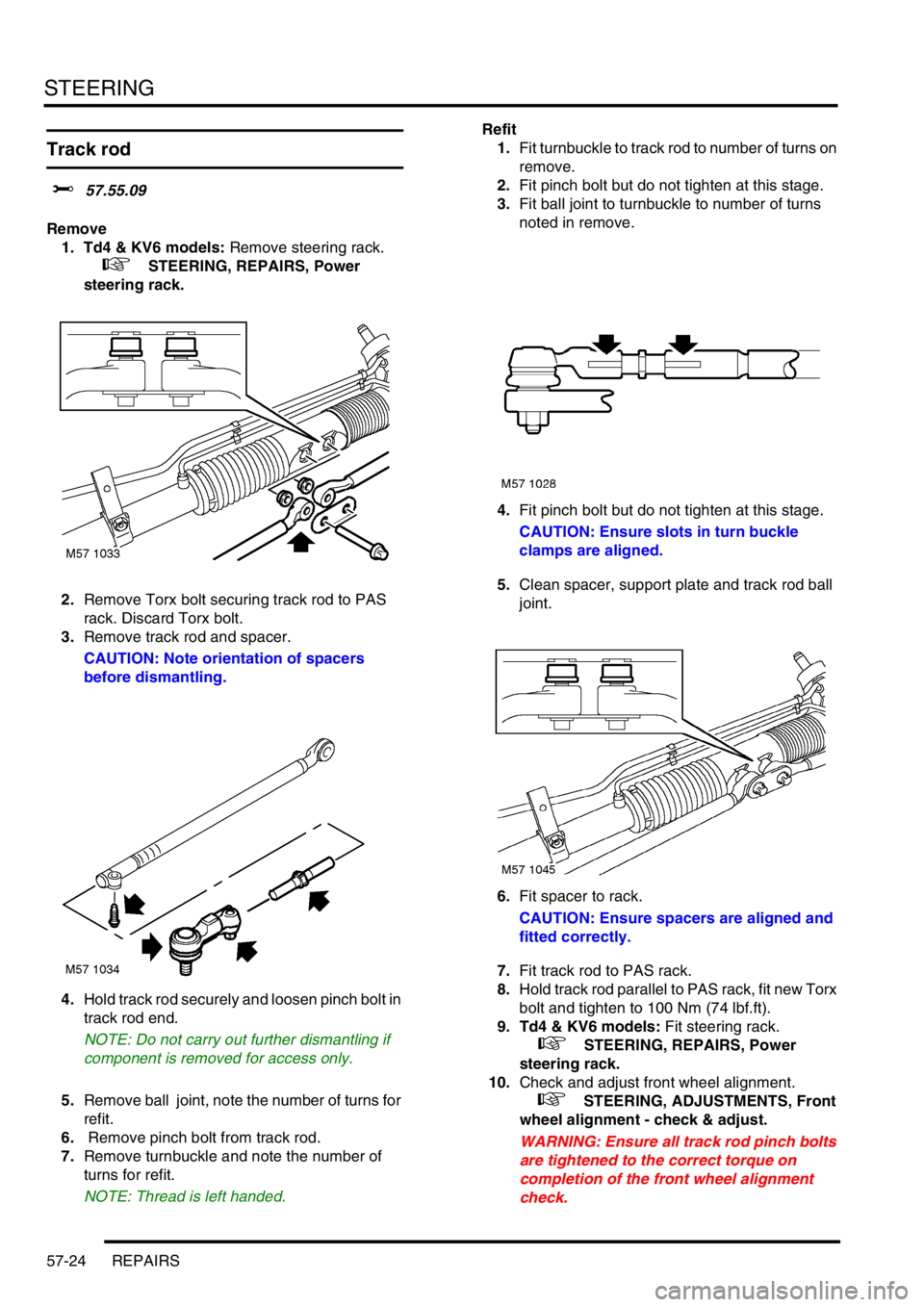
Track rod
$% 57.55.09
Remove
1. Td4 & KV6 models: Remove steering rack.
+ STEERING, REPAIRS, Power
steering rack.
2.Remove Torx bolt securing track rod to PAS
rack. Discard Torx bolt.
3.Remove track rod and spacer.
CAUTION: Note orientation of spacers
before dismantling.
4.Hold track rod securely and loosen pinch bolt in
track rod end.
NOTE: Do not carry out further dismantling if
component is removed for access only.
5.Remove ball joint, note the number of turns for
refit.
6. Remove pinch bolt from track rod.
7.Remove turnbuckle and note the number of
turns for refit.
NOTE: Thread is left handed.Refit
1.Fit turnbuckle to track rod to number of turns on
remove.
2.Fit pinch bolt but do not tighten at this stage.
3.Fit ball joint to turnbuckle to number of turns
noted in remove.
4.Fit pinch bolt but do not tighten at this stage.
CAUTION: Ensure slots in turn buckle
clamps are aligned.
5.Clean spacer, support plate and track rod ball
joint.
6.Fit spacer to rack.
CAUTION: Ensure spacers are aligned and
fitted correctly.
7.Fit track rod to PAS rack.
8.Hold track rod parallel to PAS rack, fit new Torx
bolt and tighten to 100 Nm (74 lbf.ft).
9. Td4 & KV6 models: Fit steering rack.
+ STEERING, REPAIRS, Power
steering rack.
10.Check and adjust front wheel alignment.
+ STEERING, ADJUSTMENTS, Front
wheel alignment - check & adjust.
WARNING: Ensure all track rod pinch bolts
are tightened to the correct torque on
completion of the front wheel alignment
check.