check oil MAZDA 626 1987 Owners Manual
[x] Cancel search | Manufacturer: MAZDA, Model Year: 1987, Model line: 626, Model: MAZDA 626 1987Pages: 1865, PDF Size: 94.35 MB
Page 716 of 1865
5 IGNITION COIL, HIGH-TENSION LEAD
IGNITION COIL
INSPECTION
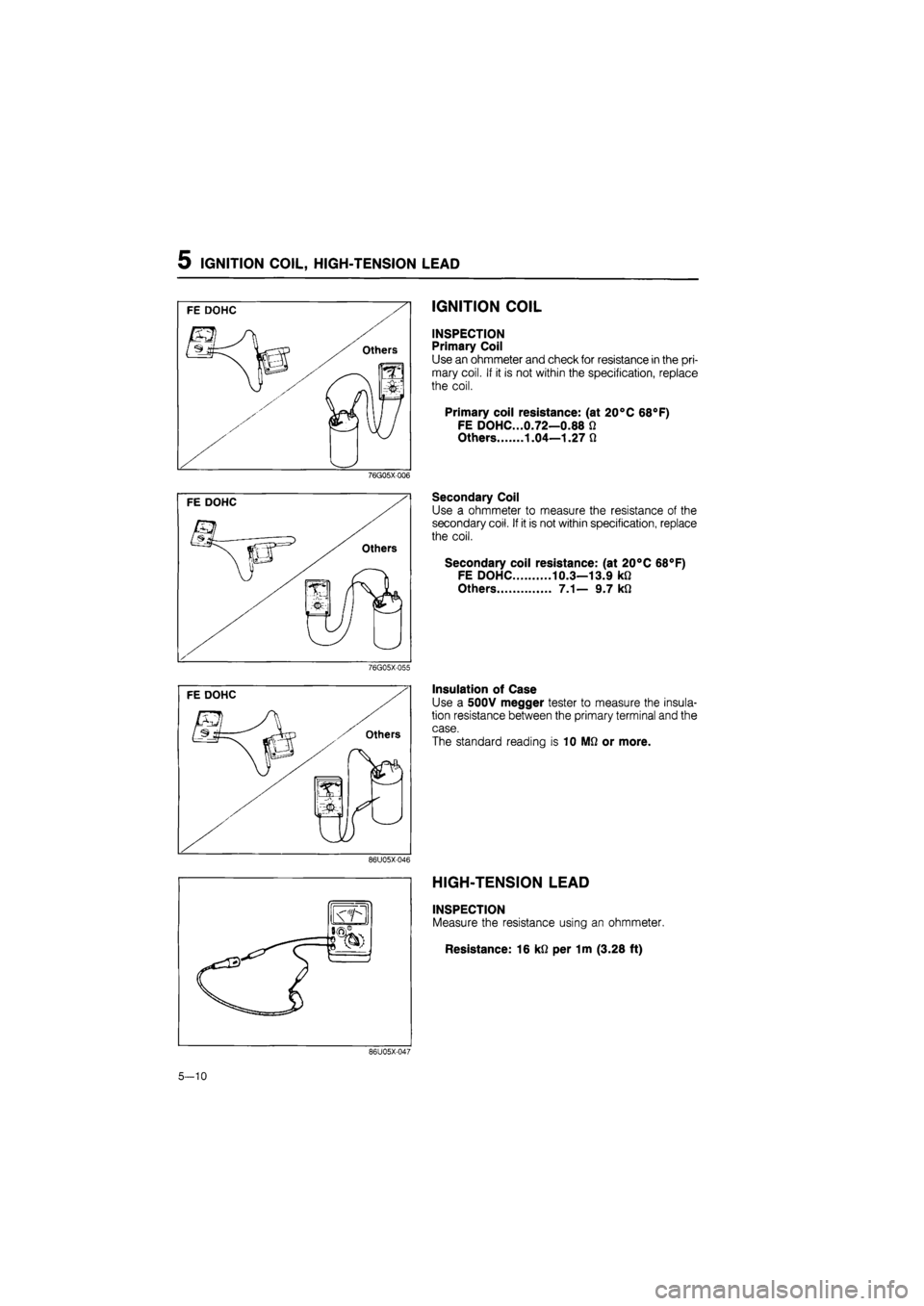
Primary Coil
Use an ohmmeter and check for resistance in the pri-
mary coil. If it is not within the specification, replace
the coil.
Primary coil resistance: (at 20°C 68°F)
FE DOHC...0.72—0.88 Q
Others 1.04—1.27 Q
76G05X-006
Secondary Coil
Use a ohmmeter to measure the resistance of the
secondary coil. If it is not within specification, replace
the coil.
Secondary coil resistance: (at 20°C 68°F)
FE DOHC 10.3—13.9 kQ
Others 7.1— 9.7 k«
76G05X-055
Insulation of Case
Use a 500V megger tester to measure the insula-
tion resistance between the primary terminal and the
case.
The standard reading is 10 MQ or more.
86U05X-046
HIGH-TENSION LEAD
INSPECTION
Measure the resistance using an ohmmeter.
Resistance: 16 kQ per 1m (3.28 ft)
5—10
Page 717 of 1865

DISTRIBUTOR 5
7BU05X-075
86U05X-048
76G05X-007
DISTRIBUTOR
SPARK TEST
1. Disconnect the distributor lead from the distributor.
2. Hold it with insulated pliers approx. 5—10 mm
(0.20—0.39 in) from a ground.
3. Crank the engine and check that a strong blue
spark is visible.
4. If there is no spark, the ignition coil or pick-up coil
may be bad.
Check once again after replacing the ignition coil
or pick-up coil.
IGNITION TIMING
1. Warm up the engine to the normal operating tem-
perature.
2. Turn all electric loads OFF.
3. Connect a tachometer and timing light to the
engine.
4. Connect a jumper wire between the test connec-
tor and ground. (Only for FE DOHC)
5. Check the idle speed. Set to the specified speed
if necessary.
Idle speed: 750 ± 50 rpm (FE DOHC)
800 t58 rpm (F6, F8 FE—MTX)
900 i58 rpm (F8, FE—ATX
in "P" range)
950 -5o rmp (F6—ATX
in "P" range)
6. Check that the timing mark (Yellow) on the crank-
shaft pulley and the mark on the timing belt cover
are aligned.
Ignition timing:
FE DOHC: 12 ± 1° BTDC
(Test connector grounded)
Others: 6 ± 1°
(Vacuum hoses disconnected and
plugged)
76G05X-008
5—11
Page 722 of 1865

5 DISTRIBUTOR
Others
1. Cap
2. Rotor
3. Gasket
4. Cover
5. Signal rotor
6. Pick-up coil with ignitor
7. Vacuum control unit
8. Breaker
9. Coupling set
10. Governor set
11. Oil seal
12. Bearing
76G05X-013
76G05X-14
INSPECTION
Pick-up Coil with Igniter (Except FE DOHC)
1. Connect an ohmmeter to the pick-up coil.
2. Measure the resistance.
Resistance: 900—1,200 Q
3. If it is not within specification, replace it.
Control Module (FE DOHC)
Refer to page 4C—108.
Cap and Rotor
1. Check for corrosion, damage, and cracks.
2. Replace if necessary.
86U05X-060
5-16
Page 723 of 1865
DISTRIBUTOR 5
Groove
86U05X-061
86U05X-062
Alignment mark
Distributor Shaft, O-Ring, and Oil Seal
1. Check for damage to the distributor shaft, O-ring,
and oil seal.
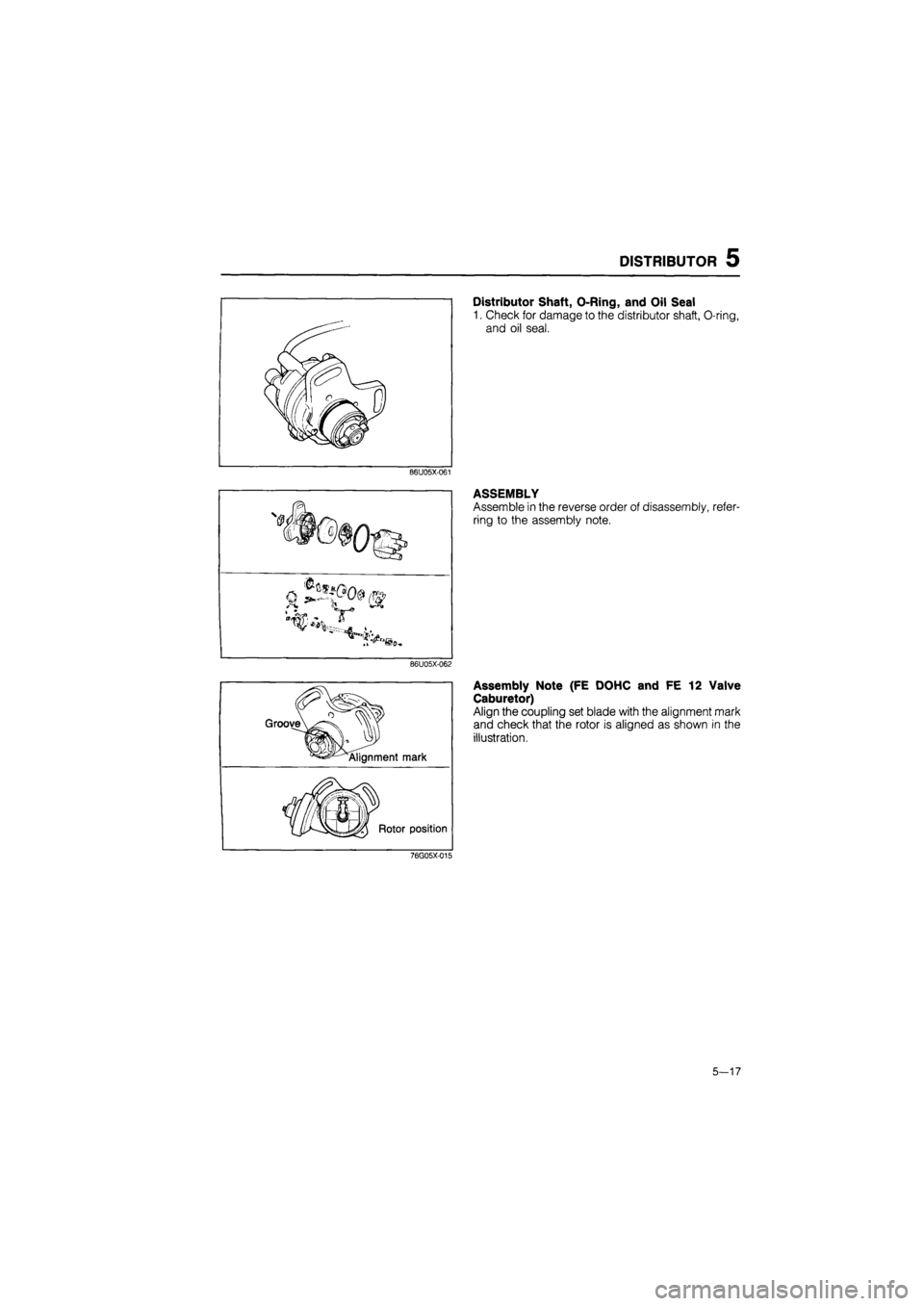
ASSEMBLY
Assemble in the reverse order of disassembly, refer-
ring to the assembly note.
Assembly Note (FE DOHC and FE 12 Valve
Caburetor)
Align the coupling set blade with the alignment mark
and check that the rotor is aligned as shown in the
illustration.
Rotor position
76G05X-015
5-17
Page 724 of 1865

5 DISTRIBUTOR
INSTALLATION
Note
After installing the distributor, adjust the ig-
nition timing (Refer to 5—11).
1. Apply engine oil to the O-ring and driven gear.
76G05X-056
Note
Gear driven type, check that the No.1 cylin-
der is at top dead center and aline the distrib-
utor matching marks.
76G05X-016
2. Install the distributor and connect the high-tension
leads and distributor connector.
3. Tighten lock bolt to the specified torque.
Torque specification:
19—25 Nm (1.9—2.6 m-kg, 14—18 ft-lb)
86U05X-064
5—18
Page 726 of 1865

5 IGNITER
(FE
DOHC)
76G05X-018
IGNITER
INSPECTION
1. Disconnect the center high tension lead from the
distributor cap.
2. Hold it with insulated pliers approx. 5—10 mm
(0.20—0.39 in) from a ground.
3. Turn th ignition switch ON.
4. Remove the rubber seal from the igniter connector.
5. Apply battery voltage to terminal A (LR) with a jum-
per wire.
6. Check that a strong blue spark is visible when the
wire is disconnected.
76G05X-019
If no spark is seen, connect a voltmeter between
terminal B (B) and terminal C (YL), and check for
battery voltage.
76G-05X-020
8. Repeat steps 5 and check
that
the voltage changes
to 2—3V.
9.
If
the voltage is not as specified, replace the igniter.
10.
If
the voltage is as specified, check the ignition coil
and high tension lead.
76G05X-021
5-20
Page 730 of 1865

5 ALTERNATOR
3. Alternator warning light operates properly, but battery discharged
OK
NG OK
1
a) Poor connection between B terminal and positive battery cable
b) Poor connection of negative battery cable c) Poor connection between alternator connector (2-pin) and positive battery terminal d) Stator coil or diodes malfunction (Refer to page 5—32 or 5—34.)
Perform TEST 2. (Refer to page 5--25.)
NG
Perform TEST 3. (Refer to Dage 5--26.)
I OK
Perfrom TEST 4. (Refer to page 5--26.)
NG
Perform TEST 5 (F Refer to page 5—26)
OK
Alternator normal.
Check other electrical components.
NG
Alternator normal.
Check other electrical components.
Perform TEST 5. (Refer to page 5—26.)
OK
Stator coil, diode, main fuse, or wiring har-ness between B ternimal and battery mal-function.
(Refer to page 5—32 or 5—34.)
IC regulator, bush, or rotor coil malfunction. (Refer to page 5—32 or 5—33)
NG
76G05X-027
4. Battery overcharged
Less than 14.1V
(At 20°C, 68°F)
More than 14.7V
(At 20oC,68°F)
IC regulator malfunction,
Perform TES T 6. (Refer to page 5—27.)
NG OK
Wiring harness malfunction.
76G05X-028
5—24
Page 738 of 1865

5 ALTERNATOR
86U05X-078
86U05X-080
86U05X-081
INSPECTION
Rotor
1. Wiring damage
(1) Check the resistance between the slip rings us-
ing an ohmmeter.
Specification: 2—6 U
(2) If it is not within specification, replace the rotor
2. Ground of the field coil
(1) Check for continuity between the slip ring and
the core using an ohmmeter.
(2) Replace the rotor if there is continuity.
3. Slip ring surface
If the slip ring surface is rough, use a lathe or fine
sandpaper to repair it.
Stator
1. Wiring damage
(1) Check for continuity between the stator coil
leads using an ohmmeter.
(2) Replace the stator if there is no continuity.
2. Ground of the stator coil
(1) Check for continuity between the stator coil
leads and the core using a circuit tester.
(2) Replace the stator if there is continuity.
86U05X-082
5—32
Page 746 of 1865

5 STARTER (GASOLINE ENGINE, 0.85, 0.95 KW TYPE)
4BG05X-078
4BG05X-079
4BG05X-080
Drive Pinion
Remove the stopper for the overrunning clutch by us-
ing a pipe as shown in the figure.
Adjustment of Pinion Gap
1. Disconnect the wiring from terminal (M).
2. Apply battery power to the terminal (S) and ground
the starter motor body, the pinion will eject outward
and then stop.
3. Measure the clearance (pinion gap) between the
pinion and the stopper.
Pinion gap: 0.5—2.0 mm (0.020—0.079 in)
Caution
Do not let electricity flow continuously for
more than 10 seconds.
If the pinion gap is not within the specified range,
make the adjustment by increasing or decreasing
the number of washers used between the magnetic
switch and the drive housing. The gap will become
smaller if the number of washers is increased.
Caution
Do not use the washers
(0.079 in) in all.
more than 2 mm
INSPECTION
Armature Coil
1. Ground of the armature coil
(1) Check for continuity between the commutator
and the core by using a circuit tester.
(2) Replace the armature if there is continuity.
4BG05X-081
5—40
Page 747 of 1865

STARTER (GASOLINE ENGINE, 0.85, 0.95 KW TYPE) 5
4BG05X-082
4BG05X-083
4BG05X-084
2. Vibration of the commutator
(1) Place the armature on V blocks, and measure
the vibration by using a dial gauge.
(2) If the vibration is Limit or more, repair so that
it becomes standard by using a lathe, or re-
place the armature.
Standard vibration: 0.05 mm (0.002 in)
Limit: 0.4 mm (0.018 in)
Note
Before checking, be sure that there is no play
in the bearings.
3. Outer diameter of the commutator
Replace the armature if the outer diameter of the
commutator is grind limit or less.
4. Roughness of the commutator surface
(1) If the commutator surface is dirty, wipe it with
a cloth.
(2) If it is rough, repair it by using a lathe or fine
sandpaper.
Grind limit: 31 mm (1.22 in)
5. Segment groove depth
If the depth of the mold between segments is limit
depth or less, undercut the grooves by standard
depth.
Standard depth:
0.5—0.8 mm (0.020—0.031 in)
Limit depth: 0.2 mm (0.008 in)
Field Coil
1. Wiring damage
(1) Check for continuity between the connector
and brushes by using a circuit tester.
(2) Replace the yoke assembly if there is no con-
tinuity.
4BG05X-085
5—41