service MERCEDES-BENZ M-CLASS SUV 2011 Workshop Manual
[x] Cancel search | Manufacturer: MERCEDES-BENZ, Model Year: 2011, Model line: M-CLASS SUV, Model: MERCEDES-BENZ M-CLASS SUV 2011Pages: 389, PDF Size: 9.22 MB
Page 332 of 389
X
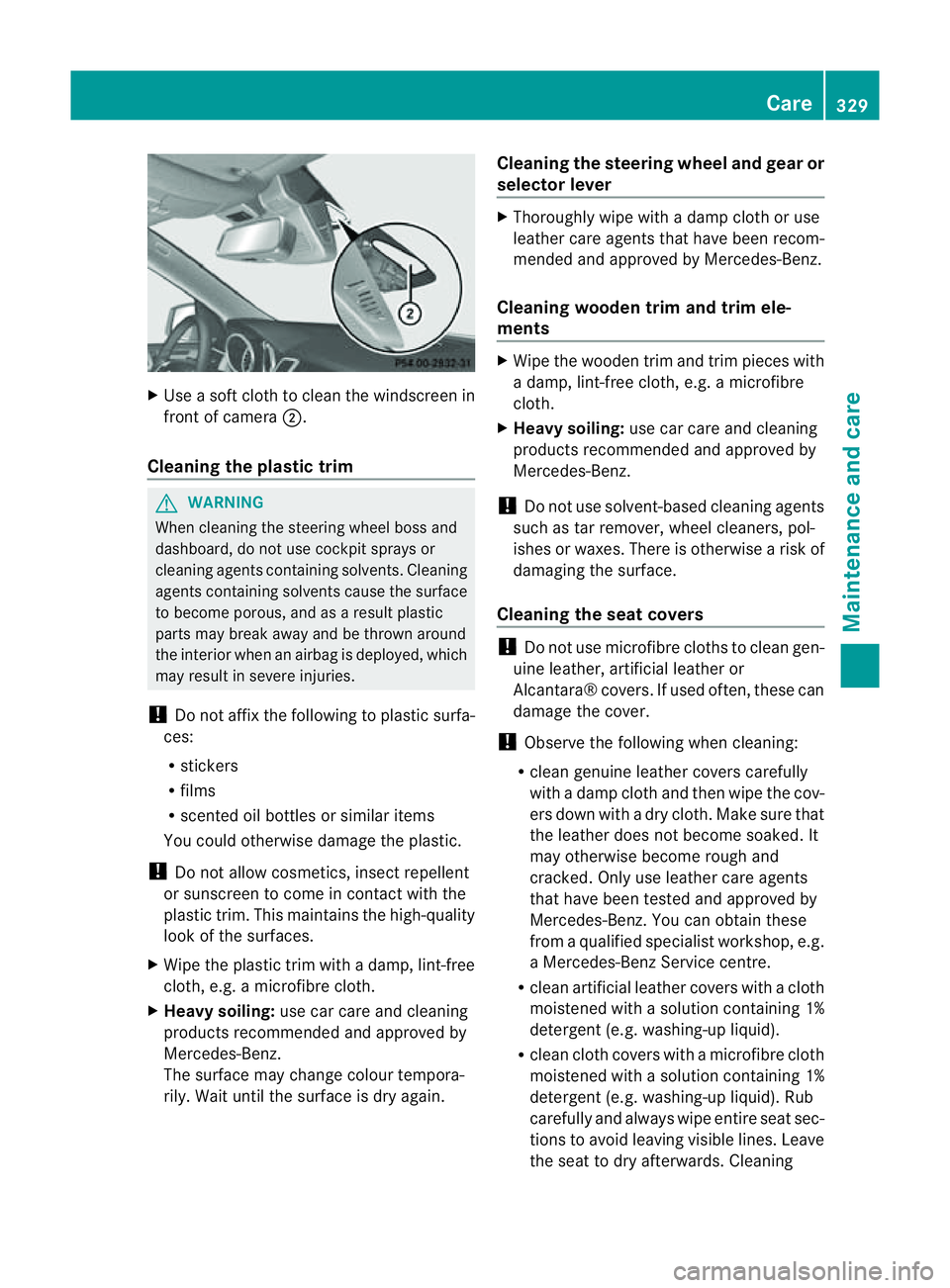
Use asoft clot htoclean the windscreen in
front of camera ;.
Cleaning the plastic trim G
WARNING
When cleanin gthe steering wheel boss and
dashboard, do not use cockpit sprays or
cleanin gagents containing solvents. Cleaning
agent scontaining solvents cause the surface
to becom eporous, and as aresult plastic
part smay break away and be thrown around
the interior when an airbag is deployed, which
may result in severe injuries.
! Do not affix the following to plastic surfa-
ces:
R stickers
R films
R scented oil bottles or similar items
You could otherwise damage the plastic.
! Do not allow cosmetics, insect repellent
or sunscreen to come in contact with the
plastic trim .This maintain sthe high-quality
look of the surfaces.
X Wipe the plastic trim with adamp, lint-free
cloth, e.g. amicrofibre cloth.
X Heavy soiling: use car care and cleaning
products recommended and approved by
Mercedes-Benz.
The surface may change colour tempora-
rily. Wait until the surface is dry again. Cleanin
gthe steering whee land gear or
selector lever X
Thoroughl ywipe with adamp cloth or use
leather care agents that have been recom-
mended and approved by Mercedes-Benz.
Cleanin gwooden trim and trim ele-
ments X
Wipe the wooden trim and trim pieces with
ad amp, lint-free cloth, e.g. amicrofibre
cloth.
X Heavy soiling: use car care and cleaning
products recommended and approved by
Mercedes-Benz.
! Do not use solvent-based cleaning agents
such as tar remover, wheel cleaners, pol-
ishes or waxes. There is otherwise arisk of
damaging the surface.
Cleanin gthe seat covers !
Do not us emicrofibre cloths to clean gen-
uine leather, artificial leather or
Alcantara® covers. If used often, these can
damage the cover.
! Observe the following when cleaning:
R clean genuine leather cover scarefully
with adamp cloth and then wipe the cov-
ers down with adry cloth .Make sure that
the leather does not become soaked .It
may otherwise become rough and
cracked .Only use leather care agents
that have bee ntested and approved by
Mercedes-Benz. You can obtain these
from aqualified specialist workshop, e.g.
aM ercedes-Ben zService centre.
R clean artificial leather covers with acloth
moistened with asolution con taining 1%
detergent (e.g. washing-up liquid).
R clean cloth cover switham icrofibre cloth
moistened with asolution con taining 1%
detergent (e.g. washing-up liquid). Rub
carefully and always wipe entire seat sec-
tions to avoid leaving visible lines. Leave
the seat to dry afterwards. Cleaning Care
329Maintenance andcare Z
Page 336 of 389
X
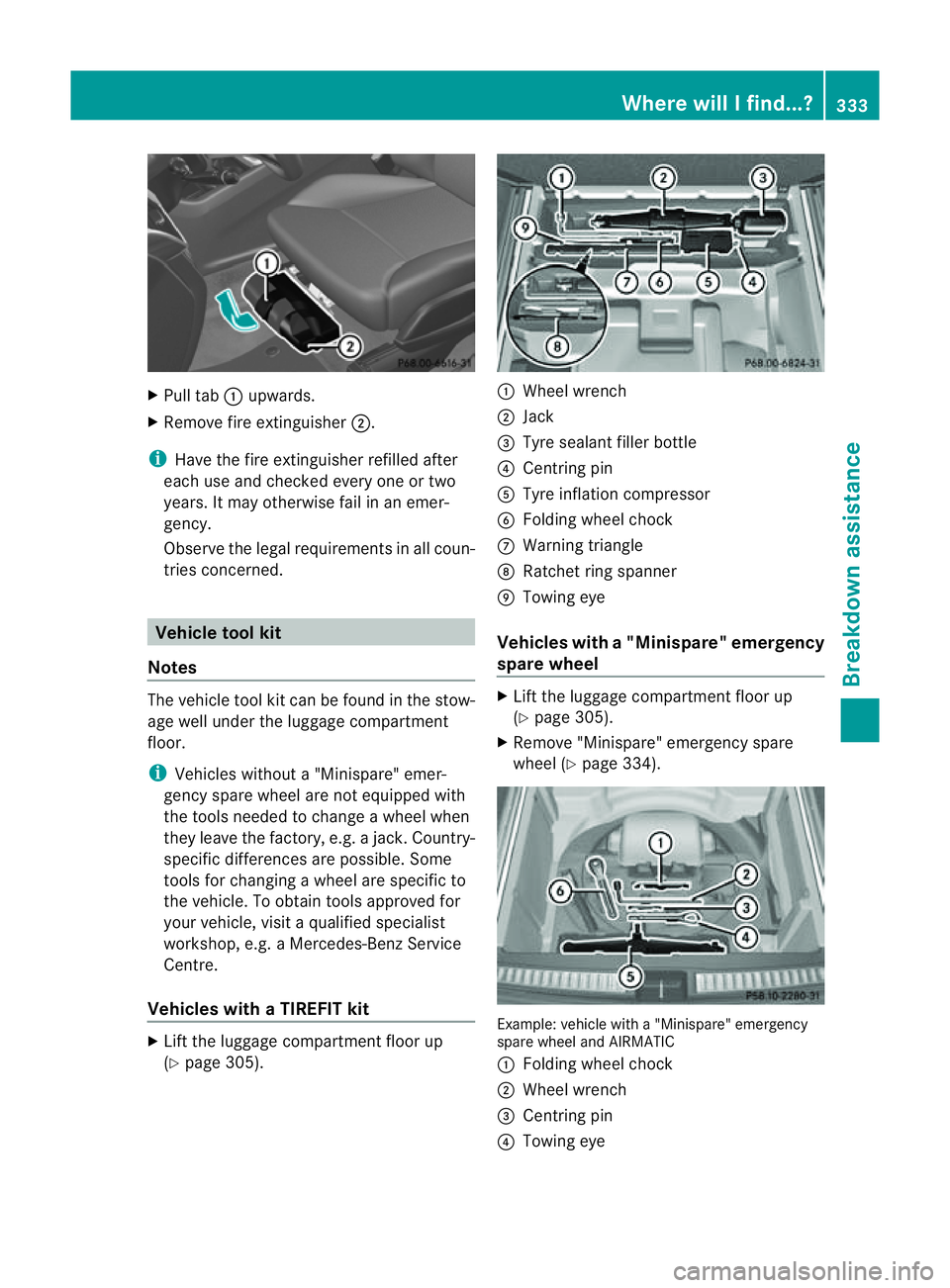
Pull tab :upwards.
X Remove fir eextinguisher ;.
i Have the fire extinguisher refille dafter
each us eand checked every one or two
years. It may otherwis efail in an emer-
gency.
Observe the legal requirement sinall coun-
tries concerned. Vehicle tool kit
Notes The vehicle tool kit can be foun
dinthe stow-
age well under the luggage compar tment
fl oor.
i Vehi cles without a"Minispare" emer-
gency spar ewheel ar enot equipped with
the tools needed to change awheel when
the yleave the fac tory, e.g .ajack. Country-
spe cificd ifferences are possible. Some
tools for changing awheel ar especific to
the vehicle. To obtain tools approved for
your vehicle, visit aqualified specialist
workshop, e.g. aMercedes-Benz Service
Centre.
Vehicles with aTIREFIT kit X
Lif tthe luggage compartmen tfloor up
(Y page 305). :
Wheel wrench
; Jack
= Tyre sealant filler bottle
? Centrin gpin
A Tyre inflation compressor
B Foldin gwheel chock
C War ning triangle
D Ratchet rin gspanner
E Towing eye
Vehicles with a"Min ispare" emerg ency
spare wheel X
Lift the luggage compartm entfloor up
(Y pag e305).
X Remove "M inispare" emergency spare
whee l(Ypag e334). Example
:vehicle with a"Minispare" emergency
spar ewheel and AIRMATIC
: Foldin gwheel chock
; Wheel wrench
= Cent ring pin
? Towing eye Where wil
lIfind...?
333Breakdownassista nce
Page 339 of 389
If yo
uget TIREFI Tonyour clothing, have it
cleaned as soo naspossible with perchloro-
ethylene. X
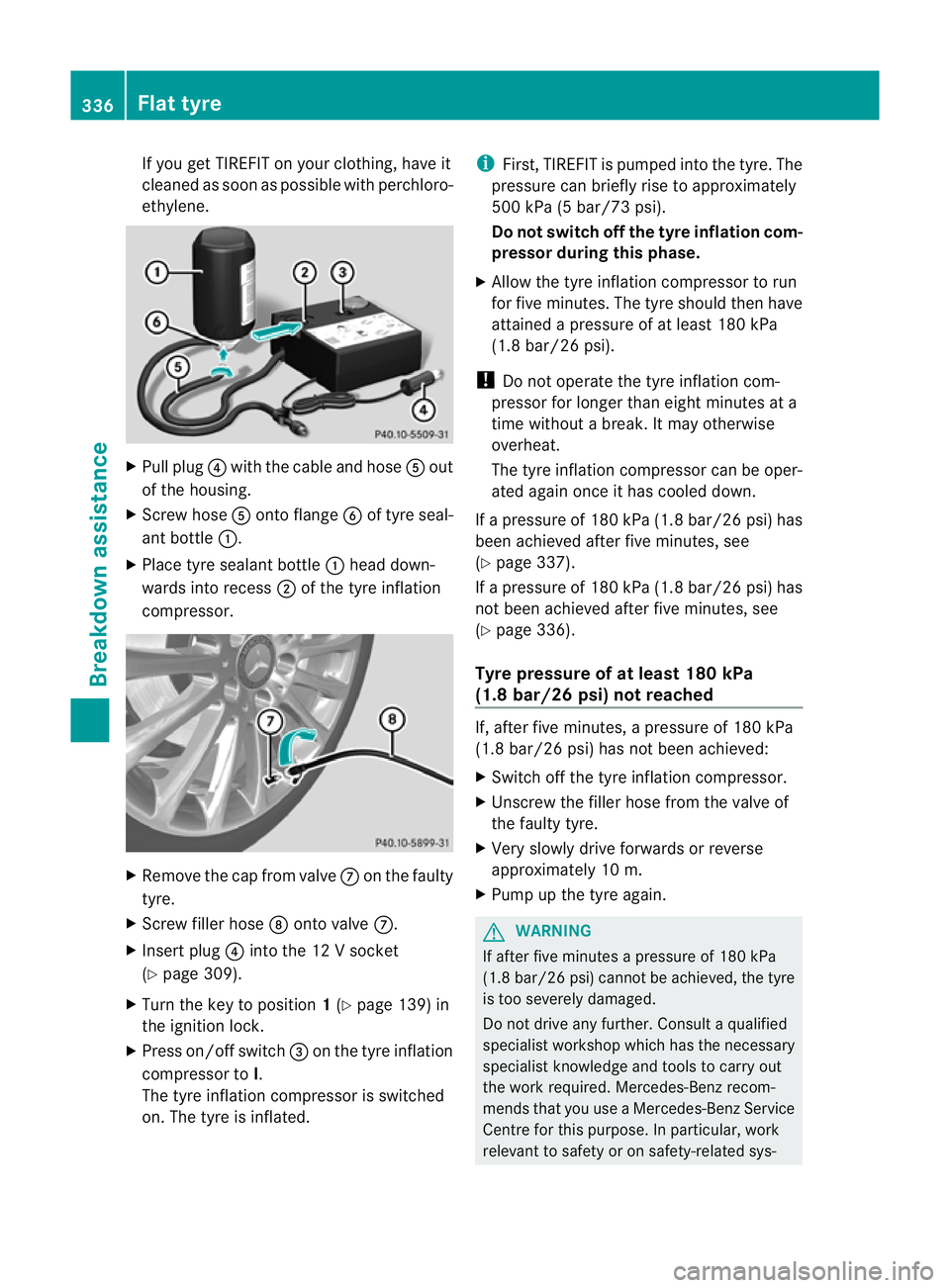
Pull plug ?with the cabl eand hose Aout
of the housing.
X Screw hose Aontoflange Bof tyre seal-
ant bottle :.
X Place tyre sealant bottle :head down-
wards int orecess ;of the tyr einflation
compressor. X
Remove the cap fro mvalve Con the faulty
tyre.
X Screw filler hose Dontovalve C.
X Insert plug ?into the 12 Vsocket
(Y page 309).
X Tur nthe key to position 1(Y page 139) in
the ignition lock.
X Press on/of fswitch =on the tyr einflation
compressor to I.
The tyr einflation compressor is switched
on. The tyre is inflated. i
First ,TIREFIT is pumpe dinto the tyre. The
pressure can briefly rise to approximately
500 kPa (5 bar/73 psi).
Do not switch off the tyr einflation com-
pressor du ring this phase.
X Allow the tyr einflation compresso rtor un
for five minutes. The tyre should then have
attained apressure of at leas t180 kPa
(1.8 bar/26 psi).
! Do not operat ethe tyr einflation com-
presso rfor longer than eight minutes at a
tim ew ithout abreak. It may otherwise
overheat.
Th et yre inflation compressor can be oper-
ated again once it has coole ddown.
If ap ressure of 180 kPa (1.8 bar/26 psi) has
been achieved afte rfive minutes, see
(Y page 337).
If ap ressure of 180 kPa (1.8 bar/26 psi) has
not been achieved afte rfive minutes, see
(Y page 336).
Tyr epressure of at least 180 kPa
(1.8 bar/26 psi) not reached If, after five minutes,
apressure of 180 kPa
(1.8 bar/26 psi) ha snot been achieved:
X Switch off the tyr einflation compresso r.
X Un screw the filler hose from the valv eof
the faulty tyre.
X Very slowly drive forwards or reverse
approximately 10 m.
X Pump up the tyre again. G
WARNING
If after five minutes apressure of 180 kPa
(1.8 bar/26 psi) cannot be achieved ,the tyre
is too severel ydamaged.
Do not drive any further. Consult aqualified
specialist workshop which has the necessary
specialist knowledge and tools to carry out
the work required. Mercedes-Benz recom-
mends that you use aMercedes-Ben zService
Centr efor this pur pose.Inp articular, work
relevant to safety or on safety-related sys- 336
Flat tyreBreakdown assistance
Page 341 of 389
genc
yspare wheel/spar ewheel the handling
characteristic softhe vehicle ma ychange.
Adap tyour style of driving accordingly.
Never operate the vehicle with mor ethan one
emergenc yspare wheel/spar ewheel that dif-
fer sins ize.
Only use an emergenc yspare wheel/spare
wheel of adiffering size briefly and do not
switch off ESP ®
.
When using an emergenc yspare wheel you
must not exceed the maximum speed of
80 km/h. G
WARNING
Hav ethe emergenc yspare wheel/spare
wheel replaced with anew wheel as soon as
possible at aqualified specialist workshop
which has the necessary specialist knowledge
and tools to carry out the work required.
Mercedes-Benz recommends that you use a
Mercedes-Benz Service Centre for this pur-
pose .Inp articular, work relevant to safety or
on safety-related systems must be carried out
at aq ualified specialist workshop.
i Vehicles withou tanemergency spare
wheel/spare whee lare not equippe dwith
wheel-changing tools at the factory. For
more information on which tools are
required to perfor mawheel change on your
vehicle, e.g. wheel chock ,wheel wrenc hor
centring pin, consult aMercedes-Benz
Servic eCentre.
X Prepar ethe vehicle as described
(Y page 334).
X Ifat railer is coupled to th evehicle, uncou-
ple it.
X Remov ethe followin gitems (depending on
the vehicle's equipment) from the stowage
well under the luggage compartment floor:
R the emergency spare wheel 23
R the whee lwrench
R thef olding wheel chock
R the jack R
the ratchet rin gspanner
R the centrin gpin
X Secur ethe vehicle to preven titfrom rolling
awa y.
Se curing the vehicle to prevent it from
rolling away If your vehicle is equippe
dwithaw heel choc k,
it can be found in the vehicle tool kit
(Y page 333).
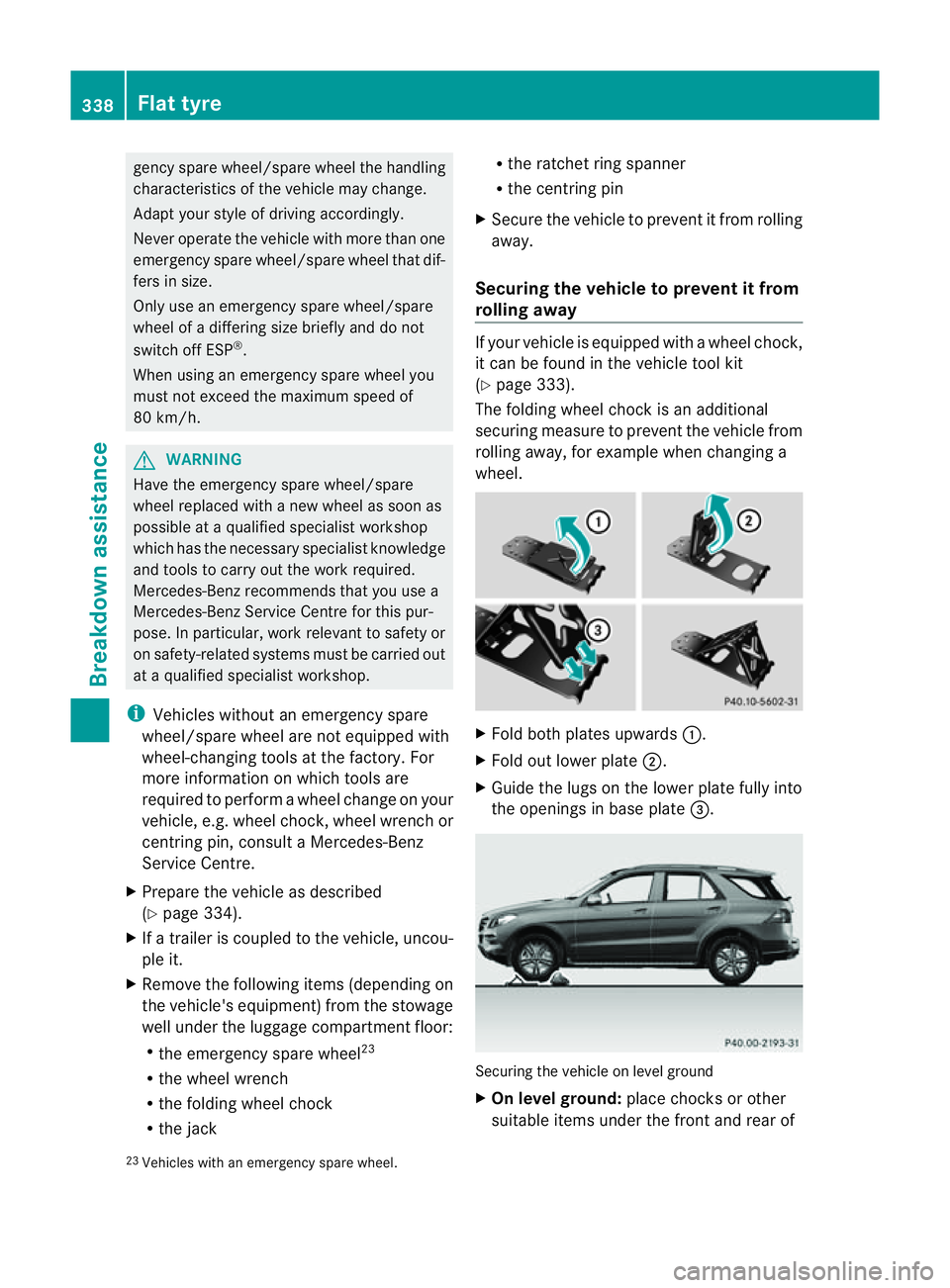
The folding wheel chock is an additional
securing measure to prevent the vehicle from
rolling away, for example when changing a
wheel. X
Fold both plates upwards :.
X Fold out lower plate ;.
X Guide the lugs on the lower plate fully into
the openings in base plate =. Securing the vehicle on level ground
X
On level ground: place chocksorother
suitable items under the front and rear of
23 Vehicles with an emergenc yspare wheel. 338
Flat tyreBreakdown assistance
Page 343 of 389
X
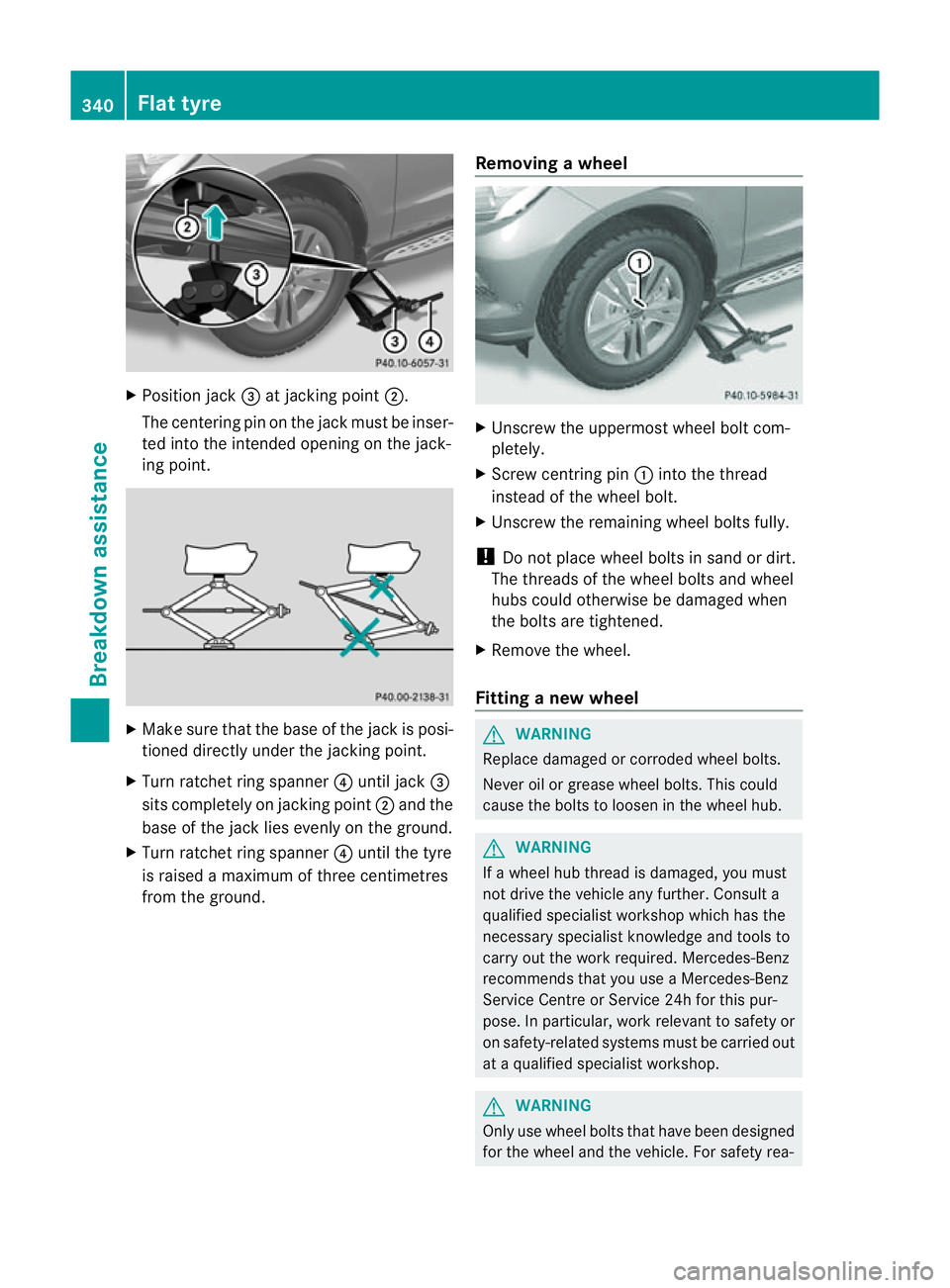
Position jack =at jac king point ;.
The centering pin on the jack must be inser-
ted into the intended opening on the jack-
ing point. X
Make sure that the bas eofthe jac kisp osi-
tioned directly under the jac king point.
X Turn ratchet ring spanner ?until jack =
sits completely on jacking point ;and the
bas eofthe jac klies evenly on the ground.
X Turn ratchet ring spanner ?until the tyre
is raised amaximum of three centimetres
from the ground. Removing
awheel X
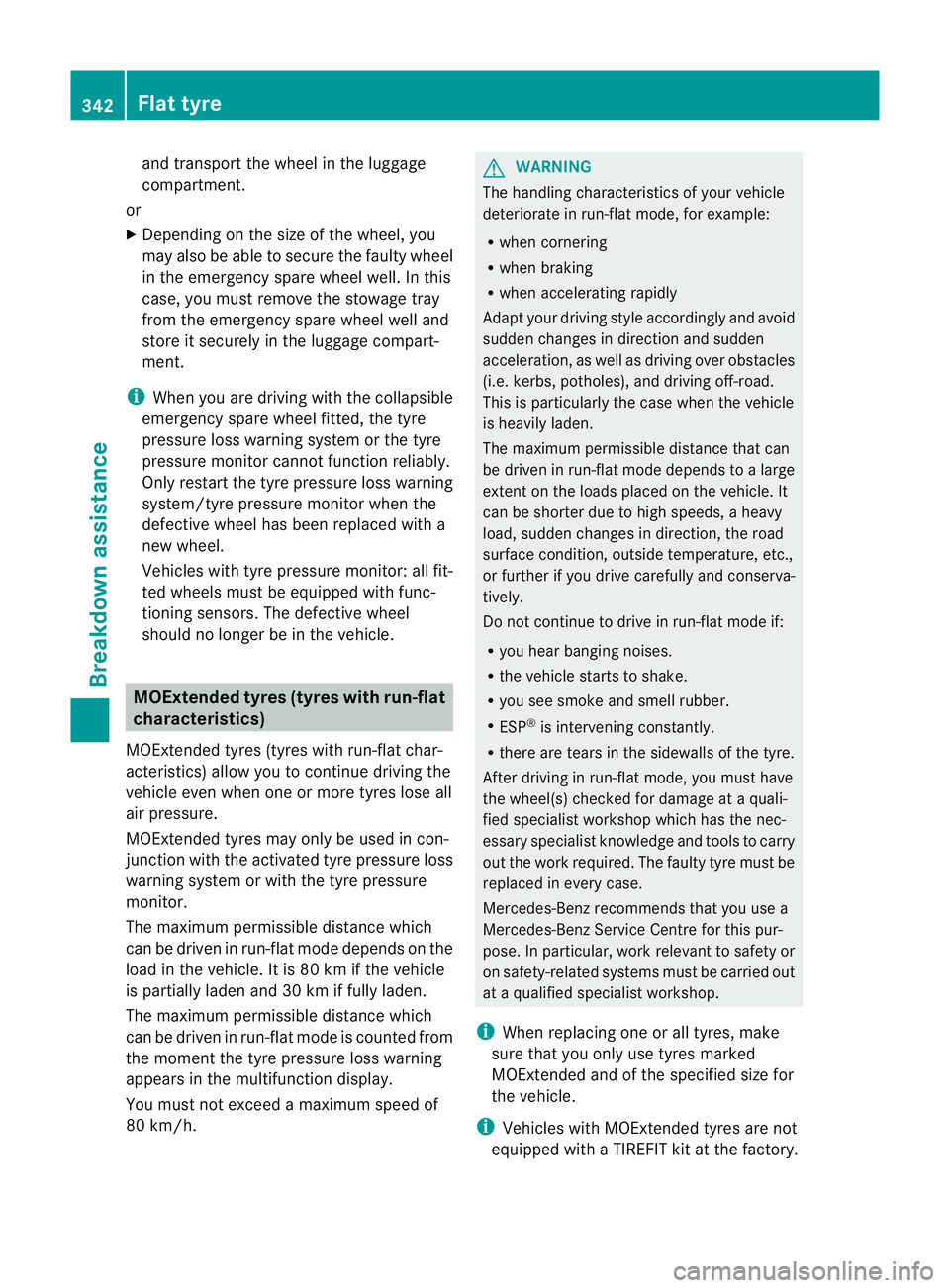
Unscre wthe uppermost wheel bolt com-
pletely.
X Screw centring pin :into the thread
instead of the wheel bolt.
X Unscrew the remaining wheel bolts fully.
! Do not place wheel bolts in sand or dirt.
The threads of the wheel bolts and wheel
hubs could otherwise be damaged when
the bolts are tightened.
X Remove the wheel.
Fitting anew wheel G
WARNING
Replac edamaged or corroded wheel bolts.
Never oil or grease wheel bolts. This could
cause the bolts to loosen in the wheel hub. G
WARNING
If aw heel hub thread is damaged, you must
not drive the vehicle any further. Consult a
qualified specialist workshop whic hhas the
necessary specialis tknowledge and tool sto
carry out the work required. Mercedes-Be nz
re commends that you use aMercedes-Benz
Ser vice Centre or Service 24h for thi spur-
pose .Inp articular, work relevant to safety or
on safety-related systems must be carried out
at aq ualified specialist workshop. G
WARNING
Only use wheel bolts that have been designed
for the wheel and the vehicle. For safety rea- 340
Flat tyreBreakdown assistance
Page 345 of 389
and transpor
tthe wheel in the luggage
compartment.
or
X Depending on the size of the wheel, you
ma yalso be able to secure the faulty wheel
in the emergenc yspare wheel well. In this
case, you must remove the stowage tray
from the emergency spare wheel well and
store it securely in the luggage compart-
ment.
i When you are driving with the collapsible
emergency spare wheel fitted, the tyre
pressur eloss warnin gsystem or the tyre
pressure monitor cannot function reliably.
Only restart the tyre pressure los swarning
system/tyre pressure monitor when the
defective wheel has been replaced with a
new wheel.
Vehicles with tyre pressure monitor: all fit-
ted wheels must be equipped with func-
tioning sensors. The defective wheel
should no longer be in the vehicle. MOExtended tyres (tyres with run-flat
characteristics)
MOExtended tyres (tyres with run-flat char-
acteristics) allow you to continue driving the
vehicle even when one or more tyres lose all
air pressure.
MOExtended tyres may only be used in con-
junction with the activated tyre pressure loss
warning system or with the tyre pressure
monitor.
The maximum permissible distance which
can be driven in run-flat mode depends on the
load in the vehicle. It is 80 km if the vehicle
is partially laden and 30 km if fully laden.
The maximum permissible distance which
can be driven in run-flat mode is counted from
the moment the tyre pressure loss warning
appears in the multifunction displ ay.
Yo um ust not exceed amaximum spee dof
80 km/h. G
WARNING
Th eh andling characteristics of your vehicle
deteriorate in run-flat mode, for example:
R when cornering
R when braking
R when accelerating rapidly
Adapt your driving style accordingly and avoid
sudden changes in direction and sudden
acceleration, as well as driving over obstacles
(i.e. kerbs, potholes), and driving off-road.
This is particularly the case when the vehicle
is heavily laden.
The maximum permissible distance that can
be driven in run-flat mode depends to alarge
exten tonthe loads placed on the vehicle. It
can be shorter due to high speeds, aheavy
load, sudden changes in direction, the road
surface condition, outside temperature, etc.,
or further if you driv ecarefully and conserva-
tively.
Do not continue to drive in run-flat mode if:
R you hear banging noises.
R the vehicle starts to shake.
R you see smoke and smell rubber.
R ESP ®
is intervening constantly.
R there are tears in the sidewalls of the tyre.
After driving in run-flat mode, you must have
the wheel(s) checked for damage at aquali-
fied specialist workshop which has the nec-
essary specialist knowledg eand tool stocarry
out the work required. The faulty tyre must be
replaced in every case.
Mercedes-Benz recommends that you use a
Mercedes-Benz Service Centr efor this pur-
pose. In particular ,work relevant to safet yor
on safety-related system smust be carried out
at aq ualified specialist workshop.
i Whe nreplacing one or all tyres, make
sure that you only use tyres marked
MOExtended and of the specified size for
the vehicle.
i Vehicles with MOExtended tyres are not
equipped with aTIREFIT kit at th efactory. 342
Flat tyreBreakdown assistance
Page 351 of 389
Jum
p-starting G
WARNING
There is arisk of acid burns when jump-starting avehicle due to the gases which escape from
the battery. Do not lean over the batter ywhile the engin eisbeing jump-started. G
WARNING
Gases escapin gfrom th ebattery during jump-starting may cause minor explosions. Avoid cre-
ating sparks. Keep naked flames away from the battery, and do not smoke.
Comply with safety precautions when handling batteries. You will find these under "Battery" in
the index.
! Avoid repeated and lengthy startin gattempts. Otherwise, non-combuste dfuel may dam-
age the catalytic converter 24
and create arisk of fire.
Do not use arapid-charging device to start the engine.
Make sure the jump leads are not damaged.
Make sure the jump leads are not touching any other metal objects when they are connected
to the battery.
If your vehicle's battery is discharged ,the engin ecan be jump-started from another vehicle
or from asecond batter yusing jum pleads.
Observ ethe followin gpoints:
X The battery is not accessible in all vehicles. If the other vehicle' sbattery is not accessible,
jump-start the vehicle using asecond batter yorajump-star ting device.
X Only jump-start the vehicl ewhen th eengineisc old an dthe catalytic converter system has
cooled down 25
.
X Do no tstart the engine if the battery is frozen. Let the battery thaw first.
X Jump-starting may only be performed from batterie swithanominal voltage of 12 V.
X Only use jum pleads which have asufficient cross-section and insulated terminal clamps.
X Make sure that the jump leads cannot come into contact with parts, such as the pulley or
the fan. Thes eparts move when the engine is started and while it is running.
X If the battery is fully discharged ,leave the batter ythat is being used to jump-star tconnected
for afew minutes befor eattempting to start. This charges the empty battery alittle.
i Jump leads and further information about jump-startin gcan be obtained from any
Mercedes-Ben zService Centre, for example.
X Make sure that the two vehicles do not touch.
X Secure the vehicle by applying the electric parking brake.
X Shif tthe transmission to position P.
X Tur nthe key to position 0(Y page 139) in the ignition lock and remove it. On vehicles with
KEYL ESS-GO ,make sure the ignition is switched off (Y page 139). All indicator lamps in the
instrumen tcluster must be off.
24 Only vehicles with apetrol engine.
25 Only vehicles with apetrol engine. 348
Jump-startingBreakdown assistance
Page 352 of 389
X
Switch off al lelec trical consumers (e.g. radio ,blow er, etc.).
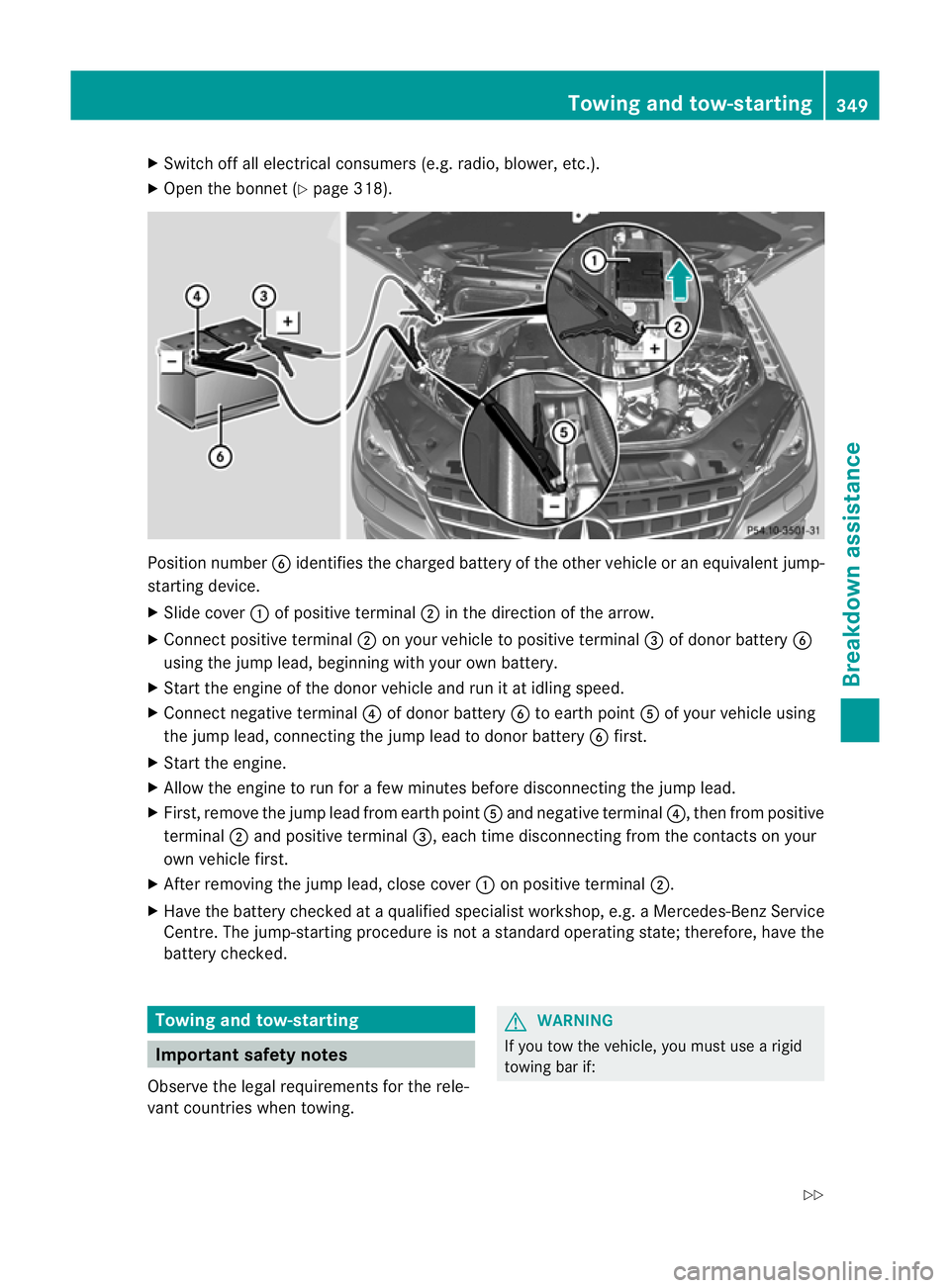
X Ope nthe bonnet (Y page 318). Position number
Bidentifies the charged battery of the other vehicle or an equivalent jump-
startin gdevice.
X Slide cover :of positiv eterminal ;in the direction of the arrow.
X Connect positiv eterminal ;on your vehicle to positiv eterminal =of donor battery B
using the jum plead, beginning with your own battery.
X Start the engine of the donor vehicle and run it at idling speed.
X Connect negative terminal ?of donor battery Bto eart hpoint Aof your vehicle using
the jum plead, connectin gthe jum plead to donor battery Bfirst.
X Start the engine.
X Allow the engine to run for afew minutes befor edisconnecting the jump lead.
X First, remov ethe jum plead from eart hpoint Aand negative terminal ?,then from positive
terminal ;and positive terminal =,each time disconnecting from the contacts on your
own vehicle first.
X After removing the jump lead, close cover :on positive terminal ;.
X Have the battery checked at aqualified specialist workshop, e.g. aMercedes-Ben zService
Cent re.T he jump-star ting procedure is not astandard operatin gstate; therefore, have the
battery checked. Towing and tow-starting
Important safet
ynotes
Observe the legal requirements for the rele-
vant countries when towing. G
WARNING
If you tow the vehicle, you must use arigid
towing bar if: Towing and tow-starting
349Breakdown assis tance
Z
Page 359 of 389
Usefu
linfor mati on
i This Owner's Manual describes all models
and all standard and optional equipment
available to your vehicle at the time of pub-
lication of the Owner's Manual. Country-
specific deviation sare possible .Please
not ethat your vehicle ma ynot be equipped
with all featur es described. This also
applies to safety-releva ntsystems and
functions.
i Please read the information on qualified
specialist workshops (Y page 24).Important safet
ynotes G
WARNING
Tyres, wheels or accessories whic hhaven ot
been approved by Mercedes- Benz foryour
vehicle or are not used as they should be, can
impair driving safety. As aresult, you could
cause an accident .Befor epurchasing and
using them, enquire about their suitability,
legal stipulations and factory recommenda-
tions at aMercedes-Benz Ser vice Centre.
Modificatio nwork on the brake system and
wheels is not permitted, nor is the use of
spacer plate sorbrake dust shields. This inva-
lidates th eGeneral Operatin gPermit for the
vehicle.
i Further information about tyres and
wheels can be obtained from any
Mercedes-Benz Ser vice Centre. Oper
ation Notes on driving
R While driving, pay attention to vibrations,
noises and unusual handling characteris-
tics ,e.g. pulling to one side. This may indi-
cate that the wheels or tyres are damaged.
If you suspect that atyre is defective,
reduce your speed immediately. Stop the vehicle as soo
naspossible to chec kthe
wheels and tyres for damage. Hidden tyre
damage could also be causing the unusual
handling characteristics. If you fin dno
signs of damage, hav ethe wheels and tyres
examined at aqualified specialist work-
shop, e.g. aMercedes-Ben zService
Cent re.
R When parkin gyour vehicle, make sure that
the tyres do not get deformed by the kerb
or other obstacles. If it is necessary to drive
over kerbs, speed humps or similar eleva-
tions, tr ytodosos lowly and at an obtuse
angle. Otherwise, the tyres, particularly the
sidewalls, can get damaged. Notes on regularly inspecting wheels
and tyres
R Regularly chec kthe wheels and tyres of
your vehicle for damage (e.g. cuts, punctu-
res, tears, bulges on tyres and deformation,
crack sorseverecorrosion on wheels), at
least ever y14d ays, as well as after driving
off-road or on rough roads. Damaged
wheels can cause aloss of tyr epressure.
R Regu larly check th etyre tread depth and
the conditio nofthe tread across the whole
widt hofthe tyr e(Ypage 357). If neces-
sary, tur nthe front wheels to full lock in
orde rtoi nspect the inner sid eofthe tyre
surface.
R All wheels must hav eavalve cap to protect
the valve against dirt and moisture. Do not
fit anything onto the valve (such as tyre
pressure monitorin gsystems) othe rthan
the standar dvalve cap or other valve caps
approved by Mercedes-Ben zfor your vehi-
cle.
R Regularly chec kthe pressur eofall the tyres
including the emergenc yspare wheel or the
spare wheel, particularly prior to long trips,
and correc tthe pressur easnecessary
(Y page 359). 356
OperationWheels and tyres
Page 360 of 389
Tyre tread
G
WARNING
Bea rinm ind that:
R tyre gri pdecrease srapidly on wetroads
when the tread depth is less than 3mm.
Thus ,you should repl acet yres that have
insufficient tread.
R winter tyres sho uld bereplaced when the
trea ddepth is 4mmorl ess as they no lon-
ger provide adequat egrip.
R thet rea donat yre may not wear evenly.
Thus ,you should regularly chec kthe tread
depth and the condition of the tread across
the entire widt hofall tyres. If necessary,
turn the fron twheels to full lock in order to
inspec tthe tyr etrea dm ore easily.
Otherwise, you coul dlose control of the vehi-
cle and cause an accident due to the reduced
grip of the tyres on the road. Note
sons electing, fitting and replac-
ing tyres
R Only fit tyres and wheels of the same type
and make.
R Only fit tyres of the correct size onto the
wheels.
R After fittin gnew tyres, run them in at mod-
erat espeeds for the first 10 0km, as they
onl yreach their ful lperformanc eafter this
distance.
R Do not drive wit htyres which have too little
tread depth ,asthis significantly reduces
the traction on wet roads (aquaplaning).
R Replace the tyres after six year satthe lat-
est, regardless of wear .This also applies to
the emergency spar ewheel/spar ewheel. MOExtended ty
res( tyres with run-flat
characteristics)
MOExtended tyres (tyres with run-flat char-
acteristics) allo wyou to continue drivin gthe vehicle even when one or mor
etyres los eall
air pressure.
MOExtended tyres may only be used in con-
junction with the tyre pressure loss warning
system or with the tyre pressure monitor and
on wheels specifically tested by Mercedes-
Benz.
i Vehicles with MOExtended tyres are not
equipped with aTIREFIT kit at th efactory.
It is therefore recommended that you addi-
tionally equip your vehicle with the TIREFIT
kit if you fit tyres that do not feature run-
flat properties, e.g. winter tyres. ATIREFIT
kit can be obtaine dfrom aMercedes-Benz
Ser vice Centre.
Notes on driving with MOExtended tyres in
the event of aflat tyre can be found in the
"Breakdown assistance" section
(Y page 342). Winter operation
Points to remember
At the onset of winter ,have your vehicle win-
terproofed at aqualified specialist workshop,
e.g. at aMercedes-Ben zService Cent re.
Observe the notes in the "Changin gawheel"
section (Y page 363). Drivin
gwith summer ty res
At temperatures below +7 †, summer tyres
los ee lasticit yand therefore traction and
braking power; chang ethe tyres on your vehi-
cle to M+S tyres .Using summer tyres at very
cold temperatures could cause tears to form,
thereby damagin gthe tyres permanently.
Mercedes-Ben zcannot accept responsibility
for this type of damage. Winter operation
357Wheels andtyres Z