oil level MERCEDES-BENZ SPRINTER 2013 MY13 Operator’s Manual
[x] Cancel search | Manufacturer: MERCEDES-BENZ, Model Year: 2013, Model line: SPRINTER, Model: MERCEDES-BENZ SPRINTER 2013Pages: 334, PDF Size: 3.88 MB
Page 244 of 334
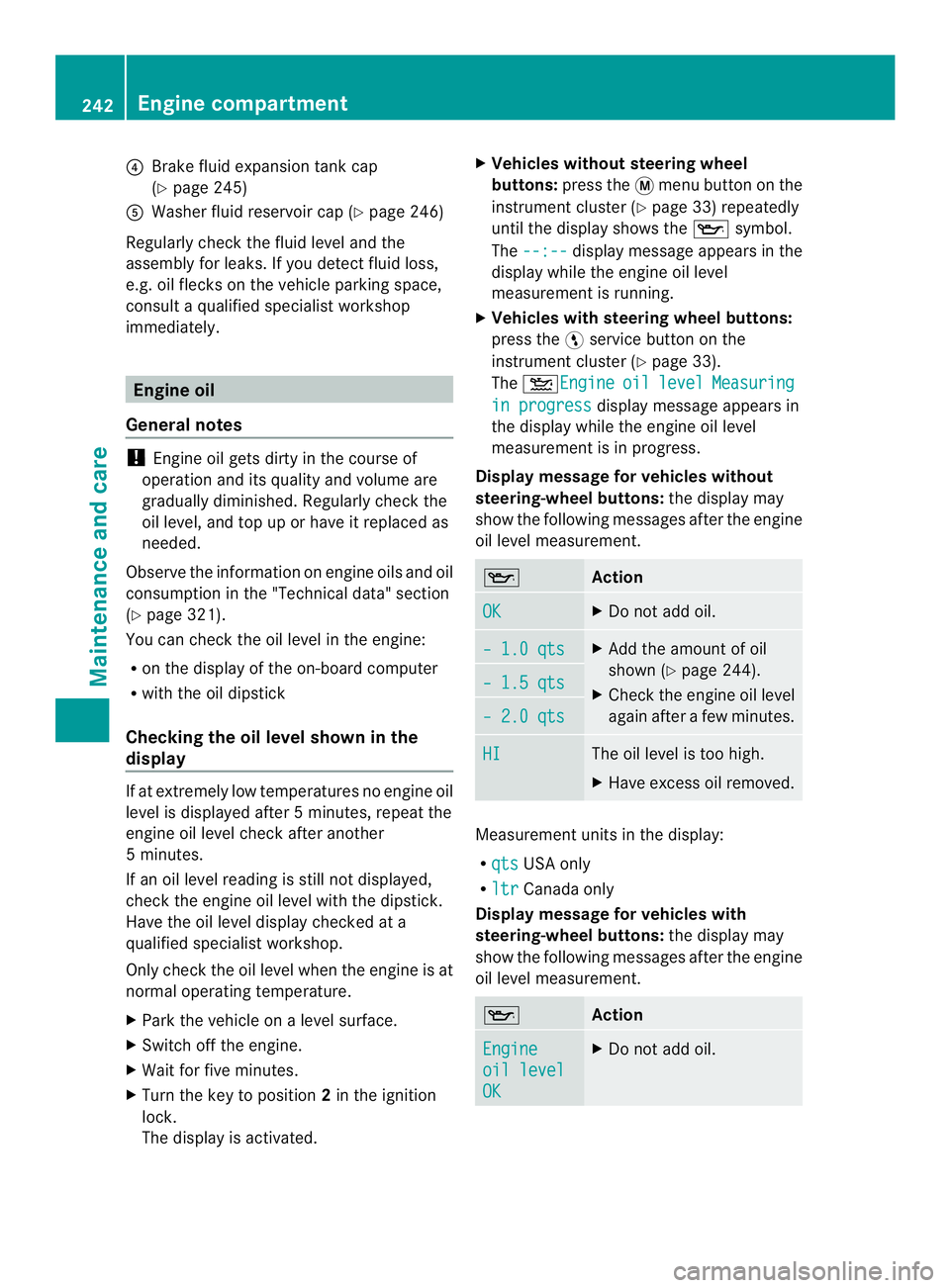
0025
Brake fluid expansion tank cap
(Ypage 245)
0023 Washe rfluid reservoir cap (Y page 246)
Regularly chec kthe fluid level and the
assembly for leaks. If you detect fluid loss,
e.g. oil flecks on the vehicle parking space,
consult a qualified specialist workshop
immediately. Engine oil
General notes !
Engine oil gets dirty in the course of
operation and its quality and volume are
gradually diminished. Regularly check the
oil level, and top up or have it replaced as
needed.
Observe the information on engine oils and oil
consumption in the "Technical data" section
(Y page 321).
You can check the oil level in the engine:
R on the display of the on-board computer
R with the oil dipstick
Checking the oil level shown in the
display If at extremely low temperatures no engine oil
level is displayed after
5minutes, repeat the
engine oil level chec kafter another
5 minutes.
If an oil level reading is still not displayed,
check the engine oil level with the dipstick.
Have the oil level display checked at a
qualified specialist workshop.
Only check the oil leve lwhen the engine is at
normal operating temperature.
X Park the vehicle on a level surface.
X Switch off the engine.
X Wait for five minutes.
X Turn the key to position 2in the ignition
lock.
The display is activated. X
Vehicles without steering wheel
buttons: press the 0004menu button on the
instrument cluster (Y page 33) repeatedly
until the display shows the 0015symbol.
The --:-- display message appears in the
display while the engine oil level
measurement is running.
X Vehicles with steering wheel buttons:
press the 0012service button on the
instrument cluster (Y page 33).
The 001DEngine oil level Measuring
in progress display message appears in
the display while the engine oil level
measurement is in progress.
Display message for vehiclesw ithout
steering-wheel buttons: the display may
show the following messages afte rthe engine
oil level measurement. 0015
Action
OK X
Do not add oil. – 1.0 qts X
Add the amount of oil
shown (Y page 244).
X Check the engine oil level
again after a few minutes. – 1.5 qts
– 2.0 qts
HI The oil level is too high.
X
Have excess oil removed. Measurement units in the display:
R
qts USA only
R ltr Canada only
Display message for vehiclesw ith
steering-wheel buttons: the display may
show the following messages afte rthe engine
oil level measurement. 0015
Action
Engine
oil level
OK X
Do not add oil. 242
Engine compartmentMaintenance and care
Page 245 of 334
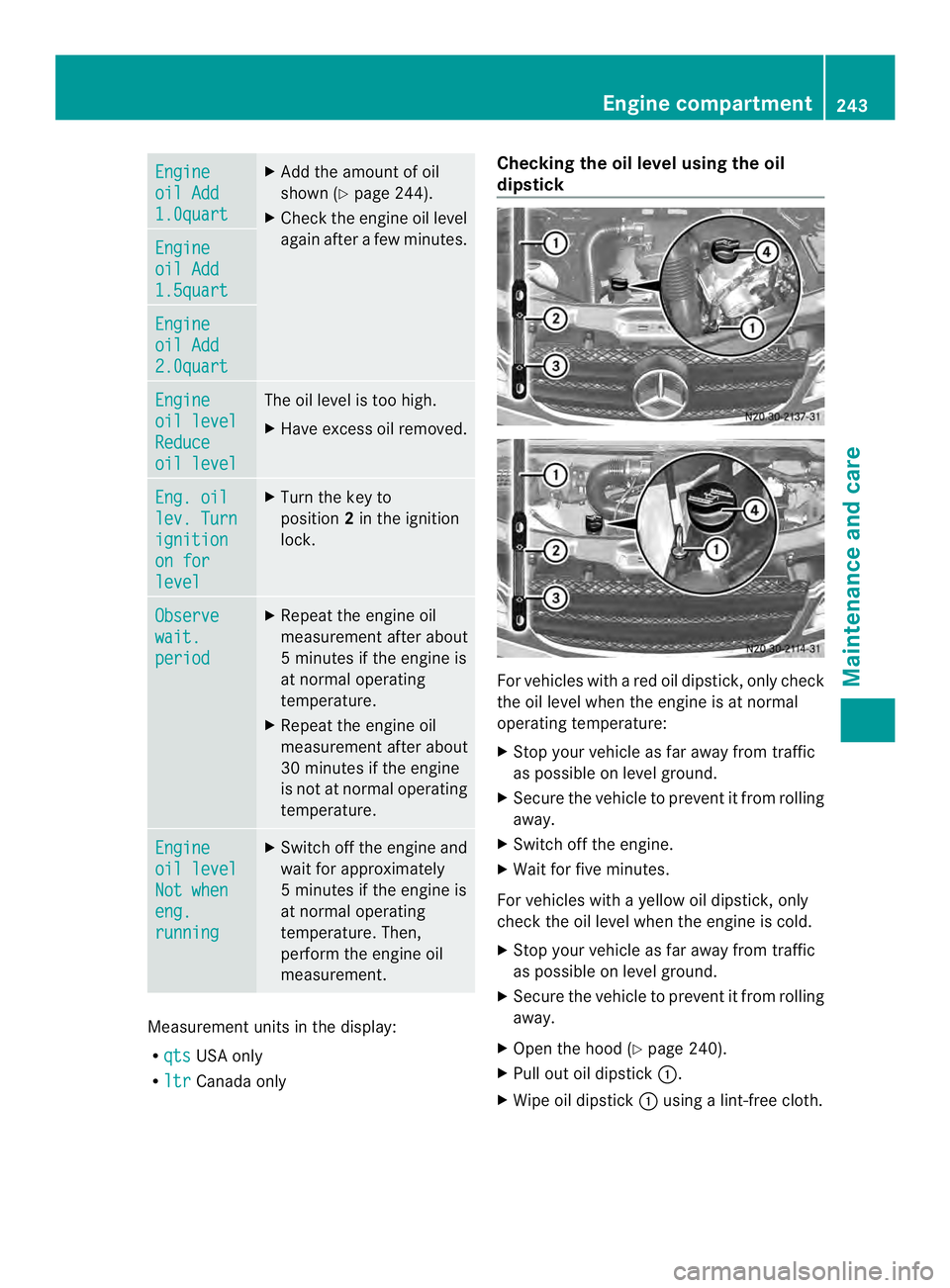
Engine
oil Add
1.0quart X
Add the amount of oil
shown (Y page 244).
X Check the engine oil level
againa fter a few minutes. Engine
oil Add
1.5quart
Engine
oil Add
2.0quart
Engine
oil level
Reduce
oil level The oil level is too high.
X
Have excess oil removed. Eng. oil
lev. Turn
ignition
on for
level X
Turn the key to
position 2in the ignition
lock. Observe
wait.
period X
Repeat the engine oil
measurement after about
5 minutes if the engine is
at normal operating
temperature.
X Repeat the engine oil
measurement after about
30 minutes if the engine
is not at normal operating
temperature. Engine
oil level
Not when
eng.
running X
Switch off the engine and
wait for approximately
5 minutes if the engine is
at normal operating
temperature. Then,
perform the engine oil
measurement. Measurement units in the display:
R
qts USA only
R ltr Canada only Checking the oil level using the oil
dipstick
For vehicles with a red oil dipstick, only check
the oil level whe
nthe engine is at normal
operating temperature:
X Stop your vehicle as far away from traffic
as possible on level ground.
X Secure the vehicle to prevent it from rolling
away.
X Switch off the engine.
X Wait for five minutes.
For vehicles with a yellow oil dipstick, only
check the oil level when the engine is cold.
X Stop your vehicle as far away from traffic
as possible on level ground.
X Secure the vehicle to prevent it from rolling
away.
X Open the hood (Y page 240).
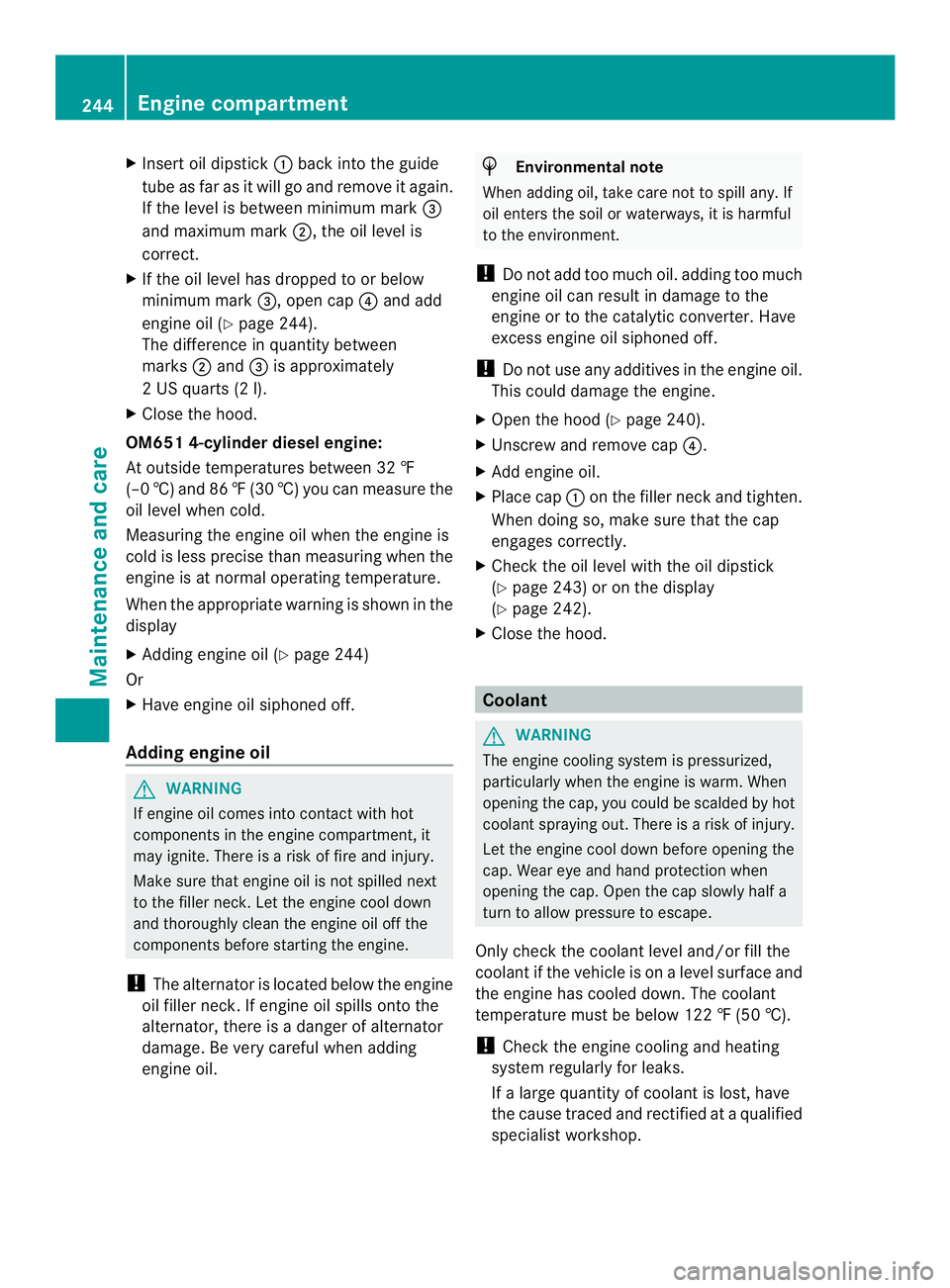
X Pull out oil dipstick 0005.
X Wipe oil dipstick 0005using a lint-free cloth. Engine compartment
243Maintenance and care Z
Page 246 of 334
X
Insert oil dipstick 0005back into the guide
tube as far as it will go and remove it again.
If the level is between minimum mark 0026
and maximum mark 0006, the oil level is
correct.
X If the oil level has droppe dto or below
minimum mark 0026, open cap0025and add
engine oil (Y page 244).
The difference in quantity between
marks 0006and 0026is approximately
2 US quarts (2 l).
X Close the hood.
OM651 4-cylinder diesel engine:
At outside temperatures between 32 ‡
(–0 †) and 86 ‡(30 †) you can measure the
oil level whe ncold.
Measuring the engine oil when the engine is
cold is less precise than measuring when the
engine is at normal operating temperature.
When the appropriate warning is shown in the
display
X Adding engine oil (Y page 244)
Or
X Have engine oil siphoned off.
Adding engine oil G
WARNING
If engine oil comes into contact with hot
components in the engine compartment, it
may ignite. There is a risk of fire and injury.
Make sure that engine oil is not spilled next
to the filler neck. Let the engine cool down
and thoroughly clean the engine oil off the
components before starting the engine.
! The alternator is located below the engine
oil filler neck.Ife ngine oil spills onto the
alternator, there is a dange rofalternator
damage. Be very careful when adding
engine oil. H
Environmental note
When adding oil, take care not to spill any. If
oil enters the soil or waterways, it is harmful
to the environment.
! Do not add too much oil. adding too much
engine oil can result in damage to the
engine or to the catalytic converter. Have
excess engine oil siphoned off.
! Do not use any additives in the engine oil.
This could damage the engine.
X Open the hood (Y page 240).
X Unscrew and remove cap 0025.
X Add engine oil.
X Place cap 0005on the filler nec kand tighten.
Whe ndoing so, make sure that the cap
engages correctly.
X Check the oil level with the oil dipstick
(Y page 243) or on the display
(Y page 242).
X Close the hood. Coolant
G
WARNING
The engine cooling system is pressurized,
particularly when the engine is warm. When
opening the cap, you could be scalded by hot
coolant spraying out. There is a risk of injury.
Let the engine cool down before opening the
cap. Wear eye and hand protection when
opening the cap. Open the cap slowly half a
turn to allow pressure to escape.
Only check the coolant level and/or fill the
coolant if the vehicle is on a level surface and
the engine has cooled down. The coolant
temperature must be below 122 ‡ (50 †).
! Check the engine cooling and heating
system regularly for leaks.
If a large quantity of coolant is lost, have
the cause traced and rectified at a qualified
specialist workshop. 244
Engine compartmentMaintenance and care
Page 248 of 334
Store brake fluid only in the original closed
container and keep it out of the reach of
children. Comply with safety regulations
when handling brake fluid.
! Brake fluid corrodes paint, plastic and
rubber .Ifpaint, plastic or rubbe rhas come
into contact with brake fluid, rinse with
wate rimmediately. G
WARNING
The brake fluid constantly absorbs moisture
from the air. This lowers the boiling point of
the brake fluid. If the boiling point of the brake
fluid is too low, vapo rpockets may form in the
brake system when the brakes are applied
hard. This would impair braking efficiency.
There is a risk of an accident.
You should have the brake fluid renewed at
the specified intervals.
! If the brake fluid level in the brake fluid
reservoir has fallen to the MIN mark or
below, check the brake system
immediately for leaks. Also check the
thickness of the brake linings. Visit a
qualified specialist workshop immediately.
Do not add brake fluid. This does not
correct the malfunction.
Have the brake fluid renewed every two
years.
Observe the information on brake fluid in the
"Technical data" section ( Ypage 245). Check the brake fluid level regularly, e.g.
weekly or when refueling. Checking the brake fluid level
X
Stop your vehicle as far away from traffic
as possible on level ground.
X Switch off the engine.
X Secure the vehicle to prevent it from rolling
away.
X Open the hood (Y page 240).
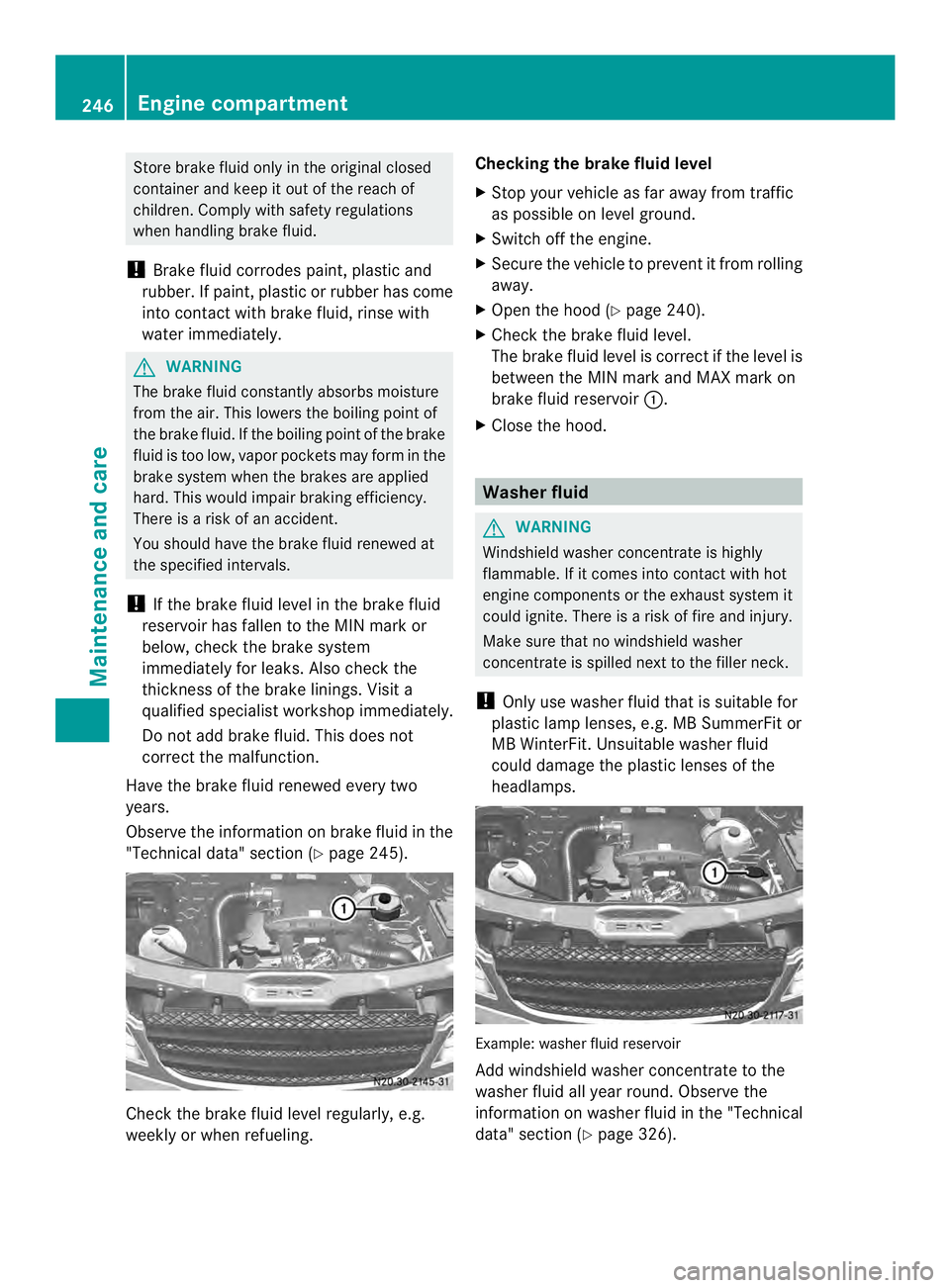
X Check the brake fluid level.
The brake fluid level is correc tifthe level is
between the MIN mark and MAX mark on
brake fluid reservoir 0005.
X Close the hood. Washer fluid
G
WARNING
Windshield washer concentrate is highly
flammable. If it comes into contact with hot
engine components or the exhaust system it
could ignite. There is a risk of fire and injury.
Make sure that no windshield washer
concentrate is spilled next to the filler neck.
! Only use washer fluid that is suitable for
plastic lamp lenses, e.g. MB SummerFit or
MB WinterFit. Unsuitable washer fluid
could damage the plastic lenses of the
headlamps. Example: washer fluid reservoir
Add windshield washer concentrate to the
washer fluid all year round. Observe the
information on washer fluid in the "Technical
data" section (Y
page 326).246
Engine compartmentMaintenance and care
Page 251 of 334
i
Maintenance services must be carried out
in accordance with the provisions and
recommendations in the Maintenance
Booklet.
Not doing so could void the warranty claim
and lead to refusal of goodwill gestures
after the manufacturer has submitted a
damage report.
i Observe the information on Sprinter
original parts in the "Technical data"
section (Y page 314). Service interval display
General notes As
ervice that is due is displayed in the service
interval display about 1monthi nadvance. A
message is then displayed while the vehicle
is in motion or when the ignition is switched
on.
i The service interval display does not
provide information about the oil level. The
service interval display should therefore
not be confused with the 001Cengine oil
level display.
The service due date is displayed in days or
miles (kilometers), depending on the total
distance driven.
The symbols or letters on the service display
show the type of service that is due.
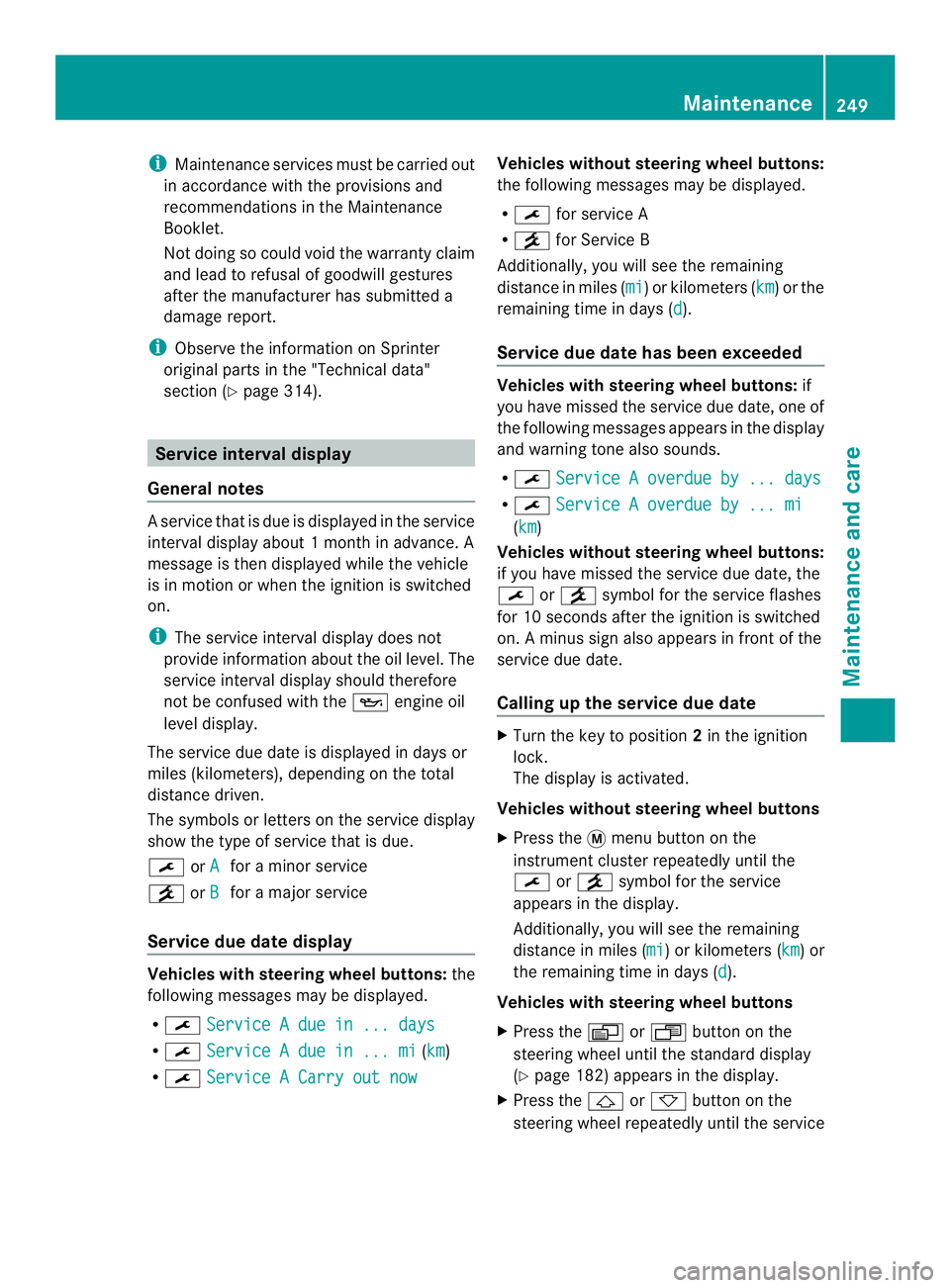
0002 orA for a minor service
0003 orB for a major service
Service due date display Vehicles with steering wheel buttons:
the
following messages may be displayed.
R 0002 Service A due in ... days R
0002 Service A due in ... mi (km )
R 0002 Service A Carry out now Vehicles without steering wheel buttons:
the following messages may be displayed.
R
0002 for service A
R 0003 for Service B
Additionally, you will see the remaining
distance in miles ( mi ) or kilometers (km ) or the
remaining time in days ( d ).
Service due date has been exceeded Vehicles with steering wheel buttons:
if
you have missed the service due date, one of
the following messages appears in the display
and warning tone also sounds.
R 0002 Service A overdue by ... days R
0002 Service A overdue by ... mi (km )
Vehicles without steering wheel buttons:
if you have missed the service due date, the
0002 or0003 symbol for the service flashes
for 10 seconds after the ignition is switched
on. A minus sign also appears in front of the
service due date.
Calling up the service due date X
Turn the key to position 2in the ignition
lock.
The display is activated.
Vehicles without steering wheel buttons
X Press the 0004menu button on the
instrument cluster repeatedly until the
0002 or0003 symbol for the service
appears in the display.
Additionally, you will see the remaining
distance in miles ( mi ) or kilometers (
km ) or
the remaining time in days (d ).
Vehicles with steering wheel buttons
X Press the 0010or0007 button on the
steering wheel until the standard display
(Y page 182) appears in the display.
X Press the 0001or0009 button on the
steering wheel repeatedly until the service Maintenance
249Maintenance and care Z
Page 296 of 334
is bar. 100 kilopascals (kPa) are the
equivalen tof1bar.
Load index
In addition to the load bearing index, a load
index can be stamped onto the sidewall of the
tire. It specifies the load-bearing capacity of
the tire more precisely.
Curb weight
The weigh tofavehicle with standard
equipment including the maximu mfilling
capacity of fuel, oil, and coolant. It also
includes the air-conditionin gsystem and
optional equipmen tifthese are installed on
the vehicle, but does not include passengers
or luggage.
Maximum tire load
The maximum tire load in kilograms or
pounds is the maximum weight for which a
tire is approved.
Maximum permissible tire pressure
Maximum permissible tire pressure for one
tire.
Maximum load on one tire
Maximum load on one tire. This is calculated
by dividing the maximum axle load of one axle
by two.
PSI (Pounds per square inch)
Standard unit of measurement for tire
pressure.
Aspect ratio
Relationship between tire height and width in
percent.
Tire pressure
Pressure inside the tire applying an outward
force to every square inch of the tire's
surface. Tire pressure is specified in pounds
per square inch (psi), in kilopascal (kPa) or in
bar. Tire pressure should only be corrected
when the tires are cold. Cold tire pressure
The tires are cold:
R if the vehicle has been parked for at least
three hours without direct sunlight on the
tires, and
R if the vehicle has not been driven further
than 1 mile (1.6 km)
Tire tread
The part of the tire that comes into contact
with the road.
Tire bead
The tire bead ensures that the tire sits
securely on the wheel. There are several steel
wires in the bead to prevent the tire from
coming loose from the wheel rim.
Sidewall
The part of the tire between the tread and the
tire bead.
Weight of optional extras
The combined weight of those optional extras
that weigh more than the replaced standard
parts and more than 2.3 kg (5 lbs). These
optional extras, such as high-performance
brakes, level control, a roof rack or a high-
performance battery, are not included in the
curb weight and the weight of the
accessories.
TIN (Tire Identification Number)
Au nique identificatio nnumbe rwhich can be
used by a tire manufacturer to identify tires,
for example for a product recall, and thus
identify the purchasers. The TIN is composed
of the manufacturer identification code, tire
size, tire model code and manufacturing date.
Load bearing index
The load bearing index (also load index) is a
code that contains the maximum load bearing
capacity of a tire. 294
What you should know about wheels and tiresWheels and tires
Page 305 of 334
Diagra
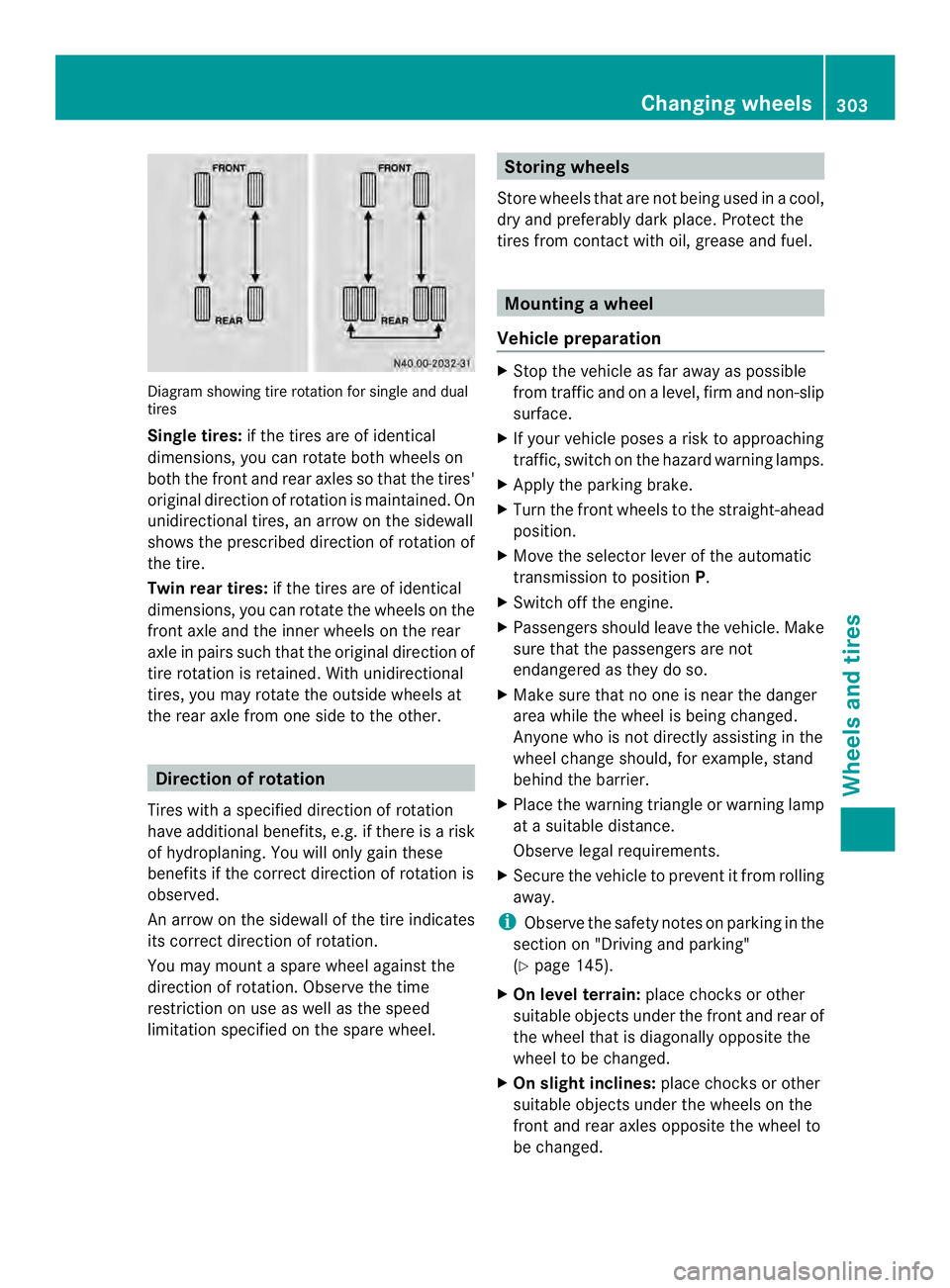
mshowing tire rotation for single and dual
tires
Single tires: if the tires are of identical
dimensions, you can rotate both wheels on
both the front and rear axles so that the tires'
original direction of rotation is maintained. On
unidirectional tires, an arrow on the sidewall
shows the prescribed direction of rotation of
the tire.
Twin rear tires: if the tires are of identical
dimensions, you can rotate the wheels on the
front axle and the inner wheels on the rear
axle in pairs such that the original direction of
tire rotation is retained. With unidirectional
tires, you may rotate the outside wheels at
the rear axle from one side to the other. Direction of rotation
Tires with a specified direction of rotation
have additional benefits, e.g. if there is a risk
of hydroplaning. You will only gain these
benefits if the correct direction of rotation is
observed.
An arrow on the sidewall of the tire indicates
its correct direction of rotation.
You may mount a spare wheel against the
direction of rotation. Observe the time
restriction on use as well as the speed
limitation specified on the spare wheel. Storing wheels
Store wheels that are not being used in a cool,
dry and preferably dark place. Protect the
tires from contact with oil, grease and fuel. Mounting
awheel
Vehicle preparation X
Stop the vehicle as far away as possible
from traffic and on a level, firm and non-slip
surface.
X If you rvehicle poses a risk to approaching
traffic, switch on the hazard warning lamps.
X Apply the parking brake.
X Turn the fron twheels to the straight-ahead
position.
X Move the selector lever of the automatic
transmission to position P.
X Switch off the engine.
X Passengers should leave the vehicle. Make
sure that the passengers are not
endangered as they do so.
X Make sure that no one is near the danger
area while the wheel is being changed.
Anyone who is not directly assisting in the
wheel change should, for example, stand
behind the barrier.
X Place the warning triangle or warning lamp
at a suitable distance.
Observe legal requirements.
X Secure the vehicle to prevent it from rolling
away.
i Observe the safety notes on parking in the
section on "Driving and parking"
(Y page 145).
X On level terrain: place chocks or other
suitable objects under the front and rear of
the wheel that is diagonally opposite the
wheel to be changed.
X On slight inclines: place chocks or other
suitable objects under the wheels on the
front and rear axles opposite the wheel to
be changed. Changing wheels
303Wheels and tires Z
Page 319 of 334
Service products include the following:
R Fuels, e.g. diesel
R Additives for the exhaus tgas
aftertreatment, e.g .Diesel Exhaust Fluid
(DEF)
R Lubricants, e.g. engine oil, transmission oil
R Coolant
R Brake fluid
R Washer fluid
R Climate control system refrigerants
Approved service products comply with the
highes tquality standards and are listed in the
MB Specifications for Service Products. Only
use service products approved for the
vehicle. This is an important condition for the
warranty.
You will recognize the approved service
products by the inscription on the container:
MB Approval (e.g. MB Approval 228.5)
Other identifications and recommendations
refer to quality level or a specification
according to an MB Sheet Number (e.g. MB
228.5). They are therefore not necessarily
approved.
Further information can be obtained at any
qualified specialist workshop.
Additives for approved service products are
neither required no rpermitted. Approved fuel
additives are the exception .Additives can
cause engine damage and must therefore not
be added to the service products.
The use of additives is always the
responsibility of the vehicle operator .The use
of additives may result in the restriction or
loss of your Limited Warranty entitlements. Fuel
Important safety notes G
WARNING
Fuel is highly flammable. Improper handing of
fuel creates a risk of fire and explosion. Avoid fire, open flames, smoking and creating
sparks under all circumstances. Switch off the
engine and, if applicable, the auxiliary heating
before refueling.
G
WARNING
Fuel is poisonous and hazardous to health.
There is a risk of injury.
You must make sure that fuel does not come
into contact with your skin, eyes or clothing
and that it is not swallowed. Do not inhale fuel
vapors. Keep fuel away from children.
If you or others come into contact with fuel,
observe the following:
R Wash away fuel from skin immediately
using soap and water.
R If fuel comes into contact with your eyes,
immediately rinse them thoroughly with
clean water. Seek medical assistance
without delay.
R If fuel is swallowed, seek medical
assistance without delay.Don ot induce
vomiting.
R Immediately change out of clothing which
has come into contact with fuel.
Tank contents Total capacity
Approximately
26.4 US gal (100 l) of which reserve
fuel
Approximately
5.3 US gal(20 l) Diesel
Fuel grade
G
WARNING
If you mix diesel fuel with gasoline, the flash
point is lower than that of pure diesel fuel.
When the engine is running, exhaust system
components could overheat without being
noticed. There is a risk of fire.
Never refuel with gasoline. Never mix gasoline
with diesel fuel. Service products and capacities
317Technical data Z
Page 325 of 334
Capacities
!
Do no tadd too much oil. adding too much
engine oil can result in damage to the
engine or to the catalytic converter. Have
excess engine oil siphoned off.
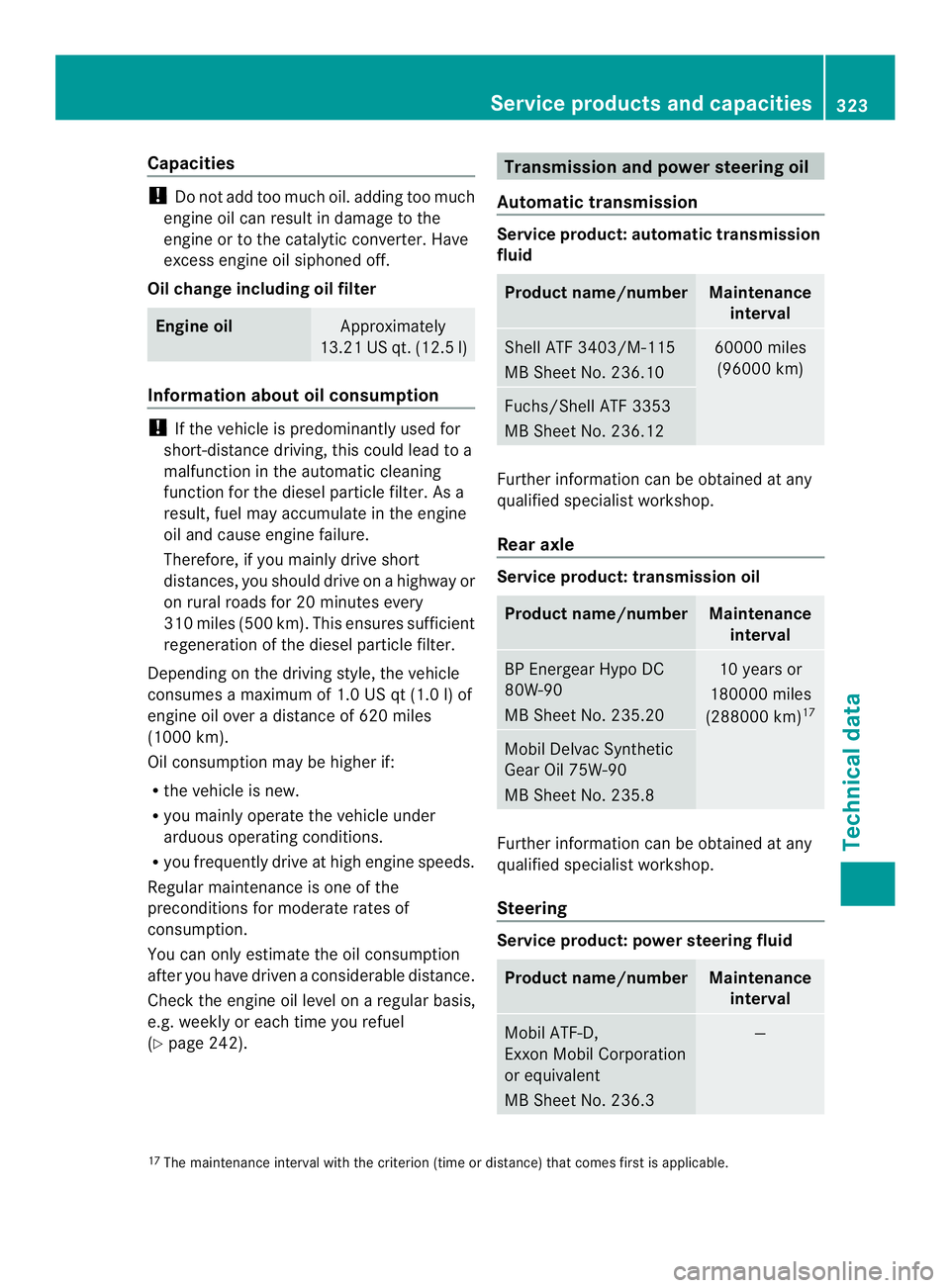
Oil change including oil filter Engine oil
Approximately
13.21 US qt. (12.5 l) Information about oil consumption
!
If the vehicle is predominantly used for
short-distance driving, this could lead to a
malfunction in the automatic cleaning
function for the diesel particle filter. As a
result, fuel may accumulate in the engine
oil and cause engine failure.
Therefore, if you mainly drive short
distances, you should drive on a highway or
on rural roads for 20 minutes every
310 miles (500 km). This ensures sufficient
regeneration of the diesel particle filter.
Depending on the driving style, the vehicle
consumes a maximum of 1.0 US qt (1.0 l)of
engine oil over a distance of 620 miles
(1000 km).
Oil consumption may be higher if:
R the vehicle is new.
R you mainly operate the vehicle under
arduous operating conditions.
R you frequently drive at high engine speeds.
Regula rmaintenance is one of the
preconditions for moderate rates of
consumption.
You can only estimate th eoil consumption
after you have drive naconsiderable distance.
Check the engine oil level on a regular basis,
e.g. weekly or each time you refuel
(Y page 242). Transmission and power steering oil
Automatic transmission Service product: automatic transmission
fluid
Product name/number Maintenance
interval Shell ATF 3403/M-115
MB Sheet No. 236.10 60000 miles
(96000 km) Fuchs/Shell ATF 3353
MB Sheet No. 236.12
Further information can be obtained at any
qualified specialist workshop.
Rear axle
Service product: transmission oil
Product name/number Maintenance
interval BP Energear Hypo DC
80W-90
MB Sheet No. 235.20 10 years or
180000 miles
(288000 km) 17 Mobil Delvac Synthetic
Gear Oil 75W-90
MB Sheet No. 235.8
Further information can be obtained at any
qualified specialist workshop.
Steering
Service product: power steering fluid
Product name/number Maintenance
interval Mobil ATF-D,
Exxon Mobil Corporation
or equivalent
MB Sheet No. 236.3 —
17
The maintenance interval with the criterion (time or distance) that comes first is applicable. Service products and capacities
323Technical data Z