steering wheel MERCEDES-BENZ SPRINTER 2013 MY13 Operator’s Manual
[x] Cancel search | Manufacturer: MERCEDES-BENZ, Model Year: 2013, Model line: SPRINTER, Model: MERCEDES-BENZ SPRINTER 2013Pages: 334, PDF Size: 3.88 MB
Page 195 of 334
button on the steering wheel or the
0007reset
button.
You cannot hide display messages of the
highest priority. These messages will
continue to be shown in the display until their
cause has been eliminated.
The on-board computer stores certain display
messages in the message memory
(Y page 193).
The following shows all the messages that
could appear in the display, arranged
alphabetically. Message memory
The on-board computer only records and
shows malfunctions and warnings from
certain systems .Therefore, make sure that
your vehicle is safe to use. You could cause
an accident by driving an unsafe vehicle.
The on-board computer stores certain display
messages. In the Message memory menu,
you can call up stored display messages.
Using the steering wheel buttons
X Press the 0010or0007 button repeatedly
until the number of stored display
messages, e.g. 2 messages , appears in the
display.
If no malfunctions have occurred, the Nomessages message appears.
X Scroll through the stored display messages
with the 0001or0009 button.
X To exit the message memory menu:
press the 0010or0007 button.
When you switch off the ignition, all display
messages are deleted from the message
memory. Display messages
193On-board computer and displays Z
Page 196 of 334
Display messages on vehicles withou
tsteering wheel buttons Display messages Possible causes/consequences and
0004 Solutions
...
LIM km/h The speed display flashes.
The vehicle has exceeded the speed se
tfor variable SPEEDTRONIC
or the programmed maximum speed for permanent
SPEEDTRONIC, e.g. on a steep downhill gradient (overrun mode).
X Apply the brakes yourself as required. NO TPMS The
NO message is displayed for 30 seconds. The
TPMS message
is also displayed after 30 seconds.
The tire pressure monitor has malfunctioned.
X Have the tire pressure monitor and the wheels checked at a
qualified specialist workshop. NO TPMS The
NO message is displayed for 30 seconds. The
TPMS message
is also displayed after 30 seconds.
The tire pressure monitor is not receiving signals from one or more
wheels because:
R a wheel has been replaced with the spare wheel without wheel
electronics.
R the maximum temperature on one of the wheel electronics units
has been exceeded.
R the wheel electronics are malfunctioning.
X Have wheels with suitable wheel electronics units installed at a
qualified specialist workshop. — — TPMS The
—— message is displayed for 30 seconds. The
TPMS message
is also displayed after 30 seconds.
The pressure is insufficient in one or more tires, or the pressures
of the individual tires differ significantly.
X Check the tire pressure at the next opportunity and correc titif
necessary (Y page 281).194
Display messagesOn-board computer and displays
Page 199 of 334
Display messages on vehicles wit
hsteering wheel buttons
Safety systems Display messages Possible causes/consequences and
0004 Solutions
ABS
Visit workshop ABS has been deactivated due to a malfunction. ESP
®
, ASR and
BAS, as well as cruise control, have also been deactivated as a
result.
G WARNING
The brake system continue sto function normally, but without the
functions listed above. The wheels could therefore lock if you
brake hard, for example.
This causes steerability and braking to be greatly impaired. The
braking distance can increase in emergency braking situations.
The driven wheels can spin when accelerating.
If ESP ®
is not operational, ESP ®
will not stabilize the vehicle.
There is an increased risk of skidding and accidents.
X Drive on with care.
X Visit a qualified specialist workshop immediately. ABS
Unavailable ABS is temporarily unavailable. ESP
®
, ASR and BAS, as well as
cruise control, are also unavailable as a result.
G WARNING
The brake system continues to function normally, but without the
functions listed above. The wheels could therefore lock if you
brake hard, for example.
This causes steerability and braking to be greatly impaired. The
braking distance can increase in emergency braking situations.
The driven wheels can spin when accelerating.
If ESP ®
is not operational, ESP ®
will not stabilize the vehicle.
There is an increased risk of skidding and accidents.
X Drive a short distance at a speed above 13 mph(20 km/h).
If the display message disappears, the functions mentioned
above are available again.
If the display message continues to be displayed:
X Drive on with care.
X Visit a qualified specialist workshop immediately. Display messages
197On-board computer and displays Z
Page 210 of 334
Display messages Possible causes/consequences and
0004 Solutions
Check tire(s)
0001 The pressure of one or more tires has dropped significantly. If the
tire pressure monitor has detected the affected wheel, the wheel
position is also displayed.
X
Stop the vehicle as soo naspossible, paying attention to road
and traffic conditions.
X Check the tires.
X Repairorc hange the wheel if necessary (Y page 302).
X Check the tire pressure and correct it if necessary
(Y page 281).
The display message disappears automatically after driving for
a few minutes with the corrected tire pressure. Warning Tire defect
0001 One or more tires is losing air rapidly.Ift
he tire pressure monitor
has detected the affected wheel, the wheel position is also
displayed.
X Stop the vehicle without making any sudden steering or braking
maneuvers, paying attention to the traffic conditions as you do
so.
X Repair or change the wheel (Y page 302).Vehicle
Display messages Possible causes/consequences and
0004 Solutions
0010
Battery/
Alternator Visit
workshop The battery is not being charged. Possible causes are a defective
alternator or a torn poly-V-belt.
X
Stop the vehicle as soon as possible, paying attention to road
and traffic conditions.
X Check the poly-V-belt.
X If the poly-V-belt is torn: do not continue driving. Consult a
qualified specialist workshop.
X If the poly-V-belt is not damaged: have the vehicle checked as
soon as possible by a qualified specialist workshop. 0001
Electrical Step The electrical step has retracted or extended only partially or not
at all.
X
Make sure there is sufficient free space for the electrical step.
X Open or close the sliding door again.
X If the electrical step still does not extend or retract fully, push
the step in manually (Y page 72). Before stepping out, remind
the passengers that the step is missing. 208
Display messagesOn-board computer and displays
Page 212 of 334
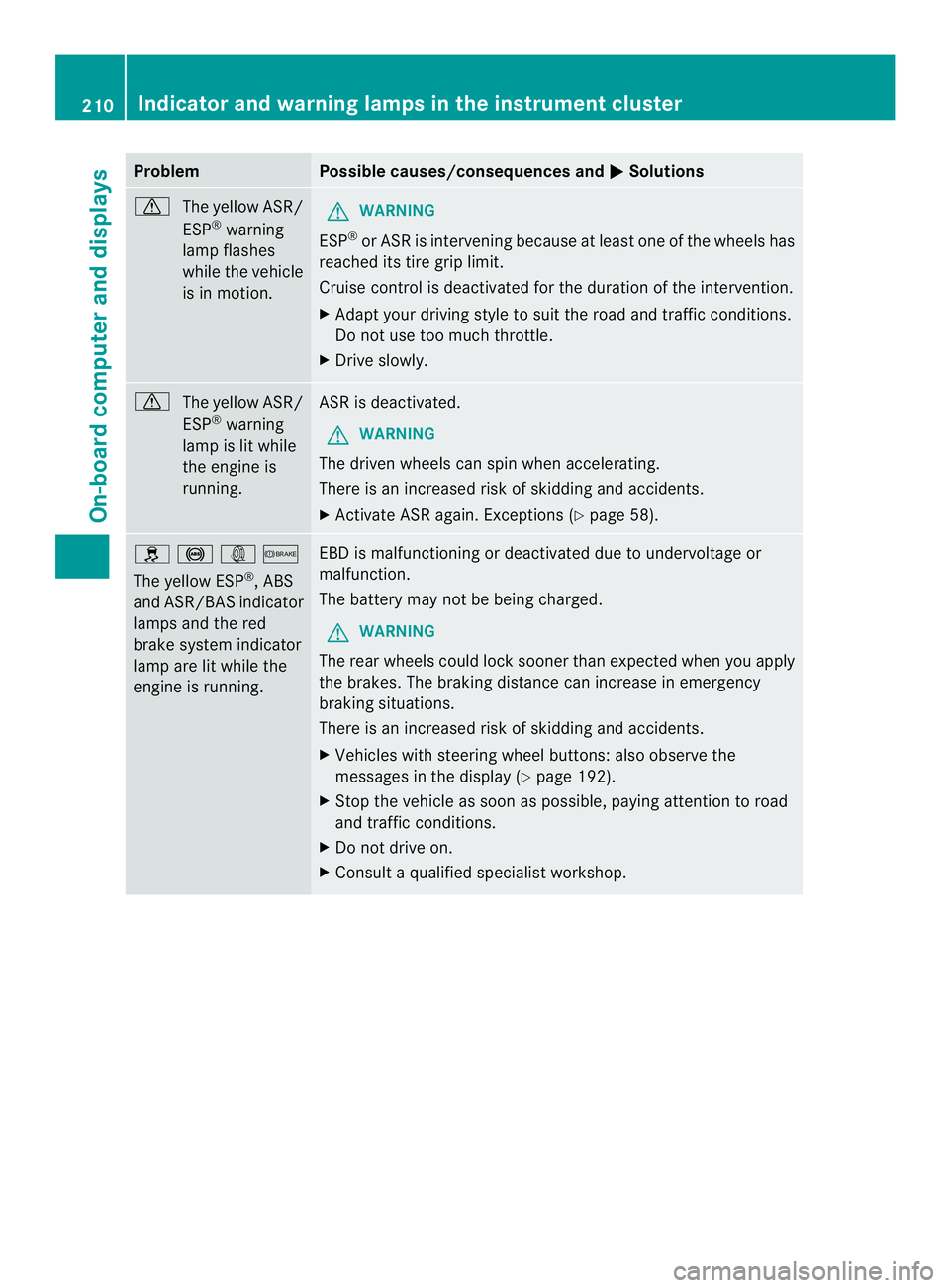
Problem Possible causes/consequences and
0004 Solutions
000D
The yellow ASR/
ESP®
warning
lamp flashes
while the vehicle
is in motion. G
WARNING
ESP ®
or ASR is intervening because at least one of the wheels has
reached its tire grip limit.
Cruise control is deactivated for the duration of the intervention.
X Adapt your driving style to suit the road and traffic conditions.
Do not use too much throttle.
X Drive slowly. 000D
The yellow ASR/
ESP®
warning
lamp is lit while
the engine is
running. ASR is deactivated.
G WARNING
The driven wheels can spin when accelerating.
There is an increased risk of skidding and accidents.
X Activate ASR again. Exceptions (Y page 58).0002
000E000A0008
The yellow ESP ®
, ABS
and ASR/BAS indicator
lamps and the red
brake system indicator
lamp are lit while the
engine is running. EBD is malfunctioning or deactivated due to undervoltage or
malfunction.
The battery may not be being charged.
G WARNING
The rear wheels could lock sooner than expected when you apply
the brakes. The braking distance can increase in emergency
braking situations.
There is an increased risk of skidding and accidents.
X Vehicles with steering wheel buttons: also observe the
messages in the display (Y page 192).
X Stop the vehicle as soon as possible, paying attention to road
and traffic conditions.
X Do not drive on.
X Consult a qualified specialist workshop. 210
Indicator and warning lamps in the instrument clusterOn-board computer and displays
Page 213 of 334
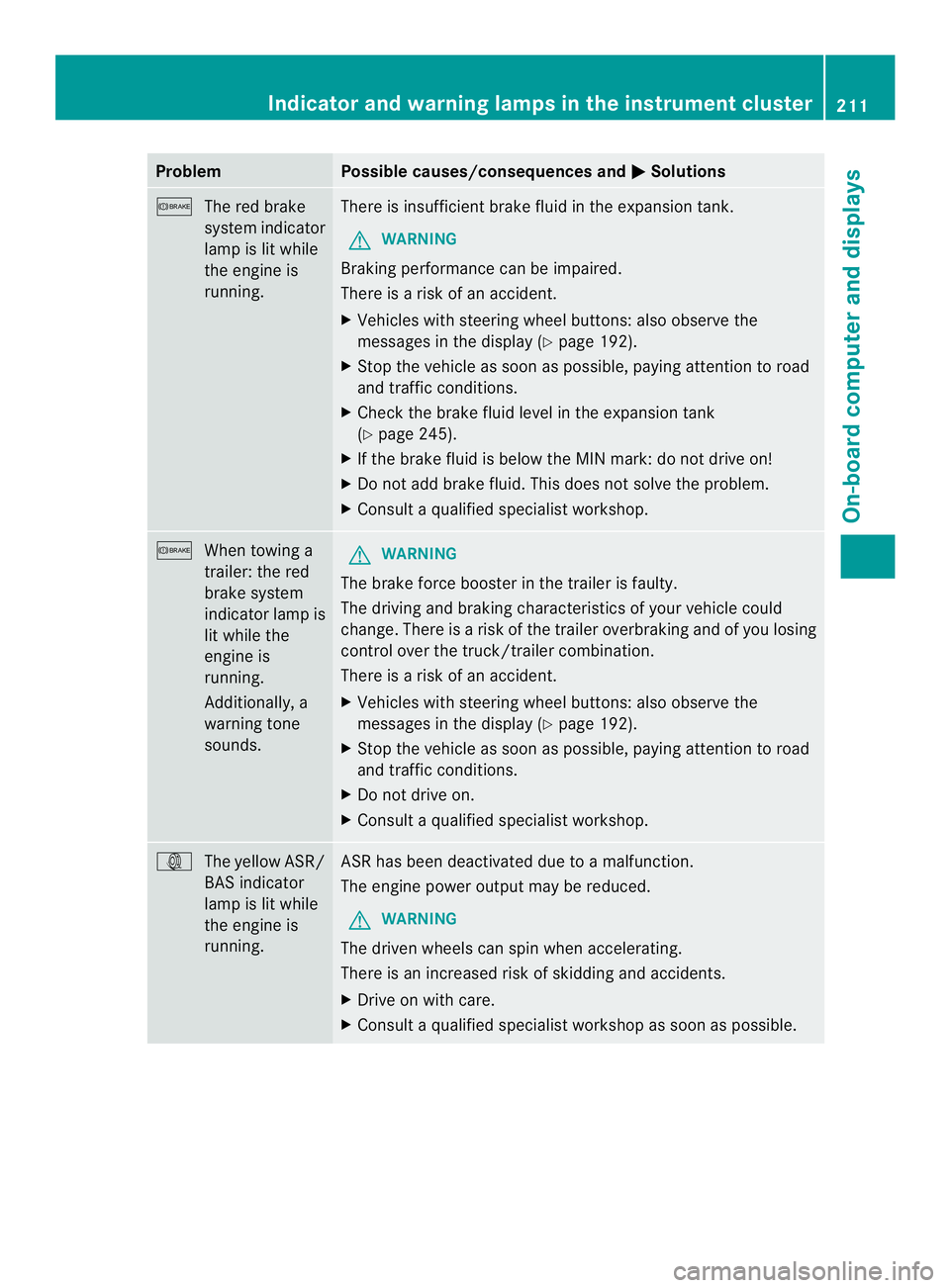
Problem Possible causes/consequences and
0004 Solutions
0008
The red brake
system indicator
lamp is lit while
the engine is
running. There is insufficient brake fluid in the expansion tank.
G WARNING
Braking performance can be impaired.
There is a risk of an accident.
X Vehicles with steering wheel buttons:a lso observe the
messages in the display (Y page 192).
X Stop the vehicle as soon as possible, paying attention to road
and traffic conditions.
X Check the brake fluid level in the expansion tank
(Y page 245).
X If the brake fluid is below the MIN mark: do not drive on!
X Do not add brake fluid. This does not solve the problem.
X Consult a qualified specialist workshop. 0008
When towing a
trailer: the red
brake system
indicator lamp is
lit while the
engine is
running.
Additionally, a
warning tone
sounds. G
WARNING
The brake force booster in the trailer is faulty.
The driving and braking characteristics of your vehicle could
change. There is a risk of the trailer overbraking and of you losing
control over the truck/trailer combination.
There is a risk of an accident.
X Vehicles with steering wheel buttons :also observe the
messages in the display (Y page 192).
X Stop the vehicle as soon as possible, paying attention to road
and traffic conditions.
X Do not drive on.
X Consult a qualified specialist workshop. 000A
The yellow ASR/
BAS indicator
lamp is lit while
the engine is
running. ASR has been deactivated due to a malfunction.
The engine power output may be reduced.
G WARNING
The drive nwheels can spin when accelerating.
There is an increased risk of skidding and accidents.
X Drive on with care.
X Consult a qualified specialist workshop as soon as possible. Indicator and warning lamps in the instrument cluster
211On-board computer and displays Z
Page 215 of 334
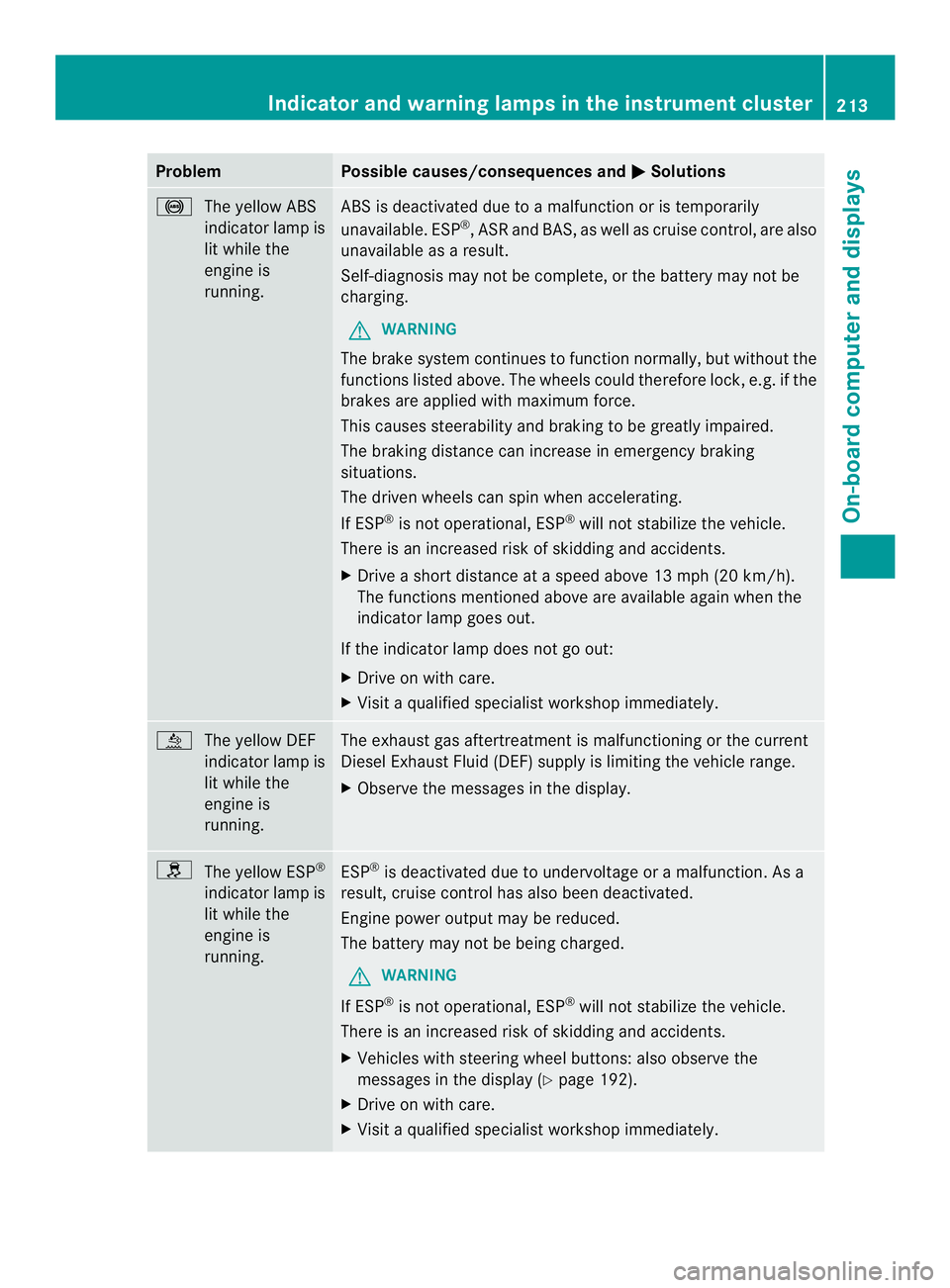
Problem Possible causes/consequences and
0004 Solutions
000E
The yellow ABS
indicator lamp is
lit while the
engine is
running. ABS is deactivated due to a malfunction or is temporarily
unavailable. ESP ®
, ASR and BAS, as well as cruise control, are also
unavailable as a result.
Self-diagnosis may not be complete, or the battery may not be
charging.
G WARNING
The brake system continues to function normally, but without the
functions listed above. The wheels could therefore lock, e.g. if the
brakes are applied with maximum force.
This causes steerability and braking to be greatly impaired.
The braking distance can increase in emergency braking
situations.
The driven wheels can spin when accelerating.
If ESP ®
is not operational, ESP ®
will not stabilize the vehicle.
There is an increased risk of skidding and accidents.
X Drive a short distance at a speed above 13 mph (20 km/h).
The functions mentioned above are available again when the
indicator lamp goes out.
If the indicator lamp does not go out:
X Drive on with care.
X Visit a qualified specialist workshop immediately. 0009
The yellow DEF
indicator lamp is
lit while the
engine is
running. The exhaust gas aftertreatment is malfunctioning or the current
Diesel Exhaust Fluid (DEF) supply is limiting the vehicle range.
X
Observe the messages in the display. 0002
The yellow ESP ®
indicator lamp is
lit while the
engine is
running. ESP
®
is deactivated due to undervoltage or a malfunction .As a
result, cruise control has also been deactivated.
Engine power output may be reduced.
The battery may not be being charged.
G WARNING
If ESP ®
is not operational, ESP ®
will not stabilize the vehicle.
There is an increased risk of skidding and accidents.
X Vehicles with steering wheel buttons: also observe the
messages in the display (Y page 192).
X Drive on with care.
X Visit a qualified specialist workshop immediately. Indicator and warning lamps in the instrument cluster
213On-board computer and displays Z
Page 220 of 334
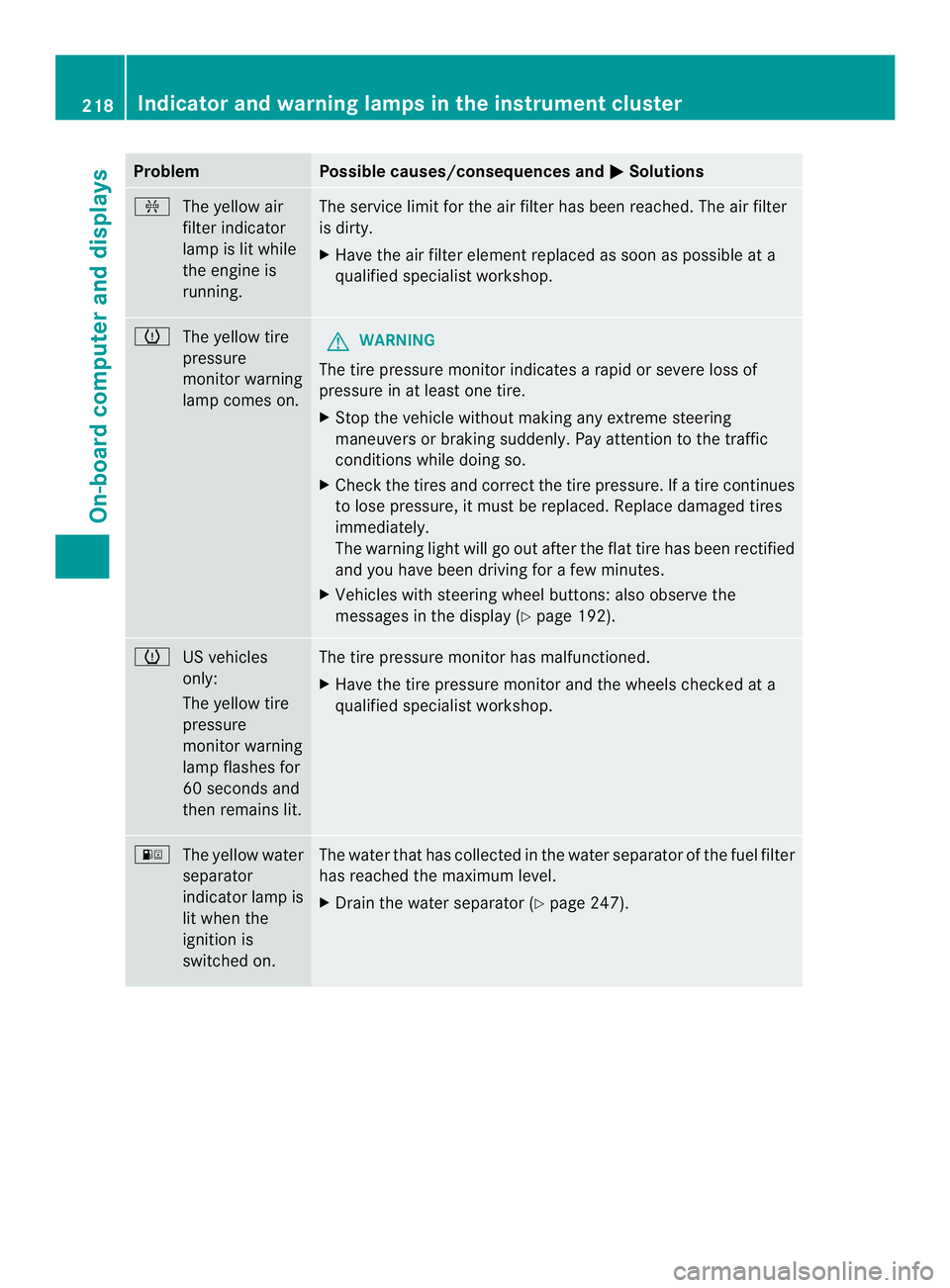
Problem Possible causes/consequences and
0004 Solutions
0013
The yellow air
filter indicator
lamp is lit while
the engine is
running. The service limit for the air filter has been reached. The air filter
is dirty.
X
Have the air filter element replaced as soon as possible at a
qualified specialist workshop. 000A
The yellow tire
pressure
monitor warning
lamp comes on. G
WARNING
The tire pressure monitor indicates a rapid or severe loss of
pressure in at least one tire.
X Stop the vehicle without making any extreme steering
maneuvers or braking suddenly. Pay attention to the traffic
conditions while doing so.
X Check the tires and correctt he tire pressure. If a tire continues
to lose pressure, it must be replaced. Replace damaged tires
immediately.
The warning light will go out after the flat tire has been rectified
and you have been driving for a few minutes.
X Vehicles with steering wheel buttons: also observe the
messages in the display (Y page 192).000A
US vehicles
only:
The yellow tire
pressure
monitor warning
lamp flashes for
60 seconds and
then remains lit. The tire pressure monitor has malfunctioned.
X
Have the tire pressure monitor and the wheels checked at a
qualified specialist workshop. 000E
The yellow water
separator
indicator lamp is
lit when the
ignition is
switched on. The water that has collected in the water separator of the fuel filter
has reached the maximum level.
X
Drain the water separator (Y page 247).218
Indicator and warning lamps in the instrument clusterOn-board computer and displays
Page 234 of 334
Useful information
This Operator's Manual describes all models
as well as standard and optional equipment
of your vehicle that were available at the time
of going to print. Country-specific variations
are possible. Note that your vehicle may not
be equipped with all of the described
functions. This also applies to systems and
functions relevant to safety.
Read the information on qualified specialist
workshops (Y page 26). Loading guidelines
Important safety notes
G
WARNING
As a result of improperly placed or unevenly
distributed loads, the center of gravity of the
load being transported may be too high or too
far back. This can significantly impair handling
as well as steering and braking
characteristics. There is a risk of an accident.
Always make sure that the center of gravity of
the load is:
R between the axles
and
R as low as possible, near the rear axle. G
WARNING
When objects are unsecured or inadequately
secured, they can slip, turn over or be thrown
about, striking vehicle occupants .This also
applies to:
R luggage or loads
R a rear bench seat which has been removed
and is being transported in the vehicle in an
exceptional case.
There is a risk of injury, particularly in the
event of braking maneuvers or abrupt
changes in direction.
Always stow objects in such a way that they
cannot be tossed about. Before traveling,
secure objects, luggage or loads to prevent them slipping or tipping over. If you remove a
rear bench seat, it is advisable to store it
outside the vehicle. G
WARNING
When the permissible wheel loads, axle loads
and/or the maximum permissible gross
vehicle weight are exceeded, driving safety is
compromised. The handling as well as
steering and braking characteristics may be
significantly impaired. Overloaded tires may
overheat, causing them to burst. There is a
risk of an accident.
When transporting a load, always observe the
permissible wheel loads, axle loads and the
maximum permissible gross vehicle weight
for the vehicle (including occupants). G
WARNING
When you load the roof, the center of gravity
of the vehicle rises and the driving
characteristics change. If you exceed the
maximum roof load, the driving
characteristics, as well as steering and
braking, will be greatly impaired. There is a
risk of an accident.
Never exceed the maximum roof load and
adjust your driving style.
! If you are using a roof carrier, observe the
maximum roof load and maximum roof
carrier load.
You will find information about the maximum
roof load in the "Technical data" section
(Y page 327) and information about roof
carriers in the "Carrier systems" section
(Y page 236).
R Do not stack luggage or loads higher than
the backrests.
R Objects to be transported should
preferably be stowed in the cargo
compartment. 232
Loading guidelinesTransporting loads
Page 243 of 334
X
Secure the vehicle to prevent it from rolling
away.
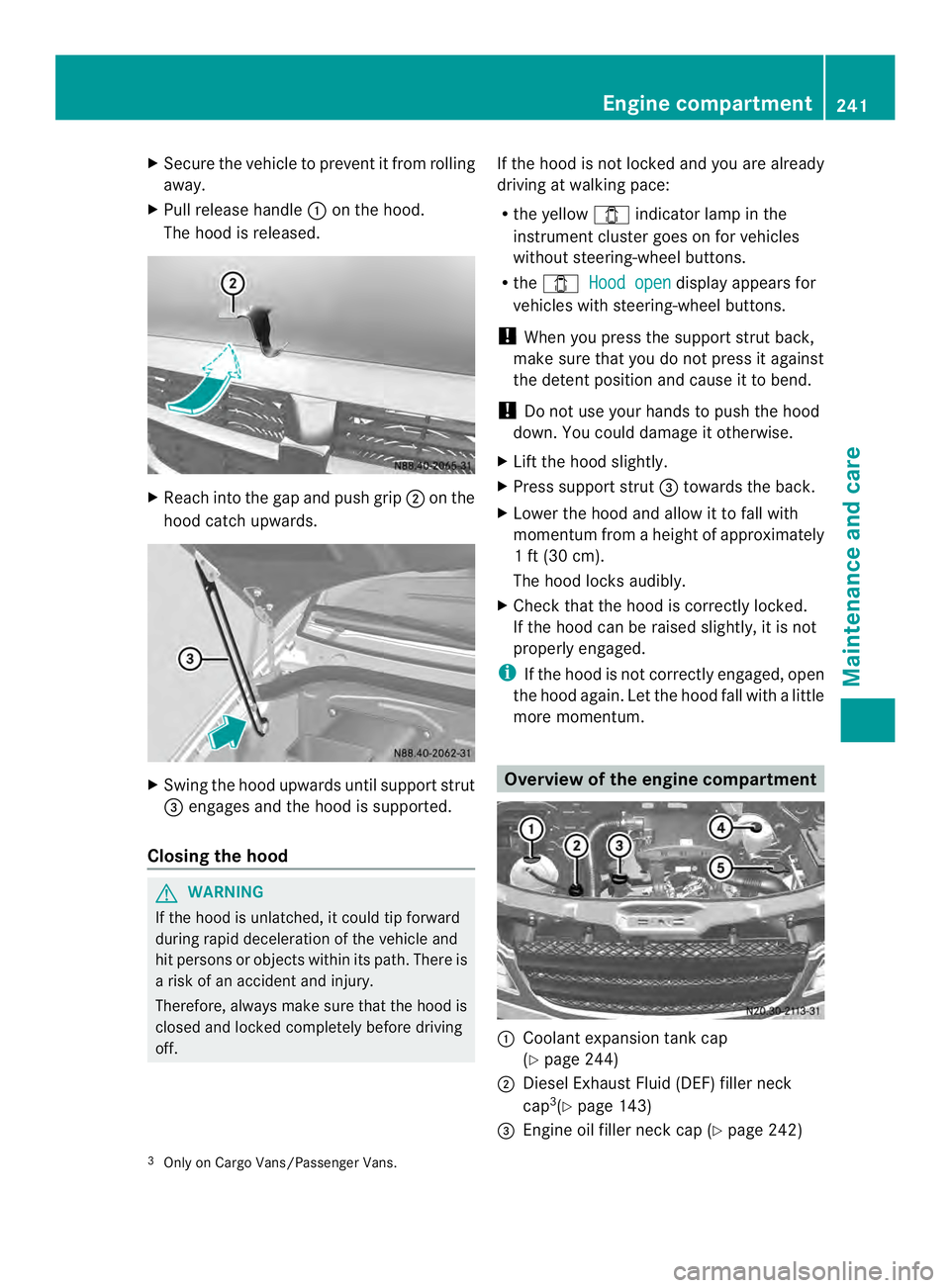
X Pull release handle 0005on the hood.
The hood is released. X
Reach into the gap and push grip 0006on the
hood catch upwards. X
Swing the hood upwards unti lsuppor tstrut
0026 engages and the hood is supported.
Closing the hood G
WARNING
If the hood is unlatched, it could tip forward
during rapid deceleratio nofthe vehicle and
hit persons or objects within its path. There is
a risk of an accident and injury.
Therefore, always make sure that the hood is
closed and locked completely before driving
off. If the hood is not locked and you are already
driving at walking pace:
R
the yellow 0004indicator lamp in the
instrumentc luster goes on for vehicles
without steering-wheel buttons.
R the 0004 Hood open display appears for
vehicles with steering-wheel buttons.
! When you press the support strut back,
make sure that you do not press it against
the detent position and cause it to bend.
! Do not use your hands to push the hood
down. You could damage it otherwise.
X Lift the hood slightly.
X Press support strut 0026towards the back.
X Lower the hood and allow it to fall with
momentum fro maheight of approximately
1 ft (30 cm).
The hood locks audibly.
X Check that the hood is correctly locked.
If the hood can be raised slightly, it is not
properly engaged.
i If the hood is not correctly engaged, open
the hood again. Let the hood fall with a little
more momentum. Overview of the engine compartment
0005
Coolant expansion tank cap
(Ypage 244)
0006 Diesel Exhaust Fluid (DEF) filler neck
cap 3
(Y page 143)
0026 Engine oil filler neck cap (Y page 242)
3 Only on Cargo Vans/Passenger Vans. Engine compartment
241Maintenance and care Z