light MITSUBISHI 3000GT 1991 Workshop Manual
[x] Cancel search | Manufacturer: MITSUBISHI, Model Year: 1991, Model line: 3000GT, Model: MITSUBISHI 3000GT 1991Pages: 1146, PDF Size: 76.68 MB
Page 286 of 1146
 Switc")
13-180CRUISE CONTROL SYSTEM - Service Adjustment Procedures.
4
ET: ON
07FOOl;Control switch
\E: ON
t
07FOOliControl switch
\
SET: ON
07FOOlControl switch
\
07FOOl
CRUISE CONTROL SETTING CHECK(1) Switch ON the main switch.
(2) Drive at the desired speed within the range of approximate-
ly 40
- 145 km/h (25 - 90 mph).
(3) Operate the control switch downward. (SET switch: ON)
(4) Check to be sure that the speed is the desired constant
speed when the switch is released, and also check to be
sure that the CRUISE indicator light (within the combination
meter) illuminates.
NOTEIf the vehicle speed decreases to approximately 15 km/h (9
mph) below the set speed, because of climbing a hill for
example, the cruise control will be cancelled.
SPEED-INCREASE SETTING CHECK(1) Set to the desired speed.
(2) Operate the control switch upward. (RESUME switch: ON)
(3) Check to be sure that acceleration continues while the
switch is hold, and that when it is released the constant.
speed at the time when it was released becomes the
driving speed.
NOTEEven if, during acceleration, the vehicle speed reaches or
exceeds the high limit [approximately 145 km/h (90 mph)],
acceleration will continue, however, when the switch is
released, the set speed (“memorized speed”) will become
the high limit of the vehicle speed.
SPEED REDUCTION SETTING CHECK(1) Set to the desired speed.
(2) Operate the control switch downward. (SET switch: ON)
(3) Check to be sure that deceleration continues while the
switch is held, and that when it is released the constant
speed at the time when it was released becomes the
driving speed.
NOTEWhen the vehicle speed reaches the low limit [approx-
imately 40 km/h (25 mph)] during deceleration, the cruise
control will be cancelled.
CRUISE CONTROL CANCELLATION AND SET SPEED RE-
SUME CHECK(1) Set cruise control.
(2) In the cruising condition of the cruise control mode, check
that when any of the following operations are performed,
the normal drive mode is restored and
,the vehicle coasts
smoothly.@ Move the control switch toward you. (CANCEL switch:@ Depress the brake pedal.@ Depress the clutch pedal.
TSB Revision
Page 287 of 1146
‘CRUISE CONTROL SYSTEM - Service Adjustment Procedures13-181
Control switch
07FOO17
\\ \18FO22;
07FOOlO6 1 4
ILL: Illumination light
I
07FOO13
(3) With the vehicle at a speed of more than about 40 km/h (25
mph), check that when the control switch is moved upward
(RESUME switch: ON), the vehicle resumes cruising at the
speed held before cancellation of the cruise control mode.
(4) In the cruise control mode, check that when the main
switch is set to OFF, the normal drive mode is restored and
the vehicle coasts smoothly.
INDIVIDUAL PARTS INSPECTION
M13FEA
CRUISE CONTROL MAIN SWITCH INSPECTION
(I) Remove the main switch together with the switch garnish.
(2) Remove the main switch from the switch garnish.
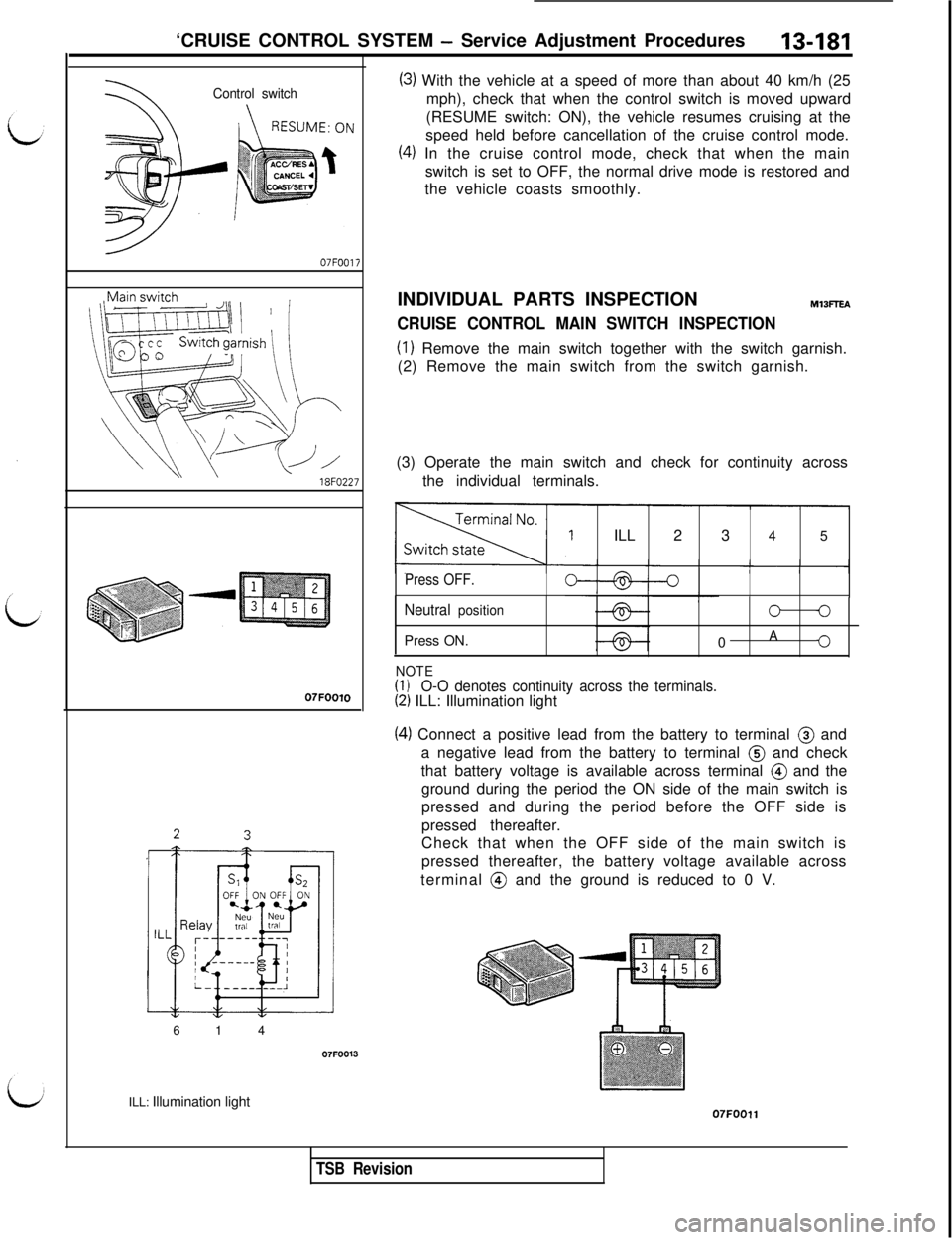
(3) Operate the main switch and check for continuity across
the individual terminals.
ILL 2 3 4 5
Press OFF.
Neutral positionPress ON.000A
0
NOTE(I 1O-O denotes continuity across the terminals.(2) ILL: Illumination light
(4) Connect a positive lead from the battery to terminal @ and
a negative lead from the battery to terminal @ and check
that battery voltage is available across terminal @ and the
ground during the period the ON side of the main switch is
pressed and during the period before the OFF side is
pressed thereafter.
Check that when the OFF side of the main switch is
pressed thereafter, the battery voltage available across
terminal @ and the ground is reduced to 0 V.
07FOOll
TSB Revision
Page 289 of 1146
CRUISE CONTROL SYSTEM - Service Adjustment Procedures13-183
onoo5J16LO285
141014;
TFA0359
16FO13LResistance
3--1Okl2
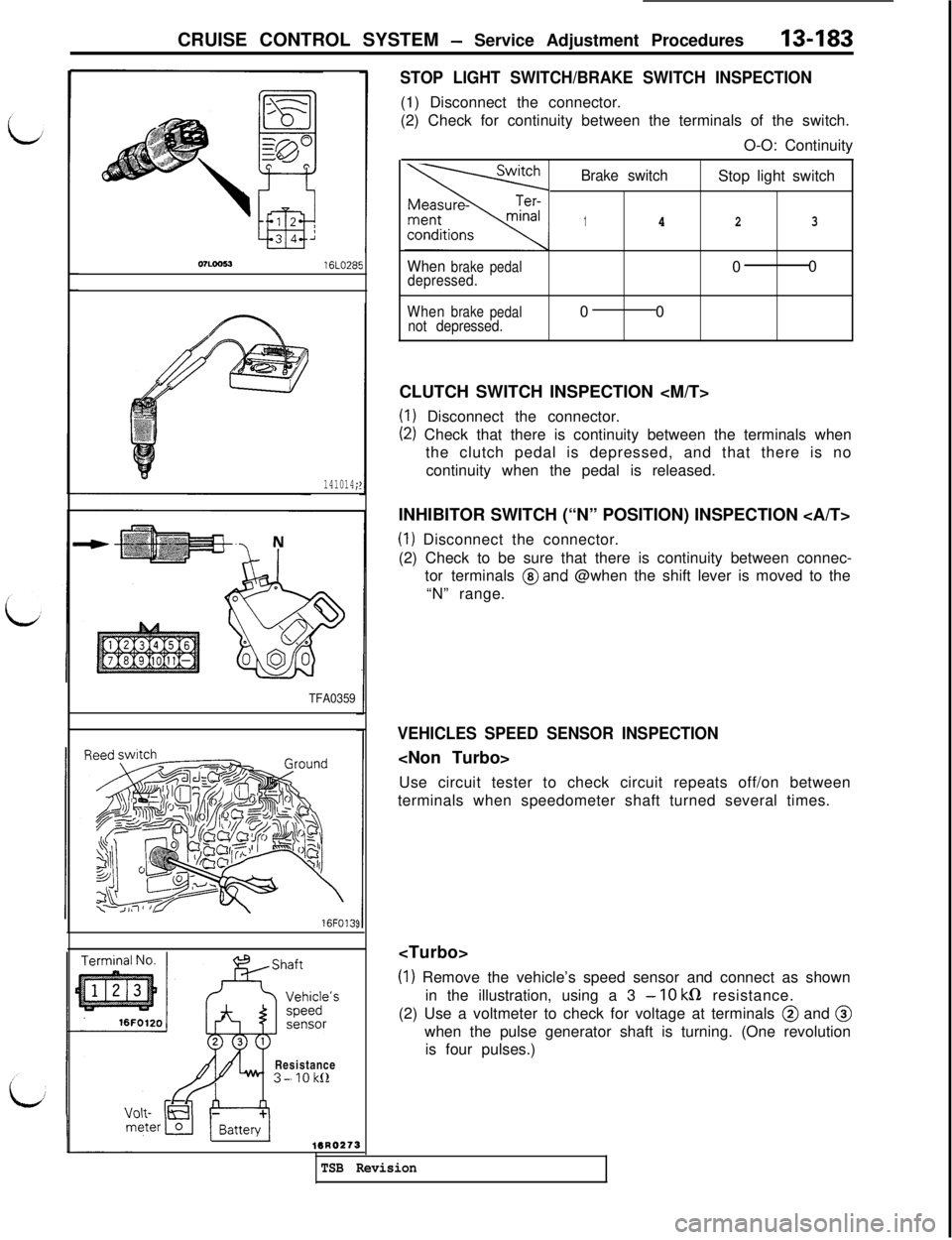
STOP LIGHT SWITCH/BRAKE SWITCH INSPECTION(1) Disconnect the connector.
(2) Check for continuity between the terminals of the switch.
O-O: Continuity
Brake switchStop light switch
1423
Whenbrakepedal00depressed.
When
brake
pedal00not depressed.CLUTCH SWITCH INSPECTION
(I) Disconnect the connector.
(2) Check that there is continuity between the terminals when
the clutch pedal is depressed, and that there is no
continuity when the pedal is released.
INHIBITOR SWITCH (“N” POSITION) INSPECTION
(1) Disconnect the connector.
(2) Check to be sure that there is continuity between connec-
tor terminals
@and @when the shift lever is moved to the
“N” range.
VEHICLES SPEED SENSOR INSPECTION
Use circuit tester to check circuit repeats off/on between
terminals when speedometer shaft turned several times.
(1) Remove the vehicle’s speed sensor and connect as shown
in the illustration, using a 3
- 10 kQ resistance.
(2) Use a voltmeter to check for voltage at terminals @ and @
when the pulse generator shaft is turning. (One revolution
is four pulses.)
16R0273
TSB Revision
Page 292 of 1146
13486CRUISE CONTROL SYSTEM - Cruise Control System
1.6
- 2.2 ft.lbs.
07FOO27
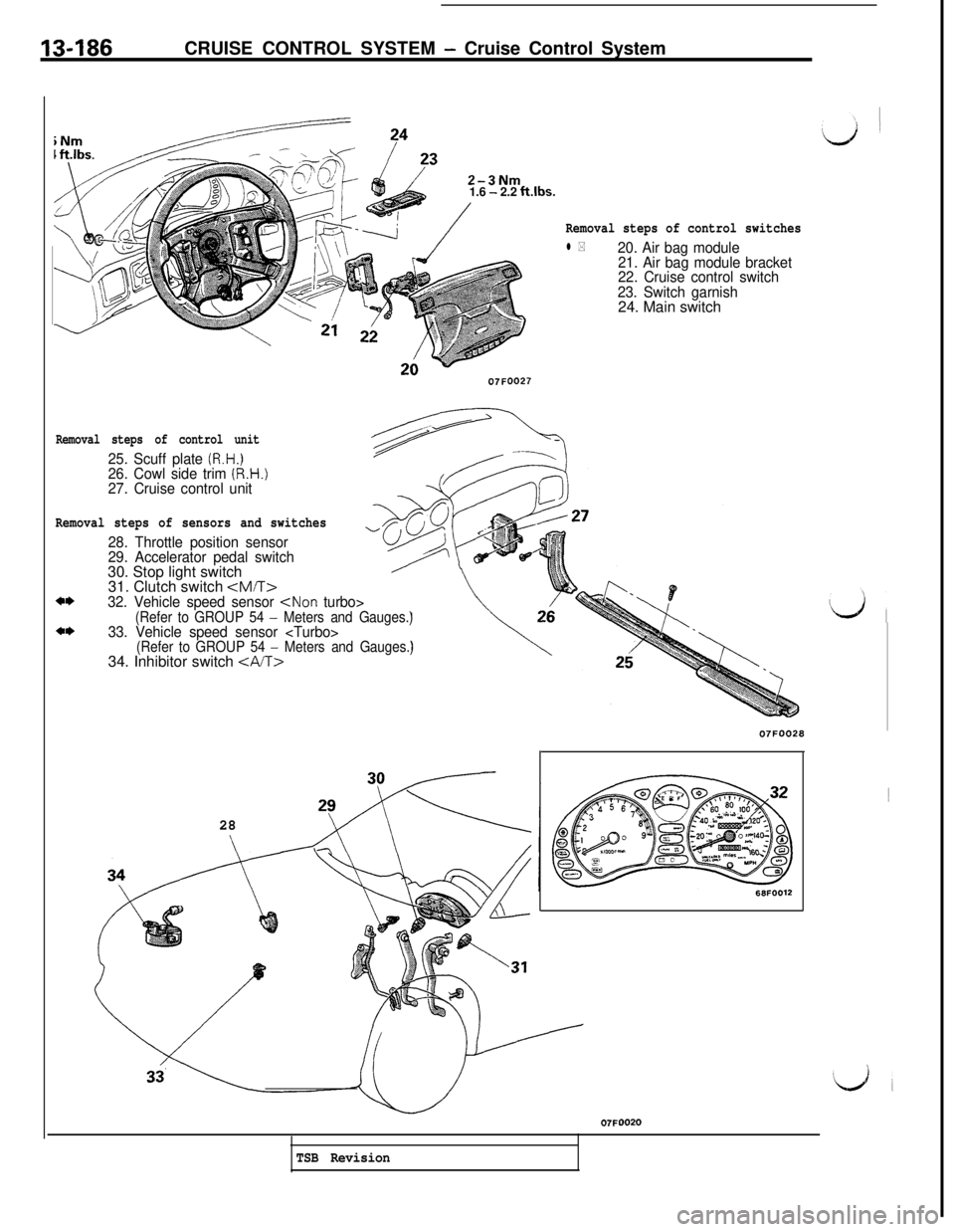
Removal steps of control switches
l *20. Air bag module
21. Air bag module bracket
22. Cruise control switch
23. Switch garnish24. Main switch
Removal steps of sensors and switches
28. Throttle position sensor
29. Accelerator pedal switch30. Stop light switch
31. Clutch switch
4*
4*
Removal steps of control unit
25. Scuff plate (R.H.)26. Cowl side trim (R.H.)27. Cruise control unit34. Inhibitor switch
2807FOO28
68FOO12
07FOO20
TSB Revision
Page 320 of 1146
15-10INTAKE AND EXHAUST - Air Cleaner
INSPECTIONM15FCAH
&$1Air intake hose C
Air intake hose A
Air intake hose B
105FOO2:
lCheck the air cleaner body, cover or packing for deforma-
tion, corrosion or damage.‘,l Check the air duct for damage.
‘4
lCheck the air cleaner element for clogging, contamination
or damage.
If element is slightly clogged, remove dust by blowing air
from inside of element.
AIR-FLOW SENSOR CHECKFor inspection of air-flow sensor, refer to GROUP 13 -Air-Flow
Sensor Check.
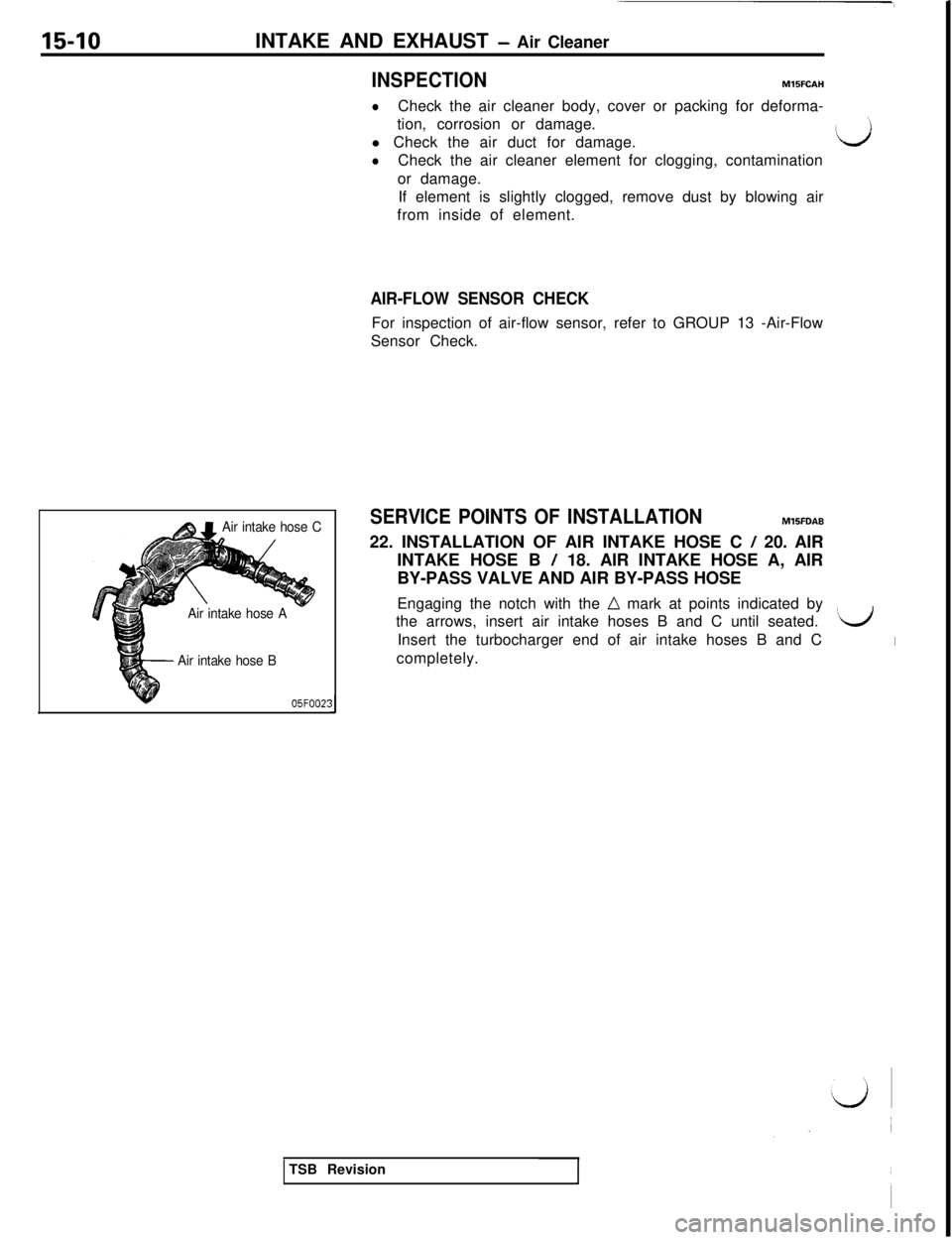
SERVICE POINTS OF INSTALLATIONMl5FDAB
22. INSTALLATION OF AIR INTAKE HOSE C
/ 20. AIR
INTAKE HOSE B
/ 18. AIR INTAKE HOSE A, AIR
BY-PASS VALVE AND AIR BY-PASS HOSE
Engaging the notch with the
n mark at points indicated by
the arrows, insert air intake hoses B and C until seated.
‘$dInsert the turbocharger end of air intake hoses B and C
Icompletely.
TSB Revision
Page 347 of 1146
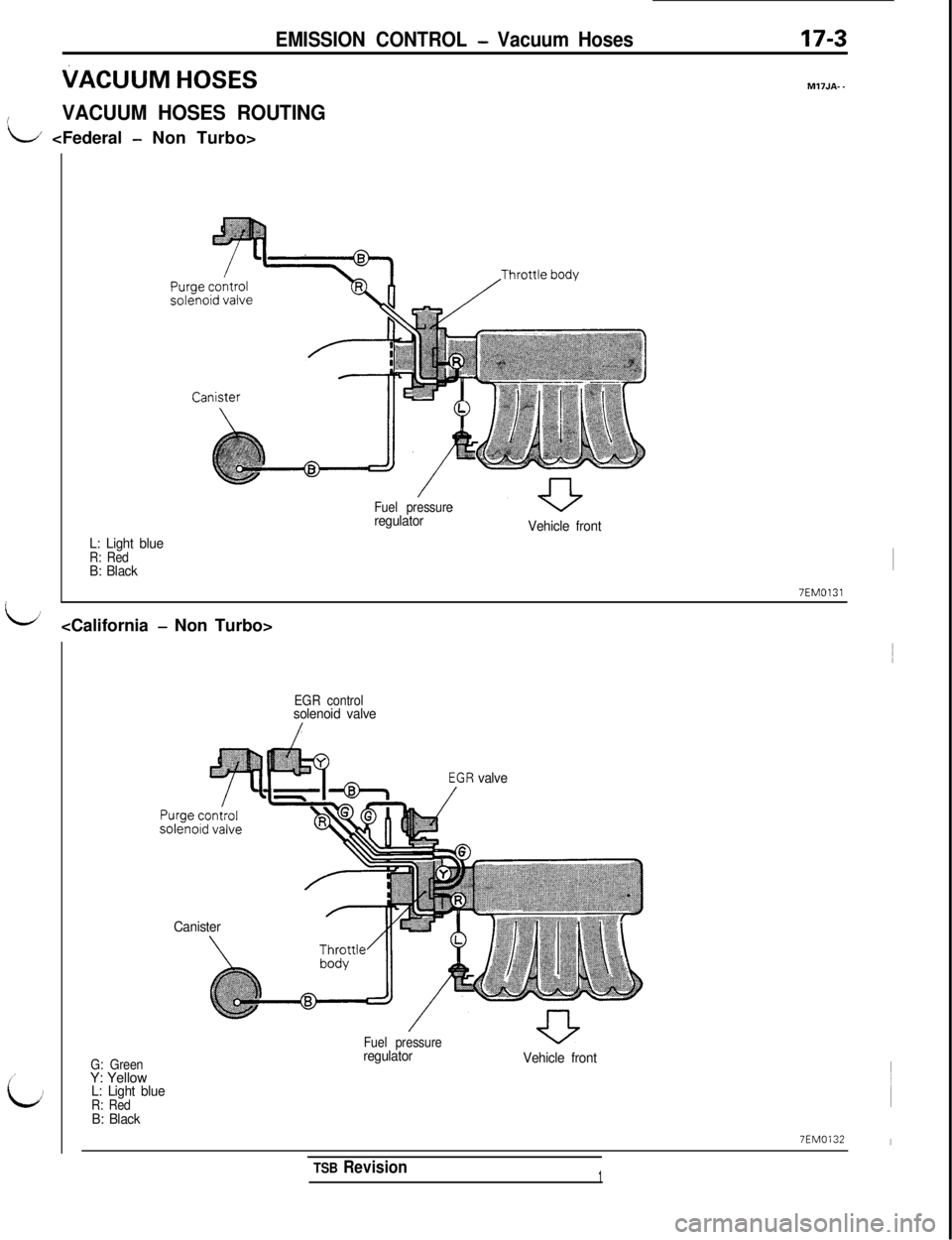
EMISSION CONTROL - Vacuum Hoses
VACUUM 1-10sEs
lVACUUM HOSES ROUTING
L//
17-3M17JA-
-
I’
Li
Fuel pressureregulator
Vehicle front
id
L: Light blueR: RedB: Black
7EM0131
EGR controlsolenoid valve
r-c,cud valve/
Canister
/Fuel pressureregulator
v
Vehicle frontG: GreenY: Yellow
L: Light blueR: RedB: Black
TSB Revision
7EM0132I
1
Page 348 of 1146
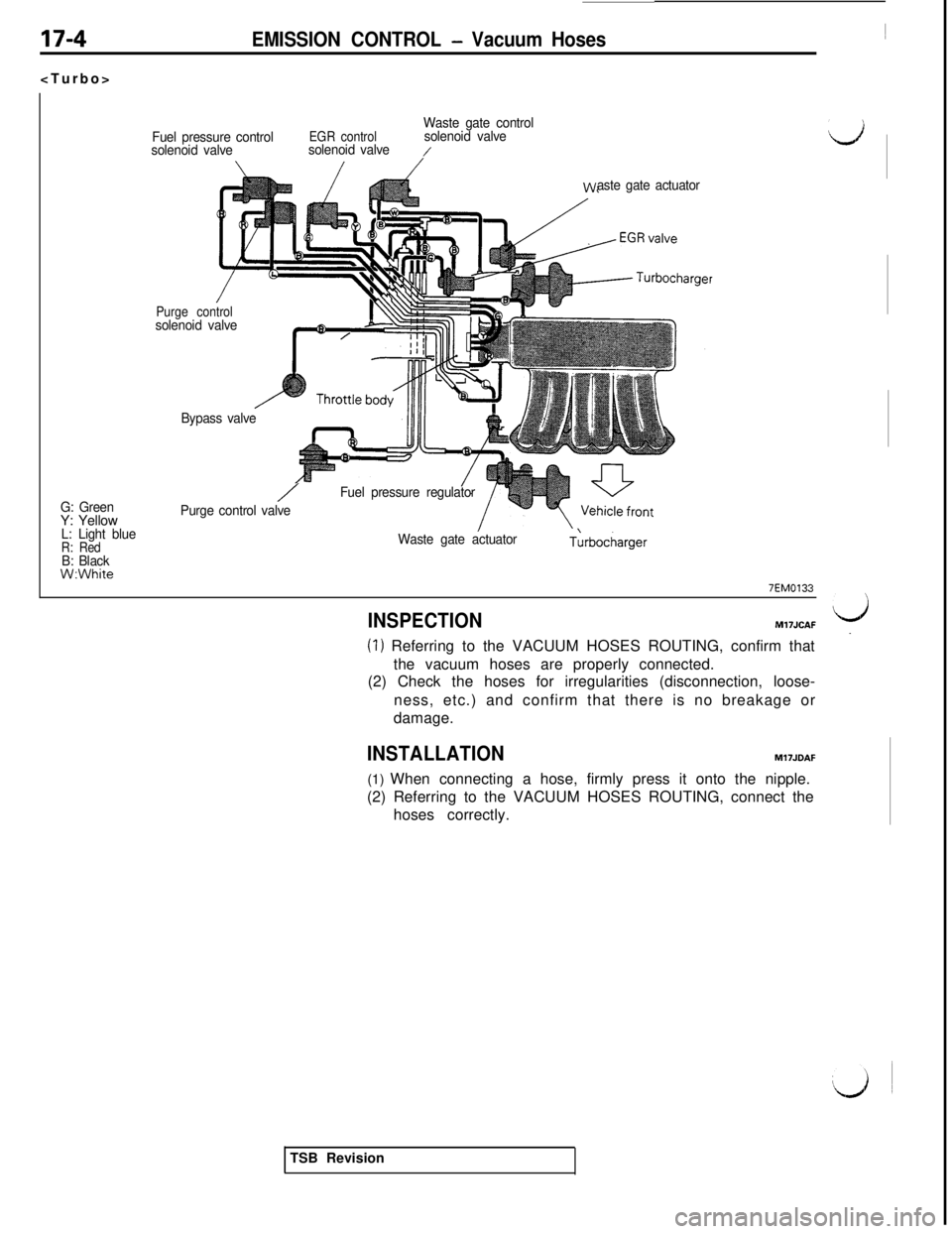
17-4EMISSION CONTROL - Vacuum Hoses
Fuel pressure control
solenoid valveEGR controlWaste gate control
solenoid valve
solenoid valve
/\,i
aste gate actuator
G: GreenY: Yellow
L: Light blueR: RedB: BlackW:White
Purge controlsolenoid valve
Bypass valve
/Fuel pressure regulator
Purge control valve
Waste gate actuator
TLrbocharger7EM0133
INSPECTIONM17JCAF +’
(1) Referring to the VACUUM HOSES ROUTING, confirm that
the vacuum hoses are properly connected.
(2) Check the hoses for irregularities (disconnection, loose-
ness, etc.) and confirm that there is no breakage or
damage.
INSTALLATIONM17JDAF(1) When connecting a hose, firmly press it onto the nipple.
(2) Referring to the VACUUM HOSES ROUTING, connect the
hoses correctly.
TSB Revision
Page 353 of 1146
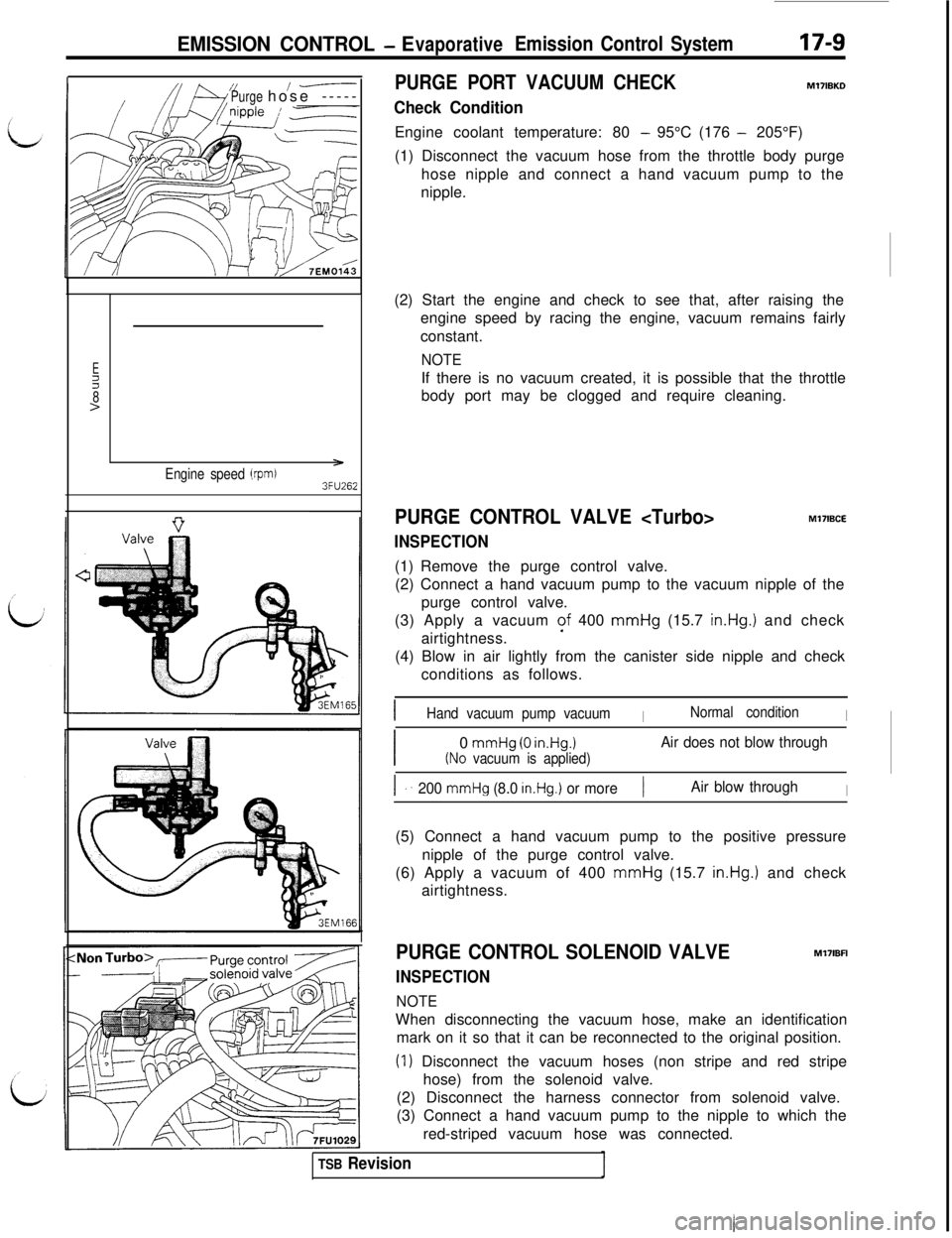
EMISSION CONTROL - EvaporativeEmission Control System
Purge/-----hose -----PURGE PORT VACUUM CHECK
Check Condition
17-9
M17lBKDEngine coolant temperature: 80
- 95°C (176 - 205°F)
(1) Disconnect the vacuum hose from the throttle body purge
hose nipple and connect a hand vacuum pump to the
nipple.
Ez8>
Engine speed (rprd3FU262(2) Start the engine and check to see that, after raising the
engine speed by racing the engine, vacuum remains fairly
constant.
NOTEIf there is no vacuum created, it is possible that the throttle
body port may be clogged and require cleaning.
PURGE CONTROL VALVE
INSPECTIONMl7IBCE
(1) Remove the purge control valve.
(2) Connect a hand vacuum pump to the vacuum nipple of the
purge control valve.
(3) Apply a vacuum of 400 mmHg (15.7
in.Hg.1 and check
airtightness.
(4) Blow in air lightly from the canister side nipple and check
conditions as follows.
IHand vacuum pump vacuumINormal conditionI
I0
mmHg (0 in.Hg.1Air does not blow through
(No vacuum is applied)
I ..200 mmHg (8.0 in.Hg.) or more1Air blow throughI(5) Connect a hand vacuum pump to the positive pressure
nipple of the purge control valve.
(6) Apply a vacuum of 400 mmHg (15.7
in.Hg.1 and check
airtightness.
PURGE CONTROL SOLENOID VALVE
INSPECTION
NOTEMl7lBFI
When disconnecting the vacuum hose, make an identification
mark on it so that it can be reconnected to the original position.
(I) Disconnect the vacuum hoses (non stripe and red stripe
hose) from the solenoid valve.
(2) Disconnect the harness connector from solenoid valve.
(3) Connect a hand vacuum pump to the nipple to which the
red-striped vacuum hose was connected.
TSB Revision
Page 358 of 1146
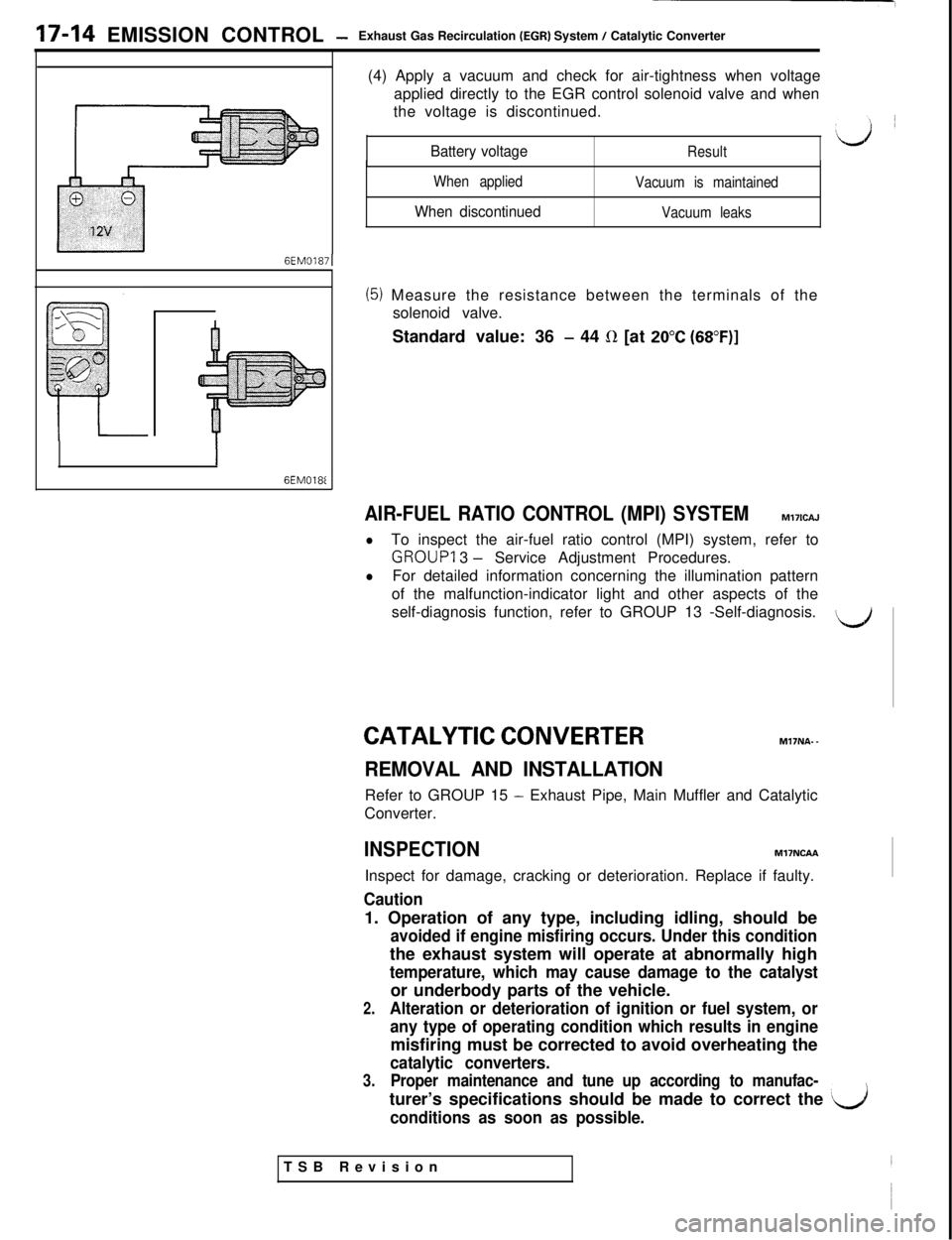
17-14 EMISSION CONTROL -Exhaust Gas Recirculation (EGR) System / Catalytic Converter
6EM01871
6EM0181(4) Apply a vacuum and check for air-tightness when voltage
applied directly to the EGR control solenoid valve and when
the voltage is discontinued.
Battery voltageResult
When applied
When discontinued
Vacuum is maintained
Vacuum leaks
(5) Measure the resistance between the terminals of the
solenoid valve.
Standard value: 36
- 44 R [at 20°C (68”F)]
AIR-FUEL RATIO CONTROL (MPI) SYSTEMM17ICAJ
lTo inspect the air-fuel ratio control (MPI) system, refer to
GROUP1 3 - Service Adjustment Procedures.
lFor detailed information concerning the illumination pattern
of the malfunction-indicator light and other aspects of the
self-diagnosis function, refer to GROUP 13 -Self-diagnosis.
\.J
CATALYTIC CONVERTERMl7N& -
REMOVAL AND INSTALLATIONRefer to GROUP 15
- Exhaust Pipe, Main Muffler and Catalytic
Converter.
INSPECTIONMl7NCAA
Inspect for damage, cracking or deterioration. Replace if faulty.
Caution1. Operation of any type, including idling, should be
avoided if engine misfiring occurs. Under this conditionthe exhaust system will operate at abnormally high
temperature, which may cause damage to the catalystor underbody parts of the vehicle.
2.Alteration or deterioration of ignition or fuel system, or
any type of operating condition which results in enginemisfiring must be corrected to avoid overheating the
catalytic converters.
3.Proper maintenance and tune up according to manufac-turer’s specifications should be made to correct the
‘bi
conditions as soon as possible.TSB Revision
Page 364 of 1146
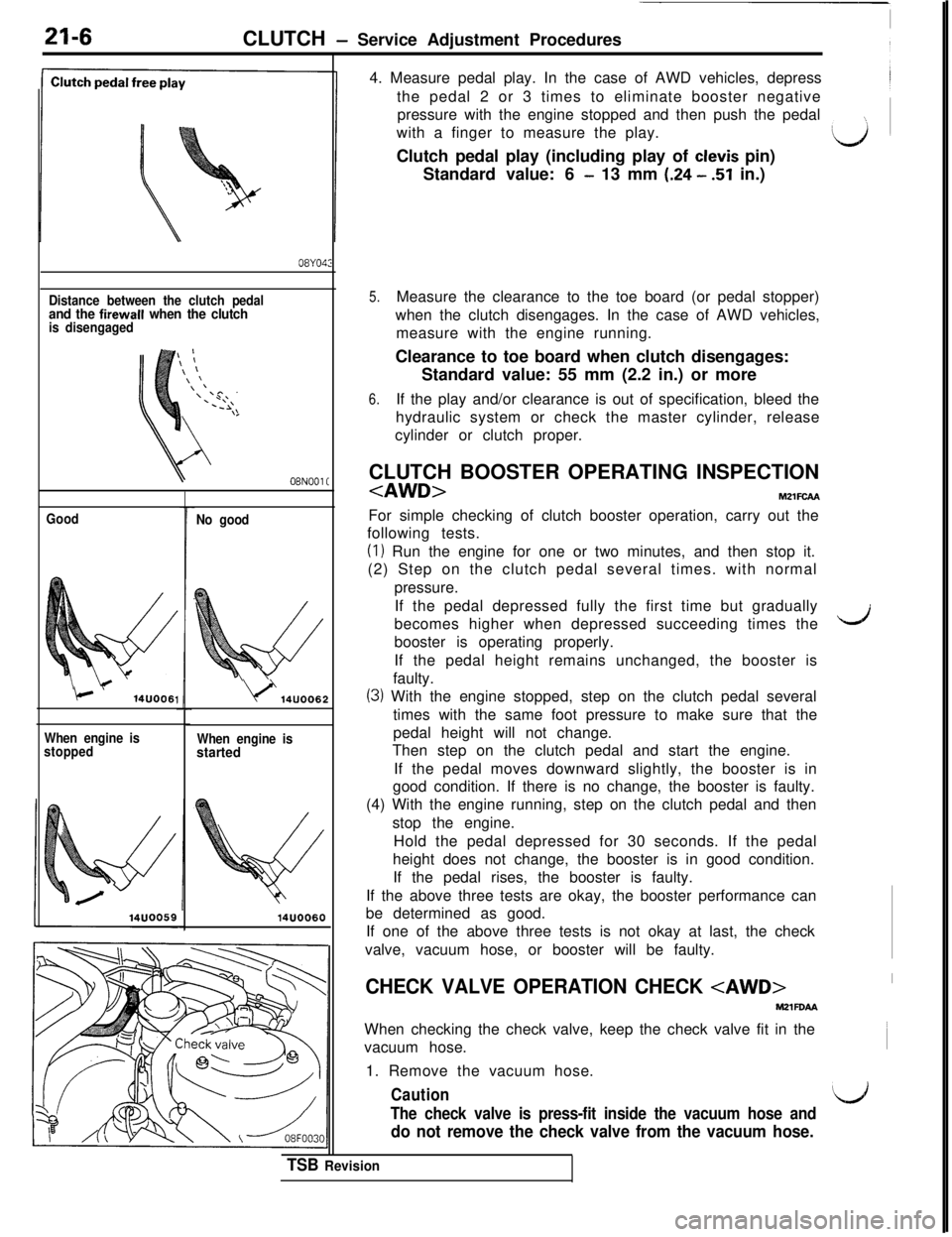
21-6CLUTCH - Service Adjustment Procedures
08YO4Z
Distance between the clutch pedaland the firewall when the clutchis disengaged
08NOOl C
Good
c1‘14UOO61
When engine is
stoppedNo good
\)‘14UOO6:
When engine isstarted
14UOO604. Measure pedal play. In the case of AWD vehicles, depress~
the pedal 2 or 3 times to eliminate booster negative
pressure with the engine stopped and then push the pedal
with a finger to measure the play.
LJClutch pedal play (including play of clevis pin)
Standard value: 6
- 13 mm (.24 - 51 in.)
2
CHECK VALVE OPERATION CHECK
MZlFOAAWhen checking the check valve, keep the check valve fit in the
vacuum hose.
1. Remove the vacuum hose.
CautionL’The check valve is press-fit inside the vacuum hose and
do not remove the check valve from the vacuum hose.
5.Measure the clearance to the toe board (or pedal stopper)
when the clutch disengages. In the case of AWD vehicles,
measure with the engine running.
Clearance to toe board when clutch disengages:
Standard value: 55 mm (2.2 in.) or more
6.If the play and/or clearance is out of specification, bleed the
hydraulic system or check the master cylinder, release
cylinder or clutch proper.
CLUTCH BOOSTER OPERATING INSPECTION
following tests.
(I) Run the engine for one or two minutes, and then stop it.
(2) Step on the clutch pedal several times. with normal
pressure.
If the pedal depressed fully the first time but gradually
becomes higher when depressed succeeding times the
dbooster is operating properly.
If the pedal height remains unchanged, the booster is
faulty.
(3) With the engine stopped, step on the clutch pedal several
times with the same foot pressure to make sure that the
pedal height will not change.
Then step on the clutch pedal and start the engine.
If the pedal moves downward slightly, the booster is in
good condition. If there is no change, the booster is faulty.
(4) With the engine running, step on the clutch pedal and then
stop the engine.
Hold the pedal depressed for 30 seconds. If the pedal
height does not change, the booster is in good condition.
If the pedal rises, the booster is faulty.
If the above three tests are okay, the booster performance can
be determined as good.
If one of the above three tests is not okay at last, the check
valve, vacuum hose, or booster will be faulty.
TSB Revision