ABS MITSUBISHI 3000GT 1991 Service Manual
[x] Cancel search | Manufacturer: MITSUBISHI, Model Year: 1991, Model line: 3000GT, Model: MITSUBISHI 3000GT 1991Pages: 1146, PDF Size: 76.68 MB
Page 7 of 1146
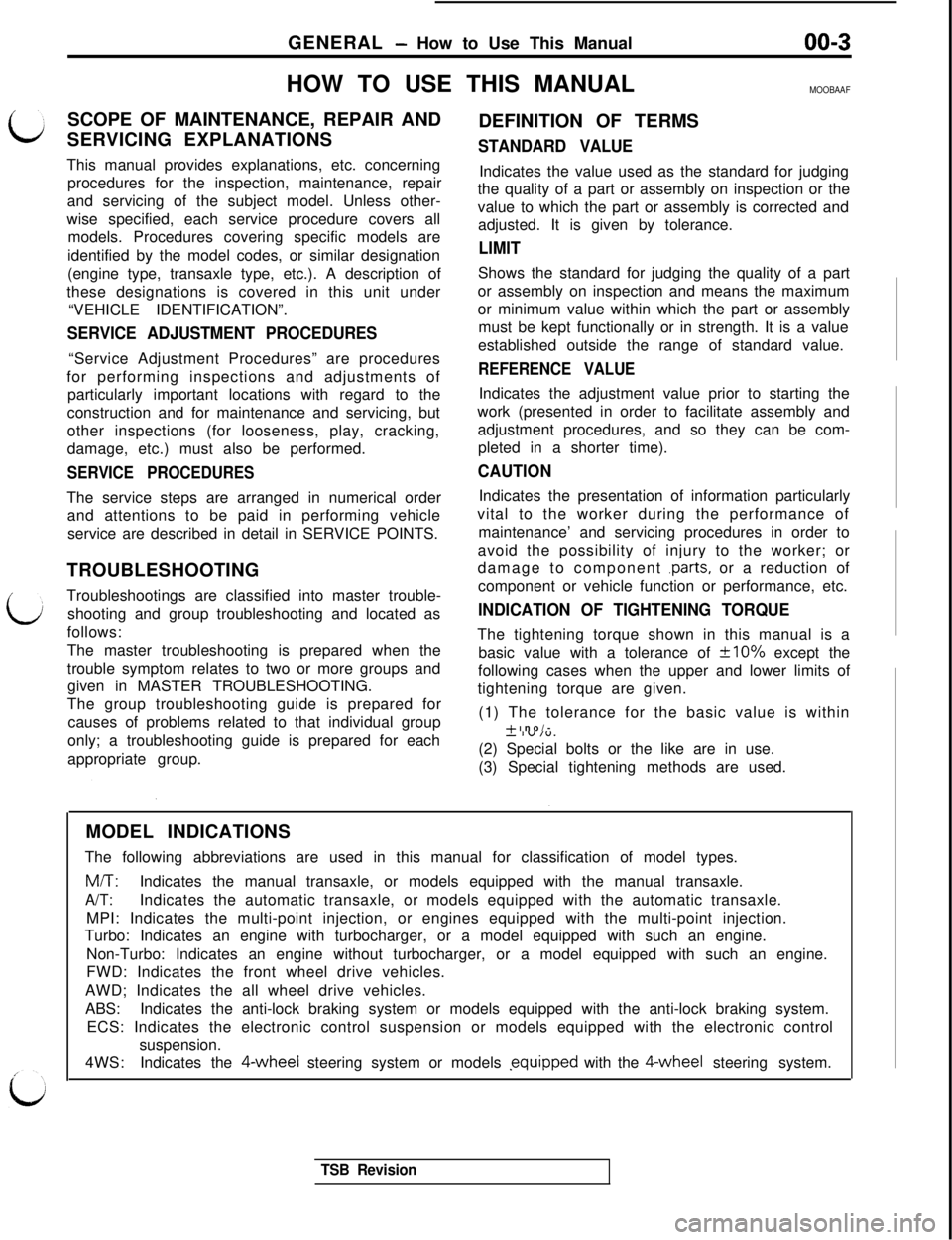
GENERAL - How to Use This Manual00-3HOW TO USE THIS MANUAL
MOOBAAF
c;SCOPE OF MAINTENANCE, REPAIR AND
DEFINITION OF TERMS
SERVICING EXPLANATIONSSTANDARD VALUE
bThis manual provides explanations, etc. concerning
procedures for the inspection, maintenance, repair
and servicing of the subject model. Unless other-
wise specified, each service procedure covers all
models. Procedures covering specific models are
identified by the model codes, or similar designation
(engine type, transaxle type, etc.). A description of
these designations is covered in this unit under
“VEHICLE IDENTIFICATION”.
SERVICE ADJUSTMENT PROCEDURES“Service Adjustment Procedures” are procedures
for performing inspections and adjustments of
particularly important locations with regard to the
construction and for maintenance and servicing, but
other inspections (for looseness, play, cracking,
damage, etc.) must also be performed.
SERVICE PROCEDURESThe service steps are arranged in numerical order
and attentions to be paid in performing vehicle
service are described in detail in SERVICE POINTS.
TROUBLESHOOTING
Troubleshootings are classified into master trouble-
shooting and group troubleshooting and located as
follows:
The master troubleshooting is prepared when the
trouble symptom relates to two or more groups and
given in MASTER TROUBLESHOOTING.
The group troubleshooting guide is prepared for
causes of problems related to that individual groupIndicates the value used as the standard for judging
the quality of a part or assembly on inspection or the
value to which the part or assembly is corrected and
adjusted. It is given by tolerance.
LIMITShows the standard for judging the quality of a part
or assembly on inspection and means the maximum
or minimum value within which the part or assembly
must be kept functionally or in strength. It is a value
established outside the range of standard value.
REFERENCE VALUEIndicates the adjustment value prior to starting the
work (presented in order to facilitate assembly and
adjustment procedures, and so they can be com-
pleted in a shorter time).
CAUTIONIndicates the presentation of information particularly
vital to the worker during the performance of
maintenance’ and servicing procedures in order to
avoid the possibility of injury to the worker; or
damage to component
.parts, or a reduction of
component or vehicle function or performance, etc.
INDICATION OF TIGHTENING TORQUEThe tightening torque shown in this manual is a
basic value with a tolerance of
+lO% except the
following cases when the upper and lower limits of
tightening torque are given.
(1) The tolerance for the basic value is within
+ I no/-
only; a troubleshooting guide is prepared for eachI iv,“.appropriate group.(2) Special bolts or the like are in use.
(3) Special tighteningmethods are used.
MODEL INDICATIONS
The following abbreviations are used in this manual for classification of model types.M/T:Indicates the manual transaxle, or models equipped with the manual transaxle.
A/T:Indicates the automatic transaxle, or models equipped with the automatic transaxle.
MPI: Indicates the multi-point injection, or engines equipped with the multi-point injection.
Turbo: Indicates an engine with turbocharger, or a model equipped with such an engine.
Non-Turbo: Indicates an engine without turbocharger, or a model equipped with such an engine.
FWD: Indicates the front wheel drive vehicles.
AWD; Indicates the all wheel drive vehicles.
ABS:Indicates the anti-lock braking system or models equipped with the anti-lock braking system.
ECS: Indicates the electronic control suspension or models equipped with the electronic control
suspension.
4WS:Indicates the 4-wheel steering system or models .equipped with the 4-wheel steering system.
TSB Revision
Page 32 of 1146
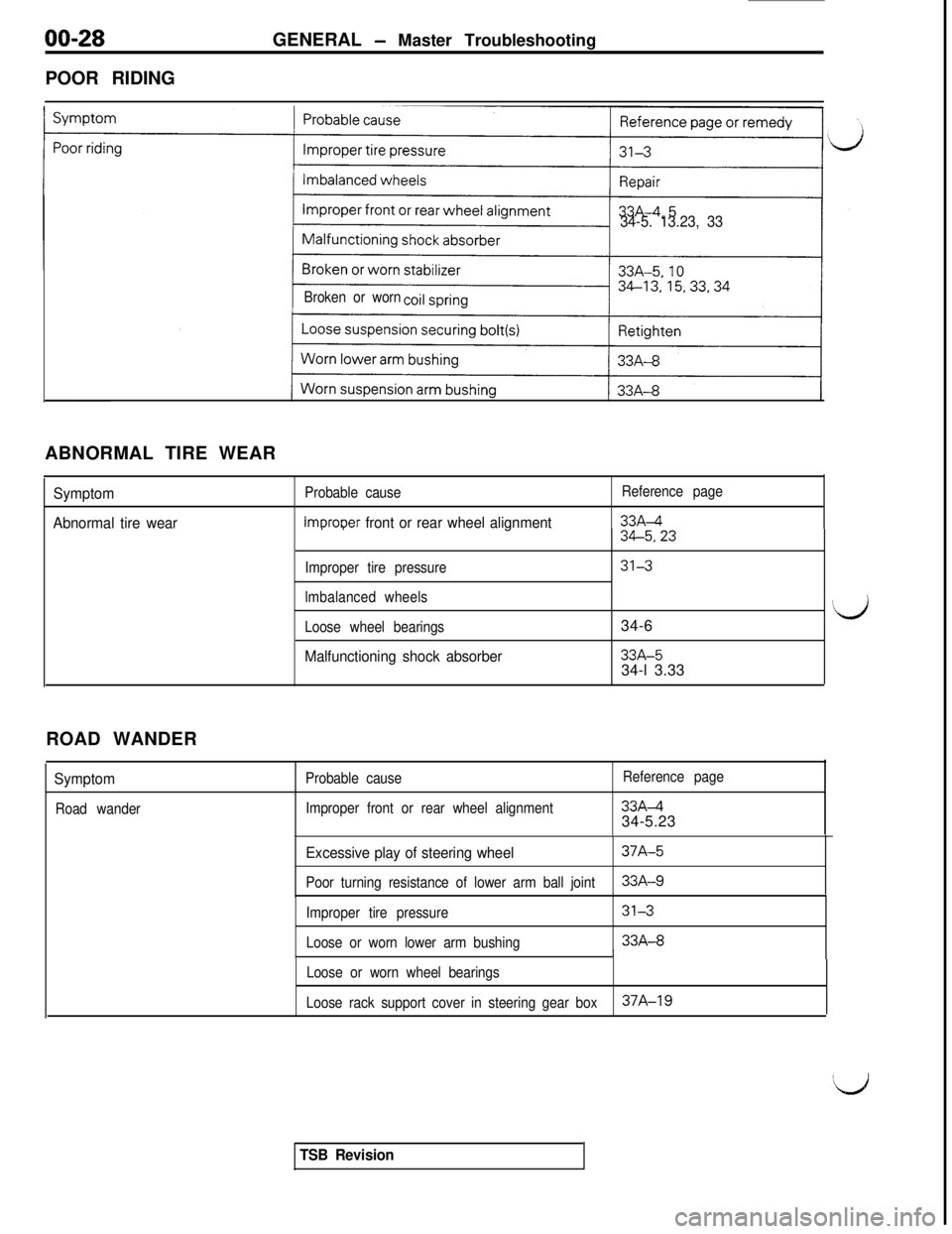
00-28GENERAL - Master Troubleshooting
POOR RIDING
34-5. 13.23, 33
Broken or wornABNORMAL TIRE WEAR
Symptom
Abnormal tire wearProbable cause
lmorooer front or rear wheel alignment, ,
Improper tire pressure
lmbalanced wheels
Loose wheel bearings
Malfunctioning shock absorber
Reference page
33Ad34-5,23
31334-6
LJ33A-5
34-l 3.33
ROAD WANDER
Symptom
Road wanderProbable cause
Improper front or rear wheel alignmentReference page33A&34-5.23
Excessive play of steering wheel
Poor turning resistance of lower arm ball joint37A-533A-9
Improper tire pressure
Loose or worn lower arm bushing31333A-8
III
Loose or worn wheel bearings
Loose rack support cover in steering gear box37A-19
TSB Revision
Page 33 of 1146
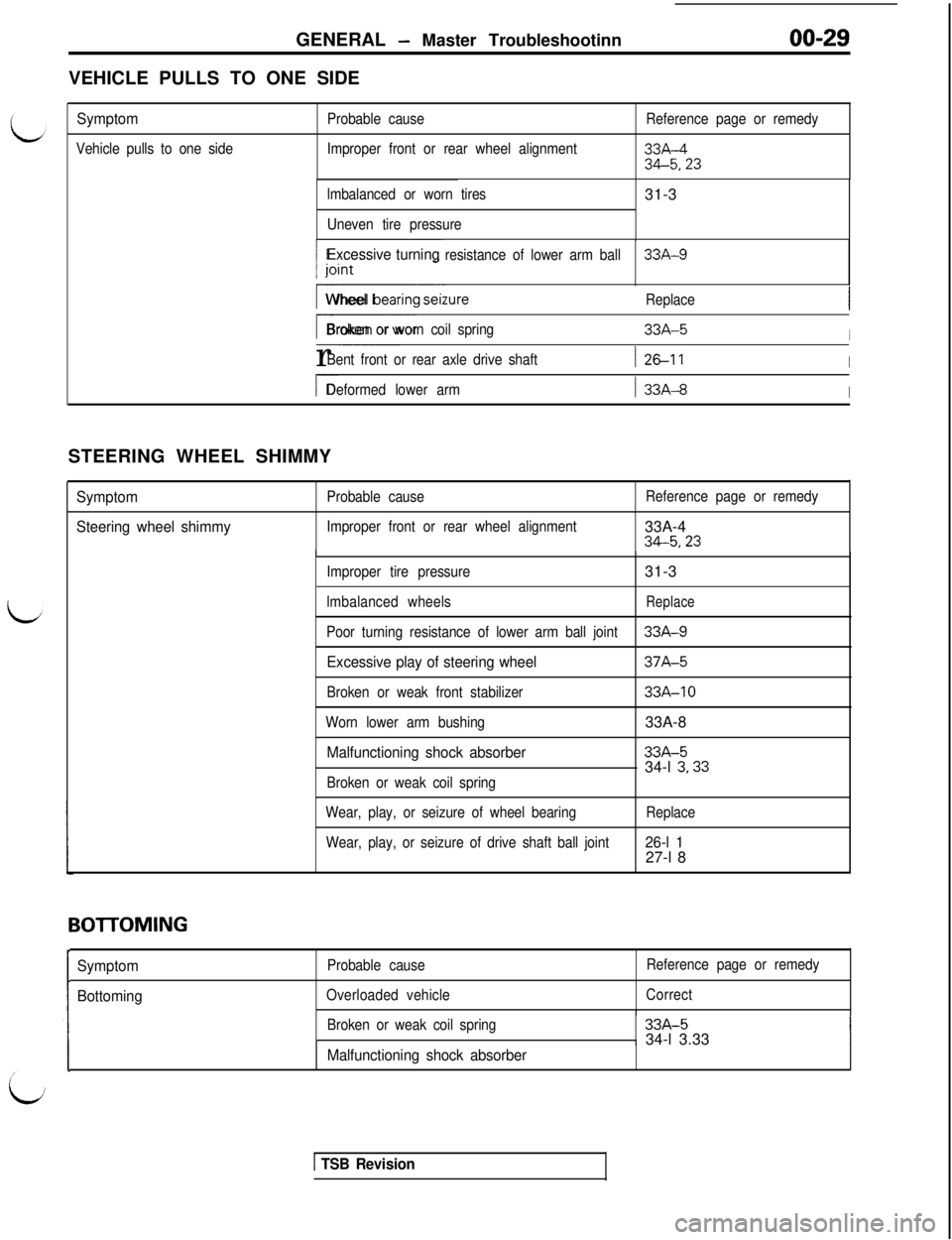
GENERAL - Master Troubleshootinn
VEHICLE PULLS TO ONE SIDE
Symptom
Vehicle pulls to one sideProbable cause
Improper front or rear wheel alignmentReference page or remedy33A-4
34-5,23
lmbalanced or worn tires
Uneven tire pressure31-3
Excessive turningresistance of lower arm ball33A-9
I--_Wheel beanng serzureReplace
I---Broken or worn coil spring33A-5Ir
~~~~~~Bent front or rear axle drive shaft126-11I
I-Deformed lower arm1 33A-8I
Improper tire pressure31-3
lmbalanced wheelsReplace
Poor turning resistance of lower arm ball joint33A-9
Excessive play of steering wheel37A-5
Broken or weak front stabilizer33A-10
Worn lower arm bushing33A-8
Malfunctioning shock absorber33A-5
34-l 3,33
Broken or weak coil spring
Wear, play, or seizure of wheel bearing
Wear, play, or seizure of drive shaft ball jointReplace
26-l 127-l 8 STEERING WHEEL SHIMMY
SymptomProbable cause
Steering wheel shimmyImproper front or rear wheel alignmentReference page or remedy33A-434-5,23
Boll-OMING
Symptom
BottomingProbable cause
Overloaded vehicleReference page or remedy
Correct
Broken or weak coil spring33A-5
34-l 3.33
IMalfunctioning shock absorber
1 TSB Revision
Page 49 of 1146
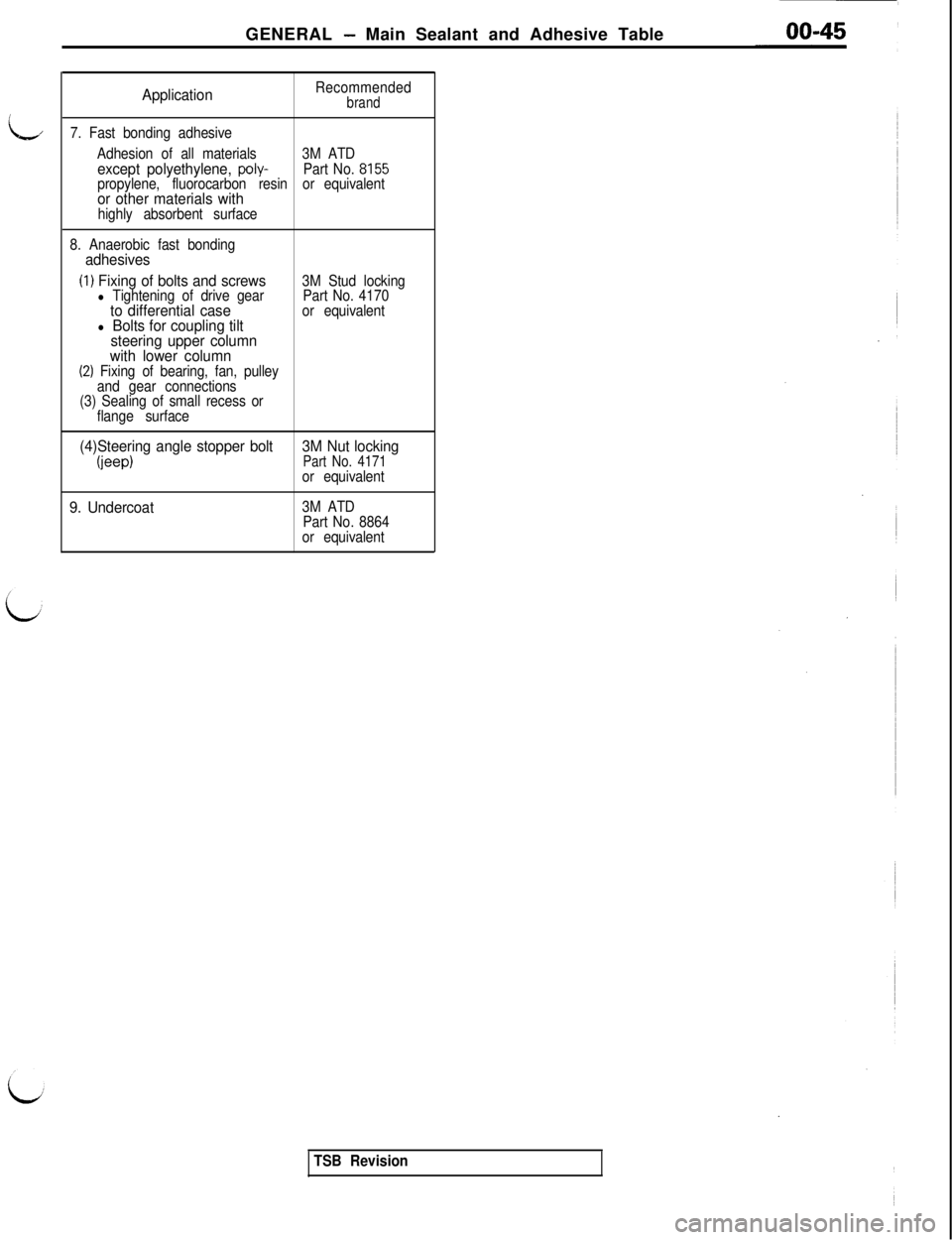
GENERAL - Main Sealant and Adhesive Table
I,i
ApplicationRecommendedbrand
7. Fast bonding adhesive
Adhesion of all materials3M ATD
except polyethylene, poly-Part No. 8155propylene, fluorocarbon resinor equivalentor other materials withhighly absorbent surface
8. Anaerobic fast bonding
adhesives
(I) Fixing of bolts and screws3M Stud lockingl Tightening of drive gearPart No. 4170to differential caseor equivalentl Bolts for coupling tilt
steering upper column
with lower column
(2) Fixing of bearing, fan, pulley
and gear connections
(3) Sealing of small recess or
flange surface
(4)Steering angle stopper bolt
(jeep)
3M Nut lockingPart No. 4171or equivalent
9. Undercoat3M ATD
Part No. 8864
or equivalent
TSB Revision
Page 134 of 1146
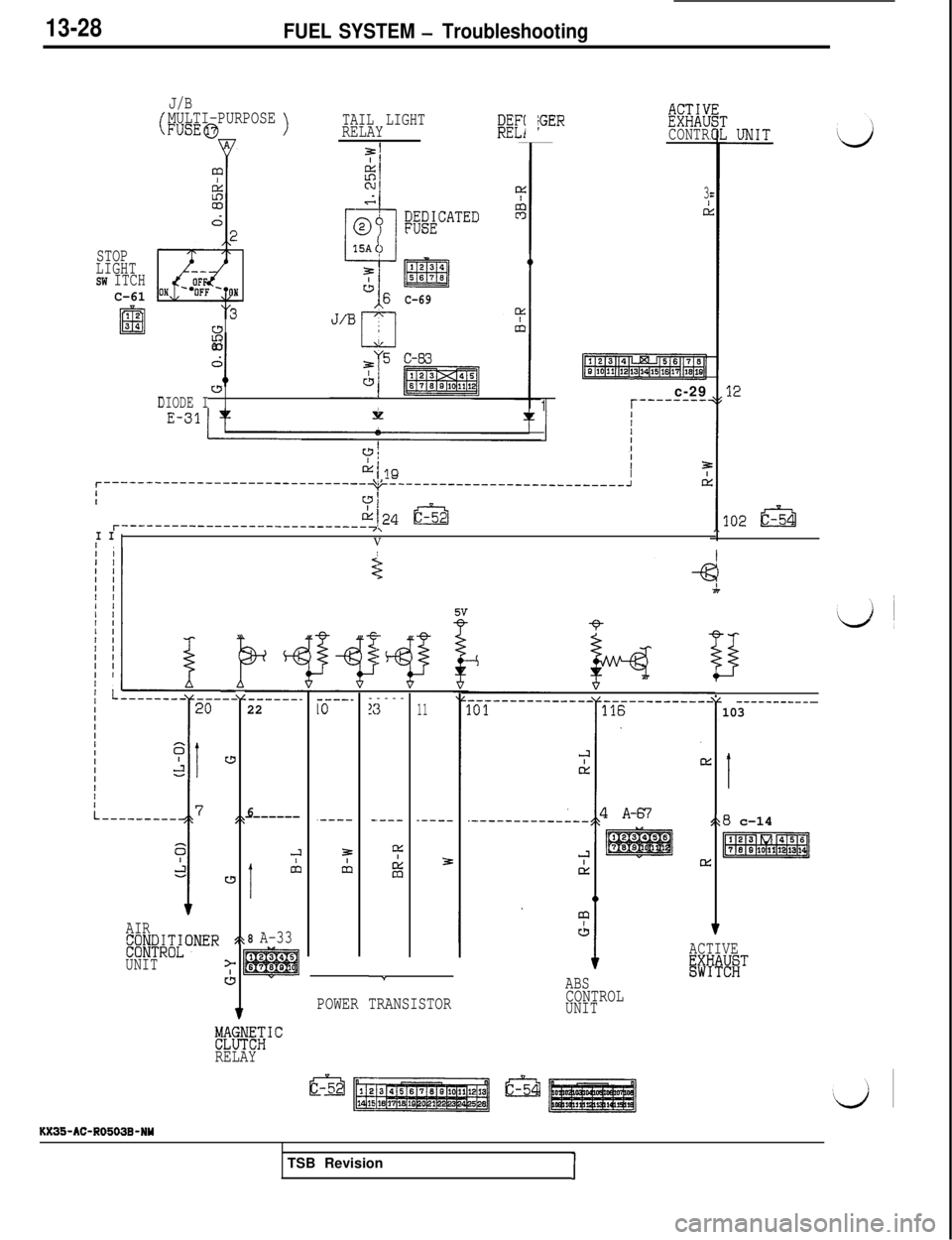
13-28FUEL SYSTEM - Troubleshooting
J/B
(MULTI-PURPOSEFUSE@>TAIL LIGHTRELAYDEF(RELfjGERKixCONTR
m
ONC-69'(3I
if2-
L&ia3
dd
I0_-w1DIODE II
3
d
STOP
LIGHT
SW ITCHC-6112
El34c-29
1r--------'
fII
--__---_-__------___------~~--- \1,--Iy----------------------------Jd
71
z?124 t&r-----------------------------7;I IIV
I---
w
Sk
w,t
>
JI
v
----_10
.----
5
cb-----
3
-.---
!xI
%
:------_22
6-------
J
1
&I
8 A-33
11
.----
3
- -----------
r
103
c
I
128 c-14
pER!Eq?
v
.-----_-_-----_
AIR
E;;F#ONER
UNITACTIVEisiii%!iTc
ABS
CONTROLUNIT
Y
POWER TRANSISTOR
FlffiWRELAYKX35-AC-R0503B-NY
TSB Revision
I
Page 166 of 1146
![MITSUBISHI 3000GT 1991 Service Manual 13-60FUEL SYSTEM - On-vehicle Inspection of MPI Components
BAROMETRIC PRESSURE SENSOR
Barometric
pressure sensor7FUO66
Output voltage (VI
a---l- 760Barometric pressure [mmHg (in.Hg)] (30) EC1551
@ Equ](/img/19/57085/w960_57085-165.png "MITSUBISHI 3000GT 1991 Service Manual 13-60FUEL SYSTEM - On-vehicle Inspection of MPI Components
BAROMETRIC PRESSURE SENSOR
Barometric
pressure sensor7FUO66
Output voltage (VI
a---l- 760Barometric pressure [mmHg (in.Hg)] (30) EC1551
@ Equ")
13-60FUEL SYSTEM - On-vehicle Inspection of MPI Components
BAROMETRIC PRESSURE SENSOR
Barometric
pressure sensor7FUO66
Output voltage (VI
a---l- 760Barometric pressure [mmHg (in.Hg)] (30) EC1551
@ Equipment side
M13YHAA2
d
connecror
Air flow sensor
connector
r
Barometric pressure sensor
@ Harness sideconnector
Engine control unit
A6 IA65A\72
7
7F U0664
Engine control unit connector
7FUO653
OPERATIONl The barometric pressure sensor converts the barometric pressure into a voltage and inputs it to the
engine control unit, which then corrects the fuel injection rate, etc. based on the input signal.
lThe 5 V power in the engine control unit is supplied to the barometric pressure sensor. Through the circuitin the sensor, it is grounded in the engine control unit.1
l
The barometric pressure sensor output voltage which is proportional to the barometric pressure (absolutepressure) is supplied to the engine control unit.
d ITSB Revision
Page 186 of 1146

13-80FUEL SYSTEM - 0
n-vehicle Inspection of MPI Components
POWER STEERING OIL PRESSURE SWITCHMlOYQAA
B
$-
Engine control unit
'107
@ Harness side
connector
ml-
Power steering oil
Pressure switch
7FUO536700-2.000 1.500-2.000(100-284) (213-284)Pressure [kPa (psi)]
0, l.oIu
OPERATIONl
The power steering oil pressure switch converts presence/absence of power steering load into low/high
voltage and inputs it to the engine control unit, which then controls the idle speed control servo based on
this signal.l The battery voltage in the engine control unit is applied through a resistor to the power steering oil
pressure switch. Steering operation causes the power steering oil pressure to increase, turning the
switch on. As a result, continuity is produced between the battery voltage applied and ground. This
causes the power steering oil pressure terminal voltage to go from high to low.
TSB Revision
Page 239 of 1146
FUEL SYSTEM - On-vehicle Inspection of MPI Components
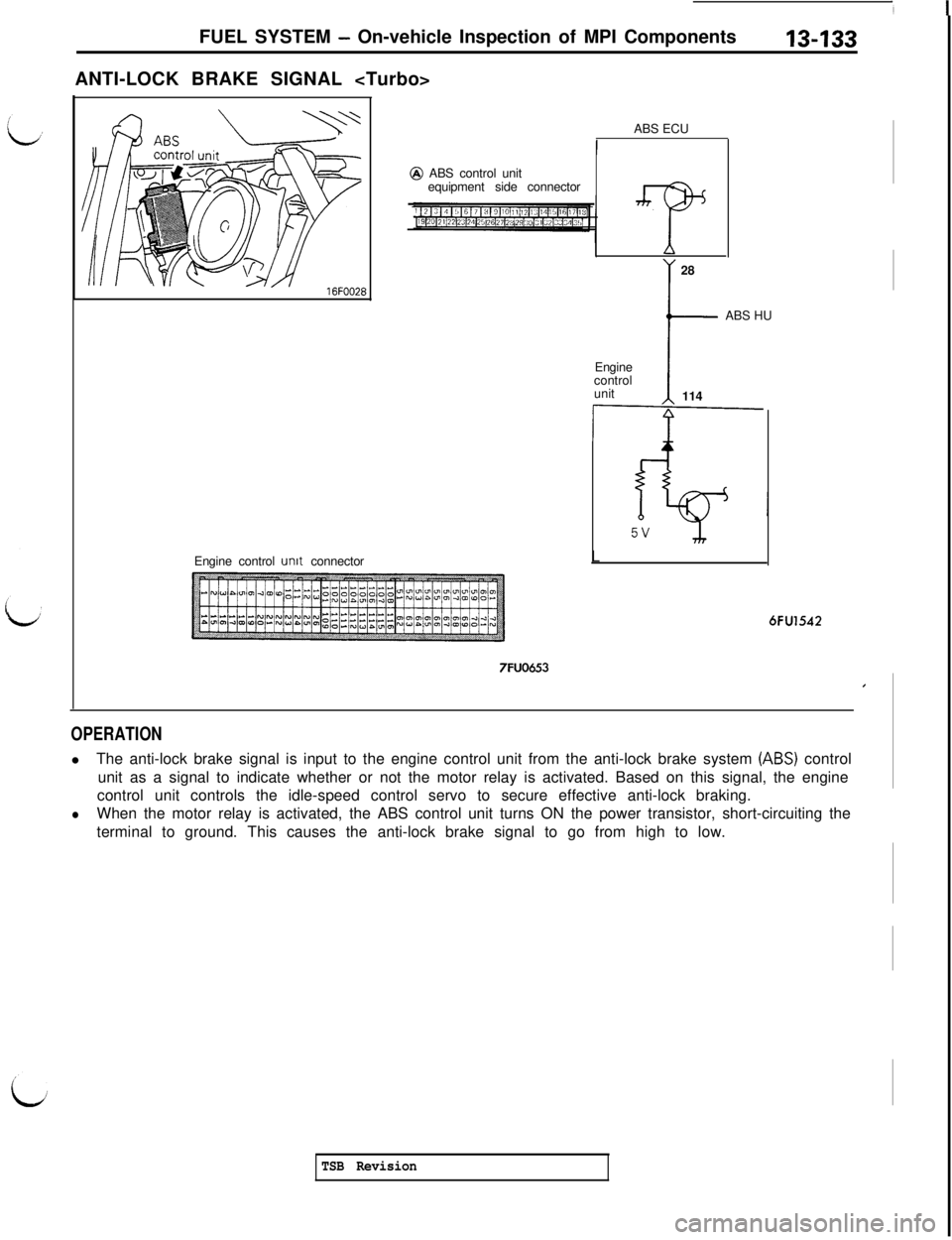
ANTI-LOCK BRAKE SIGNAL
Engine control
unit connectorABS ECU@ ABS control unit
equipment side connector
A28
tABS HU
Engine
control
unit
114
/L6FU1542
7FUO653,
OPERATIONlThe anti-lock brake signal is input to the engine control unit from the anti-lock brake system
(ABS) control
unit as a signal to indicate whether or not the motor relay is activated. Based on this signal, the engine
control unit controls the idle-speed control servo to secure effective anti-lock braking.
lWhen the motor relay is activated, the ABS control unit turns ON the power transistor, short-circuiting the
terminal to ground. This causes the anti-lock brake signal to go from high to low.
TSB Revision
Page 240 of 1146
13-134FUEL SYSTEM - On-vehicle InsDection of MPI ComDonents
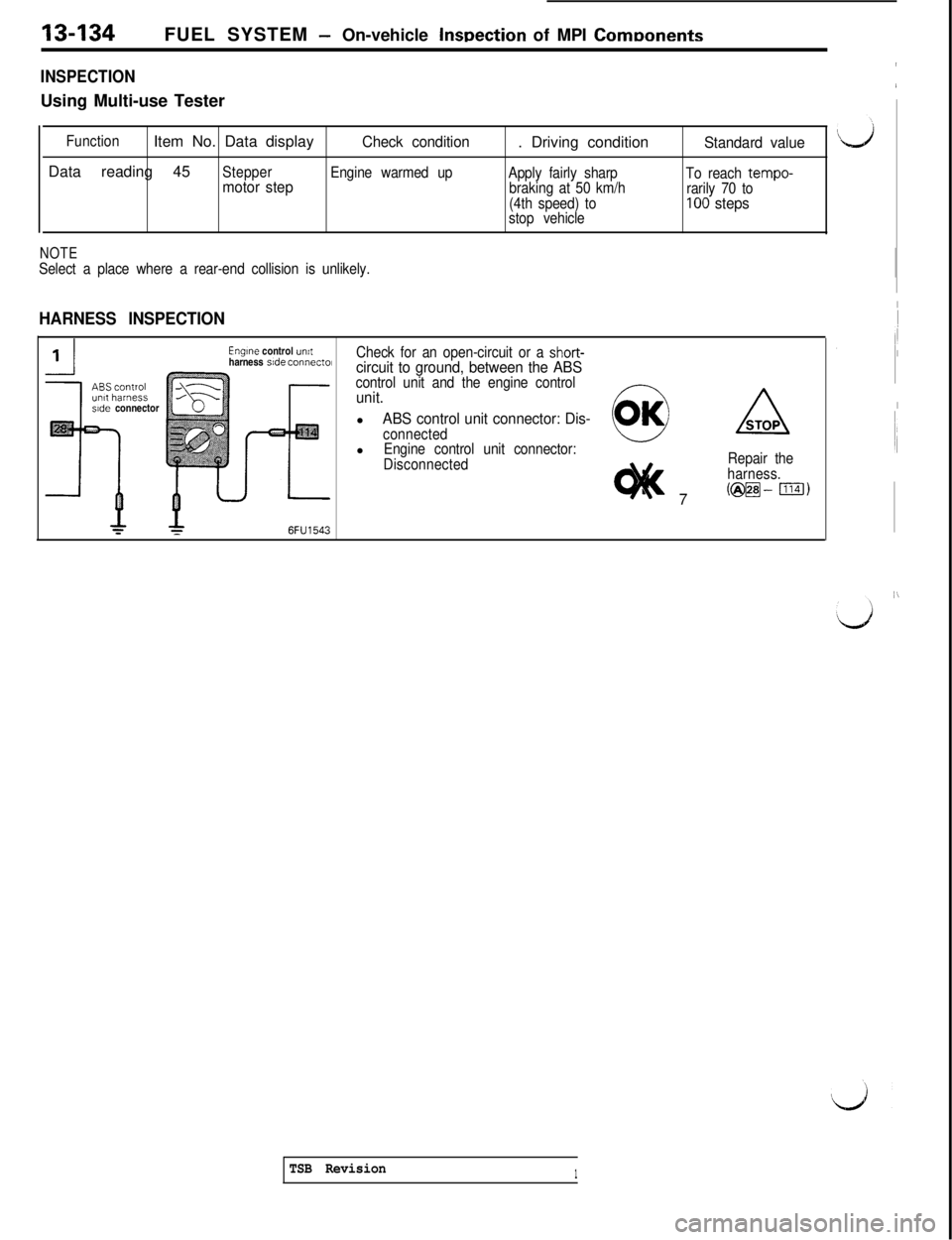
INSPECTIONUsing Multi-use Tester
FunctionItem No. Data displayCheck condition. Driving conditionStandard valueData reading 45
Stepper
Engine warmed up
Apply fairly sharp
To reach tempo-motor stepbraking at 50 km/h
rarily 70 to
(4th speed) to100 stepsstop vehicle
NOTESelect a place where a rear-end collision is unlikely.
HARNESS INSPECTION
side connector
Engine control umtharness side connecm
6FU1543
Check for an open-circuit or a short-circuit to ground, between the ABScontrol unit and the engine controlunit.l
ABS control unit connector: Dis-connectedlEngine control unit connector:
Disconnected7Repair the
harness.
(@m-ml)
I
I
I
I
IiI
I
~,
I\
TSB Revision1
Page 585 of 1146
FRONT AXLE - Hub and Knuckle26-9
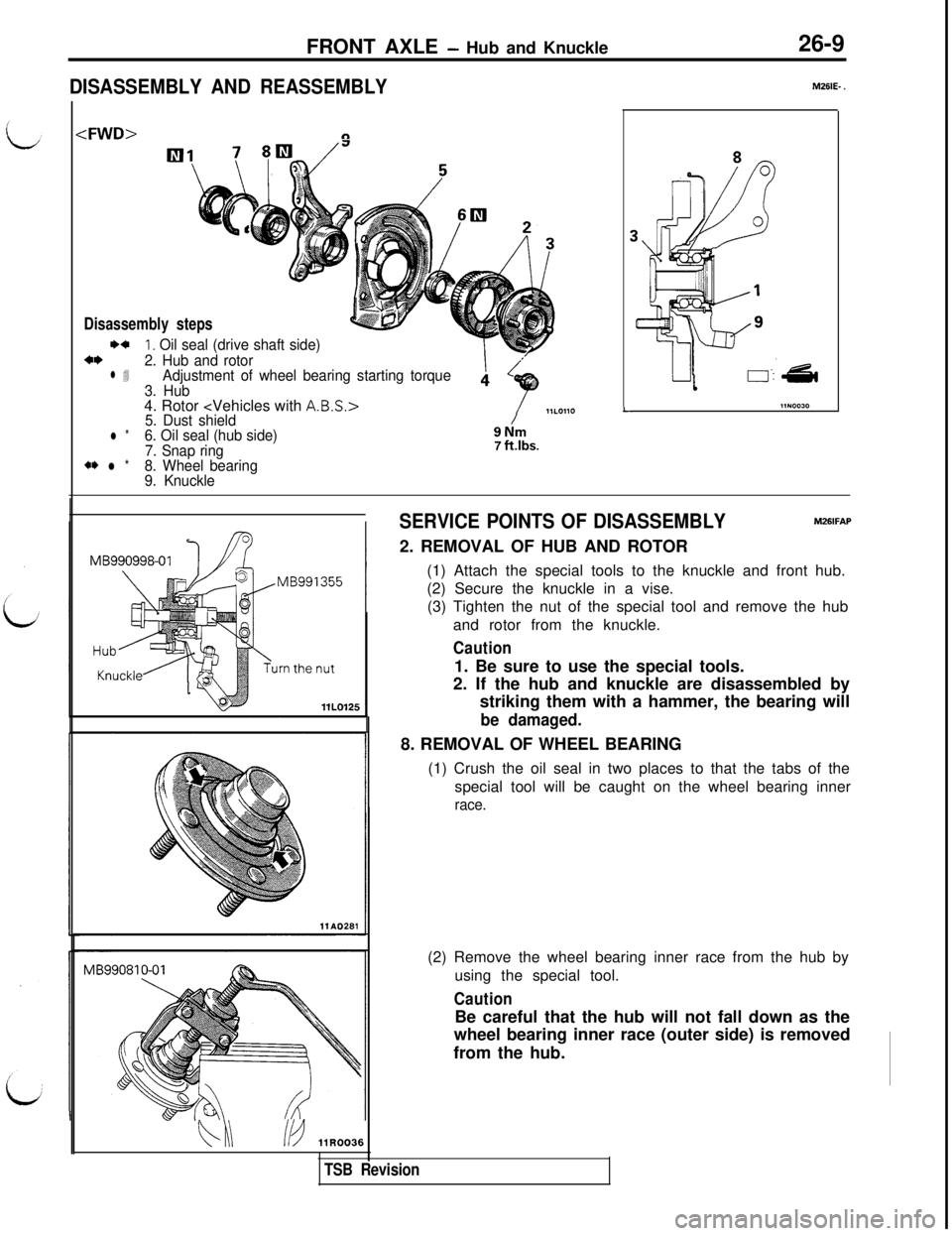
DISASSEMBLY AND REASSEMBLY
Disassembly stepsI)+
1. Oil seal (drive shaft side)*I)2. Hub and rotorl 4Adjustment of wheel bearing starting torque
3. Hub4. Rotor
5. Dust shieldl *6. Oil seal (hub side)
7. Snap ring
*I) l *8. Wheel bearing
9. Knuckle
/9Nm7 ftlbs.
L
MSIE- .
bi\/b ilR0036
SERVICE POINTS OF DISASSEMBLYM26lFAP2. REMOVAL OF HUB AND ROTOR
(1) Attach the special tools to the knuckle and front hub.
(2) Secure the knuckle in a vise.
(3) Tighten the nut of the special tool and remove the hub
and rotor from the knuckle.
Caution1. Be sure to use the special tools.
2. If the hub and knuckle are disassembled by
striking them with a hammer, the bearing will
be damaged.8. REMOVAL OF WHEEL BEARING
(1) Crush the oil seal in two places to that the tabs of the
special tool will be caught on the wheel bearing inner
race.(2) Remove the wheel bearing inner race from the hub by
using the special tool.
CautionBe careful that the hub will not fall down as the
wheel bearing inner race (outer side) is removed
from the hub.
TSB Revision