air condition MITSUBISHI 3000GT 1991 Repair Manual
[x] Cancel search | Manufacturer: MITSUBISHI, Model Year: 1991, Model line: 3000GT, Model: MITSUBISHI 3000GT 1991Pages: 1146, PDF Size: 76.68 MB
Page 354 of 1146
17-10EMISSION CONTROL - Evaporative Emission Control System
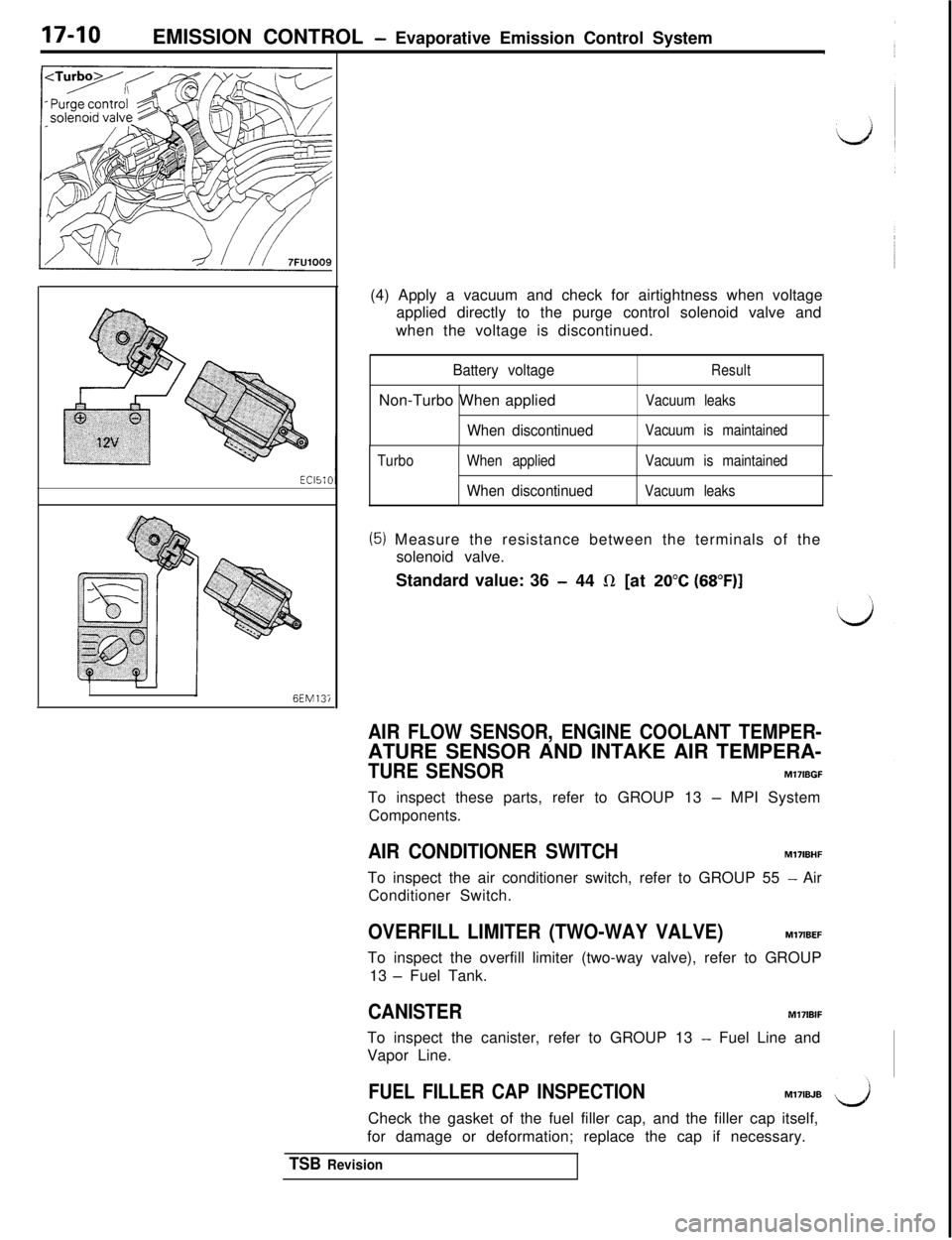
I-6EM13i(4) Apply a vacuum and check for airtightness when voltage
applied directly to the purge control solenoid valve and
when the voltage is discontinued.
Battery voltageResultNon-Turbo When applied
Vacuum leaks
When discontinuedVacuum is maintained
TurboWhen applied
When discontinued
Vacuum is maintained
Vacuum leaks
(5) Measure the resistance between the terminals of the
solenoid valve.
Standard value: 36
- 44 R [at 20°C (68”F)]
AIR FLOW SENSOR, ENGINE COOLANT TEMPER-ATURE SENSOR AND INTAKE AIR TEMPERA-
TURE SENSORM17lBGFTo inspect these parts, refer to GROUP 13
- MPI System
Components.
AIR CONDITIONER SWITCHMl7IBHF
To inspect the air conditioner switch, refer to GROUP 55
- Air
Conditioner Switch.
OVERFILL LIMITER (TWO-WAY VALVE)M17IBEFTo inspect the overfill limiter (two-way valve), refer to GROUP
13
- Fuel Tank.
CANISTERM17lBIFTo inspect the canister, refer to GROUP 13
- Fuel Line and
Vapor Line.
FUEL FILLER CAP INSPECTIONM17IBJBCheck the gasket of the fuel filler cap, and the filler cap itself,
for damage or deformation; replace the cap if necessary.
TSB Revision
Page 357 of 1146
EMISSION CONTROL - Exhaust Gas Recirculation IEGR) Svstem17-13
GM159
QQQQQQ7FMnn4EGR VALVE
M17lCKJ
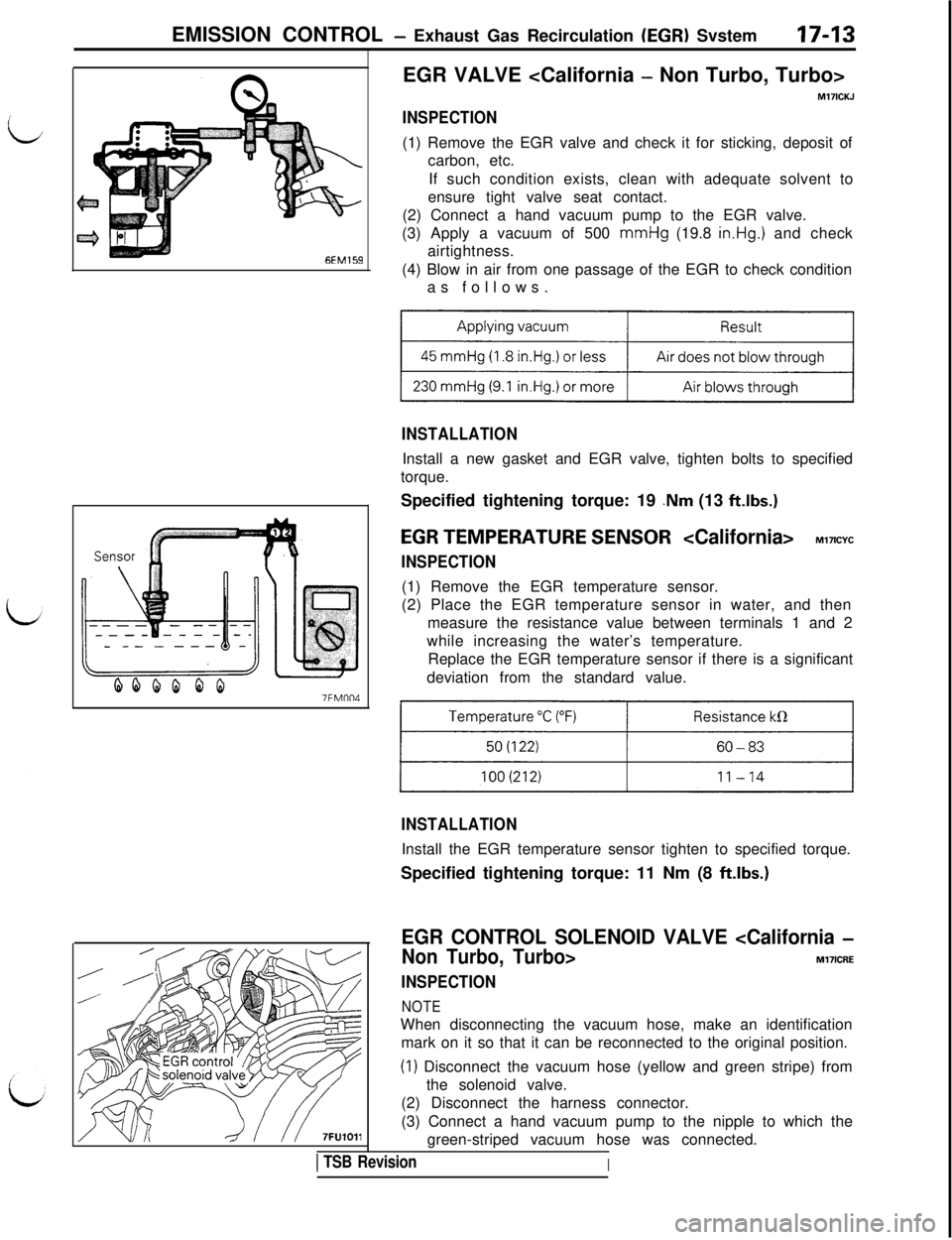
INSPECTION(1) Remove the EGR valve and check it for sticking, deposit of
carbon, etc.
If such condition exists, clean with adequate solvent to
ensure tight valve seat contact.
(2) Connect a hand vacuum pump to the EGR valve.
(3) Apply a vacuum of 500 mmHg (19.8 in.Hg.) and check
airtightness.
(4) Blow in air from one passage of the EGR to check condition
as follows.
INSTALLATIONInstall a new gasket and EGR valve, tighten bolts to specified
torque.
Specified tightening torque: 19
.Nm (13 ft.lbs.)
EGR TEMPERATURE SENSOR
INSPECTION(1) Remove the EGR temperature sensor.
(2) Place the EGR temperature sensor in water, and then
measure the resistance value between terminals 1 and 2
while increasing the water’s temperature.
Replace the EGR temperature sensor if there is a significant
deviation from the standard value.
INSTALLATIONInstall the EGR temperature sensor tighten to specified torque.
Specified tightening torque: 11 Nm (8
ftlbs.)
EGR CONTROL SOLENOID VALVE
INSPECTION
NOTEWhen disconnecting the vacuum hose, make an identification
mark on it so that it can be reconnected to the original position.
(1) Disconnect the vacuum hose (yellow and green stripe) from
the solenoid valve.
(2) Disconnect the harness connector.
(3) Connect a hand vacuum pump to the nipple to which the
green-striped vacuum hose was connected.
1 TSB RevisionI
Page 358 of 1146
17-14 EMISSION CONTROL -Exhaust Gas Recirculation (EGR) System / Catalytic Converter
6EM01871
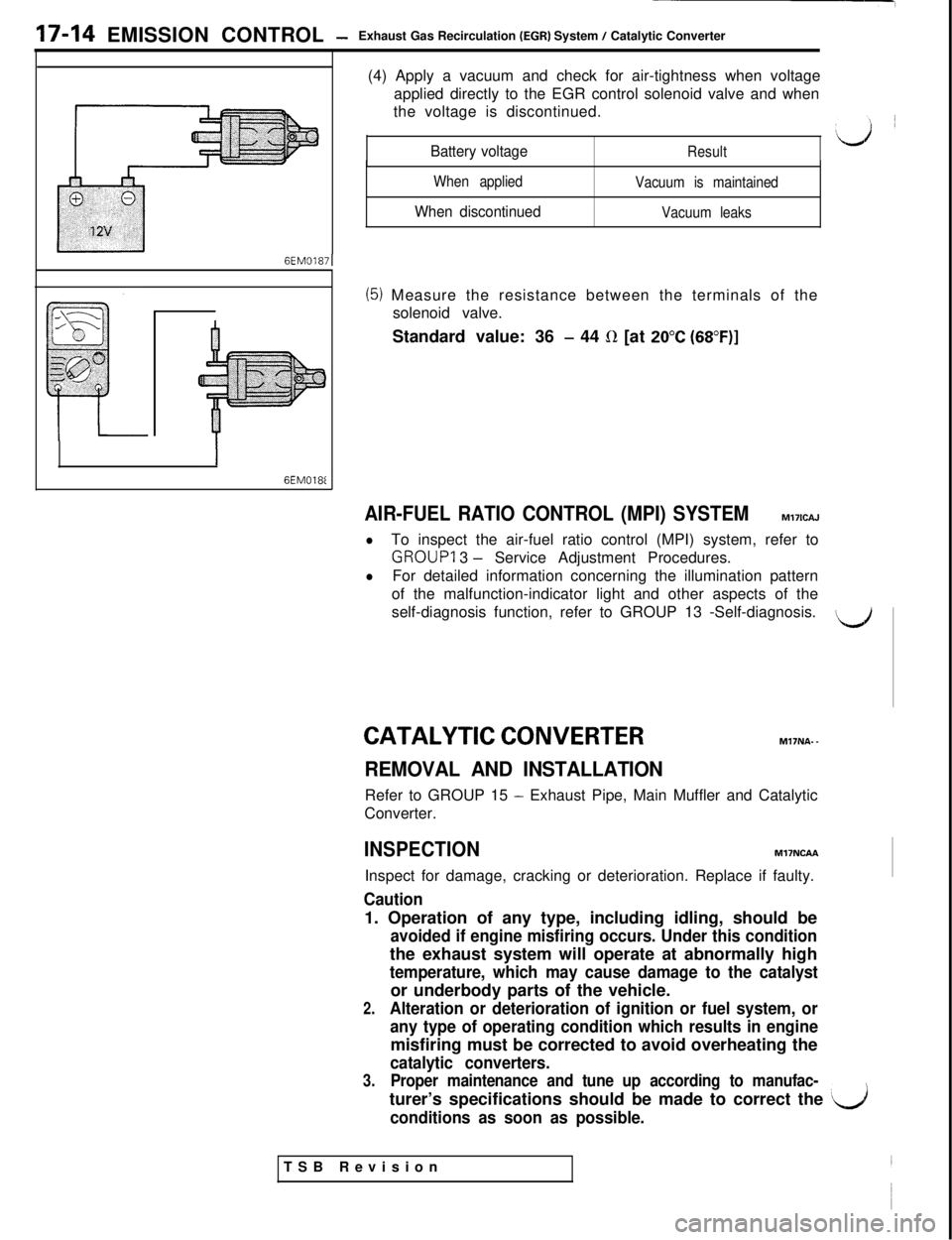
6EM0181(4) Apply a vacuum and check for air-tightness when voltage
applied directly to the EGR control solenoid valve and when
the voltage is discontinued.
Battery voltageResult
When applied
When discontinued
Vacuum is maintained
Vacuum leaks
(5) Measure the resistance between the terminals of the
solenoid valve.
Standard value: 36
- 44 R [at 20°C (68”F)]
AIR-FUEL RATIO CONTROL (MPI) SYSTEMM17ICAJ
lTo inspect the air-fuel ratio control (MPI) system, refer to
GROUP1 3 - Service Adjustment Procedures.
lFor detailed information concerning the illumination pattern
of the malfunction-indicator light and other aspects of the
self-diagnosis function, refer to GROUP 13 -Self-diagnosis.
\.J
CATALYTIC CONVERTERMl7N& -
REMOVAL AND INSTALLATIONRefer to GROUP 15
- Exhaust Pipe, Main Muffler and Catalytic
Converter.
INSPECTIONMl7NCAA
Inspect for damage, cracking or deterioration. Replace if faulty.
Caution1. Operation of any type, including idling, should be
avoided if engine misfiring occurs. Under this conditionthe exhaust system will operate at abnormally high
temperature, which may cause damage to the catalystor underbody parts of the vehicle.
2.Alteration or deterioration of ignition or fuel system, or
any type of operating condition which results in enginemisfiring must be corrected to avoid overheating the
catalytic converters.
3.Proper maintenance and tune up according to manufac-turer’s specifications should be made to correct the
‘bi
conditions as soon as possible.TSB Revision
Page 471 of 1146
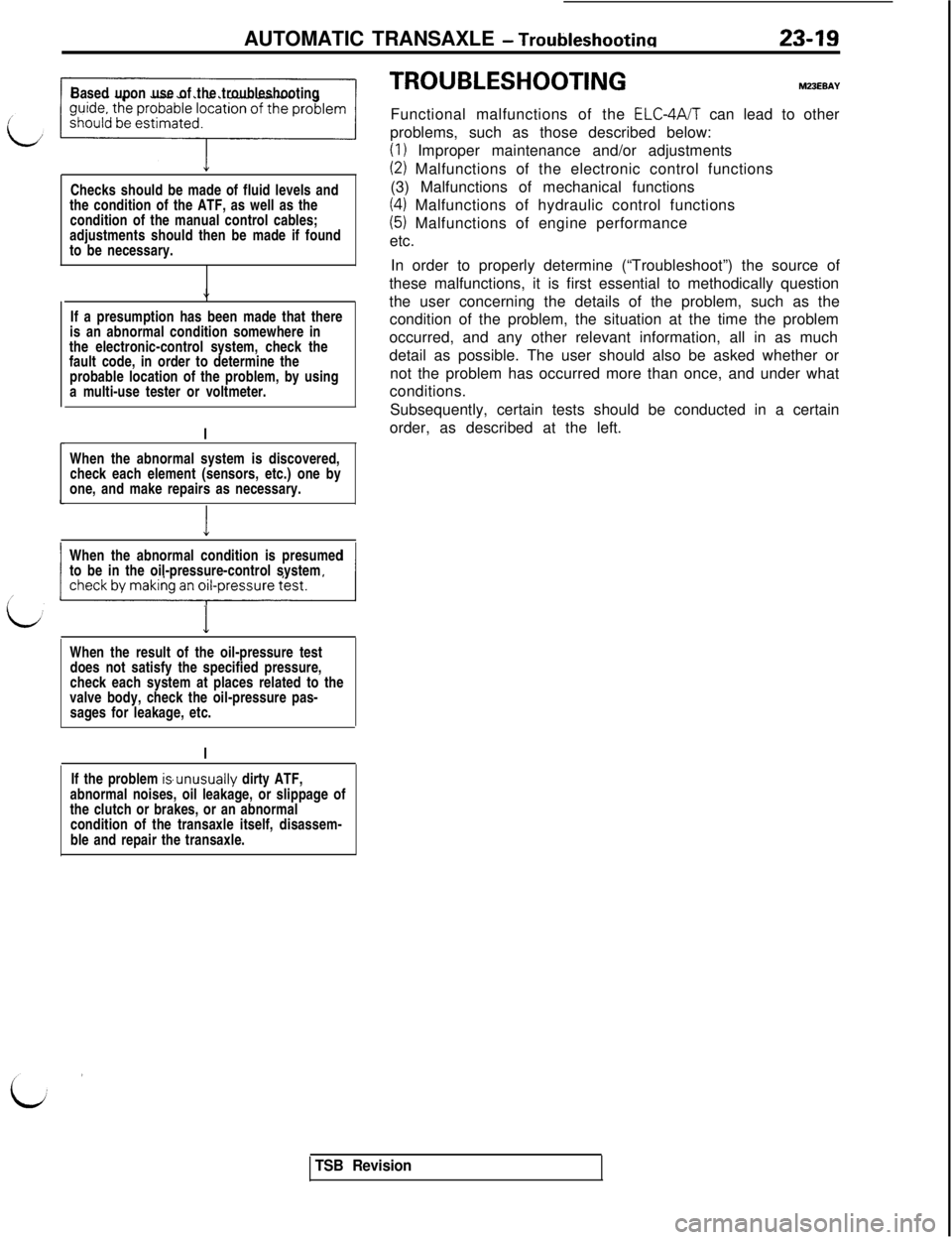
AUTOMATIC TRANSAXLE - Troubleshootincl23-19Based upon use of the troubleshooting
Checks should be made of fluid levels and
the condition of the ATF, as well as the
condition of the manual control cables;
adjustments should then be made if found
to be necessary.
If a presumption has been made that there
is an abnormal condition somewhere in
the electronic-control system, check the
fault code, in order to determine the
probable location of the problem, by using
a multi-use tester or voltmeter.
I
When the abnormal system is discovered,
check each element (sensors, etc.) one by
one, and make repairs as necessary.
IWhen the abnormal condition is presumed
to be in the oil-pressure-control system
When the result of the oil-pressure test
does not satisfy the specified pressure,
check each system at places related to the
valve body, check the oil-pressure pas-
sages for leakage, etc.
I
If the problem isunusually dirty ATF,
abnormal noises, oil leakage, or slippage of
the clutch or brakes, or an abnormal
condition of the transaxle itself, disassem-
ble and repair the transaxle.
TROUBLESHOOTINGM23EEAYFunctional malfunctions of the ELC4A/T can lead to other
problems, such as those described below:(I
) Improper maintenance and/or adjustments
(2) Malfunctions of the electronic control functions
(3) Malfunctions of mechanical functions
(4) Malfunctions of hydraulic control functions
(5) Malfunctions of engine performance
etc.
In order to properly determine (“Troubleshoot”) the source of
these malfunctions, it is first essential to methodically question
the user concerning the details of the problem, such as the
condition of the problem, the situation at the time the problem
occurred, and any other relevant information, all in as much
detail as possible. The user should also be asked whether or
not the problem has occurred more than once, and under what
conditions.
Subsequently, certain tests should be conducted in a certain
order, as described at the left.
TSB Revision
Page 474 of 1146
![MITSUBISHI 3000GT 1991 Repair Manual 23-22AUTOMATIC TRANSAXLE - Troubleshooting
0”
TM362
DIAGNOSIS AND TEST
FLUID LEVEL AND CONDITION
1.Drive until the fluid temperature reaches the usual tempera-
ture
[70 - 80°C (160 - 18O”F)].2.](/img/19/57085/w960_57085-473.png "MITSUBISHI 3000GT 1991 Repair Manual 23-22AUTOMATIC TRANSAXLE - Troubleshooting
0”
TM362
DIAGNOSIS AND TEST
FLUID LEVEL AND CONDITION
1.Drive until the fluid temperature reaches the usual tempera-
ture
[70 - 80°C (160 - 18O”F)].2.")
23-22AUTOMATIC TRANSAXLE - Troubleshooting
0”
TM362
DIAGNOSIS AND TEST
FLUID LEVEL AND CONDITION
1.Drive until the fluid temperature reaches the usual tempera-
ture
[70 - 80°C (160 - 18O”F)].2. Place vehicle on level floor.
3. Move selector lever sequentially to every position to fill
torque converter and hydraulic circuit with fluid, then place
lever in “N” Neutral position. This operation is necessary to
be sure that fluid level check is accurate.
4. Before removing dipstick, wipe all dirt from area around
dipstick. Then take out the dipstick and check the condition
of the fluid.
The transaxle should be overhauled under the following
conditions.
l If there is a “burning” odor.
l If the fluid color has become noticeably blacker.
lIf there is a noticeably great amount of metal particles in
the fluid.
5.Check to see if fluid level is in “HOT” range on dipstick. If
fluid level is low, add automatic transaxle fluid until level
reaches “HOT” range.
Low fluid level can cause a variety of conditions because it
allows pump to take in air along with fluid. Air trapped in
hydraulic circuit forms bubbles which make fluid spongy.
Therefore, pressures will be erratic.
Improper filling can also raise fluid level too high. When
transaxle has too much fluid, gears churn up foam and
cause same conditions which occur with low fluid level,
resulting in accelerated deterioration of automatic transaxle
fluid.
dIn either case, air bubbles can cause overheating, fluid
oxidation, which can interfere with normal valve, clutch, and
servo operation. Foaming can also result in fluid escaping
from transaxle vent where it may be mistaken for a leak.
6. Be sure to examine fluid on dipstick closely.
,CONTROL CABLEWhether control cable is properly adjusted can be confirmed by
checking whether inhibitor switch is performing well.
1. Apply parking brakes and service brakes securely.
2. Place selector lever to “R” range.
3. Set ignition key to “ST” position.
4. Slowly move the selector lever upward until it clicks as it
fits in notch of “P” range. If starter motor operates when
lever makes a click, “P” position is correct.
5.Then slowly move selector lever to “N” range by the same
procedure as in foregoing paragraph. If starter motor
operates when selector lever fits in
“N”, “N” position is
correct.
6. Also check to be sure the vehicle doesn’t begin to move
and the lever doesn’t stop between P-R-N-D.
7. The control cable is properly adjusted if, as described
above, the starter motor starts at both the “P” range and
the “N” range.
TSB Revision
Page 482 of 1146
23-30AUTOMATIC TRANSAXLE - Troubleshooting
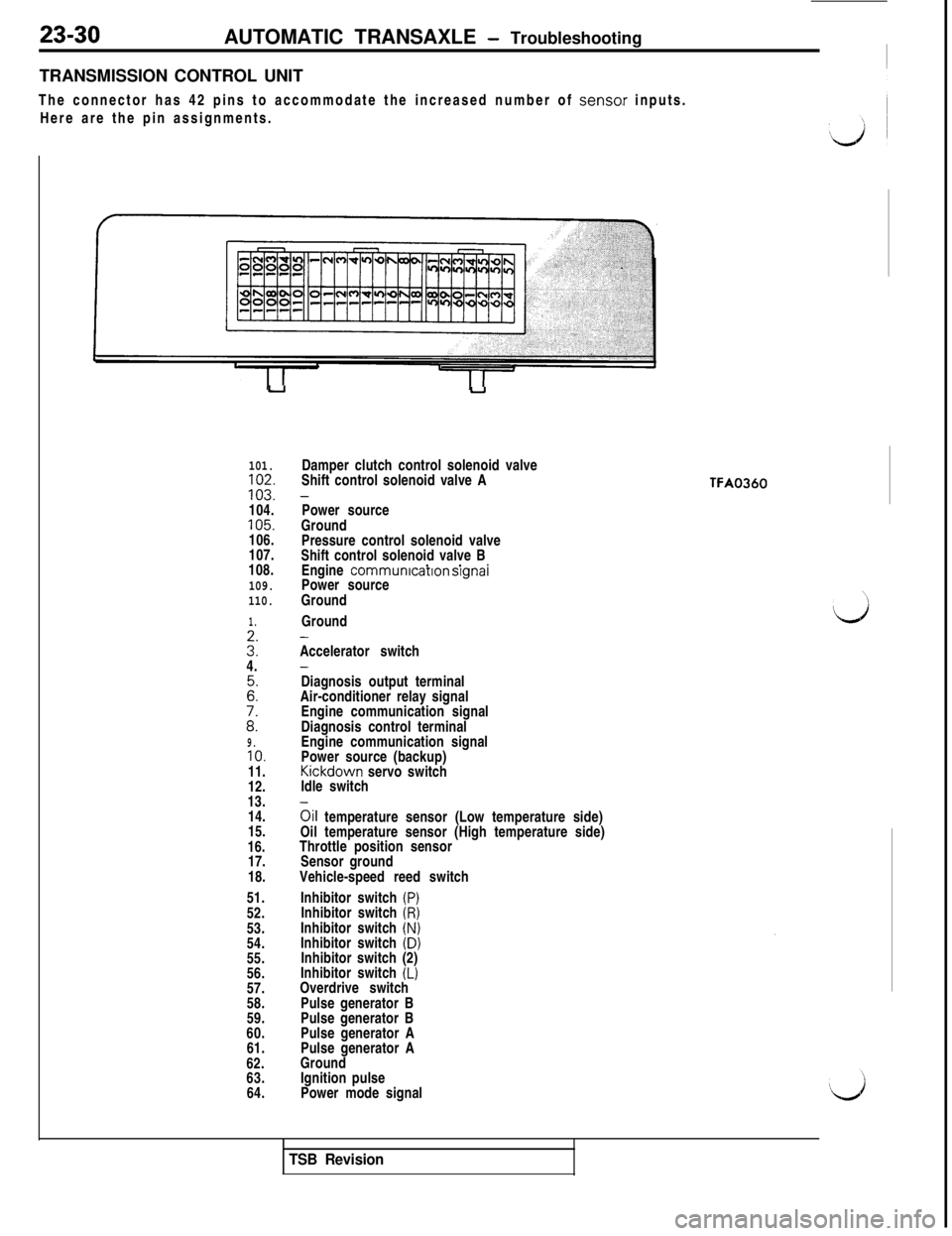
TRANSMISSION CONTROL UNIT
The connector has 42 pins to accommodate the increased number of senso.r inputs.
Here are the pin assignments.
uu
101.102.103.
104.105.
106.
107.
108.
109.
110.
1.
3':4.
Z:
i:9.10.11.
12.
13.
14.
15.
16.
17.
18.
51.
52.
53.
54.
55.
56.
57.
58.
59.
60.
61.
62.
63.
64.Damper clutch control solenoid valve
Shift control solenoid valve A
-Power source
Ground
Pressure control solenoid valve
Shift control solenoid valve B
. .
*Engine communrcatron srgnaiPower source
Ground
Ground
-Accelerator switch
-Diagnosis output terminal
Air-conditioner relay signal
Engine communication signal
Diagnosis control terminal
Engine communication signal
Power source (backup)Kickdown servo switch
Idle switch
oil temperature sensor (Low temperature side)
Oil temperature sensor (High temperature side)
Throttle position sensor
Sensor ground
Vehicle-speed reed switch
Inhibitor switch
(P)Inhibitor switch (R)Inhibitor switch (N)Inhibitor switch (D)
Inhibitor switch (2)
Inhibitor switch
(L)Overdrive switch
Pulse generator B
Pulse generator B
Pulse generator A
Pulse generator A
Ground
Ignition pulse
Power mode signal
TFA0360
TSB Revision
Page 491 of 1146
AUTOMATIC TRANSAXLE - Troubleshooting23-39
//!’ 6Rear@FrontclutchpressureI
@Kickdown brakeoressure (Release)
e
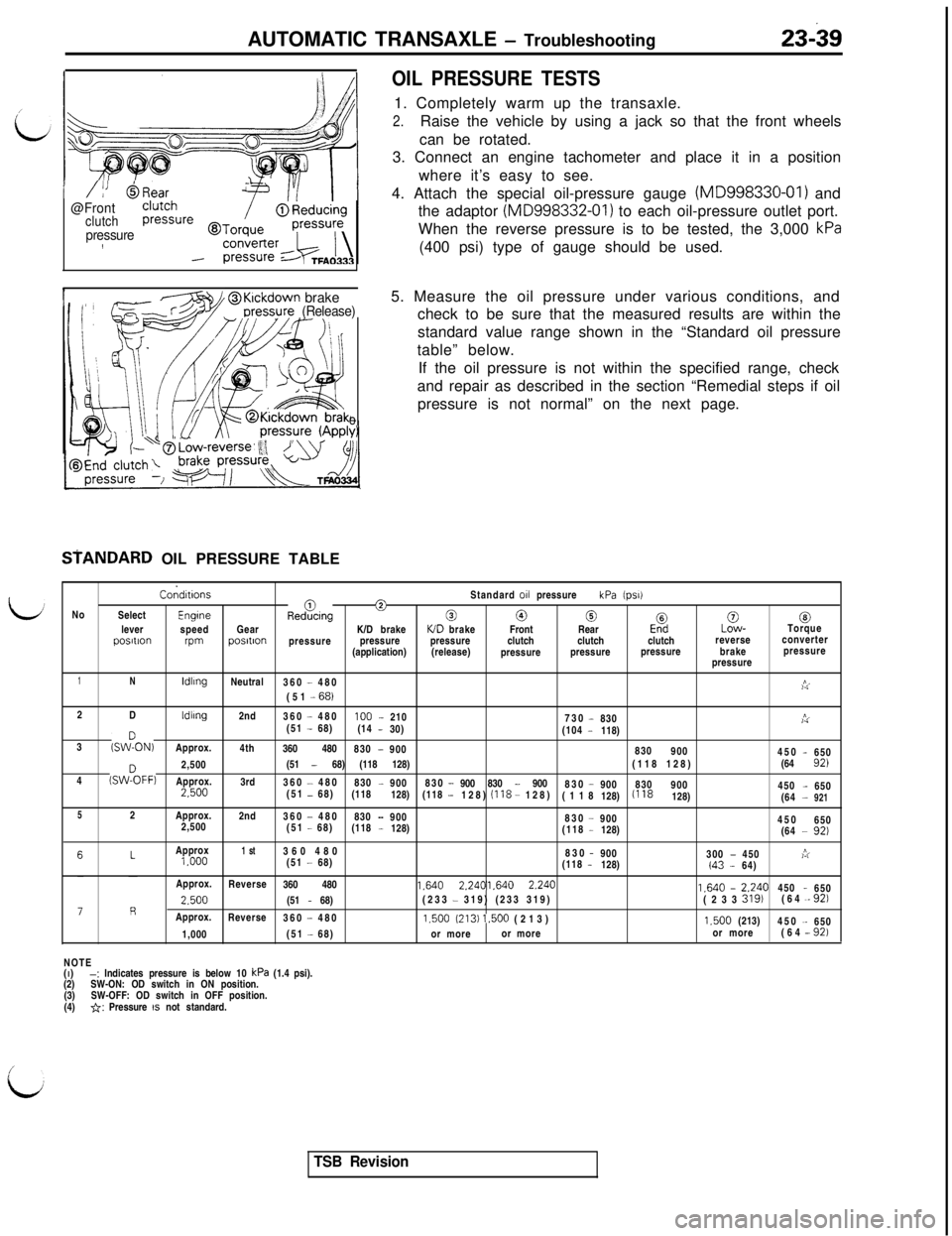
OIL PRESSURE TESTS1. Completely warm up the transaxle.
2.Raise the vehicle by using a jack so that the front wheels
can be rotated.
3. Connect an engine tachometer and place it in a position
where it’s easy to see.
4. Attach the special oil-pressure gauge (MD998330-01) and
the adaptor (MD998332-01) to each oil-pressure outlet port.
When the reverse pressure is to be tested, the 3,000
kPa(400 psi) type of gauge should be used.
5. Measure the oil pressure under various conditions, and
check to be sure that the measured results are within the
standard value range shown in the “Standard oil pressure
table” below.
If the oil pressure is not within the specified range, check
and repair as described in the section “Remedial steps if oil
pressure is not normal” on the next page.
STANDARD OIL PRESSURE TABLECondtttonsStandard
011 pressurekPa (PSI)No
SelectEngme
Red&g@000E%00leverspeedGearK/D brakeWD brakeFrontRearLow-TorqueposItlollvposltlon
pressurepressurepressureclutchclutchclutchreverseconverter
(application)(release)
pressurepressurepressurebrakepressure
pressure
1Nldlmg
Neutral
360 - 4808,(51 - 6812
Dldlmg
2nd
360
- 480100-210
730 -830k(51 - 68)
(14-30)
(104 -118)
3(SWFON,
Approx.
4th
360 480
830
-900
830
900
450-650
2,500(51 - 68) (118 128)(118 128)(64 92)
(SWZFF)Approx.
3rd
360 - 480
830
900830 -900 830 - 900
830 -900830
900
450-4
650-2.500(51 - 68)
(118
128)(118 -128) (118 - 128)
(118
128)(118128)
(64-921
52
Approx.
2nd
360
- 480
830--900
830 -900
450
650
2,500
(51 - 68)
(118-128)
(118 -128)
(64-921
Approx
1 st360 480
830 -900
300-450A1.000(51 - 68)
(118 -128)I43 .-64)
Approx.
Reverse
360 480
1.6402.2401.640 2.2401.640 -2.240450-6502.500(51 - 68)(233 - 319) (233 319)(233 319)(64 ~- 921
Approx.
Reverse
360
- 4801.500(213) 1.500 (213)1.500(213)
450~-650
1,000(51 - 68)or moreor moreor more(64 - 92)NOTE
(I)
-: Indicates pressure is below 10 kPa (1.4 psi).
(2)SW-ON: OD switch in ON position.
(3)SW-OFF: OD switch in OFF position.
(4)
a: Pressure IS not standard.
TSB Revision
Page 498 of 1146
23-46AUTOMATIC TRANSAXLE - Service Adjustment Procedures
Fluid level must be
within this range.
TFA038:
SERVICE ADJUSTMENT PROCEDURE!5
MZ3FElBJ
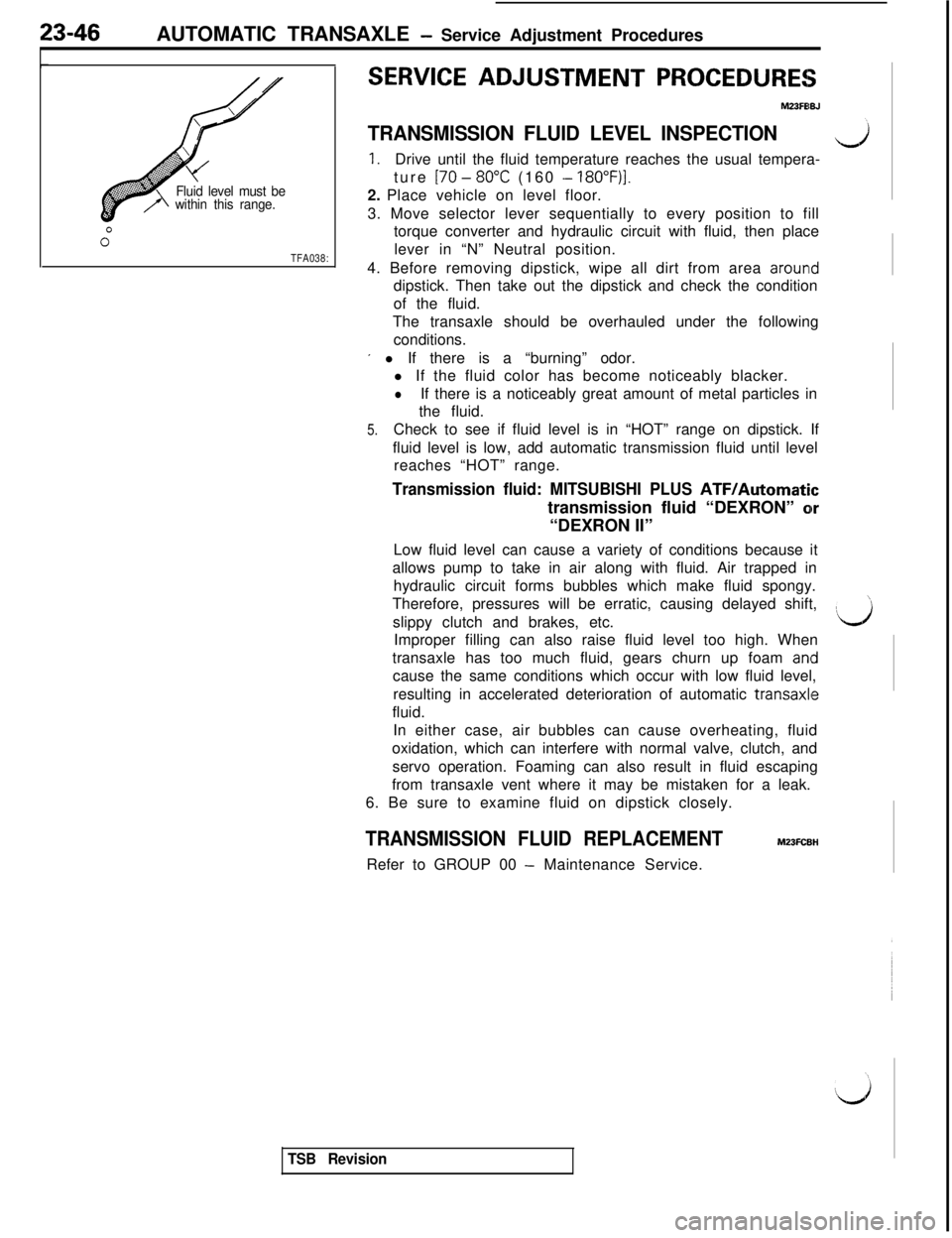
TRANSMISSION FLUID LEVEL INSPECTION
1.Drive until the fluid temperature reaches the usual tempera-
ture
170 - 80°C (160 - 18O”F)].2. Place vehicle on level floor.
3. Move selector lever sequentially to every position to fill
torque converter and hydraulic circuit with fluid, then place
lever in “N” Neutral position.
4. Before removing dipstick, wipe all dirt from area
arouniddipstick. Then take out the dipstick and check the condition
of the fluid.
The transaxle should be overhauled under the following
conditions.
’ l If there is a “burning” odor.
l If the fluid color has become noticeably blacker.
lIf there is a noticeably great amount of metal particles in
the fluid.
5.Check to see if fluid level is in “HOT” range on dipstick. If
fluid level is low, add automatic transmission fluid until level
reaches “HOT” range.
Transmission fluid: MITSUBISHI PLUS ATF/Automatictransmission fluid “DEXRON”
abr“DEXRON II”
Low fluid level can cause a variety of conditions because it
allows pump to take in air along with fluid. Air trapped in
hydraulic circuit forms bubbles which make fluid spongy.
Therefore, pressures will be erratic, causing delayed shift,
slippy clutch and brakes, etc.
Improper filling can also raise fluid level too high. When
transaxle has too much fluid, gears churn up foam
anldcause the same conditions which occur with low fluid level,
resulting in accelerated deterioration of automatic
transaxllefluid.
In either case, air bubbles can cause overheating, fluid
oxidation, which can interfere with normal valve, clutch, and
servo operation. Foaming can also result in fluid escaping
from transaxle vent where it may be mistaken for a leak.
6. Be sure to examine fluid on dipstick closely.
TRANSMISSION FLUID REPLACEMENTM23FCBHRefer to GROUP 00
- Maintenance Service.
TSB Revision
Page 738 of 1146
![MITSUBISHI 3000GT 1991 Repair Manual 35-16SERVICE BRAKES -Anti-lock Braking System Troubleshooting
BABS warning light stays on when the ignition key is in the “ON” position.
[Explanation]
[Hint]
This is the symptom when the ABS ECU d](/img/19/57085/w960_57085-737.png "MITSUBISHI 3000GT 1991 Repair Manual 35-16SERVICE BRAKES -Anti-lock Braking System Troubleshooting
BABS warning light stays on when the ignition key is in the “ON” position.
[Explanation]
[Hint]
This is the symptom when the ABS ECU d")
35-16SERVICE BRAKES -Anti-lock Braking System Troubleshooting
BABS warning light stays on when the ignition key is in the “ON” position.
[Explanation]
[Hint]
This is the symptom when the ABS ECU does not
Check the diagnosis output and if there is no output
power up due to broken ECU power circuit, etc.,
voltage or if the MUT and ABS ECU cannot
when the fail safe function operates and isolates thecommunicate, there is a good possibility that power
system or when the warning light drive circuit is
is not flowing to the ECU.
short circuited.
!8IGNIISWIT(-
:Et
J’B @
C151
:
E
COMBINATION
METER
-19
7
------____-_---1
2
610 2
~;@lizEFgIIc,
6227J
r bL-1
IN(IGl)
1
,
ig
)
158
7
r-TSB iCaution
lIf the trouble code is output, the system can
be in the fail safe mode. in such a case, erase
the trouble code and then restart the engine
to check if the system is currently in a fault
condition.
~~~~
~~~~1
I,No ,I
Yes6
Replace ECU.
41,No rIDoes the ABS warning light
remain illuminated even with
the HU connector discon-
nected?
Yes
Short-circuit in harness
between HU or ECU and ABS
warning light
> Repair harness or replace
combination meter.
bvision
Page 746 of 1146
![MITSUBISHI 3000GT 1991 Repair Manual 35-24SERVICE BRAKES -Anti-lock Braking System Troubleshooting
E-5When diagnosis code “51 VALVE RELAY” is displayed
[Explanation]
When the ignition switch is turned ON, the ABS
ECU switches the val](/img/19/57085/w960_57085-745.png "MITSUBISHI 3000GT 1991 Repair Manual 35-24SERVICE BRAKES -Anti-lock Braking System Troubleshooting
E-5When diagnosis code “51 VALVE RELAY” is displayed
[Explanation]
When the ignition switch is turned ON, the ABS
ECU switches the val")
35-24SERVICE BRAKES -Anti-lock Braking System Troubleshooting
E-5When diagnosis code “51 VALVE RELAY” is displayed
[Explanation]
When the ignition switch is turned ON, the ABS
ECU switches the valve relay OFF and ON for an
initial check, compares the voltage of the signal to
the valve relay and valve power monitor line voltage
to check whether the valve relay operation isnormal. In addition, normally it monitors whether or
not there is power in the valve power monitor line
since the valve relay is normally ON. Then, if the
supply of power to the valve power monitor line is
interrupted, this trouble code will be output.
EPfiiB EenIGNITIONSWITCH(IG1)
COMSINATIONm
I
H” g@J$s2
4:u
,,8I. -----I/IL’ /
IIII
I /IIII/I/-,----__--_,>yo “-a-‘+G ------------------ ?$”:
;’m[1?610 2pEl%zq~,___ ____________~_______~~~~
>;?
$-:dL1:27 =Yi62.G 22 +%!
i.-I
1/2131a)5161718(QIIO(I ~~~2(13~~a~i5~~6/i7~~~IQ$O~Y~2~3~24~~6~~~28~~~1~2~3~4~5~Remove and check the valve relay.
IWhen the valve relay is checked, are
the following conditions found?
No. 85
-No. 86: Resistance
value 60 - 120 fiNo. 30-No. 87a: Continuity
No. 30 - No. 87: No continuity
When battery voltage is applied
between terminals No. 86 and No. 85.
No. 30
- No. 87: Continuity
No. 30 - No. 87a: No continuity
Yes
Install the valve relay and remove
the HU connector.
E+GG-pqReplace valve relay.
&I/ NnIIWith the ignition key “ON”, does the
Is there continuity between HU No. 8
and No. 7 terminals?
IYes
Connect the HU harness and remove
the ECU connector.Faulty harness in HU
1Does resistance between body con-
nector terminal No. 2 and terminal
No. 27 indicate 60
- 120 II
NoMalfunction of harness
between HU and ECU.
Yes
With the ignition key “ON”, does the
voltage between terminal No. 22 and
ground indicate battery voltage?
YesNo
II- Malfunction of harness
between HU and ABS
ECU.Repair harness.
vision