ignition MITSUBISHI 3000GT 1991 Manual Online
[x] Cancel search | Manufacturer: MITSUBISHI, Model Year: 1991, Model line: 3000GT, Model: MITSUBISHI 3000GT 1991Pages: 1146, PDF Size: 76.68 MB
Page 298 of 1146
14-4COOLING - Troubleshooting
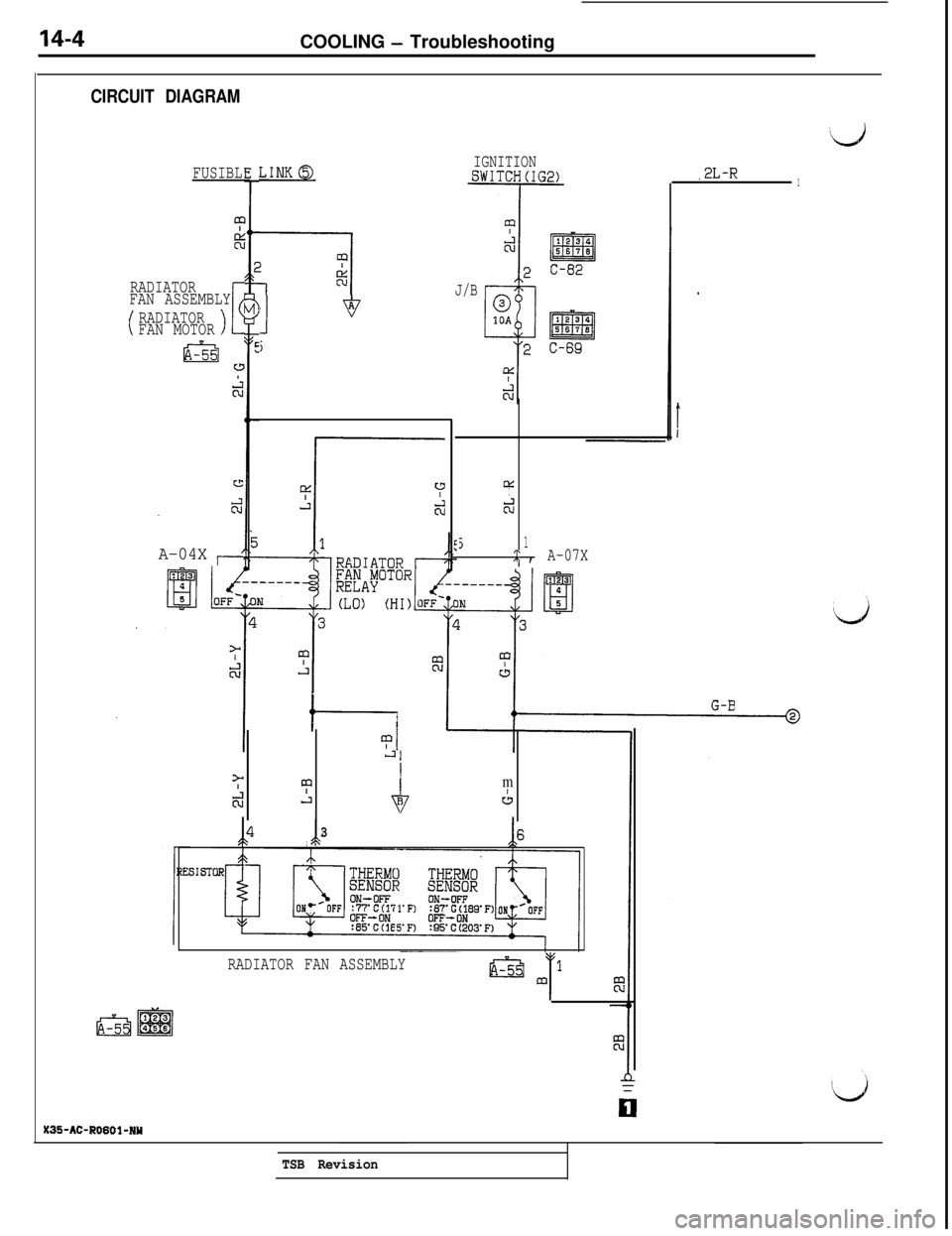
CIRCUIT DIAGRAM
FUSIBL
RADIATOR
FAN ASSEMBLY
(RADIATOR
,
FAN MOTOR>r{
!&w
F
A-04X ,---LINK0
J
0A
j
IGNITION
J/B
lxI
ti
51.: ,A-07X
J1
>II
ticpLi6
m
R&
b3
,2L-R1
RADIATOR FAN ASSEMBLYL!a ml
T
X35-AC-NWOl-NY
TSB Revision
Page 307 of 1146
COOLING - Water Pump, Water Pipe and Water Hose
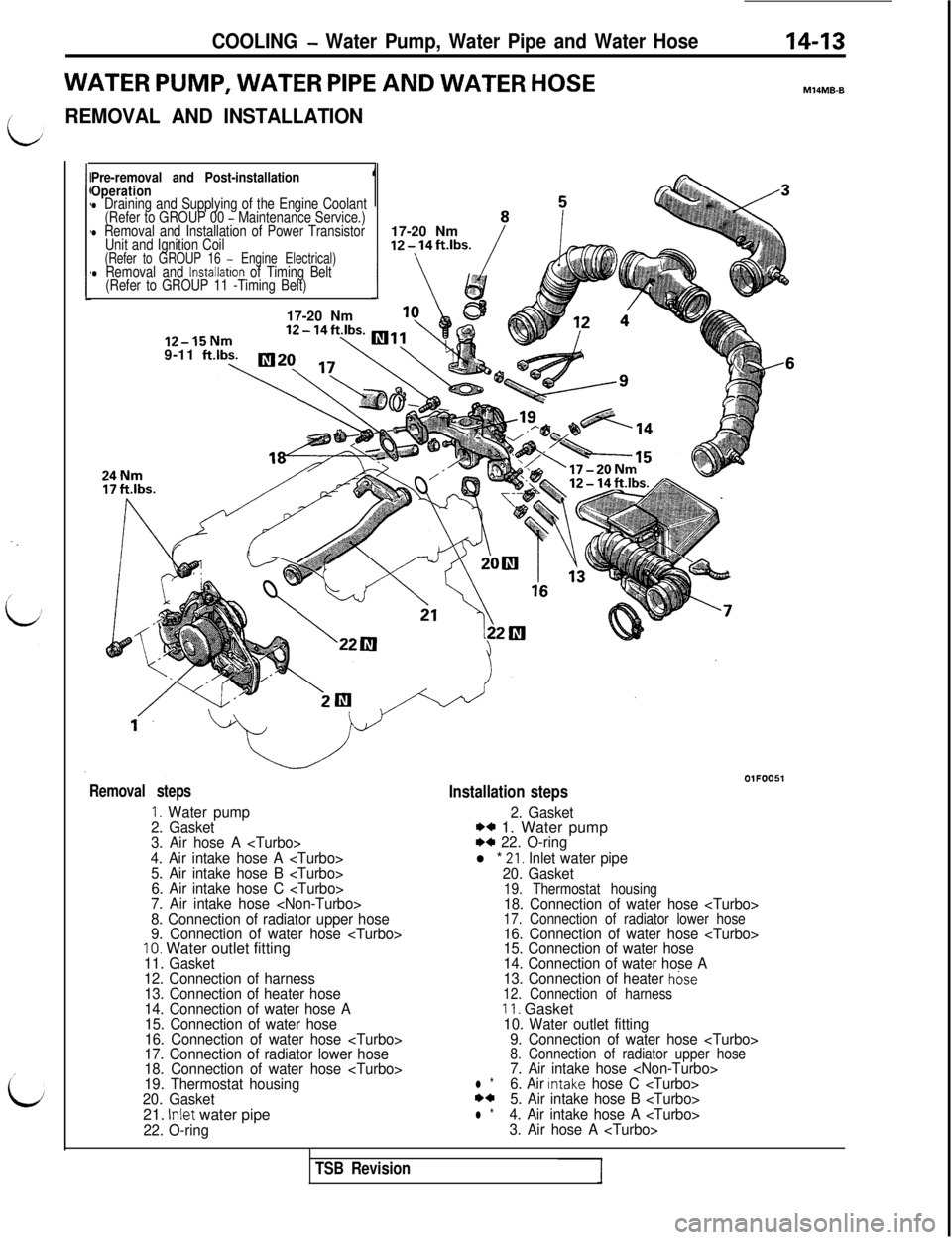
WATER PUMP, WATER PIPE AND WATER HOSE
14-13
M14MB-B
/REMOVAL AND INSTALLATION
Pre-removal and Post-installation
Operation
l Draining and Supplying of the Engine Coolant
(Refer to GROUP 00 - Maintenance Service.)l Removal and Installation of Power Transistor
Unit and Ignition Coil
(Refer to GROUP 16 - Engine Electrical)l Removal and lnstallatlon of Timing Belt
(Refer to GROUP 11 -Timing Belt)17-20 Nm17-20 Nm
12-14ft.lbs.
1
12-15Nm9-11 ft.1bs.q
Removal steps
1. Water pump
2. Gasket
3. Air hose A
4. Air intake hose A
5. Air intake hose B
6. Air intake hose C
7. Air intake hose
8. Connection of radiator upper hose
9. Connection of water hose
IO. Water outlet fitting11. Gasket
12. Connection of harness
13. Connection of heater hose
14. Connection of water hose A
15. Connection of water hose
16. Connection of water hose
17. Connection of radiator lower hose
18. Connection of water hose
19. Thermostat housing
20. Gasket21.
Her water pipe22. O-ringOlFOO51
Installation steps
2. Gasket** 1. Water pumpI)+ 22. O-ring
l * 21. Inlet water pipe
20. Gasket
19. Thermostat housing18. Connection of water hose
15. Connection of water hose
14. Connection of water hose A
13. Connection of heater h&e
12. Connection of harness11. Gasket10. Water outlet fitting
9. Connection of water hose
8. Connection of radiator upper hose7. Air intake hose
3. Air hose A
TSB Revision
Page 317 of 1146
INTAKE AND EXHAUST - Service Adiustment Procedures15-7
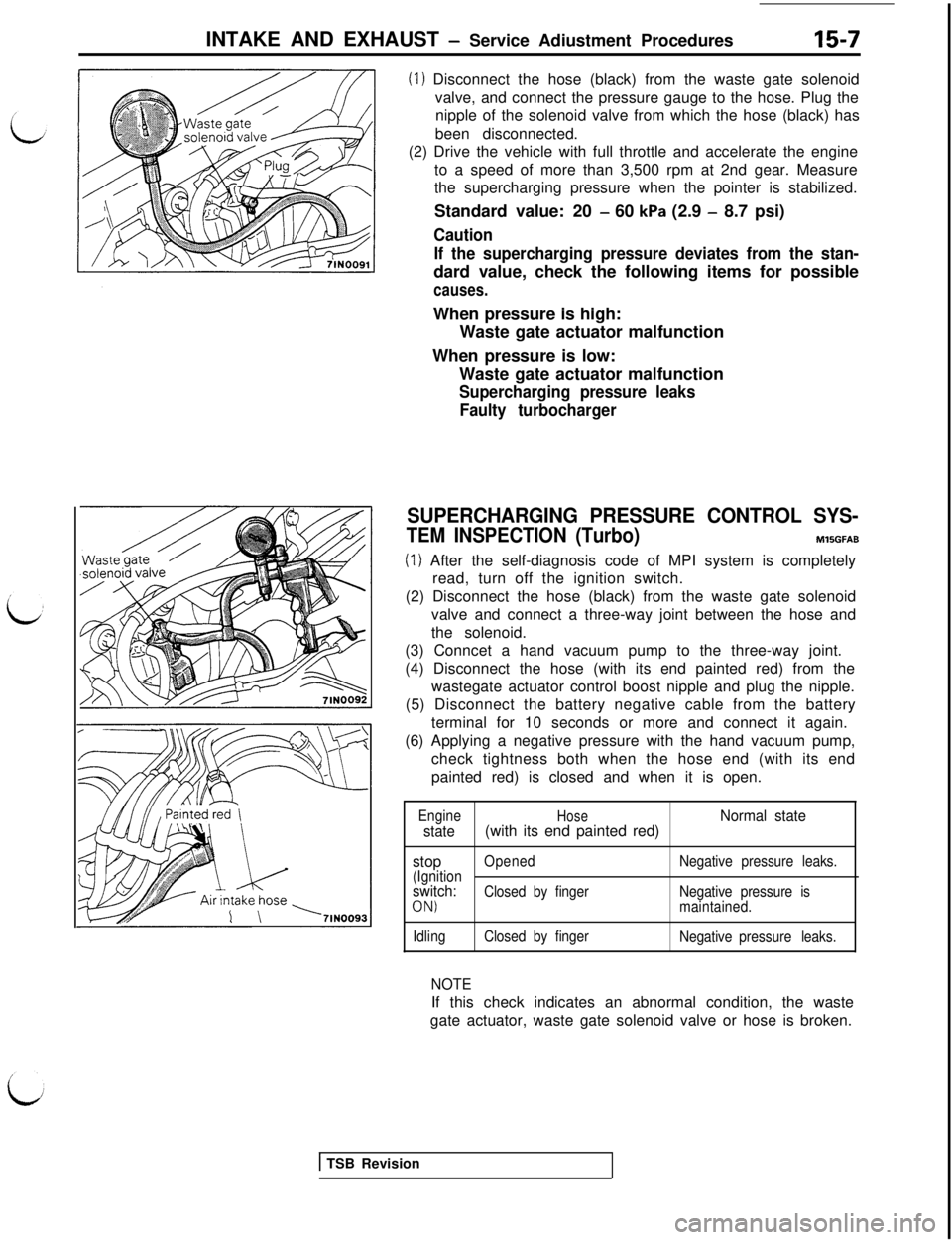
(1) Disconnect the hose (black) from the waste gate solenoid
valve, and connect the pressure gauge to the hose. Plug the
nipple of the solenoid valve from which the hose (black) has
been disconnected.
(2) Drive the vehicle with full throttle and accelerate the engine
to a speed of more than 3,500 rpm at 2nd gear. Measure
the supercharging pressure when the pointer is stabilized.
Standard value: 20
- 60 kPa (2.9 - 8.7 psi)
Caution
If the supercharging pressure deviates from the stan-dard value, check the following items for possible
causes.When pressure is high:
Waste gate actuator malfunction
When pressure is low:
Waste gate actuator malfunction
Supercharging pressure leaks
Faulty turbocharger
SUPERCHARGING PRESSURE CONTROL SYS-
TEM INSPECTION (Turbo)MlSGFAB
(1) After the self-diagnosis code of MPI system is completely
read, turn off the ignition switch.
(2) Disconnect the hose (black) from the waste gate solenoid
valve and connect a three-way joint between the hose and
the solenoid.
(3) Conncet a hand vacuum pump to the three-way joint.
(4) Disconnect the hose (with its end painted red) from the
wastegate actuator control boost nipple and plug the nipple.
(5) Disconnect the battery negative cable from the battery
terminal for 10 seconds or more and connect it again.
(6) Applying a negative pressure with the hand vacuum pump,
check tightness both when the hose end (with its end
painted red) is closed and when it is open.
EngineHoseNormal state
state(with its end painted red)
stop
OpenedNegative pressure leaks.
(Ignition
switch:Closed by fingerNegative pressure is
ON)maintained.
IdlingClosed by finger
Negative pressure leaks.
NOTEIf this check indicates an abnormal condition, the waste
gate actuator, waste gate solenoid valve or hose is broken.
1 TSB Revision
Page 358 of 1146
17-14 EMISSION CONTROL -Exhaust Gas Recirculation (EGR) System / Catalytic Converter
6EM01871
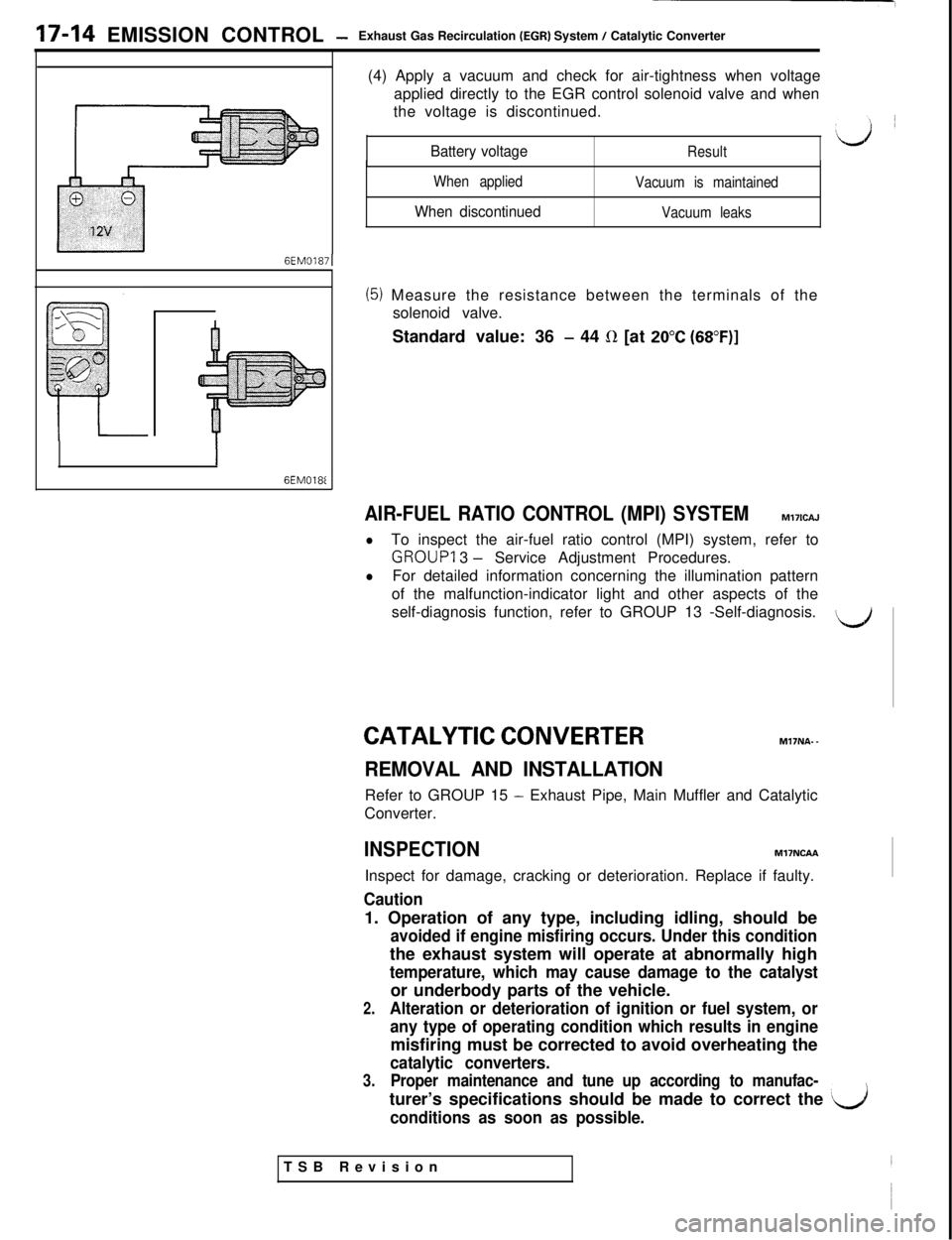
6EM0181(4) Apply a vacuum and check for air-tightness when voltage
applied directly to the EGR control solenoid valve and when
the voltage is discontinued.
Battery voltageResult
When applied
When discontinued
Vacuum is maintained
Vacuum leaks
(5) Measure the resistance between the terminals of the
solenoid valve.
Standard value: 36
- 44 R [at 20°C (68”F)]
AIR-FUEL RATIO CONTROL (MPI) SYSTEMM17ICAJ
lTo inspect the air-fuel ratio control (MPI) system, refer to
GROUP1 3 - Service Adjustment Procedures.
lFor detailed information concerning the illumination pattern
of the malfunction-indicator light and other aspects of the
self-diagnosis function, refer to GROUP 13 -Self-diagnosis.
\.J
CATALYTIC CONVERTERMl7N& -
REMOVAL AND INSTALLATIONRefer to GROUP 15
- Exhaust Pipe, Main Muffler and Catalytic
Converter.
INSPECTIONMl7NCAA
Inspect for damage, cracking or deterioration. Replace if faulty.
Caution1. Operation of any type, including idling, should be
avoided if engine misfiring occurs. Under this conditionthe exhaust system will operate at abnormally high
temperature, which may cause damage to the catalystor underbody parts of the vehicle.
2.Alteration or deterioration of ignition or fuel system, or
any type of operating condition which results in enginemisfiring must be corrected to avoid overheating the
catalytic converters.
3.Proper maintenance and tune up according to manufac-turer’s specifications should be made to correct the
‘bi
conditions as soon as possible.TSB Revision
Page 474 of 1146
![MITSUBISHI 3000GT 1991 Manual Online 23-22AUTOMATIC TRANSAXLE - Troubleshooting
0”
TM362
DIAGNOSIS AND TEST
FLUID LEVEL AND CONDITION
1.Drive until the fluid temperature reaches the usual tempera-
ture
[70 - 80°C (160 - 18O”F)].2.](/img/19/57085/w960_57085-473.png "MITSUBISHI 3000GT 1991 Manual Online 23-22AUTOMATIC TRANSAXLE - Troubleshooting
0”
TM362
DIAGNOSIS AND TEST
FLUID LEVEL AND CONDITION
1.Drive until the fluid temperature reaches the usual tempera-
ture
[70 - 80°C (160 - 18O”F)].2.")
23-22AUTOMATIC TRANSAXLE - Troubleshooting
0”
TM362
DIAGNOSIS AND TEST
FLUID LEVEL AND CONDITION
1.Drive until the fluid temperature reaches the usual tempera-
ture
[70 - 80°C (160 - 18O”F)].2. Place vehicle on level floor.
3. Move selector lever sequentially to every position to fill
torque converter and hydraulic circuit with fluid, then place
lever in “N” Neutral position. This operation is necessary to
be sure that fluid level check is accurate.
4. Before removing dipstick, wipe all dirt from area around
dipstick. Then take out the dipstick and check the condition
of the fluid.
The transaxle should be overhauled under the following
conditions.
l If there is a “burning” odor.
l If the fluid color has become noticeably blacker.
lIf there is a noticeably great amount of metal particles in
the fluid.
5.Check to see if fluid level is in “HOT” range on dipstick. If
fluid level is low, add automatic transaxle fluid until level
reaches “HOT” range.
Low fluid level can cause a variety of conditions because it
allows pump to take in air along with fluid. Air trapped in
hydraulic circuit forms bubbles which make fluid spongy.
Therefore, pressures will be erratic.
Improper filling can also raise fluid level too high. When
transaxle has too much fluid, gears churn up foam and
cause same conditions which occur with low fluid level,
resulting in accelerated deterioration of automatic transaxle
fluid.
dIn either case, air bubbles can cause overheating, fluid
oxidation, which can interfere with normal valve, clutch, and
servo operation. Foaming can also result in fluid escaping
from transaxle vent where it may be mistaken for a leak.
6. Be sure to examine fluid on dipstick closely.
,CONTROL CABLEWhether control cable is properly adjusted can be confirmed by
checking whether inhibitor switch is performing well.
1. Apply parking brakes and service brakes securely.
2. Place selector lever to “R” range.
3. Set ignition key to “ST” position.
4. Slowly move the selector lever upward until it clicks as it
fits in notch of “P” range. If starter motor operates when
lever makes a click, “P” position is correct.
5.Then slowly move selector lever to “N” range by the same
procedure as in foregoing paragraph. If starter motor
operates when selector lever fits in
“N”, “N” position is
correct.
6. Also check to be sure the vehicle doesn’t begin to move
and the lever doesn’t stop between P-R-N-D.
7. The control cable is properly adjusted if, as described
above, the starter motor starts at both the “P” range and
the “N” range.
TSB Revision
Page 475 of 1146
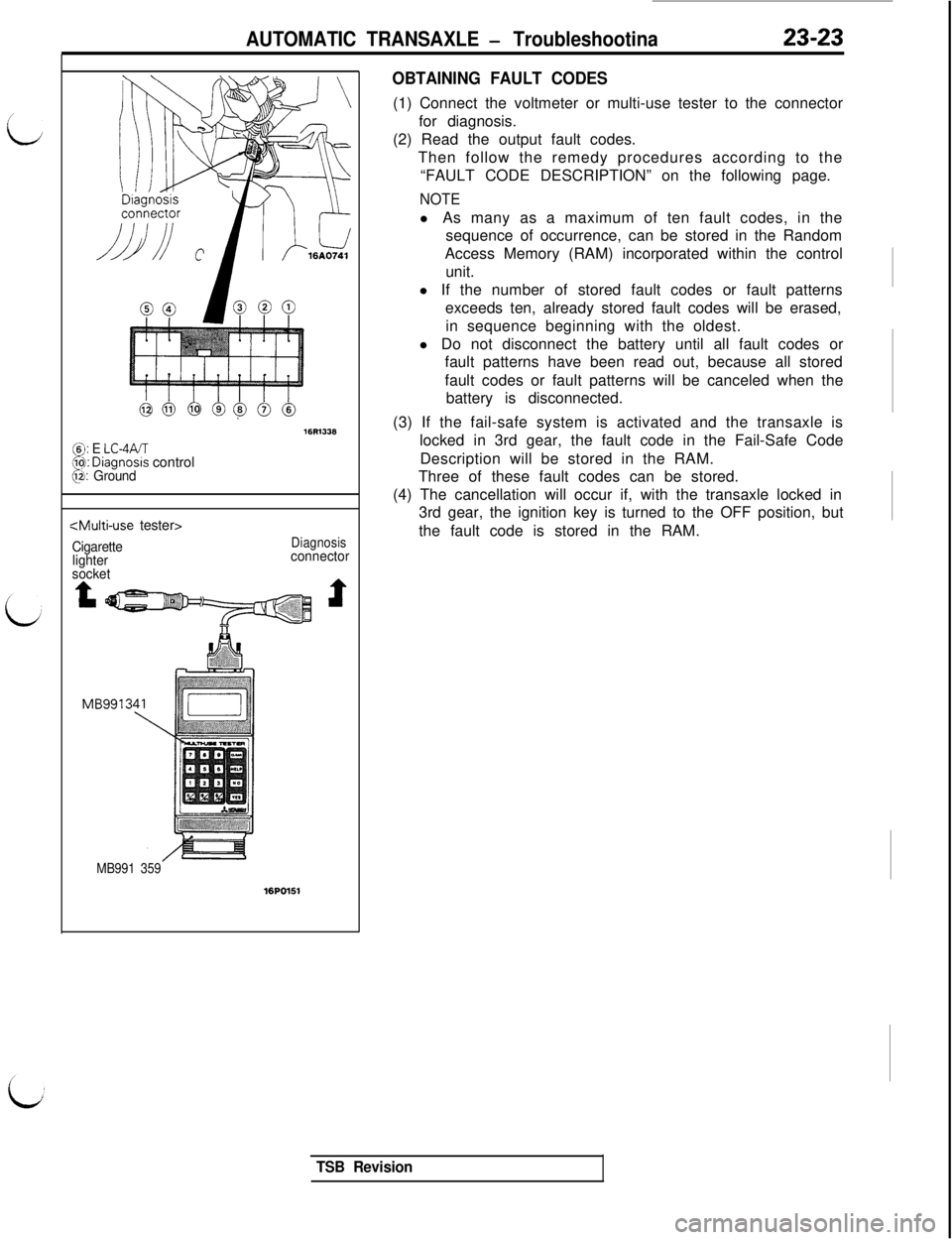
AUTOMATIC TRANSAXLE - Troubleshootina23-23
p: E LC-4A/T~9: Dlagnosls control@I: Ground
:Multi-use tester>
Cigarette
lighter
socketDiagnosisconnector
MB991 359
16POl51
OBTAINING FAULT CODES(1) Connect the voltmeter or multi-use tester to the connector
for diagnosis.
(2) Read the output fault codes.
Then follow the remedy procedures according to the
“FAULT CODE DESCRIPTION” on the following page.
NOTEl As many as a maximum of ten fault codes, in the
sequence of occurrence, can be stored in the Random
Access Memory (RAM) incorporated within the control
unit.
l If the number of stored fault codes or fault patterns
exceeds ten, already stored fault codes will be erased,
in sequence beginning with the oldest.
l Do not disconnect the battery until all fault codes or
fault patterns have been read out, because all stored
fault codes or fault patterns will be canceled when the
battery is disconnected.
(3) If the fail-safe system is activated and the transaxle is
locked in 3rd gear, the fault code in the Fail-Safe Code
Description will be stored in the RAM.
Three of these fault codes can be stored.
(4) The cancellation will occur if, with the transaxle locked in
3rd gear, the ignition key is turned to the OFF position, but
the fault code is stored in the RAM.
TSB Revision
Page 476 of 1146
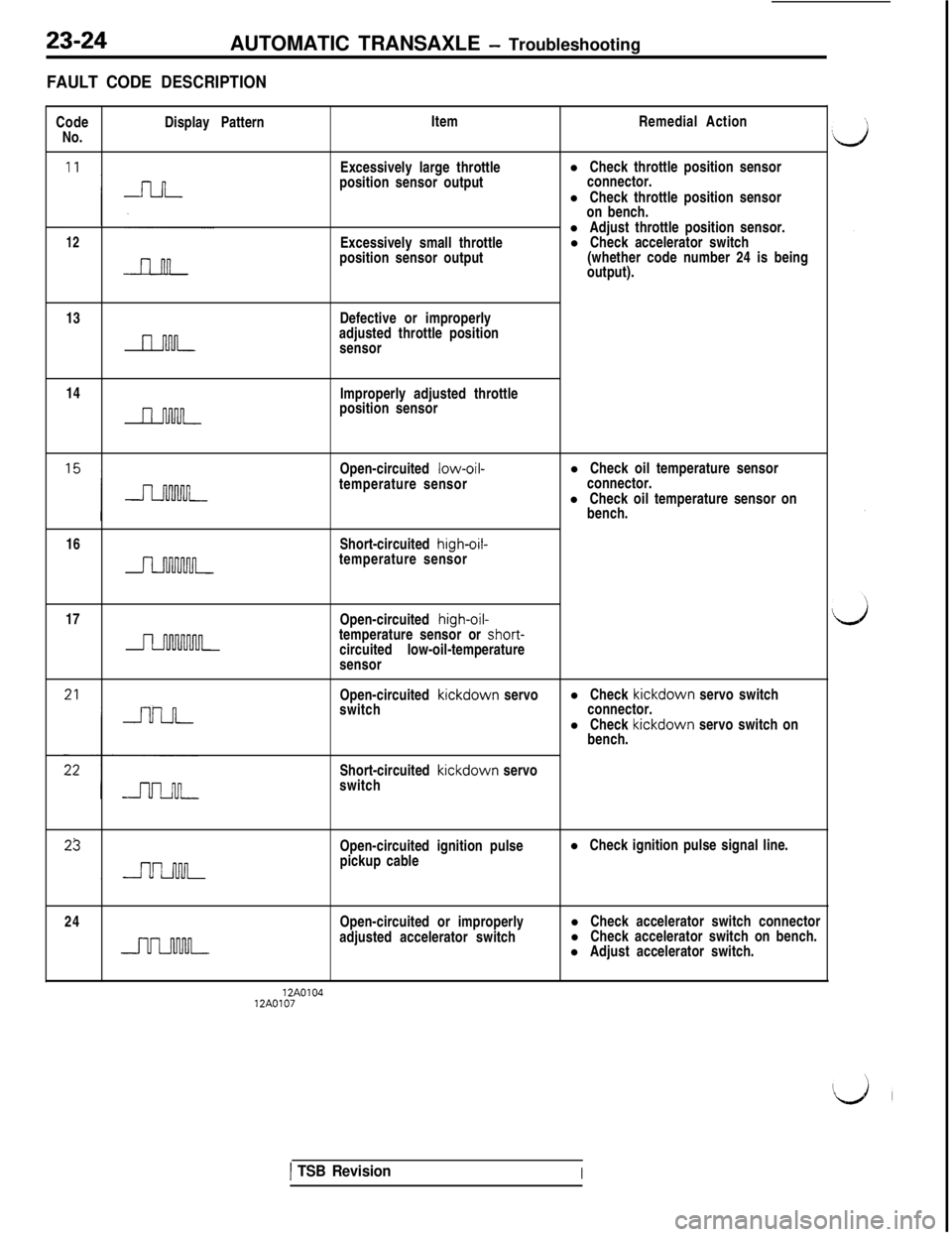
23-24AUTOMATIC TRANSAXLE - Troubleshooting
FAULT CODEDESCRIPTIONCode
No.Display PatternItemRemedial Action
Excessively large throttle
position sensor outputl Check throttle position sensor
connector.
l Check throttle position sensor
on bench.
12Excessively small throttle
position sensor outputl Adjust throttle position sensor.
l Check accelerator switch
(whether code number 24 is being
output).
13Defective or improperly
adjusted throttle position
sensor
14
Improperly adjusted throttle
position sensor
Open-circuited low-oil-
temperature sensorl Check oil temperature sensor
connector.
l Check oil temperature sensor on
bench.
16Short-circuited high-oil-
I-lMnnM-.temperature sensor
17
Open-circuited high-oil-
rlnnnruuvltemperature sensor or short-
circuited low-oil-temperature
sensor
Open-circuited kickdown servo
switch
Short-circuited kickdown servo
switchl Check kickdown servo switch
connector.
l Check kickdown servo switch on
bench.
Open-circuited ignition pulse
pickup cablel Check ignition pulse signal line.
24Open-circuited or improperly
adjusted accelerator switchl Check accelerator switch connector
l Check accelerator switch on bench.
l Adjust accelerator switch.
12A010412A0107
1 TSB RevisionI
Page 481 of 1146
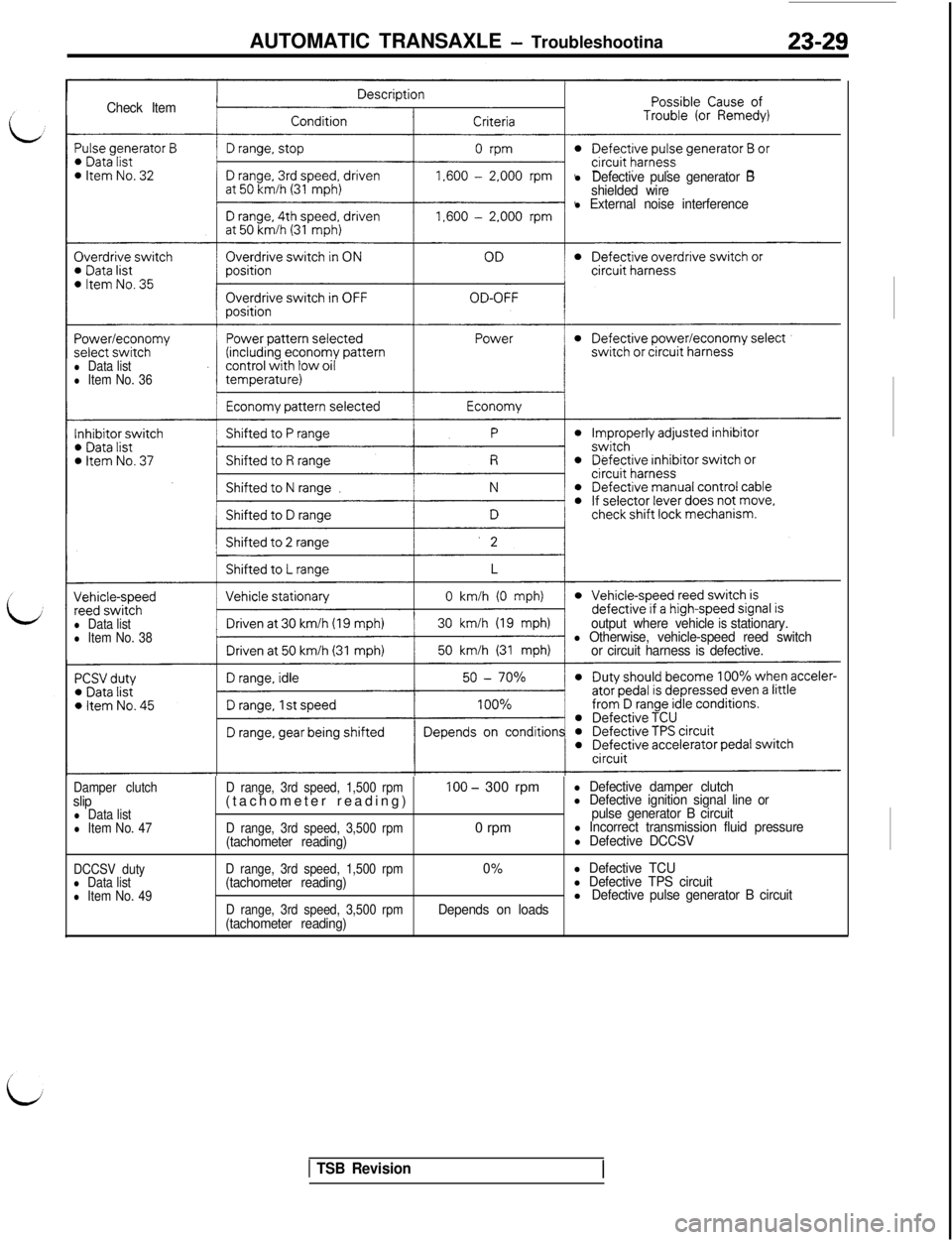
AUTOMATIC TRANSAXLE - Troubleshootina23-29
Check Iteml
Defective pulse generator B
shielded wire
l External noise interference
l Data listl Item No. 36
l Data listl Item No. 38output where vehicleisstationary.l Otherwise, vehicle-speed reed switch
or circuit harness is defective.
Damper clutchslipl Data listl Item No. 47
DCCSV duty
l Data listl Item No. 49D range, 3rd speed, 1,500 rpm(tachometer reading)
D range, 3rd speed, 3,500 rpm(tachometer reading)
D range, 3rd speed, 1,500 rpm(tachometer reading)
D range, 3rd speed, 3,500 rpm(tachometer reading)
100 - 300 rpm
0 rpm
0%
Depends on loads
l Defective damper clutchl Defective ignition signal line or
pulse generator B circuit
l Incorrect transmission fluid pressurel Defective DCCSV
l Defective TCUl Defective TPS circuitlDefective pulse generator B circuit
1 TSB Revision
Page 482 of 1146
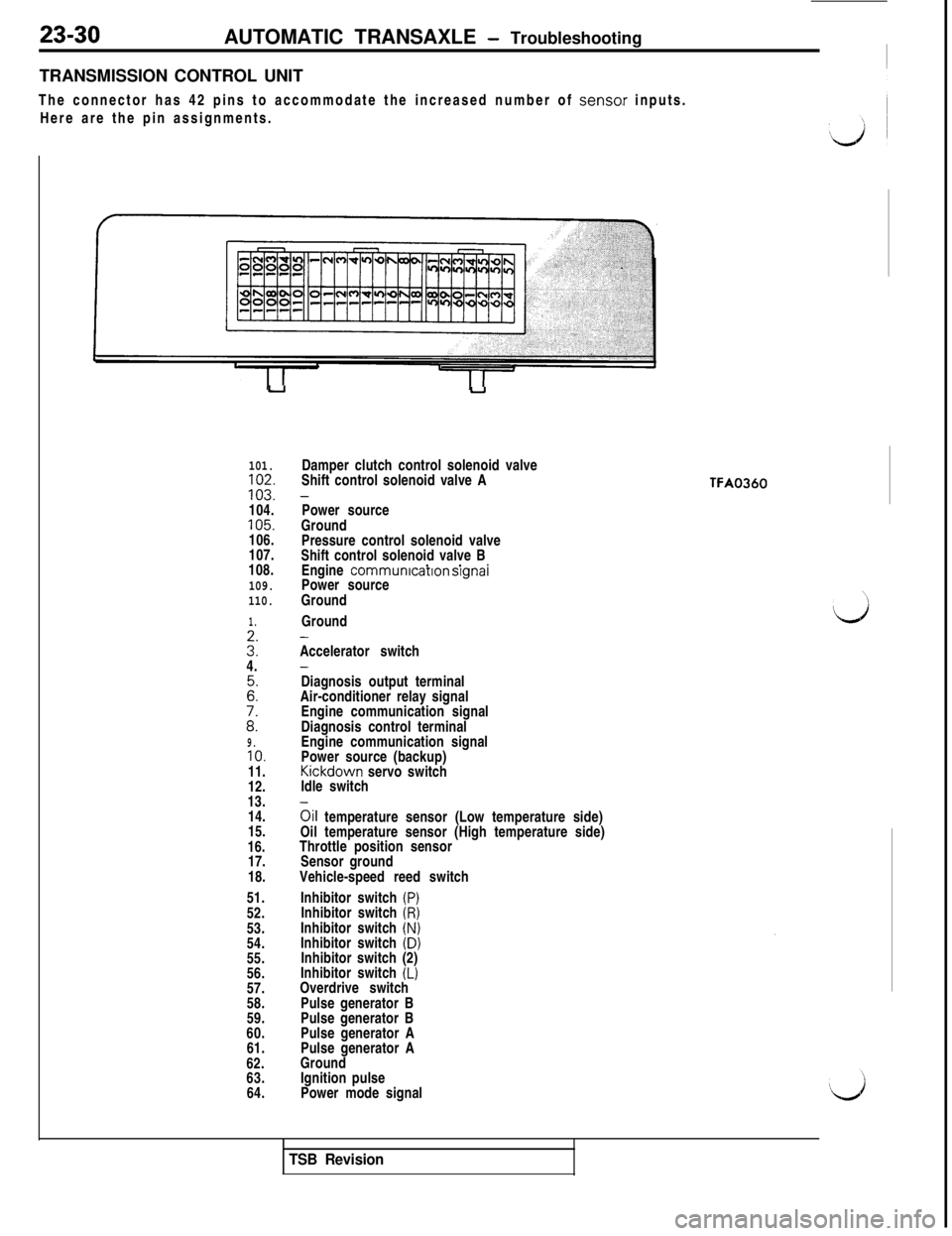
23-30AUTOMATIC TRANSAXLE - Troubleshooting
TRANSMISSION CONTROL UNIT
The connector has 42 pins to accommodate the increased number of senso.r inputs.
Here are the pin assignments.
uu
101.102.103.
104.105.
106.
107.
108.
109.
110.
1.
3':4.
Z:
i:9.10.11.
12.
13.
14.
15.
16.
17.
18.
51.
52.
53.
54.
55.
56.
57.
58.
59.
60.
61.
62.
63.
64.Damper clutch control solenoid valve
Shift control solenoid valve A
-Power source
Ground
Pressure control solenoid valve
Shift control solenoid valve B
. .
*Engine communrcatron srgnaiPower source
Ground
Ground
-Accelerator switch
-Diagnosis output terminal
Air-conditioner relay signal
Engine communication signal
Diagnosis control terminal
Engine communication signal
Power source (backup)Kickdown servo switch
Idle switch
oil temperature sensor (Low temperature side)
Oil temperature sensor (High temperature side)
Throttle position sensor
Sensor ground
Vehicle-speed reed switch
Inhibitor switch
(P)Inhibitor switch (R)Inhibitor switch (N)Inhibitor switch (D)
Inhibitor switch (2)
Inhibitor switch
(L)Overdrive switch
Pulse generator B
Pulse generator B
Pulse generator A
Pulse generator A
Ground
Ignition pulse
Power mode signal
TFA0360
TSB Revision
Page 495 of 1146
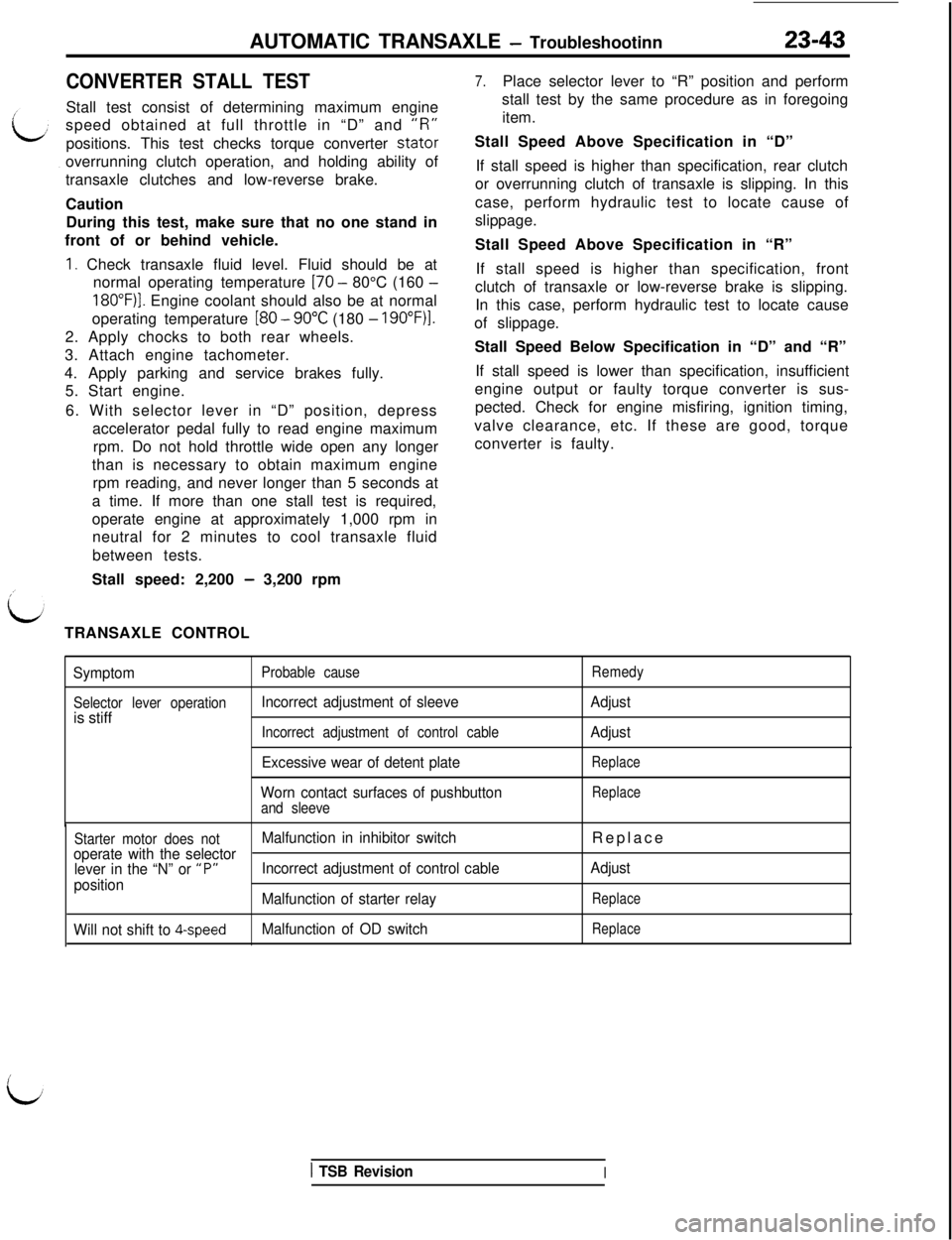
AUTOMATIC TRANSAXLE - Troubleshootinn23-43
CONVERTER STALL TESTStall test consist of determining maximum engine
speed obtained at full throttle in “D” and
“I?”positions. This test checks torque converter
statoroverrunning clutch operation, and holding ability of
transaxle clutches and low-reverse brake.
Caution
During this test, make sure that no one stand in
front of or behind vehicle.
1. Check transaxle fluid level. Fluid should be at
normal operating temperature
[70 - 80°C (160 -
18O”F)I. Engine coolant should also be at normal
operating temperature
[80 - 90°C (180 - 19O”F)l.2. Apply chocks to both rear wheels.
3. Attach engine tachometer.
4. Apply parking and service brakes fully.
5. Start engine.
6. With selector lever in “D” position, depress
accelerator pedal fully to read engine maximum
rpm. Do not hold throttle wide open any longer
than is necessary to obtain maximum engine
rpm reading, and never longer than 5 seconds at
a time. If more than one stall test is required,
operate engine at approximately 1,000 rpm in
neutral for 2 minutes to cool transaxle fluid
between tests.
Stall speed: 2,200
- 3,200 rpm
7.Place selector lever to “R” position and perform
stall test by the same procedure as in foregoing
item.
Stall Speed Above Specification in “D”
If stall speed is higher than specification, rear clutch
or overrunning clutch of transaxle is slipping. In this
case, perform hydraulic test to locate cause of
slippage.
Stall Speed Above Specification in “R”
If stall speed is higher than specification, front
clutch of transaxle or low-reverse brake is slipping.
In this case, perform hydraulic test to locate cause
of slippage.
Stall Speed Below Specification in “D” and “R”
If stall speed is lower than specification, insufficient
engine output or faulty torque converter is sus-
pected. Check for engine misfiring, ignition timing,
valve clearance, etc. If these are good, torque
converter is faulty.
TRANSAXLE CONTROL
Symptom
Selector lever operationis stiff
Probable cause
Incorrect adjustment of sleeve
Remedy
Adjust
Incorrect adjustment of control cable
Excessive wear of detent plate
Worn contact surfaces of pushbutton
and sleeve
Adjust
Replace
Replace
Starter motor does notMalfunction in inhibitor switchReplace
operate with the selector
lever in the “N” or “P”Incorrect adjustment of control cableAdjust
position
Will not shift to
4-speed
Malfunction of starter relay
Malfunction of OD switchReplace
Replace
1 TSB RevisionI