ignition MITSUBISHI 3000GT 1991 Owners Manual
[x] Cancel search | Manufacturer: MITSUBISHI, Model Year: 1991, Model line: 3000GT, Model: MITSUBISHI 3000GT 1991Pages: 1146, PDF Size: 76.68 MB
Page 496 of 1146
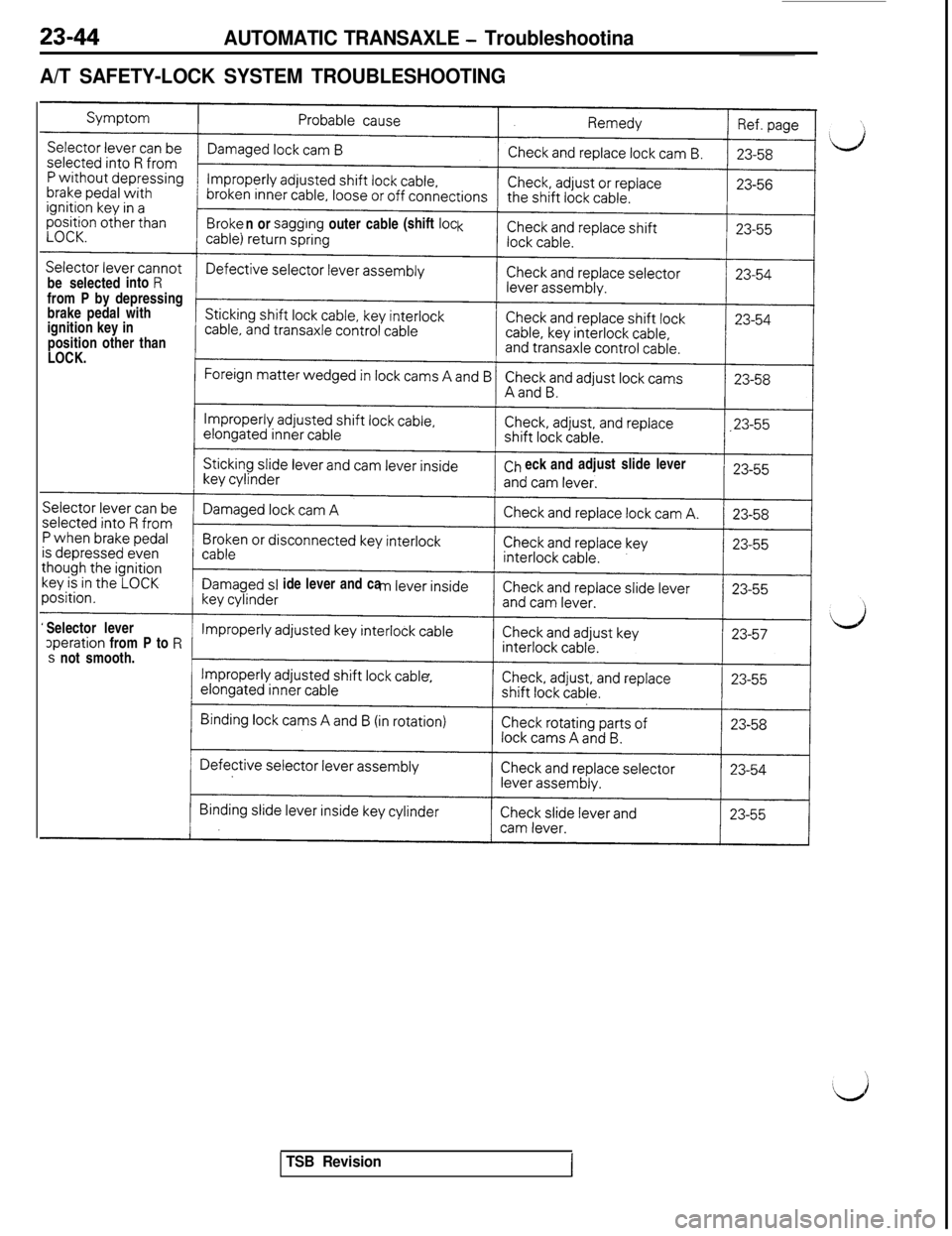
23-44AUTOMATIC TRANSAXLE - Troubleshootina
A/T SAFETY-LOCK SYSTEM TROUBLESHOOTINGbe selectedinto
Rfrom P by depressing
brake pedal with
ignition key in
position other than
LOCK.n or sagging outer cable(shift
loteck andadjust slide lever
ide lever and ca
Selector lever
Iperation from P to Rs not smooth.
TSB Revision
Page 497 of 1146
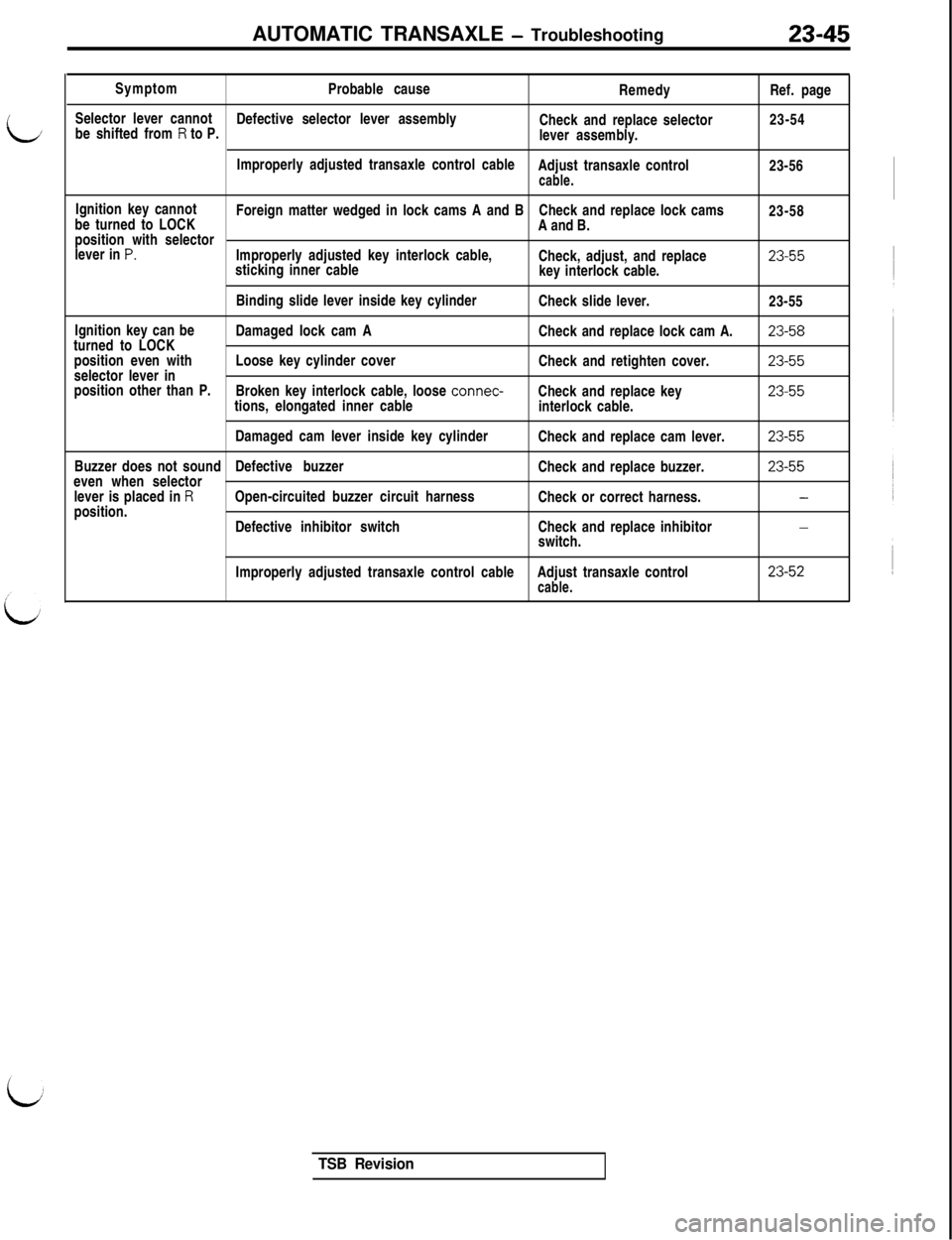
AUTOMATIC TRANSAXLE - Troubleshooting23-45Symptom
Probable cause
RemedyRef. page
Selector lever cannot
be shifted from
R to P.Defective selector lever assembly
Check and replace selector23-54
lever assembly.
Improperly adjusted transaxle control cable
Adjust transaxle control
23-56
cable.Ignition key cannot
Foreign matter wedged in lock cams A and B
23-58
be turned to LOCKCheck and replace lock cams
A and B.
position with selector
lever in
P.Improperly adjusted key interlock cable,
sticking inner cableCheck, adjust, and replace213-55key interlock cable.
Binding slide lever inside key cylinder
Check slide lever.
23-55
Ignition key can be
Damaged lock cam A
Check and replace lock cam A.
2:3-58turned to LOCK
position even withLoose key cylinder cover
Check and retighten cover.
2:3-55selector lever in
position other than P.
Broken key interlock cable, loose connec-
Check and replace key
2355tions, elongated inner cable
interlock cable.
Damaged cam lever inside key cylinder
Check and replace cam lever.
2:3-55Buzzer does not soundDefective buzzer
Check and replace buzzer.
2:3-55even when selector
lever is placed in
ROpen-circuited buzzer circuit harness
Check or correct harness.-position.
Defective inhibitor switchCheck and replace inhibitor
-switch.
Improperly adjusted transaxle control cableAdjust transaxle control
2:3-52
cable.
TSB Revision
Page 502 of 1146
23-50AUTOMATIC TRANSAXLE - service AdiustmentProcedures
09FO117
m09FOO19
L Pushbuttonv09FOO61
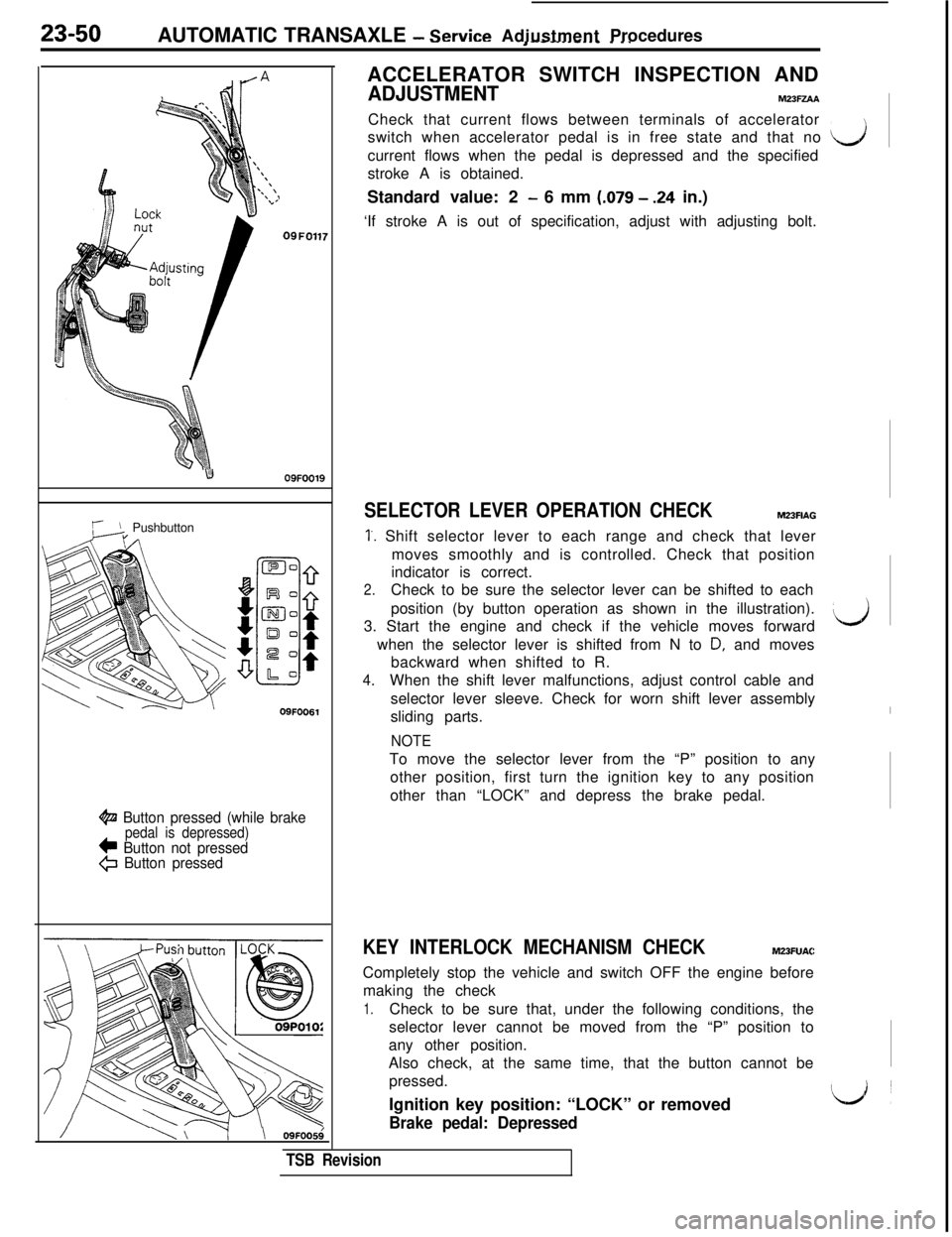
@ Button pressed (while brakepedal is depressed)c Button not pressed@ Button pressed
/\ \\ OSFODdACCELERATOR SWITCH INSPECTION AND
ADJUSTMENTM23FZAACheck that current flows between terminals of accelerator
switch when accelerator pedal is in free state and that no
dcurrent flows when the pedal is depressed and the specified
stroke A is obtained.
Standard value: 2
- 6 mm (.079 - .24 in.)
‘If stroke A is out of specification, adjust with adjusting bolt.
SELECTOR LEVER OPERATION CHECKM23FIAG
1.. Shift selector lever to each range and check that lever
moves smoothly and is controlled. Check that position
indicator is correct.
2.Check to be sure the selector lever can be shifted to each
position (by button operation as shown in the illustration).
3. Start the engine and check if the vehicle moves forward
dwhen the selector lever is shifted from N to
D, and moves
backward when shifted to R.
4.When the shift lever malfunctions, adjust control cable and
selector lever sleeve. Check for worn shift lever assembly
sliding parts.
I
NOTETo move the selector lever from the “P” position to any
other position, first turn the ignition key to any position
other than “LOCK” and depress the brake pedal.
KEY INTERLOCK MECHANISM CHECKM23FlJACCompletely stop the vehicle and switch OFF the engine before
making the check
1.Check to be sure that, under the following conditions, the
selector lever cannot be moved from the “P” position to
any other position.
Also check, at the same time, that the button cannot be
pressed.
Ignition key position: “LOCK” or removed
Brake pedal: Depressed
TSB Revision
Page 503 of 1146
AUTOMATIC TRANSAXLE - Service Adiustment Procedures23-51
D9N007SPush button
II
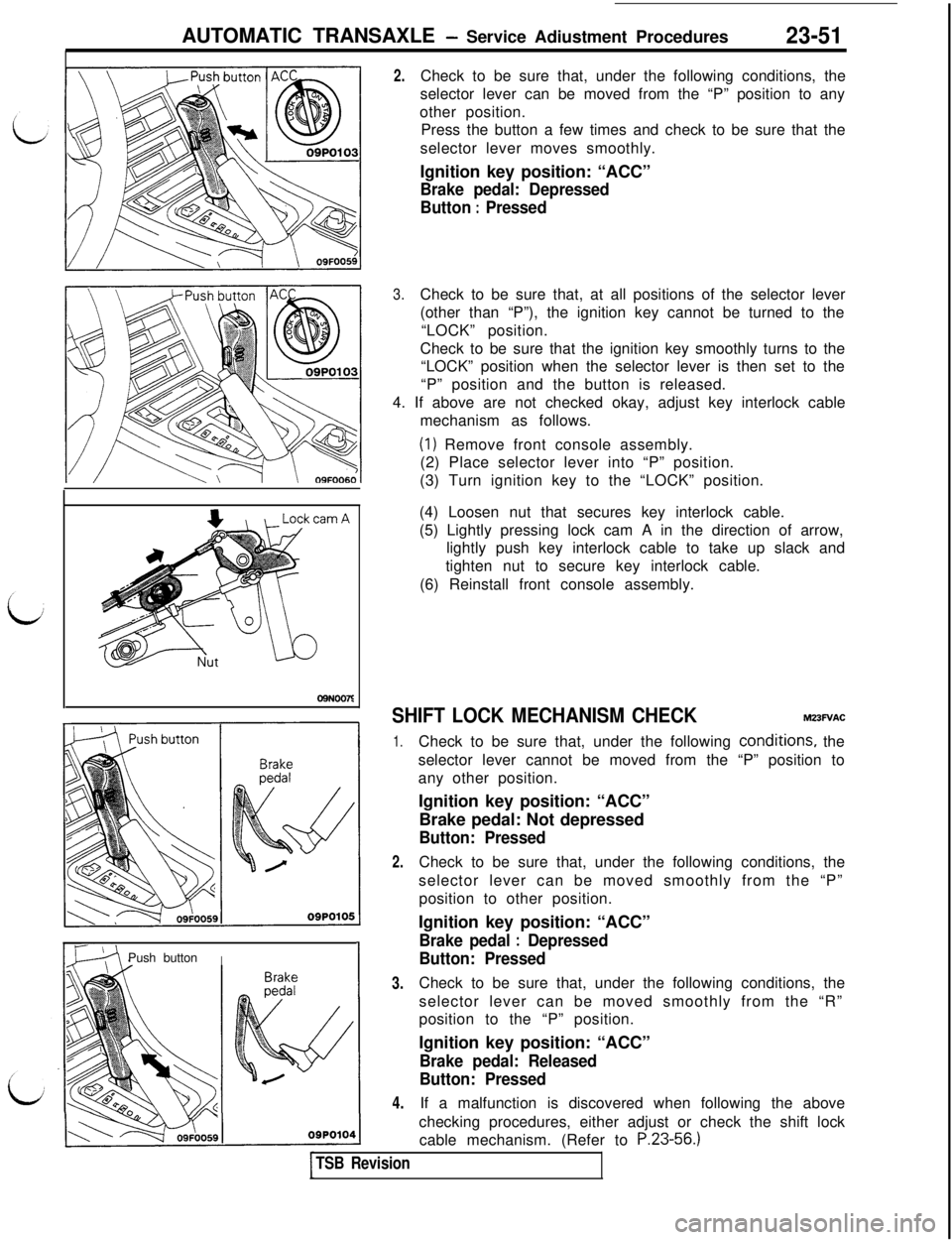
2.Check to be sure that, under the following conditions, the
selector lever can be moved from the “P” position to any
other position.
Press the button a few times and check to be sure that the
selector lever moves smoothly.
Ignition key position: “ACC”
Brake pedal: Depressed
Button
: Pressed
3.Check to be sure that, at all positions of the selector lever
(other than “P”), the ignition key cannot be turned to the
“LOCK” position.
Check to be sure that the ignition key smoothly turns to the
“LOCK” position when the selector lever is then set to the
“P” position and the button is released.
4. If above are not checked okay, adjust key interlock cable
mechanism as follows.
(1) Remove front console assembly.
(2) Place selector lever into “P” position.
(3) Turn ignition key to the “LOCK” position.
(4) Loosen nut that secures key interlock cable.
(5) Lightly pressing lock cam A in the direction of arrow,
lightly push key interlock cable to take up slack and
tighten nut to secure key interlock cable.
(6) Reinstall front console assembly.
SHIFT LOCK MECHANISM CHECKMZ3FVAC
1.
2.
3.
4.Check to be sure that, under the following
condi,tions, the
selector lever cannot be moved from the “P” position to
any other position.
Ignition key position: “ACC”
Brake pedal: Not depressed
Button: PressedCheck to be sure that, under the following conditions, the
selector lever can be moved smoothly from the “P”
position to other position.
Ignition key position: “ACC”
Brake pedal : Depressed
Button: PressedCheck to be sure that, under the following conditions, the
selector lever can be moved smoothly from the “R”
position to the “P” position.
Ignition key position: “ACC”
Brake pedal: Released
Button: PressedIf a malfunction is discovered when following the above
checking procedures, either adjust or check the shift lock
cable mechanism. (Refer to
P.23-56.)
TSB Revision
Page 508 of 1146
23-56AUTOMATIC TRANSAXLE - Transaxle ControlOQPOOQQ
09FOO5
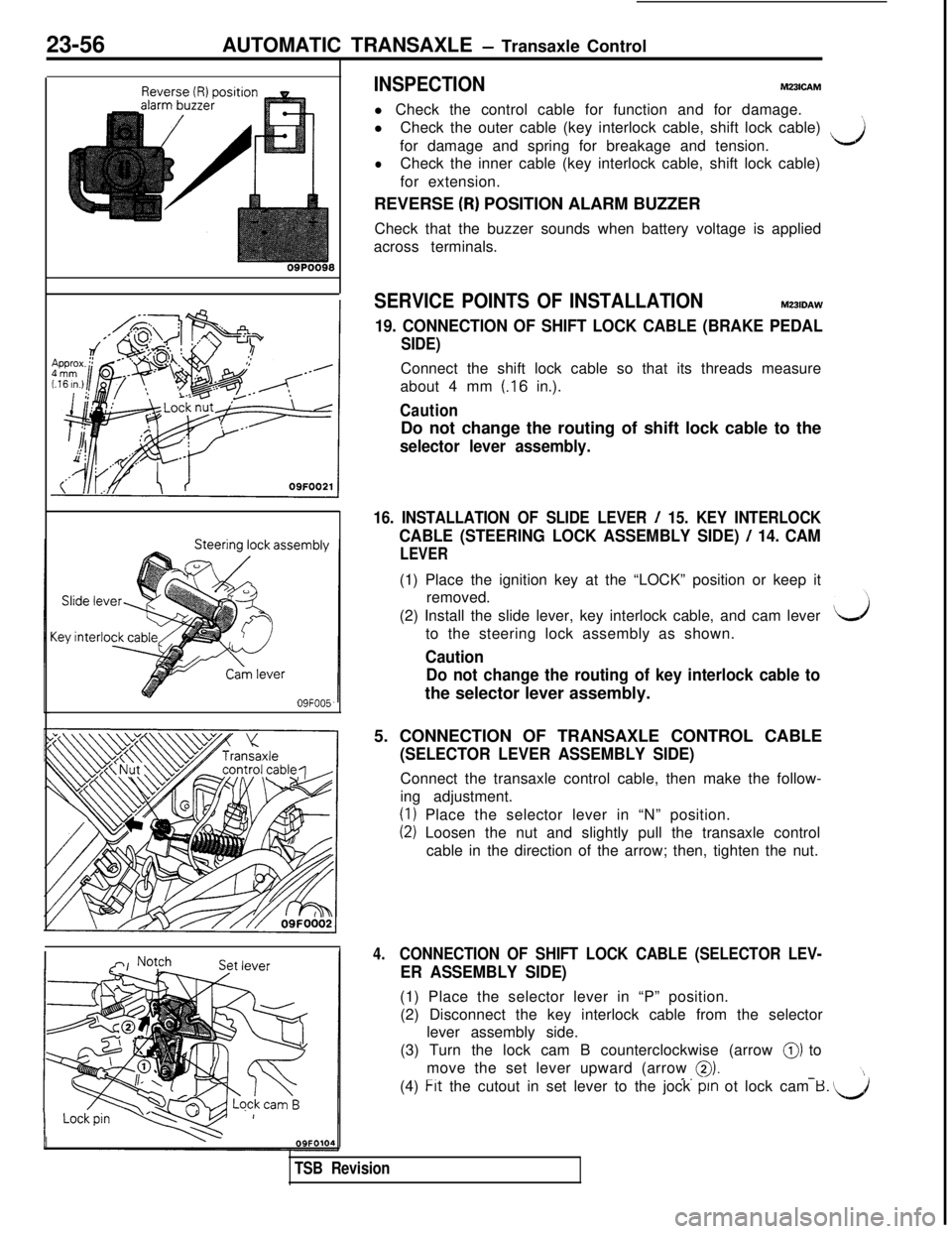
INSPECTIONM231CAMl Check the control cable for function and for damage.
lCheck the outer cable (key interlock cable, shift lock cable)
’for damage and spring for breakage and tension.~J
lCheck the inner cable (key interlock cable, shift lock cable)
for extension.
REVERSE
(R) POSITION ALARM BUZZER
Check that the buzzer sounds when battery voltage is applied
across terminals.
SERVICE POINTS OF INSTALLATIONM231DAW
19. CONNECTION OF SHIFT LOCK CABLE (BRAKE PEDAL
SIDE)Connect the shift lock cable so that its threads measure
about 4 mm
(.16 in.).
CautionDo not change the routing of shift lock cable to the
selector lever assembly.
16. INSTALLATION OF SLIDE LEVER / 15. KEY INTERLOCK
CABLE (STEERING LOCK ASSEMBLY SIDE) / 14. CAM
LEVER(1) Place the ignition key at the “LOCK” position or keep it
removed.
(2) Install the slide lever, key interlock cable, and cam lever
to the steering lock assembly as shown.
Caution
Do not change the routing of key interlock cable tothe selector lever assembly.
5. CONNECTION OF TRANSAXLE CONTROL CABLE
(SELECTOR LEVER ASSEMBLY SIDE)Connect the transaxle control cable, then make the follow-
ing adjustment.
(1) Place the selector lever in “N” position.
(2) Loosen the nut and slightly pull the transaxle control
cable in the direction of the arrow; then, tighten the nut.
4.CONNECTION OF SHIFT LOCK CABLE (SELECTOR LEV-
ER ASSEMBLY SIDE)(1) Place the selector lever in “P” position.
(2) Disconnect the key interlock cable from the selector
lever assembly side.
(3) Turn the lock cam B counterclockwise (arrow
0) to
move the set lever upward (arrow
0)._.-(4) Frt the cutout in set lever to the jock pm ot lock cam B. u
TSB Revision
Page 670 of 1146
33B-8ELECTRONIC CONTROL SUSPENSION (ECS) - Troubleshooting
III
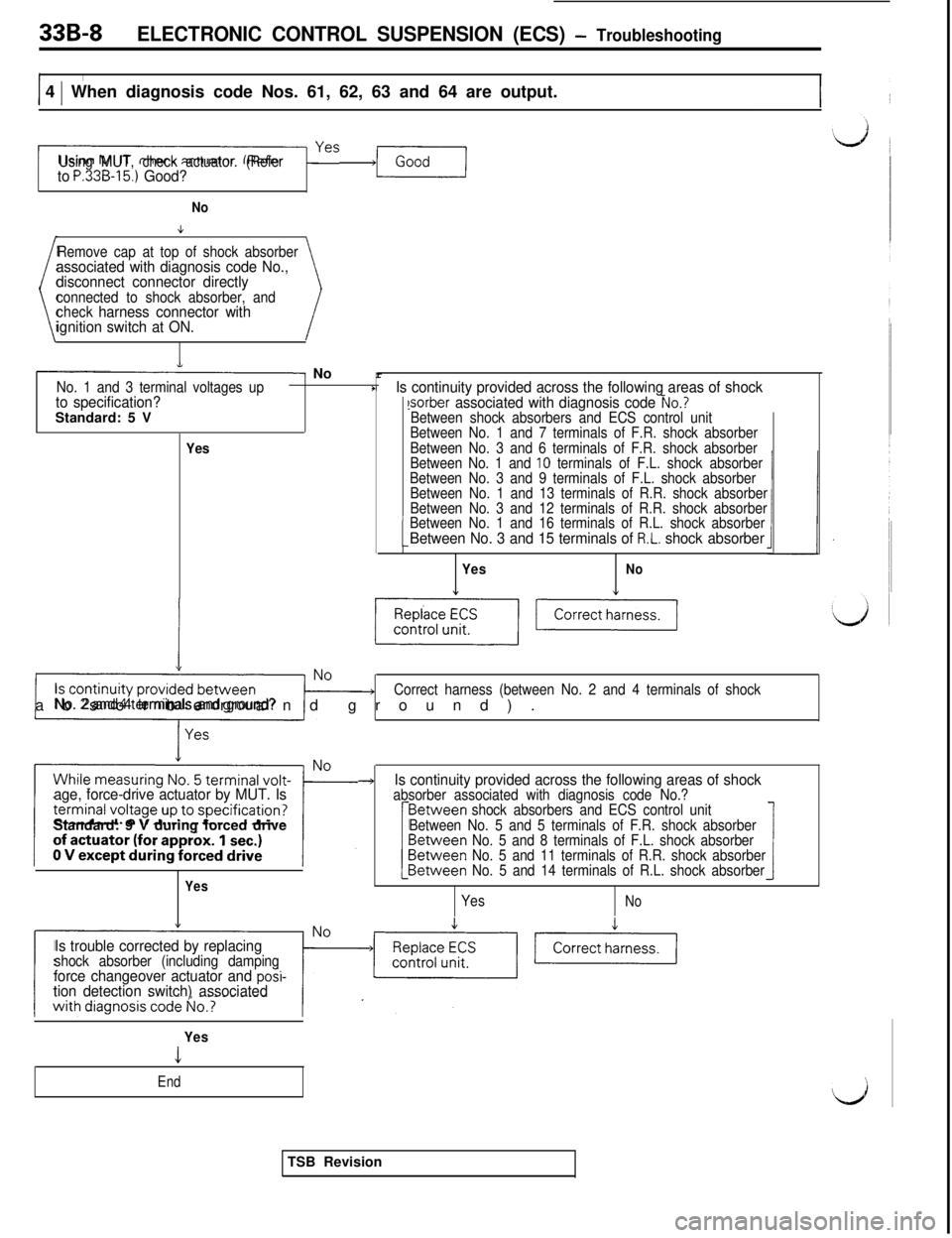
1 4 1 When diagnosis code Nos. 61, 62, 63 and 64 are output.
(-yesUsing MUT, check actuator. (Referto P.33B-15.) Good?
No
Remove cap at top of shock absorber
associated with diagnosis code No.,
disconnect connector directly
connected to shock absorber, and
checkharness connector with
ignition switch at ON.r
~...- NoNo. 1 and 3 terminal voltages upto specification?Standard: 5 V
YesIs continuity provided across the following areas of shock
Lsorber associated with diagnosis code No.?Between shock absorbers and ECS control unit
Between No. 1 and 7 terminals of F.R. shock absorber
Between No. 3 and 6 terminals of F.R. shock absorber
Between No. 1 and
10 terminals of F.L. shock absorber
Between No. 3 and 9 terminals of F.L. shock absorber
Between No. 1 and 13 terminals of R.R. shock absorber
Between No. 3 and 12 terminals of R.R. shock absorber
Between No. 1 and 16 terminals of R.L. shock absorber
Between No. 3 and 15 terminals of R.L. shock absorber1
YesNo
””
Is continuity provided between
rTi”’
Correct harness (between No. 2 and 4 terminals of shockabsorber and ground).No. 2 and 4 terminals and ground?
age, force-drive actuator by MUT. IsStandard: 9 V during forced drive
Yes
+Is continuity provided across the following areas of shockabsorber associated with diagnosis code No.?
shock absorbers and ECS control unit
Between No. 5 and 5 terminals of F.R. shock absorber
No. 5 and 8 terminals of F.L. shock absorber
No. 5 and 11 terminals of R.R. shock absorber
No. 5 and 14 terminals of R.L. shock absorber
I
YesNo
Is trouble corrected by replacingshock absorber (including dampingforce changeover actuator and POSI-tion detection switch) associated
Yes
1
EndTSB Revision
Page 673 of 1146
ELECTRONIC CONTROL SUSPENSION (ECS) - Troubleshooting 33B-11
I I7
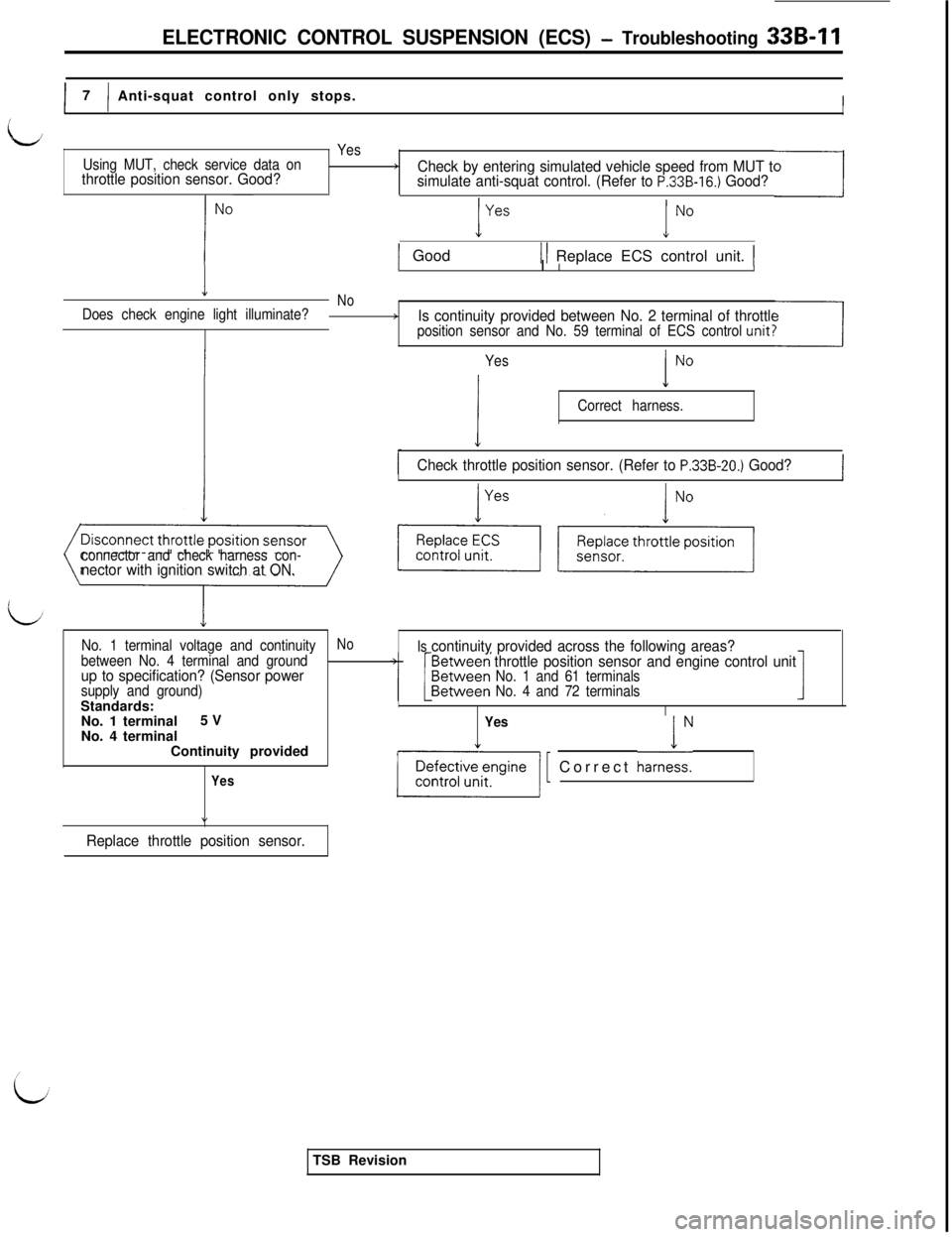
Anti-squat control only stops.III
L,
I
Using MUT, check service data onthrottle position sensor. Good?
Yes
rCheck by entering simulated vehicle speed from MUT to
simulate anti-squat control. (Refer to P.33B-16.) Good?!
1 Good1 ) Replace ECS control unit. 1
I
1I II
NoDoes check engine light illuminate?>Is continuity provided between No. 2 terminal of throttleposition sensor and No. 59 terminal of ECS controlunityII
Yes
i
Correct harness.
1Check throttle position sensor. (Refer to P.33B-20.) Good?III1
connector and check harness con-nector with ignition switch at ON.
No. 1 terminal voltage and continuityNo
Is
between No. 4 terminal and groundcontinuity provided across the following areas?
up to specification? (Sensor powerthrottle position sensor and engine control unit
No. 1 and 61 terminals
supply and ground)
No. 4 and 72 terminalsStandards:
INo. 1 terminal5 V
YesNo. 4 terminal
Continuity provided
Yes-1 1 Correct harnei:
”
Replace throttle position sensor.TSB Revision
Page 674 of 1146
33B-12ELECTRONIC CONTROL SUSPENSION (EC9 - i?:~~u:‘?s*men*
12FOOOESERVICE ADJUSTMENT PROCEDURES
I
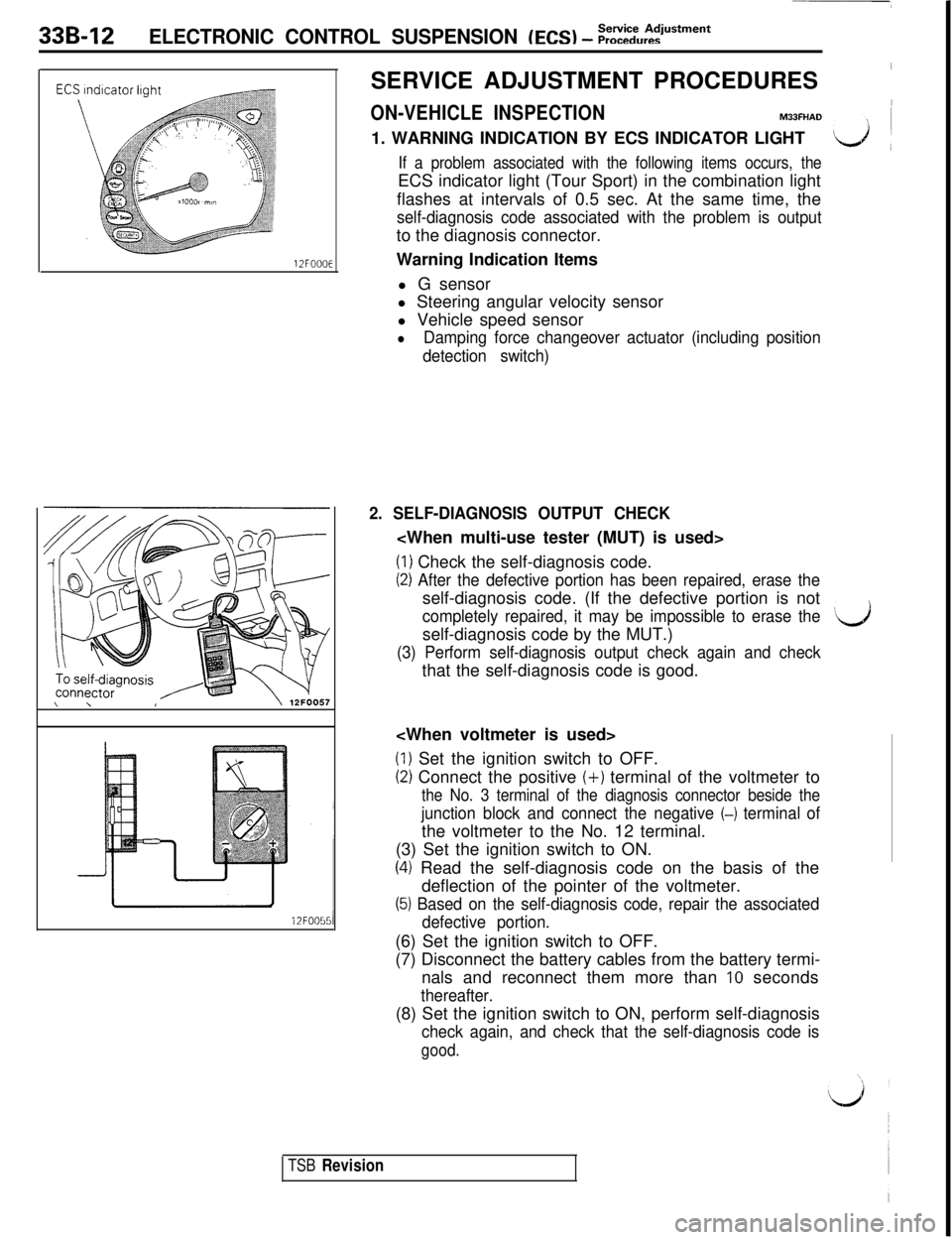
ON-VEHICLE INSPECTIONIM33FHAD1. WARNING INDICATION BY ECS INDICATOR LIGHT
If a problem associated with the following items occurs, theECS indicator light (Tour Sport) in the combination light
flashes at intervals of 0.5 sec. At the same time, the
self-diagnosis code associated with the problem is outputto the diagnosis connector.
Warning Indication Items
l G sensor
l Steering angular velocity sensor
l Vehicle speed sensor
lDamping force changeover actuator (including position
detection switch)
2. SELF-DIAGNOSIS OUTPUT CHECK
(I) Check the self-diagnosis code.
(2) After the defective portion has been repaired, erase theself-diagnosis code. (If the defective portion is not
completely repaired, it may be impossible to erase the’self-diagnosis code by the MUT.)d
(3) Perform self-diagnosis output check again and checkthat the self-diagnosis code is good.
(1) Set the ignition switch to OFF.
(2) Connect the positive (+) terminal of the voltmeter to
the No. 3 terminal of the diagnosis connector beside the
junction block and connect the negative (--) terminal ofthe voltmeter to the No. 12 terminal.
(3) Set the ignition switch to ON.
(4) Read the self-diagnosis code on the basis of the
deflection of the pointer of the voltmeter.
(5) Based on the self-diagnosis code, repair the associated
defective portion.(6) Set the ignition switch to OFF.
(7) Disconnect the battery cables from the battery termi-
nals and reconnect them more than
10 seconds
thereafter.(8) Set the ignition switch to ON, perform self-diagnosis
check again, and check that the self-diagnosis code is
good.
TSB Revision
Page 675 of 1146
![MITSUBISHI 3000GT 1991 Owners Manual Service AdjustmentELECTRONIC CONTROL SUSPENSION (ECS) - Procedures33B-13Fail Safe and Diagnosis List
Output Code
Diagnosis Item
Fail SafeCode No.Indication Pattern
0[Good]
[Good]
l-l
11G sensor defect](/img/19/57085/w960_57085-674.png "MITSUBISHI 3000GT 1991 Owners Manual Service AdjustmentELECTRONIC CONTROL SUSPENSION (ECS) - Procedures33B-13Fail Safe and Diagnosis List
Output Code
Diagnosis Item
Fail SafeCode No.Indication Pattern
0[Good]
[Good]
l-l
11G sensor defect")
Service AdjustmentELECTRONIC CONTROL SUSPENSION (ECS) - Procedures33B-13Fail Safe and Diagnosis List
Output Code
Diagnosis Item
Fail SafeCode No.Indication Pattern
0[Good]
[Good]
l-l
11G sensor defective*l Ride controls (pinching and bouncingcontrol, bad road detection control) sl:op.
21Steering angularvelocity sensor open-circuited*
l Anti-roll control stops.
24Vehicle speed sensor*nn open-crrcurtedl Steering stability controls (anti-roll, high
speed sensitive controls) and attitude
controls (anti-dive, anti-squat) stop.l Shock absorber damping force fixed
F. L. damping forcefl-~-~-j 11c$i;z;;Fr actuator
R. R. damping force
I /
64 j-jMJ-~-~-~ ~t$ec~Z$rn&ftYrrZ& /
NOTE(1)Control stop, warning indication and fixed damping force return to normal when the ignition switch is set to OFF.
When any of the problems marked* occurs, if no subsequent problem occurs (for example, when the problem IStransient) normal operation will be restored even if the ignition switch is not set to OFF.(2)Even if control stop warning indication and fixed damping force return to normal as described above, the
self-diagnosis code’is stored in the memory in the ECS control unrt.
(3)The self-diagnosis code can be force-cleared by use of the MUT or by stopping the power supply to the ECS controlunit. In addition
it is automatically cleared if the ON/OFF control of the ignition swatch is repeated 60 times after the
self-diagnosis code has been output, provided that no new self-diagnosis code is output during the period.TSB Revision
Page 676 of 1146
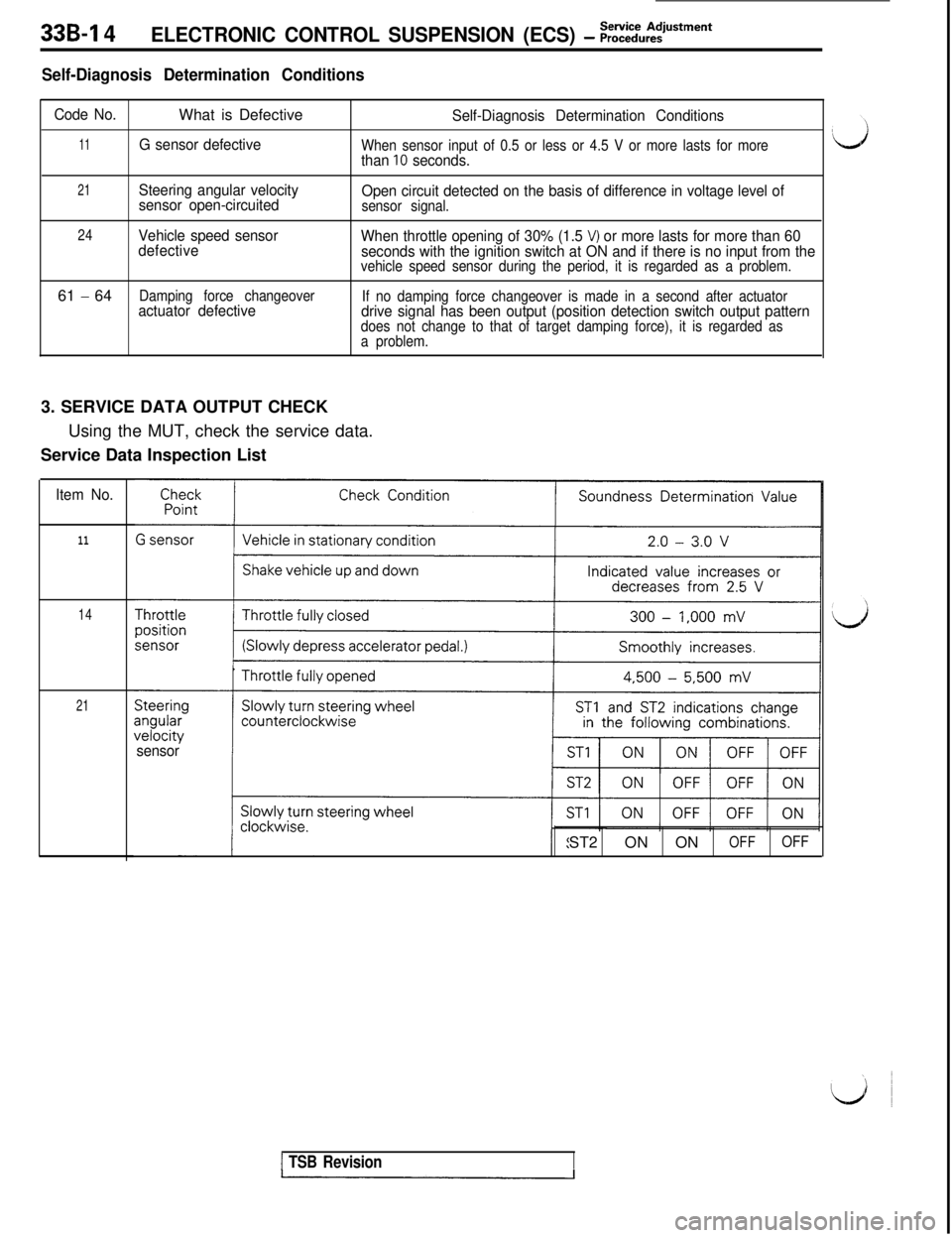
339-l 4ELECTRONIC CONTROL SUSPENSION (ECS) - ~;:i%?tment
Self-Diagnosis Determination Conditions
Code No.What is DefectiveSelf-Diagnosis Determination Conditions
11G sensor defectiveWhen sensor input of 0.5 or less or 4.5 V or more lasts for morethan 10 seconds.
21Steering angular velocity
sensor open-circuitedOpen circuit detected on the basis of difference in voltage level of
sensor signal.
24Vehicle speed sensor
defectiveWhen throttle opening of 30% (1.5 V) or more lasts for more than 60
seconds with the ignition switch at ON and if there is no input from the
vehicle speed sensor during the period, it is regarded as a problem.61
- 64Damping force changeoveractuator defectiveIf no damping force changeover is made in a second after actuatordrive signal has been output (position detection switch output patterndoes not change to that of target damping force), it is regarded as
a problem.3. SERVICE DATA OUTPUT CHECK
Using the MUT, check the service data.
Service Data Inspection List
Item No.
11
14
21
sensorST2 ON ON
OFFOFF
1 TSB Revision