service MITSUBISHI LANCER EVOLUTION 2007 Service Repair Manual
[x] Cancel search | Manufacturer: MITSUBISHI, Model Year: 2007, Model line: LANCER EVOLUTION, Model: MITSUBISHI LANCER EVOLUTION 2007Pages: 1449, PDF Size: 56.82 MB
Page 689 of 1449

14-1
ENGINE COOLING
CONTENTS
GENERAL INFORMATION 2..................
SERVICE SPECIFICATIONS 2.................
LUBRICANT 2...............................
SEALANT 2..................................
SPECIAL TOOLS 3...........................
TROUBLESHOOTING 3.......................
ON-VEHICLE SERVICE 6.....................
Engine Coolant Leak Checking 6................
Radiator Cap Opening Pressure Check 6........Engine Coolant Replacement 6..................
Concentration Measurement 7...................
Radiator Fan Relay Continuity Check 8..........
Radiator Fan Controller Check 8................
Radiator Fan Motor Check 10...................
THERMOSTAT 11............................
WATER PUMP 13............................
WATER HOSE AND WATER PIPE 14..........
RADIATOR 15................................
Page 690 of 1449

ENGINE COOLING -GeneralInformation/
Service Specifications/Lubricant/Sealant14-2
GENERAL INFORMATION
The cooling system is designed to keep every part
of the engine at appropriate temperature in
whatever condition the engine may be operated.
The cooling method is of the water-cooled, pressure
forced circulation type in which the water pump
pressurizes coolant and circulates it throughout the
engine. If the coolant temperature exceeds the
prescribed temperature, the thermostat opens to
circulate the coolant through the radiator as well
so that the heat absorbed by the coolant may be
radiated into the air.The water pump is of the centrifugal type and is
driven by the drive belt from the crankshaft.
The radiator is the corrugated fin, down flow type.
The cooling fan is controlled by the radiator fan
controller and engine-ECU depend on driving
conditions.
ItemSpecification
Radiator performance kJ/h216,700
SERVICE SPECIFICATIONS
ItemsStandard valueLimit
Radiator cap opening pressure kPa93 - 12383
Range of coolant antifreeze concentration of radiator %30 - 60-
ThermostatValve opening temperature of thermostat_C80±1.5-
Full-opening temperature of thermostat_C93-
Valve lift (at 93_C) mm9.5 or more-
LUBRICANT
ItemSpecified coolantQuantity L
Engine coolantMITSUBISHI GENUINE COOLANT or equivalent6.0Enginecoolant
(including reserve tank)
MITSUBISHIGENUINECOOLANTorequivalent6.0
SEALANT
ItemSpecified sealantRemark
Cylinder block drain plug3M Nut Locking Part No. 4171 or equivalentDrying sealant
Page 694 of 1449

ENGINE COOLING -On-vehicle Service14-6
ON-VEHICLE SERVICE
ENGINE COOLANT LEAK CHECKING
1. Confirm that the coolant level is up to the filler neck.
Install a radiator cap tester and apply 160 kPa pressure,
and then check for leakage from the radiator hose or
connections.
Caution
(1) Be sure to completely clean away any moisture
from the places checked.
(2) When the tester is taken out, be careful not to
spill any coolant from it.
(3) Be careful, when installing and removing the tester
and when testing, not to deform the filler neck
of the radiator.
2. If there is leakage, repair or replace the appropriate part.
RADIATOR CAP OPENING PRESSURE CHECK
1. Use a cap adapter to attach the cap to the tester.
2. Increase the pressure until the indicator of the gauge
stops moving.
Limit: 83 kPa
Standard value: 93 - 123 kPa
3. Replace the radiator cap if the reading does not remain
at or above the limit.
NOTE
Be sure that the cap is clean before testing, since rust
or other foreign material on the cap seal will cause an
improper indication.
ENGINE COOLANT REPLACEMENT
1. Remove the under cover.
(Refer to GROUP 51 - Front Bumper.)
2. Drain the engine coolant by removing the drain plug and
then the radiator cap.
Cap adapter
Adapter
Cap adapter
Page 695 of 1449

ENGINE COOLING -On-vehicle ServiceENGINE COOLING -On-vehicle Service14-7
3. Remove the cylinder block drain plug from the cylinder
block to drain the engine coolant.
4. Remove the reserve tank to drain the engine coolant.
5. When the engine coolant has drained, pour in water from
the radiator cap to clean the engine coolant line.
6. Coat the thread of the cylinder block drain plug with the
specified sealant and tighten to the specified torque.
Specified sealant:
3M Nut Locking Part No. 4171 or equivalent
7. Securely tighten the radiator drain plug.
8. Install the under cover.
(Refer to GROUP 51 - Front Bumper.)
9. Install the reserve tank.
10. Slowly pour the engine coolant into the mouth of the
radiator until the radiator is full, and pour also into the
reserve tank up to the FULL line.
Recommended anti-freeze:
MITUBISHI GENUINE COOLANT or equivalent
Quantity: 6.0 L
Caution
Do not use alcohol or methanol anti-freeze or any
engine coolants mixed with alcohol or methanol
anti-freeze. The use of an improper anti-freeze can
cause the corrosion of the aluminium components.
11. Install the radiator cap securely.
12. Start the engine and warm the engine until the thermostat
opens. (Touch the radiator hose with your hand to check
that warm water is flowing.)
13. After the thermostat opens, race the engine several times,
and then stop the engine.
14. Cool down the engine, and then pour engine coolant into
the reserve tank until the level reaches the FULL line. If
the level is low, repeat the operation from step 11.
CONCENTRATION MEASUREMENT
Measure the temperature and specific gravity of the engine
coolant to check the antifreeze concentration.
Standard value: 30 - 60 % (allowable concentration range)
RECOMMENDED ANTI-FREEZE
AntifreezeAllowable concentration
MITSUBISHI GENUINE COOLANT
or equivalent30 - 60 %
Caution
If the concentration of the anti-freeze is below 30 %, the
anti-corrosion property will be adversely affected. In
addition, if the concentration is above 60 %, both the
anti-freezing and engine cooling properties will decrease,
affecting the engine adversely. For these reasons, be
sure to maintain the concentration level within the
specified range.
44±5N·m
Water inlet
pipe
Page 696 of 1449
ENGINE COOLING -On-vehicle Service14-8
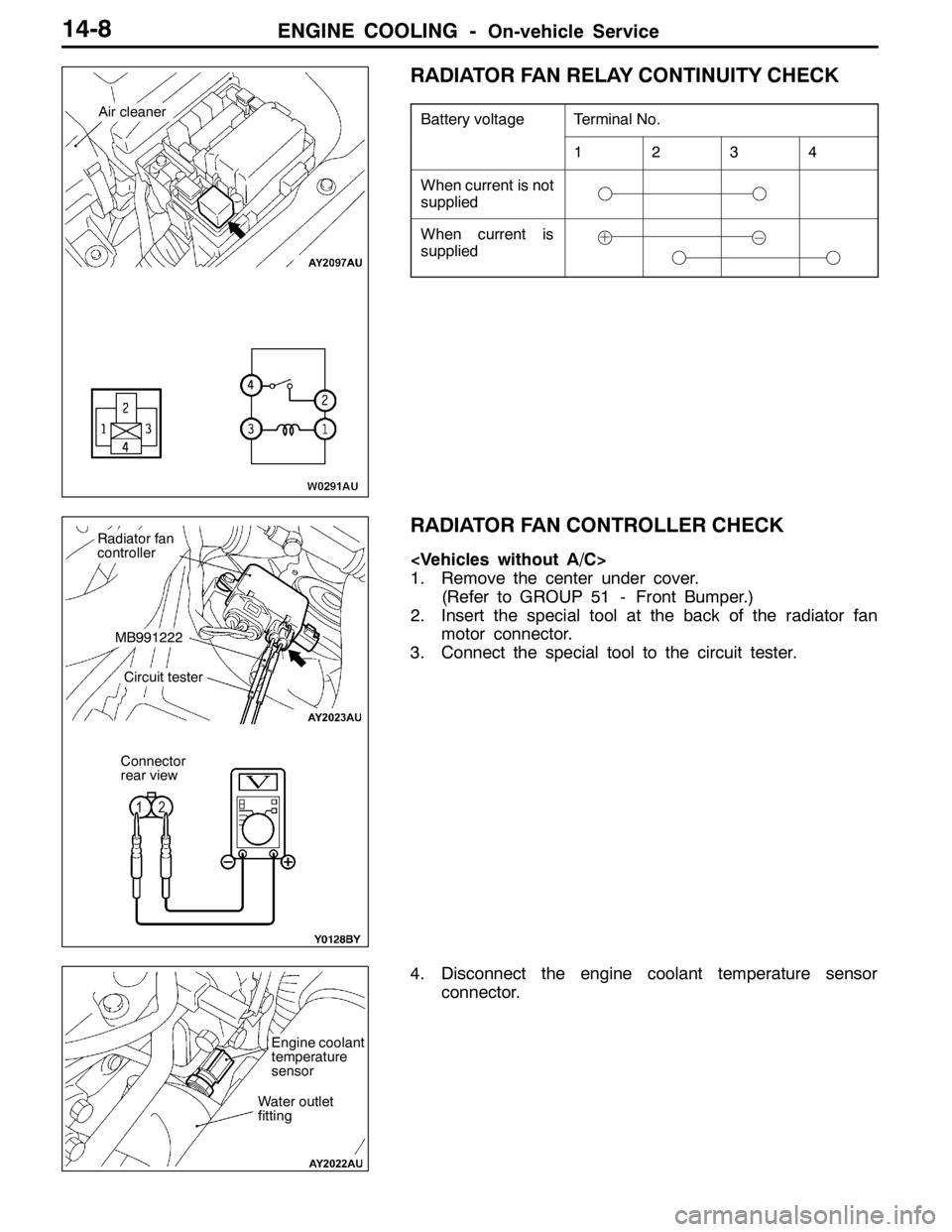
RADIATOR FAN RELAY CONTINUITY CHECK
Battery voltageTerminal No.
1234
When current is not
supplied
When current is
supplied
RADIATOR FAN CONTROLLER CHECK
1. Remove the center under cover.
(Refer to GROUP 51 - Front Bumper.)
2. Insert the special tool at the back of the radiator fan
motor connector.
3. Connect the special tool to the circuit tester.
4. Disconnect the engine coolant temperature sensor
connector.
Air cleaner
Radiator fan
controller
MB991222
Circuit tester
Connector
rear view
Water outlet
fitting
Engine coolant
temperature
sensor
Page 697 of 1449
![MITSUBISHI LANCER EVOLUTION 2007 Service Repair Manual ENGINE COOLING -On-vehicle Service14-9
5. Connect the special tool (MB991658) to the harness side
of the engine coolant temperature sensor connector.
6. Connect the special tool [MB991791(APS)] to the](/img/19/57084/w960_57084-696.png "MITSUBISHI LANCER EVOLUTION 2007 Service Repair Manual ENGINE COOLING -On-vehicle Service14-9
5. Connect the special tool (MB991658) to the harness side
of the engine coolant temperature sensor connector.
6. Connect the special tool [MB991791(APS)] to the")
ENGINE COOLING -On-vehicle Service14-9
5. Connect the special tool (MB991658) to the harness side
of the engine coolant temperature sensor connector.
6. Connect the special tool [MB991791(APS)] to the special
tool (MB991658).
7. Start the engine and let it run at idle.
NOTE
Since the resistance value of the special tool (APS)
indicates a low engine coolant temperature, engine speed
increases.
8. When the lever of the special tool (APS) is turned to
the end, check that the engine speed decreases and
the radiator fan motor rotates.
9. When the lever of the special tool (APS) is turned to
the reverse direction, check that the voltage between
terminals of the radiator fan motor connector gradually
decreases from the battery voltage to 0 V.
10. If inoperable, replace the radiator fan controller.
(Refer to P.14-15.)
11. Install the center under cover.
(Refer to GROUP 51 - Front Bumper.)
12. Connect the engine coolant temperature sensor
connector.
1. Remove the center under cover.
(Refer to GROUP 51 - Front Bumper.)
2. Insert the special tool at the back of the radiator fan
motor connector.
3. Connect the special tool to the circuit tester.
4. Start the engine and run it at idle.
5. Turn the A/C switch to the ON position and hold the
engine coolant temperature at 80_C or lower.
6. When the voltage between the terminals of the radiator
fan motor connector, the following values of (1) - (3)
can be detected at random.
(1) 0 V
(2) 8.22.6 V
(3) Battery voltage2.6 V
7. If inoperable, replace the radiator fan controller.
(Refer to P.14-15.)
8. Install the center under cover.
(Refer to GROUP 51 - Front Bumper.)
Engine coolant
temperature sensor
connector
(harness side)
MB991791(APS)
MB991658
MB991658Lever
MB991791(APS)
Radiator fan
controller
MB991222
Circuit tester
Connector
rear view
Page 698 of 1449

ENGINE COOLING -On - vehicle Service14-10
RADIATOR FAN MOTOR CHECK
1. Remove the center under cover.
(Refer to GROUP 51 - Front Bumper.)
2. Disconnect the radiator fan motor connector.
3. Check that the motor rotates when energizing battery
voltage between the terminals of connectors of the radiator
fan motor side.Check that there is abonormal noise from
the radiator fan motor then.
4. If inoperable, replace the radiator fan motor.
(Refer to P.14-15.)
5. Install the center under cover.
(Refer to GROUP 51 - Front Bumper.)Radiator fan motor
Page 699 of 1449

ENGINE COOLING -ThermostatENGINE COOLING -Thermostat14-11
THERMOSTAT
REMOVAL AND INSTALLATION
Pre-removal and Post-installation Operation
DEngine Coolant Draining and Supplying (Refer to P.14-6.)
DAir Duct Assembly Removal and Installation (Refer to GROUP 15 - Air Cleaner.)
DVacuum Pipe, Secondary Air Pipe Assembly Removal and Installation
(Refer to GROUP 15 - Secondary Air Supply System.)
1
2
3
10±1 N·m
Removal steps
AA""BA1. Radiator upper hose connection
2. Water outlet fitting
"AA3. Thermostat
REMOVAL SERVICE POINT
AA"RADIATOR UPPER HOSE DISCONNECTION
After making mating marks on the radiator hose and the hose
clamp,disconnect the radiator hose.
Page 700 of 1449

ENGINE COOLING -Thermostat14-12
INSTALLATION SERVICE POINTS
"AATHERMOSTAT INSTALLATION
Install the thermostat being careful not to fold over or scratch
the rubber ring.
Caution
Make absolutely sure that no oil is adhering to the rubber
ring of the thermostat. In addition, be careful not to fold
over or scratch the rubber ring when inserting. If the
rubber ring is damage, replace the thermostat.
"BARADIATOR UPPER HOSE CONNECTION
1. Insert each hose as far as the projection of the water
outlet fitting.
2. Align the mating marks on the radiator hose and hose
clamp, and then connect the radiator hose.
INSPECTION
THERMOSTAT CHECK
1. Immerse the thermostat in water, and heat the water while
stirring. Check the thermostat valve opening temperature.
Standard value:
Valve opening temperature: 80±1.5_C
2. Check that the amount of valve lift is at the standard value
when the water is at the full-opening temperature.
Standard value:
Full-opening temperature: 93_C
Amount of valve lift: 9.5 mm or more
NOTE
Measure the valve height when the thermostat is fully
closed, and use this measurement to calculate the valve
height when the thermostat is fully open.
Valve lift
Page 701 of 1449
ENGINE COOLING -Water Pump14-13
WATER PUMP
Caution
If the vehicle is equipped with the Brembo disc brake, during maintenance, take care not to contact
the parts or tools to the caliper because the paint of caliper will be scratched.
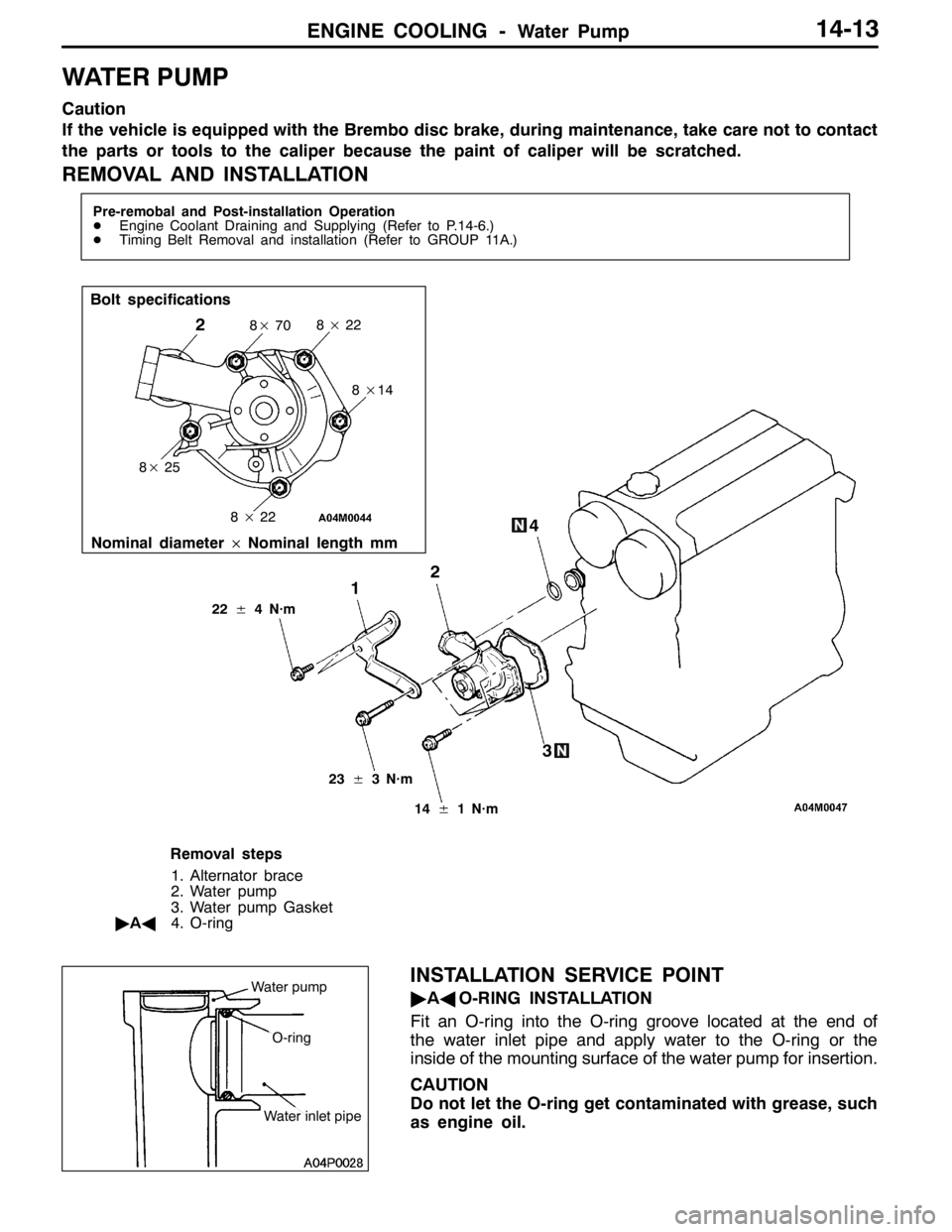
REMOVAL AND INSTALLATION
Pre-remobal and Post-installation Operation
DEngine Coolant Draining and Supplying (Refer to P.14-6.)
DTiming Belt Removal and installation (Refer to GROUP 11A.)
1
Bolt specifications
28×22
2
23±3 N·m
14±1 N·m
Nominal diameter×Nominal length mm
8×70
8×14
8×22 8×25
3 4
22±4 N·m
Removal steps
1. Alternator brace
2. Water pump
3. Water pump Gasket
"AA4. O-ring
INSTALLATION SERVICE POINT
"AAO-RING INSTALLATION
Fit an O-ring into the O-ring groove located at the end of
the water inlet pipe and apply water to the O-ring or the
inside of the mounting surface of the water pump for insertion.
CAUTION
Do not let the O-ring get contaminated with grease, such
as engine oil.Water pump
O-ring
Water inlet pipe