service MITSUBISHI LANCER EVOLUTION 2007 Service Manual Online
[x] Cancel search | Manufacturer: MITSUBISHI, Model Year: 2007, Model line: LANCER EVOLUTION, Model: MITSUBISHI LANCER EVOLUTION 2007Pages: 1449, PDF Size: 56.82 MB
Page 619 of 1449
MPI -Troubleshooting13A-87
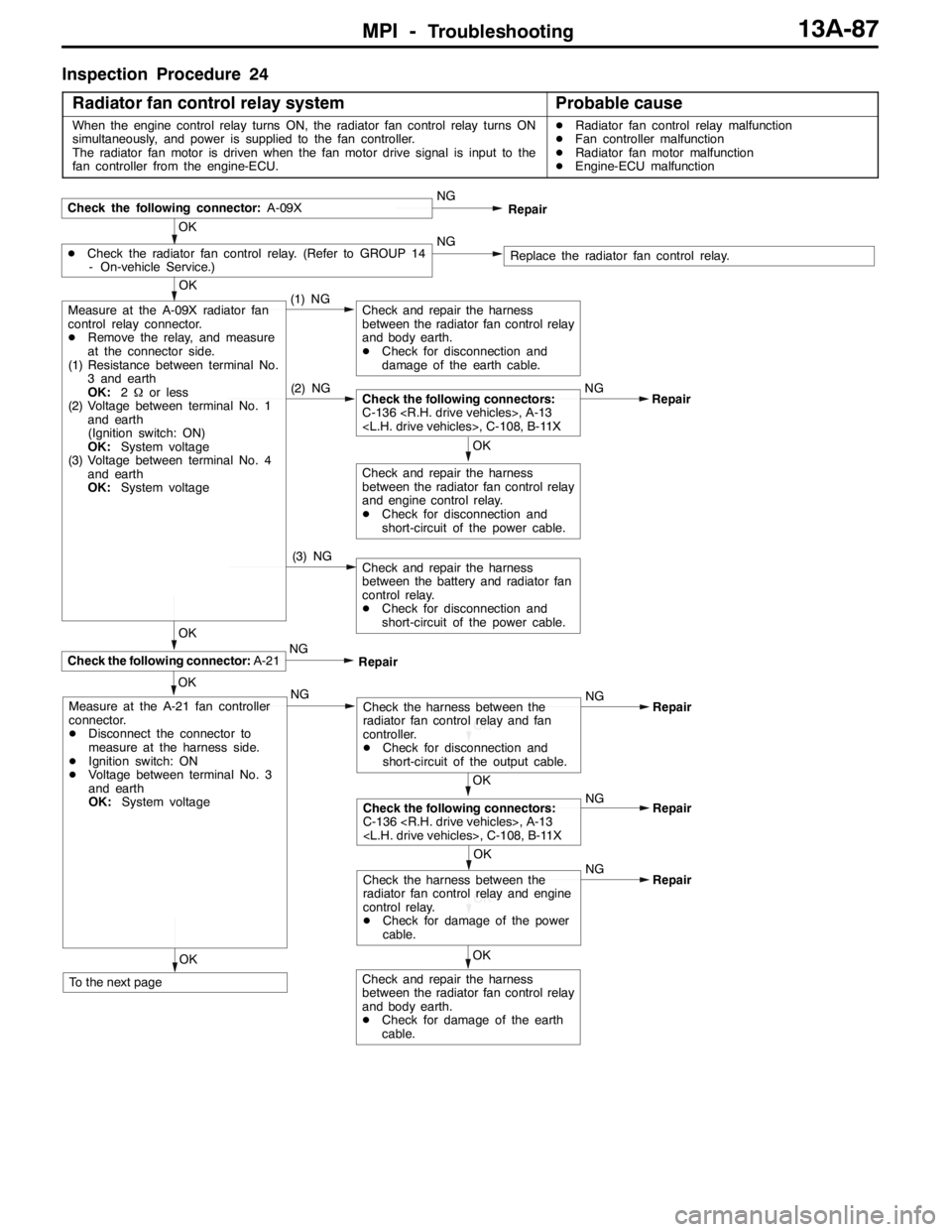
Inspection Procedure 24
Radiator fan control relay system
Probable cause
When the engine control relay turns ON, the radiator fan control relay turns ON
simultaneously, and power is supplied to the fan controller.
The radiator fan motor is driven when the fan motor drive signal is input to the
fan controller from the engine-ECU.DRadiator fan control relay malfunction
DFan controller malfunction
DRadiator fan motor malfunction
DEngine-ECU malfunction
OK
(1) NG
OK
DCheck the radiator fan control relay. (Refer to GROUP 14
- On-vehicle Service.)NGReplace the radiator fan control relay.
Check the following connector:A-09XNG
Repair
OK
OK
(2) NGCheck the following connectors:
C-136
OK
Check and repair the harness
between the radiator fan control relay
and body earth.
DCheck for disconnection and
damage of the earth cable.
Repair
OK
Check the following connector:A-21
Check and repair the harness
between the radiator fan control relay
and engine control relay.
DCheck for disconnection and
short-circuit of the power cable.
(3) NGCheck and repair the harness
between the battery and radiator fan
control relay.
DCheck for disconnection and
short-circuit of the power cable.
Measure at the A-09X radiator fan
control relay connector.
DRemove the relay, and measure
at the connector side.
(1) Resistance between terminal No.
3 and earth
OK:2Ωor less
(2) Voltage between terminal No. 1
and earth
(Ignition switch: ON)
OK:System voltage
(3) Voltage between terminal No. 4
and earth
OK:System voltage
NG
Repair
OK
Measure at the A-21 fan controller
connector.
DDisconnect the connector to
measure at the harness side.
DIgnition switch: ON
DVoltage between terminal No. 3
and earth
OK:System voltage
To the next pageNG
OK
Check the harness between the
radiator fan control relay and fan
controller.
DCheck for disconnection and
short-circuit of the output cable.NG
Repair
OK
Check the following connectors:
C-136
Repair
OK
OK
Check the harness between the
radiator fan control relay and engine
control relay.
DCheck for damage of the power
cable.NG
Repair
Check and repair the harness
between the radiator fan control relay
and body earth.
DCheck for damage of the earth
cable.
Page 621 of 1449
MPI -Troubleshooting13A-89
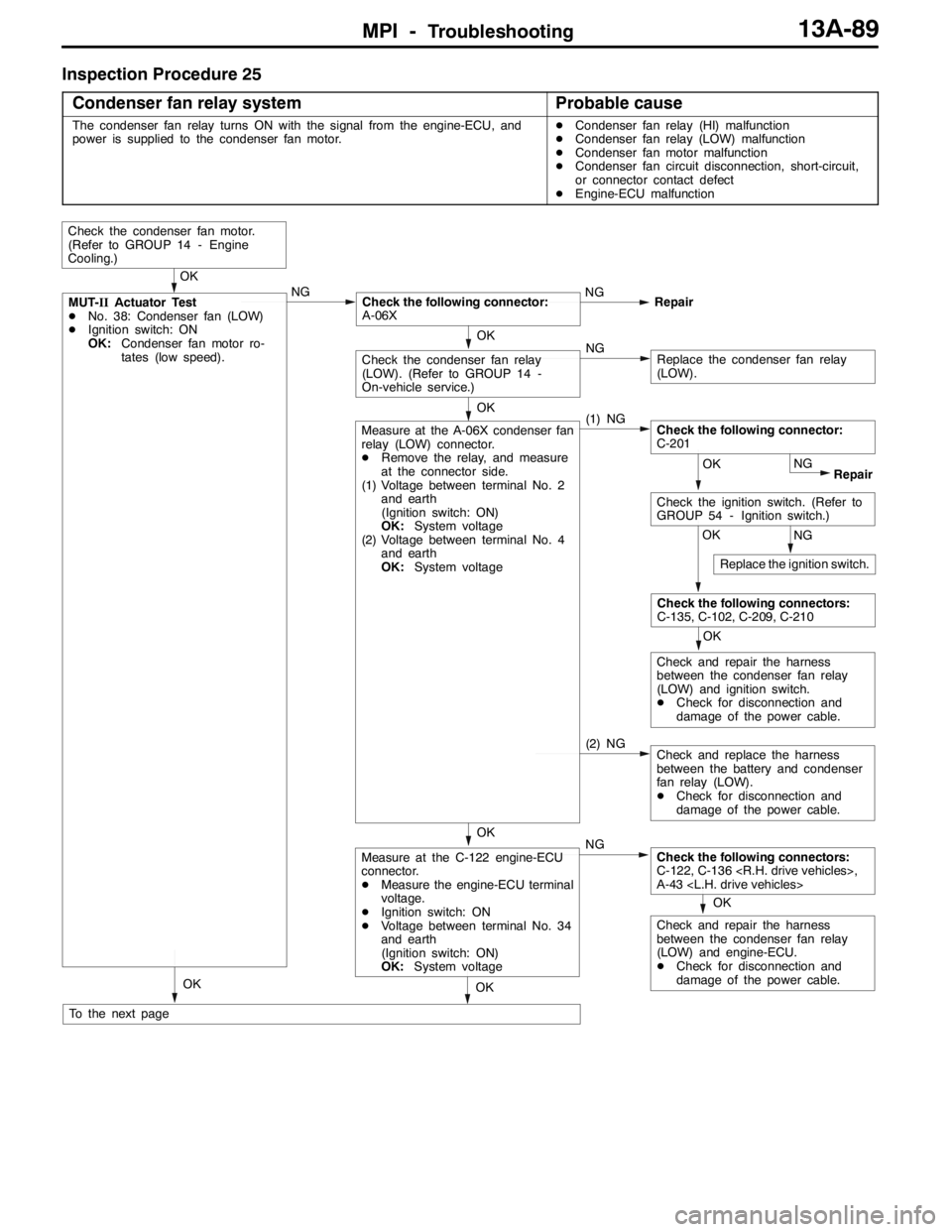
Inspection Procedure 25
Condenser fan relay system
Probable cause
The condenser fan relay turns ON with the signal from the engine-ECU, and
power is supplied to the condenser fan motor.DCondenser fan relay (HI) malfunction
DCondenser fan relay (LOW) malfunction
DCondenser fan motor malfunction
DCondenser fan circuit disconnection, short-circuit,
or connector contact defect
DEngine-ECU malfunction
OK
Check and repair the harness
between the condenser fan relay
(LOW) and engine-ECU.
DCheck for disconnection and
damage of the power cable.
(2) NG
OK
OK
Check the condenser fan motor.
(Refer to GROUP 14 - Engine
Cooling.)
OK
NG
OK
Check the following connector:
A-06X
OK
MUT-IIActuator Test
DNo. 38: Condenser fan (LOW)
DIgnition switch: ON
OK:Condenser fan motor ro-
tates (low speed).NG
OK
Measure at the C-122 engine-ECU
connector.
DMeasure the engine-ECU terminal
voltage.
DIgnition switch: ON
DVoltage between terminal No. 34
and earth
(Ignition switch: ON)
OK:System voltageRepair
NG
To the next page
NGReplace the condenser fan relay
(LOW).
OK
Check the condenser fan relay
(LOW). (Refer to GROUP 14 -
On-vehicle service.)
(1) NGMeasure at the A-06X condenser fan
relay (LOW) connector.
DRemove the relay, and measure
at the connector side.
(1) Voltage between terminal No. 2
and earth
(Ignition switch: ON)
OK:System voltage
(2) Voltage between terminal No. 4
and earth
OK:System voltage
NG
Repair OK
OK
Check the following connectors:
C-135, C-102, C-209, C-210
Check and repair the harness
between the condenser fan relay
(LOW) and ignition switch.
DCheck for disconnection and
damage of the power cable.
Check the following connectors:
C-122, C-136
A-43
Check the following connector:
C-201
NG
Check the ignition switch. (Refer to
GROUP 54 - Ignition switch.)
Replace the ignition switch.
Check and replace the harness
between the battery and condenser
fan relay (LOW).
DCheck for disconnection and
damage of the power cable.
Page 622 of 1449
MPI -Troubleshooting13A-90
(2) NG
OK
OK
OK
NG
OK
Check the following connector:
A-07X
OK
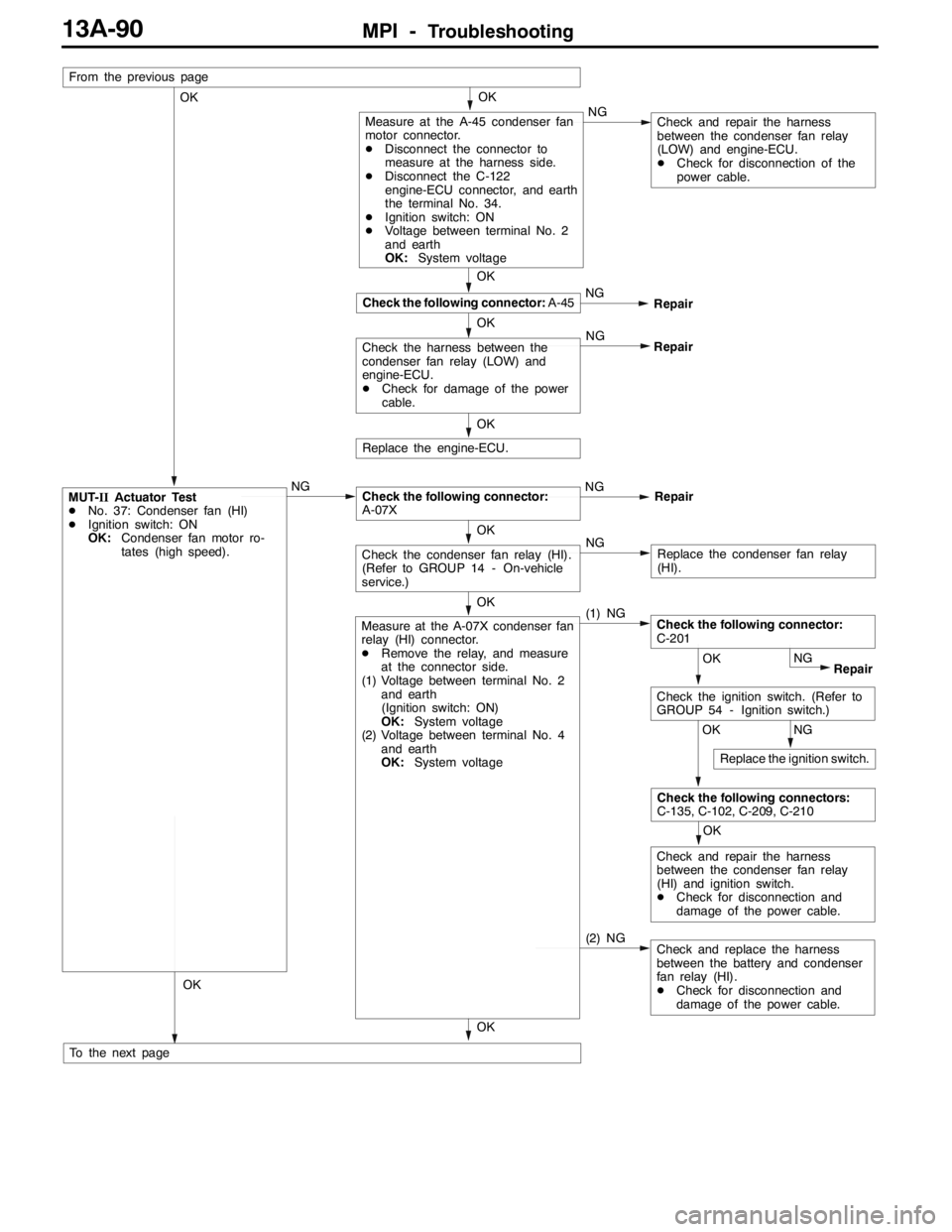
MUT-IIActuator Test
DNo. 37: Condenser fan (HI)
DIgnition switch: ON
OK:Condenser fan motor ro-
tates (high speed).NG
Repair
NGReplace the condenser fan relay
(HI).
OK
Check the condenser fan relay (HI).
(Refer to GROUP 14 - On-vehicle
service.)
(1) NGMeasure at the A-07X condenser fan
relay (HI) connector.
DRemove the relay, and measure
at the connector side.
(1) Voltage between terminal No. 2
and earth
(Ignition switch: ON)
OK:System voltage
(2) Voltage between terminal No. 4
and earth
OK:System voltage
NG
Repair OK
OK
Check the following connectors:
C-135, C-102, C-209, C-210
Check and repair the harness
between the condenser fan relay
(HI) and ignition switch.
DCheck for disconnection and
damage of the power cable.
Check the following connector:
C-201
NG
Check the ignition switch. (Refer to
GROUP 54 - Ignition switch.)
Replace the ignition switch.
Check and replace the harness
between the battery and condenser
fan relay (HI).
DCheck for disconnection and
damage of the power cable.
NGCheck the following connector:A-45
OK
Replace the engine-ECU.
OK
To the next page
NG
OK
Check the harness between the
condenser fan relay (LOW) and
engine-ECU.
DCheck for damage of the power
cable.Repair Repair
NGOK
Measure at the A-45 condenser fan
motor connector.
DDisconnect the connector to
measure at the harness side.
DDisconnect the C-122
engine-ECU connector, and earth
the terminal No. 34.
DIgnition switch: ON
DVoltage between terminal No. 2
and earth
OK:System voltageCheck and repair the harness
between the condenser fan relay
(LOW) and engine-ECU.
DCheck for disconnection of the
power cable.
From the previous page
Page 625 of 1449
MPI -Troubleshooting13A-93
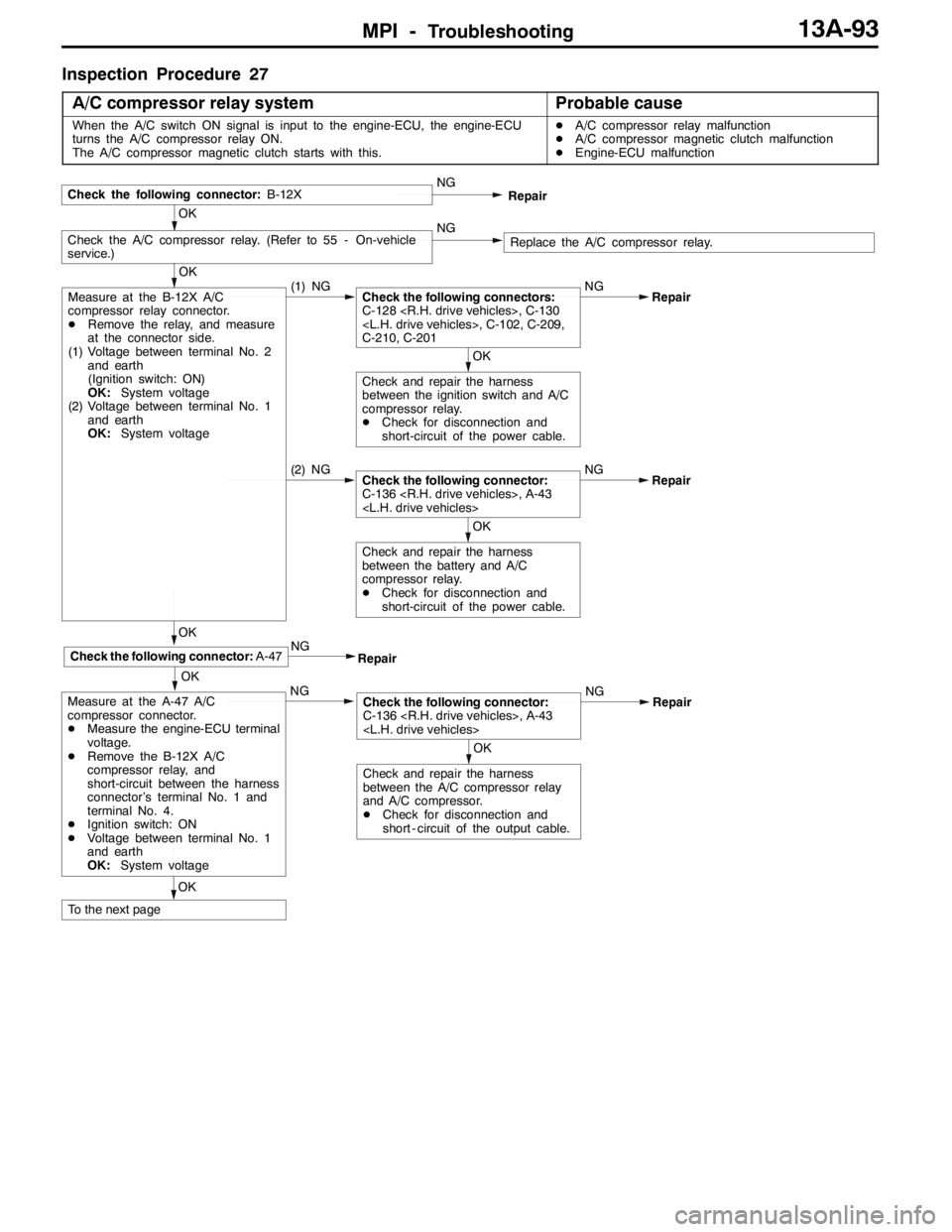
Inspection Procedure 27
A/C compressor relay system
Probable cause
When the A/C switch ON signal is input to the engine-ECU, the engine-ECU
turns the A/C compressor relay ON.
The A/C compressor magnetic clutch starts with this.DA/C compressor relay malfunction
DA/C compressor magnetic clutch malfunction
DEngine-ECU malfunction
OK
(2) NGCheck the following connector:
C-136
Check and repair the harness
between the battery and A/C
compressor relay.
DCheck for disconnection and
short-circuit of the power cable.
OK
Check the A/C compressor relay. (Refer to 55 - On-vehicle
service.)NGReplace the A/C compressor relay.
Check the following connector:B-12XNG
Repair
OK
OK
Measure at the B-12X A/C
compressor relay connector.
DRemove the relay, and measure
at the connector side.
(1) Voltage between terminal No. 2
and earth
(Ignition switch: ON)
OK:System voltage
(2) Voltage between terminal No. 1
and earth
OK:System voltage(1) NGCheck the following connectors:
C-128
C-210, C-201NG
OK
Check and repair the harness
between the ignition switch and A/C
compressor relay.
DCheck for disconnection and
short-circuit of the power cable.Repair
OKNG
Measure at the A-47 A/C
compressor connector.
DMeasure the engine-ECU terminal
voltage.
DRemove the B-12X A/C
compressor relay, and
short-circuit between the harness
connector’s terminal No. 1 and
terminal No. 4.
DIgnition switch: ON
DVoltage between terminal No. 1
and earth
OK:System voltage
To the next pageRepair
NG
OK
Check the following connector:A-47
Repair
OK
Check the following connector:
C-136
Check and repair the harness
between the A/C compressor relay
and A/C compressor.
DCheck for disconnection and
short - circuit of the output cable.Repair
Page 638 of 1449

MPI -Troubleshooting13A-106
Item
No.Reference
page Inspection
procedure
No. Normal condition Inspection contents Inspection
item
A1LOxygen
sensor
(front)Engine: After having
warmed up
(Air/fuel mixture is
made leaner whenWhen at 4,000 r/min,
engine is suddenly de-
celerated200 mV or lessCode No.
P013013A-24
madeleanerwhen
decelerating, and is
made richer when
racing.)When engine is sud-
denly raced600 - 1,000 mV
Engine: After having
warmed up
(By using oxygen
sensorcheckair/fuel
Idle operation400 mV or less↔
600 - 1,000 mV
(altered)
sensor, checkair/fuel
mixture as well as
control status by
engine-ECU)2,500 r/min
A2LOxygen
sensor
(rear)Engine: After having
warmed upWhen engine is sud-
denly raced0 and 600 - 1,000
mV alternate.Code No.
P013613A-27
8ALThrottle
position
sensor
DEngine: After
having warmed
up
Release the accelera-
tor pedal.8 - 16%Code No.
P012013A-21
sensor
(Throttle
position
opening
angle)up
DIgnition switch:
“ON” (Engine
stopped)Depress the accelera-
tor pedal gradually.Increase in re-
sponse to the
pedal depression
stroke.
Depress the accelera-
tor pedal fully.80 - 100%
NOTE
Items marked byLwill not displayed if service data is selected on the check mode.
Page 657 of 1449

MPI -On-vehicle Service13A-125
ON-VEHICLE SERVICE
FUEL PUMP CONNECTOR DISCONNECTION
(HOW TO REDUCE THE FUEL PRESSURE)
When removing the fuel pipe, hose, etc., since fuel pressure
in the fuel pipe line is high, do the following operation so
as to release the fuel pressure in the line and prevent fuel
from running out.
1. Remove the rear seat assembly. (Refer to GROUP 52A.)
2. Remove the protector.
3. Disconnect the fuel pump module connector.
4. After starting the engine and letting it run until it stops
naturally, turn the ignition switch to “LOOK” (OFF) position.
5. Connect the fuel pump module connector.
6. Install the protector and rear seat assembly.
(Refer to GROUP 52A.)
FUEL PUMP OPERATION CHECK
1. Check the operation of the fuel pump by using the MUT-II
to force-drive the fuel pump.
2. If the fuel pump will not operate, check by using the
following procedure, and if it is normal, check the drive
circuit.
(1) Turn the ignition switch to “LOOK” (OFF) position.
(2) Remove the rear seat assembly. (Refer to GROUP
52A.)
(3) Remove the protector.
(4) Disconnect the fuel pump module connector.
(5) When the fuel pump drive connector is attached
directly to the battery, check if the sound of the fuel
pump operation can be heard.
NOTE
As the fuel pump is an in-tank type, the fuel pump
sound is hard to hear, so remove the fuel filler cap
and check from the tank inlet.
(6) Check the fuel pressure by pinching the fuel hose
with the fingertips.
(7) Connect the fuel pump module connector.
(8) Install the protector and rear seat assembly. (Refer
to GROUP 52A.)
Page 658 of 1449
MPI -On-vehicle Service13A-126
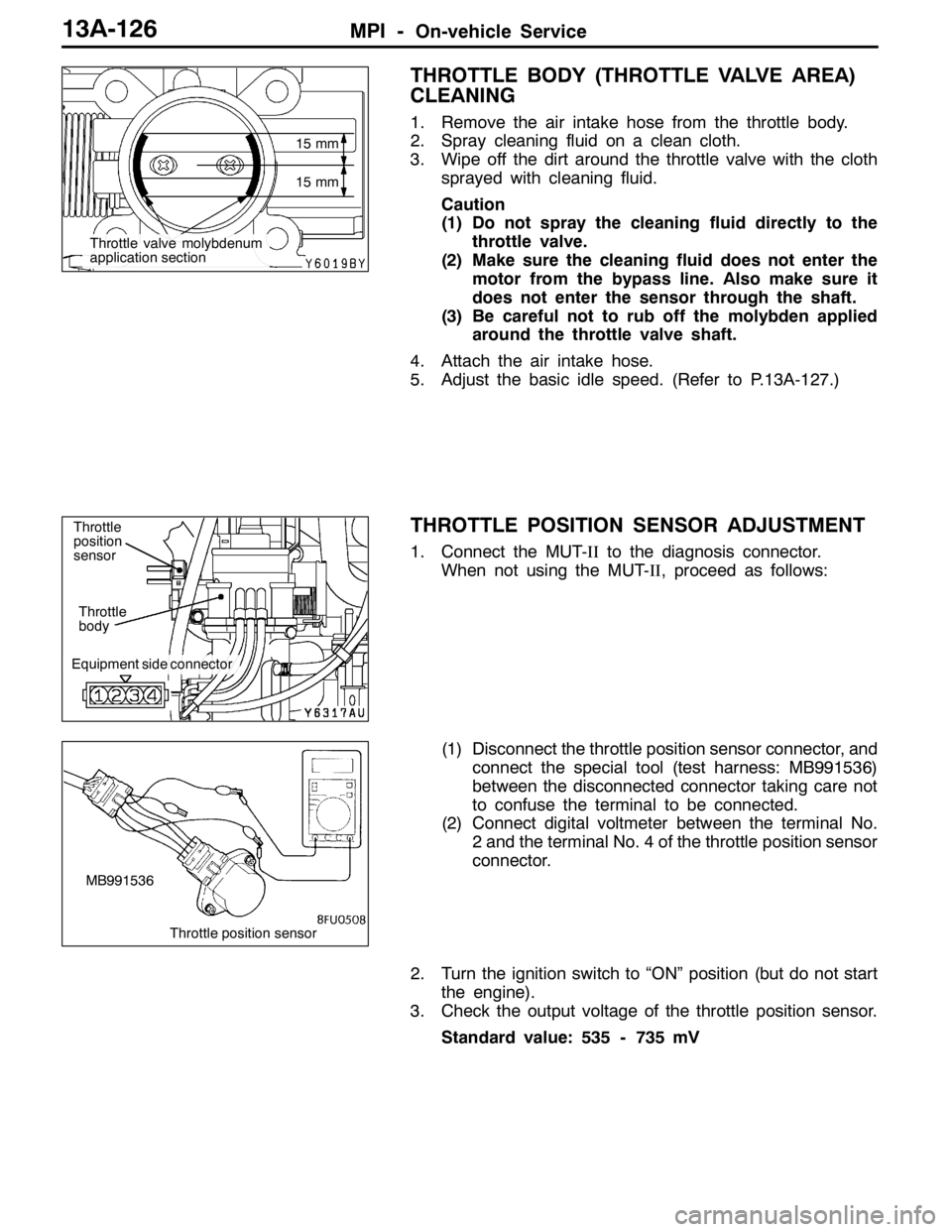
THROTTLE BODY (THROTTLE VALVE AREA)
CLEANING
1. Remove the air intake hose from the throttle body.
2. Spray cleaning fluid on a clean cloth.
3. Wipe off the dirt around the throttle valve with the cloth
sprayed with cleaning fluid.
Caution
(1) Do not spray the cleaning fluid directly to the
throttle valve.
(2) Make sure the cleaning fluid does not enter the
motor from the bypass line. Also make sure it
does not enter the sensor through the shaft.
(3) Be careful not to rub off the molybden applied
around the throttle valve shaft.
4. Attach the air intake hose.
5. Adjust the basic idle speed. (Refer to P.13A-127.)
THROTTLE POSITION SENSOR ADJUSTMENT
1. Connect the MUT-IIto the diagnosis connector.
When not using the MUT-II, proceed as follows:
(1) Disconnect the throttle position sensor connector, and
connect the special tool (test harness: MB991536)
between the disconnected connector taking care not
to confuse the terminal to be connected.
(2) Connect digital voltmeter between the terminal No.
2 and the terminal No. 4 of the throttle position sensor
connector.
2. Turn the ignition switch to “ON” position (but do not start
the engine).
3. Check the output voltage of the throttle position sensor.
Standard value: 535 - 735 mV
Throttle valve molybdenum
application section15 mm
15 mm
Equipment side connectorThrottle
position
sensor
Throttle
body
MB991536
Throttle position sensor
Page 659 of 1449

MPI -On-vehicle Service13A-127
4. If not within the standard value, loosen the throttle position
sensor mounting bolts. Then rotate the sensor body to
adjust.
5. Turn the ignition switch to “LOCK” (OFF) position.
6. Remove the MUT-II. If the MUT-IIis not used, remove
the special tool, and then connect the throttle position
sensor connector.
7. If a diagnosis code is displayed, erase the diagnosis code
by using the MUT-IIor disconnect the negative battery
cable from the battery terminal and then leave it for at
least ten seconds. After that, reconnect the battery cable,
and then let the engine run at idle for approximately 10
minutes.
BASIC IDLE SPEED ADJUSTMENT
NOTE
(1) The basic idling speed has been adjusted by the
speed adjusting screw by the manufacturer, and there
should usually be no need for readjustment.
(2) If the adjustment has been changed by mistake, the
idle speed may become too high or the idle speed
may drop too low when loads from components such
as the A/C are placed on the engine. If this occurs,
adjust by the following procedure.
(3) The adjustment, if made, should be made after first
confirming that the spark plugs, the injectors, the idle
speed control servo, the compression pressure, etc.,
are all normal.
1. Before inspection and adjustment, set the vehicle to the
pre-inspection condition.
2. Connect the MUT-IIto the diagnosis connector (16-pin).
NOTE
When the MUT-IIis connected, the diagnosis control
terminal should be earthed.
3. Start the engine and run at idle.
4. Select the item No. 30 of the MUT-IIActuator test.
NOTE
This holds the idle speed control servo at the basic step
to adjust the basic idle speed.
5. Check the basic idle speed.
Standard value: 850±100 r/min
NOTE
(1) The engine speed may be 20 to 100 r/min lower
than indicated above for a new vehicle [driven
approximately 500 km or less], but no adjustment
is necessary.
(2) If the engine stalls or the engine speed is low even
though the vehicle has been driven approximately
500 km or more, it is probable that deposits are
adhered to the throttle valve, so clean it. (Refer to
P.13A-126.)
Page 660 of 1449
MPI -On-vehicle Service13A-128
6. If not within the standard value range, turn the speed
adjusting screw to make the necessary adjustment.
7. Press the MUT-IIclear key, and release the idle speed
control servo from the Actuator test mode.
NOTE
Unless the idle speed control servo is released, the
Actuator test mode will continue 27 minutes.
8. Turn the ignition switch to “LOCK” (OFF) position.
9. Disconnect the MUT-II.
10. Start the engine again and let it run at idle speed for
approximately 10 minutes; check that the idling condition
is normal.
FUEL PRESSURE TEST
1. Release residual pressure from the fuel pipe line to prevent
fuel gush out. (Refer to P.13A-125.)
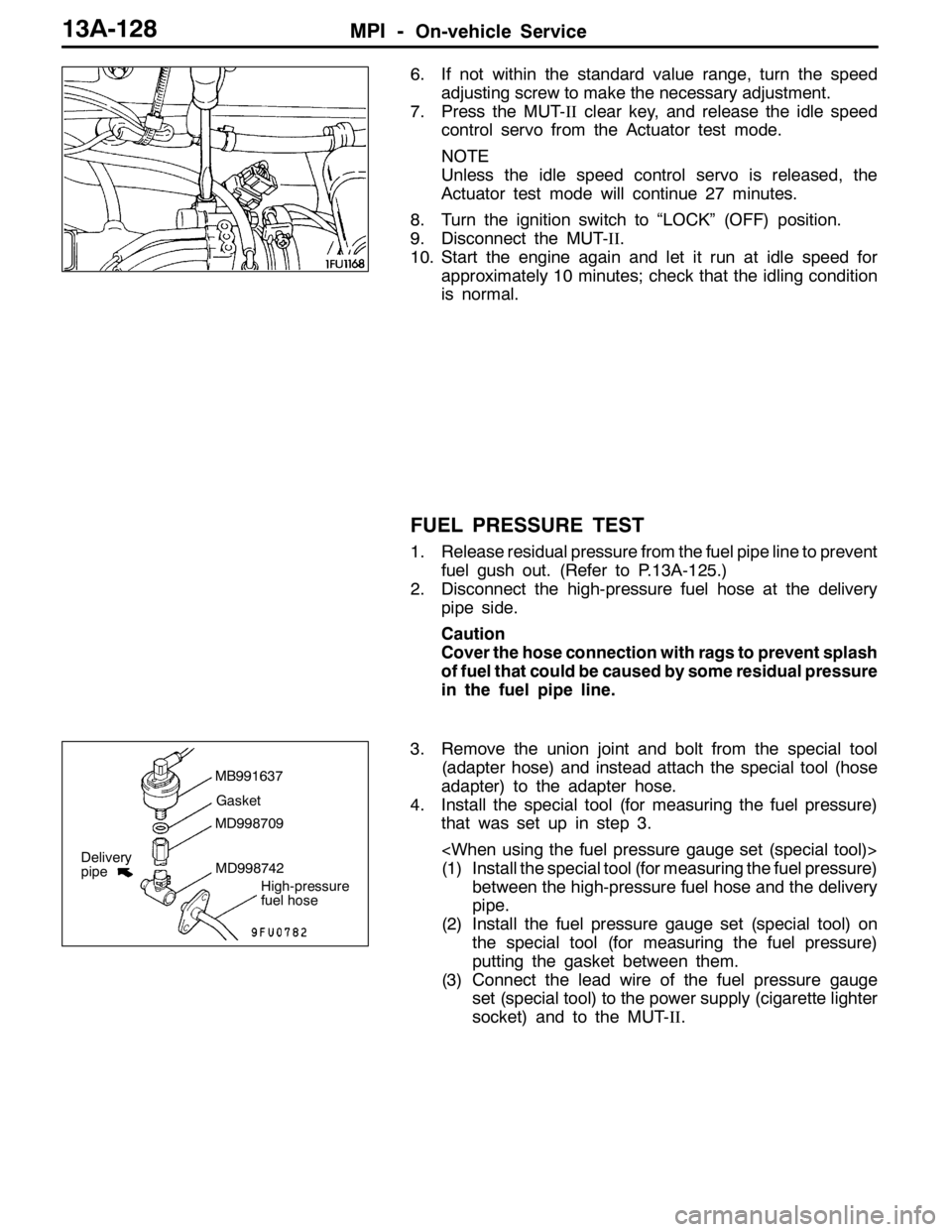
2. Disconnect the high-pressure fuel hose at the delivery
pipe side.
Caution
Cover the hose connection with rags to prevent splash
of fuel that could be caused by some residual pressure
in the fuel pipe line.
3. Remove the union joint and bolt from the special tool
(adapter hose) and instead attach the special tool (hose
adapter) to the adapter hose.
4. Install the special tool (for measuring the fuel pressure)
that was set up in step 3.
(1) Install the special tool (for measuring the fuel pressure)
between the high-pressure fuel hose and the delivery
pipe.
(2) Install the fuel pressure gauge set (special tool) on
the special tool (for measuring the fuel pressure)
putting the gasket between them.
(3) Connect the lead wire of the fuel pressure gauge
set (special tool) to the power supply (cigarette lighter
socket) and to the MUT-II.
MB991637
Gasket
MD998709
MD998742
High-pressure
fuel hose
Delivery
pipe
Page 661 of 1449

MPI -On-vehicle Service13A-129
(1) Install the fuel pressure gauge on the special tool
(for measuring the fuel pressure) putting a suitable
O-ring or gasket between them.
(2) Install the special tool which was set up in step (1)
between the high-pressure fuel hose and the delivery
pipe.
5. Connect the MUT-IIto the diagnosis connector.
6. Turn the ignition switch to “ON” position. (But do not start
the engine.)
7. Select “Item No. 07” from the MUT-IIActuator test to
drive the fuel pump. Check that there are no fuel leaks
from any parts.
8. Finish the actuator test or turn the ignition switch to “LOCK”
(OFF) position.
9. Start the engine and run at idle.
10. Measure fuel pressure while the engine is running at
idle.
Standard value: Approximately 230 kPa at cerb idle
11. Disconnect the vacuum hose from the fuel pressure
regulator and measure fuel pressure with the hose end
closed by a finger.
Standard value: 289 - 309 kPa at cerb idle
12. Check to see that fuel pressure at idle does not drop
even after the engine has been raced several times.
13. Racing the engine repeatedly, hold the fuel return hose
lightly with fingers to feel that fuel pressure is present
in the return hose.
NOTE
If the fuel flow rate is low, there will be no fuel pressure
in the return hose.Fuel pressure gauge set
O-ring or gasket
MD998709
MD998742
High-pressure
fuel hose
Delivery
pipe