engine NISSAN ALMERA N15 1995 Service Manual
[x] Cancel search | Manufacturer: NISSAN, Model Year: 1995, Model line: ALMERA N15, Model: NISSAN ALMERA N15 1995Pages: 1701, PDF Size: 82.27 MB
Page 1370 of 1701
HOWTOREAD WIRING DIAGRAMS
Description (Cont'd)
FOLDOUT PAGE
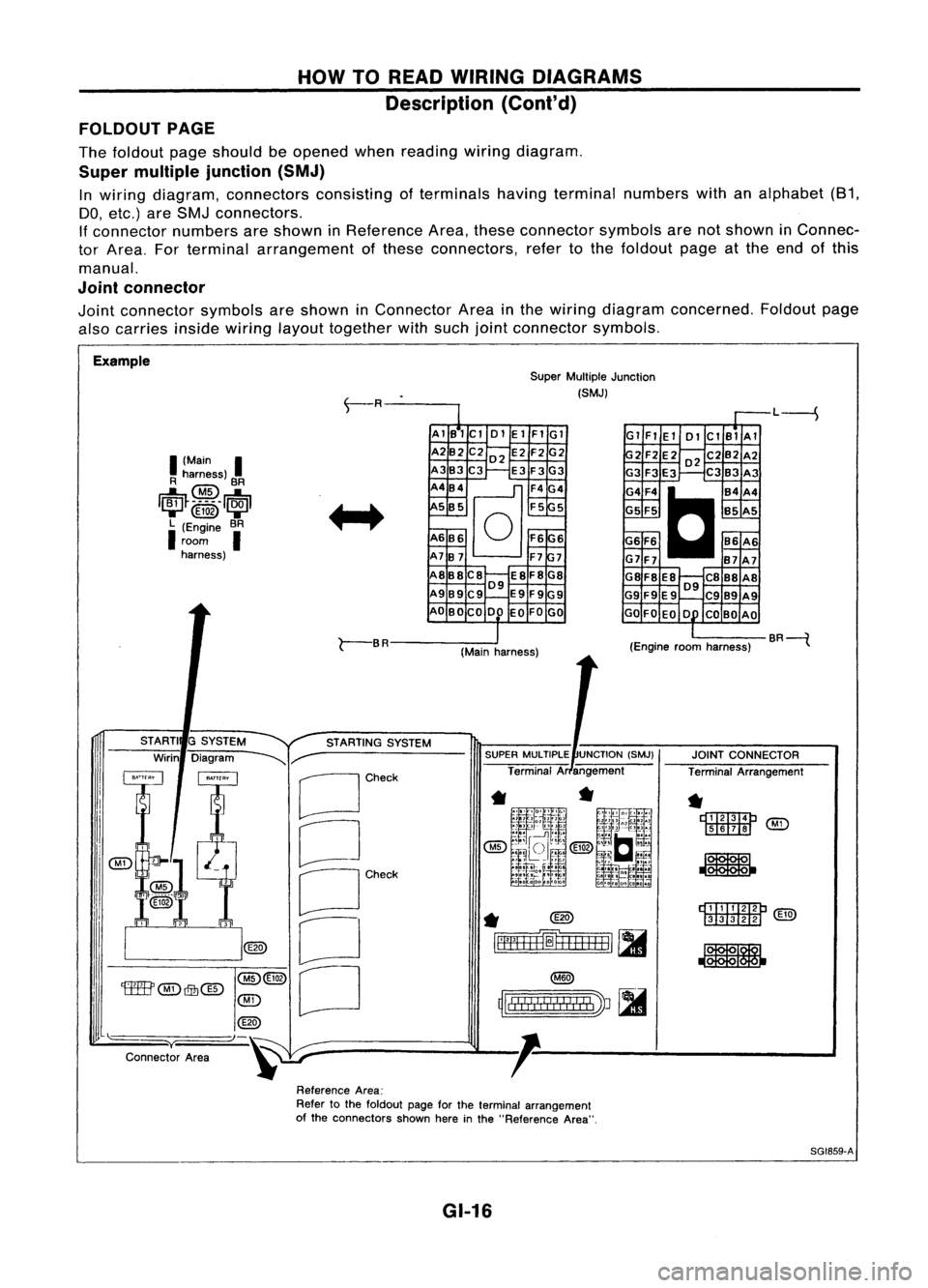
The foldout pageshould beopened whenreading wiringdiagram.
Super multiple junction (SMJ)
In wiring diagram, connectors consistingofterminals havingterminal numbers withanalphabet (81,
DO, etc.) areSMJ connectors.
If connector numbersareshown inReference Area,these connector symbolsarenotshown inConnec-
tor Area. Forterminal arrangement ofthese connectors, refertothe foldout pageatthe end ofthis
manual.
Joint connector
Joint connector symbolsareshown inConnector Areainthe wiring diagram concerned. Foldoutpage
also carries
insidewiring
layouttogether withsuch jointconnector symbols.
Example SuperMultiple Junction
(SMJ)
L----S
I
(Main
I
R harness)
@
BR
1~~_~_5 __
1~1
....... @ID .......
L (Engine BR
I
room
I
harness) AlB1Cl
01ElFIGl
A2B2 C202 E2F2G2
A3B3C3 E3F3G3
A4B4
@]
F4G4
5 B5 F55
A6B6
0
F6G6
A7B7 F77
A8B8C8 E8F8G8
09
A989C9 E9F9G9
AO BOCO DO EOFOGO Gl
FlEl 01ClBlAl
2F2E202C2B2A2
G3 F3E3 C3B3 A3
G4F4
C
B4A4
G5 F5 B5A5
G6 F6 86A6
G7F7 B7A7
G8F8 E8 C888A8
09
G9 F9E9 C989A9
GO FOEO 0 COBO AO
r-
BR
(Mainharness) (Engine
roomharness) BR----{
rDI.TI:IImP
[ill![ill]
@g)
JOINT
CONNECTOR
Terminal Arrangement
*
r::t::rrm::m:J
'M'i'
[ill]II!J ~
*
~
rll"
!! !
I
!
I II
!I
I
'J ~
~lllll!I!!lIllbV ~
SUPER
MULTIPLE UNCTION(SMJ)
Terminal Arangement
*
@)
~=fH+H=1
[II
STARTING
SYSTEM
G
SYSTEM
Diagram
~r-
[Jcheck
CJ
OCh~'
o
[J
STARTI
Wirin
@(3)
'tffB'
@)
Qfu@
@)
@
"-)-~
y
Connector Area
ReferenceArea:
Refer tothe foldout pageforthe terminal arrangement
of the connectors shownhereinthe "Reference Area".
SG1859-A
GI-16
Page 1371 of 1701
HOWTOREAD WIRING DIAGRAMS
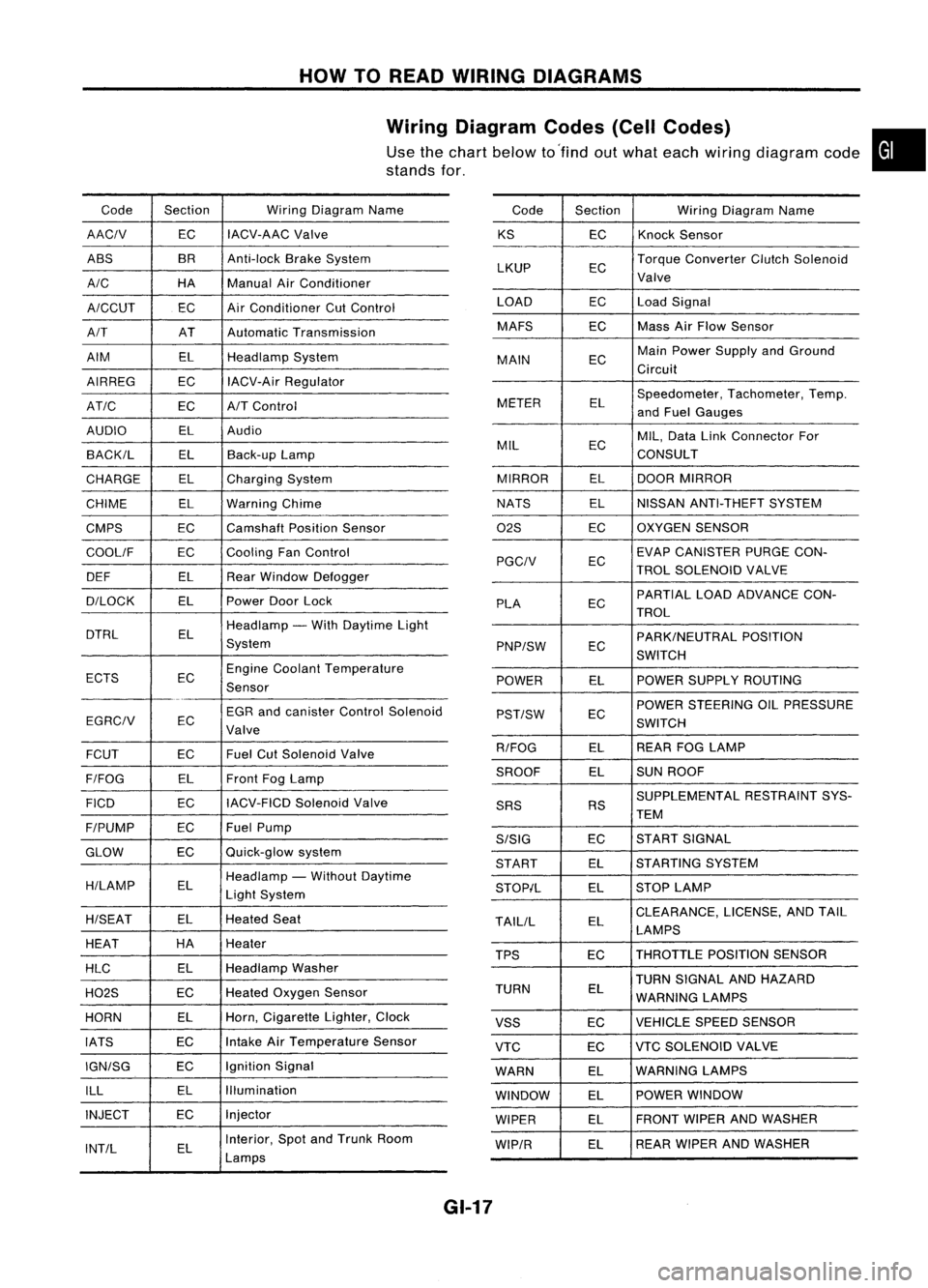
Wiring Diagram Codes(CellCodes)
Use thechart below to'find outwhat each wiring diagram code•
stands for,
Code Section WiringDiagram Name
AACIV ECIACV-AAC
Valve
ABS BR
Anti-lock BrakeSystem
A/C HAManualAirConditioner
A/CCUT ECAir
Conditioner CutControl
A/T ATAutomatic Transmission
AIM ELHeadlamp System
AIRREG ECIACV-Air Regulator
AT/C ECA/TControl
AUDIO ELAudio
BACK/L ELBack-up Lamp
CHARGE ELCharging System
CHIME ELWarning Chime
CMPS EC
Camshaft PositionSensor
COOllF ECCooling
FanControl
DEF ELRearWindow Defogger
D/LOCK ELPowerDoorLock
DTRL ELHeadlamp
-With Daytime Light
System
ECTS ECEngine
Coolant Temperature
Sensor
EGR andcanister ControlSolenoid
EGRCIV EC
Valve
FCUT ECFuel
CutSolenoid Valve
F/FOG ELFront
FogLamp
FICO ECIACV-FICD
SolenoidValve
F/PUMP ECFuel
Pump
GLOW ECQuick-glow
system
H/LAMP ELHeadlamp
-Without Daytime
Light System
H/SEAT ELHeated
Seat
HEAT HA
Heater
HLC ELHeadlamp
Washer
H02S ECHeated
Oxygen Sensor
HORN ELHorn,
Cigarette Lighter,Clock
IATS ECIntake
AirTemperature Sensor
IGN/SG ECIgnition
Signal
ILL ELIllumination
INJECT ECInjector
INT/L ELInterior,
SpotandTrunk Room
Lamps Code
Section WiringDiagram Name
KS ECKnock
Sensor
LKUP ECTorque
Converter ClutchSolenoid
Valve
LOAD ECLoadSignal
MAFS ECMass
AirFlow Sensor
MAIN ECMain
Power Supply andGround
Circuit
METER ELSpeedometer,
Tachometer,Temp.
and Fuel Gauges
MIL ECMIL,
Data LinkConnector For
CONSULT
MIRROR ELDOOR
MIRROR
NATS ELNISSAN
ANTI-THEFT SYSTEM
02S ECOXYGEN
SENSOR
EC EVAP
CANISTER PURGECON-
PGCIV TROLSOLENOID VALVE
PLA ECPARTIAL
LOADADVANCE CON-
TROL
EC PARK/NEUTRAL
POSITION
PNP/SW SWITCH
POWER ELPOWER
SUPPLY ROUTING
POWER STEERING OILPRESSURE
PST/SW EC
SWITCH
R/FOG ELREAR
FOGLAMP
SROOF ELSUN
ROOF
SUPPLEMENTAL RESTRAINTSYS-
SRS RS
TEM
S/SIG ECST
ART SIGNAL
START ELSTARTING
SYSTEM
STOP/L ELSTOP
LAMP
TAllIL ELCLEARANCE,
LICENSE,ANDTAIL
LAMPS
TPS ECTHROTTLE
POSITIONSENSOR
TURN SIGNAL ANDHAZARD
TURN EL
WARNING LAMPS
VSS ECVEHICLE
SPEEDSENSOR
VTC ECVTC
SOLENOID VALVE
WARN ELWARNING
LAMPS
WINDOW ELPOWER
WINDOW
WIPER ELFRONT
WIPERANDWASHER
WIP/R ELREAR
WIPER ANDWASHER
GI-17
Page 1372 of 1701
HOWTOPERFORM EFFICIENT DIAGNOSIS FORANELECTRICAL INCIDENT
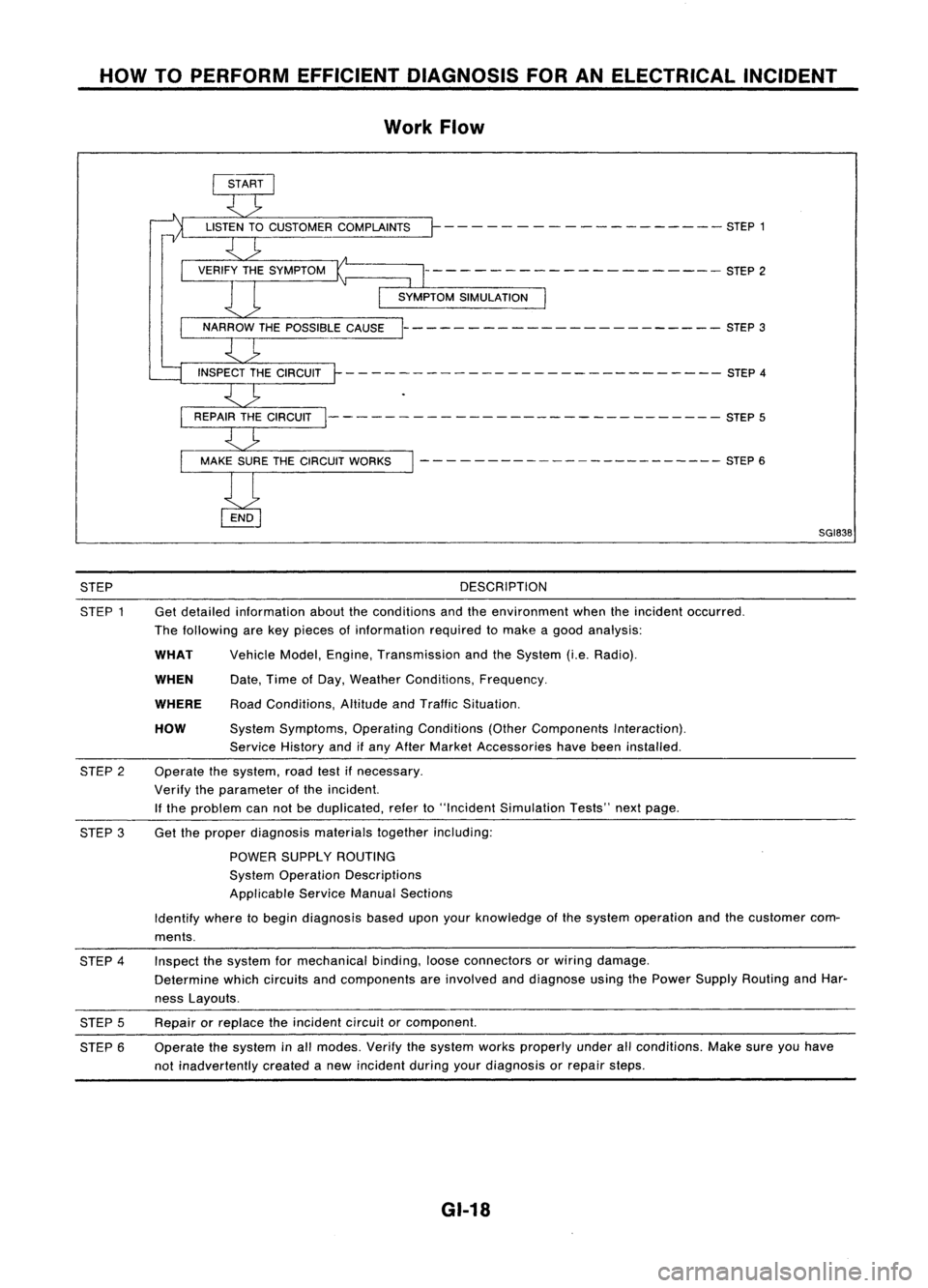
Work Flow
- - - -- - -- ------ -- - -- STEP 1
--------------------- STEP2
----------------------- STEP3
- - -- ---- - --- - -- --- --- - - --- -- STEP 4
--------- -------------------- STEP5
- - - - ---- -- -- -- -- -- --- --- STEP 6
SGI838
STEP
STEP 1 DESCRIPTION
Get detailed information abouttheconditions andtheenvironment whentheincident occurred.
The following arekey pieces ofinformation requiredtomake agood analysis:
HOW
WHEN
WHAT
WHERE
Vehicle
Model,Engine, Transmission andtheSystem (i.e.Radio).
Date, TimeofDay, Weather Conditions, Frequency.
Road Conditions, AltitudeandTraffic Situation.
System Symptoms, OperatingConditions (OtherComponents Interaction).
Service Historyandifany After Market Accessories havebeen installed.
Operate thesystem, roadtestifnecessary.
Verify theparameter ofthe incident.
If the problem cannotbeduplicated, referto"Incident Simulation Tests"nextpage.
STEP
2
STEP 3Get
theproper diagnosis materialstogetherincluding:
POWER SUPPLY ROUTING
System Operation Descriptions
Applicable ServiceManualSections
Identify wheretobegin diagnosis baseduponyourknowledge ofthe system operation andthecustomer com-
ments.
STEP 4
STEP 5
STEP 6 Inspect
thesystem formechanical binding,looseconnectors orwiring damage.
Determine whichcircuits andcomponents areinvolved anddiagnose usingthePower Supply Routing andHar-
ness Layouts.
Repair orreplace theincident circuitorcomponent.
Operate thesystem inall modes. Verifythesystem worksproperly underallconditions. Makesureyouhave
not inadvertently createdanew incident duringyourdiagnosis orrepair steps.
GI-18
Page 1373 of 1701
HOWTOPERFORM EFFICIENT DIAGNOSIS FORANELECTRICAL INCIDENT
Incident Simulation Tests
INTRODUCTION
Sometimes thesymptom isnot present whenthevehicle isbrought infor service.
If
possible, re-create
the conditions presentatthe time ofthe incident. Doingsomay help avoid aNo Trouble FoundDiag-
nosis. Thefollowing sectionillustrates waystosimulate theconditionslenvironment underwhich the
owner experiences anelectrical incident.
The section isbroken intothesixfollowing topics:
• Vehicle vibration
• Heat sensitive
• Freezing
• Water intrusion
• Electrical load
• Cold orhot start up
Get athorough description ofthe incident fromthecustomer. Itis important forsimulating thecondi-
tions ofthe problem.
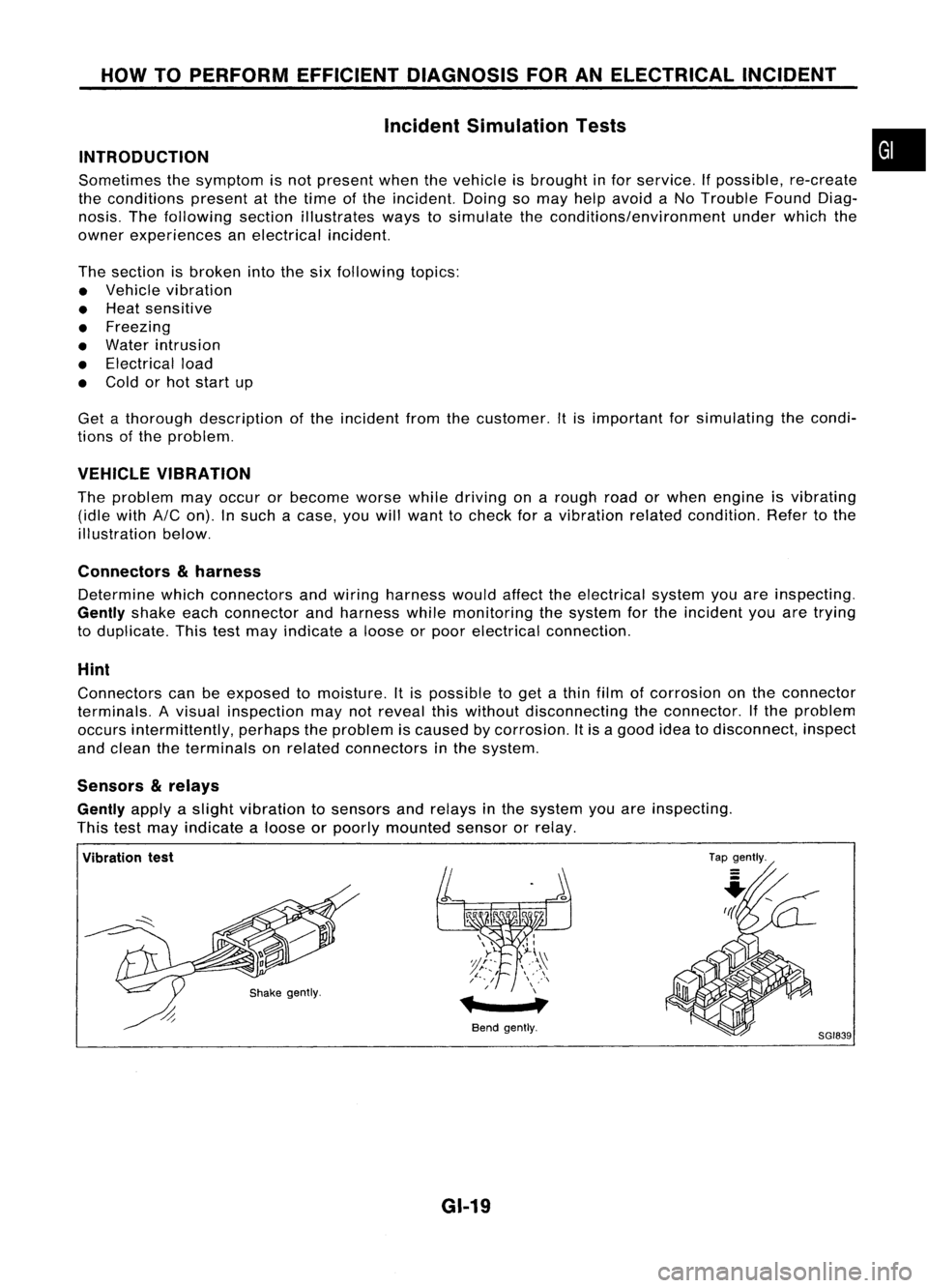
VEHICLE VIBRATION
The problem mayoccur orbecome worsewhiledriving onarough roadorwhen engine isvibrating
(idle with
AIC
on). Insuch acase, youwillwant tocheck foravibration relatedcondition. Refertothe
illustration below.
Connectors
&
harness
Determine whichconnectors andwiring harness wouldaffecttheelectrical systemyouareinspecting.
Gently
shakeeachconnector andharness whilemonitoring thesystem forthe incident youaretrying
to duplicate. Thistestmay indicate aloose orpoor electrical connection.
Hint
Connectors canbeexposed tomoisture. Itis possible toget athin film ofcorrosion onthe connector
terminals. Avisual inspection maynotreveal thiswithout disconnecting theconnector. Ifthe problem
occurs intermittently, perhapstheproblem iscaused bycorrosion. Itis agood ideatodisconnect, inspect
and clean theterminals onrelated connectors inthe system.
Sensors
&
relays
Gently
applyaslight vibration tosensors andrelays inthe system youareinspecting.
This testmay indicate aloose orpoorly mounted sensororrelay.
•
Vibration test
Bendgently.
GI-19
Tap
gently.
8GI839
Page 1375 of 1701
HOWTOPERFORM EFFICIENT DIAGNOSIS FORANELECTRICAL INCIDENT
Incident Simulation Tests(Cont'd)
Engine compartment
There areseveral reasons avehicle orengine vibration could•
cause anelectrical complaint. Someofthe things tocheck for
are:
• Connectors notfully seated.
• Wiring harness notlong enough andisbeing stressed due
to engine vibrations orrocking.
• Wires laying across brackets ormoving components.
• Loose, dirtyorcorroded groundwires.
• Wires routed tooclose tohot components.
To inspect components underthehood, startbyverifying the
integrity ofground connections. (RefertoGROUND INSPEC-
TION described later.)Firstcheck thatthesystem isproperly
grounded. Thencheck forloose connection by
gently shaking
the wiring orcomponents aspreviously explained. Usingthe
wiring diagrams inspectthewiring forcontinuity.
Behind theinstrument panel
An improperly routedorimproperly clampedharnesscan
become pinchedduringaccessory installation. Vehiclevibra-
tion canaggravate aharness whichisrouted alongabracket
or near ascrew.
Under seating areas
An unclamped orloose harness cancause wiring tobe pinched
by seat components (suchasslide guides) duringvehicle vibra-
tion. Ifthe wiring runsunder seating areas,inspect wirerout-
ing forpossible damageorpinching.
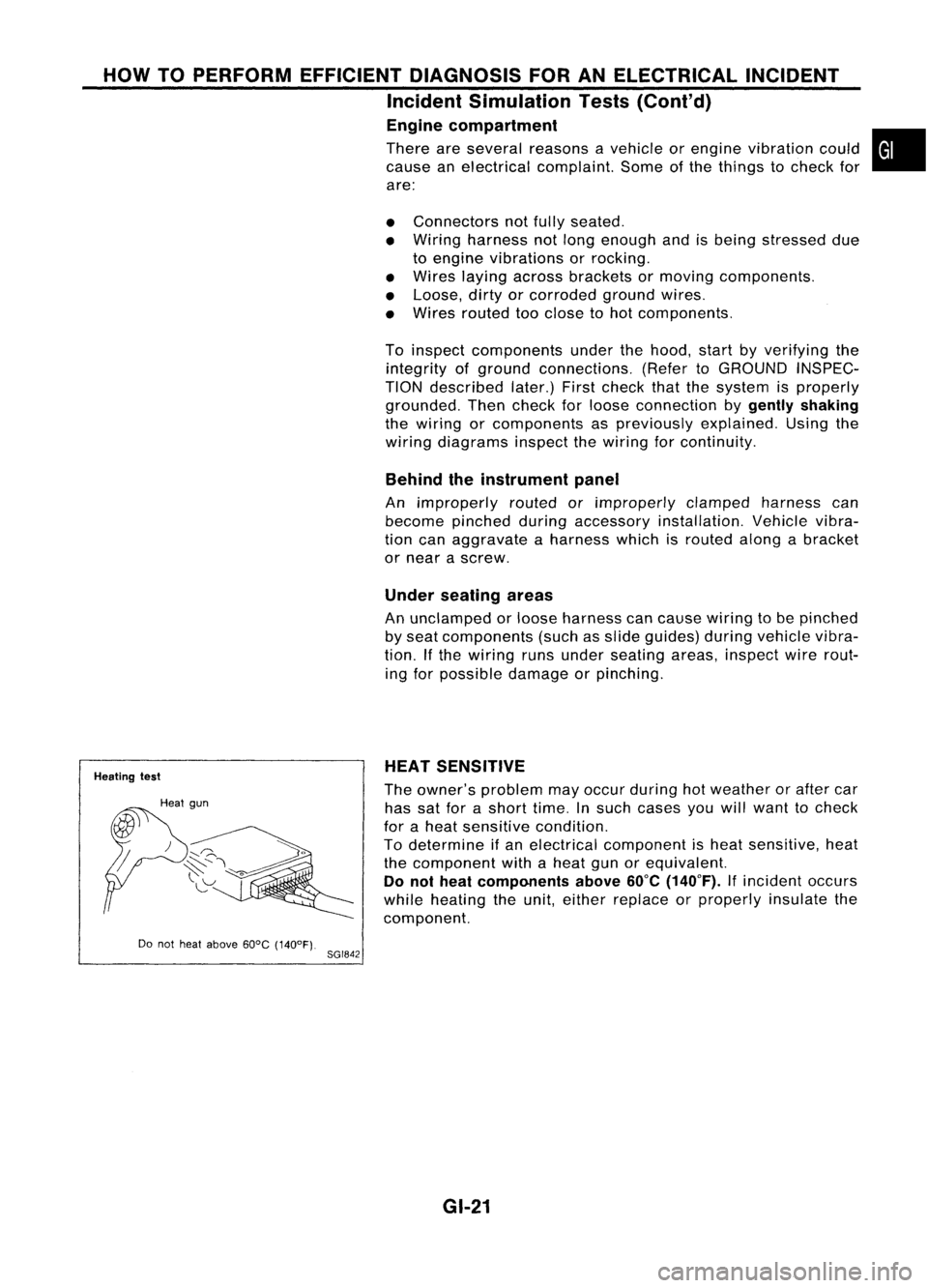
Heating test
Do not heat above 60°C(140°F).
8GI842 HEAT
SENSITIVE
The owner's problem mayoccur during hotweather orafter car
has satforashort time.Insuch cases youwillwant tocheck
for aheat sensitive condition.
To determine ifan electrical component isheat sensitive, heat
the component withaheat gunorequivalent.
Do not heat components above
60°C
(140°F).
Ifincident occurs
while heating theunit, either replace orproperly insulatethe
component.
GI-21
Page 1385 of 1701
HOWTOFOLLOW FLOWCHART INTROUBLE DIAGNOSES
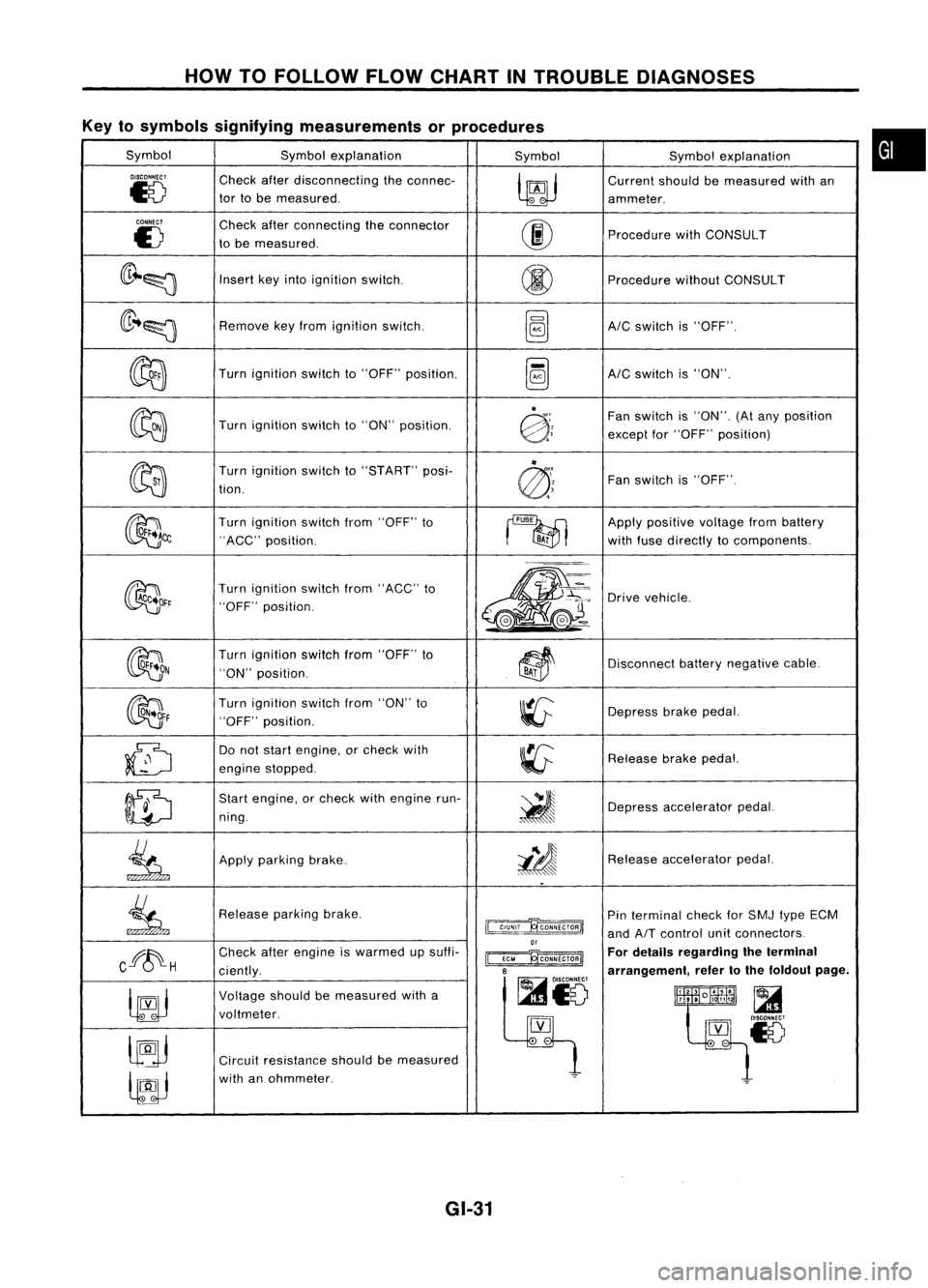
Key tosymbols signifying measurements orprocedures
Symbol Symbolexplanation
SymbolSymbolexplanation
DISCONNECT
Checkafterdisconnecting theconnec-
~
Current
shouldbemeasured withan
~8
tor
tobe measured.
ammeter.
CONNECT
Checkafterconnecting theconnector
00
E)
tobe measured. Procedure
withCONSULT
(lr~~
Insert
keyinto ignition switCh.
@
Procedure
withoutCONSULT
(lr ..~
Remove
keyfrom ignition switch.
~AIC
switch is"OFF".
~
Turn
ignition switchto"OFF" position.
~AIC
switch is"ON".
~
"
Fanswitch is"ON". (Atany position
Turn ignition switchto"ON" position.
@:;
exceptfor"OFF" position)
~ "
Turn ignition switchto"START" posi-
@'~
Fan
switch is"OFF".
tion.
~~
Turn
ignition switchfrom"OFF" to
~
Apply
positive voltagefrombattery
"ACC" position.
BA;
withfuse directly tocomponents.
~~r
Turn
ignition switchfrom"ACC" to
m-
~'~:
Drive
vehicle.
"OFF" position.
,.-=.
L
@J~ ..
~(e.-
OON
Turn
ignition switchfrom"OFF" to
~~
Disconnect
batterynegative cable.
"ON" position.
BAi
~F
Turn
ignition switchfrom"ON" to
~
Depress
brakepedal.
"OFF" position.
~
Do
not start engine, orcheck with
~
Release
brakepedal.
engine stopped.
ID
Start
engine, orcheck withengine run-
~
ning. Depress
accelerator pedal.
.
.
~
Apply
parking brake.
i!J
Release
accelerator pedal.
..
~
Release
parkingbrake.
~
Pin
terminal checkforSMJ typeECM
and
AIT
control unitconnectors
or
Cff~H
Check
afterengine iswarmed upsuffi-
~ For
details regarding theterminal
ciently.
B
arrangement,refertothe foldout page.
~io
~
Voltage
shouldbemeasured witha
lltlllliR~
t~~~18
voltmeter.
[YJ
lJ9j
.
-
Circuit resistance shouldbemeasured
lfJJ
with
anohmmeter.
~
GI-31
•
Page 1387 of 1701
IDENTIFICATIONINFORMATION
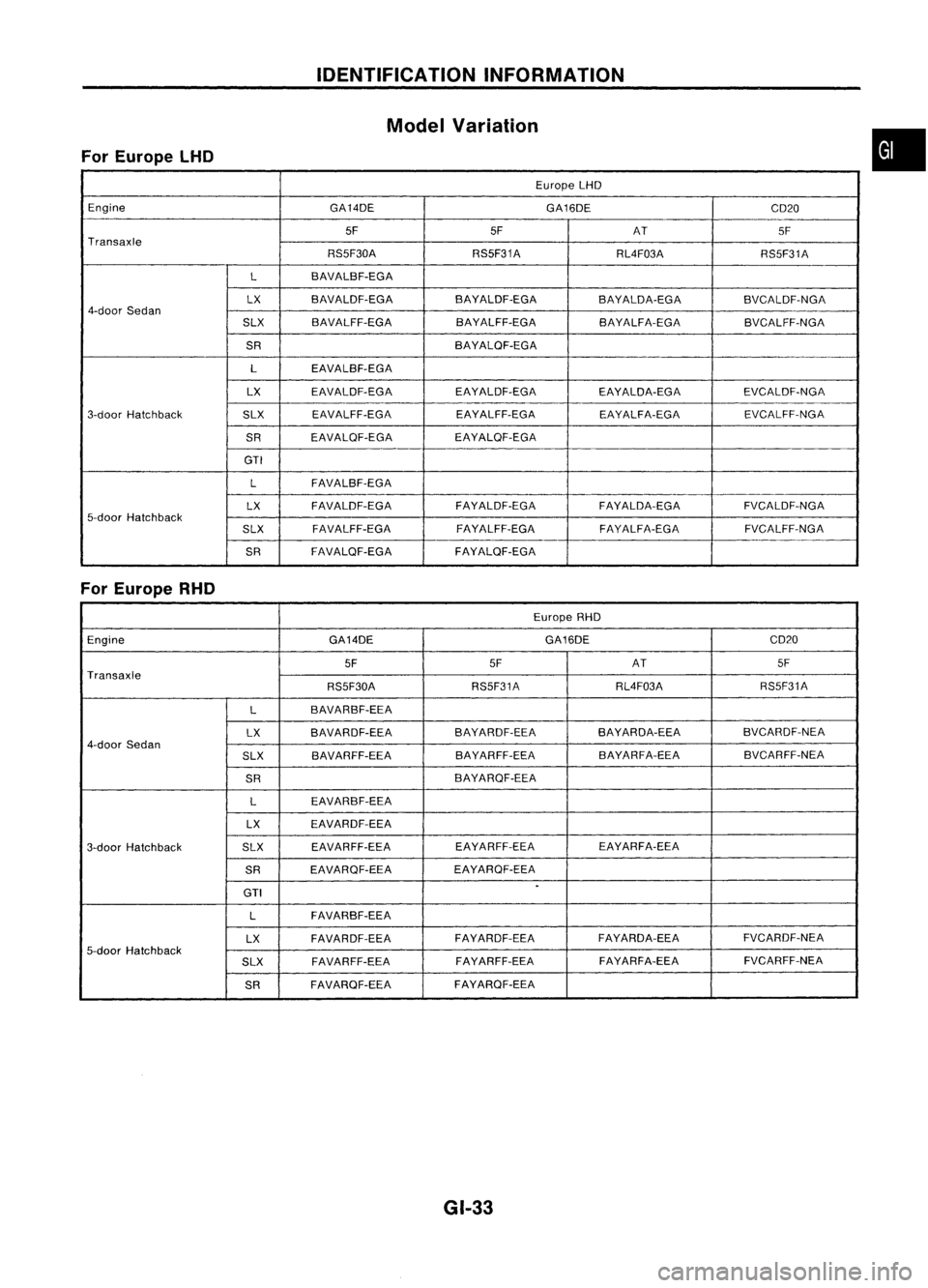
Model Variation
For Europe LHO
EuropeLHD
Engine GA14DEGA16DE
CD20
5F 5F
AT 5F
Transaxle
RS5F30ARSSF31A
RL4F03ARS5F31A
L BAVALBF-EGA
LX BAVALDF-EGA BAYALDF-EGA BAYALDA-EGA
BVCALDF-NGA
4-door Sedan
SLXBAVALFF-EGA
BAYALFF-EGA BAYALFA-EGA
BVCALFF-NGA
SR BA
YALQF-EGA
L EAVALBF-EGA
LX EAVALDF-EGA
EAYALDF-EGA EAYALDA-EGA EVCALDF-NGA
3-door Hatchback SLXEAVALFF-EGA EA
YALFF-EGA
EAYALFA-EGA EVCALFF-NGA
SR EAVALQF-EGA
EAYALQF-EGA
GTI L FAVALBF-EGA
LX FAVALDF-EGA
FAYALDF-EGAFAYALDA-EGA FVCALDF-NGA
5-door Hatchback
SLXFAVALFF-EGA
FAYALFF-EGA FAYALFA-EGA FVCALFF-NGA
SR FAVALQF-EGA
FAYALQF-EGA
For Europe RHO
EuropeRHD
Engine GA14DEGA16DE CD20
SF 5F
AT SF
Transaxle RS5F30ARS5F31A RL4F03ARS5F31A
L BAVARBF-EEA
LX BAVARDF-EEA
BAYARDF-EEA BA
YARDA-EEA BVCARDF-NEA
4-door Sedan
SLXBAVARFF-EEA BA
YARFF-EEA BAYARFA-EEA BVCARFF-NEA
SR BAYARQF-EEA
L EAVARBF-EEA
LX EAVARDF-EEA
3-door Hatchback SLXEAVARFF-EEA EAYARFF-EEA
EAYARFA-EEA
SR EAVARQF-EEA EA
YARQF-EEA
GTI
.
L FAVARBF-EEA
LX FAVARDF-EEA FAYARDF-EEAFAYARDA-EEA FVCARDF-NEA
5-door Hatchback
SLXFAVARFF-EEA FAYARFF-EEA
FAYARFA-EEA FVCARFF-NEA
SR FAVARQF-EEA
FAYARQF-EEA
GI-33
•
Page 1388 of 1701
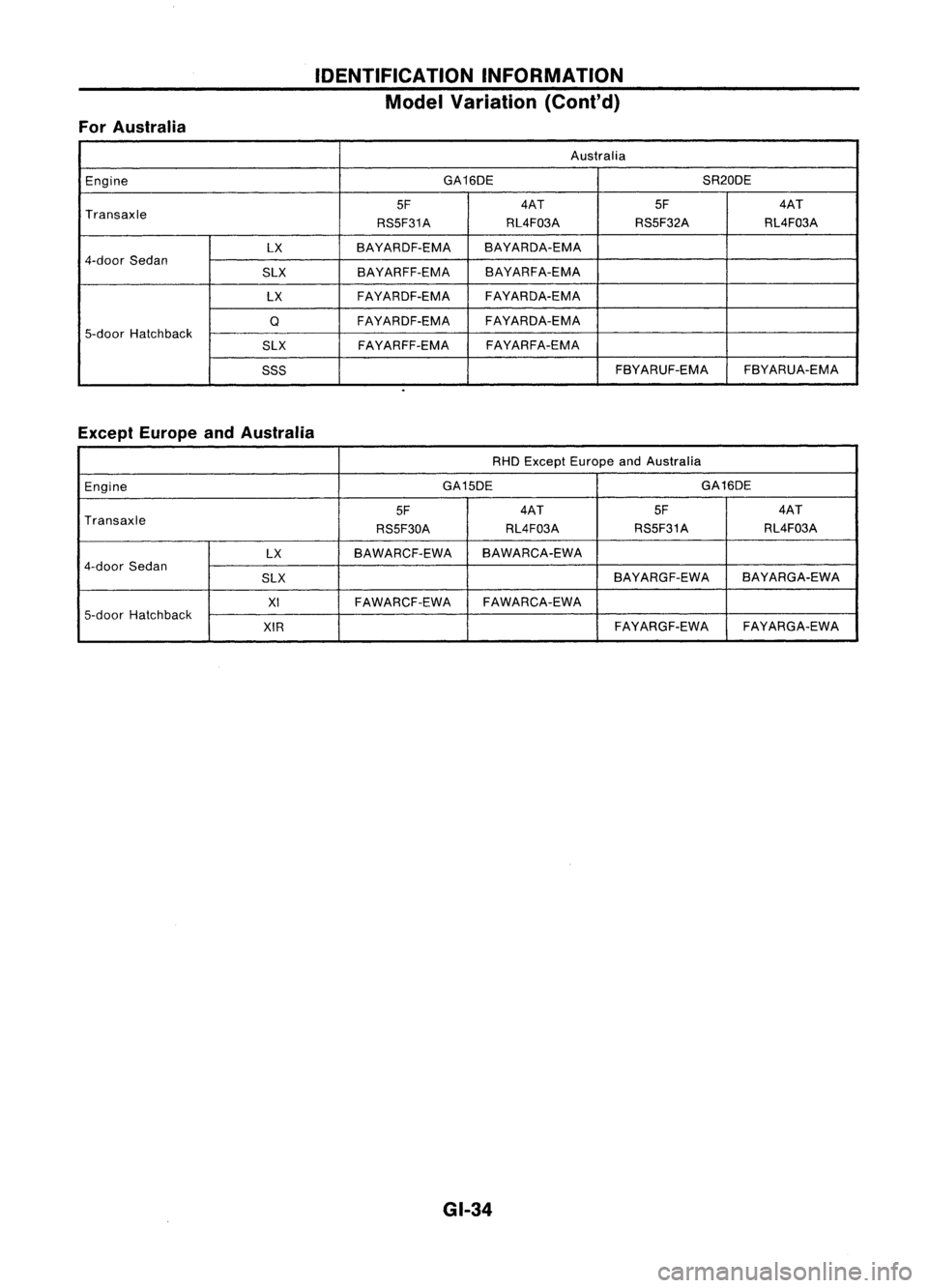
ForAustralia IDENTIFICATION
INFORMATION
Model Variation (Cont'd)
Australia
Engine GA16DE
SR20DE
Transaxle 5F
4AT
5F4AT
RS5F31A RL4F03A
RS5F32A RL4F03A
LX BAYARDF-EMA BA
YARDA-EMA
4-door Sedan
SLXBA
YARFF-EMA BAYARFA-EMA
LX FAYARDF-EMA FAYARDA-EMA
Q FAYARDF-EMA FAYARDA-EMA
5-door Hatchback
SLXFAYARFF-EMA
FAYARFA-EMA
SSS FBYARUF-EMA
FBYARUA-EMA
Except Europe andAustralia
RHDExcept Europe andAustralia
Engine GA15DE
GA16DE
5F 4AT
5F4AT
Transaxle RS5F30ARL4F03ARS5F31A RL4F03A
LX BAWARCF-EWA BAWARCA-EWA
4-door Sedan
SLX BAYARGF-EWA
BAYARGA-EWA
XI FAWARCF-EWA
FAWARCA-EWA
5-door Hatchback
XIR FAYARGF-EWA
FAYARGA-EWA
GI-34
Page 1389 of 1701
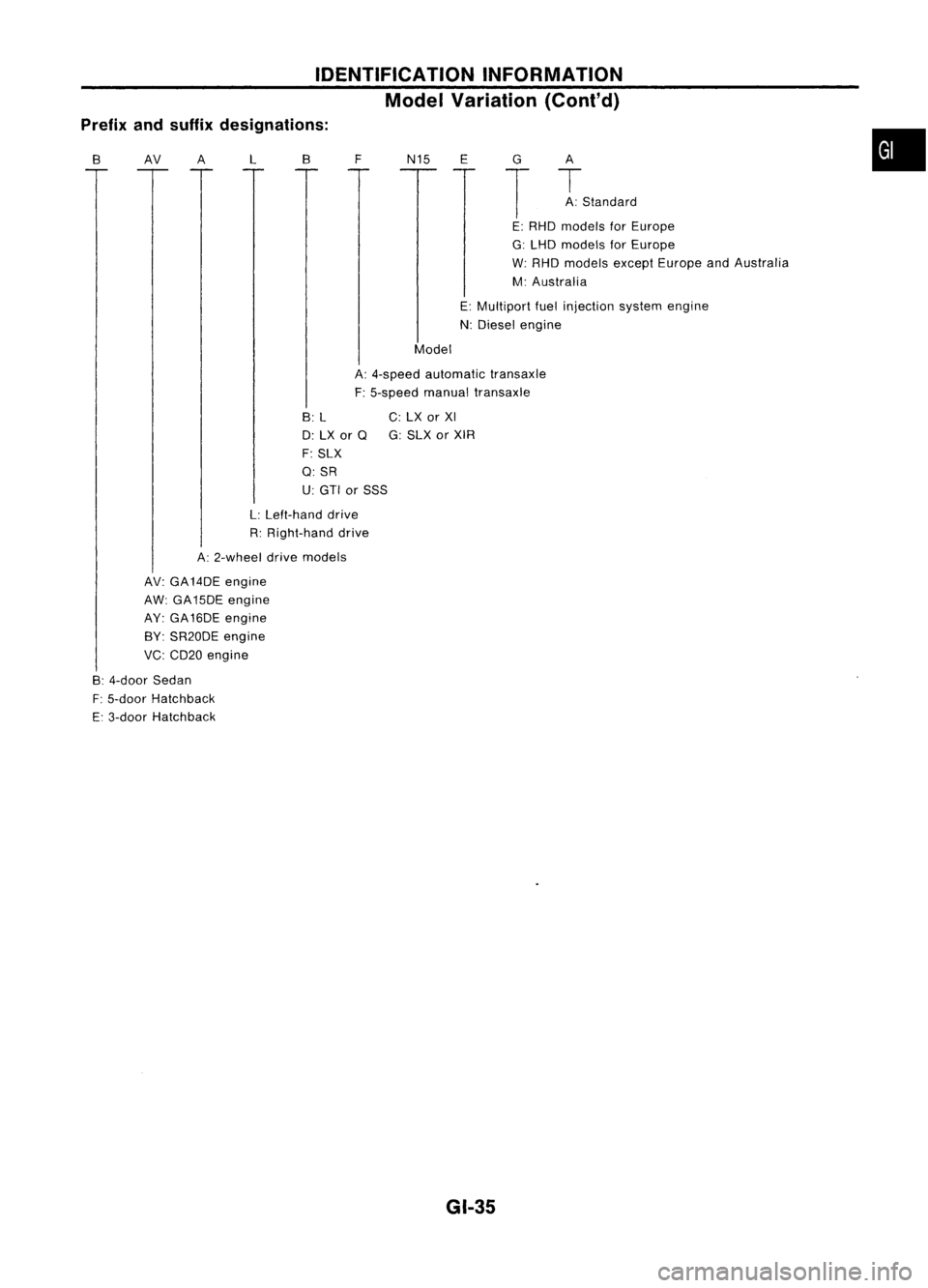
IDENTIFICATIONINFORMATION
Model Variation (Cont'd)
Prefix andsuffix designations:
B
AV
A
L
B
FN15
E
G
T
A
T
A: Standard
•
Model E:
RHO models forEurope
G: LHD models forEurope
W: RHO models exceptEurope andAustralia
M: Australia
E: Multiport fuelinjection systemengine
N: Diesel engine
A: 4-speed automatic transaxle
F: 5-speed manualtransaxle
B: L
0: LX or
Q
F: SLX
Q:SR
U: GTI orSSS
L: Left-hand drive
R: Right-hand drive
A: 2-wheel drivemodels
AV: GA14DE engine
AW: GA15DE engine
AY: GA16DE engine
BY: SR20DE engine
VC: CD20 engine
B: 4-door Sedan
F: 5-door Hatchback
E: 3-door Hatchback C:
LX orXI
G: SLX orXIR
GI-35
Page 1390 of 1701
IDENTIFICATIONINFORMATION
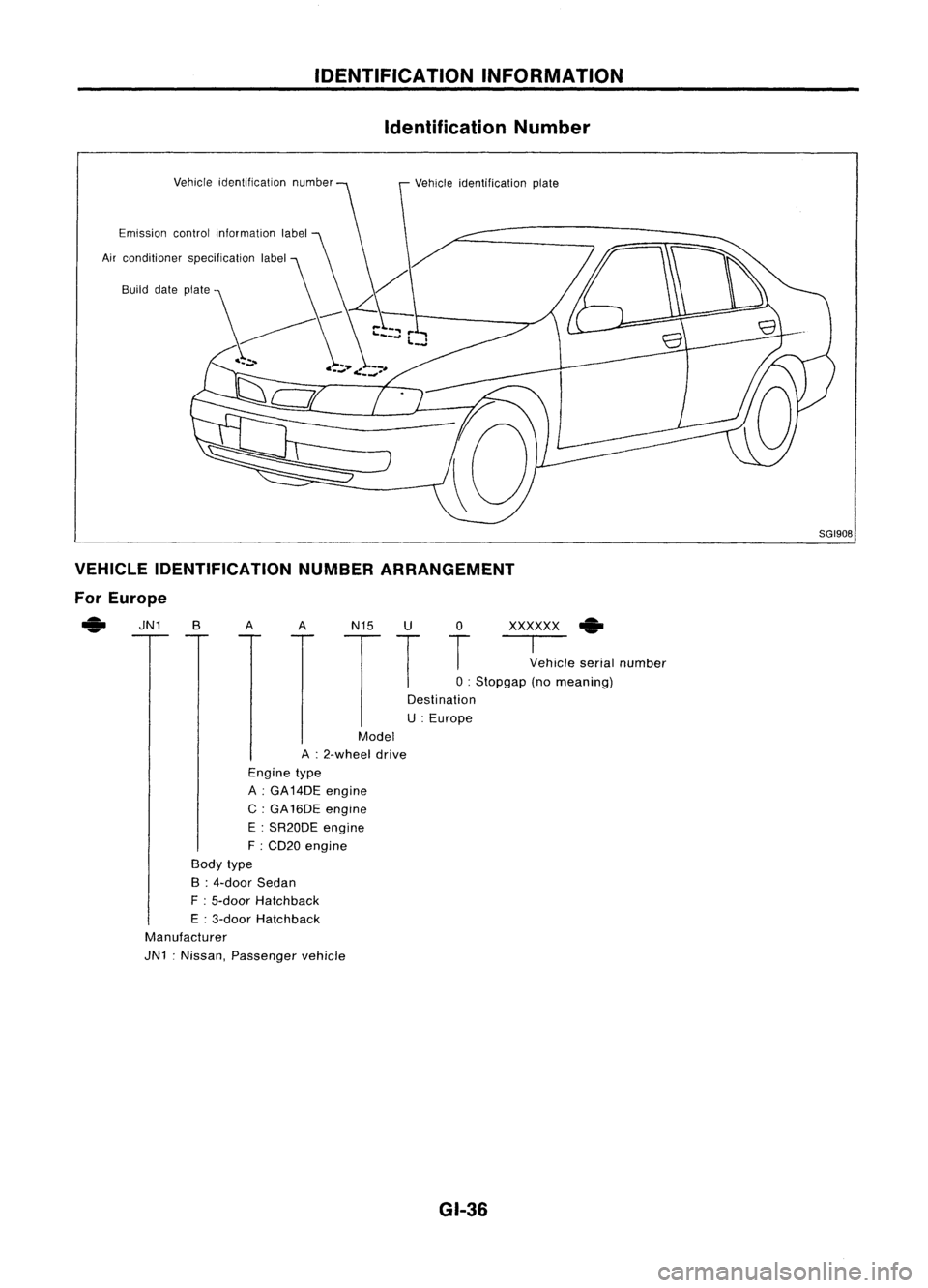
Identification Number
Vehicle identification number
Emission controlinformation label Vehicle
identification plate
SGI908
VEHICLE IDENTIFICATION NUMBERARRANGEMENT
For Europe
:
JN1
B
A
A
N15U0
xxxxxx ..
T
T
T
~ehicleserialnumber
o :
Stopgap (nomeaning)
Destination
U :Europe
Model
A :2-wheel drive
Engine type
A: GA14DE engine
C :GA 16DE engine
E :SR20DE engine
F :CD20 engine
Body type
B :4-door Sedan
F :5-door Hatchback
E :3-door Hatchback
Manufacturer
JN1 :Nissan, Passenger vehicle
GI-36