check engine NISSAN PRIMERA 1999 Electronic Repair Manual
[x] Cancel search | Manufacturer: NISSAN, Model Year: 1999, Model line: PRIMERA, Model: NISSAN PRIMERA 1999Pages: 2267, PDF Size: 35.74 MB
Page 1638 of 2267
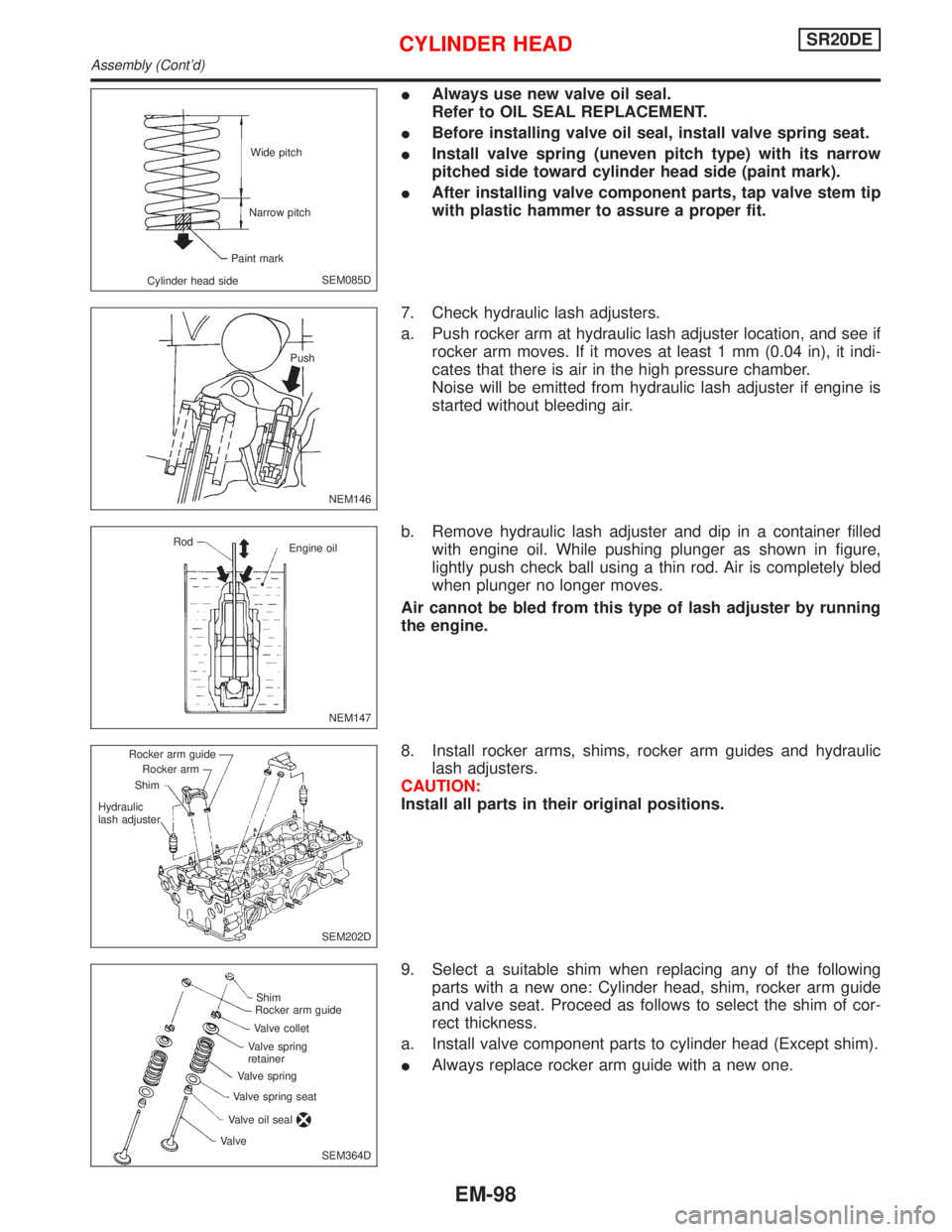
IAlways use new valve oil seal.
Refer to OIL SEAL REPLACEMENT.
IBefore installing valve oil seal, install valve spring seat.
IInstall valve spring (uneven pitch type) with its narrow
pitched side toward cylinder head side (paint mark).
IAfter installing valve component parts, tap valve stem tip
with plastic hammer to assure a proper fit.
7. Check hydraulic lash adjusters.
a. Push rocker arm at hydraulic lash adjuster location, and see if
rocker arm moves. If it moves at least 1 mm (0.04 in), it indi-
cates that there is air in the high pressure chamber.
Noise will be emitted from hydraulic lash adjuster if engine is
started without bleeding air.
b. Remove hydraulic lash adjuster and dip in a container filled
with engine oil. While pushing plunger as shown in figure,
lightly push check ball using a thin rod. Air is completely bled
when plunger no longer moves.
Air cannot be bled from this type of lash adjuster by running
the engine.
8. Install rocker arms, shims, rocker arm guides and hydraulic
lash adjusters.
CAUTION:
Install all parts in their original positions.
9. Select a suitable shim when replacing any of the following
parts with a new one: Cylinder head, shim, rocker arm guide
and valve seat. Proceed as follows to select the shim of cor-
rect thickness.
a. Install valve component parts to cylinder head (Except shim).
IAlways replace rocker arm guide with a new one.
SEM085D Wide pitch
Narrow pitch
Paint mark
Cylinder head side
NEM146 Push
NEM147 Rod
Engine oil
SEM202D Rocker arm guide
Rocker arm
Shim
Hydraulic
lash adjuster
SEM364D Shim
Rocker arm guide
Valve collet
Valve spring
retainer
Valve spring
Valve spring seat
Valve oil sealValve
CYLINDER HEADSR20DE
Assembly (Cont'd)
EM-98
Page 1652 of 2267
CYLINDER BLOCK DISTORTION AND WEAR
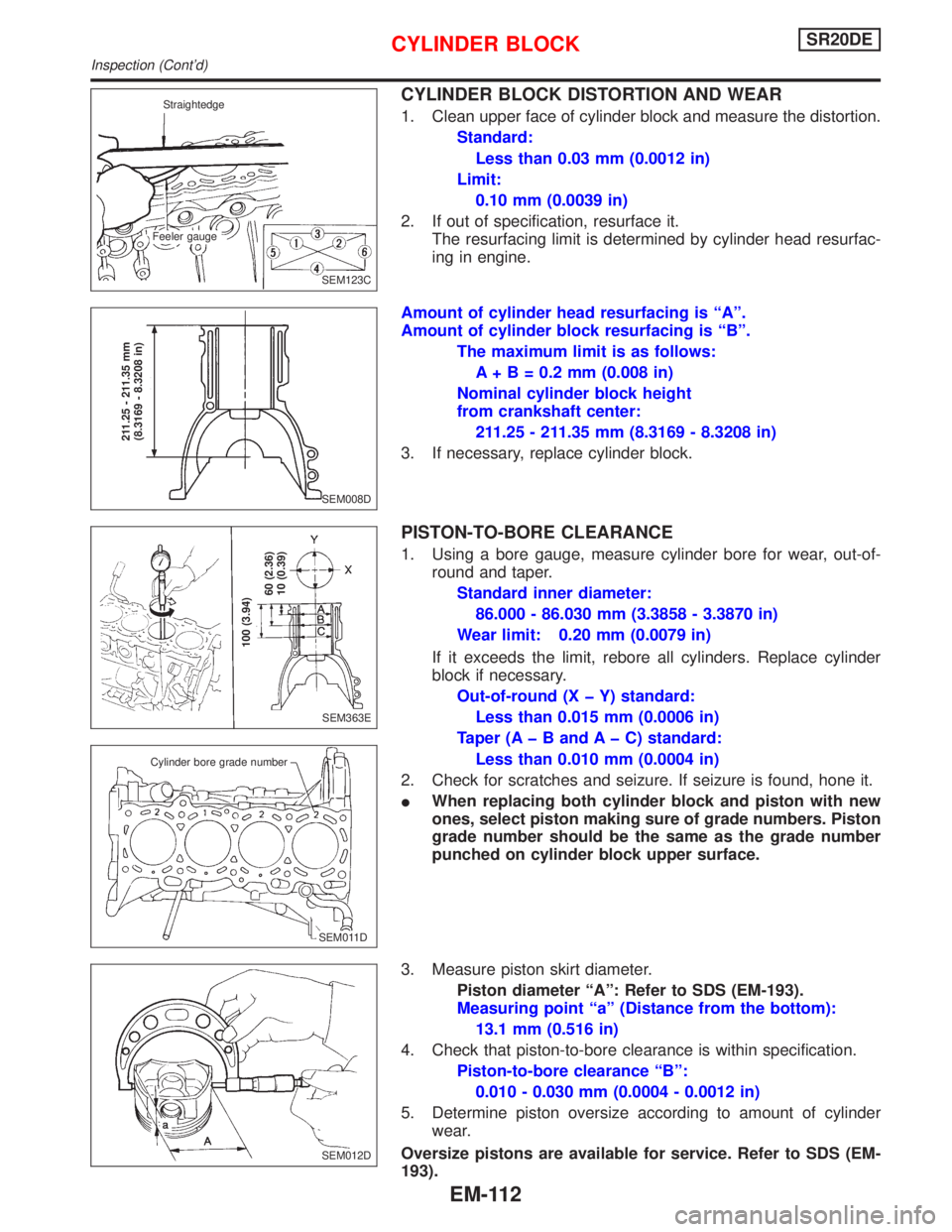
1. Clean upper face of cylinder block and measure the distortion.
Standard:
Less than 0.03 mm (0.0012 in)
Limit:
0.10 mm (0.0039 in)
2. If out of specification, resurface it.
The resurfacing limit is determined by cylinder head resurfac-
ing in engine.
Amount of cylinder head resurfacing is ªAº.
Amount of cylinder block resurfacing is ªBº.
The maximum limit is as follows:
A + B = 0.2 mm (0.008 in)
Nominal cylinder block height
from crankshaft center:
211.25 - 211.35 mm (8.3169 - 8.3208 in)
3. If necessary, replace cylinder block.
PISTON-TO-BORE CLEARANCE
1. Using a bore gauge, measure cylinder bore for wear, out-of-
round and taper.
Standard inner diameter:
86.000 - 86.030 mm (3.3858 - 3.3870 in)
Wear limit: 0.20 mm (0.0079 in)
If it exceeds the limit, rebore all cylinders. Replace cylinder
block if necessary.
Out-of-round (X þ Y) standard:
Less than 0.015 mm (0.0006 in)
Taper (A þ B and A þ C) standard:
Less than 0.010 mm (0.0004 in)
2. Check for scratches and seizure. If seizure is found, hone it.
IWhen replacing both cylinder block and piston with new
ones, select piston making sure of grade numbers. Piston
grade number should be the same as the grade number
punched on cylinder block upper surface.
3. Measure piston skirt diameter.
Piston diameter ªAº: Refer to SDS (EM-193).
Measuring point ªaº (Distance from the bottom):
13.1 mm (0.516 in)
4. Check that piston-to-bore clearance is within specification.
Piston-to-bore clearance ªBº:
0.010 - 0.030 mm (0.0004 - 0.0012 in)
5. Determine piston oversize according to amount of cylinder
wear.
Oversize pistons are available for service. Refer to SDS (EM-
193).
SEM123C Straightedge
Feeler gauge
SEM008D
211.25 - 211.35 mm
(8.3169 - 8.3208 in)
SEM363E
100 (3.94)
60 (2.36)
10 (0.39)
.SEM011D
Cylinder bore grade number
SEM012D
CYLINDER BLOCKSR20DE
Inspection (Cont'd)
EM-112
Page 1662 of 2267
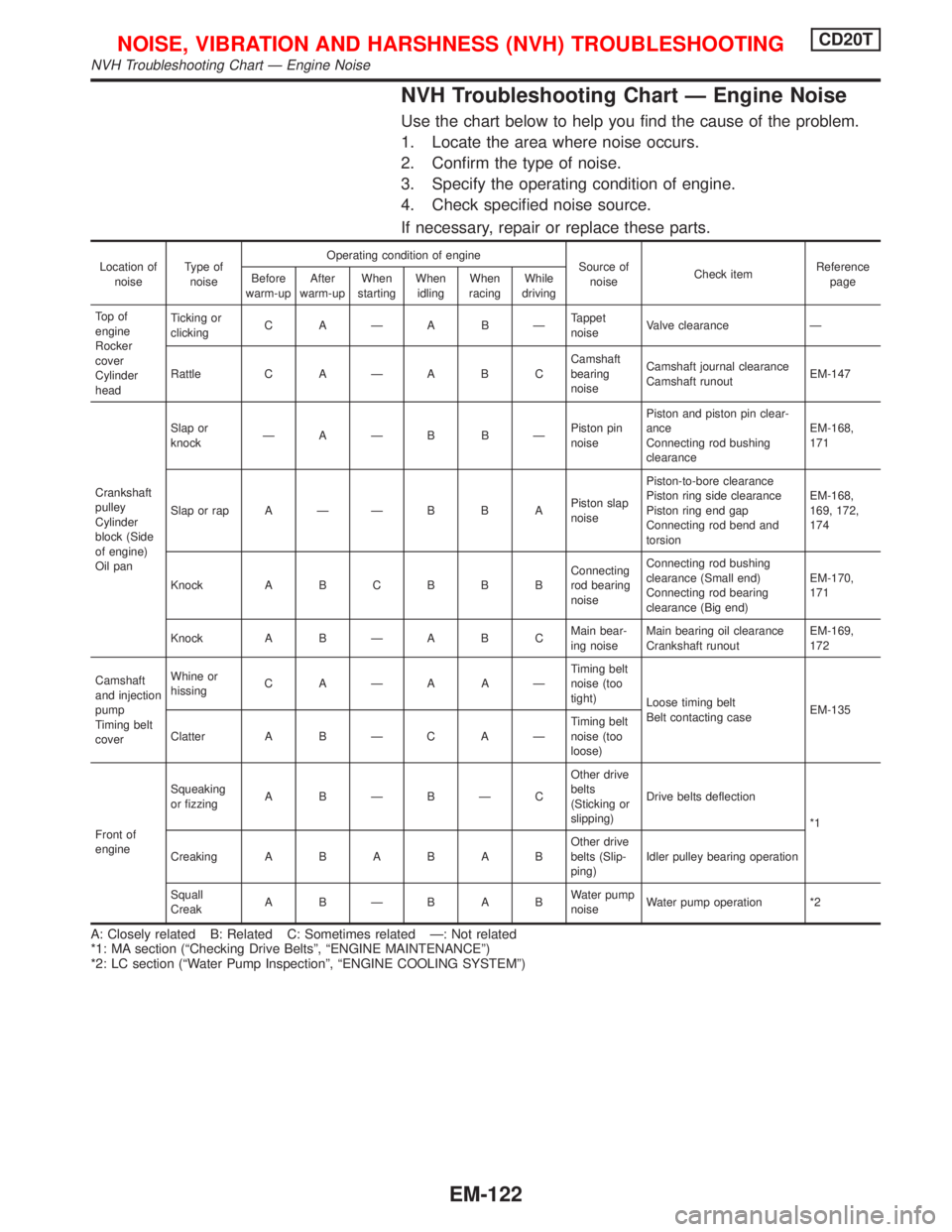
NVH Troubleshooting Chart Ð Engine Noise
Use the chart below to help you find the cause of the problem.
1. Locate the area where noise occurs.
2. Confirm the type of noise.
3. Specify the operating condition of engine.
4. Check specified noise source.
If necessary, repair or replace these parts.
Location of
noiseType of
noiseOperating condition of engine
Source of
noiseCheck itemReference
page Before
warm-upAfter
warm-upWhen
startingWhen
idlingWhen
racingWhile
driving
To p o f
engine
Rocker
cover
Cylinder
headTicking or
clickingCAÐABÐTappet
noiseValve clearance Ð
Rattle C A Ð A B CCamshaft
bearing
noiseCamshaft journal clearance
Camshaft runoutEM-147
Crankshaft
pulley
Cylinder
block (Side
of engine)
Oil panSlap or
knockÐAÐB BÐPiston pin
noisePiston and piston pin clear-
ance
Connecting rod bushing
clearanceEM-168,
171
Slap or rap A Ð Ð B B APiston slap
noisePiston-to-bore clearance
Piston ring side clearance
Piston ring end gap
Connecting rod bend and
torsionEM-168,
169, 172,
174
Knock A B C B B BConnecting
rod bearing
noiseConnecting rod bushing
clearance (Small end)
Connecting rod bearing
clearance (Big end)EM-170,
171
Knock A B Ð A B CMain bear-
ing noiseMain bearing oil clearance
Crankshaft runoutEM-169,
172
Camshaft
and injection
pump
Timing belt
coverWhine or
hissingCAÐAAÐTiming belt
noise (too
tight)
Loose timing belt
Belt contacting caseEM-135
Clatter A B Ð C A ÐTiming belt
noise (too
loose)
Front of
engineSqueaking
or fizzingABÐBÐCOther drive
belts
(Sticking or
slipping)Drive belts deflection
*1
CreakingABABABOther drive
belts (Slip-
ping)Idler pulley bearing operation
Squall
CreakABÐBABWater pump
noiseWater pump operation *2
A: Closely related B: Related C: Sometimes related Ð: Not related
*1: MA section (ªChecking Drive Beltsº, ªENGINE MAINTENANCEº)
*2: LC section (ªWater Pump Inspectionº, ªENGINE COOLING SYSTEMº)
NOISE, VIBRATION AND HARSHNESS (NVH) TROUBLESHOOTINGCD20T
NVH Troubleshooting Chart Ð Engine Noise
EM-122
Page 1673 of 2267
Inspection
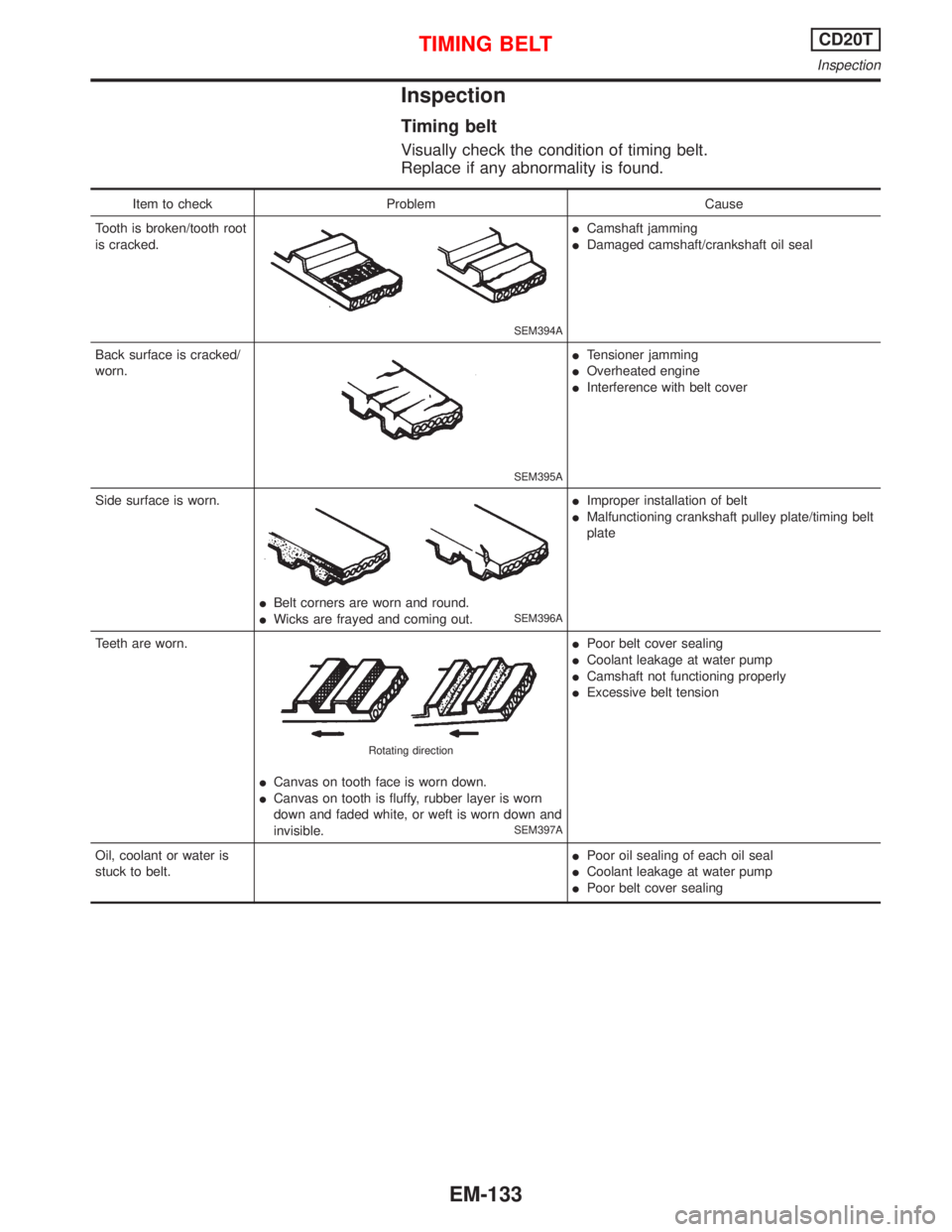
Timing belt
Visually check the condition of timing belt.
Replace if any abnormality is found.
Item to check Problem Cause
Tooth is broken/tooth root
is cracked.
SEM394A
ICamshaft jamming
IDamaged camshaft/crankshaft oil seal
Back surface is cracked/
worn.
SEM395A
ITensioner jamming
IOverheated engine
IInterference with belt cover
Side surface is worn.
IBelt corners are worn and round.
IWicks are frayed and coming out.SEM396A
IImproper installation of belt
IMalfunctioning crankshaft pulley plate/timing belt
plate
Teeth are worn.
ICanvas on tooth face is worn down.
ICanvas on tooth is fluffy, rubber layer is worn
down and faded white, or weft is worn down and
invisible.
SEM397A Rotating direction
IPoor belt cover sealing
ICoolant leakage at water pump
ICamshaft not functioning properly
IExcessive belt tension
Oil, coolant or water is
stuck to belt.IPoor oil sealing of each oil seal
ICoolant leakage at water pump
IPoor belt cover sealing
TIMING BELTCD20T
Inspection
EM-133
Page 1688 of 2267
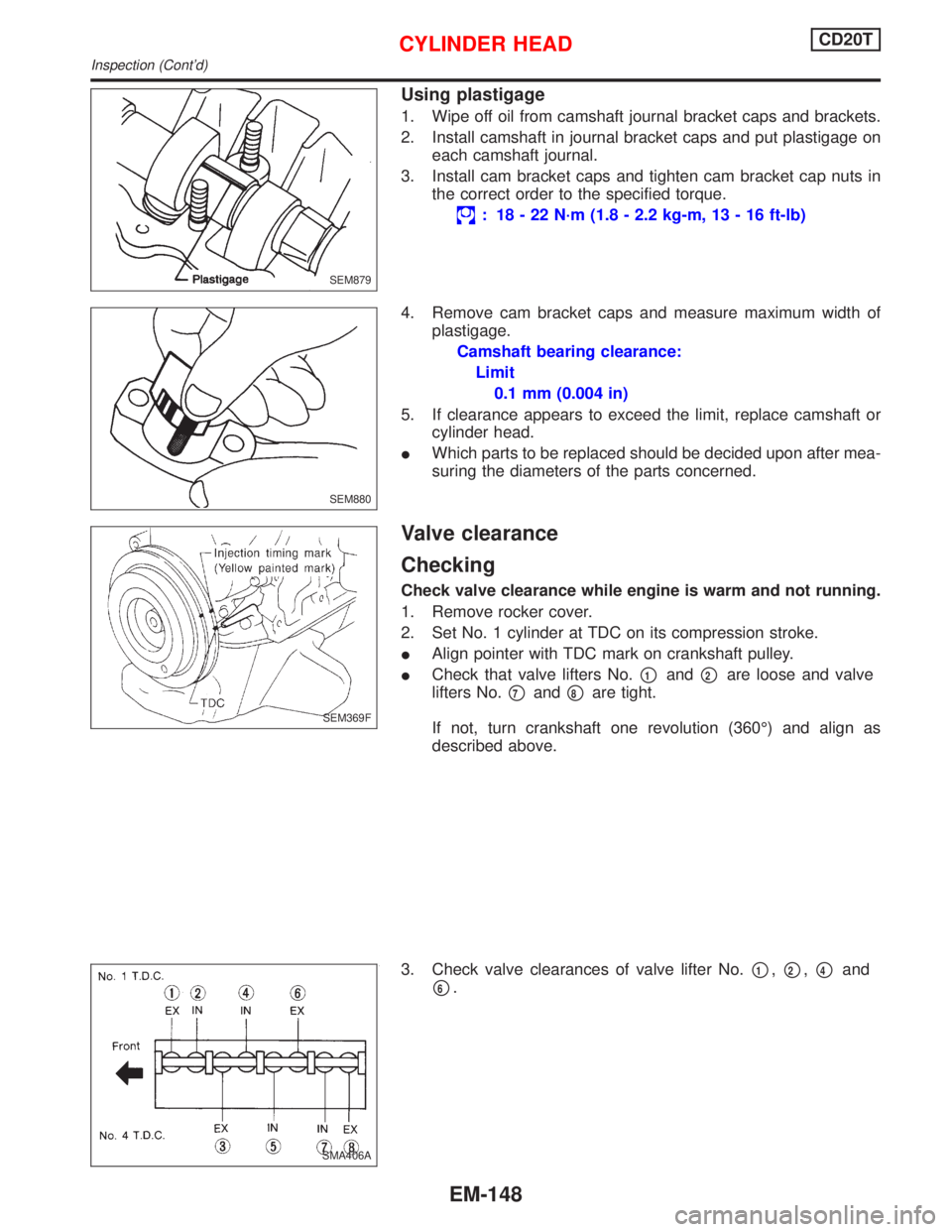
Using plastigage
1. Wipe off oil from camshaft journal bracket caps and brackets.
2. Install camshaft in journal bracket caps and put plastigage on
each camshaft journal.
3. Install cam bracket caps and tighten cam bracket cap nuts in
the correct order to the specified torque.
: 18 - 22 N´m (1.8 - 2.2 kg-m, 13 - 16 ft-lb)
4. Remove cam bracket caps and measure maximum width of
plastigage.
Camshaft bearing clearance:
Limit
0.1 mm (0.004 in)
5. If clearance appears to exceed the limit, replace camshaft or
cylinder head.
IWhich parts to be replaced should be decided upon after mea-
suring the diameters of the parts concerned.
Valve clearance
Checking
Check valve clearance while engine is warm and not running.
1. Remove rocker cover.
2. Set No. 1 cylinder at TDC on its compression stroke.
IAlign pointer with TDC mark on crankshaft pulley.
ICheck that valve lifters No.
p1andp2are loose and valve
lifters No.
p7andp8are tight.
If not, turn crankshaft one revolution (360É) and align as
described above.
3. Check valve clearances of valve lifter No.
p1,p2,p4and
p6.
SEM879
SEM880
SEM369F
SMA406A
CYLINDER HEADCD20T
Inspection (Cont'd)
EM-148
Page 1689 of 2267
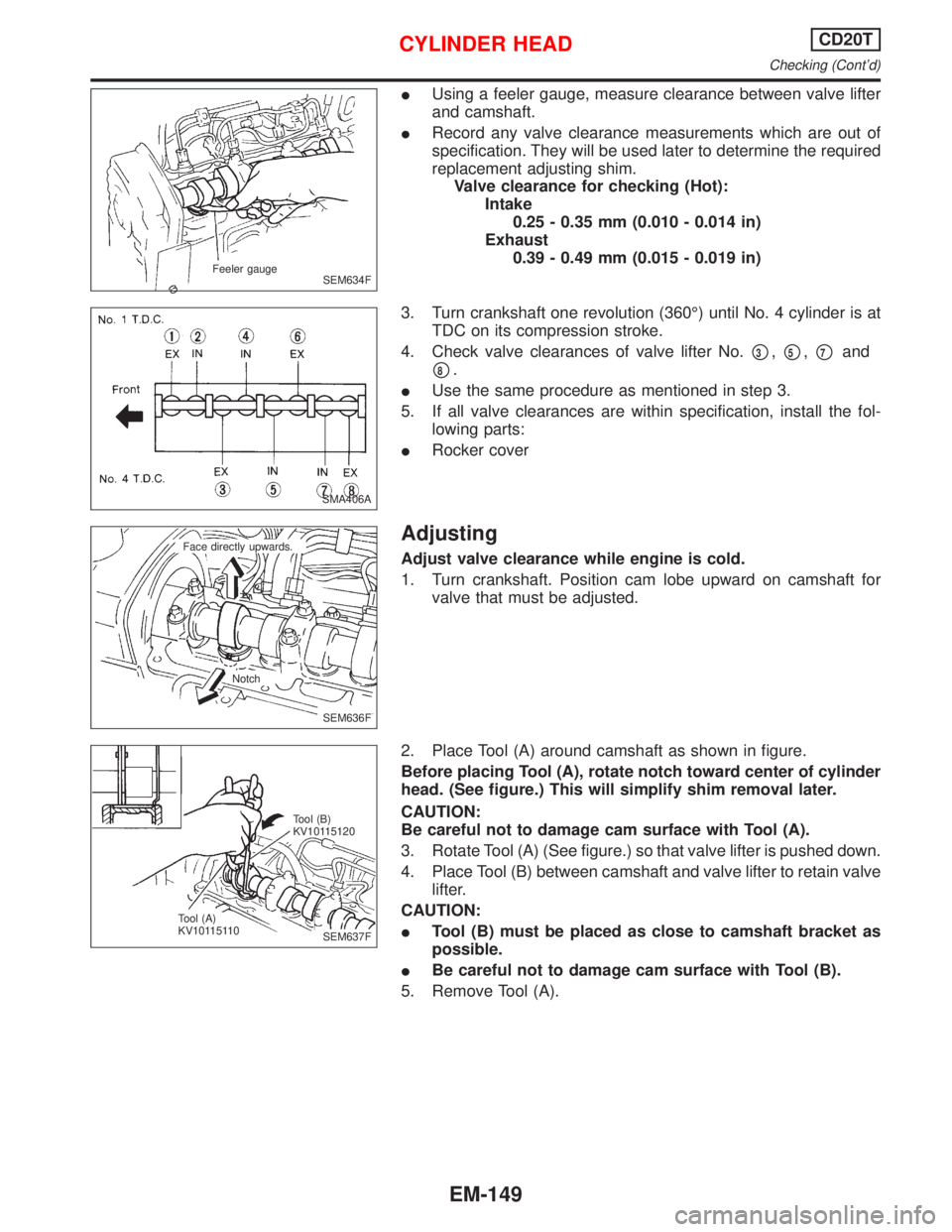
IUsing a feeler gauge, measure clearance between valve lifter
and camshaft.
IRecord any valve clearance measurements which are out of
specification. They will be used later to determine the required
replacement adjusting shim.
Valve clearance for checking (Hot):
Intake
0.25 - 0.35 mm (0.010 - 0.014 in)
Exhaust
0.39 - 0.49 mm (0.015 - 0.019 in)
3. Turn crankshaft one revolution (360É) until No. 4 cylinder is at
TDC on its compression stroke.
4. Check valve clearances of valve lifter No.
p3,p5,p7and
p8.
IUse the same procedure as mentioned in step 3.
5. If all valve clearances are within specification, install the fol-
lowing parts:
IRocker cover
Adjusting
Adjust valve clearance while engine is cold.
1. Turn crankshaft. Position cam lobe upward on camshaft for
valve that must be adjusted.
2. Place Tool (A) around camshaft as shown in figure.
Before placing Tool (A), rotate notch toward center of cylinder
head. (See figure.) This will simplify shim removal later.
CAUTION:
Be careful not to damage cam surface with Tool (A).
3. Rotate Tool (A) (See figure.) so that valve lifter is pushed down.
4. Place Tool (B) between camshaft and valve lifter to retain valve
lifter.
CAUTION:
ITool (B) must be placed as close to camshaft bracket as
possible.
IBe careful not to damage cam surface with Tool (B).
5. Remove Tool (A).
SEM634F Feeler gauge
SMA406A
.SEM636F Face directly upwards.
Notch
.SEM637F Tool (B)
KV10115120
Tool (A)
KV10115110
CYLINDER HEADCD20T
Checking (Cont'd)
EM-149
Page 1691 of 2267
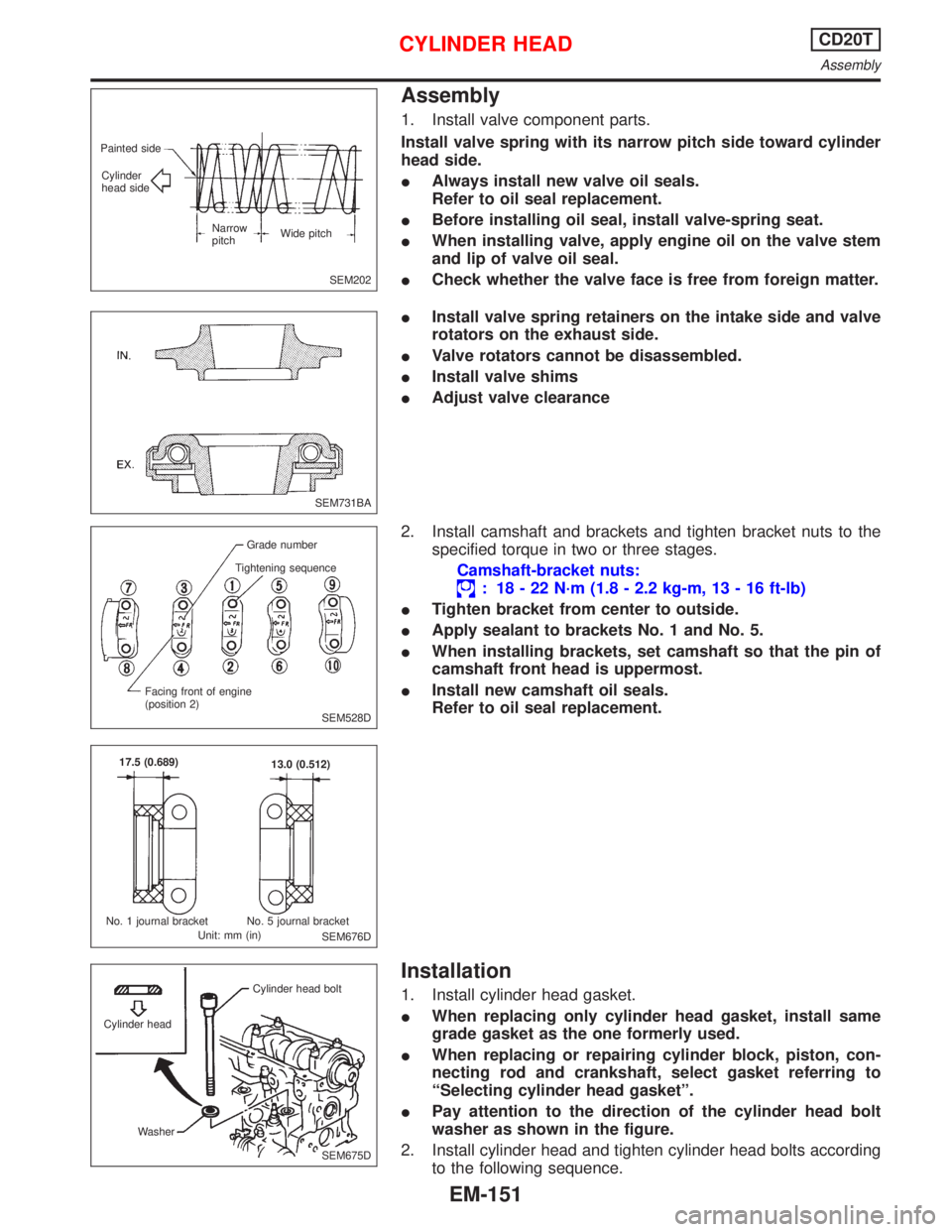
Assembly
1. Install valve component parts.
Install valve spring with its narrow pitch side toward cylinder
head side.
IAlways install new valve oil seals.
Refer to oil seal replacement.
IBefore installing oil seal, install valve-spring seat.
IWhen installing valve, apply engine oil on the valve stem
and lip of valve oil seal.
ICheck whether the valve face is free from foreign matter.
IInstall valve spring retainers on the intake side and valve
rotators on the exhaust side.
IValve rotators cannot be disassembled.
IInstall valve shims
IAdjust valve clearance
2. Install camshaft and brackets and tighten bracket nuts to the
specified torque in two or three stages.
Camshaft-bracket nuts:
: 18 - 22 N´m (1.8 - 2.2 kg-m, 13 - 16 ft-lb)
ITighten bracket from center to outside.
IApply sealant to brackets No. 1 and No. 5.
IWhen installing brackets, set camshaft so that the pin of
camshaft front head is uppermost.
IInstall new camshaft oil seals.
Refer to oil seal replacement.
Installation
1. Install cylinder head gasket.
IWhen replacing only cylinder head gasket, install same
grade gasket as the one formerly used.
IWhen replacing or repairing cylinder block, piston, con-
necting rod and crankshaft, select gasket referring to
ªSelecting cylinder head gasketº.
IPay attention to the direction of the cylinder head bolt
washer as shown in the figure.
2. Install cylinder head and tighten cylinder head bolts according
to the following sequence.
SEM202 Painted side
Cylinder
head side
Narrow
pitchWide pitch
SEM731BA
SEM528D Grade number
Tightening sequence
Facing front of engine
(position 2)
SEM676D 17.5 (0.689)
13.0 (0.512)
No. 1 journal bracket No. 5 journal bracket
Unit: mm (in)
SEM675D Cylinder headCylinder head bolt
Washer
CYLINDER HEADCD20T
Assembly
EM-151
Page 1713 of 2267
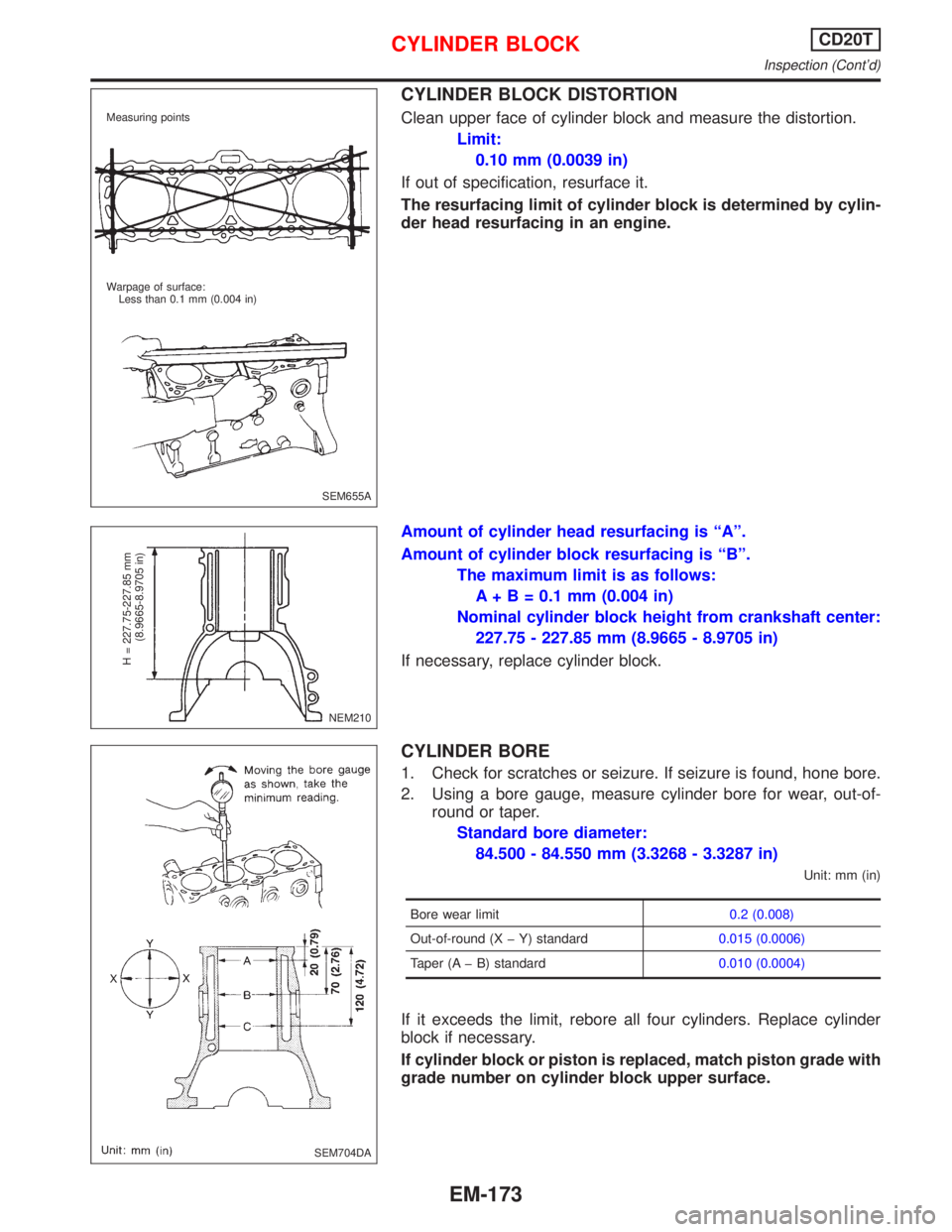
CYLINDER BLOCK DISTORTION
Clean upper face of cylinder block and measure the distortion.
Limit:
0.10 mm (0.0039 in)
If out of specification, resurface it.
The resurfacing limit of cylinder block is determined by cylin-
der head resurfacing in an engine.
Amount of cylinder head resurfacing is ªAº.
Amount of cylinder block resurfacing is ªBº.
The maximum limit is as follows:
A + B = 0.1 mm (0.004 in)
Nominal cylinder block height from crankshaft center:
227.75 - 227.85 mm (8.9665 - 8.9705 in)
If necessary, replace cylinder block.
CYLINDER BORE
1. Check for scratches or seizure. If seizure is found, hone bore.
2. Using a bore gauge, measure cylinder bore for wear, out-of-
round or taper.
Standard bore diameter:
84.500 - 84.550 mm (3.3268 - 3.3287 in)
Unit: mm (in)
Bore wear limit0.2 (0.008)
Out-of-round (X þ Y) standard0.015 (0.0006)
Taper (A þ B) standard0.010 (0.0004)
If it exceeds the limit, rebore all four cylinders. Replace cylinder
block if necessary.
If cylinder block or piston is replaced, match piston grade with
grade number on cylinder block upper surface.
SEM655A Measuring points
Warpage of surface:
Less than 0.1 mm (0.004 in)
NEM210
H = 227.75-227.85 mm
(8.9665-8.9705 in)
SEM704DA
CYLINDER BLOCKCD20T
Inspection (Cont'd)
EM-173
Page 1744 of 2267
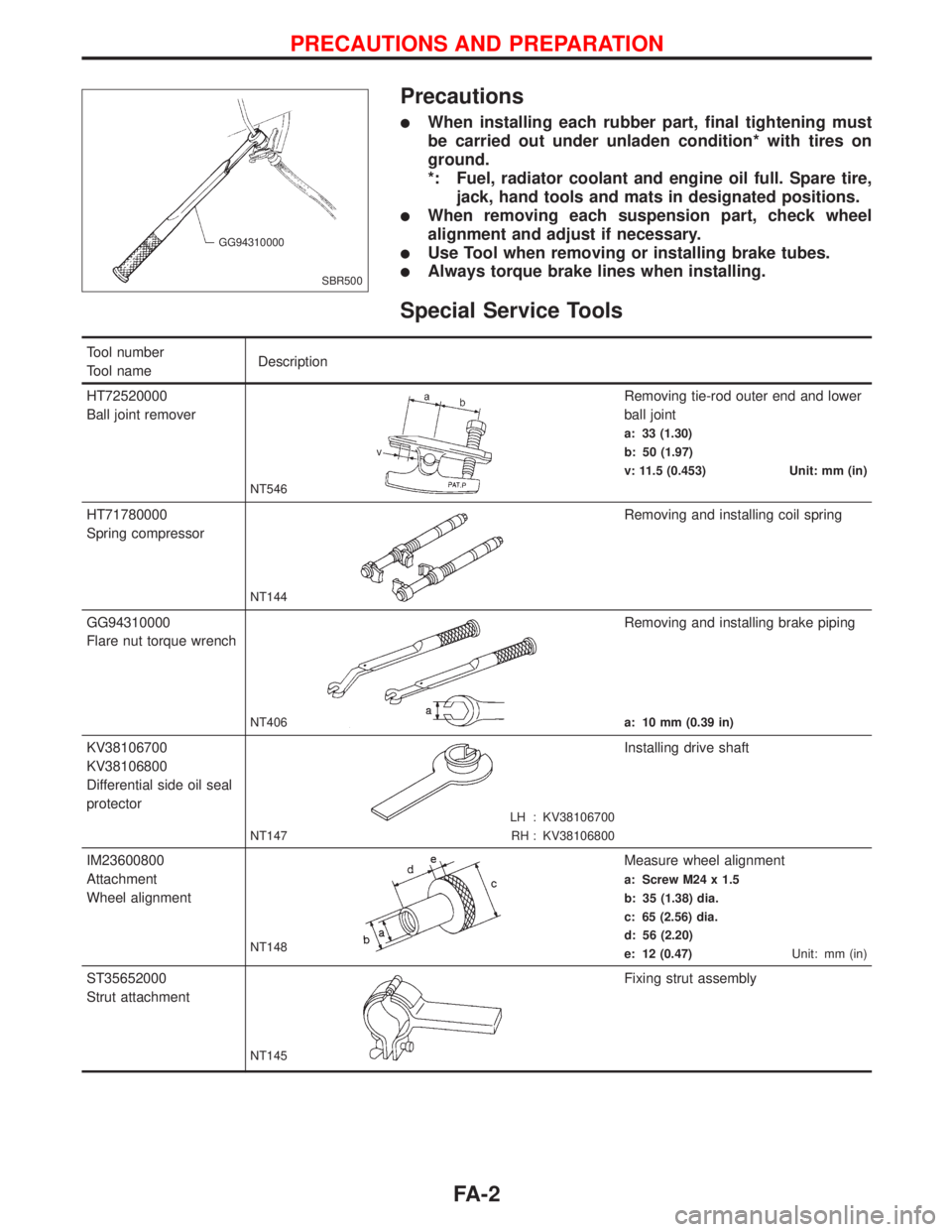
Precautions
lWhen installing each rubber part, final tightening must
be carried out under unladen condition* with tires on
ground.
*: Fuel, radiator coolant and engine oil full. Spare tire,
jack, hand tools and mats in designated positions.
lWhen removing each suspension part, check wheel
alignment and adjust if necessary.
lUse Tool when removing or installing brake tubes.
lAlways torque brake lines when installing.
Special Service Tools
Tool number
Tool nameDescription
HT72520000
Ball joint remover
NT546
Removing tie-rod outer end and lower
ball joint
a: 33 (1.30)
b: 50 (1.97)
v: 11.5 (0.453) Unit: mm (in)
HT71780000
Spring compressor
NT144
Removing and installing coil spring
GG94310000
Flare nut torque wrench
NT406
Removing and installing brake piping
a: 10 mm (0.39 in)
KV38106700
KV38106800
Differential side oil seal
protector
LH : KV38106700
RH : KV38106800 NT147
Installing drive shaft
IM23600800
Attachment
Wheel alignment
NT148
Measure wheel alignment
a: Screw M24 x 1.5
b: 35 (1.38) dia.
c: 65 (2.56) dia.
d: 56 (2.20)
e: 12 (0.47)Unit: mm (in)
ST35652000
Strut attachment
NT145
Fixing strut assembly
SBR500 GG94310000
PRECAUTIONS AND PREPARATION
FA-2
Page 1748 of 2267
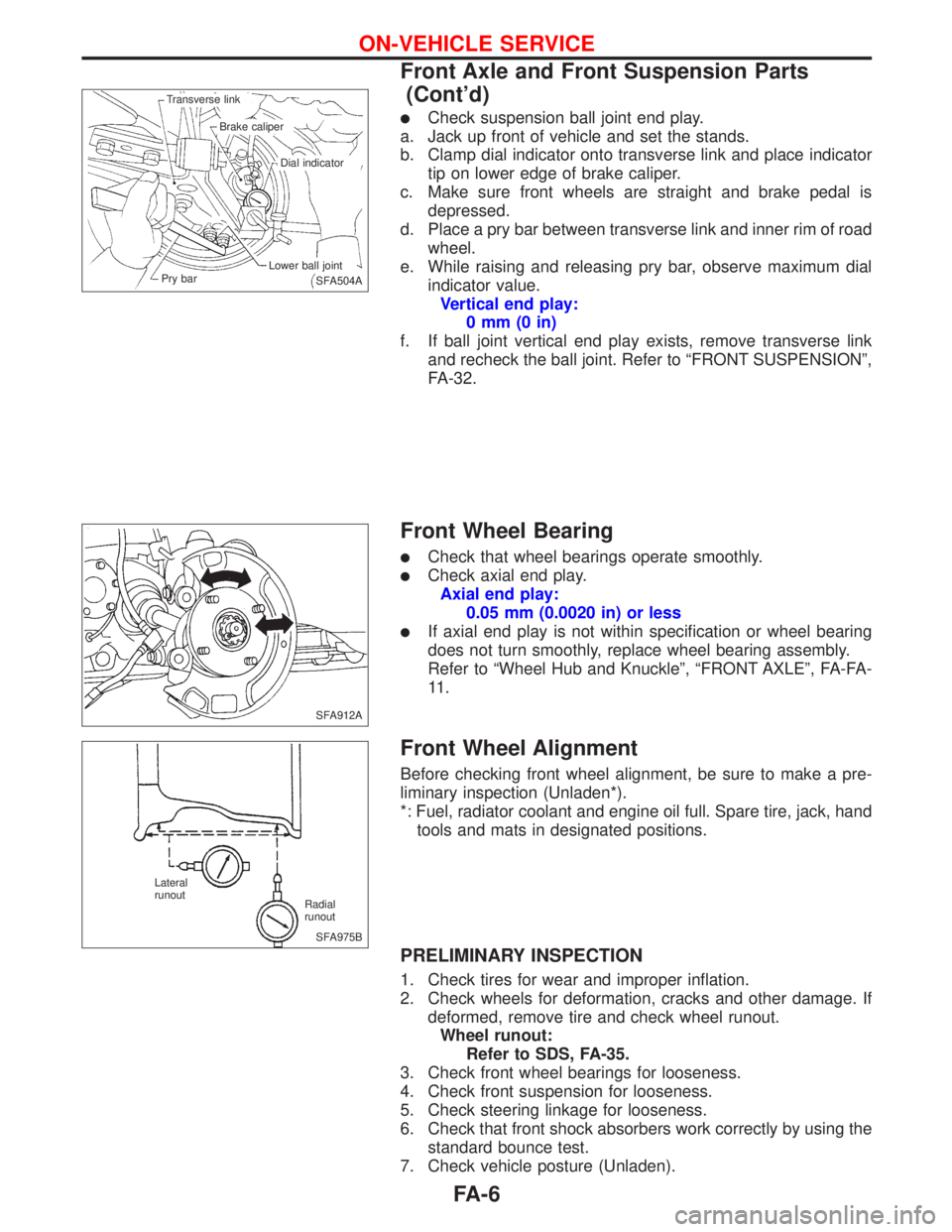
lCheck suspension ball joint end play.
a. Jack up front of vehicle and set the stands.
b. Clamp dial indicator onto transverse link and place indicator
tip on lower edge of brake caliper.
c. Make sure front wheels are straight and brake pedal is
depressed.
d. Place a pry bar between transverse link and inner rim of road
wheel.
e. While raising and releasing pry bar, observe maximum dial
indicator value.
Vertical end play:
0mm(0in)
f. If ball joint vertical end play exists, remove transverse link
and recheck the ball joint. Refer to ªFRONT SUSPENSIONº,
FA-32.
Front Wheel Bearing
lCheck that wheel bearings operate smoothly.
lCheck axial end play.
Axial end play:
0.05 mm (0.0020 in) or less
lIf axial end play is not within specification or wheel bearing
does not turn smoothly, replace wheel bearing assembly.
Refer to ªWheel Hub and Knuckleº, ªFRONT AXLEº, FA-FA-
11 .
Front Wheel Alignment
Before checking front wheel alignment, be sure to make a pre-
liminary inspection (Unladen*).
*: Fuel, radiator coolant and engine oil full. Spare tire, jack, hand
tools and mats in designated positions.
PRELIMINARY INSPECTION
1. Check tires for wear and improper inflation.
2. Check wheels for deformation, cracks and other damage. If
deformed, remove tire and check wheel runout.
Wheel runout:
Refer to SDS, FA-35.
3. Check front wheel bearings for looseness.
4. Check front suspension for looseness.
5. Check steering linkage for looseness.
6. Check that front shock absorbers work correctly by using the
standard bounce test.
7. Check vehicle posture (Unladen).
SFA504A Transverse link
Brake caliper
Dial indicator
Lower ball joint
Pry bar
SFA912A
SFA975B Lateral
runout
Radial
runout
ON-VEHICLE SERVICE
Front Axle and Front Suspension Parts
(Cont'd)
FA-6