sensor NISSAN PRIMERA 1999 Electronic Workshop Manual
[x] Cancel search | Manufacturer: NISSAN, Model Year: 1999, Model line: PRIMERA, Model: NISSAN PRIMERA 1999Pages: 2267, PDF Size: 35.74 MB
Page 124 of 2267
Inspection................................................................. 36
Assembly ................................................................. 37
Installation ................................................................ 39
REAR DISC BRAKE TYPE 2...................................... 40
Component .............................................................. 40
Pad Replacement .................................................... 40
Removal ................................................................... 42
Disassembly............................................................. 42
Inspection................................................................. 42
Installation ................................................................ 43
REAR DRUM BRAKE................................................. 44
Components............................................................. 44
Removal ................................................................... 44
Inspection - Wheel Cylinder .................................... 45
Wheel Cylinder Overhaul......................................... 46
Inspection - Drum .................................................... 46
Inspection - Lining ................................................... 46
Installation ................................................................ 46
PARKING BRAKE CONTROL.................................... 48
Removal and Installation ......................................... 48
Inspection................................................................. 49
Adjustment ............................................................... 49
ANTI-LOCK BRAKE SYSTEM.................................... 50
Purpose.................................................................... 50
Operation ................................................................. 50
ABS Hydraulic Circuit .............................................. 50
System Components ............................................... 51
System Description .................................................. 51
Removal and Installation ......................................... 53
TROUBLE DIAGNOSES............................................. 57
How to Perform Trouble Diagnoses for Quick
and Accurate Repair ................................................ 57
Preliminary Check.................................................... 59
Component Parts and Harness Connector
Location ................................................................... 60
Circuit Diagram for Quick Pinpoint Check............... 61Wiring Diagram - ABS - ........................................... 62
Self-diagnosis (Only models with data link
connector terminal No. 8) ........................................ 67
TROUBLE DIAGNOSIS - GENERAL
DESCRIPTION............................................................. 69
CONSULT-II ............................................................. 69
CONSULT-II Inspection Procedure.......................... 70
Ground Circuit Check .............................................. 75
TROUBLE DIAGNOSIS - GENERAL
DESCRIPTION............................................................. 76
Malfunction Code/Symptom Chart........................... 76
TROUBLE DIAGNOSES FOR SELF-DIAGNOSTIC
ITEMS........................................................................... 77
Diagnostic Procedure 1 (Wheel sensor or rotor) .... 77
Diagnostic Procedure 2 (ABS actuator solenoid
valve and solenoid valve relay) ............................... 79
Diagnostic Procedure 3 (Motor Relay or motor) ..... 81
Diagnostic Procedure 4 (Low voltage) .................... 83
Diagnostic Procedure 5 (Control unit) ..................... 84
TROUBLE DIAGNOSES FOR SYMPTOMS............... 85
Diagnostic Procedure 6 (ABS works frequently) ..... 85
Diagnostic Procedure 7 (Unexpected pedal
action) ...................................................................... 86
Diagnostic Procedure 8 (Long stopping distance) .. 86
Diagnostic Procedure 9 (ABS does not work.) ....... 87
Diagnostic Procedure 10 (Pedal vibration and
noise) ....................................................................... 87
Diagnostic Procedure 11 (ABS Warning lamp
does not come on when ignition switch is turned
ON) .......................................................................... 88
Diagnostic Procedure 12 (Warning lamp stays on
when ignition switch is turned ON).......................... 90
SERVICE DATA AND SPECIFICATIONS (SDS)........ 91
General Specifications ............................................. 91
Inspection and Adjustment ...................................... 92
When you read wiring diagrams:
lRead GI section, ªHOW TO READ WIRING DIAGRAMSº.
lSee EL section, ªPOWER SUPPLY ROUTINGº for power distribution circuit.
lSee EL section for NATS information and wiring diagram.
When you perform trouble diagnoses, read GI section, ªHOW TO FOLLOW FLOW
CHART IN TROUBLE DIAGNOSESº and ªHOW TO PERFORM EFFICIENT DIAGNOSIS
FOR AN ELECTRICAL INCIDENTº.
BR-2
Page 125 of 2267
Supplemental Restraint System (SRS) ªAIR
BAGº and ªSEAT BELT PRE-TENSIONERº
The Supplemental Restraint System such as ªAIR BAGº and ªSEAT BELT PRE-TENSIONERº used along
with a seat belt, helps to reduce the risk or severity of injury to the driver and front passenger for certain
types of collision. The SRS system composition which is available to NISSAN MODEL P11 is as follows (The
composition varies according to the destination and optional equipment.):
lFor a frontal collision
The Supplemental Restraint System consists of driver air bag module (located in the center of the
steering wheel), front passenger air bag module (located on the instrument panel on passenger side),
front seat belt pre-tensioners, a diagnosis sensor unit, warning lamp, wiring harness and spiral cable.
lFor a side collision
The Supplemental Restraint System consists of front side air bag module (located in the outer side of
front seat), side air bag (satellite) sensor, diagnosis sensor unit (one of components of air bags for a
frontal collision), wiring harness, warning lamp (one of components of air bags for a frontal collision).
Information necessary to service the system safely is included in theRS sectionof this Service Manual.
WARNING:
lTo avoid rendering the SRS inoperative, which could increase the risk of personal injury or death
in the event of a collision which would result in air bag inflation, all maintenance should be per-
formed by an authorized NISSAN dealer.
lImproper maintenance, including incorrect removal and installation of the SRS, can lead to per-
sonal injury caused by unintentional activation of the system. For removal of Spiral Cable and
Air Bag Module, see the RS section.
lDo not use electrical test equipment on any circuit related to the SRS unless instructed to in this
Service Manual. Spiral cable and wiring harnesses covered with yellow insulation tape either just
before the harness connectors or for the complete harness are related to the SRS.
Precautions for Brake System
lRecommended fluid is brake fluid ªDOT 4º.
lNever reuse drained brake fluid.
lBe careful not to splash brake fluid on painted areas.
lTo clean or wash all parts of master cylinder, disc brake
caliper and wheel cylinder, use clean brake fluid.
lNever use mineral oils such as gasoline or kerosene.
They will ruin rubber parts of the hydraulic system.
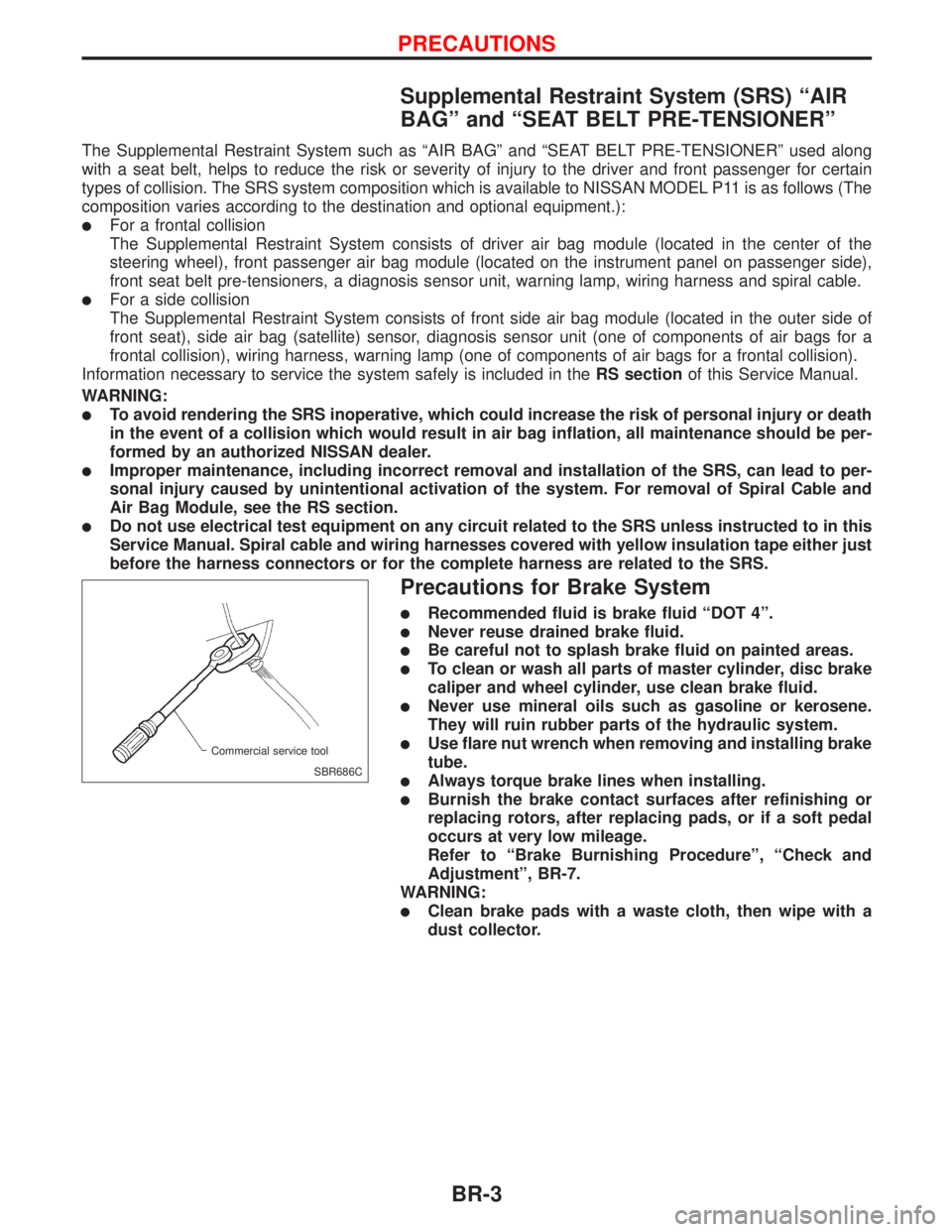
lUse flare nut wrench when removing and installing brake
tube.
lAlways torque brake lines when installing.
lBurnish the brake contact surfaces after refinishing or
replacing rotors, after replacing pads, or if a soft pedal
occurs at very low mileage.
Refer to ªBrake Burnishing Procedureº, ªCheck and
Adjustmentº, BR-7.
WARNING:
lClean brake pads with a waste cloth, then wipe with a
dust collector.
SBR686C Commercial service tool
PRECAUTIONS
BR-3
Page 173 of 2267
System Components
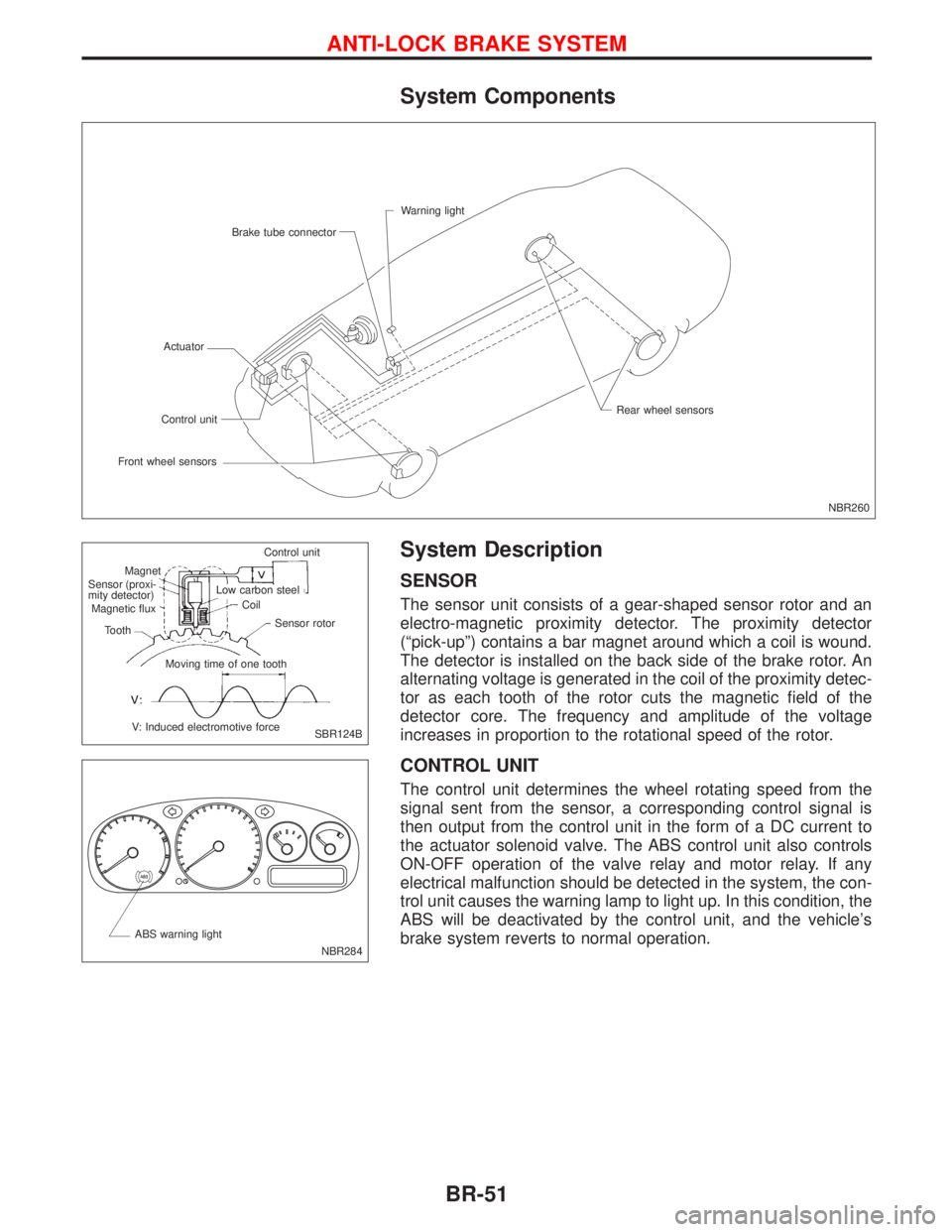
System Description
SENSOR
The sensor unit consists of a gear-shaped sensor rotor and an
electro-magnetic proximity detector. The proximity detector
(ªpick-upº) contains a bar magnet around which a coil is wound.
The detector is installed on the back side of the brake rotor. An
alternating voltage is generated in the coil of the proximity detec-
tor as each tooth of the rotor cuts the magnetic field of the
detector core. The frequency and amplitude of the voltage
increases in proportion to the rotational speed of the rotor.
CONTROL UNIT
The control unit determines the wheel rotating speed from the
signal sent from the sensor, a corresponding control signal is
then output from the control unit in the form of a DC current to
the actuator solenoid valve. The ABS control unit also controls
ON-OFF operation of the valve relay and motor relay. If any
electrical malfunction should be detected in the system, the con-
trol unit causes the warning lamp to light up. In this condition, the
ABS will be deactivated by the control unit, and the vehicle's
brake system reverts to normal operation.
NBR260 Warning light
Brake tube connector
Actuator
Front wheel sensorsControl unitRear wheel sensors
SBR124B Control unit
Magnet
.Sensor (proxi-
mity detector)
Magnetic flux
Tooth
V: Induced electromotive forceMoving time of one toothSensor rotor Coil Low carbon steel
NBR284 ABS warning light
ANTI-LOCK BRAKE SYSTEM
BR-51
Page 175 of 2267
Removal and Installation
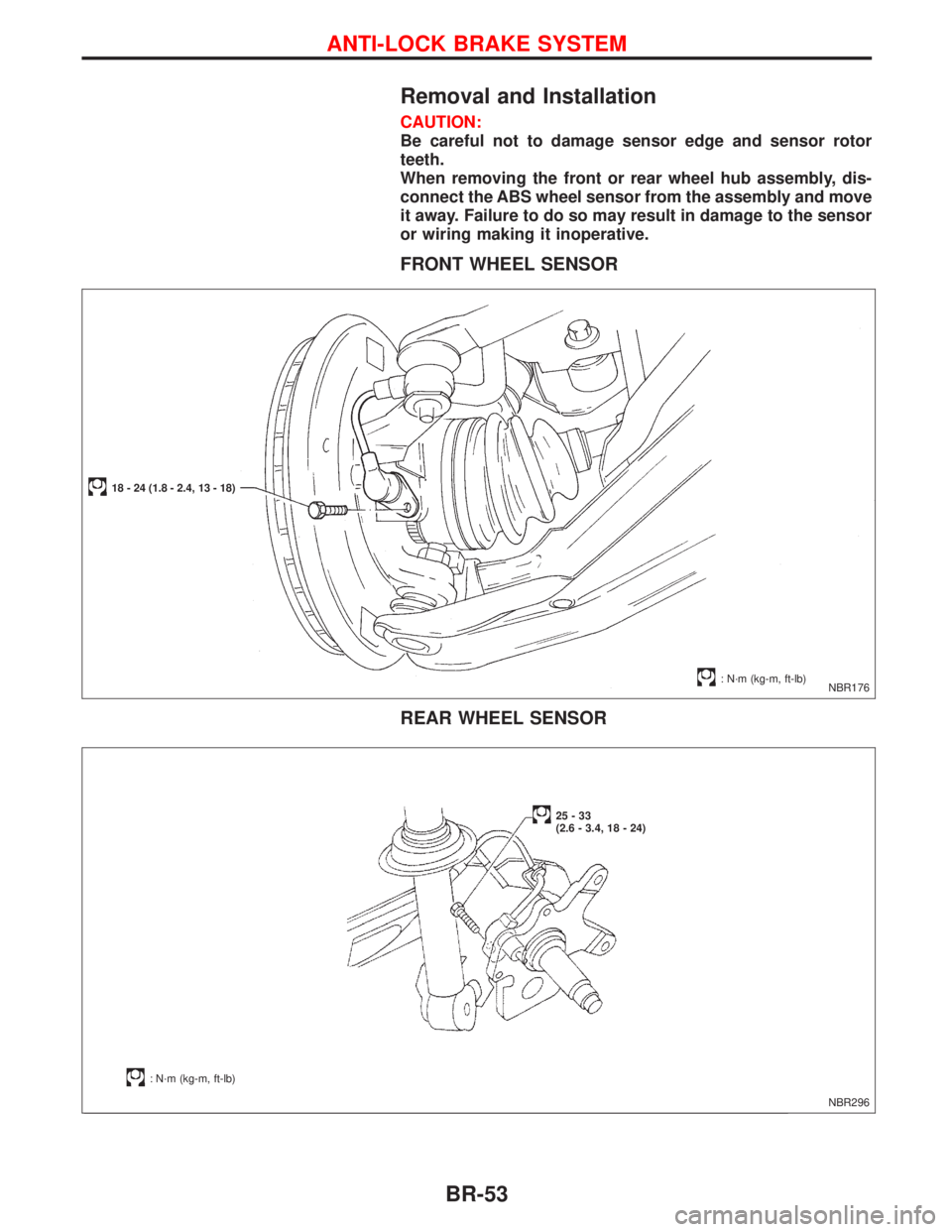
CAUTION:
Be careful not to damage sensor edge and sensor rotor
teeth.
When removing the front or rear wheel hub assembly, dis-
connect the ABS wheel sensor from the assembly and move
it away. Failure to do so may result in damage to the sensor
or wiring making it inoperative.
FRONT WHEEL SENSOR
REAR WHEEL SENSOR
NBR176
18 - 24 (1.8 - 2.4, 13 - 18)
: N´m (kg-m, ft-lb)
NBR296
: N´m (kg-m, ft-lb)
25-33
(2.6 - 3.4, 18 - 24)
ANTI-LOCK BRAKE SYSTEM
BR-53
Page 176 of 2267
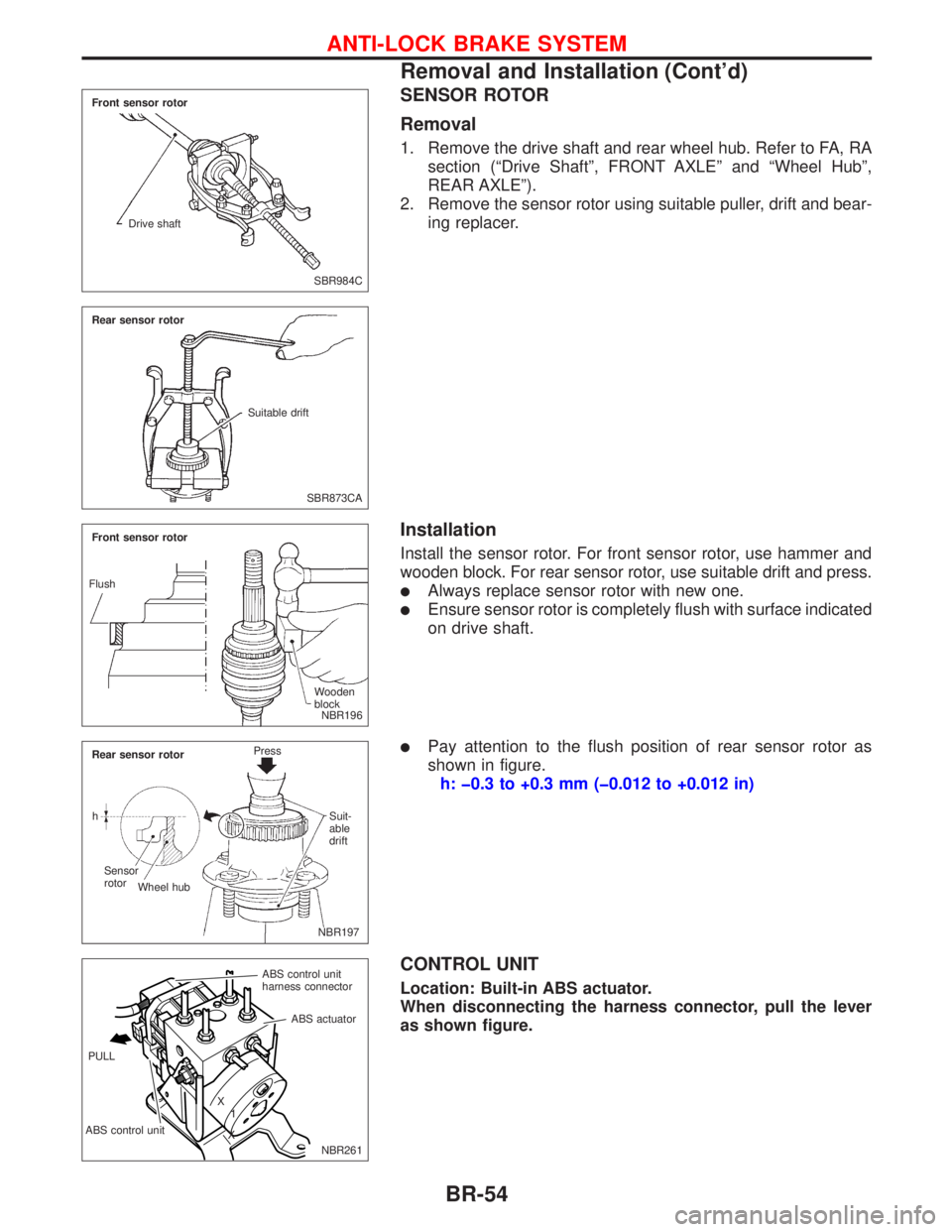
SENSOR ROTOR
Removal
1. Remove the drive shaft and rear wheel hub. Refer to FA, RA
section (ªDrive Shaftº, FRONT AXLEº and ªWheel Hubº,
REAR AXLEº).
2. Remove the sensor rotor using suitable puller, drift and bear-
ing replacer.
Installation
Install the sensor rotor. For front sensor rotor, use hammer and
wooden block. For rear sensor rotor, use suitable drift and press.
lAlways replace sensor rotor with new one.
lEnsure sensor rotor is completely flush with surface indicated
on drive shaft.
lPay attention to the flush position of rear sensor rotor as
shown in figure.
h: þ0.3 to +0.3 mm (þ0.012 to +0.012 in)
CONTROL UNIT
Location: Built-in ABS actuator.
When disconnecting the harness connector, pull the lever
as shown figure.
SBR984C Front sensor rotor
Drive shaft
SBR873CA Rear sensor rotor
Suitable drift
NBR196 Front sensor rotor
Wooden
block Flush
.NBR197 Rear sensor rotorPress
Suit-
able
drift
Sensor
rotor
Wheel hub h
NBR261 ABS control unit
harness connector
ABS control unitABS actuator
X
1
X PULL
ANTI-LOCK BRAKE SYSTEM
Removal and Installation (Cont'd)
BR-54
Page 179 of 2267
How to Perform Trouble Diagnoses for Quick
and Accurate Repair
INTRODUCTION
The ABS system has an electronic control unit to control major
braking functions. The control unit accepts input signals from
sensors and utilises the data to instantly drive the actuators. It is
essential that both input and output signals are correct and
stable. It is also important to check for conventional problems:
such as air leaks in booster lines, lack of brake fluid, or other
problems with the brake system.
It is much more difficult to diagnose a problem that occurs inter-
mittently rather than catastrophically. Most intermittent problems
are caused by poor electric connections or faulty wiring. In this
case, careful checking of suspicious circuits may help prevent
the unnecessary replacement of good parts.
A visual check may not be sufficient to find the cause of the
problems, so a road test should also be performed.
Before undertaking actual checks, take just a few minutes to talk
with a customer who approaches with a ABS complaint. The
customer is a very good source of information on such problems;
especially intermittent ones. Through the talks with the customer,
find out what symptoms are present and under what conditions
they occur.
Start your diagnosis by looking for ªconventionalº problems first.
This is one of the best ways to troubleshoot brake problems on
an ABS controlled vehicle.
SEF233G
SEF234G
TROUBLE DIAGNOSES
BR-57
Page 182 of 2267
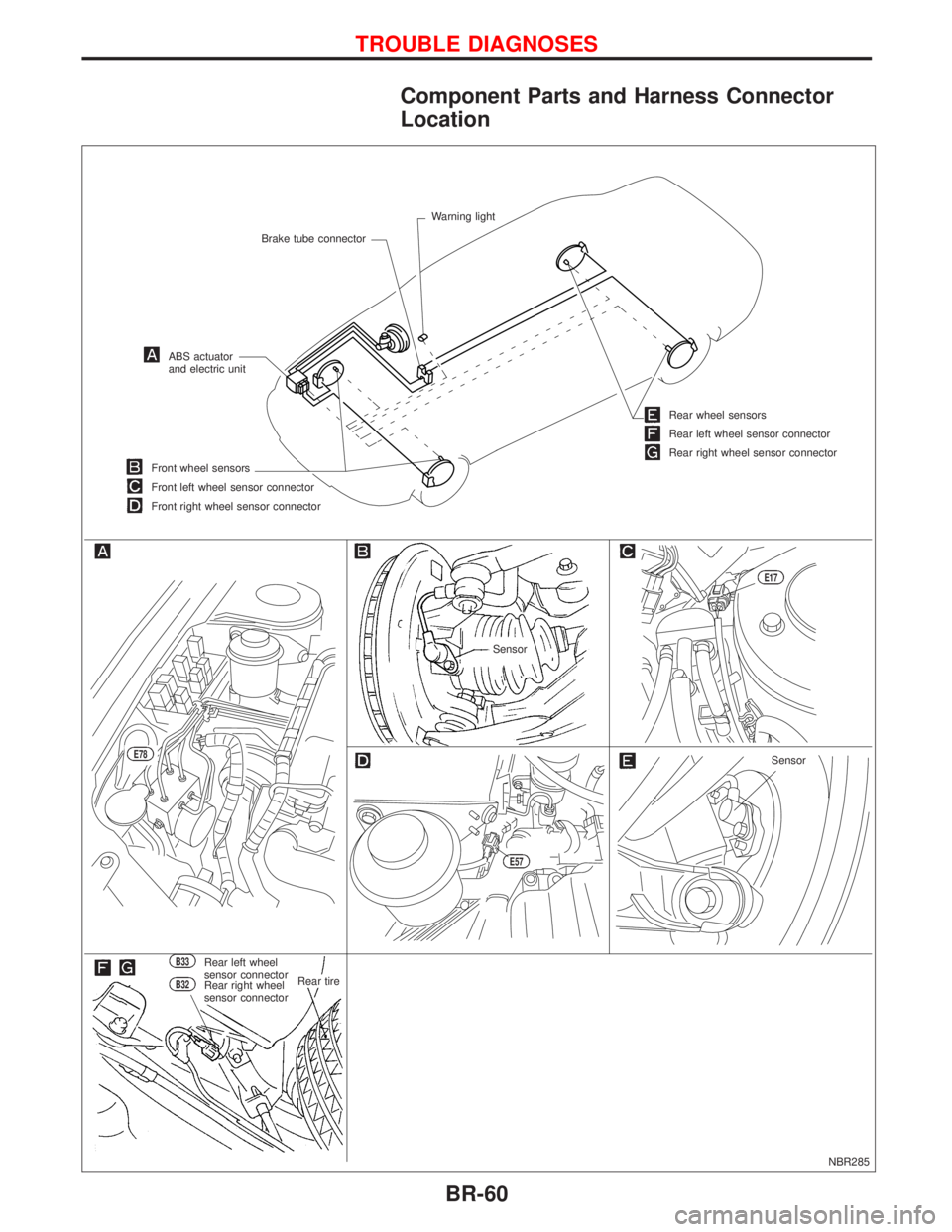
Component Parts and Harness Connector
Location
NBR285
Brake tube connectorWarning light
ABS actuator
and electric unit
Front wheel sensors
Front left wheel sensor connector
Front right wheel sensor connector
Sensor
E17
Rear wheel sensors
Rear left wheel sensor connector
Rear right wheel sensor connector
B33Rear left wheel
sensor connector
B32Rear right wheel
sensor connector.Rear tire
.E78
E57
Sensor
TROUBLE DIAGNOSES
BR-60
Page 190 of 2267
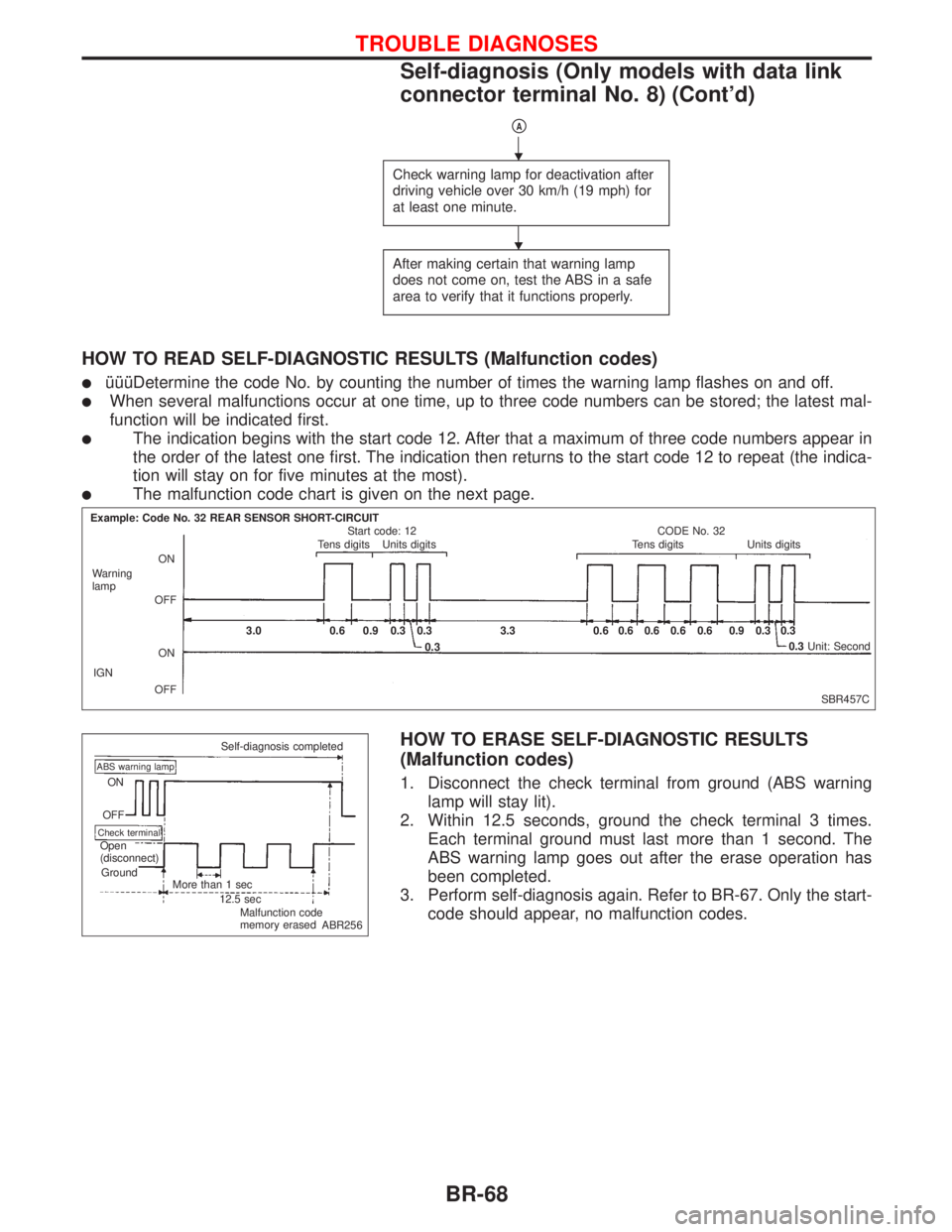
pA
Check warning lamp for deactivation after
driving vehicle over 30 km/h (19 mph) for
at least one minute.
After making certain that warning lamp
does not come on, test the ABS in a safe
area to verify that it functions properly.
HOW TO READ SELF-DIAGNOSTIC RESULTS (Malfunction codes)
lîîîDetermine the code No. by counting the number of times the warning lamp flashes on and off.
lWhen several malfunctions occur at one time, up to three code numbers can be stored; the latest mal-
function will be indicated first.
lThe indication begins with the start code 12. After that a maximum of three code numbers appear in
the order of the latest one first. The indication then returns to the start code 12 to repeat (the indica-
tion will stay on for five minutes at the most).
lThe malfunction code chart is given on the next page.
HOW TO ERASE SELF-DIAGNOSTIC RESULTS
(Malfunction codes)
1. Disconnect the check terminal from ground (ABS warning
lamp will stay lit).
2. Within 12.5 seconds, ground the check terminal 3 times.
Each terminal ground must last more than 1 second. The
ABS warning lamp goes out after the erase operation has
been completed.
3. Perform self-diagnosis again. Refer to BR-67. Only the start-
code should appear, no malfunction codes.
SBR457C Example: Code No. 32 REAR SENSOR SHORT-CIRCUIT
Warning
lampON
OFF
ON
OFF IGNStart code: 12
Tens digits Units digits
Unit: Second CODE No. 32
Tens digits Units digits
3.0 0.6 0.9 0.3 0.3
0.33.3 0.6 0.6 0.6 0.6 0.6 0.9 0.3
0.3 0.3
ABR256 Self-diagnosis completed
ABS warning lamp
ON
OFF
Check terminalOpen
(disconnect)
Ground
More than 1 sec
12.5 sec
Malfunction code
memory erased
H
H
TROUBLE DIAGNOSES
Self-diagnosis (Only models with data link
connector terminal No. 8) (Cont'd)
BR-68
Page 191 of 2267
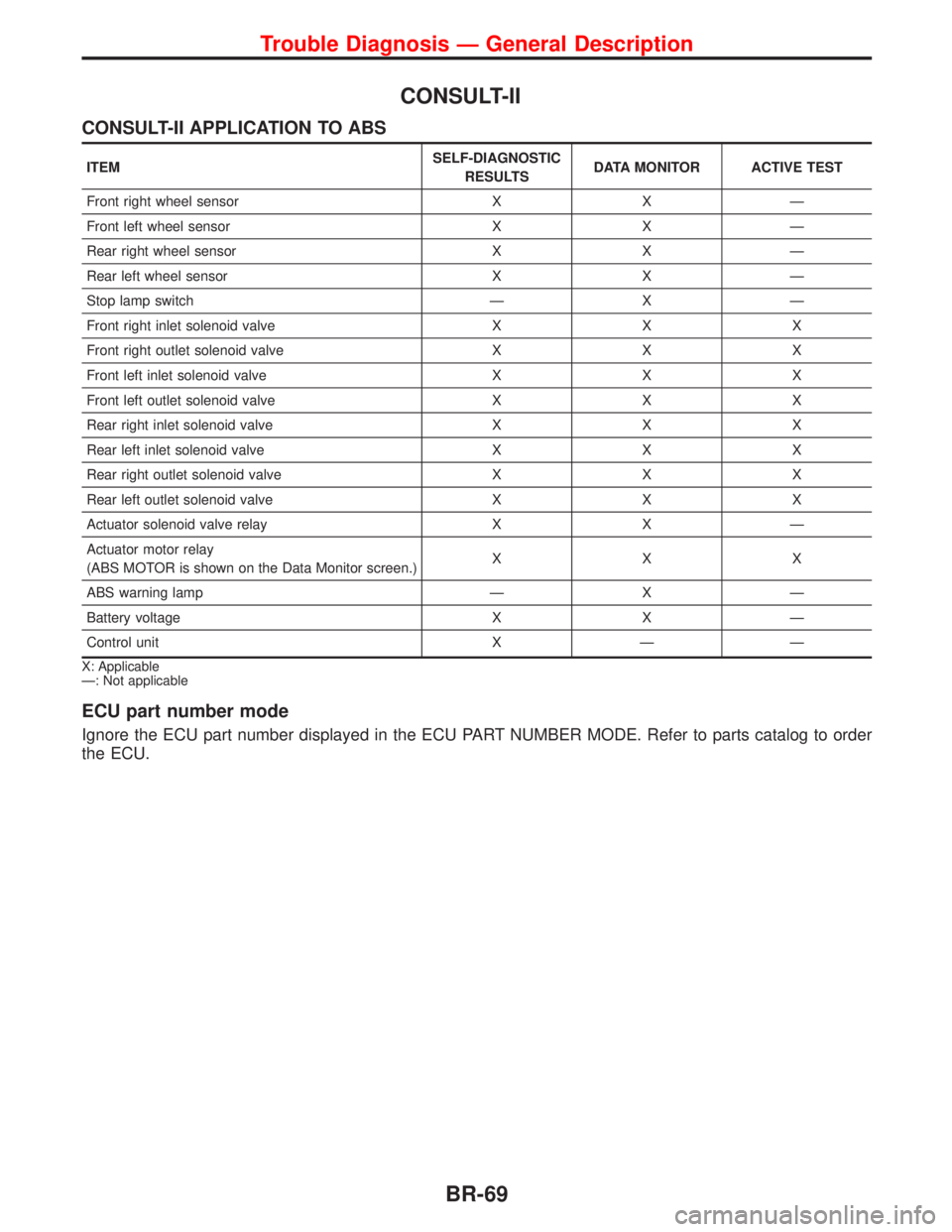
CONSULT-II
CONSULT-II APPLICATION TO ABS
ITEMSELF-DIAGNOSTIC
RESULTSDATA MONITOR ACTIVE TEST
Front right wheel sensor X X Ð
Front left wheel sensor X X Ð
Rear right wheel sensor X X Ð
Rear left wheel sensor X X Ð
Stop lamp switch Ð X Ð
Front right inlet solenoid valve X X X
Front right outlet solenoid valve X X X
Front left inlet solenoid valve X X X
Front left outlet solenoid valve X X X
Rear right inlet solenoid valve X X X
Rear left inlet solenoid valve X X X
Rear right outlet solenoid valve X X X
Rear left outlet solenoid valve X X X
Actuator solenoid valve relay X X Ð
Actuator motor relay
(ABS MOTOR is shown on the Data Monitor screen.)XXX
ABS warning lamp Ð X Ð
Battery voltage X X Ð
Control unit X Ð Ð
X: Applicable
Ð: Not applicable
ECU part number mode
Ignore the ECU part number displayed in the ECU PART NUMBER MODE. Refer to parts catalog to order
the ECU.
Trouble Diagnosis Ð General Description
BR-69
Page 193 of 2267
![NISSAN PRIMERA 1999 Electronic Workshop Manual SELF-DIAGNOSTIC RESULTS MODE
Diagnostic item Diagnostic item is detected when...Diagnostic
procedure
FR RH SENSORH
[OPEN]
lCircuit for front right wheel sensor is open.
(An abnormally high input volta](/img/5/57377/w960_57377-192.png "NISSAN PRIMERA 1999 Electronic Workshop Manual SELF-DIAGNOSTIC RESULTS MODE
Diagnostic item Diagnostic item is detected when...Diagnostic
procedure
FR RH SENSORH
[OPEN]
lCircuit for front right wheel sensor is open.
(An abnormally high input volta")
SELF-DIAGNOSTIC RESULTS MODE
Diagnostic item Diagnostic item is detected when...Diagnostic
procedure
FR RH SENSORH
[OPEN]
lCircuit for front right wheel sensor is open.
(An abnormally high input voltage is entered.)1
FR LH SENSORH
[OPEN]
lCircuit for front left wheel sensor is open.
(An abnormally high input voltage is entered.)1
RR RH SENSORH
[OPEN]
lCircuit for rear right sensor is open.
(An abnormally high input voltage is entered.)1
RR LH SENSORH
[OPEN]
lCircuit for rear left sensor is open.
(An abnormally high input voltage is entered.)1
FR RH SENSORH
[SHORT]
lCircuit for front right wheel sensor is shorted.
(An abnormally low input voltage is entered.)1
FR LH SENSORH
[SHORT]
lCircuit for front left wheel sensor is shorted.
(An abnormally low input voltage is entered.)1
RR RH SENSORH
[SHORT]
lCircuit for rear right sensor is shorted.
(An abnormally low input voltage is entered.)1
RR LH SENSOR
[SHORT]
lCircuit for rear left sensor is shorted.
(An abnormally low input voltage is entered.)1
ABS SENSORH
[ABNORMAL SIGNAL]
lTeeth damage on sensor rotor or improper installation of wheel sensor.
(Abnormal wheel sensor signal is entered.)1
FR RH IN ABS SOL
[OPEN]
lCircuit for front right inlet solenoid valve is open.
(An abnormally low output voltage is entered.)2
FR LH IN ABS SOL
[OPEN]
lCircuit for front left inlet solenoid valve is open.
(An abnormally low output voltage is entered.)2
RR RH IN ABS SOL
[OPEN]
lCircuit for rear right inlet solenoid valve is open.
(An abnormally low output voltage is entered.)2
RR LH IN ABS SOL
[OPEN]
lCircuit for rear left inlet solenoid valve is open.
(An abnormally low output voltage is entered.)2
FR RH IN ABS SOL
[SHORT]
lCircuit for front right inlet solenoid valve is shorted.
(An abnormally high output voltage is entered.)2
FR LH IN ABS SOL
[SHORT]
lCircuit for front left inlet solenoid valve is shorted.
(An abnormally high output voltage is entered.)2
RR RH IN ABS SOL
[SHORT]
lCircuit for rear right inlet solenoid valve is shorted.
(An abnormally high output voltage is entered.)2
RR LH IN ABS SOL
[SHORT]
lCircuit for rear left inlet solenoid valve is shorted.
(An abnormally high output voltage is entered.)2
FR RH OUT ABS SOL
[OPEN]
lCircuit for front right outlet solenoid valve is open.
(An abnormally low output voltage is entered.)2
FR LH OUT ABS SOL
[OPEN]
lCircuit for front left outlet solenoid valve is open.
(An abnormally low output voltage is entered.)2
RR RH OUT ABS SOL
[OPEN]
lCircuit for rear right outlet solenoid valve is open.
(An abnormally low output voltage is entered.)2
RR LH OUT ABS SOL
[OPEN]
lCircuit for rear left outlet solenoid valve is open.
(An abnormally low output voltage is entered.)2
FR RH OUT ABS SOL
[SHORT]
lCircuit for front right outlet solenoid valve is shorted.
(An abnormally high output voltage is entered.)2
FR LH OUT ABS SOL
[SHORT]
lCircuit for front left outlet solenoid valve is shorted.
(An abnormally high output voltage is entered.)2
RR RH OUT ABS SOL
[SHORT]
lCircuit for rear right outlet solenoid valve is shorted.
(An abnormally high output voltage is entered.)2
RR LH OUT ABS SOL
[SHORT]
lCircuit for rear left outlet solenoid valve is shorted.
(An abnormally high output voltage is entered.)2
ABS ACTUATOR RELAY
[ABNORMAL]
lActuator solenoid valve relay is ON, even control unit sends off signal.lActuator solenoid valve relay is OFF, even control unit sends on signal.2
ABS MOTOR RELAY
[ABNORMAL]
lCircuit for actuator motor is open or shorted.lActuator motor relay is stuck.lCircuit for actuator is open or shorted.3
BATTERY VOLT
[VB-LOW]
lPower source voltage supplied to ABS control unit is abnormally low. 4
CONTROL UNIT
lFunction of calculation in ABS control unit has failed. 5
H: If one or more wheels spin on a rough or slippery road for 40 seconds or more, the ABS warning lamp will illuminate. This does
not indicate a malfunction. Only in the case of the short-circuit after repair the ABS warning lamp also illuminates when the igni-
tion switch is turned ªONº. In this case, drive the vehicle at speeds greater than 30 km/h (19 MPH) for approximately 1 minute
as specified in ªSELF-DIAGNOSIS PROCEDUREº, BR-70. Check to ensure that the ABS warning lamp goes out while the
vehicle is being driven.
Trouble Diagnosis Ð General Description
CONSULT-II Inspection Procedure (Cont'd)
BR-71