compressor NISSAN TIIDA 2007 Service Repair Manual
[x] Cancel search | Manufacturer: NISSAN, Model Year: 2007, Model line: TIIDA, Model: NISSAN TIIDA 2007Pages: 5883, PDF Size: 78.95 MB
Page 3632 of 5883
![NISSAN TIIDA 2007 Service Repair Manual INSUFFICIENT COOLING
HAC-299
< SYMPTOM DIAGNOSIS >[AUTO AIR CONDITIONER (W/NAVI)]
C
D
E
F
G
H
J
K
L
MA
B
HAC
N
O
P
INSUFFICIENT COOLING
Component Function CheckINFOID:0000000001547374
SYMPTOM: Insuffi](/img/5/57395/w960_57395-3631.png "NISSAN TIIDA 2007 Service Repair Manual INSUFFICIENT COOLING
HAC-299
< SYMPTOM DIAGNOSIS >[AUTO AIR CONDITIONER (W/NAVI)]
C
D
E
F
G
H
J
K
L
MA
B
HAC
N
O
P
INSUFFICIENT COOLING
Component Function CheckINFOID:0000000001547374
SYMPTOM: Insuffi")
INSUFFICIENT COOLING
HAC-299
< SYMPTOM DIAGNOSIS >[AUTO AIR CONDITIONER (W/NAVI)]
C
D
E
F
G
H
J
K
L
MA
B
HAC
N
O
P
INSUFFICIENT COOLING
Component Function CheckINFOID:0000000001547374
SYMPTOM: Insufficient cooling
INSPECTION FLOW
1.CONFIRM SYMPTOM BY PERFORMING OPERATIONAL CHECK - TEMPERATURE DECREASE
1. Press the AUTO switch.
2. Turn temperature control dial counterclockwise until 18° C (60° F) is displayed.
3. Check for cold air at discharge air outlets.
Can the symptom be duplicated?
YES >> GO TO 3.
NO >> GO TO 2.
2.CHECK FOR ANY SYMPTOMS
Perform a complete operational check for any symptoms. Refer to HAC-202, "
Operational Check".
Does another symptom exist?
YES >> Refer to HAC-298, "SymptomMatrixChart".
NO >> System OK.
3.CHECK FOR SERVICE BULLETINS
Check for any service bulletins.
>> GO TO 3.
4.PERFORM SELF-DIAGNOSIS
Perform self-diagnosis Refer to HAC-213, "
Front Air Control Self-Diagnosis".
Is the inspection result normal?
YES >> GO TO 5.
NO >> Refer to HAC-218, "
Front Air Control Self-Diagnosis Code Chart".
5.CHECK DRIVE BELTS
Check compressor belt tension. Refer to EM-15, "
Checking" HR16DE EM-142, "Checking Drive Belts" or
HR18DE or EM-263, "
Inspection and Adjustment" K9K.
Is the inspection result normal?
OK >> GO TO 6.
NG >> Adjust or replace compressor belt. Refer to XX-XX, "*****"
.
6.CHECK AIR MIX DOOR OPERATION
Check and verify air mix door mechanism for smooth operation. Refer to HAC-225, "
Air Mix Door Motor Com-
ponent Function Check"
Does air mix door operate correctly?
YES >> GO TO 7.
NO >> Check air mix door motor circuit. Refer to HAC-226, "
Air Mix Door Motor Diagnosis Procedure".
7.CHECK COOLING FAN MOTOR OPERATION
Check and verify cooling fan motor for smooth operation.
Does cooling fan motor operate correctly?
YES >> GO TO 8.
NO >> Check cooling fan motor. Refer to CO-18, "
Component (Models with A/C)".
8.CHECK RECOVERY/RECYCLING EQUIPMENT BEFORE USAGE
Check recovery/recycling equipment before connecting to vehicle. Verify there is no pressure in the recovery/
recycling equipment by checking the gauges. If pressure exists, recover refrigerant from equipment lines.
Page 3635 of 5883
![NISSAN TIIDA 2007 Service Repair Manual HAC-302
< SYMPTOM DIAGNOSIS >[AUTO AIR CONDITIONER (W/NAVI)]
INSUFFICIENT COOLING
Performance Chart
INFOID:0000000001547376
PERFORMANCE CHART
Test Condition
*1HA-32, "Removal and Installation of
Comp](/img/5/57395/w960_57395-3634.png "NISSAN TIIDA 2007 Service Repair Manual HAC-302
< SYMPTOM DIAGNOSIS >[AUTO AIR CONDITIONER (W/NAVI)]
INSUFFICIENT COOLING
Performance Chart
INFOID:0000000001547376
PERFORMANCE CHART
Test Condition
*1HA-32, \"Removal and Installation of
Comp")
HAC-302
< SYMPTOM DIAGNOSIS >[AUTO AIR CONDITIONER (W/NAVI)]
INSUFFICIENT COOLING
Performance Chart
INFOID:0000000001547376
PERFORMANCE CHART
Test Condition
*1HA-32, "Removal and Installation of
Compressor - MR18DE" or HA-34,
"Removal and Installation of Com-
pressor - HR16DE" or HA-35, "Re-
moval and Installation of Compressor
- K9K"
*2HAC-233, "Front Blower Motor Com-
ponent Function Check"
*3EM-15, "Checking" (HR16DE) or EM-
142, "Checking Drive Belts"
(MR18DE) or EM-263, "
Inspection
and Adjustment" (K9K)
RJIA3107E
Page 3637 of 5883
![NISSAN TIIDA 2007 Service Repair Manual HAC-304
< SYMPTOM DIAGNOSIS >[AUTO AIR CONDITIONER (W/NAVI)]
INSUFFICIENT COOLING
Whenever system’s high and/or low side pressure(s) is/are unusual, diagnose using a manifold gauge. The
marker above](/img/5/57395/w960_57395-3636.png "NISSAN TIIDA 2007 Service Repair Manual HAC-304
< SYMPTOM DIAGNOSIS >[AUTO AIR CONDITIONER (W/NAVI)]
INSUFFICIENT COOLING
Whenever system’s high and/or low side pressure(s) is/are unusual, diagnose using a manifold gauge. The
marker above")
HAC-304
< SYMPTOM DIAGNOSIS >[AUTO AIR CONDITIONER (W/NAVI)]
INSUFFICIENT COOLING
Whenever system’s high and/or low side pressure(s) is/are unusual, diagnose using a manifold gauge. The
marker above the gauge scale in the following tables indicates the standard (usual) pressure range. Since the
standard (usual) pressure, however, differs from vehicle to vehicle, refer to above table (Ambient air tempera-
ture-to-operating pressure table).
Both High- and Low-pressure Sides are Too High
High-pressure Side is Too High and Low-pressure Side is Too Low
High-pressure Side is Too Low and Low-pressure Side is Too High
Gauge indication Refrigerant cycle Probable cause Corrective action
Both high- and low-pressure
sides are too high.Pressure is reduced soon af-
ter water is splashed on con-
denser.Excessive refrigerant charge in refrig-
eration cycle.Reduce refrigerant until
specified pressure is ob-
tained.
Air suction by cooling fan is in-
sufficient.Insufficient condenser cooling perfor-
mance.
↓
1. Condenser fins are clogged.
2. Improper fan rotation of cooling
fan. Clean condenser.
Check and repair cooling
fan if necessary.
Low-pressure pipe is not
cold.
When compressor is
stopped high-pressure val-
ue quickly drops by approx-
imately 196 kPa (1.96 bar, 2
kg/cm
2, 28 psi). It then de-
creases gradually thereaf-
ter.Poor heat exchange in condenser
(After compressor operation stops,
high-pressure decreases too slowly.).
↓
Air in refrigeration cycle.Evacuate repeatedly and
recharge system.
Engine tends to overheat. Engine cooling systems malfunction.Check and repair each en-
gine cooling system.
An area of the low-pressure
pipe is colder than areas
near the evaporator outlet.
Plates are sometimes cov-
ered with frost. Excessive liquid refrigerant on low-
pressure side.
Excessive refrigerant discharge
flow.
Expansion valve is open a little
compared with the specification.
↓
Improper expansion valve adjust-
ment.Replace expansion valve.
AC359A
Gauge indication Refrigerant cycle Probable cause Corrective action
High-pressure side is too high
and low-pressure side is too low.
Upper side of condenser and
high-pressure side are hot,
however, liquid tank is not so
hot.High-pressure tube or parts located
between compressor and condenser
are clogged or crushed. Check and repair or re-
place malfunctioning
parts.
Check oil for contami-
nation.
AC360A
Page 3638 of 5883
![NISSAN TIIDA 2007 Service Repair Manual INSUFFICIENT COOLING
HAC-305
< SYMPTOM DIAGNOSIS >[AUTO AIR CONDITIONER (W/NAVI)]
C
D
E
F
G
H
J
K
L
MA
B
HAC
N
O
P Both High- and Low-pressure Sides are Too Low
Low-pressure Side Sometimes Becomes Neg](/img/5/57395/w960_57395-3637.png "NISSAN TIIDA 2007 Service Repair Manual INSUFFICIENT COOLING
HAC-305
< SYMPTOM DIAGNOSIS >[AUTO AIR CONDITIONER (W/NAVI)]
C
D
E
F
G
H
J
K
L
MA
B
HAC
N
O
P Both High- and Low-pressure Sides are Too Low
Low-pressure Side Sometimes Becomes Neg")
INSUFFICIENT COOLING
HAC-305
< SYMPTOM DIAGNOSIS >[AUTO AIR CONDITIONER (W/NAVI)]
C
D
E
F
G
H
J
K
L
MA
B
HAC
N
O
P Both High- and Low-pressure Sides are Too Low
Low-pressure Side Sometimes Becomes Negative
Gauge indication Refrigerant cycle Probable cause Corrective action
High-pressure side is too low
and low-pressure side is too
high.High- and low-pressure sides
become equal soon after com-
pressor operation stops.Compressor pressure operation
is improper.
↓
Damaged inside compressor
packings.Replace compressor.
No temperature difference be-
tween high- and low-pressure
sides.Compressor pressure operation
is improper.
↓
Damaged inside compressor
packings.Replace compressor.
AC356A
Gauge indication Refrigerant cycle Probable cause Corrective action
Both high- and low-pressure
sides are too low. There is a big temperature dif-
ference between liquid tank
outlet and inlet. Outlet tem-
perature is extremely low.
Liquid tank inlet and expan-
sion valve are frosted.Liquid tank inside is slightly
clogged. Replace liquid tank.
Check oil for contamination.
Temperature of expansion
valve inlet is extremely low as
compared with areas near liq-
uid tank.
Expansion valve inlet may be
frosted.
Temperature difference oc-
curs somewhere in high-pres-
sure side.High-pressure pipe located be-
tween liquid tank and expansion
valve is clogged. Check and repair malfunc-
tioning parts.
Check oil for contamination.
Expansion valve and liquid tank
are warm or only cool when
touched.Low refrigerant charge.
↓
Leaking fittings or componentsCheck refrigerant for leaks.
Refer to HA-22, "
Checking of
Refrigerant Leaks".
There is a big temperature dif-
ference between expansion
valve inlet and outlet while the
valve itself is frosted.Expansion valve closes a little
compared with the specification.
↓
1. Improper expansion valve
adjustment.
2. Malfunctioning expansion
valve.
3. Outlet and inlet may be
clogged. Remove foreign particles by
using compressed air.
Replace expansion valve.
Check oil for contamination.
An area of the low-pressure pipe
is colder than areas near the
evaporator outlet.Low-pressure pipe is clogged or
crushed. Check and repair malfunc-
tioning parts.
Check oil for contamination.
Air flow volume is not enough or
is too low.Evaporator is frozen. Check intake sensor circuit.
Refer to HAC-229, "
Intake
Door Motor Component
Function Check".
Replace compressor.
Repair evaporator fins.
Replace evaporator.
Refer to HAC-233, "
Front
Blower Motor Component
Function Check".
AC353A
Page 3639 of 5883
![NISSAN TIIDA 2007 Service Repair Manual HAC-306
< SYMPTOM DIAGNOSIS >[AUTO AIR CONDITIONER (W/NAVI)]
INSUFFICIENT COOLING
Low-pressure Side Becomes Negative
Gauge indication Refrigerant cycle Probable cause Corrective action
Low-pressure si](/img/5/57395/w960_57395-3638.png "NISSAN TIIDA 2007 Service Repair Manual HAC-306
< SYMPTOM DIAGNOSIS >[AUTO AIR CONDITIONER (W/NAVI)]
INSUFFICIENT COOLING
Low-pressure Side Becomes Negative
Gauge indication Refrigerant cycle Probable cause Corrective action
Low-pressure si")
HAC-306
< SYMPTOM DIAGNOSIS >[AUTO AIR CONDITIONER (W/NAVI)]
INSUFFICIENT COOLING
Low-pressure Side Becomes Negative
Gauge indication Refrigerant cycle Probable cause Corrective action
Low-pressure side sometimes be-
comes negative. Air conditioning system does
not function and does not cy-
clically cool the compart-
ment air.
The system constantly func-
tions for a certain period of
time after compressor is
stopped and restarted.Refrigerant does not discharge
cyclically.
↓
Moisture is frozen at expan-
sion valve outlet and inlet.
↓
Water is mixed with refrigerant. Drain water from refrigerant
or replace refrigerant.
Replace liquid tank.
AC354A
Gauge indication Refrigerant cycle Probable cause Corrective action
Low-pressure side becomes nega-
tive.
Liquid tank or front/rear side of
expansion valve’s pipe is frost-
ed or dewed.High-pressure side is closed
and refrigerant does not flow.
↓
Expansion valve or liquid tank
is frosted.Leave the system at rest until
no frost is present. Start it
again to check whether or not
the malfunction is caused by
water or foreign particles.
If water is the cause, initially
cooling is okay. Then the wa-
ter freezes causing a block-
age. Drain water from
refrigerant or replace refrig-
erant.
If due to foreign particles, re-
move expansion valve and
remove the particles with dry
and compressed air (not
shop air).
If either of the above meth-
ods cannot correct the mal-
function, replace expansion
valve.
Replace liquid tank.
Check oil for contamination.
AC362A
Page 3643 of 5883
![NISSAN TIIDA 2007 Service Repair Manual HAC-310
< SYMPTOM DIAGNOSIS >[AUTO AIR CONDITIONER (W/NAVI)]
NOISE
*1HA-32, "Removal and Installation of
Compressor - MR18DE" or HA-34,
"Removal and Installation of Com-
pressor - HR16DE" or HA-35,](/img/5/57395/w960_57395-3642.png "NISSAN TIIDA 2007 Service Repair Manual HAC-310
< SYMPTOM DIAGNOSIS >[AUTO AIR CONDITIONER (W/NAVI)]
NOISE
*1HA-32, \"Removal and Installation of
Compressor - MR18DE\" or HA-34,
\"Removal and Installation of Com-
pressor - HR16DE\" or HA-35,")
HAC-310
< SYMPTOM DIAGNOSIS >[AUTO AIR CONDITIONER (W/NAVI)]
NOISE
*1HA-32, "Removal and Installation of
Compressor - MR18DE" or HA-34,
"Removal and Installation of Com-
pressor - HR16DE" or HA-35, "Re-
moval and Installation of Compressor
- K9K"
*2HA-32, "Removal and Installation of
Compressor - MR18DE" or HA-34,
"Removal and Installation of Com-
pressor - HR16DE" or HA-35, "Re-
moval and Installation of Compressor
- K9K"
*3HA-19, "Maintenance of Oil Quantity
in Compressor"
*4HAC-202, "Operational Check"5.EM-15, "Checking" (HR16DE) or EM-
142, "Checking Drive Belts"
(HR18DE) or EM-263, "
Inspection
and Adjustment" (K9K)
Page 3646 of 5883
![NISSAN TIIDA 2007 Service Repair Manual PRECAUTIONS
HAC-313
< PRECAUTION >[AUTO AIR CONDITIONER (W/NAVI)]
C
D
E
F
G
H
J
K
L
MA
B
HAC
N
O
P
PRECAUTION
PRECAUTIONS
Precaution for Supplemental Restraint System (SRS) "AIR BAG" and "SEAT BELT
P](/img/5/57395/w960_57395-3645.png "NISSAN TIIDA 2007 Service Repair Manual PRECAUTIONS
HAC-313
< PRECAUTION >[AUTO AIR CONDITIONER (W/NAVI)]
C
D
E
F
G
H
J
K
L
MA
B
HAC
N
O
P
PRECAUTION
PRECAUTIONS
Precaution for Supplemental Restraint System (SRS) \"AIR BAG\" and \"SEAT BELT
P")
PRECAUTIONS
HAC-313
< PRECAUTION >[AUTO AIR CONDITIONER (W/NAVI)]
C
D
E
F
G
H
J
K
L
MA
B
HAC
N
O
P
PRECAUTION
PRECAUTIONS
Precaution for Supplemental Restraint System (SRS) "AIR BAG" and "SEAT BELT
PRE-TENSIONER"
INFOID:0000000001548120
The Supplemental Restraint System such as “AIR BAG” and “SEAT BELT PRE-TENSIONER”, used along
with a front seat belt, helps to reduce the risk or severity of injury to the driver and front passenger for certain
types of collision. Information necessary to service the system safely is included in the SRS and SB section of
this Service Manual.
WARNING:
To avoid rendering the SRS inoperative, which could increase the risk of personal injury or death in
the event of a collision which would result in air bag inflation, all maintenance must be performed by
an authorized NISSAN/INFINITI dealer.
Improper maintenance, including incorrect removal and installation of the SRS, can lead to personal
injury caused by unintentional activation of the system. For removal of Spiral Cable and Air Bag
Module, see the SRS section.
Do not use electrical test equipment on any circuit related to the SRS unless instructed to in this
Service Manual. SRS wiring harnesses can be identified by yellow and/or orange harnesses or har-
ness connectors.
Precaution for Procedures Without Cowl Top CoverINFOID:0000000001548121
When performing the procedure after removing cowl top cover, cover
the lower end of windshield with urethane, etc.
Working with HFC-134a (R-134a)INFOID:0000000001547383
WARNING:
CFC-12 (R-12) refrigerant and HFC-134a (R-134a) refrigerant are not compatible. If the refrigerants
are mixed compressor failure is likely to occur. Refer to XX-XX, "*****"
. To determine the purity of
HFC-134a (R-134a) in the vehicle and recovery tank, use Refrigerant Recovery/Recycling Recharging
equipment and Refrigerant Identifier.
Use only specified oil for the HFC-134a (R-134a) A/C system and HFC-134a (R-134a) components. If
oil other than that specified is used, compressor failure is likely to occur.
The specified HFC-134a (R-134a) oil rapidly absorbs moisture from the atmosphere. The following
handling precautions must be observed:
- When removing refrigerant components from a vehicle, immediately cap (seal) the component to
minimize the entry of moisture from the atmosphere.
- When installing refrigerant components to a vehicle, do not remove the caps (unseal) until just
before connecting the components. Connect all refrigerant loop components as quickly as possible
to minimize the entry of moisture into system.
- Only use the specified oil from a sealed container. Immediately reseal containers of oil. Without
proper sealing, oil will become moisture saturated and should not be used.
- Avoid breathing A/C refrigerant and oil vapor or mist. Exposure may irritate eyes, nose and throat.
Remove HFC-134a (R-134a) from the A/C system using certified service equipment meeting require-
ments of SAE J2210 [HFC-134a (R-134a) recycling equipment], or J2209 [HFC-134a (R-134a) recy-
cling equipment], If accidental system discharge occurs, ventilate work area before resuming
service. Additional health and safety information may be obtained from refrigerant and oil manufac-
turers.
PIIB3706J
Page 3773 of 5883
![NISSAN TIIDA 2007 Service Repair Manual LAN
CAN COMMUNICATION SYSTEM
LAN-33
< FUNCTION DIAGNOSIS >[CAN]
C
D
E
F
G
H
I
J
K
L B A
O
P N
Check CAN system type from the vehicle shape and equipment.
CAN Communication Signal ChartINFOID:000000000](/img/5/57395/w960_57395-3772.png "NISSAN TIIDA 2007 Service Repair Manual LAN
CAN COMMUNICATION SYSTEM
LAN-33
< FUNCTION DIAGNOSIS >[CAN]
C
D
E
F
G
H
I
J
K
L B A
O
P N
Check CAN system type from the vehicle shape and equipment.
CAN Communication Signal ChartINFOID:000000000")
LAN
CAN COMMUNICATION SYSTEM
LAN-33
< FUNCTION DIAGNOSIS >[CAN]
C
D
E
F
G
H
I
J
K
L B A
O
P N
Check CAN system type from the vehicle shape and equipment.
CAN Communication Signal ChartINFOID:0000000001162801
Refer to LAN-21, "How to Use CAN Communication Signal Chart" for how to use CAN communication signal
chart.
NOTE:
Refer to LAN-27, "
Abbreviation List" for the abbreviations of the connecting units.
T: Transmit R: Receive
ALMIA0068GB
Signal name/Connecting unitECM
BCM
EPS
I-KEY
M&A
STRG
AV
ABS
TCM
IPDM-E
A/C compressor request signal TR
Accelerator pedal position signal T
R
*1R
ASCD CRUISE lamp signal T R
ASCD status signal T R
Closed throttle position signal T R
Cooling fan speed request signal TR
Engine coolant temperature signal T R R
Engine speed signal T R R R
R
*1R
Engine status signal T R R R
Fuel consumption monitor signal T R R
Glow indicator signal
*2TR
Malfunctioning indicator lamp signal (×2
*2)TR
Wide open throttle signal T R
A/C switch signal R T
Blower fan motor switch signal
*3RT
Page 4237 of 5883
![NISSAN TIIDA 2007 Service Repair Manual LU-30
< ON-VEHICLE REPAIR >[K9K]
OIL COOLER
OIL COOLER
Exploded ViewINFOID:0000000001381543
Removal and InstallationINFOID:0000000001381544
CAUTION:
Be careful not to get burned when the engine and](/img/5/57395/w960_57395-4236.png "NISSAN TIIDA 2007 Service Repair Manual LU-30
< ON-VEHICLE REPAIR >[K9K]
OIL COOLER
OIL COOLER
Exploded ViewINFOID:0000000001381543
Removal and InstallationINFOID:0000000001381544
CAUTION:
Be careful not to get burned when the engine and")
LU-30
< ON-VEHICLE REPAIR >[K9K]
OIL COOLER
OIL COOLER
Exploded ViewINFOID:0000000001381543
Removal and InstallationINFOID:0000000001381544
CAUTION:
Be careful not to get burned when the engine and engine oil are hot.
When removing, prepare a shop cloth to absorb any oil leakage or spillage.
Completely wipe off any oil that adhere to the engine and the vehicle.
REMOVAL
1. Remove engine undercover using power tool.
2. Drain engine coolant. Refer to CO-58, "
Draining".
CAUTION:
Perform when engine is cold.
3. Remove RH front wheel. Refer to WT-6, "
Rotation".
4. Remove RH fender protector. Refer to EXT-22, "
Removal and Installation".
5. Remove drive belt. Refer to EM-263, "
Removal and Installation".
6. Remove generator and position aside. Refer to CHG-43, "
Removal and Installation".
7. Remove A/C compressor and position aside. Refer to HA-35, "
Removal and Installation of Compressor -
K9K".
8. Remove oil filter and oil filter bracket. Refer to LU-28, "
Replacement".
1. Cylinder block 2. Water pipe 3. O-ring
4. O-ring 5. O-ring 6. Oil cooler
7. Connecting stud 8. O-ring 9. Oil filter bracket
10. Oil pressure switch 11. Oil filter 12. O-ring
13. Connecting bolt
A. To radiator lower hose B. To water pump
E1BIA0011GB
Page 4262 of 5883
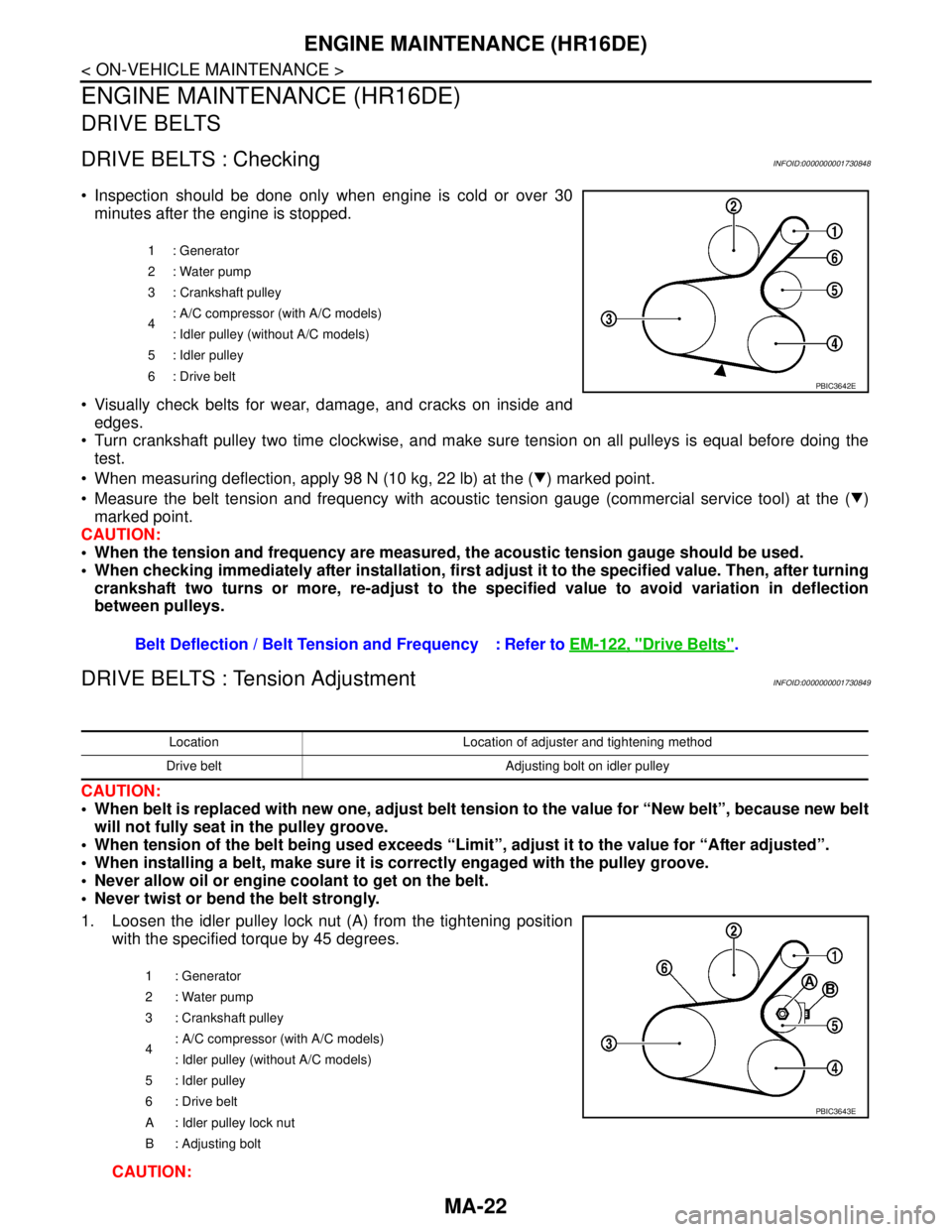
MA-22
< ON-VEHICLE MAINTENANCE >
ENGINE MAINTENANCE (HR16DE)
ENGINE MAINTENANCE (HR16DE)
DRIVE BELTS
DRIVE BELTS : CheckingINFOID:0000000001730848
Inspection should be done only when engine is cold or over 30
minutes after the engine is stopped.
Visually check belts for wear, damage, and cracks on inside and
edges.
Turn crankshaft pulley two time clockwise, and make sure tension on all pulleys is equal before doing the
test.
When measuring deflection, apply 98 N (10 kg, 22 lb) at the ( ) marked point.
Measure the belt tension and frequency with acoustic tension gauge (commercial service tool) at the ( )
marked point.
CAUTION:
When the tension and frequency are measured, the acoustic tension gauge should be used.
When checking immediately after installation, first adjust it to the specified value. Then, after turning
crankshaft two turns or more, re-adjust to the specified value to avoid variation in deflection
between pulleys.
DRIVE BELTS : Tension AdjustmentINFOID:0000000001730849
CAUTION:
When belt is replaced with new one, adjust belt tension to the value for “New belt”, because new belt
will not fully seat in the pulley groove.
When tension of the belt being used exceeds “Limit”, adjust it to the value for “After adjusted”.
When installing a belt, make sure it is correctly engaged with the pulley groove.
Never allow oil or engine coolant to get on the belt.
Never twist or bend the belt strongly.
1. Loosen the idler pulley lock nut (A) from the tightening position
with the specified torque by 45 degrees.
CAUTION:
1 : Generator
2: Water pump
3 : Crankshaft pulley
4: A/C compressor (with A/C models)
: Idler pulley (without A/C models)
5 : Idler pulley
6: Drive belt
Belt Deflection / Belt Tension and Frequency : Refer to EM-122, "Drive Belts".
PBIC3642E
Location Location of adjuster and tightening method
Drive belt Adjusting bolt on idler pulley
1 : Generator
2: Water pump
3 : Crankshaft pulley
4: A/C compressor (with A/C models)
: Idler pulley (without A/C models)
5 : Idler pulley
6 : Drive belt
A : Idler pulley lock nut
B : Adjusting bolt
PBIC3643E