check engine NISSAN X-TRAIL 2003 Electronic Repair Manual
[x] Cancel search | Manufacturer: NISSAN, Model Year: 2003, Model line: X-TRAIL, Model: NISSAN X-TRAIL 2003Pages: 3066, PDF Size: 51.47 MB
Page 984 of 3066
![NISSAN X-TRAIL 2003 Electronic Repair Manual BRC-116
[ESP/TCS/ABS]
TROUBLE DIAGNOSIS
Symptom 7: SLIP Indicator Lamp Does Not Illuminate
EFS001AY
Inspection procedure
1.SLIP INDICATOR LAMP BURNED-OUT BULB INSPECTION
Check for continuity between t](/img/5/57402/w960_57402-983.png "NISSAN X-TRAIL 2003 Electronic Repair Manual BRC-116
[ESP/TCS/ABS]
TROUBLE DIAGNOSIS
Symptom 7: SLIP Indicator Lamp Does Not Illuminate
EFS001AY
Inspection procedure
1.SLIP INDICATOR LAMP BURNED-OUT BULB INSPECTION
Check for continuity between t")
BRC-116
[ESP/TCS/ABS]
TROUBLE DIAGNOSIS
Symptom 7: SLIP Indicator Lamp Does Not Illuminate
EFS001AY
Inspection procedure
1.SLIP INDICATOR LAMP BURNED-OUT BULB INSPECTION
Check for continuity between the power supply terminal of meter and terminal of ABS warning lamp.
Is inspection result OK?
OK >> GO TO 2.
NG >> Circuit malfunction in SLIP indicator lamp or combination meter
2.SLIP INDICATOR LAMP POWER CIRCUIT INSPECTION
Disconnect the meter connector. Check that the voltage between the vehicle-side harness terminal and body
ground is battery voltage (Approx. 12V).
Is inspection result OK?
YES >> GO TO 3.
NO >>
lFuse inspection
lInspection for harness and connectors between fuse block and meter
lCheck the power supply circuit (battery and ignition switch circuit).
3.SLIP INDICATOR LAMP HARNESS INSPECTION
1. Disconnect connectors for the ESP/TCS/ABS control unit and meter vehicle-side harness.
2. Check the harness between the meter and the ESP/TCS/ABS control unit for an open/shorted circuit.
Is inspection result OK?
OK >> GO TO 4.
NG >> Repair or replace the disconnected harness.
4.SLIP INDICATOR LAMP CONNECTOR INSPECTION
Check connectors for the ESP/TCS/ABS control unit and meter vehicle-side harness.
Is inspection result OK?
YES >> Connect connectors, and perform the self-diagnosis. The vehicle harness has the intermediate
connector. Refer to the vehicle wiring diagram, always check it.
NG >> Repair or replace the disconnected connector.
Symptom 8: During ESP/TCS/ABS Control, Vehicle Behavior is Jerky.EFS001AZ
Inspection procedure
1.ENGINE SPEED SIGNAL INSPECTION
Perform²DATA MONITOR²with CONSULT-II for the ESP/TCS/ABS control unit.
Is the engine speed at idle 400 rpm or higher?
YES >> Normal
NO >> GO TO 2.
2.SELF-DIAGNOSIS RESULT CHECK 1
Perform the ESP/TCS/ABS control unit self-diagnosis.
Is the self-diagnosis results displayed?
YES >> After checking and repairing the applicable item, perform the ESP/TCS/ABS control unit self-
diagnosis again.
NO >> GO TO 3.
Page 985 of 3066
![NISSAN X-TRAIL 2003 Electronic Repair Manual TROUBLE DIAGNOSIS
BRC-117
[ESP/TCS/ABS]
C
D
E
G
H
I
J
K
L
MA
B
BRC
3.ECM SELF-DIAGNOSIS RESULT CHECK
Perform the ECM self-diagnosis.
Is the self-diagnosis results indicated?
YES >> Repair or replace t](/img/5/57402/w960_57402-984.png "NISSAN X-TRAIL 2003 Electronic Repair Manual TROUBLE DIAGNOSIS
BRC-117
[ESP/TCS/ABS]
C
D
E
G
H
I
J
K
L
MA
B
BRC
3.ECM SELF-DIAGNOSIS RESULT CHECK
Perform the ECM self-diagnosis.
Is the self-diagnosis results indicated?
YES >> Repair or replace t")
TROUBLE DIAGNOSIS
BRC-117
[ESP/TCS/ABS]
C
D
E
G
H
I
J
K
L
MA
B
BRC
3.ECM SELF-DIAGNOSIS RESULT CHECK
Perform the ECM self-diagnosis.
Is the self-diagnosis results indicated?
YES >> Repair or replace the camshaft position sensor system.
NO >> GO TO 4.
4.SELF-DIAGNOSIS RESULT 2
Disconnect connectors for the ESP/TCS/ABS control unit and ECM, and reconnect them correctly to perform
the self-diagnosis again.
Is inspection result OK?
OK >> GO TO 5.
NG >> Connector malfunction. Repair or replace the connector.
5.SELF-DIAGNOSIS RESULT CHECK 3
Perform the 4WD control unit self-diagnosis.
Is inspection result OK?
OK >> GO TO 6.
NG >> Repair or replace the applicable part.
6.SELF-DIAGNOSIS RESULT CHECK 4
Perform the ESP/TCS/4WD control unit self-diagnosis again.
Is the self-diagnosis results displayed?
YES >> Repair or replace the applicable item.
NO >> GO TO 7.
7.CIRCUIT CHECK BETWEEN ESP/TCS/ABS CONTROL UNIT AND ECM
1. Disconnect connectors for the ESP/TCS/ABS control unit and ECM.
2. Check the engine speed signal harness between the ESP/TCS/ABS control unit and ECM for an open/
shorted circuit.
3. Check connectors for the ESP/TCS/ABS control unit and ECM.
Is inspection result OK?
OK >> Inspection End
NG >> Repair or replace the applicable item and perform the ESP/TCS/ABS control unit self-diagnosis
again.
Page 998 of 3066
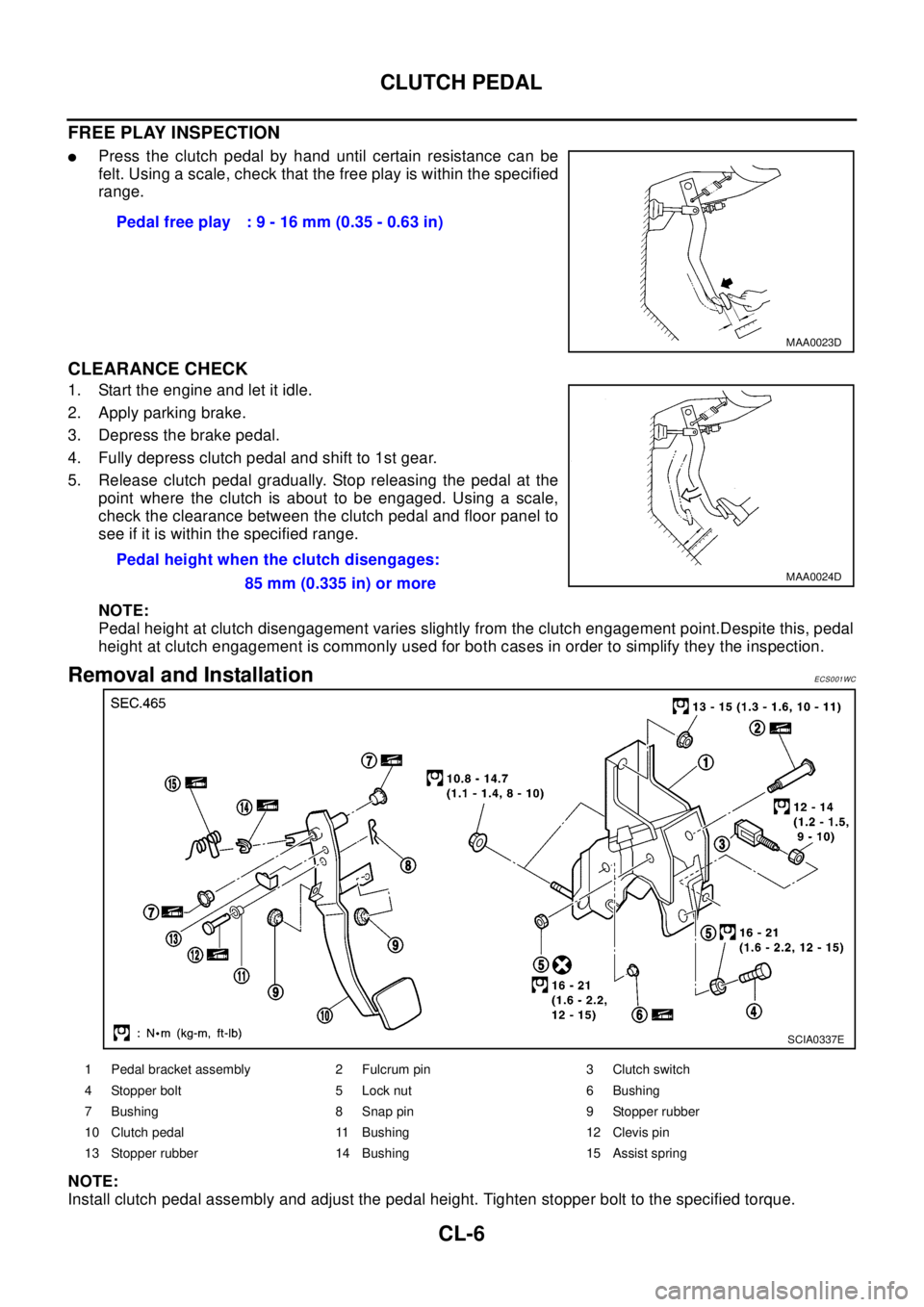
CL-6
CLUTCH PEDAL
FREE PLAY INSPECTION
lPress the clutch pedal by hand until certain resistance can be
felt. Using a scale, check that the free play is within the specified
range.
CLEARANCE CHECK
1. Start the engine and let it idle.
2. Apply parking brake.
3. Depress the brake pedal.
4. Fully depress clutch pedal and shift to 1st gear.
5. Release clutch pedal gradually. Stop releasing the pedal at the
point where the clutch is about to be engaged. Using a scale,
check the clearance between the clutch pedal and floor panel to
see if it is within the specified range.
NOTE:
Pedal height at clutch disengagement varies slightly from the clutch engagement point.Despite this, pedal
height at clutch engagement is commonly used for both cases in order to simplify they the inspection.
Removal and InstallationECS001WC
NOTE:
Install clutch pedal assembly and adjust the pedal height. Tighten stopper bolt to the specified torque.Pedalfreeplay :9-16mm(0.35-0.63in)
MAA0023D
Pedal height when the clutch disengages:
85 mm (0.335 in) or more
MAA0024D
SCIA0337E
1 Pedal bracket assembly 2 Fulcrum pin 3 Clutch switch
4 Stopper bolt 5 Lock nut 6 Bushing
7 Bushing 8 Snap pin 9 Stopper rubber
10 Clutch pedal 11 Bushing 12 Clevis pin
13 Stopper rubber 14 Bushing 15 Assist spring
Page 1008 of 3066
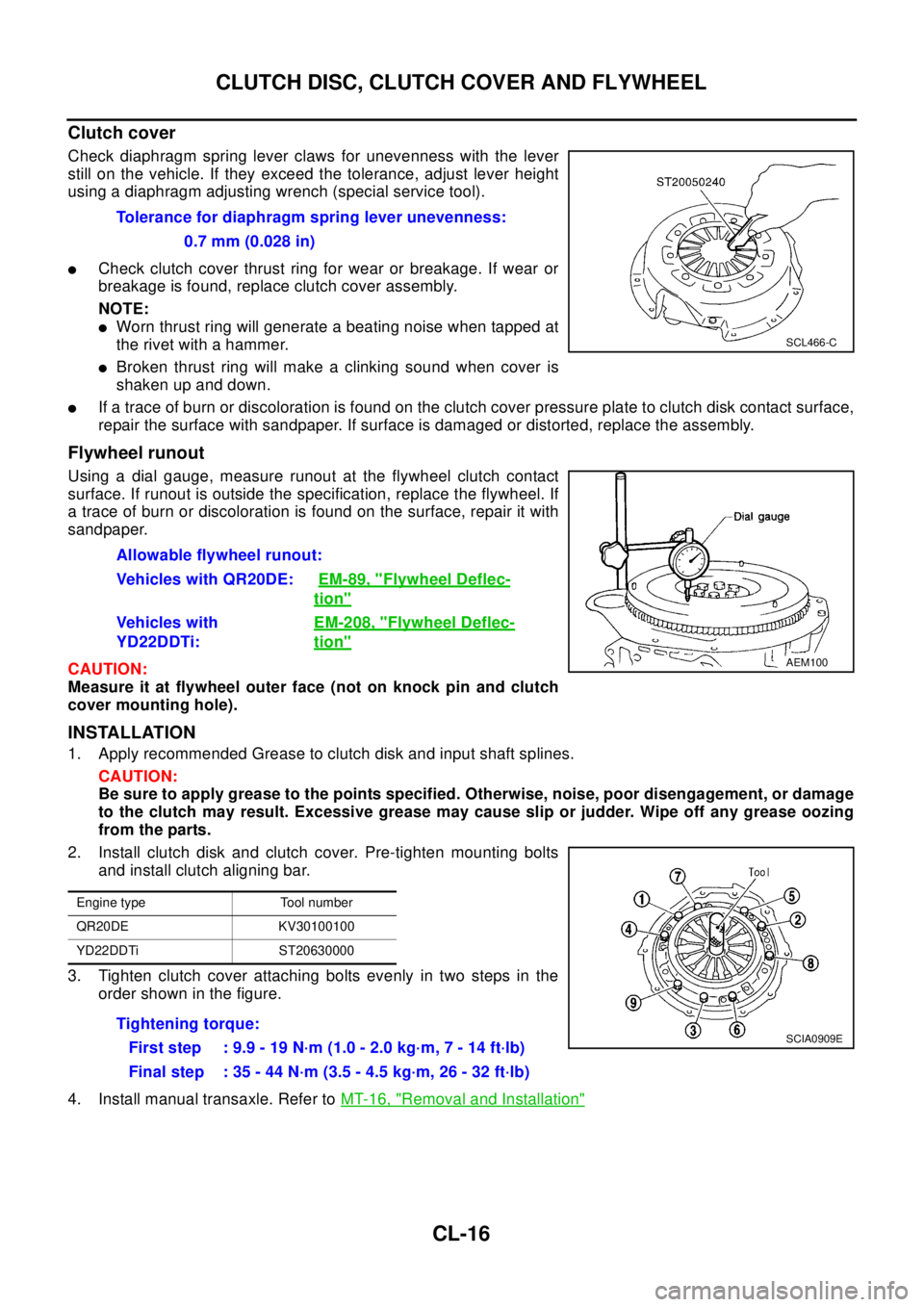
CL-16
CLUTCH DISC, CLUTCH COVER AND FLYWHEEL
Clutch cover
Check diaphragm spring lever claws for unevenness with the lever
still on the vehicle. If they exceed the tolerance, adjust lever height
using a diaphragm adjusting wrench (special service tool).
lCheck clutch cover thrust ring for wear or breakage. If wear or
breakage is found, replace clutch cover assembly.
NOTE:
lWorn thrust ring will generate a beating noise when tapped at
therivetwithahammer.
lBroken thrust ring will make a clinking sound when cover is
shaken up and down.
lIf a trace of burn or discoloration is found on the clutch cover pressure plate to clutch disk contact surface,
repair the surface with sandpaper. If surface is damaged or distorted, replace the assembly.
Flywheel runout
Using a dial gauge, measure runout at the flywheel clutch contact
surface. If runout is outside the specification, replace the flywheel. If
a trace of burn or discoloration is found on the surface, repair it with
sandpaper.
CAUTION:
Measure it at flywheel outer face (not on knock pin and clutch
cover mounting hole).
INSTALLATION
1. Apply recommended Grease to clutch disk and input shaft splines.
CAUTION:
Be sure to apply grease to the points specified. Otherwise, noise, poor disengagement, or damage
to the clutch may result. Excessive grease may cause slip or judder. Wipe off any grease oozing
from the parts.
2. Install clutch disk and clutch cover. Pre-tighten mounting bolts
and install clutch aligning bar.
3. Tighten clutch cover attaching bolts evenly in two steps in the
order shown in the figure.
4. Install manual transaxle. Refer toMT-16, "
Removal and Installation"
Tolerance for diaphragm spring lever unevenness:
0.7 mm (0.028 in)
SCL466-C
Allowable flywheel runout:
Vehicles with QR20DE:EM-89, "
Flywheel Deflec-
tion"
Vehicles with
YD22DDTi:EM-208, "Flywheel Deflec-
tion"
AEM100
Engine type Tool number
QR20DE KV30100100
YD22DDTi ST20630000
Tightening torque:
First step : 9.9 - 19 N·m (1.0 - 2.0 kg·m, 7 - 14 ft·lb)
Final step : 35 - 44 N·m (3.5 - 4.5 kg·m, 26 - 32 ft·lb)SCIA0909E
Page 1011 of 3066

CO-1
ENGINE COOLING SYSTEM
B ENGINE
CONTENTS
C
D
E
F
G
H
I
J
K
L
M
SECTION
A
CO
ENGINE COOLING SYSTEM
QR20DE
PRECAUTIONS .......................................................... 3
Precautions For Liquid Gasket ................................. 3
REMOVAL OF LIQUID GASKET .......................... 3
LIQUID GASKET APPLICATION PROCEDURE..... 3
PREPARATION ........................................................... 4
Special Service Tools ............................................... 4
OVERHEATING CAUSE ANALYSIS .......................... 5
Troubleshooting Chart .............................................. 5
COOLING SYSTEM .................................................... 7
Cooling Circuit .......................................................... 7
ENGINE COOLANT .................................................... 9
Inspection ................................................................. 9
LEVEL CHECK ..................................................... 9
LEAK CHECK ....................................................... 9
Changing Engine Coolant ........................................ 9
DRAINING ENGINE COOLANT ........................... 9
REFILLING ENGINE COOLANT ........................ 10
FLUSHING COOLING SYSTEM ......................... 10
RADIATOR ................................................................ 12
Removal and Installation ........................................ 12
REMOVAL ........................................................... 12
INSTALLATION ................................................... 12
Disassembly and Assembly Radiator Fan ............. 13
DISASSEMBLY ................................................... 13
ASSEMBLY ......................................................... 13
INSPECTION ......................................................... 13
CHECKING RADIATOR CAP .............................. 13
CHECKING RADIATOR ...................................... 14
RADIATOR (ALUMINUM TYPE) .............................. 15
Disassembly and Assembly ................................... 15
PREPARATION ................................................... 15
DISASSEMBLY ................................................... 15
ASSEMBLY ......................................................... 16
INSPECTION ...................................................... 18WATER PUMP .......................................................... 19
Removal and Installation ........................................ 19
REMOVAL ........................................................... 19
INSPECTION AFTER REMOVAL ....................... 20
INSTALLATION ................................................... 20
INSPECTION AFTER INSTALLATION ................ 20
THERMOSTAT AND WATER CONTROL VALVE .... 21
Removal and Installation ........................................ 21
REMOVAL ........................................................... 21
INSPECTION AFTER REMOVAL ....................... 22
INSTALLATION ................................................... 22
SERVICE DATA AND SPECIFICATIONS (SDS) ...... 23
Capacity .................................................................. 23
Thermostat ............................................................. 23
Water Control Valve ................................................ 23
Radiator .................................................................. 23
Tightening Torque ................................................... 23
YD22DDTi
PRECAUTIONS ........................................................ 24
Precautions For Liquid Gasket ............................... 24
REMOVAL AND LIQUID GASKET ...................... 24
LIQUID GASKET APPLICATION PROCEDURE... 24
PREPARATION ......................................................... 25
Special Service Tools ............................................. 25
OVERHEATING CAUSE ANALYSIS ........................ 26
Troubleshooting Chart ............................................ 26
COOLING SYSTEM .................................................. 28
Cooling Circuit ........................................................ 28
ENGINE COOLANT .................................................. 30
Inspection ............................................................... 30
LEVEL CHECK .................................................... 30
LEAK CHECK ...................................................... 30
Changing Engine Coolant ....................................... 30
DRAINING ENGINE COOLANT .......................... 30
REFILLING ENGINE COOLANT ......................... 31
FLUSHING COOLING SYSTEM ......................... 32
RADIATOR ................................................................ 33
Removal and Installation ........................................ 33
Page 1016 of 3066
![NISSAN X-TRAIL 2003 Electronic Repair Manual CO-6
[QR20DE]
OVERHEATING CAUSE ANALYSIS
Except cool-
ing system
parts mal-
function— OverloadonengineAbusive drivingHigh engine rpm under no
load
Driving in low gear for
extended time
Driving at ex](/img/5/57402/w960_57402-1015.png "NISSAN X-TRAIL 2003 Electronic Repair Manual CO-6
[QR20DE]
OVERHEATING CAUSE ANALYSIS
Except cool-
ing system
parts mal-
function— OverloadonengineAbusive drivingHigh engine rpm under no
load
Driving in low gear for
extended time
Driving at ex")
CO-6
[QR20DE]
OVERHEATING CAUSE ANALYSIS
Except cool-
ing system
parts mal-
function— OverloadonengineAbusive drivingHigh engine rpm under no
load
Driving in low gear for
extended time
Driving at extremely high
speed
Powertrain system mal-
function
— Installed improper size
wheels and tires
Dragging brakes
Improper ignition timing
Blocked or restricted air
flowBlocked bumper —
— Blocked radiator grilleInstalled car brassiere
Mud contamination or
paper clogging
Blocked radiator —
Blocked condenser
—
Installed large fog lamp Symptom Check items
Page 1019 of 3066
![NISSAN X-TRAIL 2003 Electronic Repair Manual ENGINE COOLANT
CO-9
[QR20DE]
C
D
E
F
G
H
I
J
K
L
MA
CO
ENGINE COOLANTPFP:KQ100
InspectionEBS009SD
LEVEL CHECK
lCheck if the reservoir tank coolant level within MIN to MAX when
engine is cool.
lAdjust](/img/5/57402/w960_57402-1018.png "NISSAN X-TRAIL 2003 Electronic Repair Manual ENGINE COOLANT
CO-9
[QR20DE]
C
D
E
F
G
H
I
J
K
L
MA
CO
ENGINE COOLANTPFP:KQ100
InspectionEBS009SD
LEVEL CHECK
lCheck if the reservoir tank coolant level within MIN to MAX when
engine is cool.
lAdjust")
ENGINE COOLANT
CO-9
[QR20DE]
C
D
E
F
G
H
I
J
K
L
MA
CO
ENGINE COOLANTPFP:KQ100
InspectionEBS009SD
LEVEL CHECK
lCheck if the reservoir tank coolant level within MIN to MAX when
engine is cool.
lAdjust coolant if too much or too little.
LEAK CHECK
lTo check for leakage, apply pressure to the cooling system with
atester.
WA RN ING:
Never remove the radiator cap when the engine is hot. Serious
burns could occur from high pressure coolant escaping from
the radiator.
CAUTION:
Higher pressure than specified may cause radiator damage.
Changing Engine CoolantEBS009SE
WA RN ING:
lTo avoid being scalded, never change the coolant when the engine is hot.
lWrap a thick cloth around cap and carefully remove the cap. First, turn the cap a quarter of a turn
to release built-up pressure. Then turn the cap all the way.
DRAINING ENGINE COOLANT
1. Open radiator drain plug at the bottom of radiator, and remove
radiator cap.
lBe careful not to allow coolant to contact drive belts.
SMA412B
Testing pressure
: 157 kPa (1.57bar 1.6 kg/cm2,23psi)
SLC134B
PBIC0236E
Page 1020 of 3066
![NISSAN X-TRAIL 2003 Electronic Repair Manual CO-10
[QR20DE]
ENGINE COOLANT
2. Open drain plugs on cylinder block.
3. Remove reservoir tank and drain coolant.
4. Check drained coolant for contaminants such as rust, corrosion
or discoloration.
If](/img/5/57402/w960_57402-1019.png "NISSAN X-TRAIL 2003 Electronic Repair Manual CO-10
[QR20DE]
ENGINE COOLANT
2. Open drain plugs on cylinder block.
3. Remove reservoir tank and drain coolant.
4. Check drained coolant for contaminants such as rust, corrosion
or discoloration.
If")
CO-10
[QR20DE]
ENGINE COOLANT
2. Open drain plugs on cylinder block.
3. Remove reservoir tank and drain coolant.
4. Check drained coolant for contaminants such as rust, corrosion
or discoloration.
If contaminated, flush engine cooling system. Refer toCO-10,
"FLUSHING COOLING SYSTEM".
REFILLING ENGINE COOLANT
1. Install reservoir tank, radiator drain plug and cylinder block drain plug.
Apply sealant to the thread of cylinder block drain plug.
lUse Genuine Liquid Gasket or equivalent.
2. Fill radiator and reservoir tank to specified level.
lUse genuine Nissan anti-freeze coolant or equivalent mixed
with water (distilled or demineralized).
Refer toMA-17, "
RECOMMENDED FLUIDS AND LUBRI-
CANTS".
lPour coolant slowly of less than 2 (2-1/8US qt,1-3/4 lmp
qt) a minute to allow air in system to escape.
3. Warm up engine to normal operating temperature without radia-
tor cap installed.
lIf coolant overflows radiator filler hole, install filler cap.
4. Run engine at 3,000 rpm for 10 seconds and return to idle speed
with radiator cap installed.
lRepeat two or three times.
Watch coolant temperature gauge so as not to overheat the engine.
5. Stop engine and cool down to less than approximately 50°C(122°F).
lCool down using a fan to reduce the time.
lIf necessary, refill radiator up to filler neck with coolant.
6. Refill reservoir tank to MAX level line with coolant.
7. Repeat steps 5 through 7 two or more times with radiator cap installed until coolant level no longer drops.
8. Check cooling system for leaks with engine running.
9. Warm up engine, and check for sound of coolant flow while running engine from idle up to 3,000 rpm with
heater temperature controller set at several position between COOL and WARM.
lSound may be noticeable at heater unit.
10. If sound is heard, bleed air from cooling system by repeating steps 5 through 7 until coolant level no
longer drops.
lClean excess coolant from engine.
FLUSHING COOLING SYSTEM
1. Fill radiator and reservoir tank with water and reinstall radiator cap.
KBIA0163E
: 7.8 - 11.8 N·m (0.8 -1.2 kg-m , 69 - 104 in-lb)
Engine coolant capacity (With reservoir tank):
Approx. 7.1 (6-1/4 Imp qt)
SMA182B
Reservoir tank:
0.6 (1/2 lmp qt )
SMA412B
Page 1022 of 3066
![NISSAN X-TRAIL 2003 Electronic Repair Manual CO-12
[QR20DE]
RADIATOR
RADIATOR
PFP:21400
Removal and InstallationEBS009SF
WAR NIN G:
Never remove the radiator cap when the engine is hot. Serious burns could occur from high pressure
coolant escapi](/img/5/57402/w960_57402-1021.png "NISSAN X-TRAIL 2003 Electronic Repair Manual CO-12
[QR20DE]
RADIATOR
RADIATOR
PFP:21400
Removal and InstallationEBS009SF
WAR NIN G:
Never remove the radiator cap when the engine is hot. Serious burns could occur from high pressure
coolant escapi")
CO-12
[QR20DE]
RADIATOR
RADIATOR
PFP:21400
Removal and InstallationEBS009SF
WAR NIN G:
Never remove the radiator cap when the engine is hot. Serious burns could occur from high pressure
coolant escaping from the radiator. Wrap a thick cloth around the cap. Slowly turn it a quarter turn to
allow built-up pressure to escape. Carefully remove the cap by turning it all the way.
REMOVAL
1. Drain coolant. Refer toCO-9, "DRAINING ENGINE COOLANT".
2. Remove air duct with air cleaner assembly.
3. Remove A/T oil cooler hose.
lInstall blind plug to avoid leakage of A/T fluid.
4. Disconnect radiator upper hose, lower hose and mounting bracket.
5. Remove radiator and radiator fan assembly
CAUTION:
lDo not damage or scratch radiator core when removing.
INSTALLATION
lReinstall any parts removed in reverse order of removal.
lCheck for coolant leaks. Refer toCO-9, "LEAK CHECK".
PBIC0237E
1 Radiator 2 Bracket 3 Mounting rubber
4 A/T oil cooler hose 5 Radiator hose (lower) 6 Radiator fan assembly
7 Reservoir tank 8 Radiator hose (upper) 9 Radiator filler cap
Page 1037 of 3066
![NISSAN X-TRAIL 2003 Electronic Repair Manual OVERHEATING CAUSE ANALYSIS
CO-27
[YD22DDTi]
C
D
E
F
G
H
I
J
K
L
MA
CO
Except cool-
ing system
parts mal-
function— Overload on engineAbusive drivingHigh engine rpm under no
load
Driving in low gear](/img/5/57402/w960_57402-1036.png "NISSAN X-TRAIL 2003 Electronic Repair Manual OVERHEATING CAUSE ANALYSIS
CO-27
[YD22DDTi]
C
D
E
F
G
H
I
J
K
L
MA
CO
Except cool-
ing system
parts mal-
function— Overload on engineAbusive drivingHigh engine rpm under no
load
Driving in low gear")
OVERHEATING CAUSE ANALYSIS
CO-27
[YD22DDTi]
C
D
E
F
G
H
I
J
K
L
MA
CO
Except cool-
ing system
parts mal-
function— Overload on engineAbusive drivingHigh engine rpm under no
load
Driving in low gear for
extended time
Driving at extremely high
speed
Powertrain system mal-
function
— Installed improper size
wheels and tires
Dragging brakes
Improper ignition timing
Blocked or restricted air
flowBlocked bumper —
— Blocked radiator grilleInstalled car brassiere
Mud contamination or
paper clogging
Blocked radiator —
Blocked condenser
—
Installed large fog lamp Symptom Check items