check engine NISSAN X-TRAIL 2003 Electronic Repair Manual
[x] Cancel search | Manufacturer: NISSAN, Model Year: 2003, Model line: X-TRAIL, Model: NISSAN X-TRAIL 2003Pages: 3066, PDF Size: 51.47 MB
Page 846 of 3066
BR-12
BRAKE PIPING AND HOSE
5. Refill brake fluid until new brake fluid comes out of each air bleeder.
6. Afterwards, bleed air.
Removal and Installation of Rear Brake Piping and Brake HoseEFS000C8
REMOVAL
CAUTION:
lDo not allow brake fluid to spill or splash on painted surfaces. Brake fluid can seriously damage
paint. If it gets on a painted surface, wipe it off immediately and wash with water.
lDo not bend or twist the brake hose sharply, or strongly pull it.
lCover brake fluid line connections to prevent dust and other foreign material from entering.
1. Connect a vinyl tube to the air bleeder.
2. Drain brake fluid gradually from the air bleeder of each wheel while depressing the brake pedal.
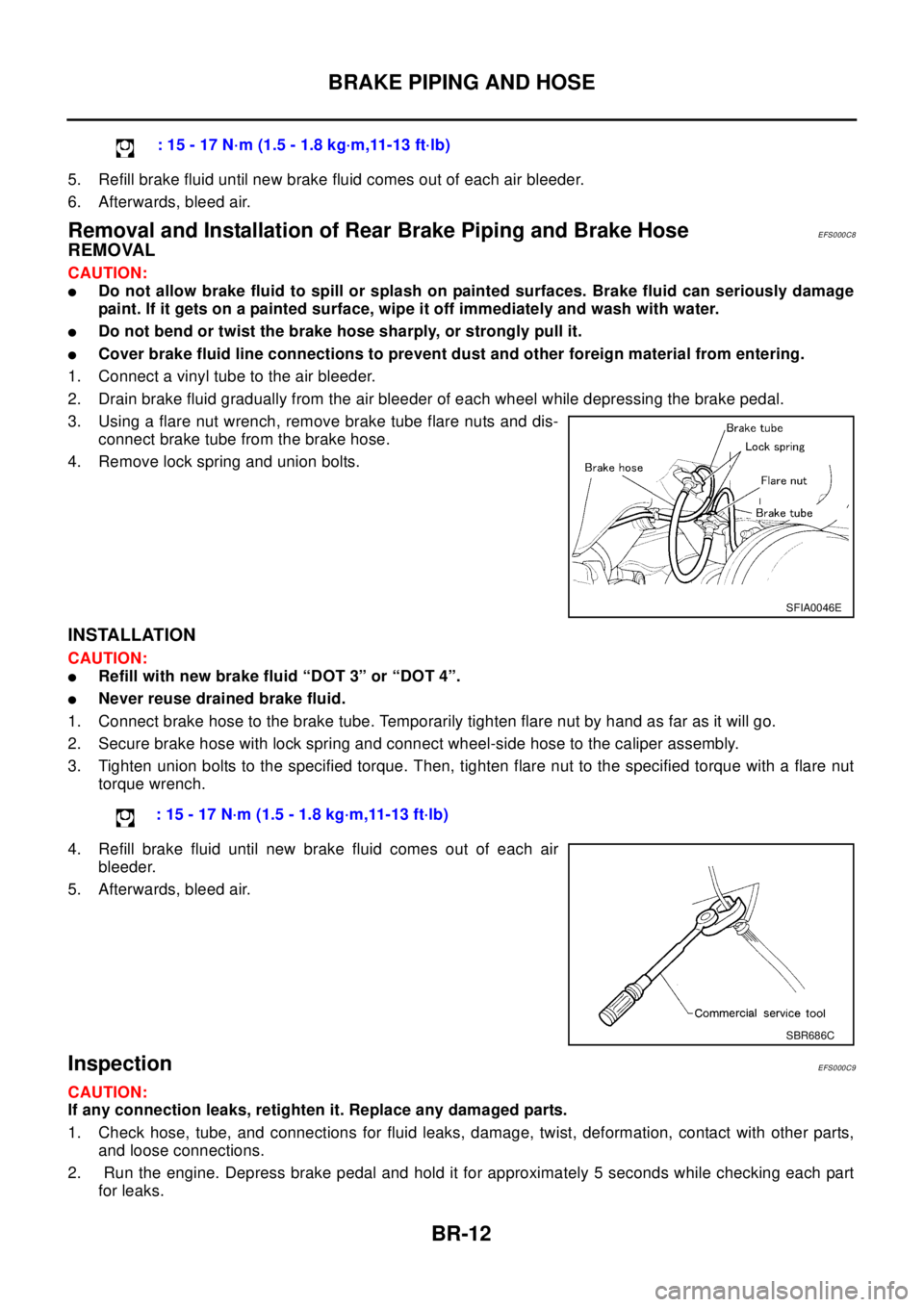
3. Using a flare nut wrench, remove brake tube flare nuts and dis-
connect brake tube from the brake hose.
4. Remove lock spring and union bolts.
INSTALLATION
CAUTION:
lRefill with new brake fluid “DOT 3” or “DOT 4”.
lNever reuse drained brake fluid.
1. Connect brake hose to the brake tube. Temporarily tighten flare nut by hand as far as it will go.
2. Secure brake hose with lock spring and connect wheel-side hose to the caliper assembly.
3. Tighten union bolts to the specified torque. Then, tighten flare nut to the specified torque with a flare nut
torque wrench.
4. Refill brake fluid until new brake fluid comes out of each air
bleeder.
5. Afterwards, bleed air.
InspectionEFS000C9
CAUTION:
If any connection leaks, retighten it. Replace any damaged parts.
1. Check hose, tube, and connections for fluid leaks, damage, twist, deformation, contact with other parts,
and loose connections.
2. Run the engine. Depress brake pedal and hold it for approximately 5 seconds while checking each part
for leaks.:15-17N·m(1.5-1.8kg·m,11-13ft·lb)
SFIA0046E
: 15 - 17 N·m (1.5 - 1.8 kg·m,11-13 ft·lb)
SBR686C
Page 851 of 3066
BRAKE BOOSTER
BR-17
C
D
E
G
H
I
J
K
L
MA
B
BR
BRAKE BOOSTERPFP:47200
On-Vehicle Inspection and ServiceEFS000CC
FUNCTION INSPECTION
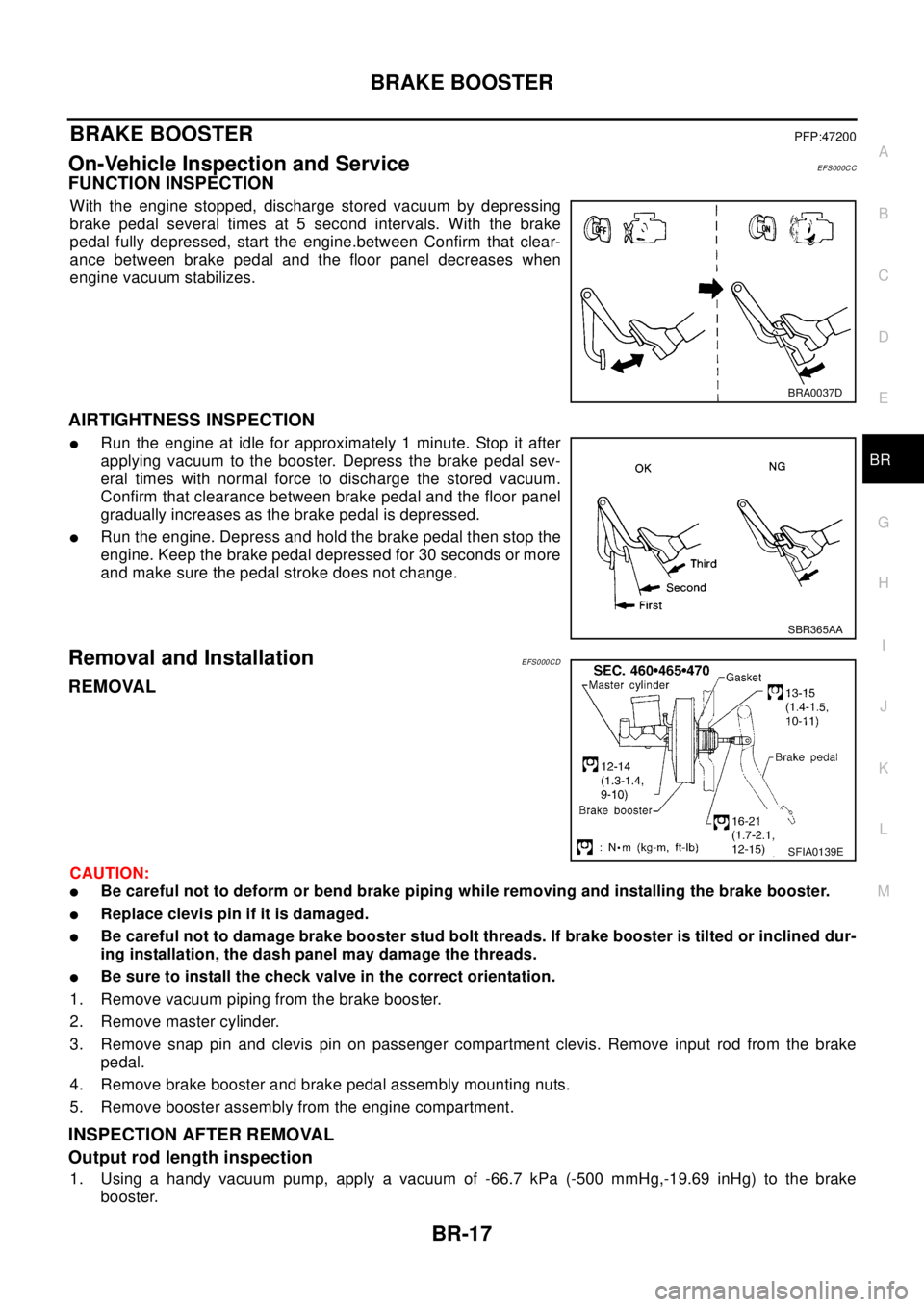
With the engine stopped, discharge stored vacuum by depressing
brake pedal several times at 5 second intervals. With the brake
pedal fully depressed, start the engine.between Confirm that clear-
ance between brake pedal and the floor panel decreases when
engine vacuum stabilizes.
AIRTIGHTNESS INSPECTION
lRun the engine at idle for approximately 1 minute. Stop it after
applying vacuum to the booster. Depress the brake pedal sev-
eral times with normal force to discharge the stored vacuum.
Confirm that clearance between brake pedal and the floor panel
gradually increases as the brake pedal is depressed.
lRun the engine. Depress and hold the brake pedal then stop the
engine. Keep the brake pedal depressed for 30 seconds or more
and make sure the pedal stroke does not change.
Removal and InstallationEFS000CD
REMOVAL
CAUTION:
lBe careful not to deform or bend brake piping while removing and installing the brake booster.
lReplace clevis pin if it is damaged.
lBe careful not to damage brake booster stud bolt threads. If brake booster is tilted or inclined dur-
ing installation, the dash panel may damage the threads.
lBe sure to install the check valve in the correct orientation.
1. Remove vacuum piping from the brake booster.
2. Remove master cylinder.
3. Remove snap pin and clevis pin on passenger compartment clevis. Remove input rod from the brake
pedal.
4. Remove brake booster and brake pedal assembly mounting nuts.
5. Remove booster assembly from the engine compartment.
INSPECTION AFTER REMOVAL
Output rod length inspection
1. Using a handy vacuum pump, apply a vacuum of -66.7 kPa (-500 mmHg,-19.69 inHg) to the brake
booster.
BRA0037D
SBR365AA
SFIA0139E
Page 854 of 3066
BR-20
VACUUM LINES
CHECK VALVE INSPECTION
Quick Inspection
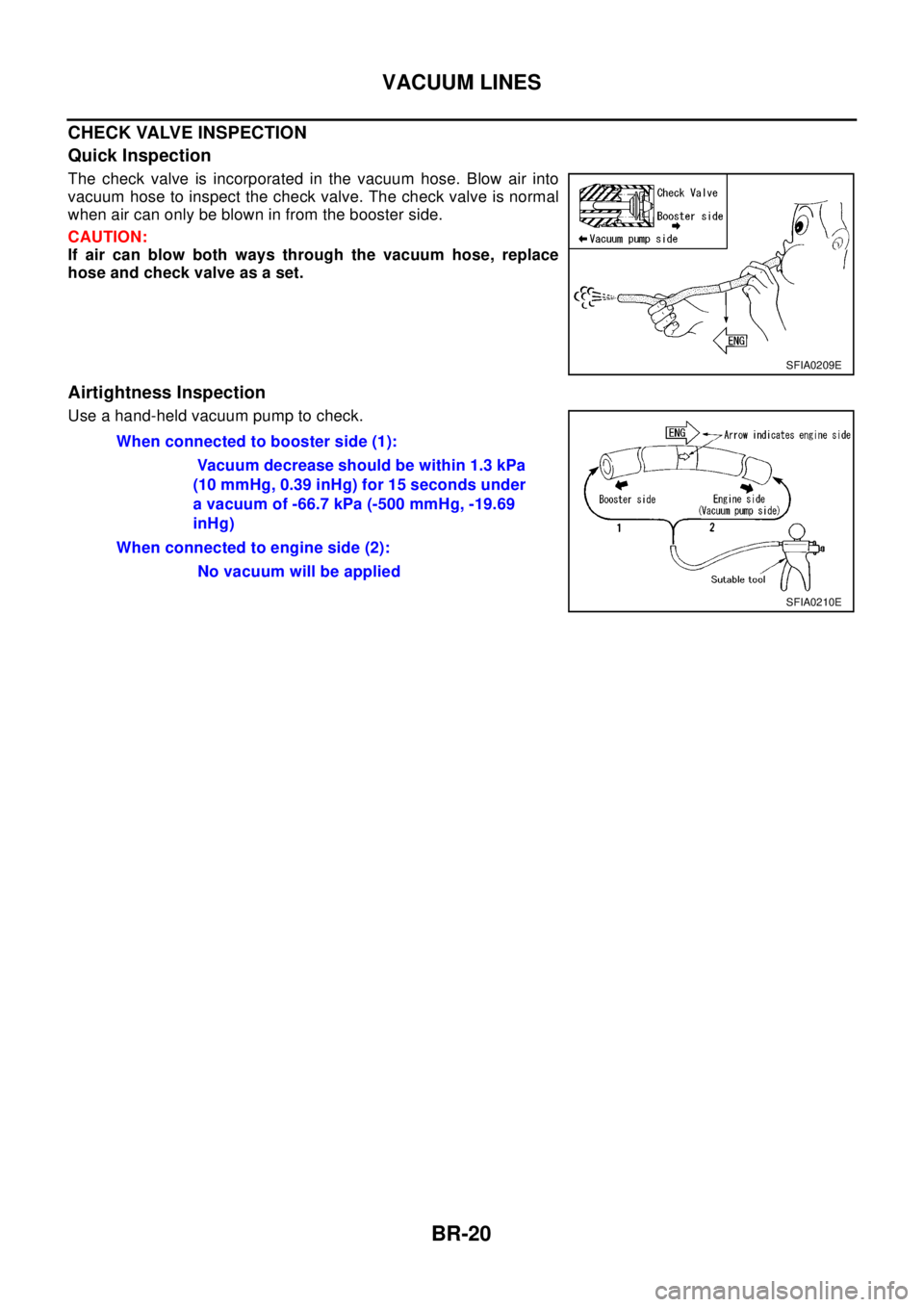
The check valve is incorporated in the vacuum hose. Blow air into
vacuum hose to inspect the check valve. The check valve is normal
when air can only be blown in from the booster side.
CAUTION:
If air can blow both ways through the vacuum hose, replace
hose and check valve as a set.
Airtightness Inspection
Use a hand-held vacuum pump to check.
SFIA0209E
When connected to booster side (1):
Vacuum decrease should be within 1.3 kPa
(10 mmHg, 0.39 inHg) for 15 seconds under
a vacuum of -66.7 kPa (-500 mmHg, -19.69
inHg)
When connected to engine side (2):
No vacuum will be applied
SFIA0210E
Page 870 of 3066

BRC-2
ACTUATOR RELAY) TURNS ON/OFF FRE-
QUENTLY ............................................................ 42
ABS warning lamp does not illuminate. (ABS warn-
ing lamp does not come on when the ignition switch
is turned ON.) ......................................................... 42
ABS warning lamp illuminates with ignition ON, but
does not illuminates after a few seconds. (ABS
warning lamp has illuminated.) ............................... 42
4WD warning lamp does not illuminate with ignition
ON. ......................................................................... 43
4WD warning lamp does not go out several seconds
after engine is started. (Drive mode indicator lamp
goes out.) ................................................................ 43
Heavy tight-corner braking symptom occurs when
the vehicle is driven in AUTO mode and the steering
wheel is turned fully to either side after the engine
is started. ................................................................ 44
Drive modes cannot be switched after engine is
started. .................................................................... 45
Wheel driving, 4WD warning lamp flashes rapidly.
(When it flashes for Approx. one minute, then does
not illuminate.) ........................................................ 45
Wheel driving, 4WD warning lamp flashes slowly.
(When it continues to illuminate until engine turns
OFF.) ....................................................................... 45
Vehicle does not enter 4WD mode even though
4WD warning lamp is off. ........................................ 46
Tight-corner braking symptom occurs when the
vehicle is started in AUTO mode (4WD warning lamp
remain OFF). .......................................................... 46
E-TS actuator relay (4WD solenoid actuator relay)
turns ON/OFF frequently. ........................................ 46
Inspection of drive mode change-over switch path... 47
WHEEL SENSORS ................................................... 48
Removal and Installation ........................................ 48
G-SENSOR (4WD MODEL ONLY) ............................ 49
Removal and Installation ........................................ 49
SENSOR ROTOR ...................................................... 50
Removal and Installation ........................................ 50
REMOVAL ........................................................... 50
INSTALLATION .................................................... 50
ACTUATOR ............................................................... 51
Removal and Installation ........................................ 51
REMOVAL ........................................................... 51
INSTALLATION .................................................... 51
ESP/TCS/ABS
PRECAUTIONS ......................................................... 52
Precautions for Supplemental Restraint System
(SRS) “AIR BAG” and “SEAT BELT PRE-TEN-
SIONER” ................................................................. 52
Precautions for Brake System ................................ 52
Precautions for Brake Control ................................ 52
Precautions for CAN System .................................. 53
FOR INSPECTION .............................................. 53
FOR HARNESS REPAIR .................................... 53ON-VEHICLE SERVICE ............................................54
Adjustment of Neutral Position of Steering Angle
Sensor .....................................................................54
GENERAL INFORMATION .......................................56
Fail-Safe ..................................................................56
ABS SYSTEM ......................................................56
ESP/TCS SYSTEM ..............................................56
Hydraulic Circuit ......................................................56
ABS Functions ........................................................56
TCS Functions ........................................................57
ESP Functions ........................................................57
System Diagram .....................................................58
CAN COMMUNICATION ...........................................59
System Description .................................................59
FOR M/T MODELS ..............................................59
TROUBLE DIAGNOSIS ............................................60
How to Perform Trouble Diagnoses for Quick and
Accurate Repair ......................................................60
INTRODUCTION .................................................60
WORK FLOW ......................................................61
ASKING COMPLAINTS .......................................62
EXAMPLE OF DIAGNOSIS SHEET ....................62
Component Parts and Harness Connector Location... 63
Schematic ...............................................................64
Wiring Diagram —ESP/TCS/ABS— .....................65
Control Unit Input/Output Signal Standard ..............71
STANDARDS USING A CIRCUIT TESTER AND
OSCILLOSCOPE .................................................71
STANDARDS WITH CONSULT-II ........................75
Functions of CONSULT-II .......................................77
CONSULT-II MAINLY FUNCTION APPLICA-
TION TO ESP/TCS/ABS ......................................77
SELF-DIAGNOSIS ...............................................78
DATA MONITOR ..................................................81
ACTIVE TEST ......................................................84
For Correct and Quick Diagnosis ............................88
PRECAUTIONS FOR TROUBLE DIAGNOSIS ... 88
Basic Inspection ......................................................89
PRELIMINARY CHECK 1: (BRAKE FLUID
LEVEL AND LEAK INSPECTION) .......................89
PRELIMINARY CHECK 2: (INSPECTION FOR
LOOSE POWER SUPPLY TERMINAL) ...............89
PRELIMINARY CHECK 3: (INSPECTION FOR
ABS WARNING LAMP, ESP OFF INDICATOR
LAMP, AND SLIP INDICATOR LAMP) .................89
Inspection 1 Wheel Speed Sensor and Circuit .......90
Inspection 2 Engine System ...................................92
Inspection 3 ESP/TCS/ABS Control Unit System ...92
Inspection 4 Pressure Sensor and the Circuit
between Pressure Sensor and ESP/TCS/ABS Con-
trol Unit. ...................................................................93
Inspection 5 Steering Angle Sensor and the Circuit
between Steering Angle Sensor and ESP/TCS/ABS
Control Unit. ............................................................94
Inspection 6 Yaw Rate Sensor/ Side G sensor and
the Circuit between Yaw Rate Sensor/ Side G sen-
sor and ESP/TCS/ABS Control Unit. ......................95
Inspection 7 Solenoid Valve, ESP Switch-over Sole-
Page 874 of 3066
![NISSAN X-TRAIL 2003 Electronic Repair Manual BRC-6
[4WD/ABS]
ALL MODE 4X4 SYSTEM
ALL MODE 4X4 SYSTEM
PFP:47850
System DescriptionEFS001CJ
ABS FUNCTION
lDuring ABS operation, brake pedal lightly vibrates and its mechanical noise may be heard. Thi](/img/5/57402/w960_57402-873.png "NISSAN X-TRAIL 2003 Electronic Repair Manual BRC-6
[4WD/ABS]
ALL MODE 4X4 SYSTEM
ALL MODE 4X4 SYSTEM
PFP:47850
System DescriptionEFS001CJ
ABS FUNCTION
lDuring ABS operation, brake pedal lightly vibrates and its mechanical noise may be heard. Thi")
BRC-6
[4WD/ABS]
ALL MODE 4X4 SYSTEM
ALL MODE 4X4 SYSTEM
PFP:47850
System DescriptionEFS001CJ
ABS FUNCTION
lDuring ABS operation, brake pedal lightly vibrates and its mechanical noise may be heard. This is a nor-
mal condition.
lWhen starting engine, or just after starting vehicle, brake pedal may vibrate. Also motor operating noise
may be heard from engine compartment. This is a normal status of operation check.
lWhen vehicle drives on rough, gravel, or snowy (fresh deep snow) road, the following conditions occur.
Stopping distance may be longer than that of vehicles without ABS.
4WD FUNCTION
lElectronically controlled 4WD is controlled by the same control module as that for ABS (4WD/ABS control
unit). 4WD/ABS control unit controls both electronically-controlled 4WD and ABS, based on input signals
from several sensors.
lIf electrical system-related malfunction occurred in 4WD/ABS system, control unit illuminates the following
lamps: 4WD warning lamp and/or ABS warning lamp on meter control unit assembly. This notifies driver of
malfunction. At the same time, control unit indicates malfunctioning part detected by self-diagnosis with
flashing pattern of LED. Indication on electronic system diagnosis tester (CONSULT) corresponds to this
flashing pattern as shown below.
Control System DiagramEFS001CK
Self-diagnostic test mode Remarks
Result of self-diagnosis Conformable to 4WD/ABS
Data monitor Conformable to 4WD/ABS
Active testChecks ABS solenoid valve ON/OFF, ABS motor ON/OFF, 4WD sole-
noid
Control unit part No. 4WD/ABS control unit
SFIA0350E
Page 886 of 3066
![NISSAN X-TRAIL 2003 Electronic Repair Manual BRC-18
[4WD/ABS]
TROUBLE DIAGNOSIS
Trouble Diagnosis Chart by Symptom
EFS001BF
When ABS and 4WD warning lamps illuminate, perform self-diagnosis.
Symptom Condition Check items Reference page
When igni](/img/5/57402/w960_57402-885.png "NISSAN X-TRAIL 2003 Electronic Repair Manual BRC-18
[4WD/ABS]
TROUBLE DIAGNOSIS
Trouble Diagnosis Chart by Symptom
EFS001BF
When ABS and 4WD warning lamps illuminate, perform self-diagnosis.
Symptom Condition Check items Reference page
When igni")
BRC-18
[4WD/ABS]
TROUBLE DIAGNOSIS
Trouble Diagnosis Chart by Symptom
EFS001BF
When ABS and 4WD warning lamps illuminate, perform self-diagnosis.
Symptom Condition Check items Reference page
When ignition switch is turned ON,
drive mode indicator lamp does not illu-
minate for Approx. 1 second (drive
mode lamp check)IGN-ON
lBlown drive mode indicator lamp bulb
lBlown fuse between ignition and drive mode
indicator lamp
lOpen circuit of wiring between ignition and
drive mode indicator lampBRC-42
ABS warning lamp does not illuminate
with ignition ON. (ABS warning lamp
check)IGN-ON
lBlown ABS warning lamp bulb
lBlown fuse between ignition and ABS warning
lamp.
lOpen circuit of wiring between ignition and
ABS warning lamp.
lMalfunction in ABS systemBRC-42
ABS warning lamp illuminates with
ignition ON, but does not illuminates
after a few seconds. (ABS warning
lamp has not illuminated.)IGN-ONl4WD/ABS control unit connector discon-
nected
lMalfunction in ABS systemBRC-42
4WD warning lamp does not illuminate
with ignition ON.IGN-ON
lBlown 4WD warning lamp bulb
lBlown fuse between ignition and 4WD warn-
ing lamp
lOpen circuit in wire between ignition and 4WD
warning lamp
lOpen circuit in wire between 4WD warning
lamp and 4WD actuator relay
lDisconnected 4WD actuator relay
lOpen circuit in wire between 4WD actuator
relay and body groundBRC-43
4WD warning lamp does not go out
several seconds after engine is started.
(Drive mode indicator lamp goes out.)Engine runningl4WD/ABS control unit connector discon-
nected
lMalfunction present in 4WD systemBRC-43
Heavy tight-corner braking symptom
occurs when vehicle is driven in the fol-
lowing conditions: AUTO mode and
steering wheel is turned fully to either
sides after engine is started (Note 1,
Note 2).lEngine run-
ning
lAUTO mode
lSteering
wheel fully
turned
lOperation is not in AUTO mode (in 2WD or
LOCK mode).
lThrottle position signal error
lMechanical malfunction of electronically con-
trolled coupling
lMalfunction present in 4WD systemBRC-44
Drive modes cannot be switched after
engine is started.Engine running
lDrive mode change-over switch is discon-
nected.
lOpen circuit between drive mode change-over
switch and 4WD /ABS control unit
lOpen circuit between drive mode change-over
switch and body groundBRC-45
Vehicle running, 4WD warning lamp
flashes rapidly. (When it flashes for
Approx. One minute, then does not illu-
minate.) Rapid flashing: Two times
flashing per 1 secondEngine running
(to other than
2WD mode)Protection function was activated due to heavy
load to electronically controlled coupling. (4WD
system is not malfunctioning.)BRC-45
Page 887 of 3066
![NISSAN X-TRAIL 2003 Electronic Repair Manual TROUBLE DIAGNOSIS
BRC-19
[4WD/ABS]
C
D
E
G
H
I
J
K
L
MA
B
BRC
CAUTION:
1. Light tight-corner braking symptom may occur depending on driving conditions in AUTO mode.
This is not malfunction.
2. Heavy t](/img/5/57402/w960_57402-886.png "NISSAN X-TRAIL 2003 Electronic Repair Manual TROUBLE DIAGNOSIS
BRC-19
[4WD/ABS]
C
D
E
G
H
I
J
K
L
MA
B
BRC
CAUTION:
1. Light tight-corner braking symptom may occur depending on driving conditions in AUTO mode.
This is not malfunction.
2. Heavy t")
TROUBLE DIAGNOSIS
BRC-19
[4WD/ABS]
C
D
E
G
H
I
J
K
L
MA
B
BRC
CAUTION:
1. Light tight-corner braking symptom may occur depending on driving conditions in AUTO mode.
This is not malfunction.
2. Heavy tight-corner braking symptom occurs when vehicle is driven in the following conditions:
LOCK mode, steering wheel is turned fully to either sides, and accelerator pedal was depressed.
4WD/ABS Control Unit Input/Output Signal StandardEFS001BG
4WD/ABS CONTROL UINT CONNECTOR TERMINAL ARRANGEMENT
CAUTION:
When ignition switch is turned to ON with connectors of 4WD/ABS control unit and actuator con-
nected.
REFERENCE STANDARD TABLE
Specifications defined by circuit tester
Vehicle running, 4WD warning lamp
flashes slowly. (When it flashes for
Approx. One minute, then does not illu-
minate.)Slow flashing: One flashing
per 2 secondslEngine run-
ning
lDriving at
vehicle speed
30km/hTire size is different for front and rear of vehicle.BRC-45
Vehicle does not enter 4WD mode
even though 4WD warning lamp is off.Engine runningMechanical malfunction of electronically con-
trolled coupling (Mechanical engagement of
clutch is not possible.)BRC-46
Symptom Condition Check items Reference page
SFIA0351E
Terminal No.
Location Standard (note 1)(Note) Check
points when result
was malfunctioning +-
3.
109Power supply Ignition switch ONBattery voltage (Approx.
12V)Control unit power
supply circuit
Page 888 of 3066
![NISSAN X-TRAIL 2003 Electronic Repair Manual BRC-20
[4WD/ABS]
TROUBLE DIAGNOSIS
11 5
Body
groundGround -Control unit ground
path 11 3
111
108
106
104
13 Stop lamp signalDepress the brake pedal.
Release brake pedal.Battery voltage (Approx.
12V)
A](/img/5/57402/w960_57402-887.png "NISSAN X-TRAIL 2003 Electronic Repair Manual BRC-20
[4WD/ABS]
TROUBLE DIAGNOSIS
11 5
Body
groundGround -Control unit ground
path 11 3
111
108
106
104
13 Stop lamp signalDepress the brake pedal.
Release brake pedal.Battery voltage (Approx.
12V)
A")
BRC-20
[4WD/ABS]
TROUBLE DIAGNOSIS
11 5
Body
groundGround -Control unit ground
path 11 3
111
108
106
104
13 Stop lamp signalDepress the brake pedal.
Release brake pedal.Battery voltage (Approx.
12V)
Approx. 0VStop lamp switch
and path
5ABS MOTOR
RELAYABS motor actuated
(byactivetestmodeofCONSULT)
ABS motor stopped (Ignition switch is in
ON)Approx. 2 V or less
Battery voltage (Approx.
12V)ABS motor, motor
relay and harness
17ABS ACTUATOR
RELAYWhen actuator relay is active.
(the engine running)
When actuator relay is inactive.
(In fail-safe mode, before starting
engine)Approx. 2 V or less
Battery voltage (Approx.
12V)ABS actuator relay
and harness
11 6Front RH wheel IN
solenoid
Actuator is activated (by active test
mode of CONSULT) or actuator relay is
not activated
(In fail-safe mode, before starting
engine)
Actuator is not activated and actuator
relay is activated (Vehicle stopped with
engine running)Approx. 0V
Battery voltage (Approx.
12V)ABS solenoid valve
path 11 4Front RH wheel
OUT solenoid
11 2Front LH wheel IN
solenoid
11 0Front LH wheel
OUT solenoid
107Rear RH wheel IN
solenoid
105Rear RH wheel
OUT solenoid
103Rear LH wheel IN
solenoid
101Rear LH wheel
OUT solenoid
74WD warning lamp
(Note 2)4WD warning lamp ON
4WD warning lamp OFFApprox. 0V
Battery voltage (Approx.
12V)4WD warning lamp
and harness
4ABS warning lamp
(Note 3)ABS warning lamp ON
ABS warning lamp OFFApprox. 0V
Battery voltage (Approx.
12V)ABS warning lamp
and path
16AUTO indicator
lampAUTO indicator lamp ON
AUTO indicator lamp OFFApprox. 0V
Battery voltage (Approx.
12V)AUTO indicator
lamp and harness
6LOCK indicator
lampLOCK indicator lamp ON
LOCK indicator lamp OFFApprox. 0V
Battery voltage (Approx.
12V)LOCK indicator
lamp and harness
46 37 FR RH SENSOR
At vehicle rotating (Approx. 30km/h)Pulse generation
Approx. 200HzSpeed sensor and
harness 34 43FR LH SENSOR
[OPEN]
36 45 RR RH SENSOR
44 35 RR LH SENSOR Te r m i n a l N o .
Location Standard (note 1)(Note) Check
points when result
was malfunctioning +-
Page 889 of 3066
![NISSAN X-TRAIL 2003 Electronic Repair Manual TROUBLE DIAGNOSIS
BRC-21
[4WD/ABS]
C
D
E
G
H
I
J
K
L
MA
B
BRC
CAUTION:
1. If a circuit tester for measuring voltage is used for the check, do not forcibly extend any connector
terminals.
CAUTION:
2. 4](/img/5/57402/w960_57402-888.png "NISSAN X-TRAIL 2003 Electronic Repair Manual TROUBLE DIAGNOSIS
BRC-21
[4WD/ABS]
C
D
E
G
H
I
J
K
L
MA
B
BRC
CAUTION:
1. If a circuit tester for measuring voltage is used for the check, do not forcibly extend any connector
terminals.
CAUTION:
2. 4")
TROUBLE DIAGNOSIS
BRC-21
[4WD/ABS]
C
D
E
G
H
I
J
K
L
MA
B
BRC
CAUTION:
1. If a circuit tester for measuring voltage is used for the check, do not forcibly extend any connector
terminals.
CAUTION:
2. 4WD warning lamp ON/OFF timing
CAUTION:
3. ABS warning lamp ON/OFF timing
CAUTION:
4. Unit name is indicated by the name used in circuit diagram (4WD solenoid valve). However, it is “E-
TS solenoid” in CONSULT-II data.
Specifications defined by CONSULT
102
Body ground
4WD solenoid valve
(E-TS solenoid
valve)At vehicle stop engine idlingBattery voltage (Approx.
12V)4WD actuator relay
solenoid valve and
harness
18 4WD actuator relay At vehicle stop engine idling 2 V or lower4WD actuator relay
and harness
2
4G - sensor power
supply
At ignition switch ON (vehicle horizontal
stop condition)Approx. 8 V
G -sensor and har-
ness
32Longitudinal G -
sensorApprox. 2.5V
41 G -sensor ground Approx. 0V
22Throttle position
sensorWide open throttle
Closed throttleApprox. 4.0 V
Approx. 0.5 VThrottle position
sensor and har-
ness
24Parking brake
switchIn parking position
In other than parking position-Parking brake
switch and harness
26Drive mode
change-over switch
AUTODrive mode change-over switch: 2WD
Drive mode change-over switch: other
than 2WDSW ON: Approx. 0 V
SW OFF: Approx. 5 VDrive mode
change-over switch
and path
27Drive mode
change-over switch
LOCKDrive mode change-over switch: LOCK
Drive mode change-over switch: other
than LOCKSW ON: Approx. 0 V
SW OFF: Approx. 5 VDrive mode
change-over switch
and path
ON: When ignition switch is turned ON (before engine starts) or when malfunction is
detected
OFF: After engine is started (When the system is in normal condition)
ON: When ignition switch is turned ON (before engine starts) or when malfunction is
detected
OFF: After engine is started (When the system is in normal condition)
Terminal No.
Location Standard (note 1)(Note) Check
points when result
was malfunctioning +-
Items to be monitored ContentsData monitor
(Reference)
Check points when result
was malfunctioning ConditionReference values in
normal operation
Wheel speed sensor
FR,
FL, RR, RL (km/h)Vehicle wheel speedWhen the vehicle is
stopped0km/h
Wheel speed sensor and
harness
While driving (note:1)Almost in accordance
with speedometer dis-
play (within±10%)
LONGITUDINAL G-
SENSOR (4WD mod-
els)G -sensor operating
conditionWith vehicle stopped
on flat road.plus; 0.15 G G -sensor and harness
Page 891 of 3066
![NISSAN X-TRAIL 2003 Electronic Repair Manual TROUBLE DIAGNOSIS
BRC-23
[4WD/ABS]
C
D
E
G
H
I
J
K
L
MA
B
BRC
CAUTION:
1. Check air pressure of tire under normal condition.
2. ABS warning lamp ON/OFF timing
CONSULT-II FunctionsEFS001BH
CONSULT-II F](/img/5/57402/w960_57402-890.png "NISSAN X-TRAIL 2003 Electronic Repair Manual TROUBLE DIAGNOSIS
BRC-23
[4WD/ABS]
C
D
E
G
H
I
J
K
L
MA
B
BRC
CAUTION:
1. Check air pressure of tire under normal condition.
2. ABS warning lamp ON/OFF timing
CONSULT-II FunctionsEFS001BH
CONSULT-II F")
TROUBLE DIAGNOSIS
BRC-23
[4WD/ABS]
C
D
E
G
H
I
J
K
L
MA
B
BRC
CAUTION:
1. Check air pressure of tire under normal condition.
2. ABS warning lamp ON/OFF timing
CONSULT-II FunctionsEFS001BH
CONSULT-II FUNCTION APPLICATION TABLE
4WD MODE MONI-
TOROutput condition of
drive mode indicator
lamp signalEngine running, vehi-
cle stoppedUsing drive mode
change-over switchDrive mode indicator lamp
and path
IMPROPER SIZE
TIRE MONITOR (mm)Improper size tire
installed condition- 0-4,4-8Front/Rear tire size differ-
ence, wear condition
PARKING BRAKE
SWITCH (ON/OFF)Parking brake switch
operating conditionParking brake
depressedON
Parking brake switch and
harness
Parking brake not
depressedOFF
METER OUTPUT
(km/h)Output condition of
vehicle speed for
speedometerWheel stopped 0 km/h
Speed meter and harness
Vehicle runningAlmost in accordance
with the wheel speed
sensor display
ON: When ignition switch is turned ON (before engine starts) or when malfunction is
detected
OFF: After engine is started (When the system is in normal condition)
Item Self-diagnosis Data monitor Active test
FR RH SENSOR´´-
FR LH SENSOR [OPEN]´´-
RR RH SENSOR´´-
RR LH SENSOR´´-
Speed sensor´--
Stop lamp switch -´-
FR RH IN ABS SOL´´´
FR RH OUT ABS SOL´´´
FR LH IN ABS SOL´´´
FR LH OUT ABS SOL´´´
RR RH IN ABS SOL´´´
RR RH OUT ABS SOL´´´
RR LH IN ABS SOL´´´
RR LH OUT ABS SOL´´´
ABS ACTUATOR RELAY´´-
ABS MOTOR RELAY´´´
ABS warning lamp -´-
Battery voltage´´-
Control module´--
ABS MOTOR´-´
Longitudinal G -sensor´´-
4WD solenoid valve´´´
4WD actuator relay -´-
Engine speed signal -´-
Throttle position sensor´´-