engine NISSAN X-TRAIL 2003 Electronic Repair Manual
[x] Cancel search | Manufacturer: NISSAN, Model Year: 2003, Model line: X-TRAIL, Model: NISSAN X-TRAIL 2003Pages: 3066, PDF Size: 51.47 MB
Page 595 of 3066
![NISSAN X-TRAIL 2003 Electronic Repair Manual REFRIGERATION SYSTEM
ATC-17
C
D
E
F
G
H
I
K
L
MA
B
AT C
cm2, 540 psi)], the release port on the pressure relief valve automatically opens and releases refrigerant into
the atmosphere.
V-6 Variable Dis](/img/5/57402/w960_57402-594.png "NISSAN X-TRAIL 2003 Electronic Repair Manual REFRIGERATION SYSTEM
ATC-17
C
D
E
F
G
H
I
K
L
MA
B
AT C
cm2, 540 psi)], the release port on the pressure relief valve automatically opens and releases refrigerant into
the atmosphere.
V-6 Variable Dis")
REFRIGERATION SYSTEM
ATC-17
C
D
E
F
G
H
I
K
L
MA
B
AT C
cm2, 540 psi)], the release port on the pressure relief valve automatically opens and releases refrigerant into
the atmosphere.
V-6 Variable Displacement Compressor (With Gasoline Engine: CWV-165M
Compressor)
EJS000TF
GENERAL INFORMATION
1. The V-6 variable compressor differs from previous units. The vent temperatures of the V-6 variable com-
pressor do not drop too far below 5°C(41°F) when:
Evaporator intake air temperature is less than 20°C(68°F).
Engine is running at speeds less than 1,500 rpm.
This is because the V-6 compressor provides a means of "capacity" control.
2. The V-6 variable compressor provides refrigerant control under varying conditions. During cold winters, it
may not produce high refrigerant pressure discharge (compared to previous units) when used with air
conditioning systems.
3. A "clanking" sound may occasionally be heard during refrigerant charge. The sound indicates that the tilt
angle of the swash plate has changed and is not a problem.
4. For air conditioning systems with the V-6 compressor, the clutch remains engaged unless: the system
main switch, fan switch or ignition switch is turned OFF. When ambient (outside) temperatures are low or
when the amount of refrigerant is insufficient, the clutch is disengaged to protect the compressor.
5. A constant range of suction pressure is maintained when engine speed is greater than a certain value. It
normally ranges from 147 to 177 kPa (1.5 to 1.8 kg/cm
2, 21 to 26 psi) under varying conditions.
In previous compressors, however, suction pressure was reduced with increases in engine speed.
DESCRIPTION
General
The variable compressor is basically a swash plate type that changes piston stroke in response to the required
cooling capacity.
RJIA0198E
Page 599 of 3066
LUBRICANT
ATC-21
C
D
E
F
G
H
I
K
L
MA
B
AT C
LUBRICANTPFP:KLG00
Maintenance of Lubricant Quantity in CompressorEJS000TH
The lubricant in the compressor circulates through the system with the refrigerant. Add lubricant to compres-
sor when replacing any component or after a large gas leakage occurred. It is important to maintain the speci-
fied amount.
If lubricant quantity is not maintained properly, the following malfunctions may result:
lLack of lubricant: May lead to a seized compressor
lExcessive lubricant: Inadequate cooling (thermal exchange interference)
LUBRICANT
LUBRICANT RETURN OPERATION
Adjust the lubricant quantity according to the test group shown below.
1.CHECK LUBRICANT RETURN OPERATION
Can lubricant return operation be performed?
lA/C system works properly.
lThere is no evidence of a large amount of lubricant leakage.
Ye s o r N o
Yes >>GOTO2.
No >> GO TO 3.
2.PERFORM LUBRICANT RETURN OPERATION, PROCEEDING AS FOLLOWS:
1. Start engine, and set the following conditions:
–Test condition
Engine speed: Idling to 1,200 rpm
A/C or AUTO switch: ON
Blower speed: Max. position
Temp. control: Optional [Set so that intake air temperature is 25 to 30°C (77 to 86°F).]
Intake position: Recirculation (REC)
2. Perform lubricant return operation for about 10 minutes.
3. Stop engine.
CAUTION:
If excessive lubricant leakage is noted, do not perform the lubricant return operation.
>> GO TO 3.
3.CHECK COMPRESSOR
Should the compressor be replaced?
Ye s o r N o
Ye s > > G o t oAT C - 2 2 , "LUBRICANT ADJUSTING PROCEDURE FOR COMPRESSOR REPLACE-
MENT".
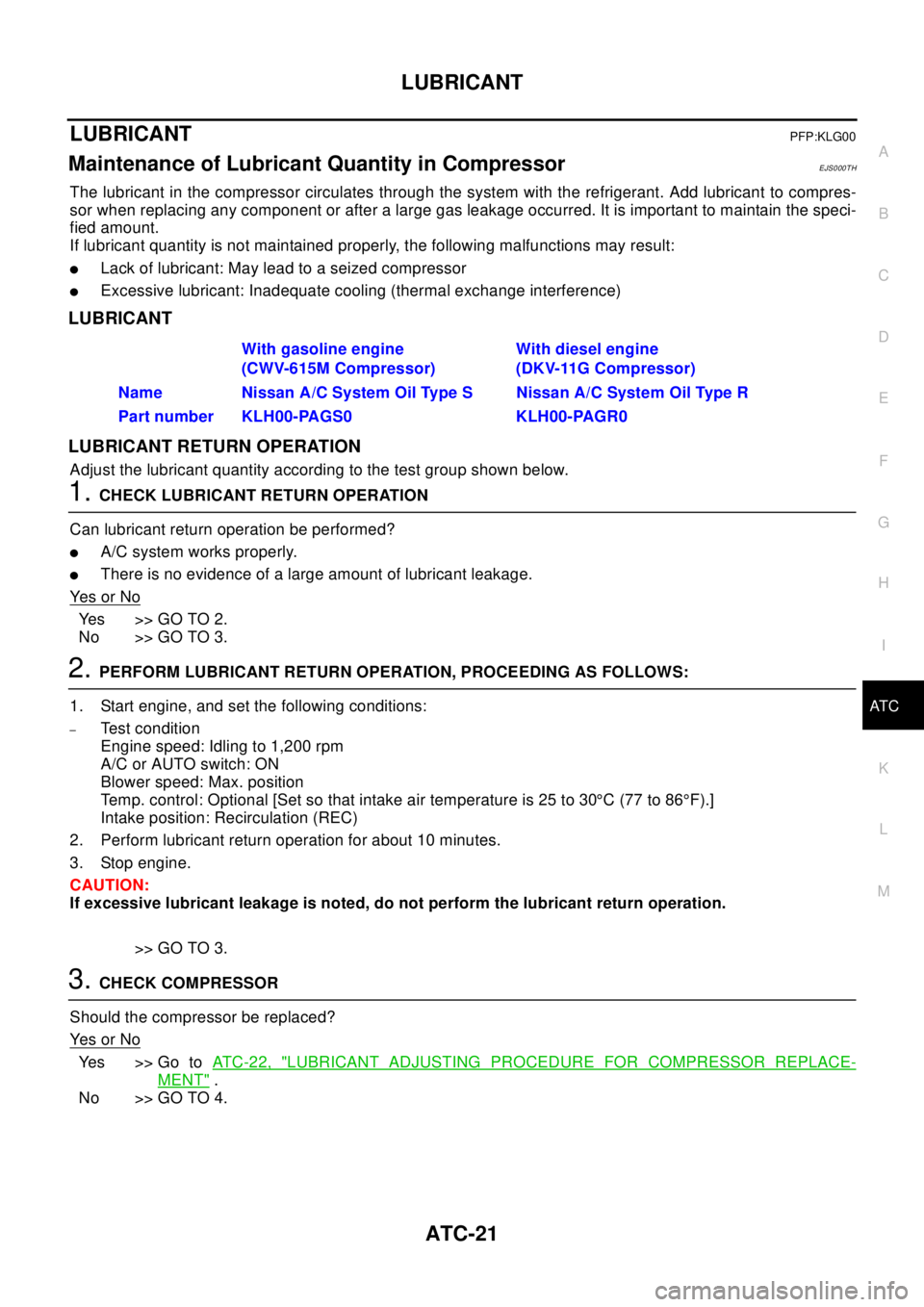
No >> GO TO 4.With gasoline engine
(CWV-615M Compressor)With diesel engine
(DKV-11G Compressor)
Name Nissan A/C System Oil Type S Nissan A/C System Oil Type R
Part number KLH00-PAGS0 KLH00-PAGR0
Page 604 of 3066
ATC-26
AIR CONDITIONER CONTROL
FAN SPEED CONTROL
Blower speed is automatically controlled based on temperature setting, ambient temperature, in-vehicle tem-
perature, intake temperature, amount of sunload and air mix door position.
With FAN switch set to AUTO, the blower motor starts to gradually increase air flow volume.
When engine coolant temperature is low, the blower motor operation is delayed to prevent cool air from flow-
ing.
INTAKE DOOR CONTROL
The intake doors are automatically controlled by: The temperature setting, ambient temperature, in-vehicle
temperature, intake temperature, amount of sunload and ON-OFF operation of the compressor.
OUTLET DOOR CONTROL
The outlet door is automatically controlled by: The temperature setting, ambient temperature, in-vehicle tem-
perature, intake temperature and amount of sunload.
MAGNET CLUTCH CONTROL
The ECM controls compressor operation using input signals from the throttle position sensor and auto ampli-
fier.
SELF-DIAGNOSTIC SYSTEM
The self-diagnostic system is built into the auto amplifier (LCU) to quickly locate the cause of problems.
Overview of Control systemEJS000TK
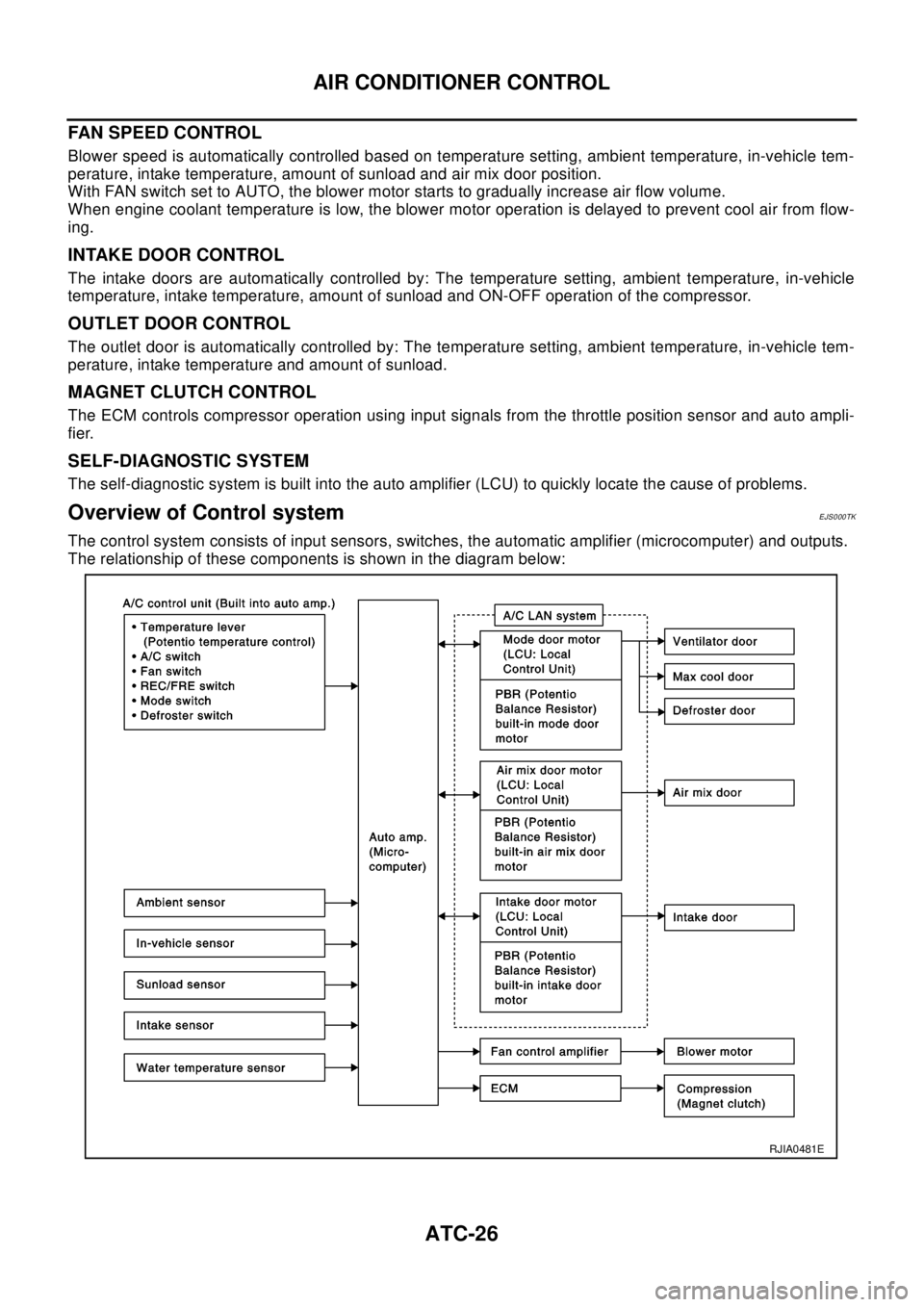
The control system consists of input sensors, switches, the automatic amplifier (microcomputer) and outputs.
The relationship of these components is shown in the diagram below:
RJIA0481E
Page 609 of 3066
TROUBLE DIAGNOSIS
ATC-31
C
D
E
F
G
H
I
K
L
MA
B
AT C
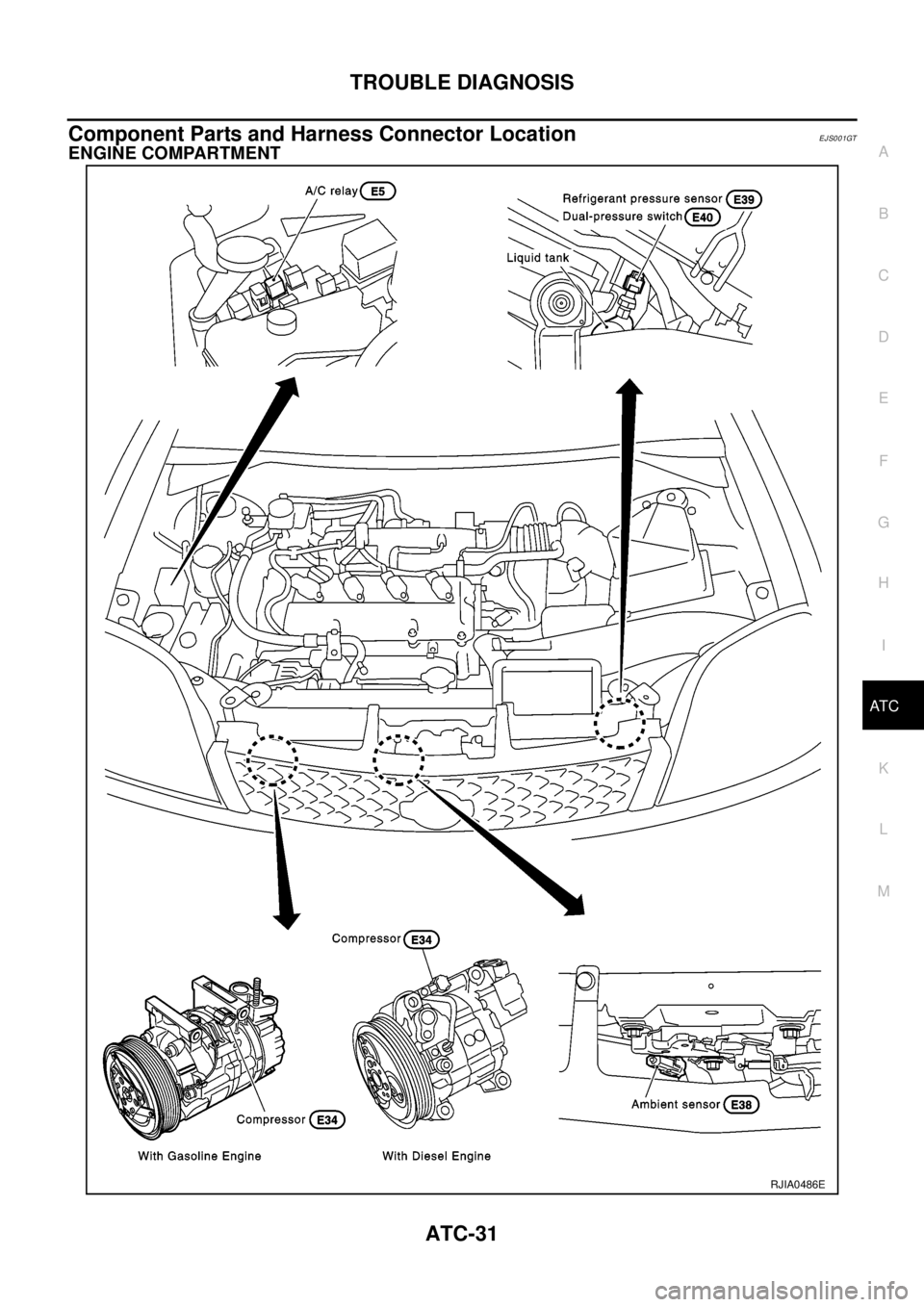
Component Parts and Harness Connector LocationEJS001GT
ENGINE COMPARTMENT
RJIA0486E
Page 611 of 3066
TROUBLE DIAGNOSIS
ATC-33
C
D
E
F
G
H
I
K
L
MA
B
AT C
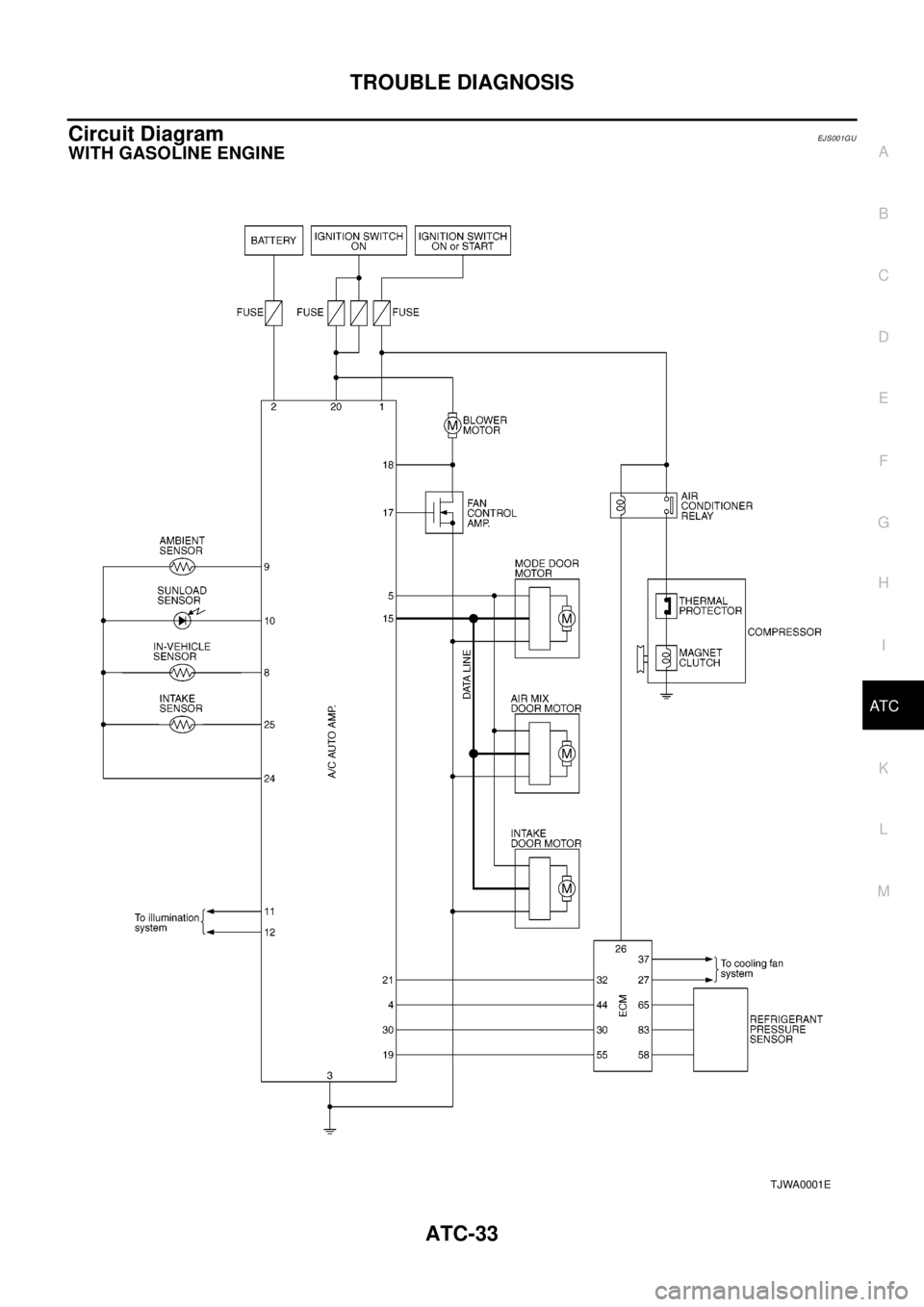
Circuit DiagramEJ S00 1G U
WITH GASOLINE ENGINE
TJWA0001E
Page 612 of 3066
ATC-34
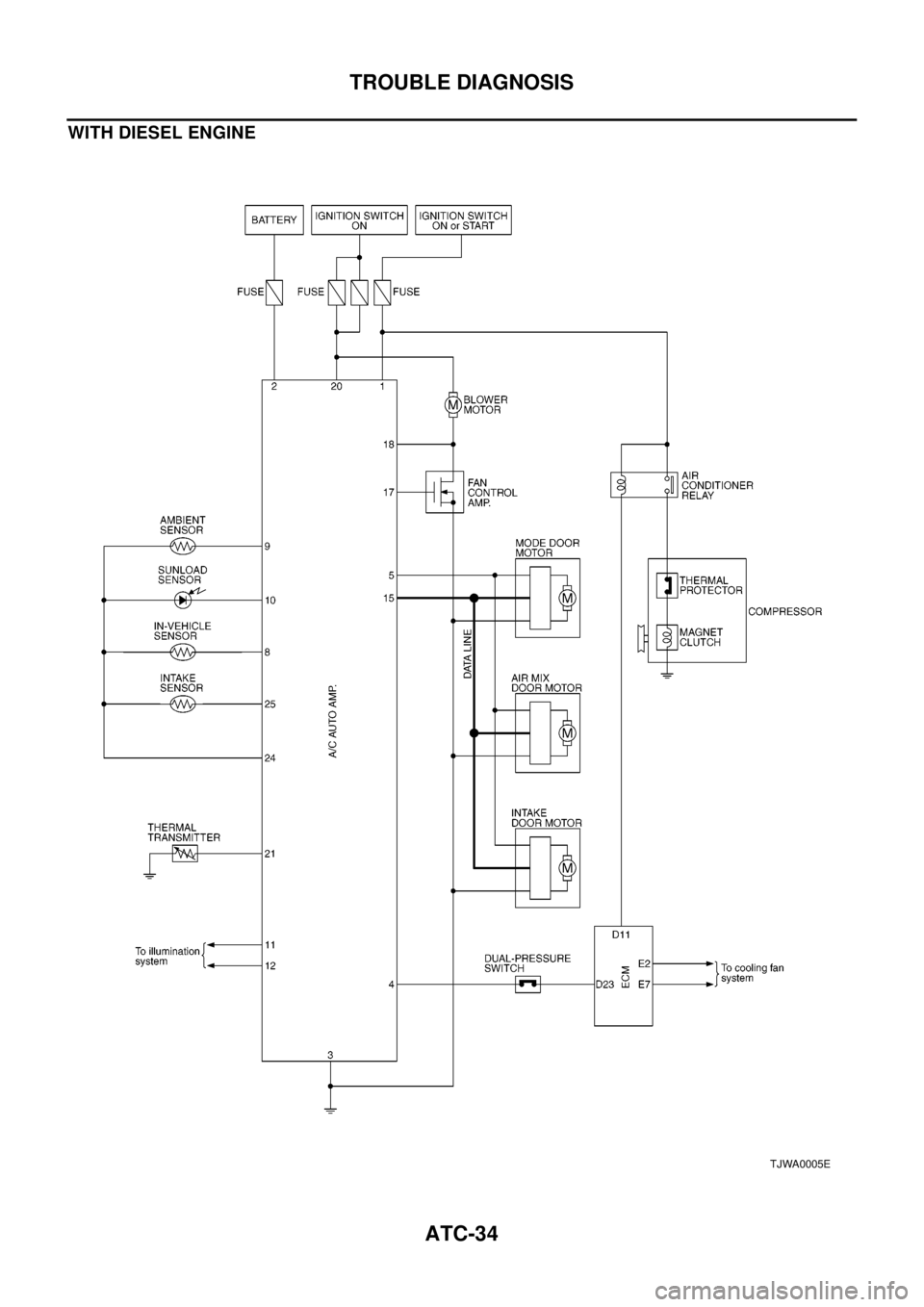
TROUBLE DIAGNOSIS
WITH DIESEL ENGINE
TJWA0005E
Page 613 of 3066
TROUBLE DIAGNOSIS
ATC-35
C
D
E
F
G
H
I
K
L
MA
B
AT C
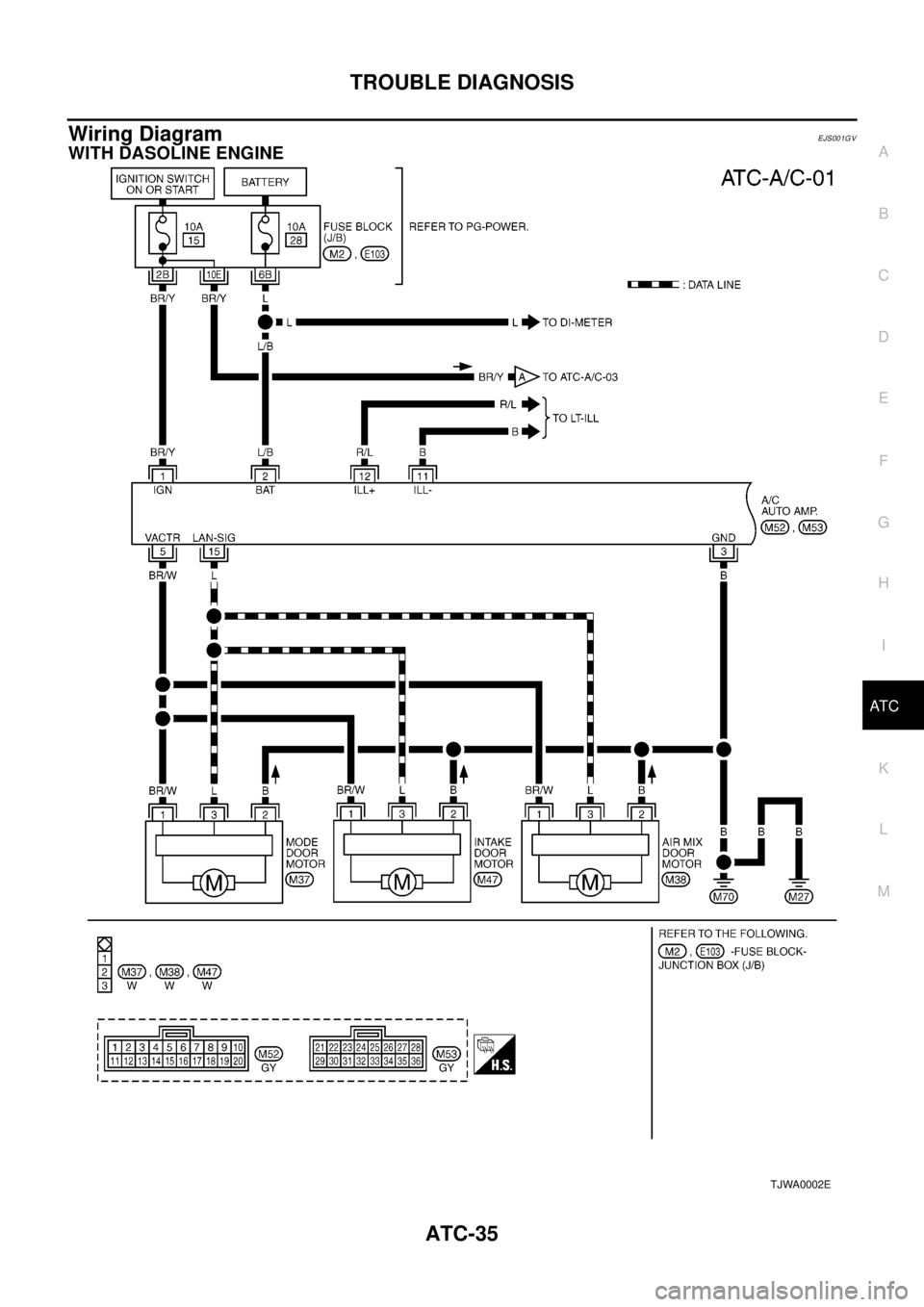
Wiring DiagramEJS001GV
WITH DASOLINE ENGINE
TJWA0002E
Page 616 of 3066
ATC-38
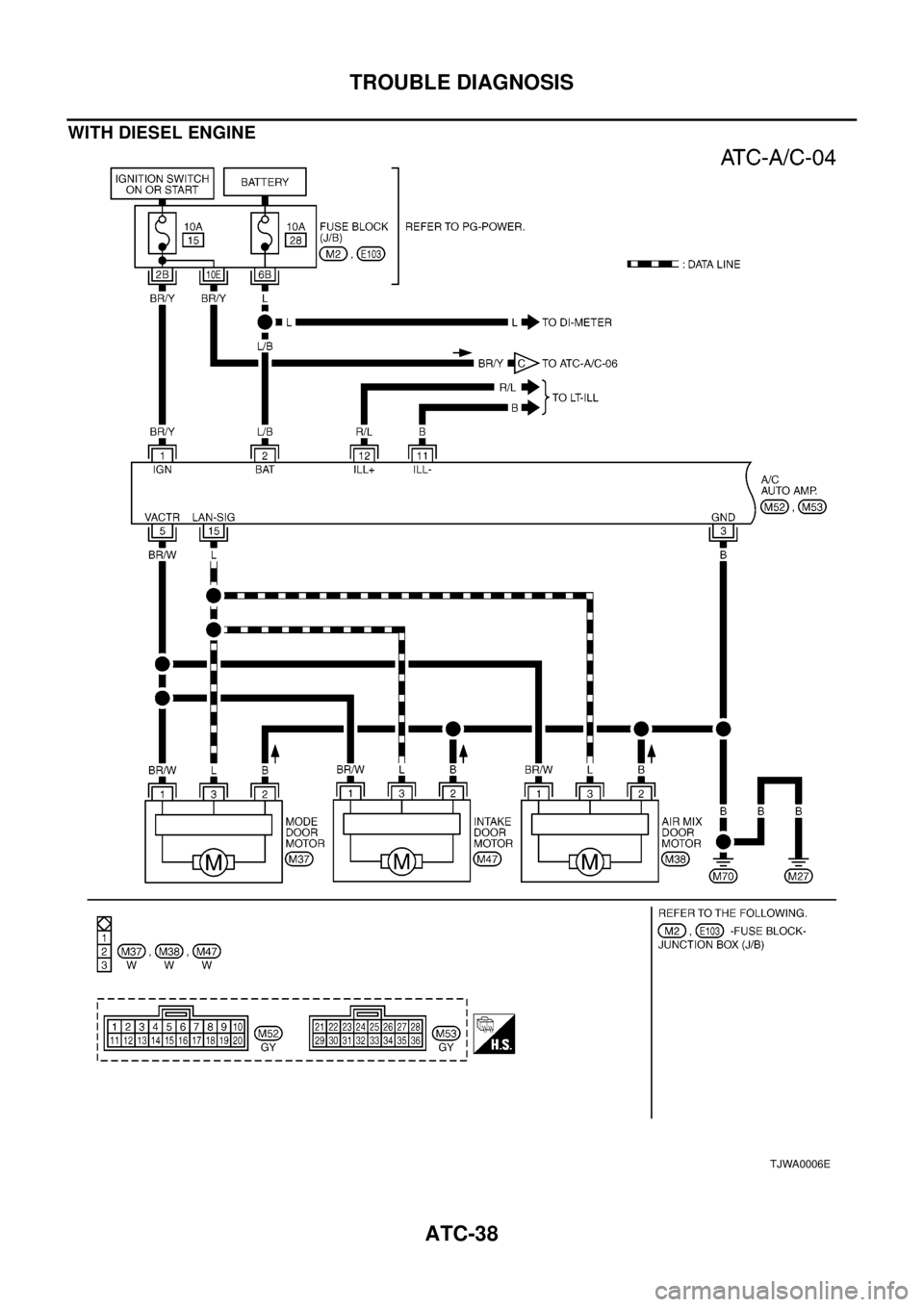
TROUBLE DIAGNOSIS
WITH DIESEL ENGINE
TJWA0006E
Page 620 of 3066

ATC-42
TROUBLE DIAGNOSIS
Self-diagnosis Function
EJS001GX
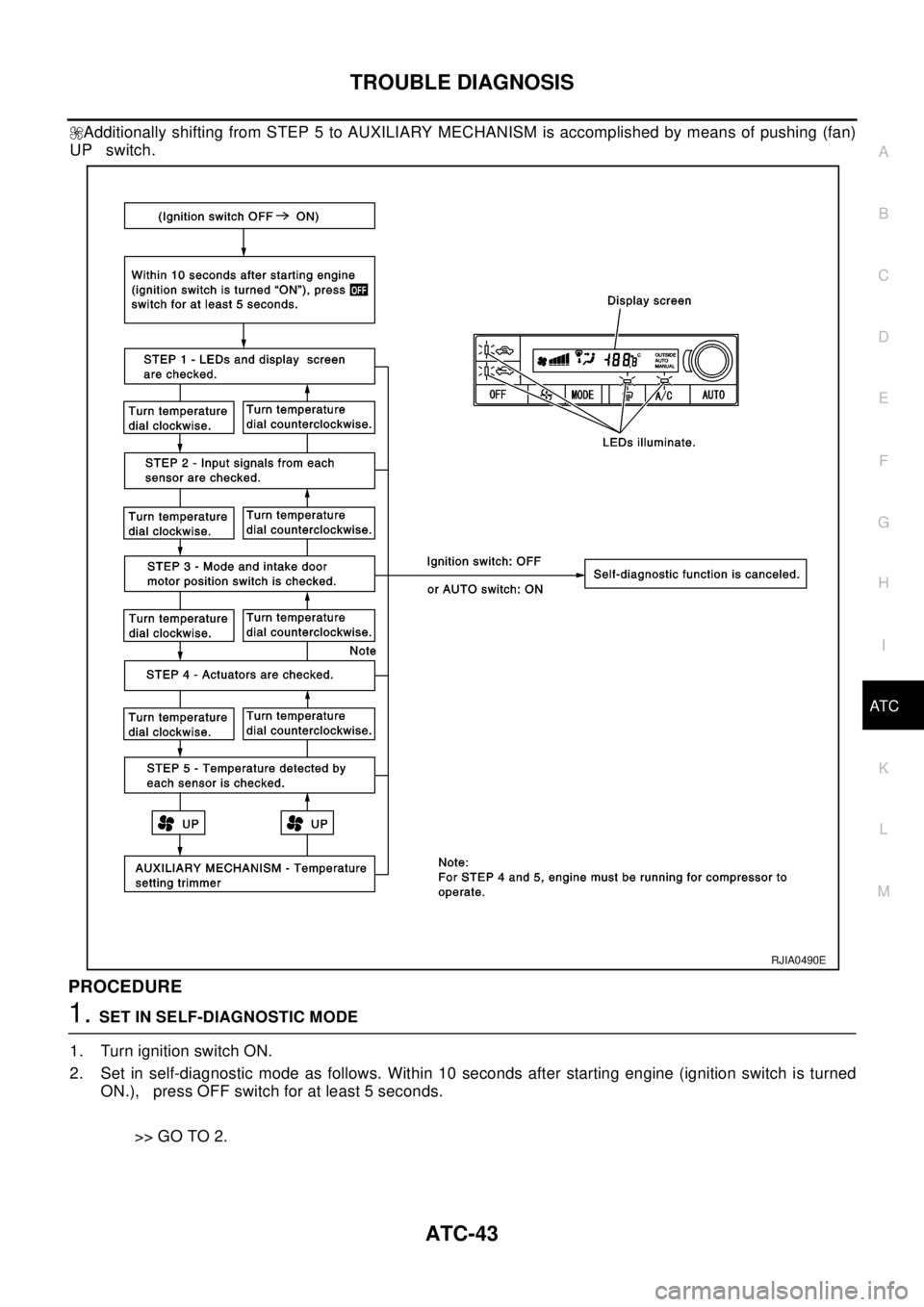
DESCRIPTION
The self-diagnostic system diagnoses sensors, door motors, blower motor, etc. by system line. Refer to appli-
cable sections (items) for details. Shifting from normal control to the self-diagnostic system is accomplished
by starting the engine (turning the ignition switch from OFF to ON) and pressing OFF switch for at least 5
seconds. The "OFF" switch must be pressed within 10 seconds after starting the engine (ignition switch is
turned ON). This system will be canceled by either pressing A/C switch or turning the ignition switch OFF.
Shifting from one step to another is accomplished by means of turning temperature dial, as required.
17Fan control amp. control
signalIGN
ONFan speed: 1st, 2nd, 3rd, 4th Approx. 2.5 - 3.5
Fan speed: 5th Approx. 9.0
18 Blower motor feed backIGN
ONFan speed: 1st Approx. 8.0
19 Fan ON signalIGN
ONBlower fan: ON Approx. 0
Blower fan: OFF Approx. 4.8
20 Power supply for ACCIGN
ON-Approx.12
21With gasoline engine:
Water temperature sensorIGN
ON-
With diesel engine:
Thermal transmitterIGN
ONWater temperature: 56°C Approx. 5.67 - 7.01
24 Sensor groundIGN
ON-Approx.0
25 Intake sensor - - -
30Compressor feed back sig-
nal (With gasoline engine)IGN
ON-Approx.0
Disconnect the refrigerant pressure sensor
connectorApprox. 5 TERMI-
NAL NO.ITEM CONDITIONVo ltag e
(V)
SKIA0056J
Page 621 of 3066
TROUBLE DIAGNOSIS
ATC-43
C
D
E
F
G
H
I
K
L
MA
B
AT C
Additionally shifting from STEP 5 to AUXILIARY MECHANISM is accomplished by means of pushing (fan)
UP switch.
PROCEDURE
1.SET IN SELF-DIAGNOSTIC MODE
1. Turn ignition switch ON.
2. Set in self-diagnostic mode as follows. Within 10 seconds after starting engine (ignition switch is turned
ON.), press OFF switch for at least 5 seconds.
>> GO TO 2.
RJIA0490E