engine NISSAN X-TRAIL 2003 Electronic Repair Manual
[x] Cancel search | Manufacturer: NISSAN, Model Year: 2003, Model line: X-TRAIL, Model: NISSAN X-TRAIL 2003Pages: 3066, PDF Size: 51.47 MB
Page 693 of 3066
HEATER & COOLING UNIT ASSEMBLY
ATC-115
C
D
E
F
G
H
I
K
L
MA
B
AT C
HEATER & COOLING UNIT ASSEMBLYPFP:27110
Removal and InstallationEJS000UT
REMOVAL
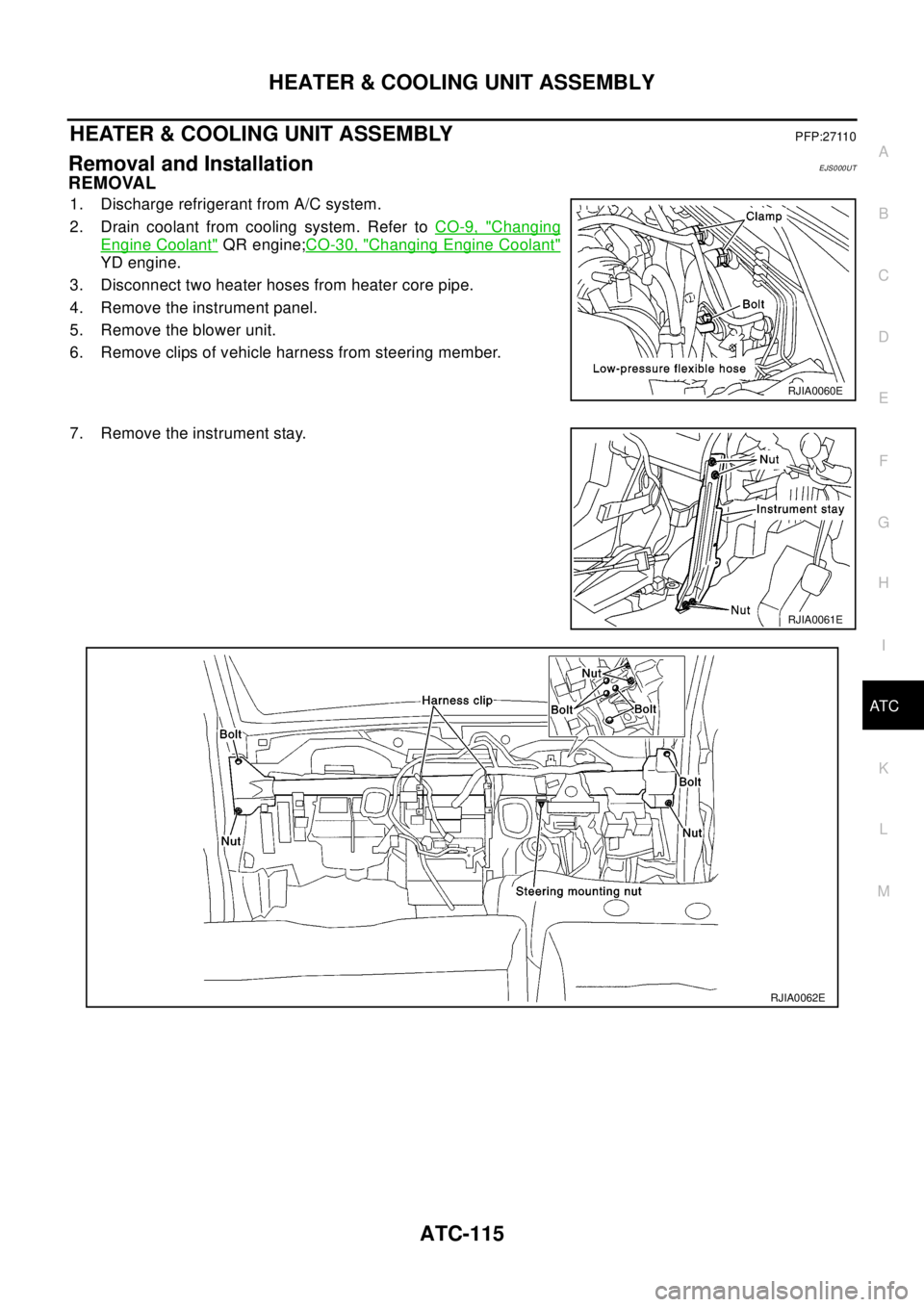
1. Discharge refrigerant from A/C system.
2. Drain coolant from cooling system. Refer toCO-9, "
Changing
Engine Coolant"QR engine;CO-30, "Changing Engine Coolant"
YD engine.
3. Disconnect two heater hoses from heater core pipe.
4. Remove the instrument panel.
5. Remove the blower unit.
6. Remove clips of vehicle harness from steering member.
7. Remove the instrument stay.
RJIA0060E
RJIA0061E
RJIA0062E
Page 694 of 3066
ATC-116
HEATER & COOLING UNIT ASSEMBLY
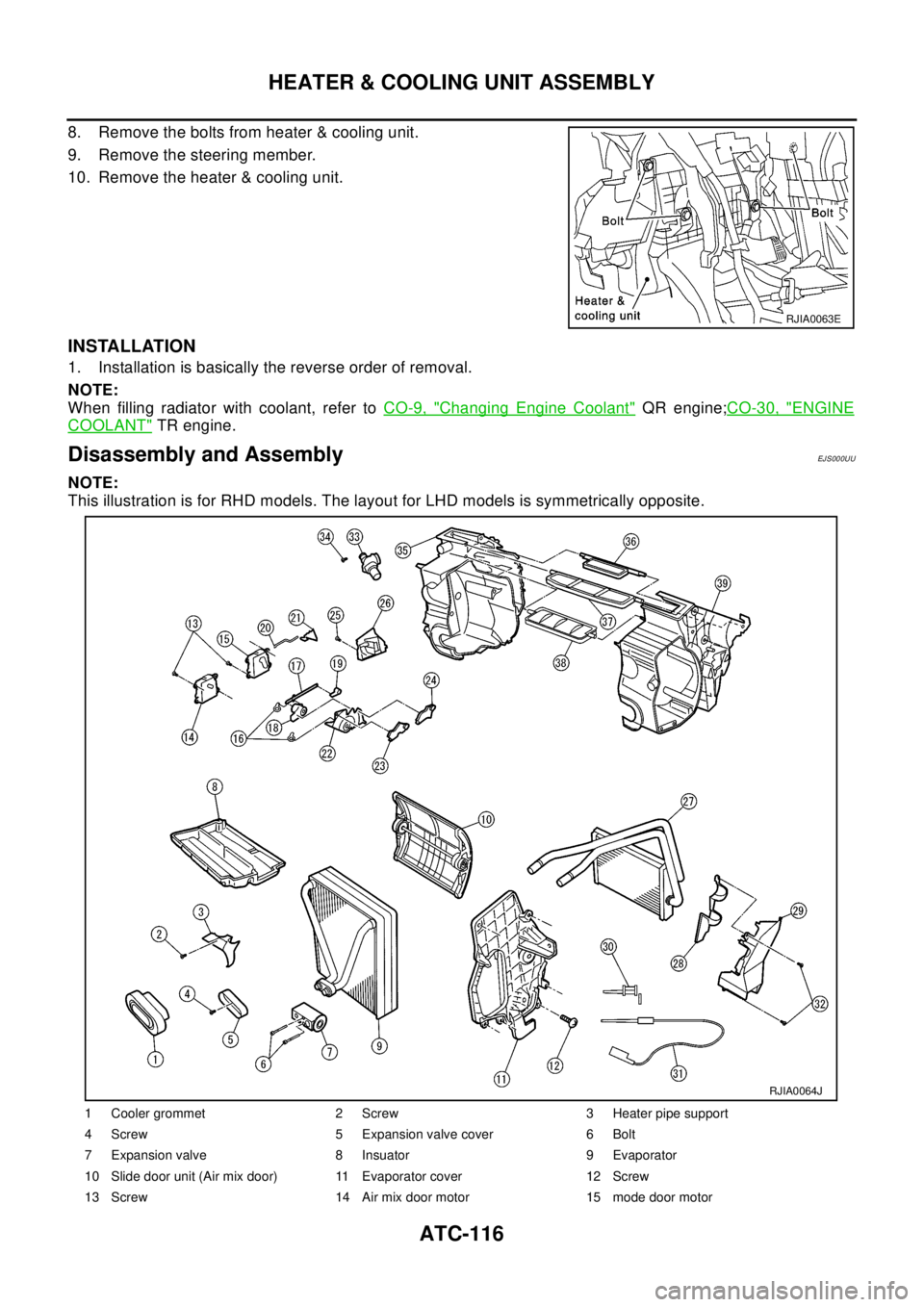
8. Remove the bolts from heater & cooling unit.
9. Remove the steering member.
10. Remove the heater & cooling unit.
INSTALLATION
1. Installation is basically the reverse order of removal.
NOTE:
When filling radiator with coolant, refer toCO-9, "
Changing Engine Coolant"QR engine;CO-30, "ENGINE
COOLANT"TR engine.
Disassembly and AssemblyEJ S00 0UU
NOTE:
This illustration is for RHD models. The layout for LHD models is symmetrically opposite.
RJIA0063E
1 Cooler grommet 2 Screw 3 Heater pipe support
4 Screw 5 Expansion valve cover 6 Bolt
7 Expansion valve 8 Insuator 9 Evaporator
10 Slide door unit (Air mix door) 11 Evaporator cover 12 Screw
13 Screw 14 Air mix door motor 15 mode door motor
RJIA0064J
Page 704 of 3066
ATC-126
REFRIGERANT LINES
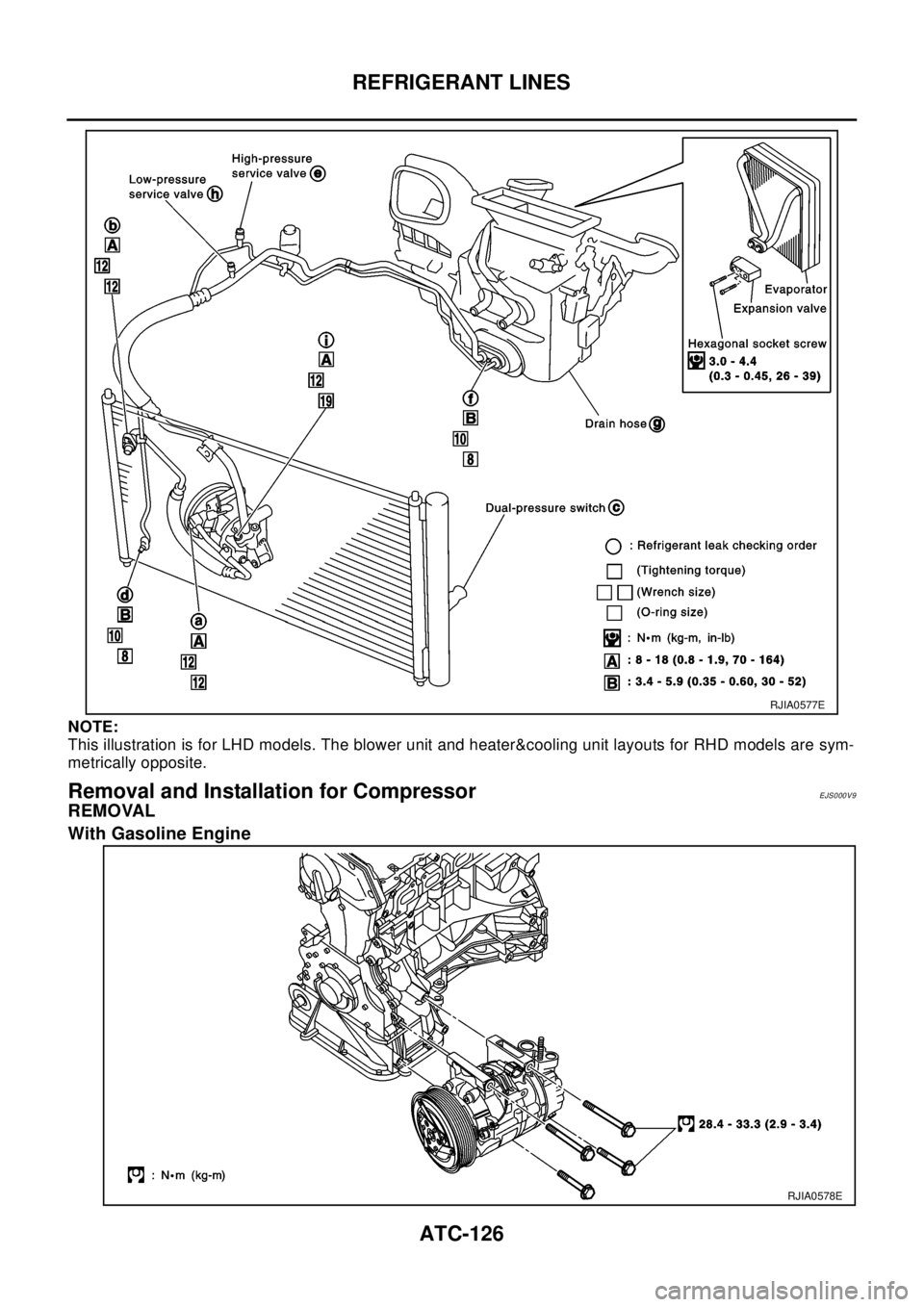
NOTE:
This illustration is for LHD models. The blower unit and heater&cooling unit layouts for RHD models are sym-
metrically opposite.
Removal and Installation for CompressorEJS000V9
REMOVAL
With Gasoline Engine
RJIA0577E
RJIA0578E
Page 705 of 3066
REFRIGERANT LINES
ATC-127
C
D
E
F
G
H
I
K
L
MA
B
AT C
With Diesel Engine
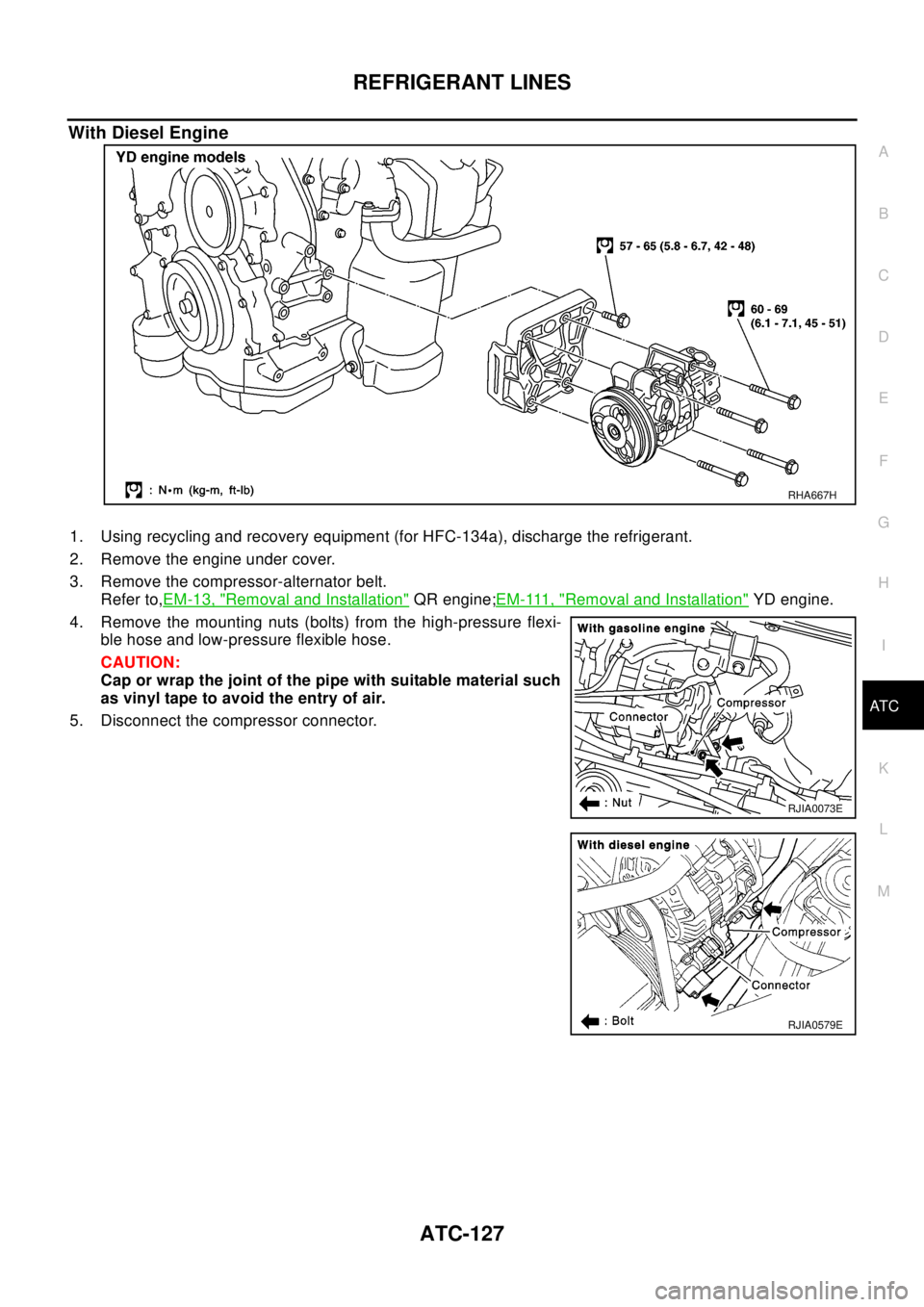
1. Using recycling and recovery equipment (for HFC-134a), discharge the refrigerant.
2. Remove the engine under cover.
3. Remove the compressor-alternator belt.
Refer to,EM-13, "
Removal and Installation"QR engine;E M - 111 , "Removal and Installation"YD engine.
4. Remove the mounting nuts (bolts) from the high-pressure flexi-
ble hose and low-pressure flexible hose.
CAUTION:
Cap or wrap the joint of the pipe with suitable material such
as vinyl tape to avoid the entry of air.
5. Disconnect the compressor connector.
RHA667H
RJIA0073E
RJIA0579E
Page 707 of 3066
REFRIGERANT LINES
ATC-129
C
D
E
F
G
H
I
K
L
MA
B
AT C
Removal and Installation for Compressor ClutchEJS000VA
REMOVAL
Overhaul (With Gasoline Engine: CWV-615M Compressor)
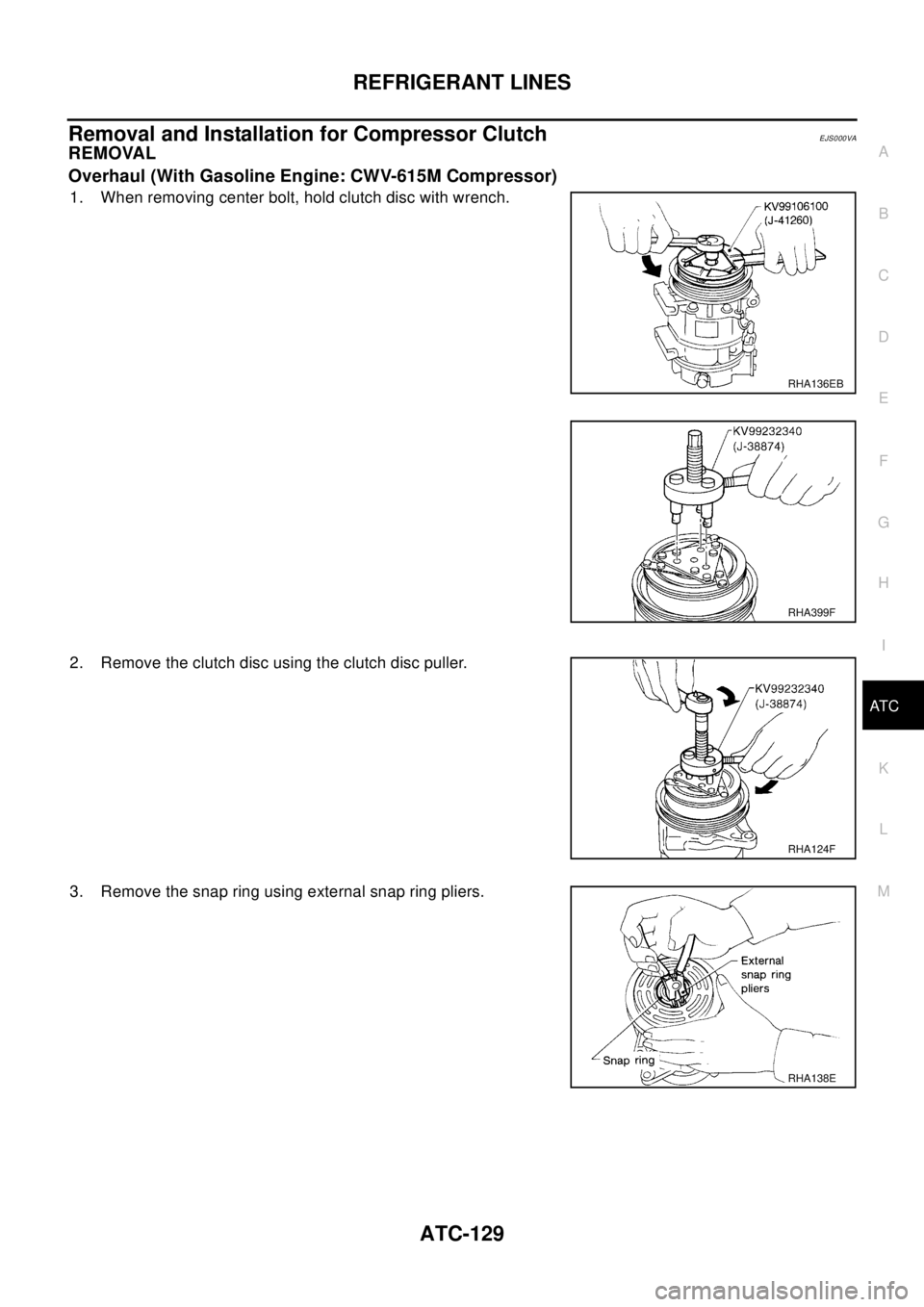
1. When removing center bolt, hold clutch disc with wrench.
2. Removetheclutchdiscusingtheclutchdiscpuller.
3. Remove the snap ring using external snap ring pliers.
RHA136EB
RHA399F
RHA124F
RHA138E
Page 708 of 3066
ATC-130
REFRIGERANT LINES
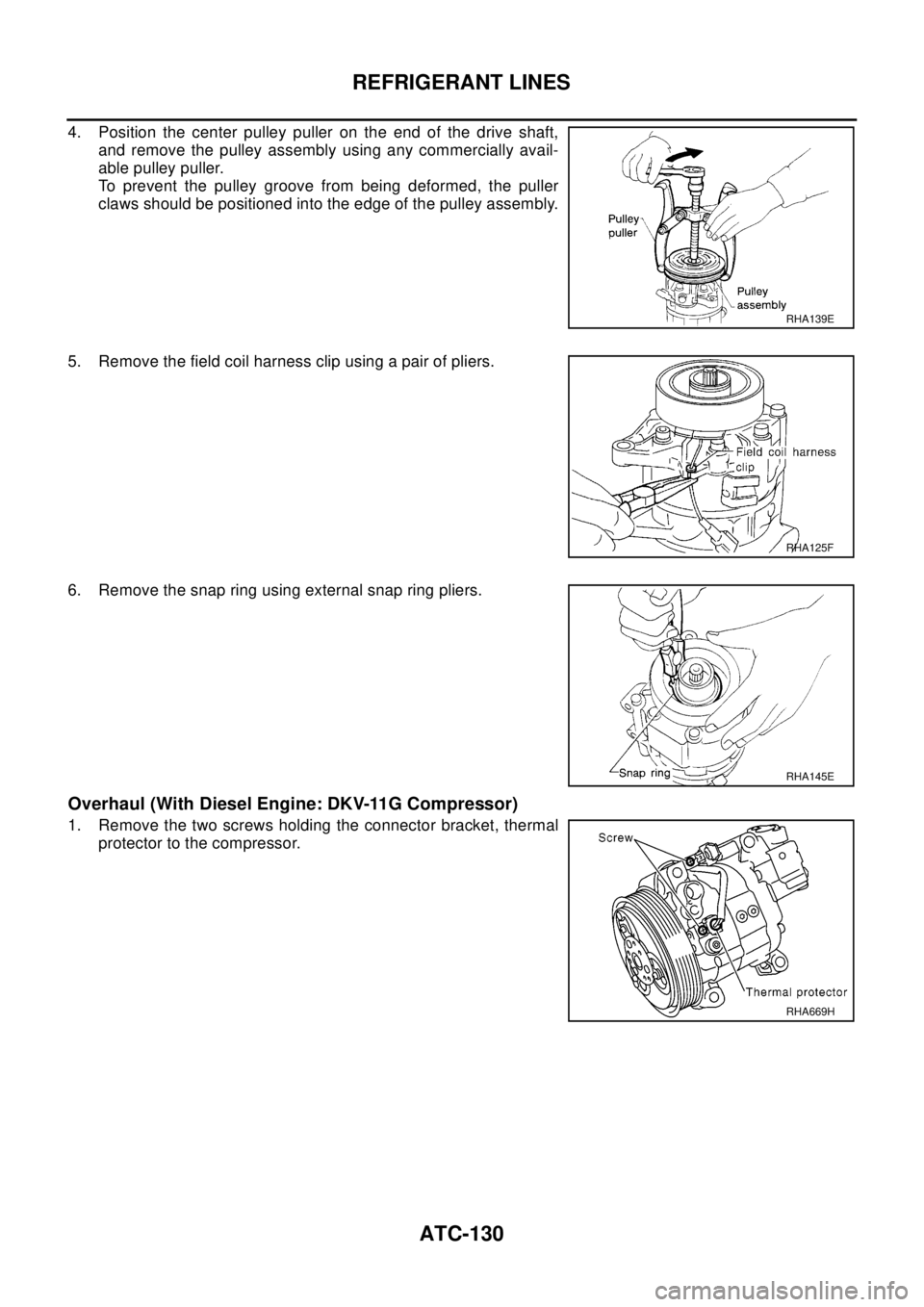
4. Position the center pulley puller on the end of the drive shaft,
and remove the pulley assembly using any commercially avail-
able pulley puller.
To prevent the pulley groove from being deformed, the puller
claws should be positioned into the edge of the pulley assembly.
5. Remove the field coil harness clip using a pair of pliers.
6. Remove the snap ring using external snap ring pliers.
Overhaul (With Diesel Engine: DKV-11G Compressor)
1. Remove the two screws holding the connector bracket, thermal
protector to the compressor.
RHA139E
RHA125F
RHA145E
RHA669H
Page 710 of 3066
ATC-132
REFRIGERANT LINES
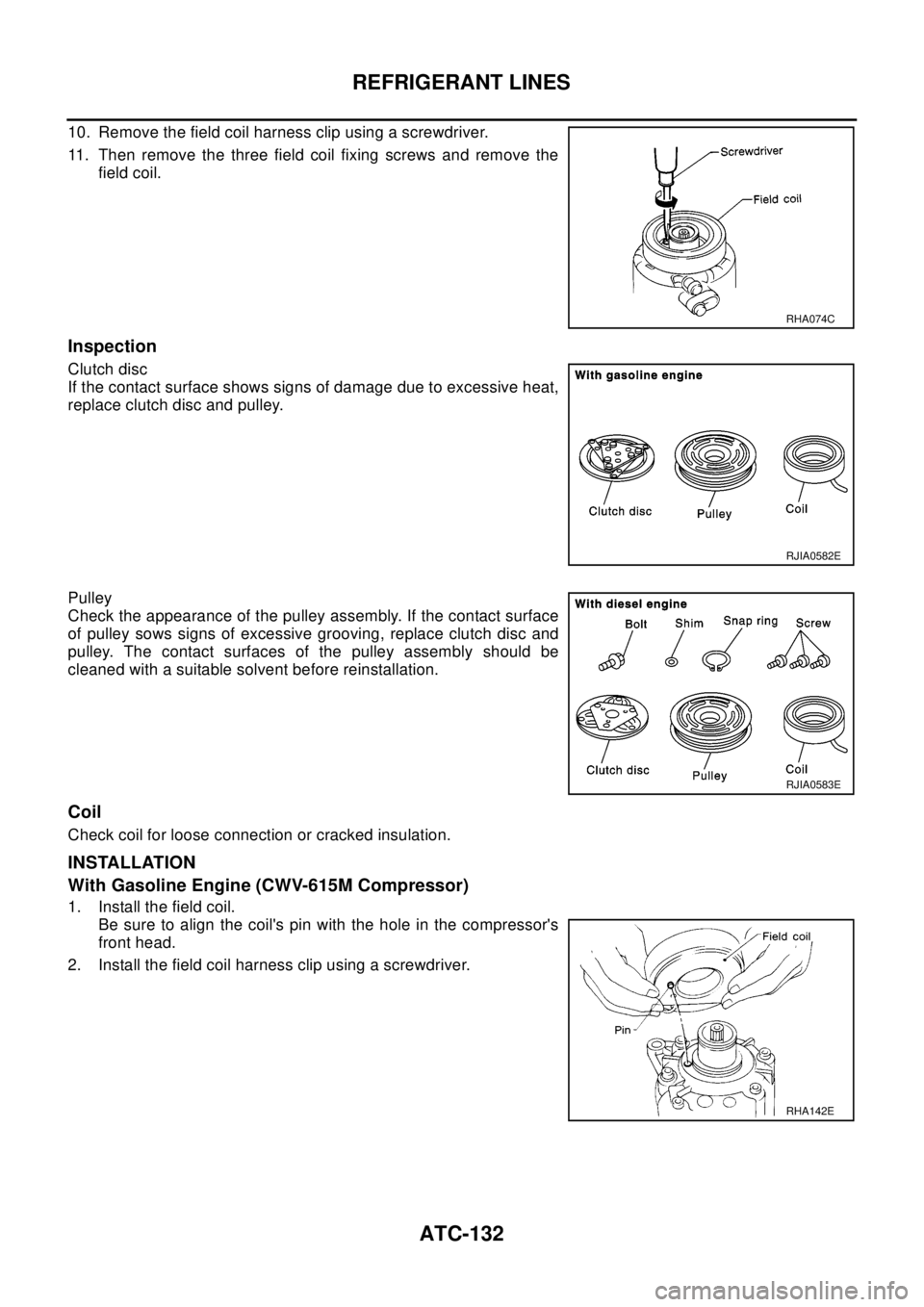
10. Remove the field coil harness clip using a screwdriver.
11. Then remove the three field coil fixing screws and remove the
field coil.
Inspection
Clutch disc
If the contact surface shows signs of damage due to excessive heat,
replace clutch disc and pulley.
Pulley
Check the appearance of the pulley assembly. If the contact surface
of pulley sows signs of excessive grooving, replace clutch disc and
pulley. The contact surfaces of the pulley assembly should be
cleaned with a suitable solvent before reinstallation.
Coil
Check coil for loose connection or cracked insulation.
INSTALLATION
With Gasoline Engine (CWV-615M Compressor)
1. Install the field coil.
Be sure to align the coil's pin with the hole in the compressor's
front head.
2. Install the field coil harness clip using a screwdriver.
RHA074C
RJIA0582E
RJIA0583E
RHA142E
Page 712 of 3066
ATC-134
REFRIGERANT LINES
With Diesel Engine (DKV-11G Compressor)
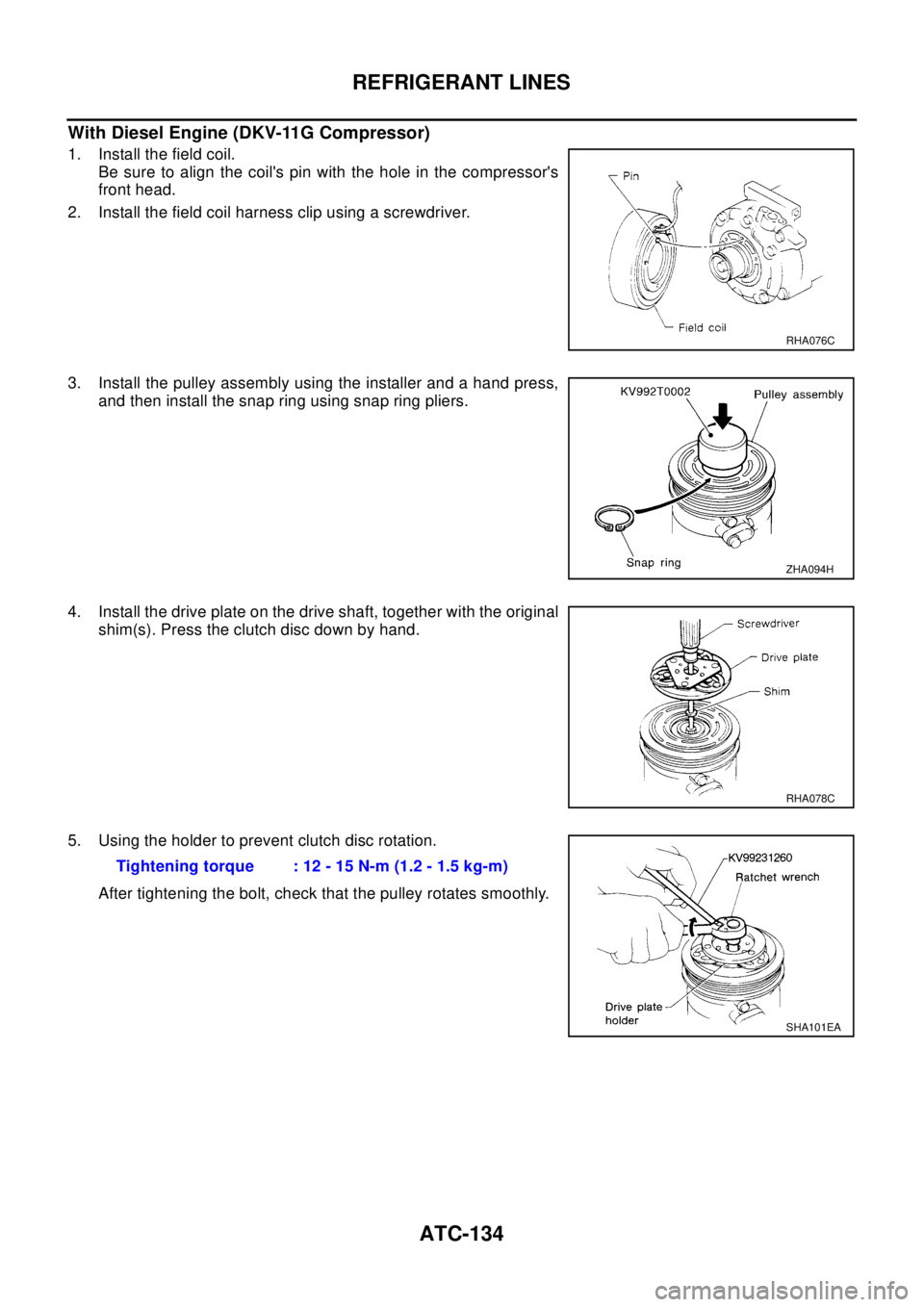
1. Install the field coil.
Be sure to align the coil's pin with the hole in the compressor's
front head.
2. Install the field coil harness clip using a screwdriver.
3. Install the pulley assembly using the installer and a hand press,
and then install the snap ring using snap ring pliers.
4. Install the drive plate on the drive shaft, together with the original
shim(s). Press the clutch disc down by hand.
5. Using the holder to prevent clutch disc rotation.
After tightening the bolt, check that the pulley rotates smoothly.
RHA076C
ZHA094H
RHA078C
Tightening torque : 12 - 15 N-m (1.2 - 1.5 kg-m)
SHA101EA
Page 716 of 3066
ATC-138
REFRIGERANT LINES
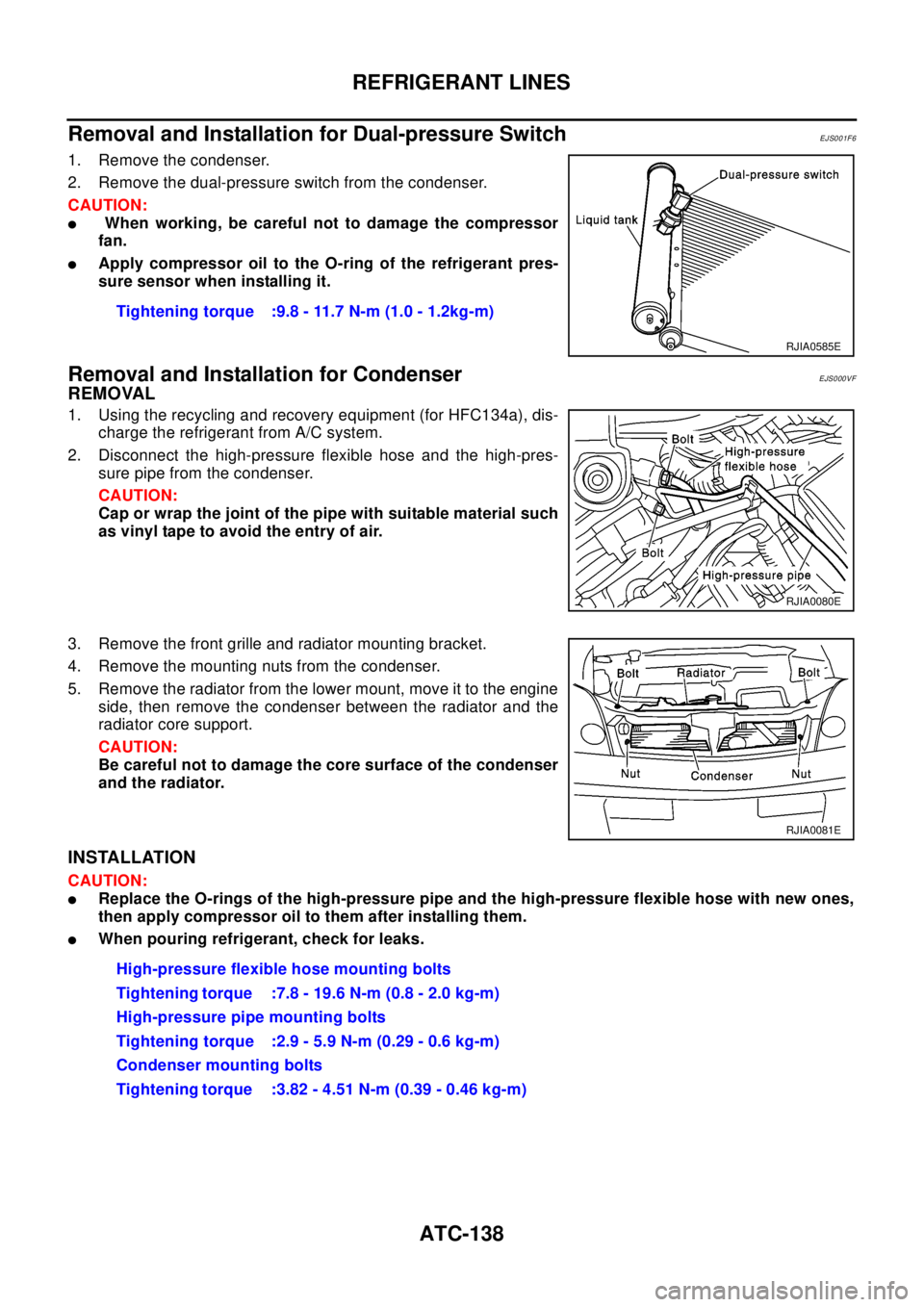
Removal and Installation for Dual-pressure Switch
EJS001F6
1. Remove the condenser.
2. Remove the dual-pressure switch from the condenser.
CAUTION:
lWhen working, be careful not to damage the compressor
fan.
lApply compressor oil to the O-ring of the refrigerant pres-
sure sensor when installing it.
Removal and Installation for CondenserEJS000VF
REMOVAL
1. Using the recycling and recovery equipment (for HFC134a), dis-
charge the refrigerant from A/C system.
2. Disconnect the high-pressure flexible hose and the high-pres-
sure pipe from the condenser.
CAUTION:
Cap or wrap the joint of the pipe with suitable material such
as vinyl tape to avoid the entry of air.
3. Remove the front grille and radiator mounting bracket.
4. Remove the mounting nuts from the condenser.
5. Remove the radiator from the lower mount, move it to the engine
side, then remove the condenser between the radiator and the
radiator core support.
CAUTION:
Be careful not to damage the core surface of the condenser
and the radiator.
INSTALLATION
CAUTION:
lReplace the O-rings of the high-pressure pipe and the high-pressure flexible hose with new ones,
then apply compressor oil to them after installing them.
lWhen pouring refrigerant, check for leaks.Tightening torque :9.8 - 11.7 N-m (1.0 - 1.2kg-m)
RJIA0585E
RJIA0080E
RJIA0081E
High-pressure flexible hose mounting bolts
Tightening torque :7.8 - 19.6 N-m (0.8 - 2.0 kg-m)
High-pressure pipe mounting bolts
Tightening torque :2.9 - 5.9 N-m (0.29 - 0.6 kg-m)
Condenser mounting bolts
Tightening torque :3.82 - 4.51 N-m (0.39 - 0.46 kg-m)
Page 719 of 3066

REFRIGERANT LINES
ATC-141
C
D
E
F
G
H
I
K
L
MA
B
AT C
CAUTION:
Moving the electronic leak detector probe slower and closer to the suspected leak area will improve
the chances of finding a leak.
Checking System for Leaks Using the Fluorescent Leak DetectorEJS000VK
1. Check A/C system for leaks using the UV lamp and safety glasses (J-42220) in a low sunlight area (area
without windows preferable). Illuminate all components, fittings and lines. The dye will appear as a bright
green/yellow area at the point of leakage. Fluorescent dye observed at the evaporator drain opening indi-
cates an evaporator core assembly (tubes, core or TXV) leak.
2. If the suspected area is difficult to see, use an adjustable mirror or wipe the area with a clean shop rag or
cloth, with the UV lamp for dye residue.
3. After the leak is repaired, remove any residual dye using dye cleaner (J-43872) to prevent future misdiag-
nosis.
4. Perform a system performance check and verify the leak repair with an approved electronic refrigerant
leak detector.
NOTE:
Other gases in the work area or substances on the A/C components, for example, anti-freeze, windshield
washer fluid, solvents and lubricants, may falsely trigger the leak detector. Make sure the surfaces to be
checked are clean.
Clean with a dry cloth or blow off with shop air.
Do not allow the sensor tip of the detector to contact with any substance. This can also cause false readings
and may damage the detector.
Dye InjectionEJS000VL
(This procedure is only necessary when recharging the system or when the compressor has seized and was
replaced.)
1. Check A/C system static (at rest) pressure. Pressure must be at least 345 kPa (50 psi).
2. Pour one bottle (1/4 ounce / 7.4 cc) of the A/C refrigerant dye into the injector tool (J-41459).
3. Connect the injector tool to the A/C LOW PRESSURE side service fitting.
4. Start engine and switch A/C ON.
5. When the A/C operating (compressor running), inject one bottle (1/4 ounce / 7.4 cc) of fluorescent dye
through the low-pressure service valve using dye injector tool J-41459 (refer to the manufacture's operat-
ing instructions).
6. With the engine still running, disconnect the injector tool from the service fitting.
CAUTION:
Be careful the A/C system or replacing a component, pour the dye directly into the open system con-
nection and proceed with the service procedures.
7. Operate the A/C system for a minimum of 20 minutes to mix the dye with the system oil. Depending on the
leak size, operating conditions and location of the leak, it may take from minutes to days for the dye to
penetrate a leak and become visible.
Electronic Refrigerant Leak DetectorEJS000VM
PRECAUTIONS FOR HANDLING LEAK DETECTOR
When performing a refrigerant leak check, use an A/C leak detector
or equivalent. Ensure that the instrument is calibrated and set prop-
erly per the operating instructions.
The leak detector is a delicate device. In order to use the leak detec-
tor properly, read the operating instructions and perform any speci-
fied maintenance.
SHA705EB