secure NISSAN X-TRAIL 2003 Electronic Owner's Guide
[x] Cancel search | Manufacturer: NISSAN, Model Year: 2003, Model line: X-TRAIL, Model: NISSAN X-TRAIL 2003Pages: 3066, PDF Size: 51.47 MB
Page 975 of 3066
![NISSAN X-TRAIL 2003 Electronic Owners Guide TROUBLE DIAGNOSIS
BRC-107
[ESP/TCS/ABS]
C
D
E
G
H
I
J
K
L
MA
B
BRC
2.SELF-DIAGNOSIS RESULT CHECK 2
Turn the ignition switch OFF, and ON to erase the self-diagnosis results. And perform the ESP/TCS/ABS](/img/5/57402/w960_57402-974.png "NISSAN X-TRAIL 2003 Electronic Owners Guide TROUBLE DIAGNOSIS
BRC-107
[ESP/TCS/ABS]
C
D
E
G
H
I
J
K
L
MA
B
BRC
2.SELF-DIAGNOSIS RESULT CHECK 2
Turn the ignition switch OFF, and ON to erase the self-diagnosis results. And perform the ESP/TCS/ABS")
TROUBLE DIAGNOSIS
BRC-107
[ESP/TCS/ABS]
C
D
E
G
H
I
J
K
L
MA
B
BRC
2.SELF-DIAGNOSIS RESULT CHECK 2
Turn the ignition switch OFF, and ON to erase the self-diagnosis results. And perform the ESP/TCS/ABS con-
trol unit self-diagnosis again.
Is the same self-diagnosis item indicated again?
YES >> After replacing the spiral cable (with the steering angle sensor), perform the neutral position
adjustment. Then conduct the self-diagnosis again.
NO >> Inspection End
Inspection 14 Brake Fluid Level of Reservoir Tank, Communication Circuit
between ESP/TCS/ABS Control Unit and Brake Fluid Level Warning Switch
EFS001AQ
Inspection procedure
1.SELF-DIAGNOSIS RESULT CHECK 1
Check the self-diagnosis results.
Does the brake warning light turn on?
YES >> Check the pad for wear. Check the brake fluid for leakage.
NO >> GO TO 2.
2.SELF-DIAGNOSIS RESULT CHECK 2
1. Disconnect connectors for the brake fluid level warning switch and the ESP/TCS/ABS control unit.
2. Securely connect connectors. Perform the ESP/TCS/ABS control unit self-diagnosis again.
Is the same self-diagnosis item indicated again?
YES >> Poor connection of connector. Repair or replace the poorly connected connector.
NO >> GO TO 3.
3.CIRCUIT CHECK BETWEEN BRAKE FLUID LEVEL WARNING SWITCH AND ESP/TCS/ABS CON-
TROL UNIT
1. Disconnect connectors for the brake fluid level warning switch
and the ESP/TCS/ABS control unit.
2. Check for continuity between the brake fluid level warning switch (vehicle-side connector) and the ESP/
TCS/ABS control unit (vehicle-side connector).
Is inspection result OK?
OK >> Perform the ESP/TCS/ABS control unit self-diagnosis again.
NG >> Repair or replace the disconnected harness.Self-diagnosis results
CONSULT-II indication item
BR FLUID LEVEL LOW
SFIA0388E
ESP/TCS/ABS control unit
(Vehicle-side connector)Brake fluid level warning switch
(Vehicle-side connector)Continuity
40 1 Yes
Page 989 of 3066
![NISSAN X-TRAIL 2003 Electronic Owners Guide ESP/TCS/ABS ACTUATOR AND RELAY BOX
BRC-121
[ESP/TCS/ABS]
C
D
E
G
H
I
J
K
L
MA
B
BRC
ESP/TCS/ABS ACTUATOR AND RELAY BOXPFP:47850
Removal and InstallationEFS001CR
Be careful of the following.
CAUTION:
l](/img/5/57402/w960_57402-988.png "NISSAN X-TRAIL 2003 Electronic Owners Guide ESP/TCS/ABS ACTUATOR AND RELAY BOX
BRC-121
[ESP/TCS/ABS]
C
D
E
G
H
I
J
K
L
MA
B
BRC
ESP/TCS/ABS ACTUATOR AND RELAY BOXPFP:47850
Removal and InstallationEFS001CR
Be careful of the following.
CAUTION:
l")
ESP/TCS/ABS ACTUATOR AND RELAY BOX
BRC-121
[ESP/TCS/ABS]
C
D
E
G
H
I
J
K
L
MA
B
BRC
ESP/TCS/ABS ACTUATOR AND RELAY BOXPFP:47850
Removal and InstallationEFS001CR
Be careful of the following.
CAUTION:
lBefore servicing, disconnect the battery terminals.
lTo remove the brake tube, use a flare nut wrench to prevent the flare nuts and brake tube from
being damaged. To install, use a brake tube torque wrench.
lDo not remove and install the actuator by holding the harness.
lAfter completing the work, bleed the brake piping of air. Refer toBR-10, "Brake Burnishing Proce-
dure".
lMake sure to connect the ground terminal securely.
SFIA0332E
Page 1002 of 3066
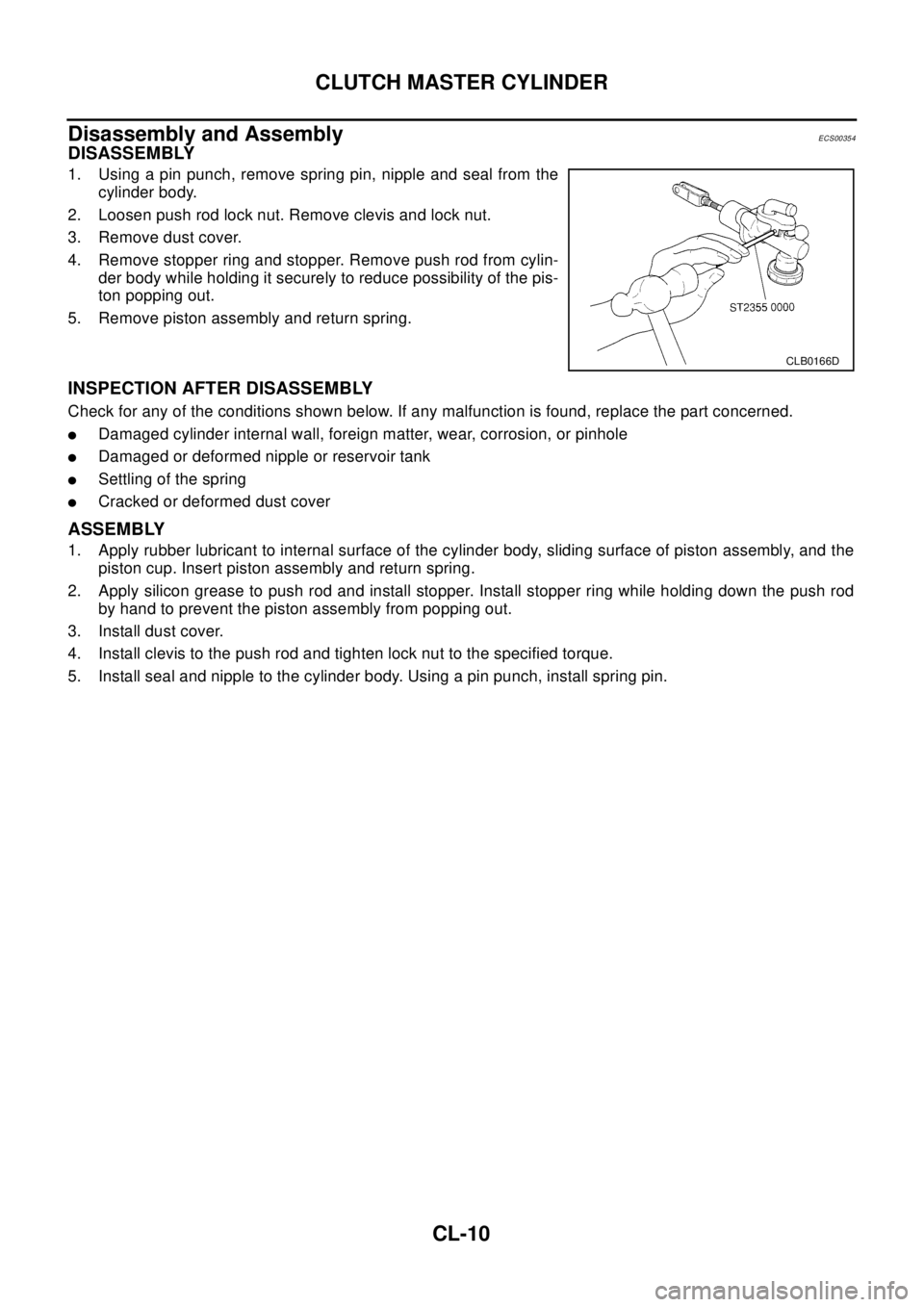
CL-10
CLUTCH MASTER CYLINDER
Disassembly and Assembly
ECS00354
DISASSEMBLY
1. Using a pin punch, remove spring pin, nipple and seal from the
cylinder body.
2. Loosen push rod lock nut. Remove clevis and lock nut.
3. Remove dust cover.
4. Remove stopper ring and stopper. Remove push rod from cylin-
der body while holding it securely to reduce possibility of the pis-
ton popping out.
5. Remove piston assembly and return spring.
INSPECTION AFTER DISASSEMBLY
Check for any of the conditions shown below. If any malfunction is found, replace the part concerned.
lDamaged cylinder internal wall, foreign matter, wear, corrosion, or pinhole
lDamaged or deformed nipple or reservoir tank
lSettling of the spring
lCracked or deformed dust cover
ASSEMBLY
1. Apply rubber lubricant to internal surface of the cylinder body, sliding surface of piston assembly, and the
piston cup. Insert piston assembly and return spring.
2. Apply silicon grease to push rod and install stopper. Install stopper ring while holding down the push rod
by hand to prevent the piston assembly from popping out.
3. Install dust cover.
4. Install clevis to the push rod and tighten lock nut to the specified torque.
5. Install seal and nipple to the cylinder body. Using a pin punch, install spring pin.
CLB0166D
Page 1028 of 3066
![NISSAN X-TRAIL 2003 Electronic Owners Guide CO-18
[QR20DE]
RADIATOR (ALUMINUM TYPE)
5. Make sure that the rim is completely crimped down.
6. Confirm that there is no leakage.
Refer to Inspection.
INSPECTION
1. Apply pressure with Tool.
WAR NIN](/img/5/57402/w960_57402-1027.png "NISSAN X-TRAIL 2003 Electronic Owners Guide CO-18
[QR20DE]
RADIATOR (ALUMINUM TYPE)
5. Make sure that the rim is completely crimped down.
6. Confirm that there is no leakage.
Refer to Inspection.
INSPECTION
1. Apply pressure with Tool.
WAR NIN")
CO-18
[QR20DE]
RADIATOR (ALUMINUM TYPE)
5. Make sure that the rim is completely crimped down.
6. Confirm that there is no leakage.
Refer to Inspection.
INSPECTION
1. Apply pressure with Tool.
WAR NIN G:
To prevent the risk of the hose coming undone while under
pressure, securely fasten it down with a hose clamp.
Attach a hose to the oil cooler as well. (A/T model only)
2. Check for leakage.Standard height “H” : 8.0 - 8.4 mm (0.315 - 0.331 in)
SLC554A
Specified pressure
value: 157 kPa (1.57 bar, 1.6 kg/cm2,
23 psi)
SLC933
SLC934
Page 1032 of 3066
![NISSAN X-TRAIL 2003 Electronic Owners Guide CO-22
[QR20DE]
THERMOSTAT AND WATER CONTROL VALVE
INSPECTION AFTER REMOVAL
lPlace a string so that it is caught in the valves of the thermostat
and water control valve. Immerse fully in a container fi](/img/5/57402/w960_57402-1031.png "NISSAN X-TRAIL 2003 Electronic Owners Guide CO-22
[QR20DE]
THERMOSTAT AND WATER CONTROL VALVE
INSPECTION AFTER REMOVAL
lPlace a string so that it is caught in the valves of the thermostat
and water control valve. Immerse fully in a container fi")
CO-22
[QR20DE]
THERMOSTAT AND WATER CONTROL VALVE
INSPECTION AFTER REMOVAL
lPlace a string so that it is caught in the valves of the thermostat
and water control valve. Immerse fully in a container filled with
water. Heat while stirring. (The example in the figure shows the
thermostat.)
lThe valve opening temperature is the temperature at which the
valve opens and the falls from the thread.
lContinue heating. Check the full-open lift amount.
NOTE:
The full-open lift amount standard temperature for the water
control valve is the reference value.
lAfter checking the full-open lift amount, lower the water temper-
ature and check the valve closing temperature.
Standard values
INSTALLATION
lInstall in the reverse order of removal paying attention to the following.
Installation of Thermostat and Water Control Valve
lInstall the thermostat and water control valve with the whole cir-
cumference of each flange part fit securely inside the rubber
ring. (The example in the figure shows the thermostat.)
lInstall the thermostat with the jiggle valve facing upwards. (The
position deviation may be within the range of±10°)
lInstall the water control valve with the up-mark facing up and the
frame center part facing upwards. (The position deviation may
be within the range of±10°)
Heater Pipe Installation
lFirst apply a neutral detergent to the O-ring, then quickly insert the insertion parts of the heater pipe into
the installation holes.
SLC252B
Thermostat Water control valve
Valve opening temperature 80.5 - 83.5°C(177-182°F) 93.5 - 96.5°C (200 - 206°F)
Full-open lift amountMore than 8 mm/ 95°C
(0.315 in/ 203°F)More than 8 mm/ 108°C
(0.315 in/ 226°F)
Valve closing temperature 77°C(171°F) 90°C (194°F)
PBIC0157E
PBIC0158E
Page 1049 of 3066
![NISSAN X-TRAIL 2003 Electronic Owners Guide RADIATOR (ALLUMINUM TYPE)
CO-39
[YD22DDTi]
C
D
E
F
G
H
I
J
K
L
MA
CO
5. Make sure that the rim is completely crimped down.
6. Confirm that there is no leakage.
Refer to Inspection.
INSPECTION
1. Apply](/img/5/57402/w960_57402-1048.png "NISSAN X-TRAIL 2003 Electronic Owners Guide RADIATOR (ALLUMINUM TYPE)
CO-39
[YD22DDTi]
C
D
E
F
G
H
I
J
K
L
MA
CO
5. Make sure that the rim is completely crimped down.
6. Confirm that there is no leakage.
Refer to Inspection.
INSPECTION
1. Apply")
RADIATOR (ALLUMINUM TYPE)
CO-39
[YD22DDTi]
C
D
E
F
G
H
I
J
K
L
MA
CO
5. Make sure that the rim is completely crimped down.
6. Confirm that there is no leakage.
Refer to Inspection.
INSPECTION
1. Apply pressure with Tool.
WAR NIN G:
To prevent the risk of the hose coming undone while under
pressure, securely fasten it down with a hose clamp.
Attach a hose to the oil cooler as well. (A/T model only)
2. Check for leakage.Standard height “H” : 8.0 - 8.4 mm (0.315 - 0.331 in)
SLC554A
Specified pressure
value: 157 kPa (1.57 bar, 1.6 kg/cm2,
23 psi)
SLC933
SLC934
Page 1053 of 3066
![NISSAN X-TRAIL 2003 Electronic Owners Guide THERMOSTAT AND WATER PIPING
CO-43
[YD22DDTi]
C
D
E
F
G
H
I
J
K
L
MA
CO
INSPECTION AFTER REMOVAL
Thermostat
lPlace a string so that it is caught in the valves of the thermostat.
Immerse fully in a cont](/img/5/57402/w960_57402-1052.png "NISSAN X-TRAIL 2003 Electronic Owners Guide THERMOSTAT AND WATER PIPING
CO-43
[YD22DDTi]
C
D
E
F
G
H
I
J
K
L
MA
CO
INSPECTION AFTER REMOVAL
Thermostat
lPlace a string so that it is caught in the valves of the thermostat.
Immerse fully in a cont")
THERMOSTAT AND WATER PIPING
CO-43
[YD22DDTi]
C
D
E
F
G
H
I
J
K
L
MA
CO
INSPECTION AFTER REMOVAL
Thermostat
lPlace a string so that it is caught in the valves of the thermostat.
Immerse fully in a container filled with water. Heat while stirring.
lThe valve opening temperature is the temperature at which the
valve opens and falls from the thread.
lContinue heating. Check the full-open lift amount.
lAfter checking the full-open lift amount, lower the water temper-
ature and check the valve closing temperature.
Standard values
INSTALLATION
lInstall in the reverse order of removal paying attention to the following.
Thermostat
lInstall the thermostat with the whole circumference of each
flange part fit securely inside the rubber ring.
lInstall the thermostat with the jiggle valve facing upwards.
Heater Pipe
lFirst apply a neutral detergent to the O-ring, then quickly insert the insertion parts of the heater pipe into
the installation holes.
SLC252B
Item Thermostat
Valve opening temperature 80 - 84°C (176 - 183°F)
Full-open lift amount More than 10 mm/ 95°C (0.39 in/ 203°F)
Valve closing temperature Approximatery 77°C (171°F)
JLC300B
Page 1130 of 3066
![NISSAN X-TRAIL 2003 Electronic Owners Guide EC-16
[QR (WITH EURO-OBD)]
PRECAUTIONS
PRECAUTIONS
PFP:00001
Precautions for Supplemental Restraint System (SRS) “AIR BAG” and “SEAT
BELT PRE-TENSIONER”
EBS00B0I
The Supplemental Restraint Sys](/img/5/57402/w960_57402-1129.png "NISSAN X-TRAIL 2003 Electronic Owners Guide EC-16
[QR (WITH EURO-OBD)]
PRECAUTIONS
PRECAUTIONS
PFP:00001
Precautions for Supplemental Restraint System (SRS) “AIR BAG” and “SEAT
BELT PRE-TENSIONER”
EBS00B0I
The Supplemental Restraint Sys")
EC-16
[QR (WITH EURO-OBD)]
PRECAUTIONS
PRECAUTIONS
PFP:00001
Precautions for Supplemental Restraint System (SRS) “AIR BAG” and “SEAT
BELT PRE-TENSIONER”
EBS00B0I
The Supplemental Restraint System such as “AIR BAG” and “SEAT BELT PRE-TENSIONER”, used along
with a front seat belt, helps to reduce the risk or severity of injury to the driver and front passenger for certain
types of collision. Information necessary to service the system safely is included in the SRS and SB section of
this Service Manual.
WAR NIN G:
lTo avoid rendering the SRS inoperative, which could increase the risk of personal injury or death
in the event of a collision which would result in air bag inflation, all maintenance must be per-
formed by an authorized NISSAN/INFINITI dealer.
lImproper maintenance, including incorrect removal and installation of the SRS, can lead to per-
sonal injury caused by unintentional activation of the system. For removal of Spiral Cable and Air
Bag Module, see the SRS section.
lDo not use electrical test equipment on any circuit related to the SRS unless instructed to in this
Service Manual. SRS wiring harnesses can be identified by yellow harness connectors.
On Board Diagnostic (OBD) System of Engine and A/TEBS00B0J
The ECM has an on board diagnostic system. It will light up the malfunction indicator (MI) to warn the driver of
a malfunction causing emission deterioration.
CAUTION:
lBe sure to turn the ignition switch OFF and disconnect the negative battery terminal before any
repair or inspection work. The open/short circuit of related switches, sensors, solenoid valves,
etc. will cause the MI to light up.
lBe sure to connect and lock the connectors securely after work. A loose (unlocked) connector will
cause the MI to light up due to the open circuit. (Be sure the connector is free from water, grease,
dirt, bent terminals, etc.)
lCertain systems and components, especially those related to OBD, may use a new style slide-
locking type harness connector. For description and how to disconnect, refer toPG-70, "
HAR-
NESS CONNECTOR".
lBe sure to route and secure the harnesses properly after work. The interference of the harness
with a bracket, etc. may cause the MI to light up due to the short circuit.
lBe sure to connect rubber tubes properly after work. A misconnected or disconnected rubber tube
may cause the MI to light up due to the malfunction of the fuel injection system, etc.
lBe sure to erase the unnecessary malfunction information (repairs completed) from the ECM and
TCM (Transmission control module) before returning the vehicle to the customer.
PrecautionEBS00B0K
lAlways use a 12 volt battery as power source.
lDo not attempt to disconnect battery cables while engine is
running.
lBefore connecting or disconnecting the ECM harness con-
nector, turn ignition switch OFF and disconnect negative
battery terminal. Failure to do so may damage the ECM
because battery voltage is applied to ECM even if ignition
switch is turned off.
lBefore removing parts, turn ignition switch OFF and then
disconnect battery ground cable.
SEF289H
Page 1131 of 3066
![NISSAN X-TRAIL 2003 Electronic Owners Guide PRECAUTIONS
EC-17
[QR (WITH EURO-OBD)]
C
D
E
F
G
H
I
J
K
L
MA
EC
lDo not disassemble ECM.
lIf a battery terminal is disconnected, the memory will return
to the ECM value.
The ECM will now start to sel](/img/5/57402/w960_57402-1130.png "NISSAN X-TRAIL 2003 Electronic Owners Guide PRECAUTIONS
EC-17
[QR (WITH EURO-OBD)]
C
D
E
F
G
H
I
J
K
L
MA
EC
lDo not disassemble ECM.
lIf a battery terminal is disconnected, the memory will return
to the ECM value.
The ECM will now start to sel")
PRECAUTIONS
EC-17
[QR (WITH EURO-OBD)]
C
D
E
F
G
H
I
J
K
L
MA
EC
lDo not disassemble ECM.
lIf a battery terminal is disconnected, the memory will return
to the ECM value.
The ECM will now start to self-control at its initial value.
Engine operation can vary slightly when the terminal is dis-
connected. However, this is not an indication of a problem.
Do not replace parts because of a slight variation.
lWhen connecting ECM harness connector, fasten it
securely with a lever as far as it will go as shown at right.
lWhen connecting or disconnecting pin connectors into or
from ECM, take care not to damage pin terminals (bend or
break).
Make sure that there are not any bends or breaks on ECM
pin terminal, when connecting pin connectors.
lSecurely connect ECM harness connectors.
A poor connection can cause an extremely high (surge)
voltage to develop in coil and condenser, thus resulting in
damage to ICs.
lKeep engine control system harness at least 10 cm (4 in)
away from adjacent harness, to prevent engine control sys-
tem malfunctions due to receiving external noise, degraded
operation of ICs, etc.
lKeep engine control system parts and harness dry.
lBefore replacing ECM, perform “ECM Terminals and Refer-
ence Value” inspection and make sure ECM functions prop-
erly. Refer toEC-79
.
lHandle mass air flow sensor carefully to avoid damage.
lDo not disassemble mass air flow sensor.
lDo not clean mass air flow sensor with any type of deter-
gent.
lDo not disassemble electric throttle control actuator.
lEven a slight leak in the air intake system can cause seri-
ous problems.
lDo not shock or jar the camshaft position sensor (PHASE),
crankshaft position sensor (POS).
SEF707Y
SEF908W
PBIB0090E
MEF040D
Page 1495 of 3066
![NISSAN X-TRAIL 2003 Electronic Owners Guide PRECAUTIONS
EC-381
[QR (WITHOUT EURO-OBD)]
C
D
E
F
G
H
I
J
K
L
MA
EC
PRECAUTIONSPFP:00001
Precautions for Supplemental Restraint System (SRS) “AIR BAG” and “SEAT
BELT PRE-TENSIONER”
EBS00BEL
T](/img/5/57402/w960_57402-1494.png "NISSAN X-TRAIL 2003 Electronic Owners Guide PRECAUTIONS
EC-381
[QR (WITHOUT EURO-OBD)]
C
D
E
F
G
H
I
J
K
L
MA
EC
PRECAUTIONSPFP:00001
Precautions for Supplemental Restraint System (SRS) “AIR BAG” and “SEAT
BELT PRE-TENSIONER”
EBS00BEL
T")
PRECAUTIONS
EC-381
[QR (WITHOUT EURO-OBD)]
C
D
E
F
G
H
I
J
K
L
MA
EC
PRECAUTIONSPFP:00001
Precautions for Supplemental Restraint System (SRS) “AIR BAG” and “SEAT
BELT PRE-TENSIONER”
EBS00BEL
The Supplemental Restraint System such as “AIR BAG” and “SEAT BELT PRE-TENSIONER”, used along
with a front seat belt, helps to reduce the risk or severity of injury to the driver and front passenger for certain
types of collision. Information necessary to service the system safely is included in the SRS and SB section of
this Service Manual.
WA RN ING:
lTo avoid rendering the SRS inoperative, which could increase the risk of personal injury or death
in the event of a collision which would result in air bag inflation, all maintenance must be per-
formed by an authorized NISSAN/INFINITI dealer.
lImproper maintenance, including incorrect removal and installation of the SRS, can lead to per-
sonal injury caused by unintentional activation of the system. For removal of Spiral Cable and Air
Bag Module, see the SRS section.
lDo not use electrical test equipment on any circuit related to the SRS unless instructed to in this
Service Manual. SRS wiring harnesses can be identified by yellow harness connector.
On Board Diagnostic (OBD) System of Engine and A/TEBS00BEM
The ECM has an on board diagnostic system. It will light up the malfunction indicator (MI) to warn the driver of
a malfunction causing emission deterioration.
CAUTION:
lBe sure to turn the ignition switch OFF and disconnect the negative battery terminal before any
repair or inspection work. The open/short circuit of related switches, sensors, solenoid valves,
etc. will cause the MI to light up.
lBe sure to connect and lock the connectors securely after work. A loose (unlocked) connector will
cause the MI to light up due to the open circuit. (Be sure the connector is free from water, grease,
dirt, bent terminals, etc.)
lCertain systems and components, especially those related to OBD, may use a new style slide-
locking type harness connector. For description and how to disconnect, refer toPG-70, "
HAR-
NESS CONNECTOR".
lBe sure to route and secure the harnesses properly after work. The interference of the harness
with a bracket, etc. may cause the MI to light up due to the short circuit.
lBe sure to connect rubber tubes properly after work. A misconnected or disconnected rubber tube
may cause the MI to light up due to the malfunction of the fuel injection system, etc.
lBe sure to erase the unnecessary malfunction information (repairs completed) from the ECM and
TCM (Transmission control module) before returning the vehicle to the customer.
PrecautionEBS00BEN
lAlways use a 12 volt battery as power source.
lDo not attempt to disconnect battery cables while engine is
running.
lBefore connecting or disconnecting the ECM harness con-
nector, turn ignition switch OFF and disconnect negative
battery terminal. Failure to do so may damage the ECM
because battery voltage is applied to ECM even if ignition
switch is turned off.
lBefore removing parts, turn ignition switch OFF and then
disconnect battery ground cable.
SEF289H