seats PEUGEOT 108 2015 User Guide
[x] Cancel search | Manufacturer: PEUGEOT, Model Year: 2015, Model line: 108, Model: PEUGEOT 108 2015Pages: 271, PDF Size: 7.42 MB
Page 122 of 271
120
108_en_Chap07_securite_ed01-2015
Sit in a normal upright position.
Wear a correctly adjusted seat belt.
Do not leave anything between the
occupants and the airbags (a child, pet,
object...), nor fix or attach anything close to
the inflation trajectory of the airbags; this
could cause injuries during their deployment.
Never modify the original definition of your
vehicle, particularly in the area directly
around the airbags.
After an accident or if the vehicle has been
stolen or broken into, have the airbag
systems checked.
All work on the airbag system must be
carried out by a P
e
uge
Ot
dealer or a
qualified workshop.
ev
en if all of the precautions mentioned
are observed, a risk of injury or of minor
burns to the head, chest or arms when an
airbag is deployed cannot be ruled out.
t
h
e
bag inflates almost instantly (within a few
milliseconds) then deflates within the same
time discharging the hot gas via openings
provided for this purpose.Front airbags
Do not drive holding the steering wheel by its
spokes or resting your hands on the centre
part of the wheel.
Passengers must not place their feet on the
dashboard.
Do not smoke as deployment of the airbags
can cause burns or the risk of injury from a
cigarette or pipe.
Never remove or pierce the steering wheel or
hit it violently.
Do not fit or attach anything to the steering
wheel or dashboard, this could cause
injuries with deployment of the airbags.
For the airbags to be fully effective, observe the following safety rules:
Lateral airbags
use only approved covers on the seats,
compatible with the deployment the lateral
airbags. For information on the range of seat
covers suitable for your vehicle, you can
contact a P
e
uge
Ot
dealer.
Refer to the "Accessories" section.
Do not fix or attach anything to the seat
backs (clothing...).
t
h
is could cause injury
to the chest or arms if the lateral airbag is
deployed.
Do not sit with the upper part of the body any
nearer to the door than necessary.
Curtain airbags
Do not fix or attach anything to the roof. th is
could cause injury to the head if the curtain
airbag is deployed.
If fitted on your vehicle, do not remove the
grab handles installed on the roof, they play
a part in securing the curtain airbags.
Safety
Page 123 of 271
121
108_en_Chap08_securite-enfants_ed01-2015
general points relating to child seats
PEUGEOT recommends that children
should travel on the rear seats of your
vehicle:
-
"rearward-facing" up to the age of 3,- "forward-facing" over the age of 3.
Although one of P
e
uge
Ot
main criteria when designing your vehicle, the safety of your children
also depends on you.
For maximum safety, please observe the
following recommendations:
-
i
n accordance with
e
u
ropean regulations,
all children under the age of 12 or less
than one and a half metres tall must
travel in approved child seats suited to
their weight , on seats fitted with a seat
belt or ISOFIX mountings*,
-
s
tatistically, the safest seats in your
vehicle for carr ying children are the
rear seats,
-
a c
hild weighing less than 9 kg must
travel in the "rear ward facing" position
both in the front and in the rear.
*
t
h
e regulations on carrying children are
specific to each country. Refer to the
legislation in force in your country.
8
Child safety
Page 124 of 271
122
108_en_Chap08_securite-enfants_ed01-2015
Child seat at the rear
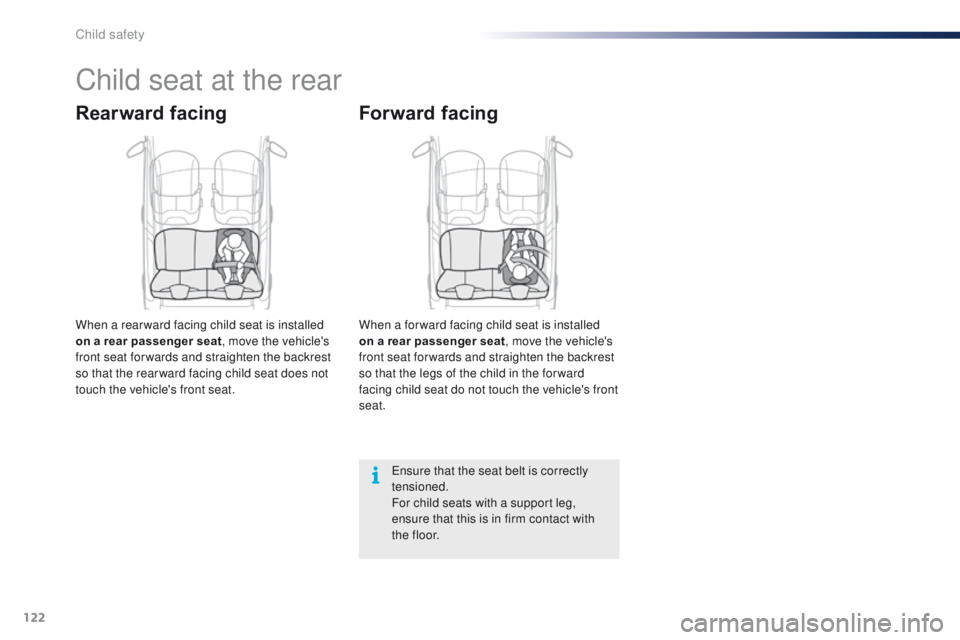
Rearward facing
When a rear ward facing child seat is installed
on a rear passenger seat, move the vehicle's
front seat for wards and straighten the backrest
so that the rear ward facing child seat does not
touch the vehicle's front seat.
Forward facing
When a for ward facing child seat is installed
on a rear passenger seat , move the vehicle's
front seat for wards and straighten the backrest
so that the legs of the child in the for ward
facing child seat do not touch the vehicle's front
seat.
en
sure that the seat belt is correctly
tensioned.
For child seats with a support leg,
ensure that this is in firm contact with
t h e f l o o r.
Child safety
Page 125 of 271
123
108_en_Chap08_securite-enfants_ed01-2015
Child seat in the front*
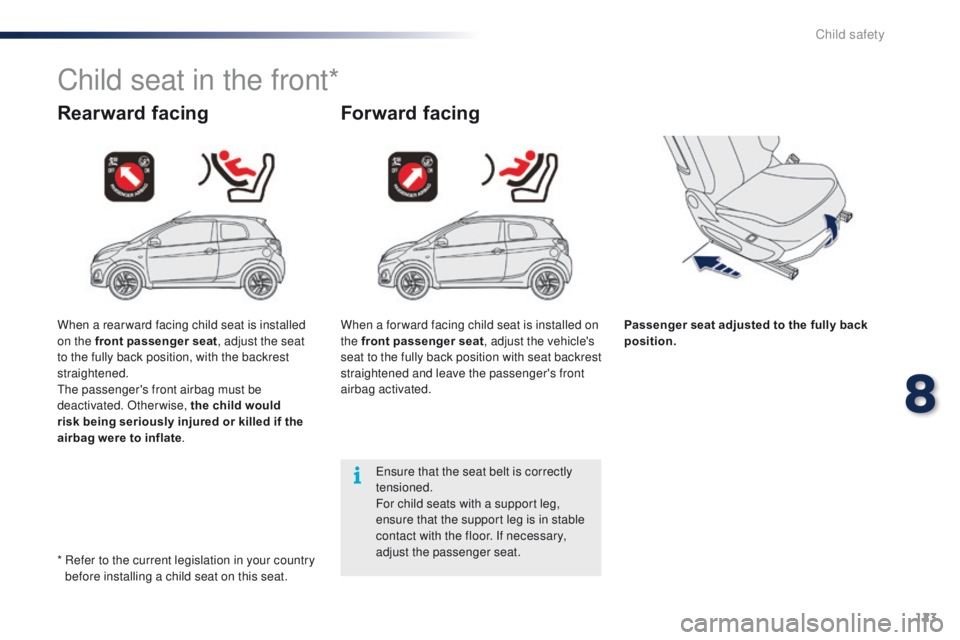
Rearward facingForward facing
Passenger seat adjusted to the fully back
position.
en
sure that the seat belt is correctly
tensioned.
For child seats with a support leg,
ensure that the support leg is in stable
contact with the floor. If necessary,
adjust the passenger seat.
When a rear ward facing child seat is installed
on the front passenger seat
, adjust the seat
to the fully back position, with the backrest
straightened.
th
e passenger's front airbag must be
deactivated. Otherwise, the child would
risk being seriously injured or killed if the
airbag were to inflate . When a for ward facing child seat is installed on
the front passenger seat
, adjust the vehicle's
seat to the fully back position with seat backrest
straightened and leave the passenger's front
airbag activated.
*
R
efer to the current legislation in your country
before installing a child seat on this seat.
8
Child safety
Page 129 of 271
127
108_en_Chap08_securite-enfants_ed01-2015
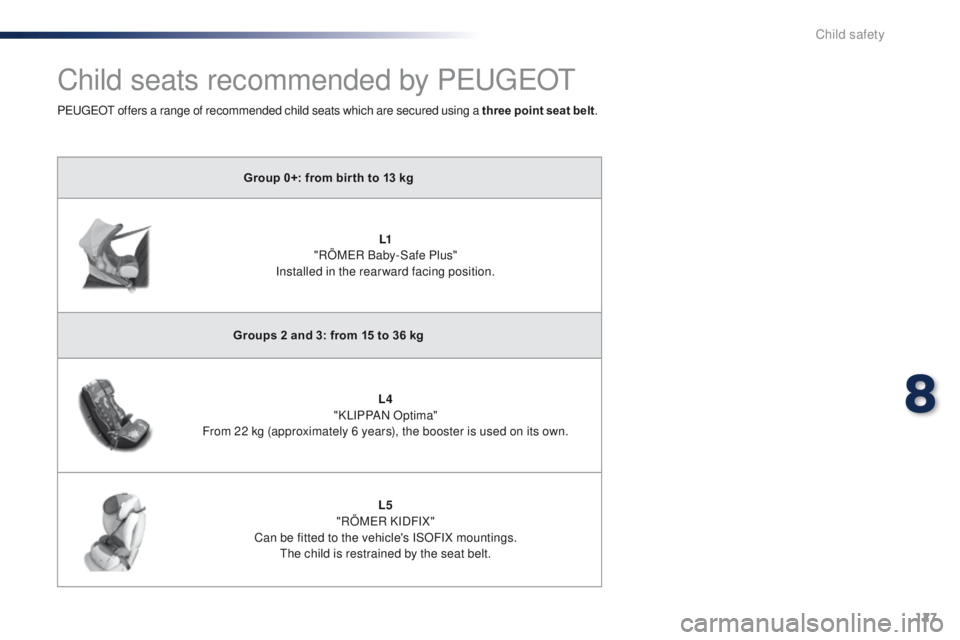
Child seats recommended by PeugeOt
Group 0+: from bir th to 13 kg
L1
"RÖM
eR B
aby-Safe Plus"
Installed in the rearward facing position.
Groups 2 and 3: from 15 to 36 kg L4
"KLIPPAN Optima"
From 22 kg (approximately 6 years), the booster is used on its own.
L5
"RÖM
eR
KIDFIX"
Can be fitted to the vehicle's ISOFIX mountings.
th
e child is restrained by the seat belt.
PeugeOt offers a range of recommended child seats which are secured using a three point seat belt .
8
Child safety
Page 130 of 271
128
108_en_Chap08_securite-enfants_ed01-2015
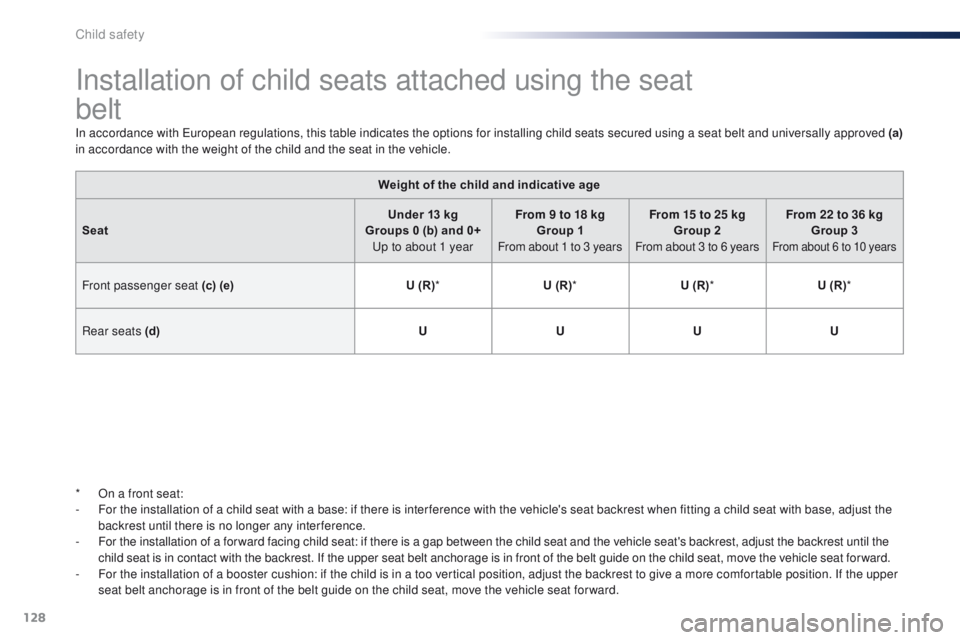
Installation of child seats attached using the seat
belt
In accordance with european regulations, this table indicates the options for installing child seats secured using a seat belt and universally approved (a)
in accordance with the weight of the child and the seat in the vehicle.
Weight of the child and indicative age
Seat Under 13 kg
Groups 0 (b) and 0+
up t
o about 1 yearFrom 9 to 18 kg
Group 1
From about 1 to 3 years From 15 to 25 kg
Group 2
From about 3 to 6 years From 22 to 36 kg
Group 3
From about 6 to 10 years
Front passenger seat (c) (e) U (R)* U (R)* U (R)* U (R)*
Rear seats (d) UUUU
*
O
n a front seat:
-
F
or the installation of a child seat with a base: if there is inter ference with the vehicle's seat backrest when fitting a child seat with base, adjust the
backrest until there is no longer any interference.
-
F
or the installation of a for ward facing child seat: if there is a gap between the child seat and the vehicle seat's backrest, adjust the backrest until the
child seat is in contact with the backrest. If the upper seat belt anchorage is in front of the belt guide on the child seat, move the vehicle seat for ward.
-
F
or the installation of a booster cushion: if the child is in a too vertical position, adjust the backrest to give a more comfortable position. If the upper
seat belt anchorage is in front of the belt guide on the child seat, move the vehicle seat for ward.
Child safety
Page 131 of 271
129
108_en_Chap08_securite-enfants_ed01-2015
a: universal child seat: child seat that can be installed in any vehicle using the vehicle's
seat belt.
b :
g
r
oup 0: from birth to 10 kg. Infant car
seats and "car cots" cannot be installed on
the front passenger seat
W
hen installed on the 2
nd row, they may
prevent the use of the other seats
c :
R
efer the legislation in force in your country
before installing your child on this seat.
d :
t
o i
nstall a child seat on a rear seat,
rear ward or for ward facing, move
the vehicle's seats in front for wards
and straighten the backrests to leave
enough space for the child seat and the
child's
legs.
e :
W
hen a rear ward facing child seat is
installed on the front passenger seat ,
the passenger's front airbag must be
deactivated. Otherwise, the child would
risk being seriously injured or killed
during deployment of the airbag .
W
hen a for ward facing child seat is
installed on the front passenger seat ,
the passenger's front airbag must remain
active. Remove and stow the head restraint
before installing a child seat with a
backrest on a passenger seat. Refit the
head restraint once the child seat has
been removed.
U
:
S
eat suitable for the installation of a
universally approved child seat secured
using a seat belt, rear ward facing and/or
forward facing, with the passenger seat
adjusted to the midway longitudinal position.
U (R) :
s
ame as for U
, with the vehicle's seat in
the fully back position and the backrest
straightened.
8
Child safety
Page 132 of 271
130
108_en_Chap08_securite-enfants_ed01-2015
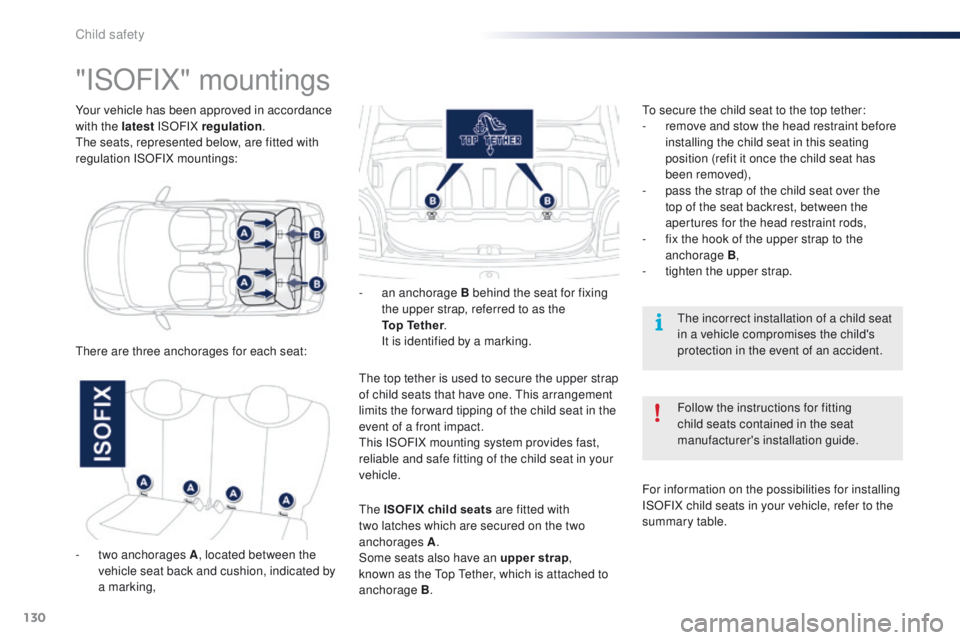
Your vehicle has been approved in accordance
with the latest ISOFIX regulation .
th
e seats, represented below, are fitted with
regulation ISOFIX mountings:
"ISOFIX" mountings
there are three anchorages for each seat: -
an
anchorage B behind the seat for fixing
the upper strap, referred to as the
Top Tether . I t is identified by a marking.
th
e top tether is used to secure the upper strap
of child seats that have one.
t
h
is arrangement
limits the for ward tipping of the child seat in the
event of a front impact.
th
is ISOFIX mounting system provides fast,
reliable and safe fitting of the child seat in your
vehicle. Follow the instructions for fitting
child seats contained in the seat
manufacturer's installation guide.
th
e incorrect installation of a child seat
in a vehicle compromises the child's
protection in the event of an accident.
th
e ISOFIX child seats are fitted with
two latches which are secured on the two
anchorages A .
Some seats also have an upper strap ,
known as the
t
o
p t
e
ther, which is attached to
anchorage B .
to s
ecure the child seat to the top tether:
-
r
emove and stow the head restraint before
installing the child seat in this seating
position (refit it once the child seat has
been removed),
-
p
ass the strap of the child seat over the
top of the seat backrest, between the
apertures for the head restraint rods,
-
f
ix the hook of the upper strap to the
anchorage B ,
-
t
ighten the upper strap.
For information on the possibilities for installing
ISOFIX child seats in your vehicle, refer to the
summary table.
-
t
wo anchorages A , located between the
vehicle seat back and cushion, indicated by
a marking,
Child safety
Page 133 of 271
131
108_en_Chap08_securite-enfants_ed01-2015
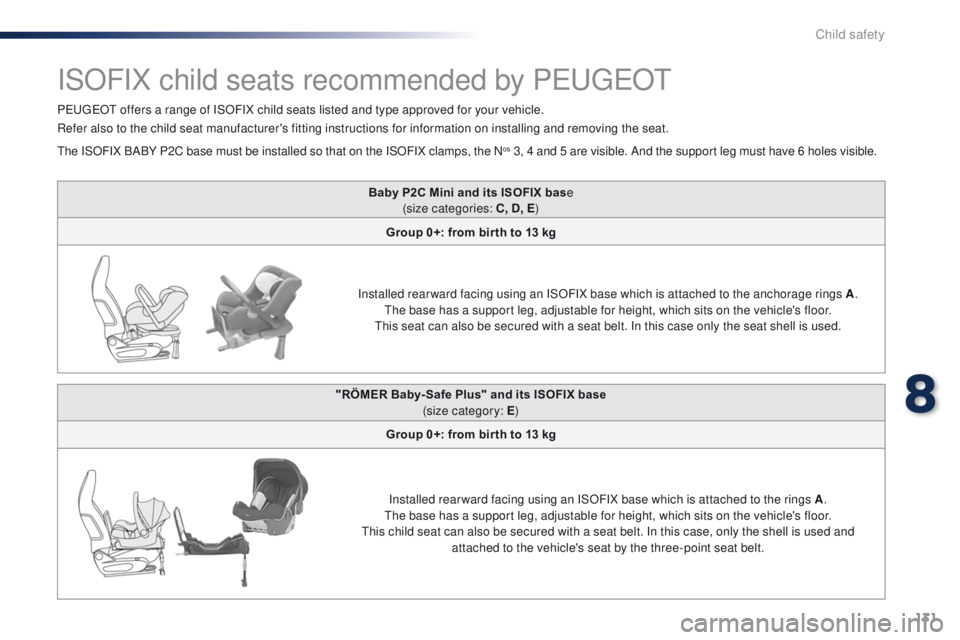
Baby P2C Mini and its ISOFIX base
(size categories: C, D, E )
Group 0+: from bir th to 13 kg
Installed rear ward facing using an ISOFIX base which is attached to the anchorage rings A .
th
e base has a support leg, adjustable for height, which sits on the vehicle's floor.
th
is seat can also be secured with a seat belt. In this case only the seat shell is used.
ISOFIX child seats recommended by Pe ugeOt
PeugeOt offers a range of ISOFIX child seats listed and type approved for your vehicle.
Refer also to the child seat manufacturer's fitting instructions for information on installing and removing the seat.
th
e ISOFIX BABY P2C base must be installed so that on the ISOFIX clamps, the N
os 3, 4 and 5 are visible. And the support leg must have 6 holes visible.
"RÖMER Baby- Safe Plus" and its ISOFIX base (size category: E )
Group 0+: from bir th to 13 kg
Installed rear ward facing using an ISOFIX base which is attached to the rings A .
th
e base has a support leg, adjustable for height, which sits on the vehicle's floor.
th
is child seat can also be secured with a seat belt. In this case, only the shell is used and attached to the vehicle's seat by the three-point seat belt.
8
Child safety
Page 134 of 271
132
108_en_Chap08_securite-enfants_ed01-2015
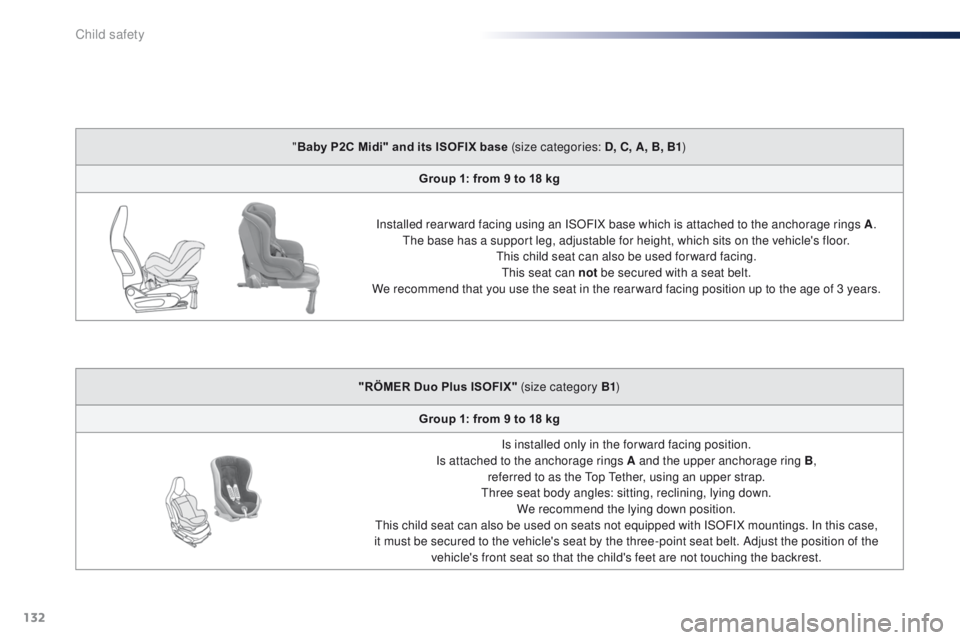
"Baby P2C Midi" and its ISOFIX base (size categories: D, C, A, B, B1 )
Group 1: from 9 to 18 kg
Installed rear ward facing using an ISOFIX base which is attached to the anchorage rings A .
th
e base has a support leg, adjustable for height, which sits on the vehicle's floor.
th
is child seat can also be used for ward facing.
th
is seat can not be secured with a seat belt.
We recommend that you use the seat in the rear ward facing position up to the age of 3 years.
"RÖMER Duo Plus ISOFIX" (size category B1 )
Group 1: from 9 to 18 kg Is installed only in the forward facing position.
Is attached to the anchorage rings A and the upper anchorage ring B, referred to as the
t
o
p t
e
ther, using an upper strap.
th
ree seat body angles: sitting, reclining, lying down.We recommend the lying down position.
th
is child seat can also be used on seats not equipped with ISOFIX mountings. In this case,
it must be secured to the vehicle's seat by the three-point seat belt. Adjust the position of the vehicle's front seat so that the child's feet are not touching the backrest.
Child safety