parking brake Peugeot 3008 Hybrid 4 2012 - RHD (UK. Australia) User Guide
[x] Cancel search | Manufacturer: PEUGEOT, Model Year: 2012, Model line: 3008 Hybrid 4, Model: Peugeot 3008 Hybrid 4 2012Pages: 284, PDF Size: 14.08 MB
Page 145 of 284
D
R
143
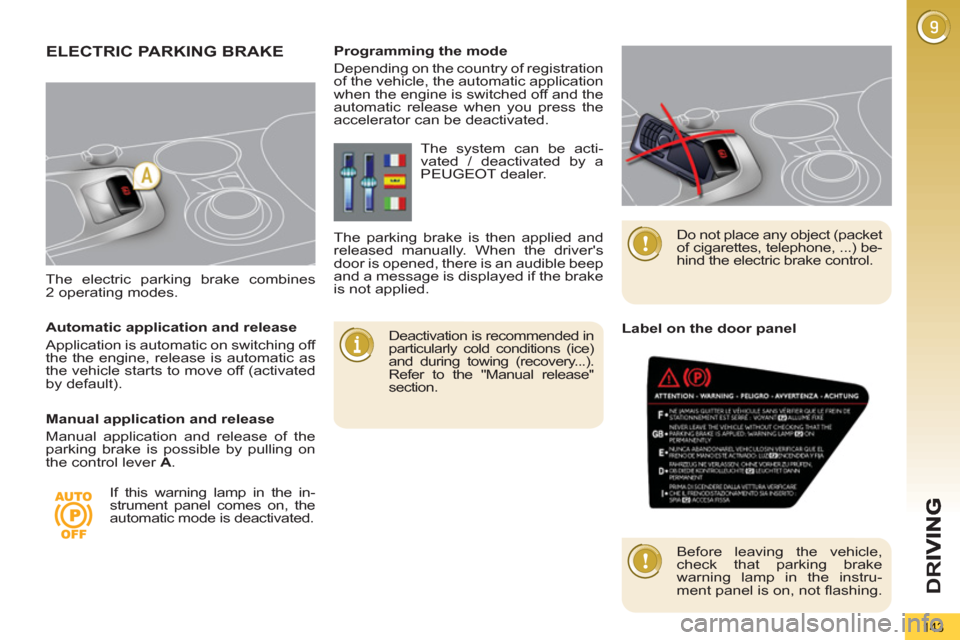
The electric parking brake combines
2 operating modes.
ELECTRIC PARKING BRAKE
Deactivation is recommended in
particularly cold conditions (ice)
and during towing (recovery...).
Refer to the "Manual release"
section.
Programming the mode
Depending on the country of registration
of the vehicle, the automatic application
when the engine is switched off and the
automatic release when you press the
accelerator can be deactivated.
If this warning lamp in the in-
strument panel comes on, the
automatic mode is deactivated. The system can be acti-
vated / deactivated by a
PEUGEOT dealer.
The parking brake is then applied and
released manually. When the driver's
door is opened, there is an audible beep
and a message is displayed if the brake
is not applied.
Do not place any object (packet
of cigarettes, telephone, ...) be-
hind the electric brake control.
Automatic application and release
Application is automatic on switching off
the the engine, release is automatic as
the vehicle starts to move off (activated
by default).
Manual application and release
Manual application and release of the
parking brake is possible by pulling on
the control lever A
.
Label on the door panel
Before leaving the vehicle,
check that parking brake
warning lamp in the instru-
ment panel is on, not fl ashing.
Page 146 of 284
D
R
I
144
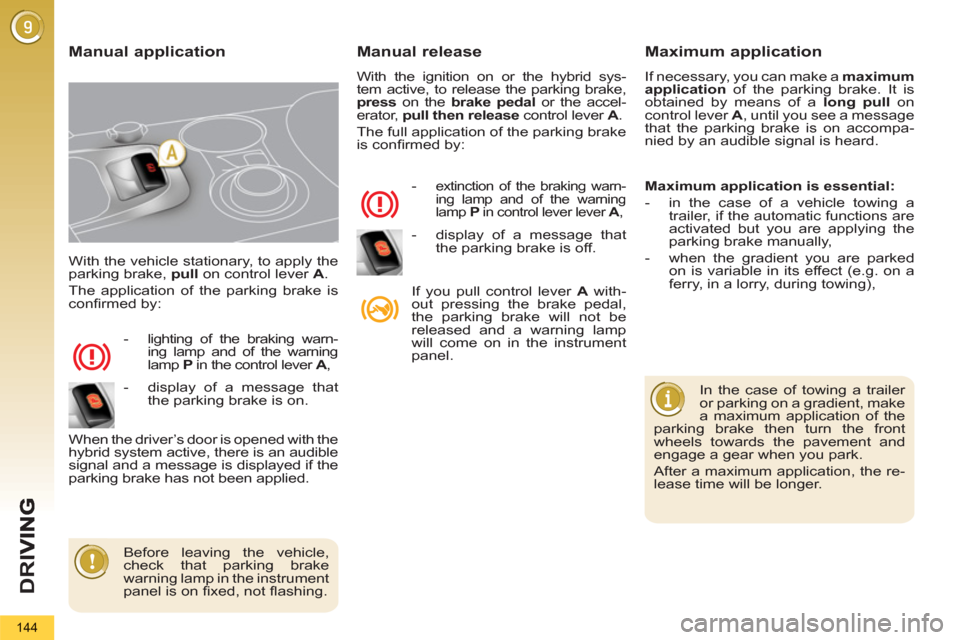
With the vehicle stationary, to apply the
parking brake, pull
on control lever A
.
The application of the parking brake is
confi rmed by:
- lighting of the braking warn-
ing lamp and of the warning
lamp P
in the control lever A
,
When the driver’s door is opened with the
hybrid system active, there is an audible
signal and a message is displayed if the
parking brake has not been applied.
Manual release
With the ignition on or the hybrid sys-
tem active, to release the parking brake,
press
on the brake
pedal
or the accel-
erator, pull then release
control lever A
.
The full application of the parking brake
is confi rmed by:
-
extinction of the braking warn-
ing lamp and of the warning
lamp P
in control lever lever A
,
If you pull control lever A
with-
out pressing the brake pedal,
the parking brake will not be
released and a warning lamp
will come on in the instrument
panel.
Manual application Maximum application
If necessary, you can make a maximum
application
of the parking brake. It is
obtained by means of a long pull
on
control lever A
, until you see a message
that the parking brake is on accompa-
nied by an audible signal is heard.
In the case of towing a trailer
or parking on a gradient, make
a maximum application of the
parking brake then turn the front
wheels towards the pavement and
engage a gear when you park.
After a maximum application, the re-
lease time will be longer.
Before leaving the vehicle,
check that parking brake
warning lamp in the instrument
panel is on fi xed, not fl ashing.
Maximum application is essential:
- in the case of a vehicle towing a
trailer, if the automatic functions are
activated but you are applying the
parking brake manually,
- when the gradient you are parked
on is variable in its effect (e.g. on a
ferry, in a lorry, during towing),
- display of a message that
the parking brake is on.
- display of a message that
the parking brake is off.
Page 147 of 284
145
Automatic application,
hybrid system off
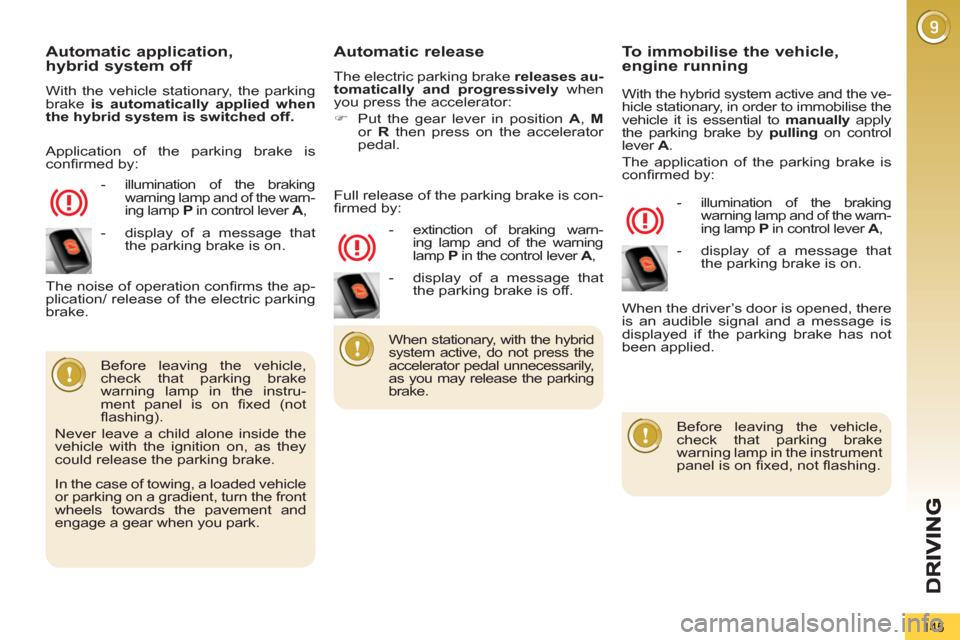
With the vehicle stationary, the parking
brake is automatically applied when
the hybrid system is switched off.
- illumination of the braking
warning lamp and of the warn-
ing lamp P
in control lever A
,
Automatic release
The electric parking brake releases au-
tomatically and progressively
when
you press the accelerator:
)
Put the gear lever in position A
, M
or R
then press on the accelerator
pedal.
Before leaving the vehicle,
check that parking brake
warning lamp in the instru-
ment panel is on fi xed (not
fl ashing).
Never leave a child alone inside the
vehicle with the ignition on, as they
could release the parking brake.
- extinction of braking warn-
ing lamp and of the warning
lamp P
in the control lever A
,
The noise of operation confi rms the ap-
plication/ release of the electric parking
brake. Full release of the parking brake is con-
fi rmed by:
To immobilise the vehicle, engine running
With the hybrid system active and the ve-
hicle stationary, in order to immobilise the
vehicle it is essential to manually apply
the parking brake by pulling
on control
lever A
.
The application of the parking brake is
confi rmed by:
- illumination of the braking
warning lamp and of the warn-
ing lamp P
in control lever A
,
When the driver’s door is opened, there
is an audible signal and a message is
displayed if the parking brake has not
been applied.
Before leaving the vehicle,
check that parking brake
warning lamp in the instrument
panel is on fi xed, not fl ashing.
When stationary, with the hybrid
system active, do not press the
accelerator pedal unnecessarily,
as you may release the parking
brake.
Application of the parking brake is
confi rmed by:
- display of a message that
the parking brake is on.
In the case of towing, a loaded vehicle
or parking on a gradient, turn the front
wheels towards the pavement and
engage a gear when you park.
- display of a message that
the parking brake is off.
- display of a message that
the parking brake is on.
Page 148 of 284
D
R
I
146
Special situationsEMERGENCY BRAKING
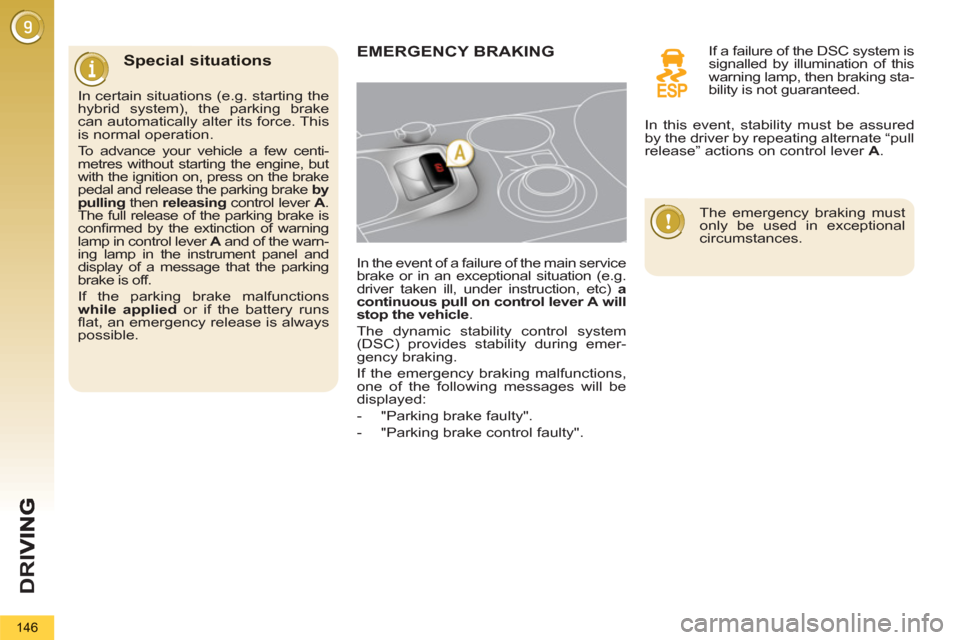
In the event of a failure of the main service
brake or in an exceptional situation (e.g.
driver taken ill, under instruction, etc) a
continuous pull on control lever
A
will
stop the vehicle
.
The dynamic stability control system
(DSC) provides stability during emer-
gency braking.
If the emergency braking malfunctions,
one of the following messages will be
displayed:
- "Parking brake faulty".
- "Parking brake control faulty". In certain situations (e.g. starting the
hybrid system), the parking brake
can automatically alter its force. This
is normal operation.
To advance your vehicle a few centi-
metres without starting the engine, but
with the ignition on, press on the brake
pedal and release the parking brake by
pulling
then releasing
control lever A
.
The full release of the parking brake is
confi rmed by the extinction of warning
lamp in control lever A
and of the warn-
ing lamp in the instrument panel and
display of a message that the parking
brake is off.
If the parking brake malfunctions
while applied
or if the battery runs
fl at, an emergency release is always
possible.
If a failure of the DSC system is
signalled by illumination of this
warning lamp, then braking sta-
bility is not guaranteed.
The emergency braking must
only be used in exceptional
circumstances.
In this event, stability must be assured
by the driver by repeating alternate “pull
release” actions on control lever A
.
Page 149 of 284
D
R
147
Emergency release
For safety reasons, after this
manoeuvre it is essential to
contact a PEUGEOT dealer
urgently to replace the protec-
tive cover.
Following an emergency unlocking,
immobilisation of the vehicle is no
longer guaranteed once the manual
emergency release has been de-
ployed and the manual control does
not allow the re-application of your
parking brake.
Take no action, either on control le-
ver A
, or stopping / starting the hybrid
system while the release device is en-
gaged.
Take care not to allow moisture or dust
in the proximity of the protective cover.
)
Immobilise the vehicle (or keep
it stationary, if the brake pedal is
pressed), with the hybrid system ac-
tive, by putting the gear selector into
position M
or R
.
)
Switch off the hybrid system but leave
the ignition on (position 2). If it is im-
possible to immobilise the vehicle, do
not action the control and urgently
contact a PEUGEOT dealer.
)
Fetch the two vehicle blocks and
the release device, located under
the boot carpet (see "Changing a
wheel" in the "Practical information"
section).
)
Immobilise the vehicle by placing
blocks in front and behind one of the
front wheels.
)
Slide the front left-hand seat back
as far as possible.
)
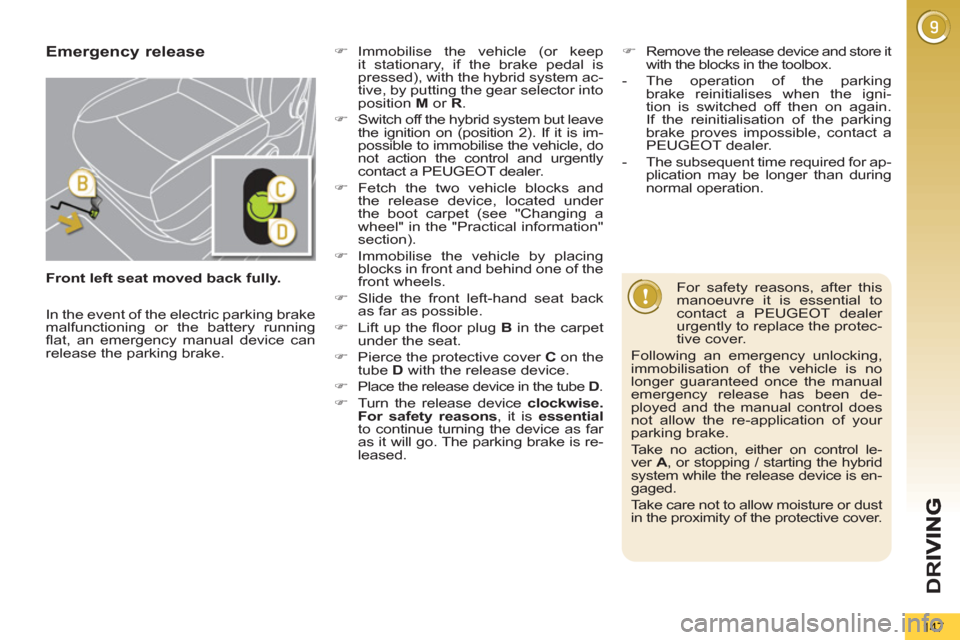
Lift up the fl oor plug B
in the carpet
under the seat.
)
Pierce the protective cover C
on the
tube D
with the release device.
)
Place the release device in the tube D
.
)
Turn the release device clockwise.
For safety reasons
, it is essential
to continue turning the device as far
as it will go. The parking brake is re-
leased.
)
Remove the release device and store it
with the blocks in the toolbox.
- The operation of the parking
brake reinitialises when the igni-
tion is switched off then on again.
If the reinitialisation of the parking
brake proves impossible, contact a
PEUGEOT dealer.
- The subsequent time required for ap-
plication may be longer than during
normal operation.
Front left seat moved back fully.
In the event of the electric parking brake
malfunctioning or the battery running
fl at, an emergency manual device can
release the parking brake.
Page 150 of 284
D
R
I
148
HILL START ASSIST
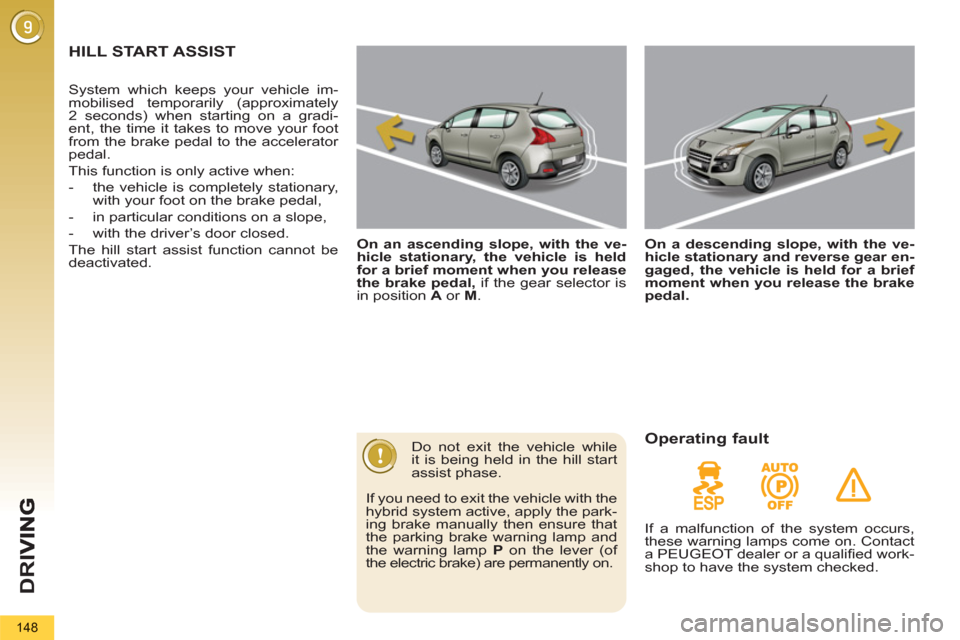
On an ascending slope, with the ve-
hicle stationary, the vehicle is held
for a brief moment when you release
the brake pedal,
if the gear selector is
in position A
or M
.
On a descending slope, with the ve-
hicle stationary and reverse gear en-
gaged, the vehicle is held for a brief
moment when you release the brake
pedal.
Do not exit the vehicle while
it is being held in the hill start
assist phase.
If you need to exit the vehicle with the
hybrid system active, apply the park-
ing brake manually then ensure that
the parking brake warning lamp and
the warning lamp P
on the lever (of
the electric brake) are permanently on.
Operating fault
If a malfunction of the system occurs,
these warning lamps come on. Contact
a PEUGEOT dealer or a qualifi ed work-
shop to have the system checked.
System which keeps your vehicle im-
mobilised temporarily (approximately
2 seconds) when starting on a gradi-
ent, the time it takes to move your foot
from the brake pedal to the accelerator
pedal.
This function is only active when:
- the vehicle is completely stationary,
with your foot on the brake pedal,
- in particular conditions on a slope,
- with the driver’s door closed.
The hill start assist function cannot be
deactivated.
Page 151 of 284
D
R
149
Operating faults
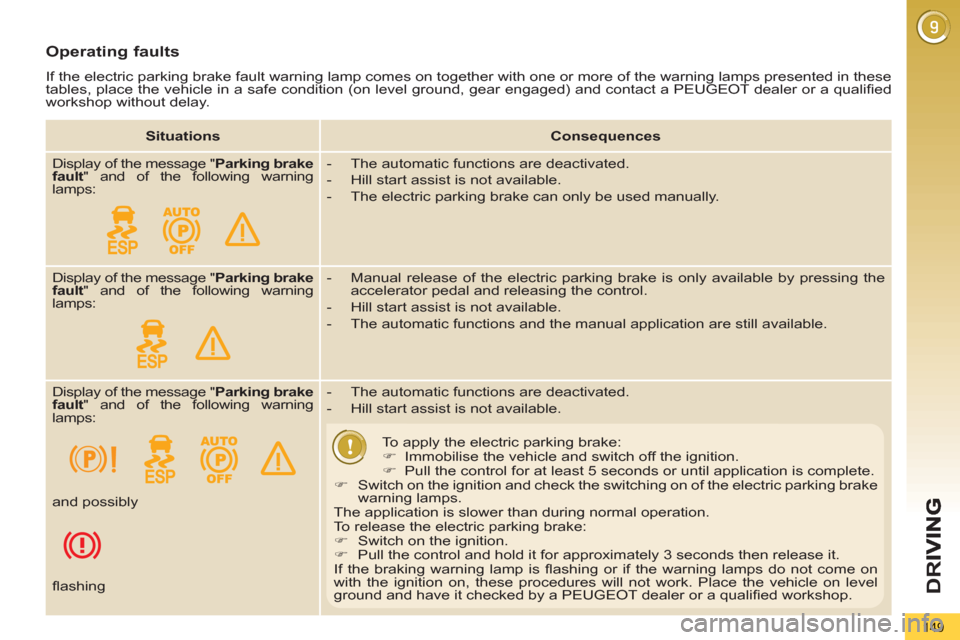
If the electric parking brake fault warning lamp comes on together with one or more of the warning lamps presented in these
tables, place the vehicle in a safe condition (on level ground, gear engaged) and contact a PEUGEOT dealer or a qualifi ed
workshop without delay.
Situations
Consequences
Display of the message " Parking brake
fault
" and of the following warning
lamps:
- The automatic functions are deactivated.
- Hill start assist is not available.
- The electric parking brake can only be used manually.
Display of the message " Parking brake
fault
" and of the following warning
lamps:
- Manual release of the electric parking brake is only available by pressing the
accelerator pedal and releasing the control.
- Hill start assist is not available.
- The automatic functions and the manual application are still available.
Display of the message " Parking brake
fault
" and of the following warning
lamps:
- The automatic functions are deactivated.
- Hill start assist is not available.
To apply the electric parking brake:
)
Immobilise the vehicle and switch off the ignition.
)
Pull the control for at least 5 seconds or until application is complete.
)
Switch on the ignition and check the switching on of the electric parking brake
warning lamps.
The application is slower than during normal operation.
To release the electric parking brake:
)
Switch on the ignition.
)
Pull the control and hold it for approximately 3 seconds then release it.
If the braking warning lamp is fl ashing or if the warning lamps do not come on
with the ignition on, these procedures will not work. Place the vehicle on level
ground and have it checked by a PEUGEOT dealer or a qualifi ed workshop. and possibly
fl ashing
Page 152 of 284
D
R
I
150
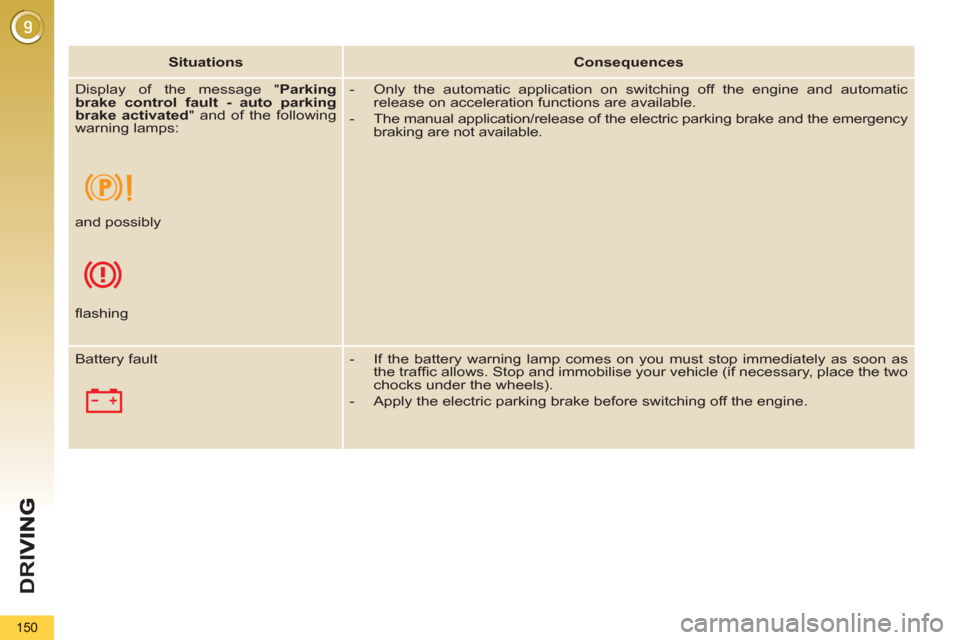
Situations
Consequences
Display of the message " Parking
brake control fault - auto parking
brake activated
" and of the following
warning lamps:
- Only the automatic application on switching off the engine and automatic
release on acceleration functions are available.
- The manual application/release of the electric parking brake and the emergency
braking are not available.
and possibly
fl ashing
Battery fault
- If the battery warning lamp comes on you must stop immediately as soon as
the traffi c allows. Stop and immobilise your vehicle (if necessary, place the two
chocks under the wheels).
- Apply the electric parking brake before switching off the engine.
Page 160 of 284
D
R
I
158
Displays in the instrument panel
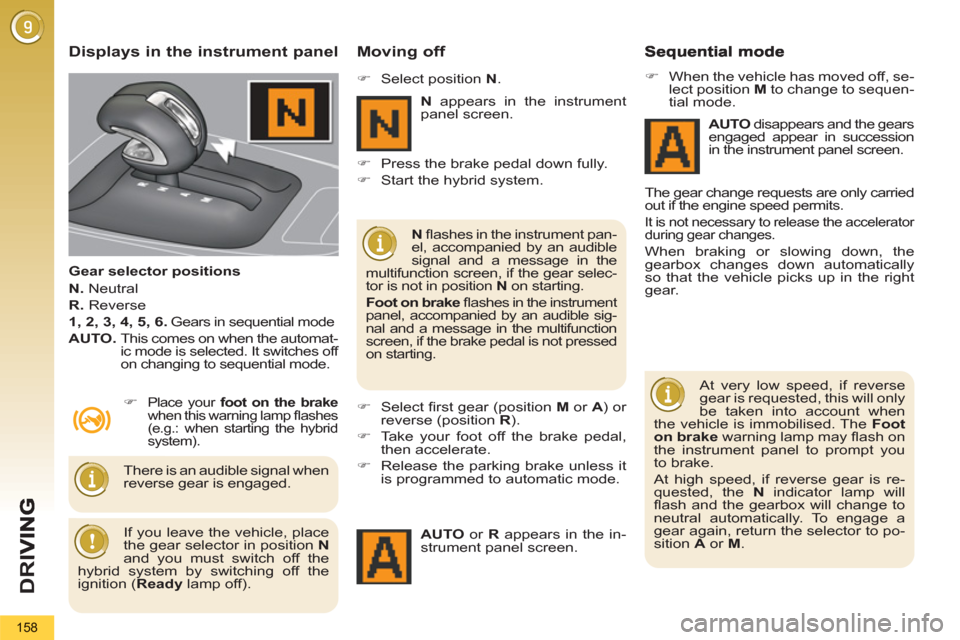
Gear selector positions
N.
Neutral
R.
Reverse
1, 2, 3, 4, 5, 6.
Gears in sequential mode
AUTO.
This comes on when the automat-
ic mode is selected. It switches off
on changing to sequential mode.
Moving off
)
Place your foot on the brake
when this warning lamp fl ashes
(e.g.: when starting the hybrid
system).
)
Select position N
.
)
Select fi rst gear (position M
or A
) or
reverse (position R
).
)
Take your foot off the brake pedal,
then accelerate.
)
Release the parking brake unless it
is programmed to automatic mode.
AUTO
or R
appears in the in-
strument panel screen.
N
fl ashes in the instrument pan-
el, accompanied by an audible
signal and a message in the
multifunction screen, if the gear selec-
tor is not in position N
on starting.
Foot on brake
fl ashes in the instrument
panel, accompanied by an audible sig-
nal and a message in the multifunction
screen, if the brake pedal is not pressed
on starting.
There is an audible signal when
reverse gear is engaged. N
appears in the instrument
panel screen.
)
When the vehicle has moved off, se-
lect position M
to change to sequen-
tial mode.
AUTO
disappears and the gears
engaged appear in succession
in the instrument panel screen.
The gear change requests are only carried
out if the engine speed permits.
It is not necessary to release the accelerator
during gear changes.
When braking or slowing down, the
gearbox changes down automatically
so that the vehicle picks up in the right
gear.
At very low speed, if reverse
gear is requested, this will only
be taken into account when
the vehicle is immobilised. The Foot
on brake
warning lamp may fl ash on
the instrument panel to prompt you
to brake.
At high speed, if reverse gear is re-
quested, the N
indicator lamp will
fl ash and the gearbox will change to
neutral automatically. To engage a
gear again, return the selector to po-
sition A
or M
.
If you leave the vehicle, place
the gear selector in position N
and you must switch off the
hybrid system by switching off the
ignition ( Ready
lamp off).
)
Press the brake pedal down fully.
)
Start the hybrid system.
Page 162 of 284
D
R
I
160
Stopping the vehicle
It is essential to press the
brake pedal when starting the
hybrid system.
When parking, is it essential to apply
the parking brake to immobilise the
vehicle, whatever the circumstances.
When immobilising the ve-
hicle, with the hybrid system
active, it is essential to place
the gear selector in neutral N
.
Before doing anything in the engine
compartment, check that the gear
selector is in neutral N
, the parking
brake is applied, the ignition is off
and the Ready
lamp is off.
Before switching off the hybrid system,
you can choose to:
- move to position N
to engage neutral,
- leave the gear engaged; in this
case, it will not be possible to move
the vehicle.
In both cases, it is essential that you apply
the parking brake to immobilise the vehicle.
Move off and drive, withoutaccelerating
- put the gear lever in position N
so as
to be in neutral,
- press the brake pedal,
- place the selector in position A
, R
or
M
and release the brake. The vehicle
moves off and runs at about 6 mph
(10 km/h) without accelerating.
This function does not operate
on slopes greater than about
5 %.
It is deactivated if the driver's door
is opened To reactivate it, close the
door and then press the brake pedal
or accelerator pedal.