check engine Peugeot 3008 Hybrid 4 2012 Owner's Manual - RHD (UK. Australia)
[x] Cancel search | Manufacturer: PEUGEOT, Model Year: 2012, Model line: 3008 Hybrid 4, Model: Peugeot 3008 Hybrid 4 2012Pages: 284, PDF Size: 14.08 MB
Page 5 of 284
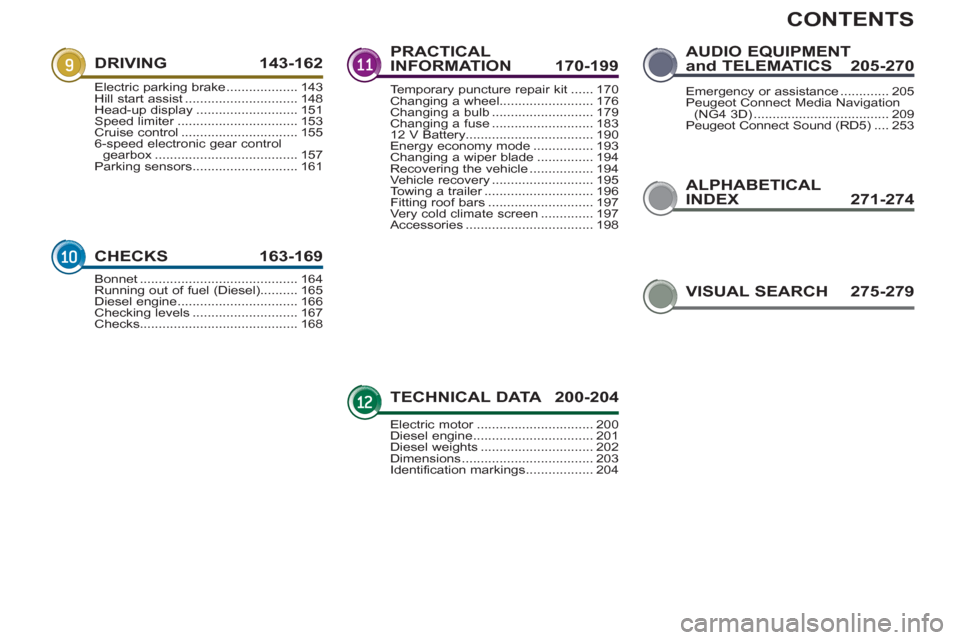
CONTENTS
ALPHABETICALINDEX 271-274
DRIVING 143-162
CHECK
S 163-169
PRACTICAL
INFORMATION 170-199
TECHNICAL DATA 200-204
AUDIO EQUIPMENTand TELEMATICS 205-270
Electric parking brake...................143Hill start assist..............................148Head-up display...........................151Speed limiter................................r153Cruise control...............................1556-speed electronic gear control gearbox......................................157Parking sensors ............................161
Bonnet..........................................164Running out of fuel (Diesel)..........165Diesel engine................................166Checking levels............................167Checks..........................................168
Temporary puncture repair kit......170Changing a wheel.........................176Changing a bulb...........................179Changing a fuse ...........................18312 V Battery..................................190Energy economy mode................193Changing a wiper blade...............194Recovering the vehicle.................194Vehicle recovery ...........................195Towing a trailer.............................r196Fitting roof bars............................197Very cold climate screen..............197Accessories..................................198
Electric motor...............................r200Diesel engine................................201Diesel weights ..............................202Dimensions ...................................203Identification markings..................204
VISUAL SEARCH 275-279
Emergency or assistance.............205Peugeot Connect Media Navigation(NG4 3D)....................................209Peugeot Connect Sound (RD5)....253
Page 10 of 284
8
FA
M
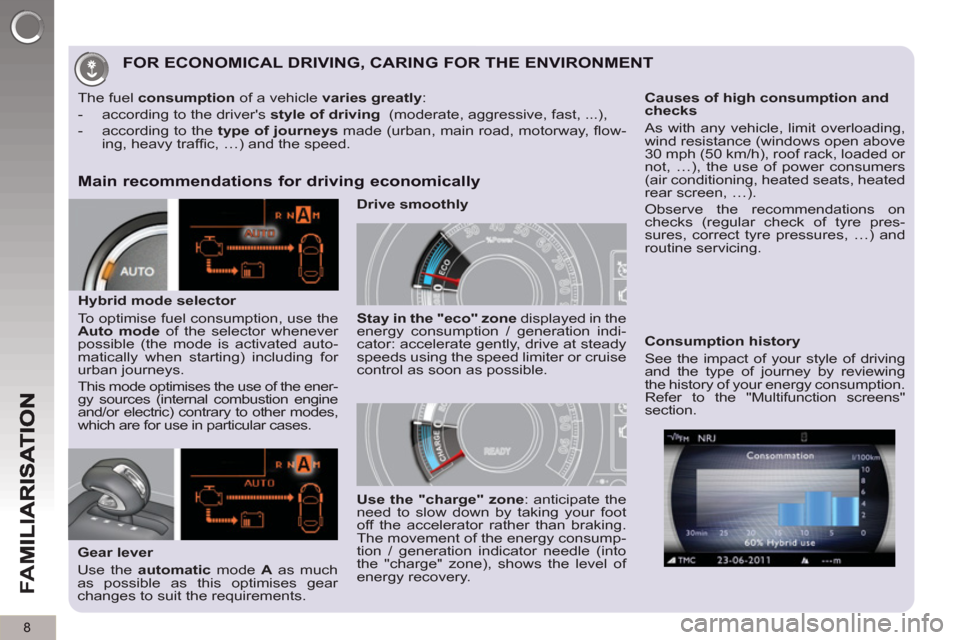
FOR ECONOMICAL DRIVING, CARING FOR THE ENVIRONMENT
Main recommendations for driving economically
Gear lever
Use the automatic
mode A
as much
as possible as this optimises gear
changes to suit the requirements.
The fuel consumption
of a vehicle varies greatly
:
- according to the driver's style of driving
(moderate, aggressive, fast, ...),
- according to the type of journeys
made (urban, main road, motorway, fl ow-
ing, heavy traffi c, …) and the speed.
Hybrid mode selector
To optimise fuel consumption, use the
Auto
mode
of the selector whenever
possible (the mode is activated auto-
matically when starting) including for
urban journeys.
This mode optimises the use of the ener-
gy sources (internal combustion engine
and/or electric) contrary to other modes,
which are for use in particular cases.
Stay in the "eco" zone
displayed in the
energy consumption / generation indi-
cator: accelerate gently, drive at steady
speeds using the speed limiter or cruise
control as soon as possible.
Causes of high consumption and
checks
As with any vehicle, limit overloading,
wind resistance (windows open above
30 mph (50 km/h), roof rack, loaded or
not, …), the use of power consumers
(air conditioning, heated seats, heated
rear screen, …).
Observe the recommendations on
checks (regular check of tyre pres-
sures, correct tyre pressures, …) and
routine servicing.
Consumption history
See the impact of your style of driving
and the type of journey by reviewing
the history of your energy consumption.
Refer to the "Multifunction screens"
section.
Use the "charge"
zone: anticipate the
need to slow down by taking your foot
off the accelerator rather than braking.
The movement of the energy consump-
tion / generation indicator needle (into
the "charge" zone), shows the level of
energy recovery.
Drive smoothly
Page 42 of 284
HY
B
40
Limit the causes of excess consumption
Spread loads throughout the vehicle;
place the heaviest items in the bottom
of the boot, as close as possible to the
rear seats.
Limit the loads carried in the vehicle
and reduce wind resistance (roof bars,
roof rack, bicycle carrier, trailer...). Use
a roof box in preference.
Remove roof bars and roof racks after
use.
At the end of winter, remove snow
tyres and refi t your summer tyres.
Observe the recommendationson maintenance
Check the tyre pressures regularly,
when cold, referring to the label in the
door aperture, driver's side.
Carry out this check in particular:
- before a long journey,
- at each change of season,
- after a long period out of use.
Have your vehicle serviced regularly
(engine oil, oil fi lter, air fi lter...) and ob-
serve the schedule of operations rec-
ommended by the manufacturer.
When refuelling, do not continue after
the 3 rd cut-off of the nozzle to avoid
any overfl ow.
At the wheel of your new vehicle,
it is only after the fi rst 1 800 miles
(3 000 kilometres) that you will see
the fuel consumption settle down to a
consistent average.
Page 57 of 284
55
IN
S
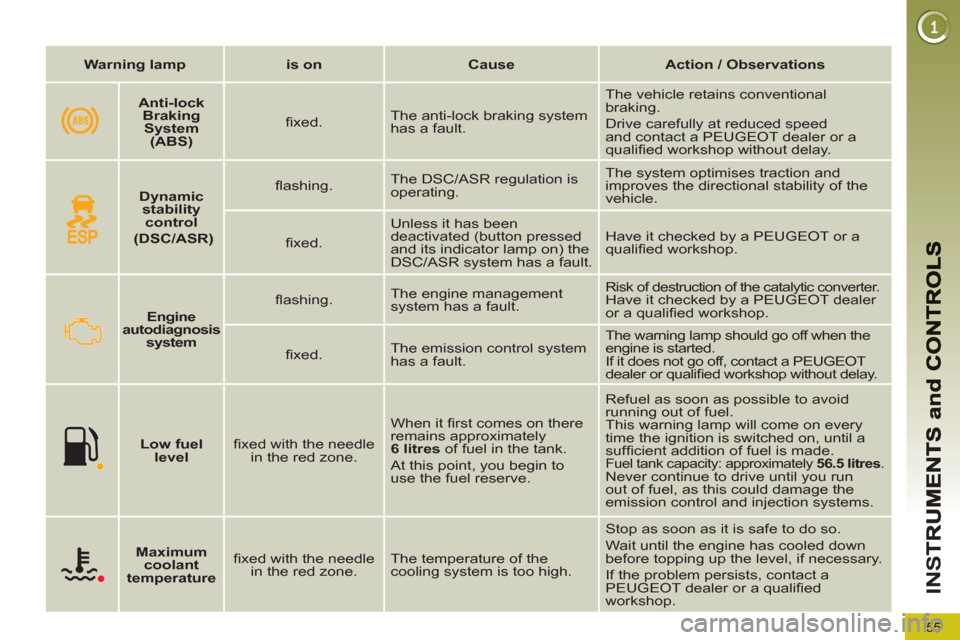
Warning lamp
is on
Cause
Action / Observations
Engine
autodiagnosis
system
fl ashing. The engine management
system has a fault. Risk of destruction of the catalytic converter.
Have it checked by a PEUGEOT dealer
or a qualifi ed workshop.
fi xed. The emission control system
has a fault. The warning lamp should go off when the
engine is started.
If it does not go off, contact a PEUGEOT
dealer or qualifi ed workshop without delay.
Low fuel
level
fi xed with the needle
in the red zone. When it fi rst comes on there
remains approximately
6 litres
of fuel in the tank.
At this point, you begin to
use the fuel reserve. Refuel as soon as possible to avoid
running out of fuel.
This warning lamp will come on every
time the ignition is switched on, until a
suffi cient addition of fuel is made.
Fuel tank capacity: approximately 56.5 litres
.
Never continue to drive until you run
out of fuel, as this could damage the
emission control and injection systems.
Maximum
coolant
temperature
fi xed with the needle
in the red zone. The temperature of the
cooling system is too high. Stop as soon as it is safe to do so.
Wait until the engine has cooled down
before topping up the level, if necessary.
If the problem persists, contact a
PEUGEOT dealer or a qualifi ed
workshop.
Dynamic
stability
control
(DSC/ASR)
fl ashing. The DSC/ASR regulation is
operating. The system optimises traction and
improves the directional stability of the
vehicle.
fi xed. Unless it has been
deactivated (button pressed
and its indicator lamp on) the
DSC/ASR system has a fault. Have it checked by a PEUGEOT or a
qualifi ed workshop.
Anti-lock
Braking
System
(ABS)
fi xed. The anti-lock braking system
has a fault. The vehicle retains conventional
braking.
Drive carefully at reduced speed
and contact a PEUGEOT dealer or a
qualifi ed workshop without delay.
Page 58 of 284
56
IN
S
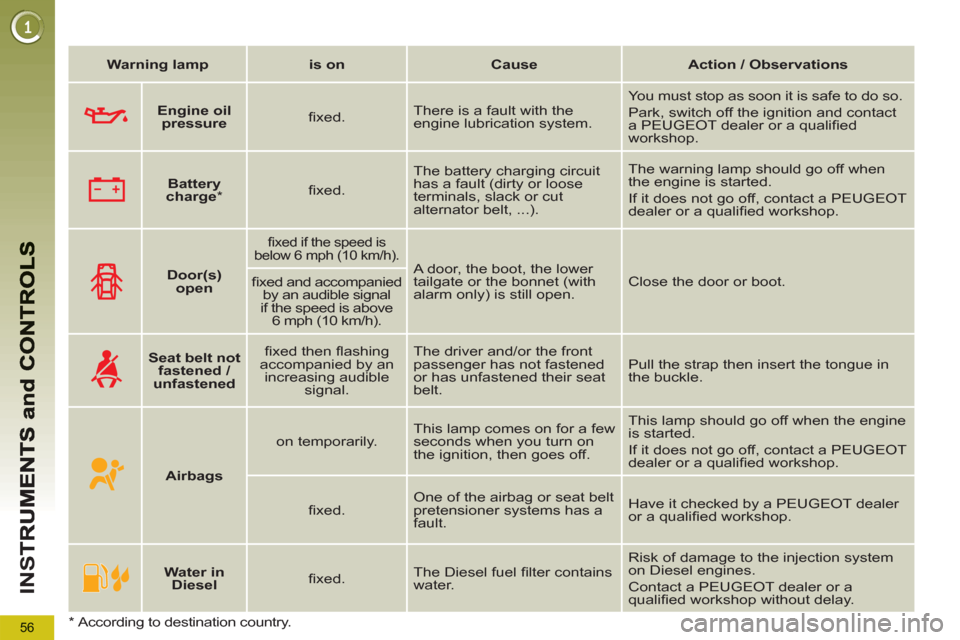
Warning lamp
is on
Cause
Action / Observations
Door(s)
open
fi xed if the speed is
below 6 mph (10 km/h).
A door, the boot, the lower
tailgate or the bonnet (with
alarm only) is still open. Close the door or boot.
fi xed and accompanied
by an audible signal
if the speed is above
6 mph (10 km/h).
Seat belt not
fastened /
unfastened
fi xed then fl ashing
accompanied by an
increasing audible
signal. The driver and/or the front
passenger has not fastened
or has unfastened their seat
belt. Pull the strap then insert the tongue in
the buckle.
Airbags
on temporarily. This lamp comes on for a few
seconds when you turn on
the ignition, then goes off. This lamp should go off when the engine
is started.
If it does not go off, contact a PEUGEOT
dealer or a qualifi ed workshop.
fi xed. One of the airbag or seat belt
pretensioner systems has a
fault. Have it checked by a PEUGEOT dealer
or a qualifi ed workshop.
Water in
Diesel
fi xed. The Diesel fuel fi lter contains
water. Risk of damage to the injection system
on Diesel engines.
Contact a PEUGEOT dealer or a
qualifi ed workshop without delay.
Engine oil
pressure
fi xed. There is a fault with the
engine lubrication system. You must stop as soon it is safe to do so.
Park, switch off the ignition and contact
a PEUGEOT dealer or a qualifi ed
workshop.
Battery
charge
*
fi xed. The battery charging circuit
has a fault (dirty or loose
terminals, slack or cut
alternator belt, ...). The warning lamp should go off when
the engine is started.
If it does not go off, contact a PEUGEOT
dealer or a qualifi ed workshop.
*
According to destination country.
Page 62 of 284
IN
S
The level shown will only be
correct if the vehicle is on level
ground and the engine has been
off for more than 30 minutes.
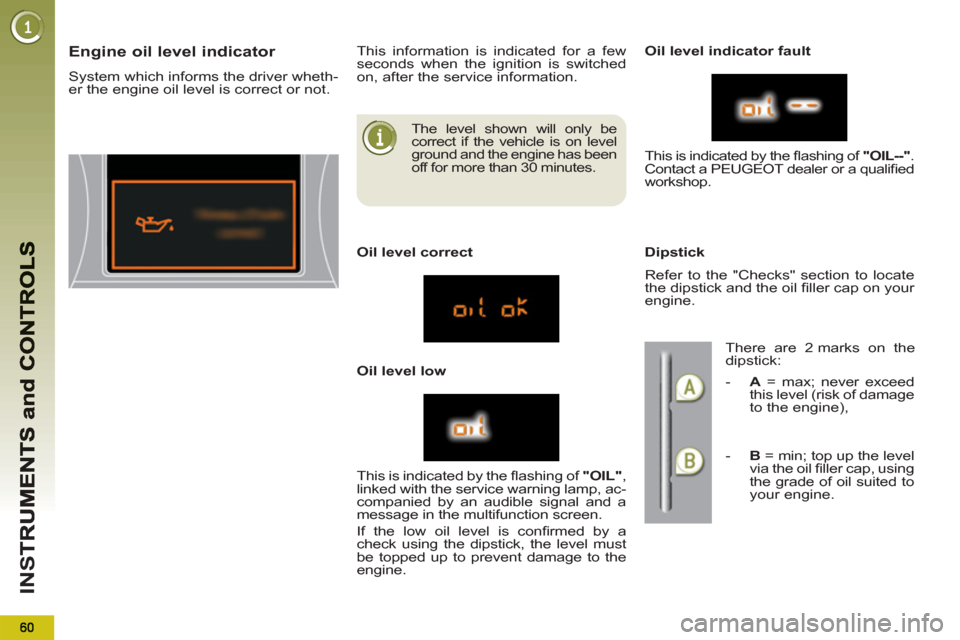
Engine oil level indicator
System which informs the driver wheth-
er the engine oil level is correct or not. This information is indicated for a few
seconds when the ignition is switched
on, after the service information.
Oil level correct
Oil level low
Oil level indicator fault
Dipstick
This is indicated by the fl ashing of "OIL"
,
linked with the service warning lamp, ac-
companied by an audible signal and a
message in the multifunction screen.
If the low oil level is confi rmed by a
check using the dipstick, the level must
be topped up to prevent damage to the
engine. This is indicated by the fl ashing of "OIL
--"
.
Contact a PEUGEOT dealer or a qualifi ed
workshop.
Refer to the "Checks" section to locate
the dipstick and the oil fi ller cap on your
engine.
There are 2 marks on the
dipstick:
- A
= max; never exceed
this level (risk of damage
to the engine),
- B
= min; top up the level
via the oil fi ller cap, using
the grade of oil suited to
your engine.
Page 74 of 284
72
The air conditioning system does not contain chlorine and does not pres-
ent any danger to the ozone layer.
Recommendations for ventilation and air conditioning
In order for these systems to be fully effective, follow the operation and mainte-
nance guidelines below:
)
If the interior temperature remains very high after the vehicle has been
parked in the sun for a considerable time, fi rst ventilate the passenger com-
partment for a few minutes.
Place the air fl ow control at a suffi cient level to provide an adequate renewal
of air in the passenger compartment.
)
To obtain an even air distribution, take care not to obstruct the exterior air
intake grilles located at the base of the windscreen, the nozzles, the vents
and the air outlets, as well as the air extractor located in the boot.
)
Use in preference the intake of exterior air as prolonged use of the air recir-
culation may cause misting of the windows and side windows.
)
Do not cover the sunshine sensor, located on the dashboard; this is used for
regulation of the automatic air conditioning system.
)
Operate the air conditioning system for 5 to 10 minutes, once or twice a
month to keep it in good working order.
)
Ensure that the passenger compartment fi lter is in good condition and have
the fi lter elements replaced regularly (refer to the "Checks" section).
We recommend the use of a combined passenger compartment fi lter. Thanks
to its second special active fi lter, it contributes to the purifi cation of the air
breathed by the occupants and the cleanliness of the passenger compart-
ment (reduction of allergic symptoms, bad odours and greasy deposits).
)
The air conditioning uses power from the engine while operating. This re-
sults in an increase in the vehicle's fuel consumption.
When towing at or near maximum capacity or on steep slopes in high ambi-
ent temperatures, switching off the air conditioning saves engine power and
so improves towing capacity.
Condensation created by the air conditioning results in a discharge of water
under the vehicle when stationary, which is perfectly normal.
)
To ensure correct operation of the air conditioning system, you are also ad-
vised to have it checked regularly.
)
If the system does not produce cold air, do not use it and contact a PEUGEOT
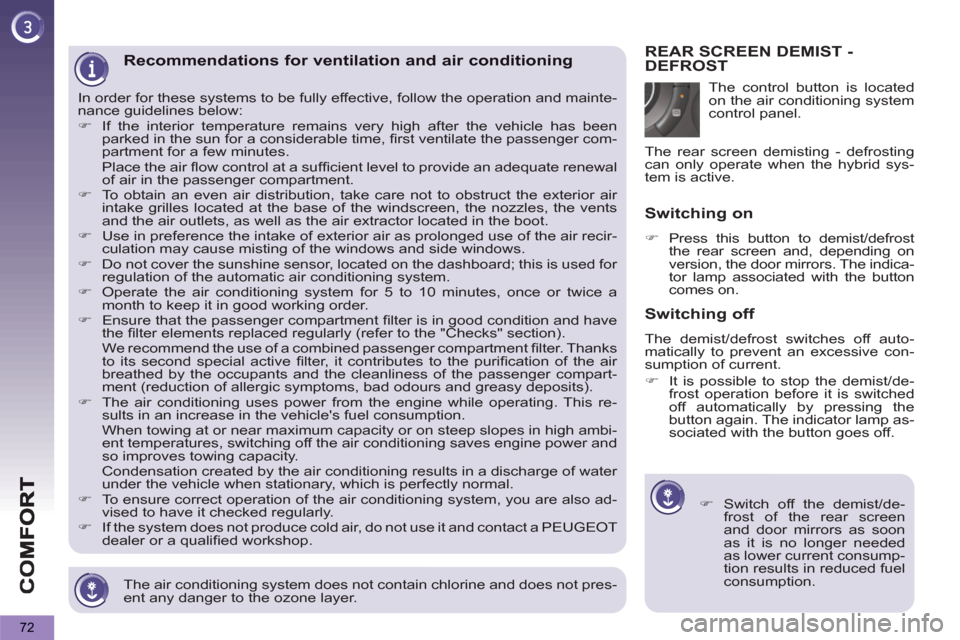
dealer or a qualifi ed workshop. The control button is located
on the air conditioning system
control panel.
REAR SCREEN DEMIST - DEFROST
)
Switch off the demist/de-
frost of the rear screen
and door mirrors as soon
as it is no longer needed
as lower current consump-
tion results in reduced fuel
consumption.
Switching on
)
Press this button to demist/defrost
the rear screen and, depending on
version, the door mirrors. The indica-
tor lamp associated with the button
comes on.
Switching off
The demist/defrost switches off auto-
matically to prevent an excessive con-
sumption of current.
)
It is possible to stop the demist/de-
frost operation before it is switched
off automatically by pressing the
button again. The indicator lamp as-
sociated with the button goes off.
The rear screen demisting - defrosting
can only operate when the hybrid sys-
tem is active.
Page 91 of 284
AC
C
89
Lost keys
Visit a PEUGEOT dealer with the vehicle's registration document, your
personal identifi cation documents and if possible the key code label.
The PEUGEOT dealer will be able to fi nd the key code and the transponder
code required to order a new key.
Do not throw the remote control
batteries away, they contain met-
als which are harmful to the en-
vironment.
Take them to an approved collection
point.
Remote control
The high frequency remote control is a sensitive system; do not operate it while it is in your
pocket as there is a possibility that it may unlock the vehicle, without you being aware of it.
Do not repeatedly press the buttons of your remote control out of range and out of sight of
your vehicle. You run the risk of stopping it from working and the remote control would have
to be reinitialised.
The remote control does not operate when the key is in the ignition switch, even when the
ignition is switched off, except for reinitialisation.
Locking the vehicle
Driving with the doors locked may make access to the passenger compartment
by the emergency services more diffi cult in an emergency.
As a safety precaution (with children on board), remove the key from the ignition
switch when you leave the vehicle, even for a short time.
Anti-theft protection
Do not make any modifi cations to the electronic engine immobiliser system; this
could cause malfunctions.
When purchasing a second-hand vehicle
Have the pairing of all of the keys in your possession checked by a PEUGEOT dealer,
to ensure that only your keys can be used to open and start the vehicle.
Page 100 of 284
AC
C
98
The key cannot be removed
from the lock until the cap is
put back on the tank.
Opening the cap may trigger an in-
rush of air. This vacuum, which is
completely normal, is caused by the
sealing of the fuel system.
FUEL TANK
Capacity of the tank: approximately
56.5 litres.
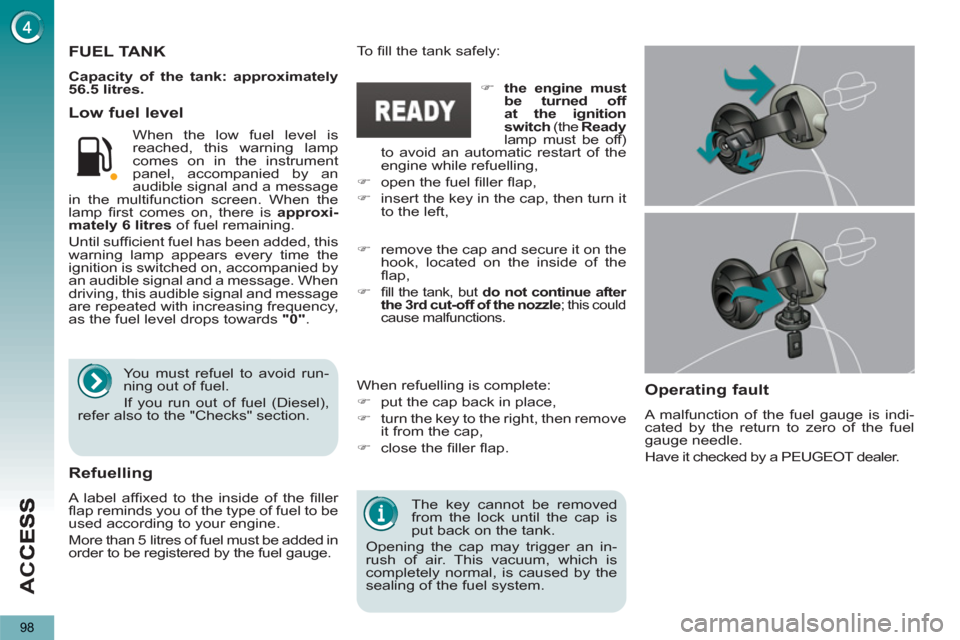
To fi ll the tank safely:
When refuelling is complete:
)
put the cap back in place,
)
turn the key to the right, then remove
it from the cap,
)
close the fi ller fl ap.
)
remove the cap and secure it on the
hook, located on the inside of the
fl ap,
)
fi ll the tank, but do not continue after
the 3rd cut-off of the nozzle
; this could
cause malfunctions.
Low fuel level
Operatin
g fault
A malfunction of the fuel gauge is indi-
cated by the return to zero of the fuel
gauge needle.
Have it checked by a PEUGEOT dealer.
Refuelling
A label affi xed to the inside of the fi ller
fl ap reminds you of the type of fuel to be
used according to your engine.
More than 5 litres of fuel must be added in
order to be registered by the fuel gauge. When the low fuel level is
reached, this warning lamp
comes on in the instrument
panel, accompanied by an
audible signal and a message
in the multifunction screen. When the
lamp fi rst comes on, there is approxi-
mately
6 litres
of fuel remaining.
Until suffi cient fuel has been added, this
warning lamp appears every time the
ignition is switched on, accompanied by
an audible signal and a message. When
driving, this audible signal and message
are repeated with increasing frequency,
as the fuel level drops towards "0"
.
You must refuel to avoid run-
ning out of fuel.
If you run out of fuel (Diesel),
refer also to the "Checks" section.
)
the engine must
be turned off
at the ignition
switch
(the Ready
lamp must be off)
to avoid an automatic restart of the
engine while refuelling,
)
open the fuel fi ller fl ap,
)
insert the key in the cap, then turn it
to the left,
Page 101 of 284
DIESEL
AC
C
99
Quality of the fuel used for Diesel engines
The Diesel engines are perfectly com-
patible with biofuels which conform to
current and future European standards
(Diesel fuel which complies with stan-
dard EN 590 mixed with a biofuel which
complies with standard EN 14214)
available at the pumps (containing up
to 7 % Fatty Acid Methyl Ester).
The B30 biofuel can be used in certain
Diesel engines; however, this use is sub-
ject to strict application of the special ser-
vicing conditions. Contact a PEUGEOT
dealer or a qualifi ed workshop.
The use of any other type of (bio)fuel
(vegetable or animal oils, pure or dilut-
ed, domestic fuel...) is strictly prohibited
(risk of damage to the engine and fuel
system).
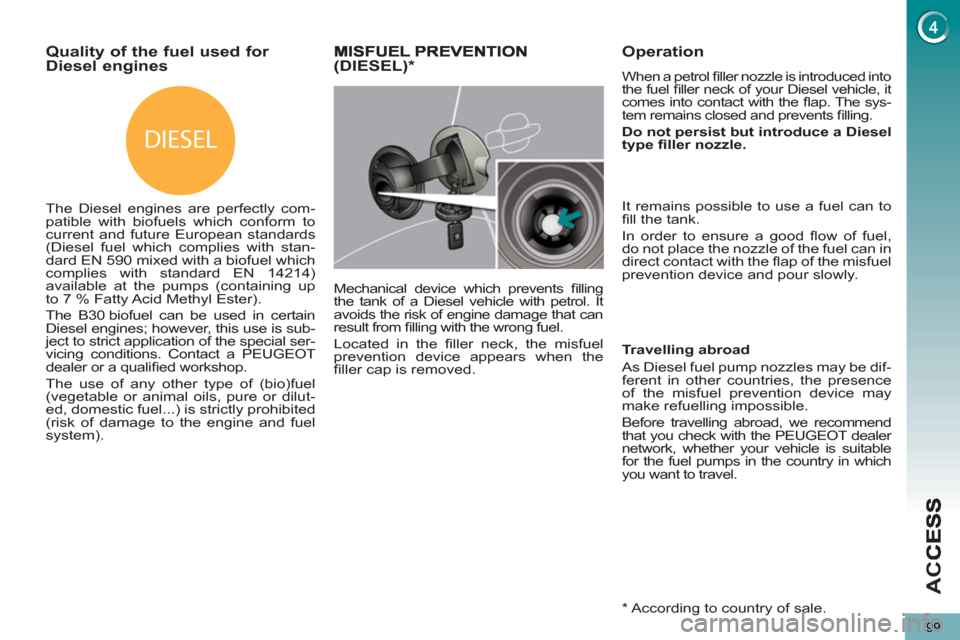
(DIESEL)
*
Mechanical device which prevents fi lling
the tank of a Diesel vehicle with petrol. It
avoids the risk of engine damage that can
result from fi lling with the wrong fuel.
Located in the fi ller neck, the misfuel
prevention device appears when the
fi ller cap is removed.
Operation
When a petrol fi ller nozzle is introduced into
the fuel fi ller neck of your Diesel vehicle, it
comes into contact with the fl ap. The sys-
tem remains closed and prevents fi lling.
Do not persist but introduce a Diesel
type fi ller nozzle.
It remains possible to use a fuel can to
fi ll the tank.
In order to ensure a good fl ow of fuel,
do not place the nozzle of the fuel can in
direct contact with the fl ap of the misfuel
prevention device and pour slowly.
*
According to country of sale.
Travelling abroad
As Diesel fuel pump nozzles may be dif-
ferent in other countries, the presence
of the misfuel prevention device may
make refuelling impossible.
Before travelling abroad, we recommend
that you check with the PEUGEOT dealer
network, whether your vehicle is suitable
for the fuel pumps in the country in which
you want to travel.