Air PEUGEOT 5008 2018 Workshop Manual
[x] Cancel search | Manufacturer: PEUGEOT, Model Year: 2018, Model line: 5008, Model: PEUGEOT 5008 2018Pages: 364, PDF Size: 13.03 MB
Page 147 of 364
145
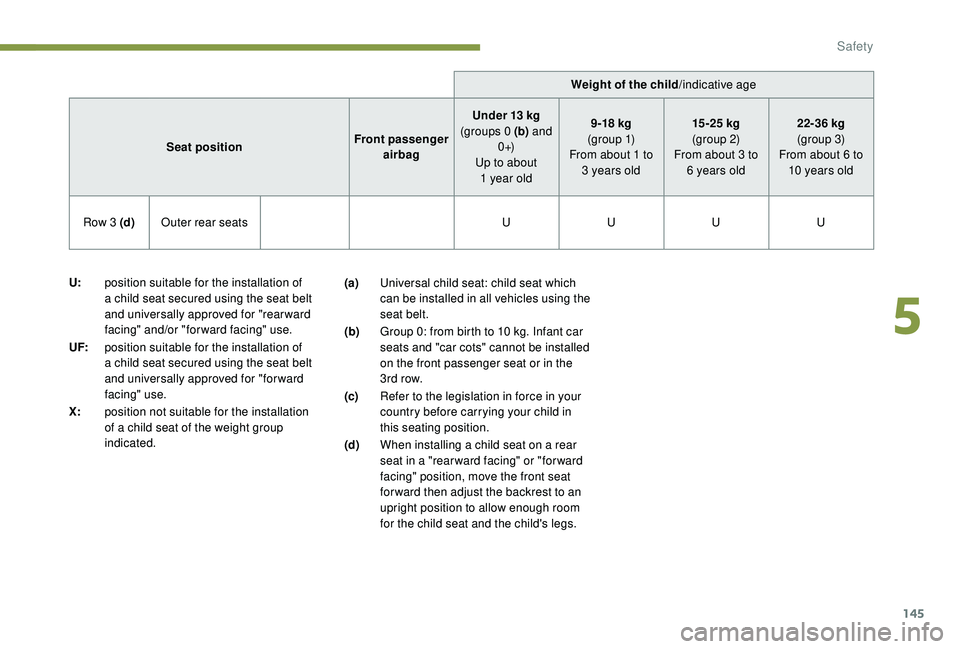
(a)Universal child seat: child seat which
can be installed in all vehicles using the
seat belt.
(b) Group 0: from birth to 10
kg. Infant car
seats and "car cots" cannot be installed
on the front passenger seat or in the
3rd row.
(c) Refer to the legislation in force in your
country before carrying your child in
this seating position.
(d) When installing a
child seat on a rear
seat in a
"rear ward facing" or "for ward
facing" position, move the front seat
for ward then adjust the backrest to an
upright position to allow enough room
for the child seat and the child's legs.
U:
position suitable for the installation of
a
child seat secured using the seat belt
and universally approved for "rearward
facing" and/or "forward facing" use.
UF: position suitable for the installation of
a
child seat secured using the seat belt
and universally approved for "forward
facing" use.
X: position not suitable for the installation
of a
child seat of the weight group
indicated. Weight of the child
/indicative age
Seat position Front passenger
airbag Under 13 kg
(groups 0 (b) and
0 +)
Up to about 1 year old
9 -18
kg
(g r o u p 1)
From about 1 to
3 years old
15 -25
kg
(group 2)
From about 3 to
6 years old
22-36 kg
(group 3)
From about 6 to
10 years old
Row 3 (d) Outer rear seats UUUU
5
Safety
Page 150 of 364
148
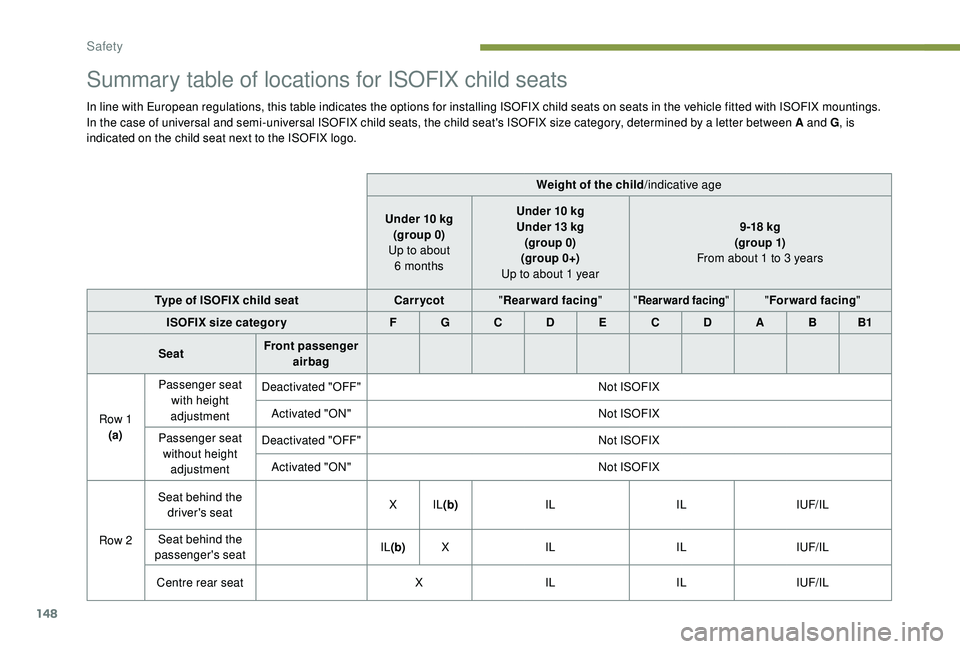
Summary table of locations for ISOFIX child seats
In line with European regulations, this table indicates the options for installing ISOFIX child seats on seats in the vehicle fitted with ISOFIX mountings.
In the case of universal and semi-universal ISOFIX child seats, the child seat's ISOFIX size category, determined by a letter between A and G, is
indicated on the child seat next to the ISOFIX logo.
Weight of the child/indicative age
Under 10
kg
(group 0)
Up to about 6
monthsUnder 10
kg
Under 13
kg
(group 0)
(group 0+)
Up to about 1
year9 -18
kg
(g ro up 1)
From about 1
to 3 years
Type of ISOFIX child seat Carr ycot"Rearward facing "
"Rearward facing ""Forward facing "
ISOFIX size categor y F G C D E C D A B B1
Seat Front passenger
airbag
Row 1 (a) Passenger seat
with height
adjustment Deactivated "OFF"
Not ISOFIX
Activated "ON" Not ISOFIX
Passenger seat without height adjustment Deactivated "OFF"
Not ISOFIX
Activated "ON" Not ISOFIX
Row 2 Seat behind the
driver's seat X
IL(b) IL ILIUF/IL
Seat behind the
passenger's seat IL
(b) X IL ILIUF/IL
Centre rear seat XIL ILIUF/IL
Safety
Page 151 of 364
149
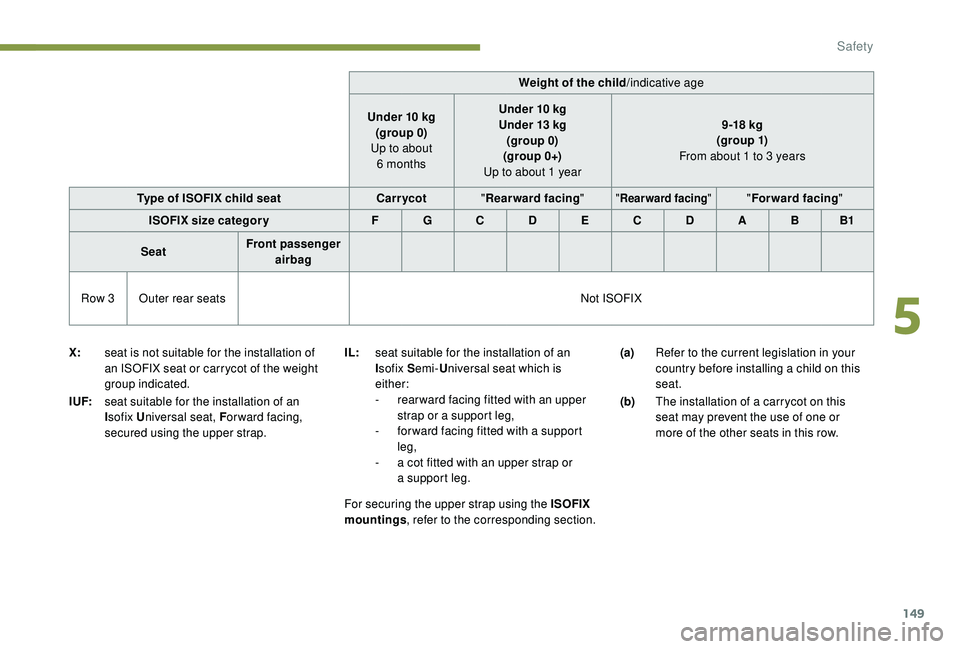
X:seat is not suitable for the installation of
an ISOFIX seat or carrycot of the weight
group indicated.
I UF: seat suitable for the installation of an
Isofix U niversal seat, F or ward facing,
secured using the upper strap. IL:
seat suitable for the installation of an
Isofix S emi-Universal seat which is
either:
-
r
ear ward facing fitted with an upper
strap or a
support leg,
-
f
or ward facing fitted with a support
leg,
-
a c
ot fitted with an upper strap or
a
support leg.(a)
Refer to the current legislation in your
country before installing a
child on this
seat.
(b) The installation of a
carrycot on this
seat may prevent the use of one or
more of the other seats in this row.
Weight of the child
/indicative age
Under 10 kg
(group 0)
Up to about 6 months
Under 10 kg
Under 13 kg
(group 0)
(group 0+)
Up to about 1 year
9 -18
kg
(g ro up 1)
From about 1 to 3 years
Type of ISOFIX child seat Carr ycot"Rearward facing "
"Rearward facing ""Forward facing "
ISOFIX size categor y F G C D E C D A B B1
Seat Front passenger
airbag
Row 3 Outer rear seats Not ISOFIX
For securing the upper strap using the ISOFIX
mountings , refer to the corresponding section.
5
Safety
Page 152 of 364
150
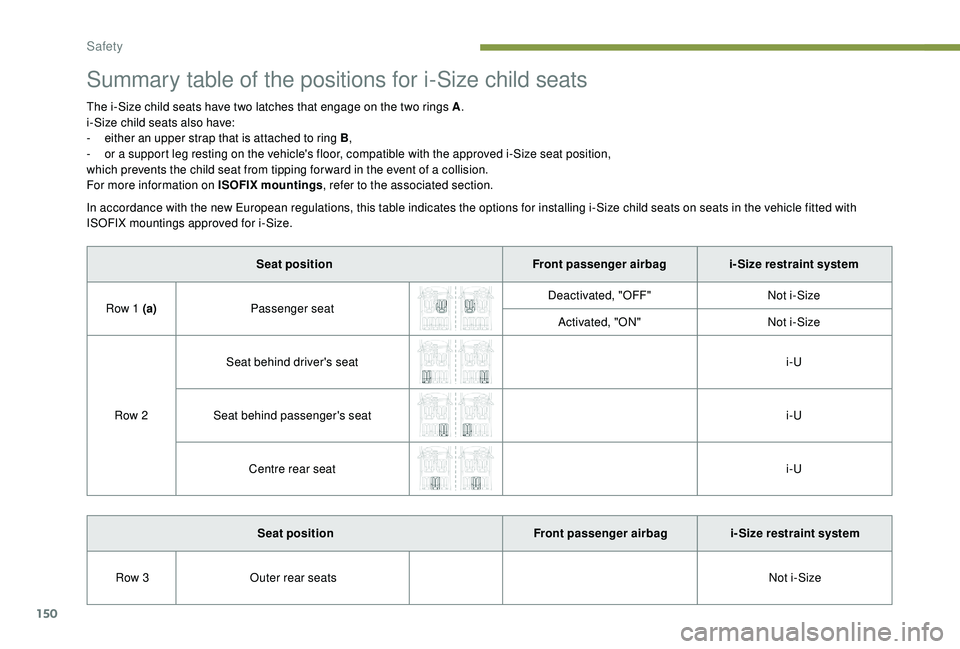
Summary table of the positions for i-Size child seats
The i-Size child seats have two latches that engage on the two rings A.
i-Size child seats also have:
-
e
ither an upper strap that is attached to ring B ,
-
o
r a support leg resting on the vehicle's floor, compatible with the approved i-Size seat position,
which prevents the child seat from tipping for ward in the event of a
collision.
For more information on ISOFIX mountings , refer to the associated section.
In accordance with the new European regulations, this table indicates the options for installing i-Size child seats on seats in the vehicle fitted with
ISOFIX mountings approved for i-Size.
Seat position Front passenger airbagi- Size restraint system
Row 1 (a) Passenger seat Deactivated, "OFF"
Not i-Size
Activated, "ON" Not i-Size
Row 2 Seat behind driver's seat
i-U
Seat behind passenger's seat i-U
Centre rear seat i-U
Seat position Front passenger airbagi- Size restraint system
Row 3 Outer rear seats Not i-Size
Safety
Page 154 of 364
152
The incorrect installation of a child seat in
a vehicle compromises the child's protection
in the event of an accident.
Ensure that there is no seat belt or seat belt
buckle under the child seat, as this could
destabilise it.
Remember to fasten the seat belts or the
child seat harnesses keeping the slack
relative to the child's body to a
minimum,
even for short journeys.
When installing a
child seat using the seat
belt, ensure that the seat belt is tightened
correctly on the child seat and that it secures
the child seat firmly on the seat of your
vehicle. If your passenger seat is adjustable,
move it for wards if necessary.
At rear seating positions, always leave
sufficient space between the front seat and:
-
a r
ear ward facing child seat,
-
t
he child's feet for a child seat fitted
forward facing.
To do this, move the front seat for wards
and, if necessary, move its backrest into the
upright position.
For optimal installation of the forward facing
child seat, verify that its backrest is as close
as possible to the backrest of the vehicle
seat, if possible in contact with it. The head restraint must be removed before
installing a
child seat with a backrest on
a
passenger seat.
Ensure that the head restraint is stored or
attached securely to prevent it from being
thrown around the vehicle in the event of
sharp braking. Refit the head restraint when
the child seat is removed. As a
safety precaution, do not leave:
- a c hild or children alone and unattended in
a
vehicle,
-
a c
hild or an animal in a vehicle which
is exposed to the sun, with the windows
closed,
-
t
he keys within reach of children inside the
vehicle.
To prevent accidental opening of the doors
and rear windows, use the child lock.
Take care not to open the rear windows by
more than one third.
To protect young children from the rays of the
sun, fit side blinds on the rear windows.
Advice
Children in front
The legislation on carrying children on the
front passenger seat is specific to each
country. Refer to the legislation in force in
your country.
Deactivate the front passenger airbag when
a
rear ward facing child seat is installed on the
front passenger seat.
Otherwise, the child would risk being
seriously injured or killed if the airbag were
deployed.
Installing a
booster seat
The chest part of the seat belt must be
positioned on the child's shoulder without
touching the neck.
Ensure that the lap part of the seat belt
passes correctly over the child's thighs.
PEUGEOT recommends using a
booster seat
with a
backrest equipped with a belt guide at
shoulder level.
Safety
Page 174 of 364
172
For your comfort, during parking
manoeuvres, STOP mode is not available
for a few seconds after coming out of
reverse gear.
The Stop & Start does not affect the
operation of vehicle systems such as
braking, power steering, etc.
Special cases: STOP mode not
available
In this case, this indicator lamp
flashes for a few seconds then goes
of f.
Going into engine START mode
This indicator lamp goes off and the
engine starts automatically:
Special cases: START mode
triggered automatically
- the speed of the vehicle exceeds 16 mph
(25 km/h) with the 2.0 BlueHDi 180 version
with automatic gearbox in mode D , or 2
mph
(3
km/h) with other versions,
-
t
he electric parking brake is being applied,
-
s
ome specific conditions (battery charge,
engine temperature, braking assistance, air
conditioning setting, etc.) require it for the
control of a
system or the vehicle.
In this case, this indicator lamp
flashes for a
few seconds, then goes
of f.
STOP mode is not invoked when:
-
t
he vehicle is on a
steep slope (rising or
falling),
-
t
he driver's door is open,
-
t
he driver's seat belt is not fastened,
-
t
he vehicle has not exceeded 6
mph
(10
km/h) since the last engine start (with
the key or the " START/STOP" b u t to n),
-
t
he electric parking brake is applied or being
applied,
-
t
he engine is needed to maintain
a
comfortable temperature in the passenger
compartment,
-
d
emisting is active,
-
s
ome temporary conditions (battery charge,
engine temperature, braking assistance,
exterior temperature, etc.) make this
necessary to ensure control of a
system. This operation is perfectly normal.
-
w
ith a
manual gearbox , when you fully
depress the clutch pedal,
-
W
ith an automatic gearbox:
•
g
ear selector in mode D or M, when you
release the brake pedal,
•
o
r gear selector in mode N
and brake pedal released, when you
place the gear selector in mode D or M,
•
o
r when you engage reverse.
Deactivation/Reactivation
In certain circumstances, such as the need
to maintain the temperature in the passenger
compartment, it may be useful to deactivate the
Stop & Start system.
The system can be deactivated at any time,
once the ignition is switched on.
If the engine is in STOP mode, it restarts
immediately.
The Stop & Start system is reactivated
automatically every time the ignition is switched
on.
As a
safety measure or to maintain comfort
levels in the vehicle, START mode is triggered
automatically when:
-
y
ou open the driver's door,
-
y
ou unfasten the driver's seat belt, This operation is perfectly normal.
Driving
Page 176 of 364
174
Under-inflation detection
System which automatically checks the
pressures of the tyres while driving.
The system monitors the pressures in the four
tyres, once the vehicle is moving.
It compares the information given by the wheel
speed sensors with reference values, which
must be reinitialised ever y time the tyre
pressures are adjusted or a wheel changed.
The system triggers an alert as soon as it
detects a
drop in the inflation pressure of one
or more tyres.
The under-inflation detection system does
not replace the need for vigilance on the
part of the driver.
This system does not avoid the need to
check the tyre pressures (including the
spare wheel) every month as well as
before a
long journey.
Driving with under-inflated tyres worsens
road-holding, lengthens braking distances,
causes premature wear of the tyres,
particularly in adverse conditions (heavy
loads, high speeds, long journeys). Driving with under-inflated tyres
increases fuel consumption.
The inflation pressures defined for your
vehicle can be found on the tyre pressure
label.
For more information on the
Identification markings , refer to the
corresponding section.
Checking tyre pressures
This check should be done when the tyres
are "cold" (vehicle stopped for 1
hour or
after a
journey of less than 6 miles (10 km)
at moderate speeds).
Other wise, add 0.3
bar to the pressures
shown on the label.
Snow chains
The system does not have to be
reinitialised after fitting or removing snow
chains.
Under-inflation alert
This warning is indicated by
continuous illumination of this lamp,
an audible signal and, depending on
the equipment installed, a message
displayed on the screen.
F
R
educe speed immediately, avoid excessive
steering movements and sudden braking.
F
S
top the vehicle as soon as it is safe to do
so.
The loss of pressure detected does not
always cause visible bulging of the tyre.
Do not satisfy yourself with just a
visual
check.
F
I
f you have a compressor, such as the one
in the temporary puncture repair kit, check
the pressures of the four tyres when cold.
F
I
f it is not possible to make this check
immediately, drive carefully at reduced
speed.
or
F
I
n case of a puncture, use the temporary
puncture repair kit or the spare wheel
(depending on equipment).
The alert is kept active until the system is
reinitialised.
Driving
Page 180 of 364
178
Operating limits
The legislation on speed limits is specific to
each country.
The system does not take account of reduced
speed limits in the following cases:
-
p
oor weather (rain, snow),
-
a
tmospheric pollution,
-
t
railer, caravan,
-
d
riving with a space-saver type spare wheel
or snow chains fitted,
-
p
uncture repair using the temporary repair
kit,
-
y
oung drivers, etc.
The following situations may inter fere with the
operation of the system or prevent it working:
-
p
oor visibility (inadequate street lighting,
falling snow, rain, fog),
-
w
indscreen area located in front of the
camera dirty, misted, frost-covered, snow-
covered, damaged or covered by a
sticker,
-
f
ault with the camera,
-
o
bsolete or incorrect mapping,
-
h
idden road signs (other vehicles,
vegetation, snow),
-
s
peed limit signs that do not conform to the
standard, are damaged or distorted.
Memorising the speed
setting
This memorise function is in addition to the
display of Recognition of speed limit signs.
For more information on the Speed
limiter, Cruise control , or Adaptive
cruise control with Stop function , refer
to the corresponding sections.
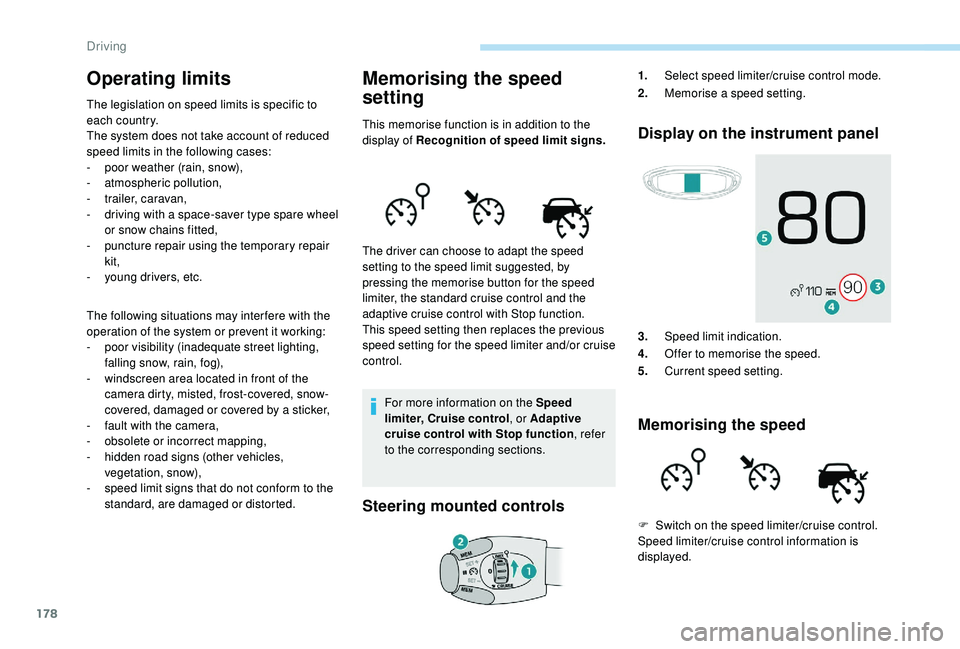
Steering mounted controls Display on the instrument panel
3.
Speed limit indication.
4. Offer to memorise the speed.
5. Current speed setting.
Memorising the speed
The driver can choose to adapt the speed
setting to the speed limit suggested, by
pressing the memorise button for the speed
limiter, the standard cruise control and the
adaptive cruise control with Stop function.
This speed setting then replaces the previous
speed setting for the speed limiter and/or cruise
control. 1.
Select speed limiter/cruise control mode.
2. Memorise a
speed setting.
F
S
witch on the speed limiter/cruise control.
Speed limiter/cruise control information is
displayed.
Driving
Page 194 of 364
192
The camera may be disrupted or not work
in the following situations:
-
p
oor visibility (inadequate street
lighting, falling snow, heavy rain, dense
f o g , e t c .),
-
d
azzle (headlamps of an oncoming
vehicle, low sun, reflections on a
damp
road, leaving a
tunnel, alternating
shade and light, etc.),
-
c
amera or radar obstructed (mud, frost,
snow, condensation, etc.).
In these situations, detection performance
may be reduced. The system is not intended for the
following situations:
-
i
f the front end of the vehicle has
been modified (addition of long-range
headlamps, painting of the front
bumper),
-
d
riving on a racing circuit,
-
r
unning on a rolling road,
-
u
se of snow chains, non-slip covers or
studded tyres.
The use of mats not approved by
PEUGEOT may inter fere with the
operation of the cruise control.
To avoid any risk of jamming of the pedals:
-
e
nsure that the mat is secured
c o r r e c t l y,
-
d
o not fit one mat on top of another.
Operation of the radar, located in the
front bumper, may be impaired by the
accumulation of dirt (dust, mud, etc.) or in
certain weather conditions (snow, frost,
e t c .) .
Clean the front bumper regularly.
Clean the windscreen regularly,
particularly the area in front of the
detection camera.
Do not allow snow to accumulate on the
bonnet or roof of the vehicle, as this could
obscure the camera.
Operating fault
In the event of a fault with the cruise
c ontrol, you are alerted by the
illumination of this warning lamp
and the display of a
message in the
instrument panel, accompanied by
an audible signal.
Have the system checked by a
PEUGEOT
dealer or a
qualified workshop.
Distance Alert and Active
Safety Brake
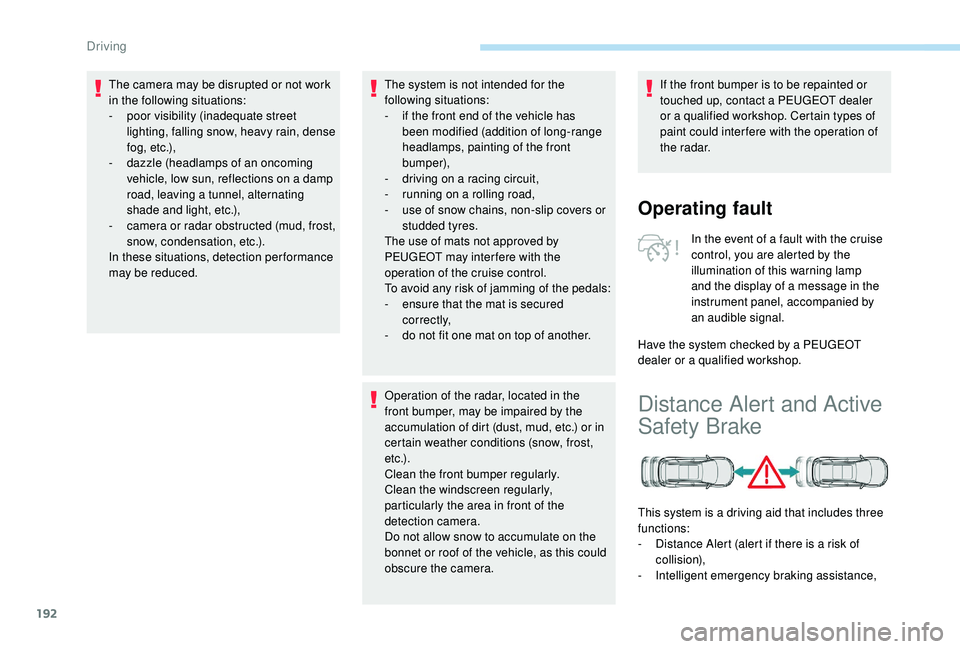
This system is a driving aid that includes three
f unctions:
-
D
istance Alert (alert if there is a risk of
collision),
-
I
ntelligent emergency braking assistance,If the front bumper is to be repainted or
touched up, contact a
PEUGEOT dealer
or a qualified workshop. Certain types of
paint could inter fere with the operation of
the radar.
Driving
Page 222 of 364
220
Fuel
Fuel tank capacity: approximately 56 litres.
R eser ve level: 6 litres.
Low fuel level
If your vehicle is fitted with Stop & Start,
never refuel with the engine in STOP
mode; you must switch off the ignition
using the key, or the START/STOP button
if your vehicle has
K
eyless Entry and
Starting.
Refuelling
If you have put in the wrong fuel for your
vehicle, you must have the fuel tank
drained and filled with the correct fuel
before starting the engine.
When the low fuel level is reached
in the fuel tank, this warning lamp
comes on in the instrument panel,
accompanied by the display of
a
message and an audible signal.
When it first comes on, about
6
litres of fuel is left in the tank.
Until sufficient fuel is added, this warning lamp
appears every time the ignition is switched on,
accompanied by the display of a
message and
an audible signal. When driving, this message
and audible signal are repeated with increasing
frequency as the fuel level drops towards 0 .
Refuel as soon as possible to avoid running out
of fuel.
For more information on Running out of fuel
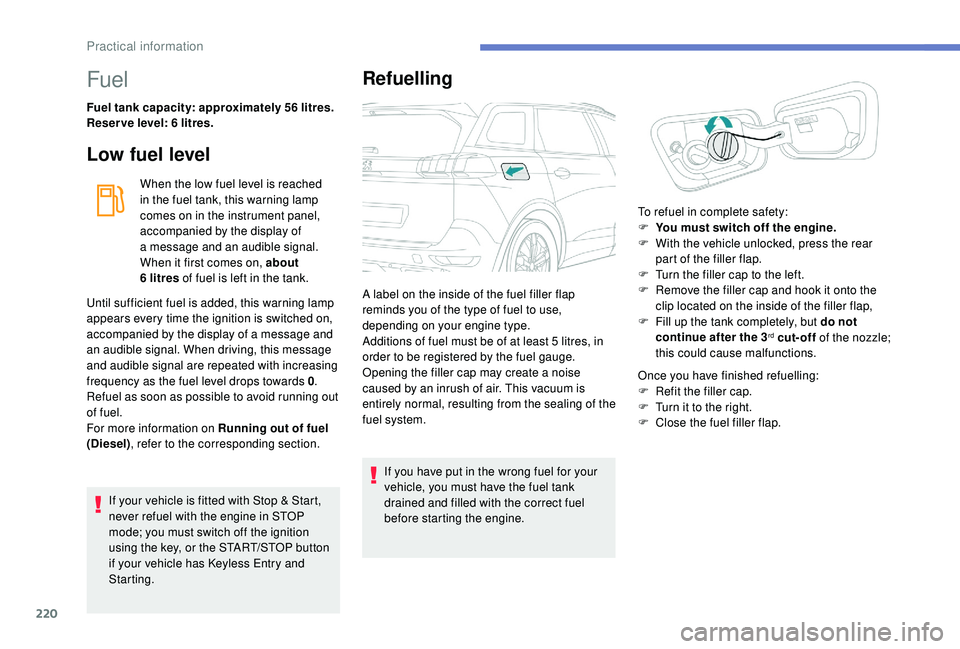
(Diesel) , refer to the corresponding section. A label on the inside of the fuel filler flap
reminds you of the type of fuel to use,
depending on your engine type.
Additions of fuel must be of at least 5
litres, in
order to be registered by the fuel gauge.
Opening the filler cap may create a noise
caused by an inrush of air. This vacuum is
entirely normal, resulting from the sealing of the
fuel system. Once you have finished refuelling:
F
R
efit the filler cap.
F
T
urn it to the right.
F
C
lose the fuel filler flap.
To refuel in complete safety:
F
Y
ou must switch off the engine.
F
W
ith the vehicle unlocked, press the rear
part of the filler flap.
F
T
urn the filler cap to the left.
F
R
emove the filler cap and hook it onto the
clip located on the inside of the filler flap,
F
F
ill up the tank completely, but do not
continue after the 3
rd cut-off of the nozzle;
this could cause malfunctions.
Practical information