wheel Peugeot 508 RXH 2014 Owner's Guide
[x] Cancel search | Manufacturer: PEUGEOT, Model Year: 2014, Model line: 508 RXH, Model: Peugeot 508 RXH 2014Pages: 338, PDF Size: 10.81 MB
Page 98 of 338
96
508RXH_en_Chap03_confort_ed01-2014
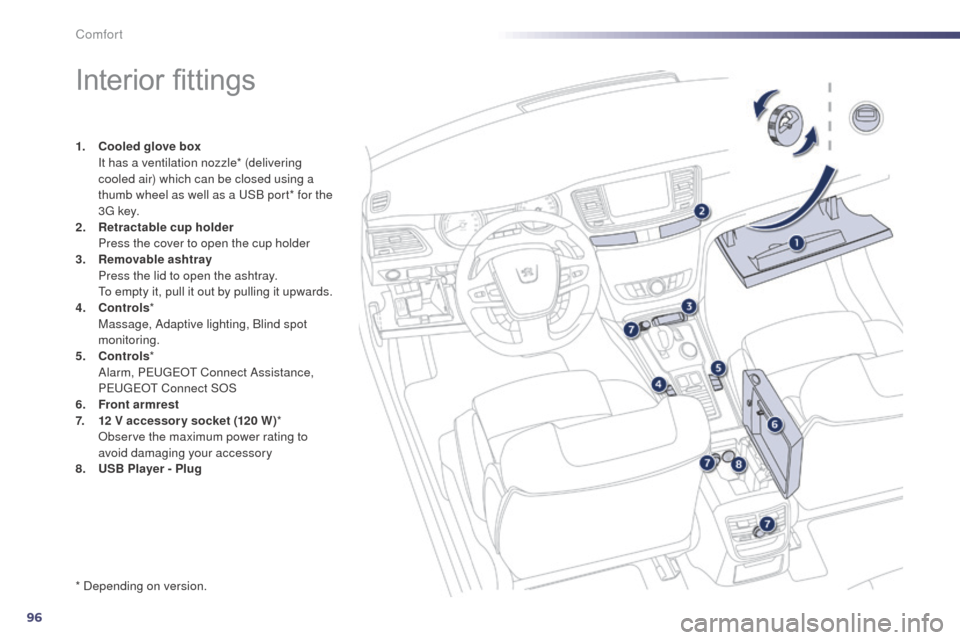
Interior fittings
1. Cooled glove box I
t has a ventilation nozzle* (delivering
cooled air) which can be closed using a
thumb wheel as well as a
u
S
B port* for the
3
g k
ey.
2.
R
etractable cup holder
P
ress the cover to open the cup holder
3.
Re
movable ashtray
P
ress the lid to open the ashtray.
t
o e
mpty it, pull it out by pulling it upwards.
4.
C
ontrols *
M
assage, Adaptive lighting, Blind spot
monitoring.
5.
C
ontrols *
Alarm, Peuge
O
t Connect Assistance,
Peuge
O
t Connect SOS
6.
F
ront armrest
7.
1
2 V accessor y socket (120 W) *
O
bserve the maximum power rating to
avoid damaging your accessory
8.
U
SB Player - Plug
* Depending on version.
Comfort
Page 101 of 338
99
508RXH_en_Chap03_confort_ed01-2014
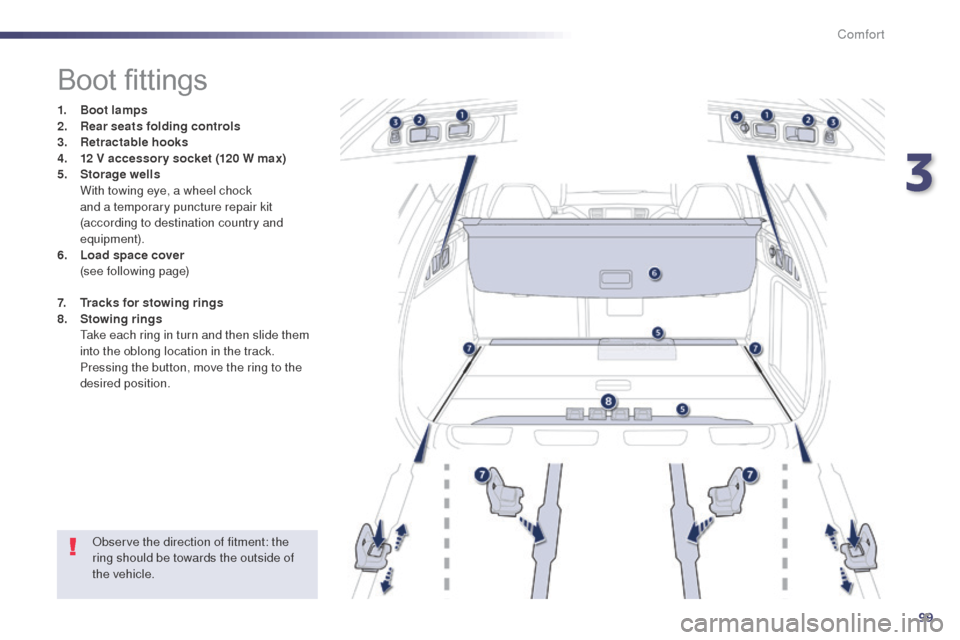
Boot fittings
1. Boot lamps
2. Rear seats folding controls
3.
R
etractable hooks
4.
1
2 V accessor y socket (120 W max)
5.
Sto
rage wells
W
ith towing eye, a wheel chock
and a temporary puncture repair kit
(according to destination country and
equipment).
6.
L
oad space cover
(
see following page)
7.
T
r a c k s for stowing rings
8.
S
towing rings
t
a
ke each ring in turn and then slide them
into the oblong location in the track.
P
ressing the button, move the ring to the
desired position.
Observe the direction of fitment: the
ring should be towards the outside of
the vehicle.
3
Comfort
Page 117 of 338
115
508RXH_en_Chap03_confort_ed01-2014
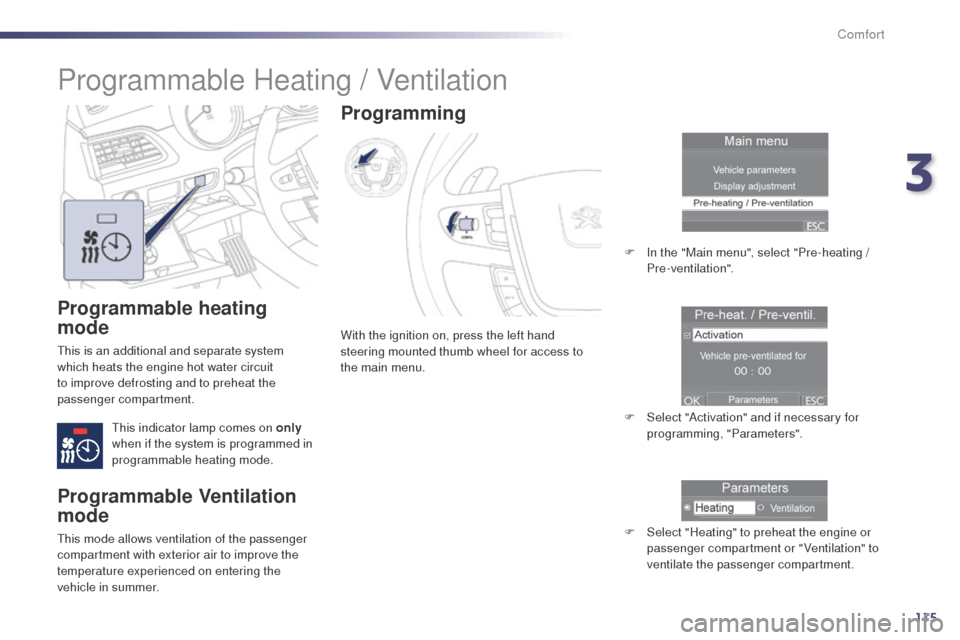
Programmable heating
mode
this is an additional and separate system
which heats the engine hot water circuit
to improve defrosting and to preheat the
passenger compartment.
th
is indicator lamp comes on only
when if the system is programmed in
programmable heating mode. With the ignition on, press the left hand
steering mounted thumb wheel for access to
the main menu.
Programming
F In the "Main menu", select "Pre-heating
/
Pre-ventilation".
F
S
elect "Activation" and if necessary for
programming, "Parameters".
F
S
elect "Heating" to preheat the engine or
passenger compartment or "Ventilation" to
ventilate the passenger compartment.
Programmable Heating / Ventilation
Programmable Ventilation
mode
this mode allows ventilation of the passenger
compartment with exterior air to improve the
temperature experienced on entering the
vehicle in summer.
3
Comfort
Page 120 of 338
118
508RXH_en_Chap04_conduite_ed01-2014
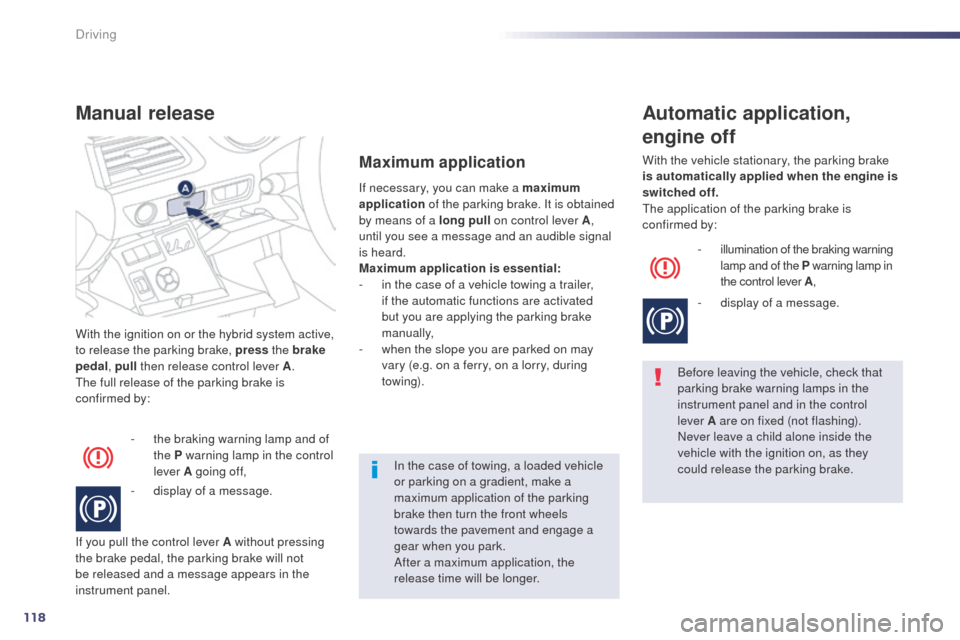
With the ignition on or the hybrid system active,
to release the parking brake, press the brake
pedal , pull then release control lever A .
th
e full release of the parking brake is
confirmed by:
Manual release
- the braking warning lamp and of the P warning lamp in the control
lever A going of f,
-
d
isplay of a message.
If you pull the control lever A without pressing
the brake pedal, the parking brake will not
be released and a message appears in the
instrument panel. If necessary, you can make a maximum
application
of the parking brake. It is obtained
by means of a long pull on control lever A,
until you see a message and an audible signal
is heard.
Maximum application is essential:
-
i
n the case of a vehicle towing a trailer,
if the automatic functions are activated
but you are applying the parking brake
manually,
-
w
hen the slope you are parked on may
vary (e.g. on a ferry, on a lorry, during
towing).
Maximum application
Before leaving the vehicle, check that
parking brake warning lamps in the
instrument panel and in the control
lever
A are on fixed (not flashing).
Never leave a child alone inside the
vehicle with the ignition on, as they
could release the parking brake.
Automatic application,
engine off
- illumination of the braking warning lamp and of the P warning lamp in
the control lever A ,
-
d
isplay of a message.
With the vehicle stationary, the parking brake
is automatically applied when the engine is
switched off.
th
e application of the parking brake is
confirmed by:
In the case of towing, a loaded vehicle
or parking on a gradient, make a
maximum application of the parking
brake then turn the front wheels
towards the pavement and engage a
gear when you park.
After a maximum application, the
release time will be longer.
Driving
Page 122 of 338
120
508RXH_en_Chap04_conduite_ed01-2014
Emergency braking
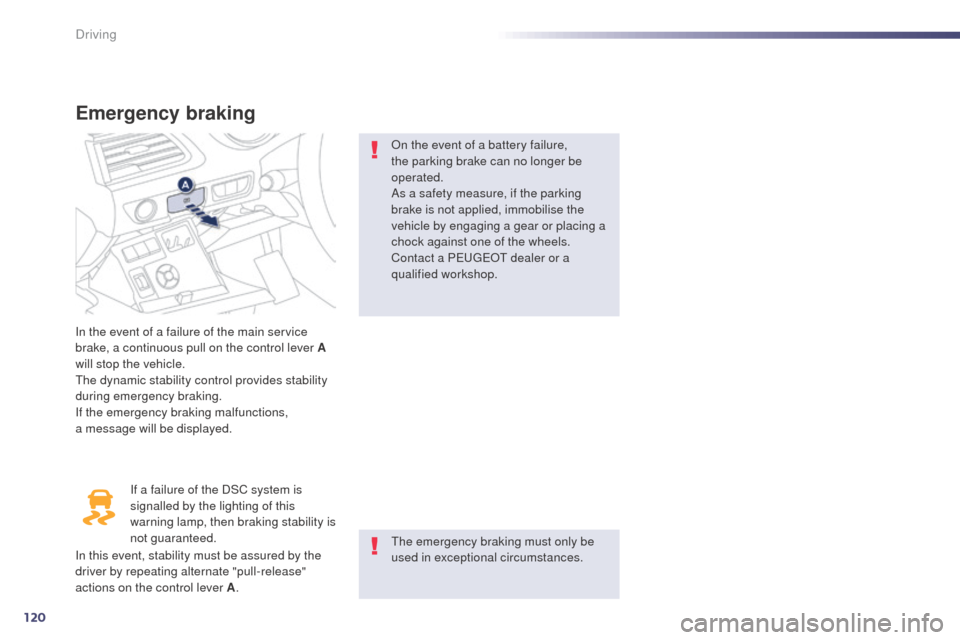
In the event of a failure of the main service
brake, a continuous pull on the control lever A
will stop the vehicle.
th
e dynamic stability control provides stability
during emergency braking.
If the emergency braking malfunctions,
a
message will be displayed. If a failure of the DSC system is
signalled by the lighting of this
warning lamp, then braking stability is
not guaranteed.
th
e emergency braking must only be
used in exceptional circumstances.
In this event, stability must be assured by the
driver by repeating alternate "pull-release"
actions on the control lever A
.On the event of a battery failure,
the parking brake can no longer be
operated.
As a safety measure, if the parking
brake is not applied, immobilise the
vehicle by engaging a gear or placing a
chock against one of the wheels.
Contact a P
e
uge
Ot
dealer or a
qualified workshop.
Driving
Page 124 of 338
122
508RXH_en_Chap04_conduite_ed01-2014
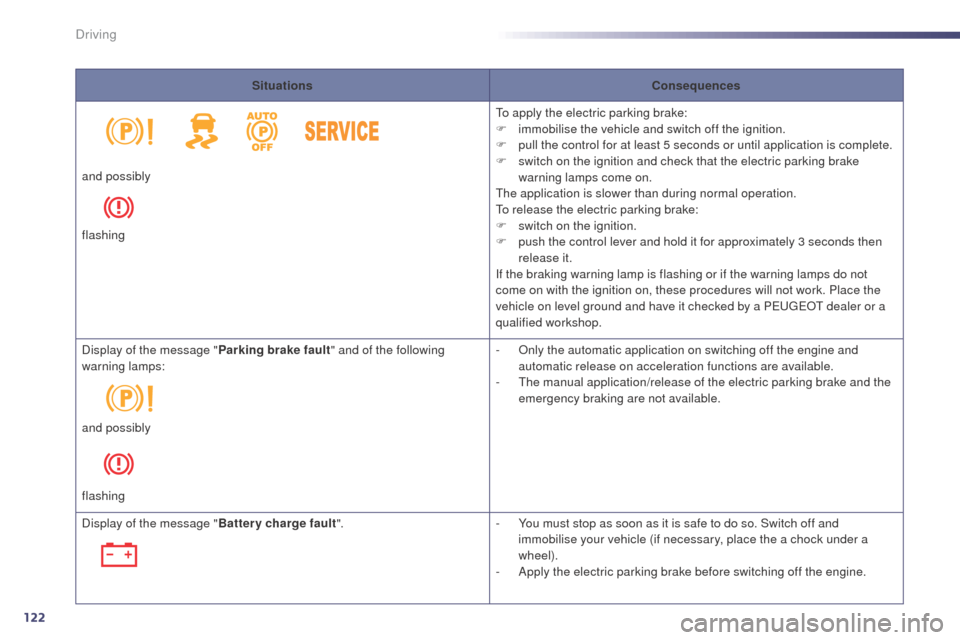
SituationsConsequences
to a
pply the electric parking brake:
F
i
mmobilise the vehicle and switch off the ignition.
F
p
ull the control for at least 5 seconds or until application is complete.
F
s
witch on the ignition and check that the electric parking brake
warning lamps come on.
th
e application is slower than during normal operation.
to r
elease the electric parking brake:
F
s
witch on the ignition.
F
p
ush the control lever and hold it for approximately 3 seconds then
release it.
If the braking warning lamp is flashing or if the warning lamps do not
come on with the ignition on, these procedures will not work. Place the
vehicle on level ground and have it checked by a P
e
uge
Ot
dealer or a
qualified workshop.
and possibly
flashing
Display of the message "
Parking brake fault" and of the following
warning lamps: -
O
nly the automatic application on switching off the engine and
automatic release on acceleration functions are available.
-
t
h
e manual application/release of the electric parking brake and the
emergency braking are not available.
and possibly
flashing
Display of the message " Battery charge fault". -
Y
ou must stop as soon as it is safe to do so. Switch off and
immobilise your vehicle (if necessary, place the a chock under a
wheel).
-
A
pply the electric parking brake before switching off the engine.
Driving
Page 126 of 338
124
508RXH_en_Chap04_conduite_ed01-2014
electronic gearbox
Six-speed electronic gearbox which offers a
choice between the comfort of fully automatic
operation or the pleasure of manual gear
changing.
th
ere are two driving modes:
-
a
utomated mode for automatic control of
the gears by the gearbox,
-
m
anual mode for sequential gear changing
by the driver.
In automated mode, it remains possible to
change gear manually by using the steering
mounted control paddles as desired, when
overtaking, for example.
th
is gearbox provides additional functions:
-
h
ill start assist,
-
c
reep function (the vehicle moves on
its own on releasing the brake pedal) in
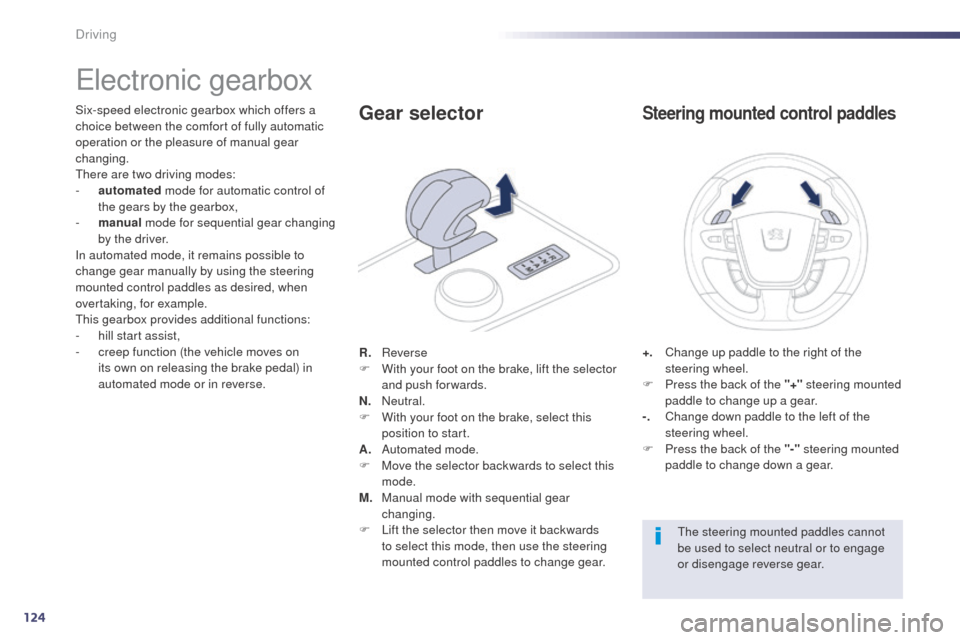
automated mode or in reverse. R.
R
everse
F
W
ith your foot on the brake, lift the selector
and push forwards.
N.
N
eutral.
F
W
ith your foot on the brake, select this
position to start.
A.
A
utomated mode.
F
M
ove the selector backwards to select this
mode.
M.
M
anual mode with sequential gear
changing.
F
L
ift the selector then move it backwards
to select this mode, then use the steering
mounted control paddles to change gear.Gear selector
+. Change up paddle to the right of the steering wheel.
F
P
ress the back of the "+" steering mounted
paddle to change up a gear.
-.
C
hange down paddle to the left of the
steering wheel.
F
P
ress the back of the "-" steering mounted
paddle to change down a gear.
Steering mounted control paddles
the steering mounted paddles cannot
be used to select neutral or to engage
or disengage reverse gear.
Driving
Page 153 of 338
151
508RXH_en_Chap05_visibilite_ed01-2014
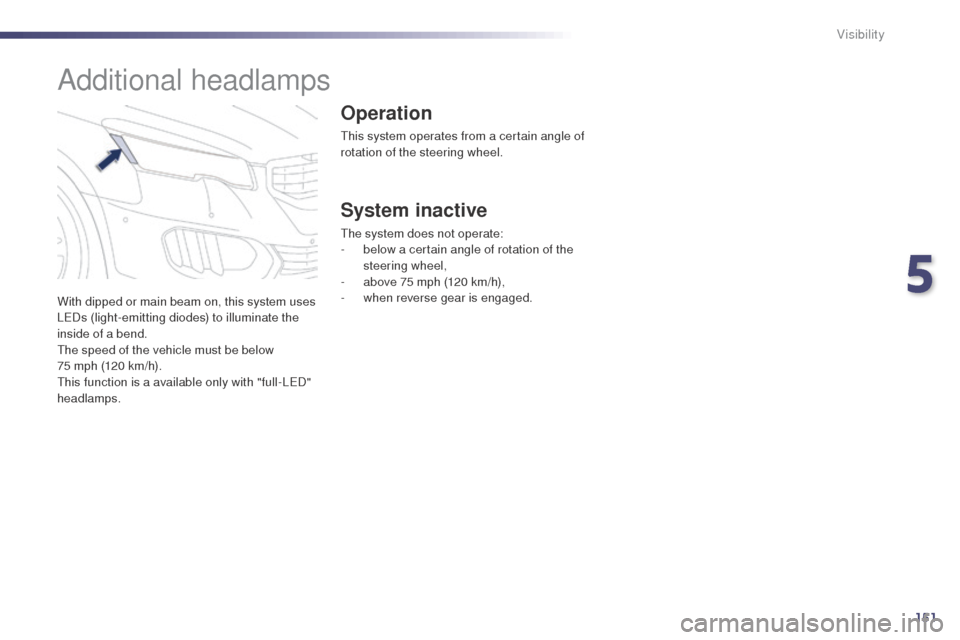
With dipped or main beam on, this system uses
LeDs (light-emitting diodes) to illuminate the
inside of a bend.
th
e speed of the vehicle must be below
75 mph (120 km/h).
th
is function is a available only with "full-L
eD
"
headlamps.
Additional headlamps
Operation
this system operates from a certain angle of
rotation of the steering wheel.
System inactive
the system does not operate:
- b elow a certain angle of rotation of the
steering wheel,
-
a
bove 75 mph (120 km/h),
-
w
hen reverse gear is engaged.
5
Visibility
Page 175 of 338
173
508RXH_en_Chap07_securite_ed01-2014
Horn
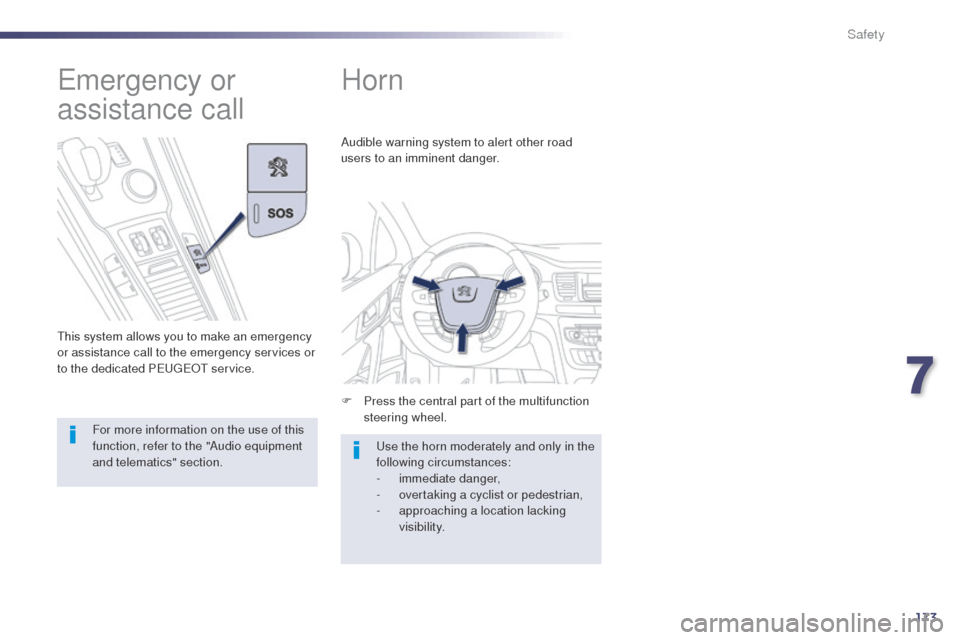
F Press the central part of the multifunction steering wheel.
Audible warning system to alert other road
users to an imminent danger.
us
e the horn moderately and only in the
following circumstances:
-
i
mmediate danger,
-
ov
ertaking a cyclist or pedestrian,
-
a
pproaching a location lacking
visibility.
emergency or
assistance call
this system allows you to make an emergency
or assistance call to the emergency services or
to the dedicated P
e
uge
Ot
service.
For more information on the use of this
function, refer to the "Audio equipment
and telematics" section.
7
Safety
Page 177 of 338
175
508RXH_en_Chap07_securite_ed01-2014
Tyre under-inflation detection
System which automatically checks the pressures of the tyres while driving.the system continuously monitors the pressures of the four tyres, as soon as the vehicle is moving.
th
e tyre under-inflation detection
system is an aid to driving which does
not replace the need for the driver to be
vigilant or to drive responsibly.
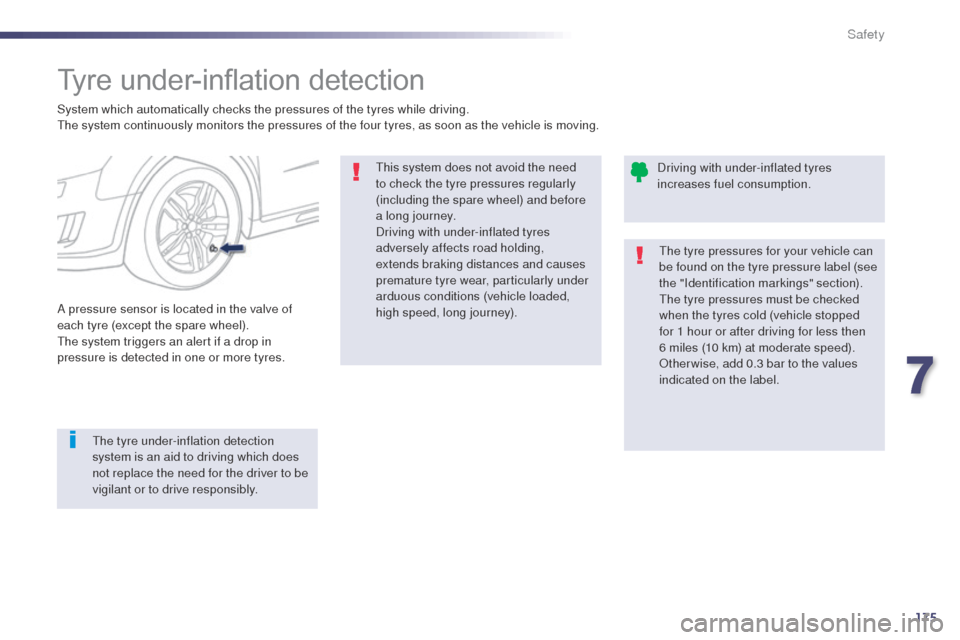
A pressure sensor is located in the valve of
each tyre (except the spare wheel).
th
e system triggers an alert if a drop in
pressure is detected in one or more tyres.
th
is system does not avoid the need
to check the tyre pressures regularly
(including the spare wheel) and before
a long journey.
Driving with under-inflated tyres
adversely affects road holding,
extends braking distances and causes
premature tyre wear, particularly under
arduous conditions (vehicle loaded,
high speed, long journey). Driving with under-inflated tyres
increases fuel consumption.
th
e tyre pressures for your vehicle can
be found on the tyre pressure label (see
the "Identification markings" section).
th
e tyre pressures must be checked
when the tyres cold (vehicle stopped
for 1 hour or after driving for less then
6 miles (10 km) at moderate speed).
Other wise, add 0.3 bar to the values
indicated on the label.
7
Safety