lock Peugeot Bipper 2015 User Guide
[x] Cancel search | Manufacturer: PEUGEOT, Model Year: 2015, Model line: Bipper, Model: Peugeot Bipper 2015Pages: 192, PDF Size: 7.97 MB
Page 42 of 192
40
Bipper_en_Chap03_pret-a-partir_ed02-2014
ALARM
this provides:
-
exterior perimeter protection by means of
detectors on the doors and bonnet and
on the electrical supply,
-
interior protection,
-
anti-tilt protection,
-
protection against the unauthorised
insertion of a key in the starter.
t
he equipment includes a siren.
Activation of the alarm
First ensure that all of the accesses are
closed correctly.
t
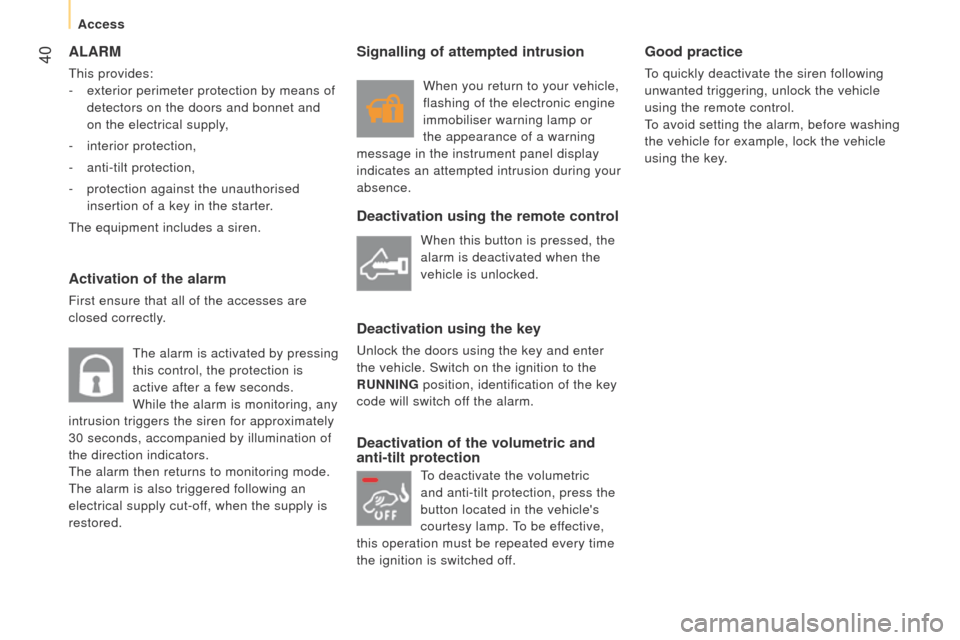
he alarm is activated by pressing
this control, the protection is
active after a few seconds.
While the alarm is monitoring, any
intrusion triggers the siren for approximately
30 seconds, accompanied by illumination of
the direction indicators.
t
he alarm then returns to monitoring mode.
t
he alarm is also triggered following an
electrical supply cut-off, when the supply is
restored.
Deactivation using the remote control
Deactivation using the key
unlock the doors using the key and enter
the vehicle. Switch on the ignition to the
RUNNING position, identification of the key
code will switch off the alarm.
Deactivation of the volumetric and
anti-tilt protection Good practice
to quickly deactivate the siren following
unwanted triggering, unlock the vehicle
using the remote control.
to avoid setting the alarm, before washing
the vehicle for example, lock the vehicle
using the key.
When this button is pressed, the
alarm is deactivated when the
vehicle is unlocked.
Signalling of attempted intrusion
When you return to your vehicle,
flashing of the electronic engine
immobiliser warning lamp or
the appearance of a warning
message in the instrument panel display
indicates an attempted intrusion during your
absence.
to deactivate the volumetric
and anti-tilt protection, press the
button located in the vehicle's
courtesy lamp.
to be ef
fective,
this operation must be repeated every time
the ignition is switched off.
Access
Page 43 of 192
41
Bipper_en_Chap03_pret-a-partir_ed02-2014
OPENING FROM THE OUTSIDE
Driver's door
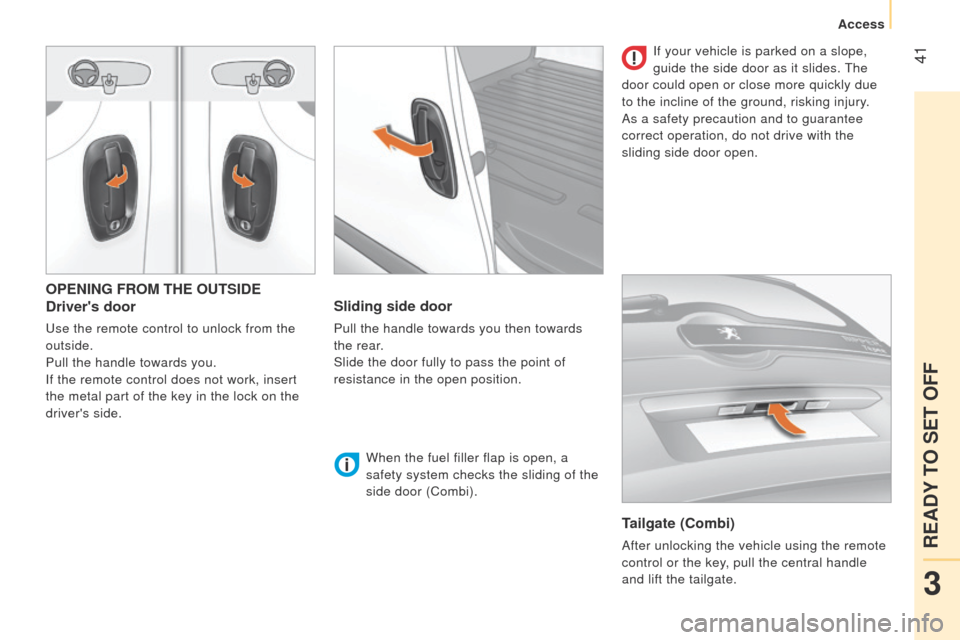
use the remote control to unlock from the
outside.
Pull the handle towards you.
If the remote control does not work, insert
the metal part of the key in the lock on the
driver's side.
Sliding side door
Pull the handle towards you then towards
the rear.
Slide the door fully to pass the point of
resistance in the open position.
When the fuel filler flap is open, a
safety system checks the sliding of the
side door (Combi).
Tailgate (Combi)
After unlocking the vehicle using the remote
control or the key, pull the central handle
and lift the tailgate.If your vehicle is parked on a slope,
guide the side door as it slides.
t
he
door could open or close more quickly due
to the incline of the ground, risking injury.
As a safety precaution and to guarantee
correct operation, do not drive with the
sliding side door open.
3
READY TO SET OFF
Access
Page 44 of 192
42
Bipper_en_Chap03_pret-a-partir_ed02-2014
OPENING FROM THE INSIDEDriver's door
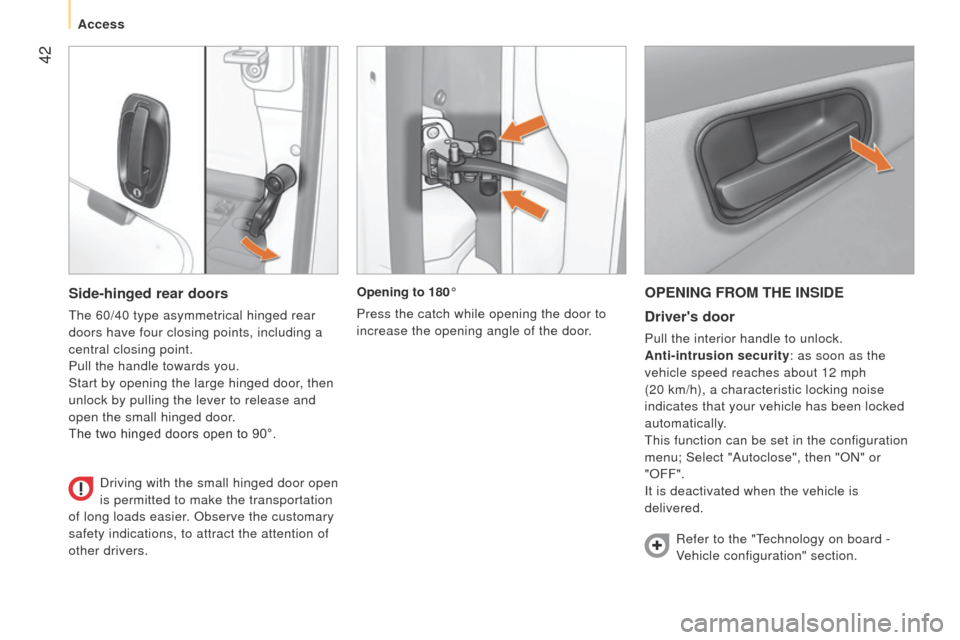
Pull the interior handle to unlock.
Anti-intrusion security: as soon as the
vehicle speed reaches about 12 mph
(20 km/h), a characteristic locking noise
indicates that your vehicle has been locked
automatically.
t
his function can be set in the configuration
menu; Select "Autoclose", then "ON" or
"OFF".
It is deactivated when the vehicle is
delivered.
Opening to 180°
Press the catch while opening the door to
increase the opening angle of the door.
Side-hinged rear doors
the 60/40 type asymmetrical hinged rear
doors have four closing points, including a
central closing point.
Pull the handle towards you.
Start by opening the large hinged door, then
unlock by pulling the lever to release and
open the small hinged door.
The two hinged doors open to 90°.
Driving with the small hinged door open
is permitted to make the transportation
of long loads easier. Observe the customary
safety indications, to attract the attention of
other drivers. Refer to the "
t
echnology on board -
Vehicle configuration" section.
Access
Page 45 of 192
43
Bipper_en_Chap03_pret-a-partir_ed02-2014
Good practice
When opening, take care not to obstruct the
guide space on the floor to allow the door to
slide correctly.
Do not block traffic.Load space
Sliding side door (Combi)
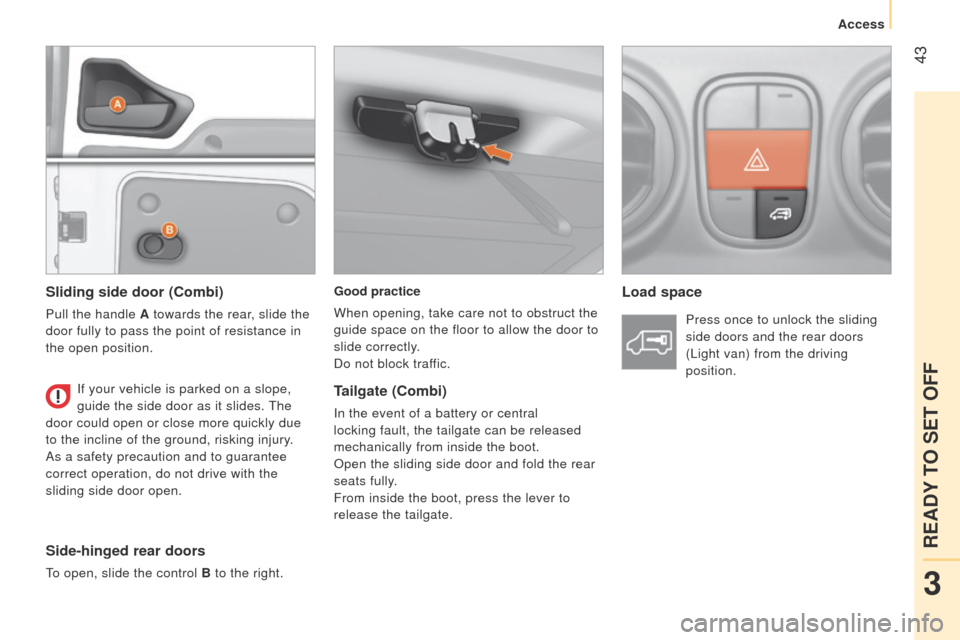
Pull the handle A towards the rear, slide the
door fully to pass the point of resistance in
the open position.
Side-hinged rear doors
to open, slide the control B to the right.
If your vehicle is parked on a slope,
guide the side door as it slides.
t
he
door could open or close more quickly due
to the incline of the ground, risking injury.
As a safety precaution and to guarantee
correct operation, do not drive with the
sliding side door open. Press once to unlock the sliding
side doors and the rear doors
( l ight van) from the driving
position.
Tailgate (Combi)
In the event of a battery or central
locking fault, the tailgate can be released
mechanically from inside the boot.
Open the sliding side door and fold the rear
seats fully.
From inside the boot, press the lever to
release the tailgate.
3
READY TO SET OFF
Access
Page 46 of 192
44
Bipper_en_Chap03_pret-a-partir_ed02-2014
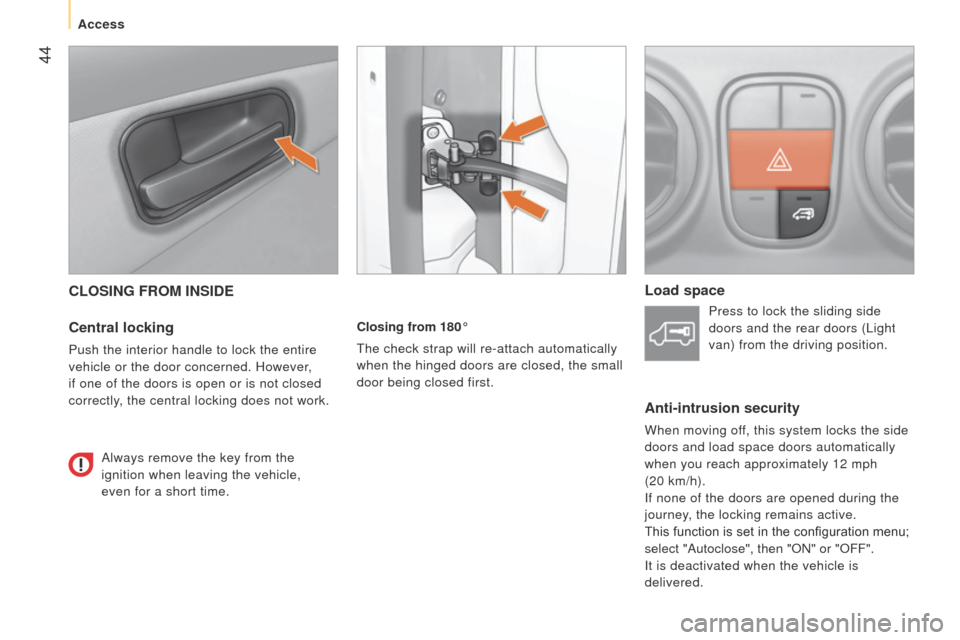
CLOSING FROM INSIDE
Central locking
Push the interior handle to lock the entire
vehicle or the door concerned. However,
if one of the doors is open or is not closed
correctly, the central locking does not work.Always remove the key from the
ignition when leaving the vehicle,
even for a short time. Closing from 180°t
he check strap will re-attach automatically
when the hinged doors are closed, the small
door being closed first.
Load space
Press to lock the sliding side
doors and the rear doors ( l ight
van) from the driving position.
Anti-intrusion security
When moving off, this system locks the side
doors and load space doors automatically
when you reach approximately 12 mph
(20
km/h).
If none of the doors are opened during the
journey, the locking remains active.
This function is set in the configuration menu;
select "Autoclose", then "ON" or "OFF".
It is deactivated when the vehicle is
delivered.
Access
Page 54 of 192
52
Bipper_en_Chap03_pret-a-partir_ed02-2014
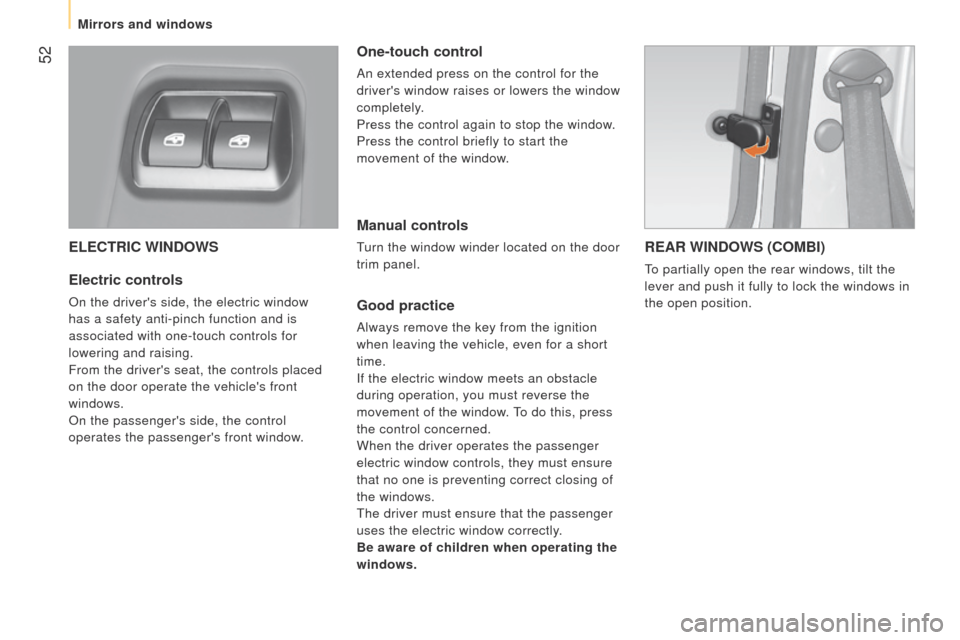
ELECTRIC WINDOWS
Electric controls
On the driver's side, the electric window
has a safety anti-pinch function and is
associated with one-touch controls for
lowering and raising.
From the driver's seat, the controls placed
on the door operate the vehicle's front
windows.
On the passenger's side, the control
operates the passenger's front window.
One-touch control
An extended press on the control for the
driver's window raises or lowers the window
completely.
Press the control again to stop the window.
Press the control briefly to start the
movement of the window.
Manual controls
turn the window winder located on the door
trim panel.
Good practice
Always remove the key from the ignition
when leaving the vehicle, even for a short
time.
If the electric window meets an obstacle
during operation, you must reverse the
movement of the window.
to do this, press
the control concerned.
When the driver operates the passenger
electric window controls, they must ensure
that no one is preventing correct closing of
the windows.
t
he driver must ensure that the passenger
uses the electric window correctly.
Be aware of children when operating the
windows.
REAR WINDOWS (COMBI)
to partially open the rear windows, tilt the
lever and push it fully to lock the windows in
the open position.
Mirrors and windows
Page 55 of 192
53
Bipper_en_Chap03_pret-a-partir_ed02-2014
Good practice
to change gear smoothly
, always press the
clutch pedal fully down.
to prevent the mat from becoming caught under the pedal:
- ensure that the mat is positioned correctly ,
-
never fit one mat on top of another
.
Avoid leaving your hand on the gear knob as
the force exerted, even if slight, may cause
wear of the internal components of the
gearbox over time.
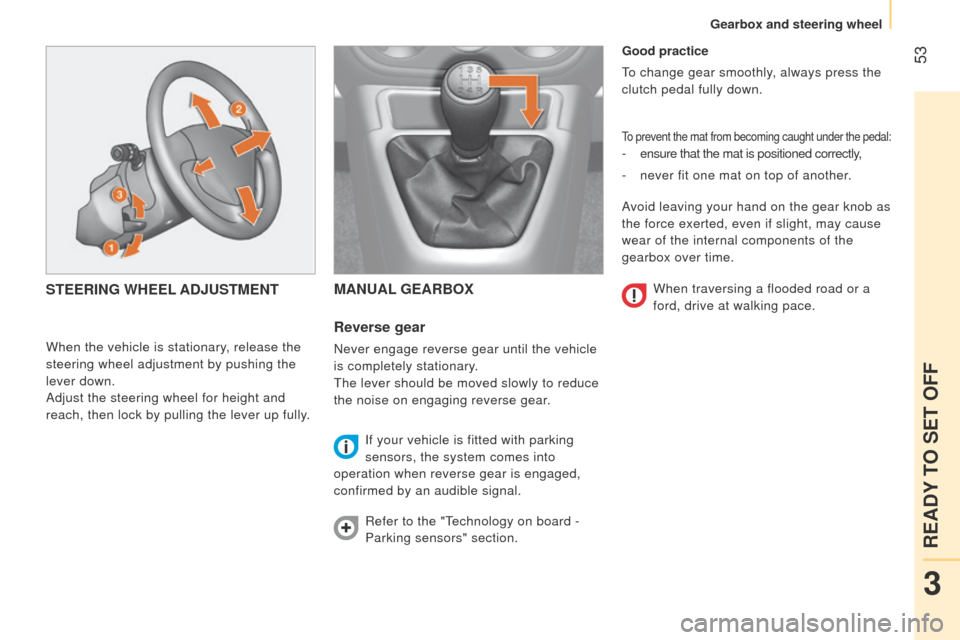
MANUAL GEARBOX
Reverse
gear
Never engage reverse gear until the vehicle
is completely stationary.
t
he lever should be moved slowly to reduce
the noise on engaging reverse gear.
If your vehicle is fitted with parking
sensors, the system comes into
operation when reverse gear is engaged,
confirmed by an audible signal.
Refer to the "
t
echnology on board -
Parking sensors" section.
STEERING WHEEL ADJUSTMENT
When the vehicle is stationary, release the
steering wheel adjustment by pushing the
lever down.
Adjust the steering wheel for height and
reach, then lock by pulling the lever up fully. When traversing a flooded road or a
ford, drive at walking pace.
3
READY TO SET OFF
Gearbox and steering wheel
Page 61 of 192
59
Bipper_en_Chap03_pret-a-partir_ed02-2014
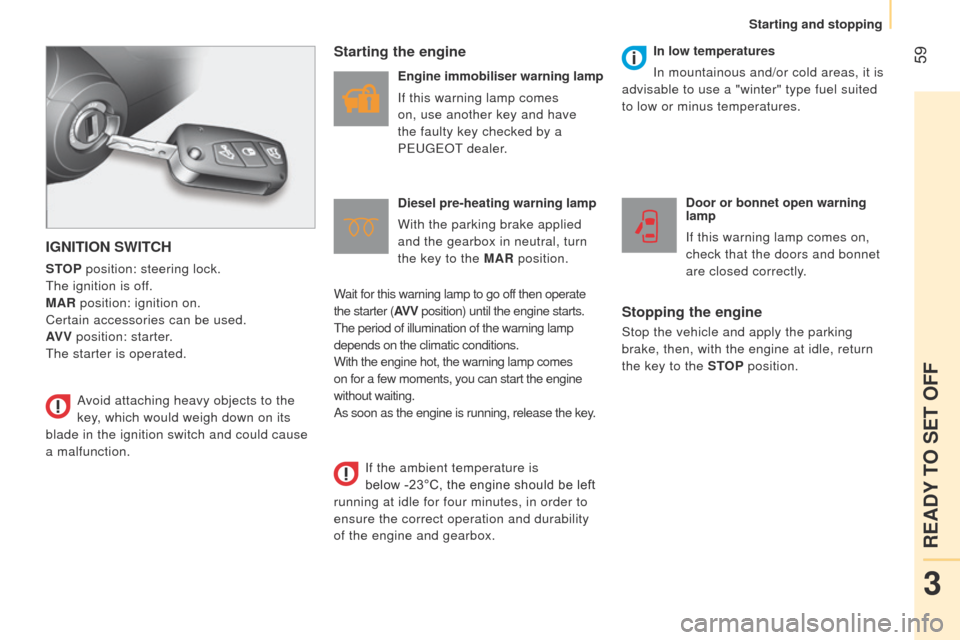
IGNITION SWITCH
STOP position: steering lock.
t
he ignition is off.
MAR position: ignition on.
Certain accessories can be used.
AV V position: starter.
t
he starter is operated.
Starting the engine
Engine immobiliser warning lamp
If this warning lamp comes
on, use another key and have
the faulty key checked by a
P euge O t
dealer
.
Diesel pre-heating warning lamp
With the parking brake applied
and the gearbox in neutral, turn
the key to the MAR position. Door or bonnet open warning
lamp
If this warning lamp comes on,
check that the doors and bonnet
are closed correctly.
Stopping the engine
Stop the vehicle and apply the parking
brake, then, with the engine at idle, return
the key to the STOP position.
Avoid attaching heavy objects to the
key, which would weigh down on its
blade in the ignition switch and could cause
a malfunction. In low temperatures
In mountainous and/or cold areas, it is
advisable to use a "winter" type fuel suited
to low or minus temperatures.
Wait for this warning lamp to go off then operate
the starter (AV V position) until the engine starts.t
he period of illumination of the warning lamp
depends on the climatic conditions.
With the engine hot, the warning lamp comes
on for a few moments, you can start the engine
without waiting.
As soon as the engine is running, release the key.
If the ambient temperature is
below
-23°C, the engine should be left
running at idle for four minutes, in order to
ensure the correct operation and durability
of the engine and gearbox.
3
READY TO SET OFF
Starting and stopping
Page 68 of 192
66
Bipper_en_Chap04_ergonomie_ed02-2014
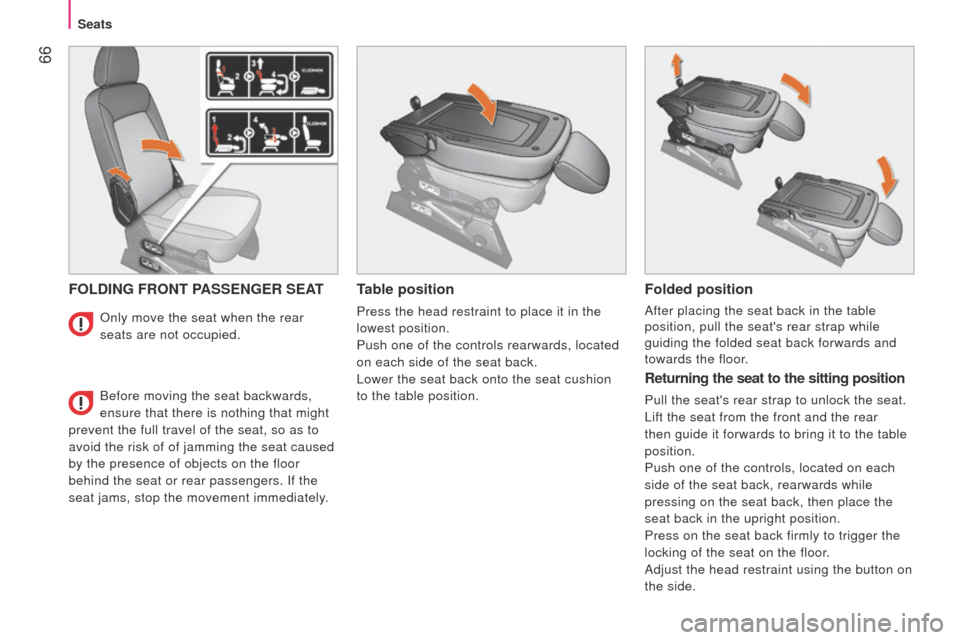
FOLDING FRONT PASSENGER SEATTable position
Press the head restraint to place it in the
lowest position.
Push one of the controls rearwards, located
on each side of the seat back.
l
ower the seat back onto the seat cushion
to the table position.
Folded position
After placing the seat back in the table
position, pull the seat's rear strap while
guiding the folded seat back forwards and
towards the floor.
Returning the seat to the sitting position
Pull the seat's rear strap to unlock the seat.
l
ift the seat from the front and the rear
then guide it forwards to bring it to the table
position.
Push one of the controls, located on each
side of the seat back, rearwards while
pressing on the seat back, then place the
seat back in the upright position.
Press on the seat back firmly to trigger the
locking of the seat on the floor.
Adjust the head restraint using the button on
the side.
Only move the seat when the rear
seats are not occupied.
Before moving the seat backwards,
ensure that there is nothing that might
prevent the full travel of the seat, so as to
avoid the risk of of jamming the seat caused
by the presence of objects on the floor
behind the seat or rear passengers. If the
seat jams, stop the movement immediately.
Seats
Page 69 of 192
67
Bipper_en_Chap04_ergonomie_ed02-2014
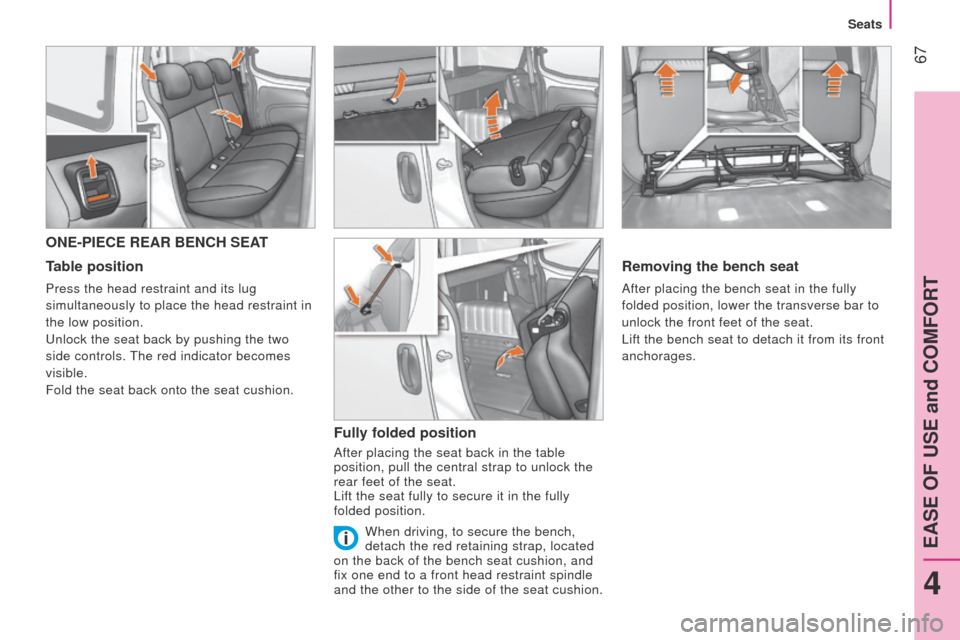
ONE-PIECE REAR BENCH SEAT
Table position
Press the head restraint and its lug
simultaneously to place the head restraint in
the low position.
u
nlock the seat back by pushing the two
side controls.
t
he red indicator becomes
visible.
Fold the seat back onto the seat cushion.
Fully folded position
After placing the seat back in the table
position, pull the central strap to unlock the
rear feet of the seat.
l
ift the seat fully to secure it in the fully
folded position.
Removing the bench seat
After placing the bench seat in the fully
folded position, lower the transverse bar to
unlock the front feet of the seat.
l
ift the bench seat to detach it from its front
anchorages.
When driving, to secure the bench,
detach the red retaining strap, located
on the back of the bench seat cushion, and
fix one end to a front head restraint spindle
and the other to the side of the seat cushion.
4
EASE OF USE and COMFORT
Seats