check engine PEUGEOT PARTNER TEPEE ELECTRIC 2017 User Guide
[x] Cancel search | Manufacturer: PEUGEOT, Model Year: 2017, Model line: PARTNER TEPEE ELECTRIC, Model: PEUGEOT PARTNER TEPEE ELECTRIC 2017Pages: 252, PDF Size: 9.89 MB
Page 107 of 252
69
Recommendations for ventilation and air conditioning
In order for these systems to be fully effective,
follow the operation and maintenance
guidelines below:
F
T
o ensure that the air is distributed evenly,
keep the external air intake grilles at the
base of the windscreen, the nozzles, the
vents, the air outlets and the air extractor
in the boot free from obstructions.
F
D
o not cover the sunshine sensor,
located on the dashboard; this is used for
regulation of the automatic air conditioning
system.
F
O
perate the air conditioning system for
at least 5 to 10
minutes once or twice a
month to keep it in per fect working order.
F
E
nsure that the passenger compartment
filter is in good condition and have the
filter elements replaced regularly. We
recommend the use of a combined
passenger compartment filter. Thanks to
its special active additive, it contributes
to the purification of the air breathed by
the occupants and the cleanliness of the
passenger compartment (reduction of
allergic symptoms, bad odours and greasy
deposits). If after an extended stop in sunshine, the
interior temperature is very high, first air
the passenger compartment for a few
moments.
Put the air flow control at a setting high
enough to quickly change the air in the
passenger compartment.
The condensation created by the air
conditioning results in a discharge of water
under the vehicle which is per fectly normal.
Depending on version and country
of sale, the air conditioning system
contains fluorinated greenhouse gas
R13 4A
.
Gas capacity: 0.450
kg (+/- 0.025 kg),
GWP index 1,430 t (equivalent CO
2:
0.6 4 4 t).
F
T
o ensure correct operation of the
air conditioning system, you are also
advised to have it checked regularly
as recommended in the Warranty and
Maintenance Record.
F
I
f the system does not produce cold air,
switch it off and contact a PEUGEOT
dealer or a qualified workshop.
When towing the maximum load on a steep
gradient in high temperatures, switching off
the air conditioning increases the available
engine power and so improves the towing
ability.
To avoid the windows misting up and
deterioration in the quality of the air:
-
d
o not drive for too long with the
ventilation switched off.
-
d
o not keep air recirculation set for an
extended period.
Stop & Star t
The heating and air conditioning systems
only work when the engine is running.
Temporarily deactivate the Stop &
Start system to maintain a comfortable
temperature in the passenger
compartment.
For more information on Stop & Star t,
refer to the corresponding section.
3
Ease of use and comfort
Page 118 of 252
80
Operation
The warning lamp flashes when the
ASR or ESC is triggered.
Deactivation
In exceptional conditions (moving a vehicle that
is bogged down in mud, stuck in snow, on loose
soil, etc.), it may prove useful to deactivate the
ASR and ESC systems, so that the wheels can
spin and regain grip.F
P
ress the button or turn the
knob to the ESC OFF position
(depending on version).
The LED lights up: the ASR and ESC systems
are deactivated.
They reactivate again:
-
a
utomatically above 31 mph (50 km/h),
If there is a difference between the path followed
by the vehicle and that required by the driver, the
ESC system automatically acts on the brake of
one or more wheels and on the engine to return
the vehicle to the required path.
- manually when you press the button again or turn the knob
to this position (depending on
ve r s i o n).
Operating fault
In the event of a malfunction of the
systems, the warning lamp and the
LED come on, accompanied by an
audible signal and a message on the
screen.
Contact a PEUGEOT dealer or a qualified
workshop to have the system checked.
The warning lamp may also come on if the
tyres are under-inflated. Check the pressure of
each tyre.
Although the ASR /ESC systems help to
improve safety in normal driving, they
should not encourage the driver to take
extra risks or drive at high speed.
The correct operation of these systems
is ensured if the recommendations of the
manufacturer regarding the wheels (tyres
and rims), the braking components, the
electronic components and the fitting and
repair procedures are observed.
After an impact, have these systems
checked by a PEUGEOT dealer or a
qualified workshop.
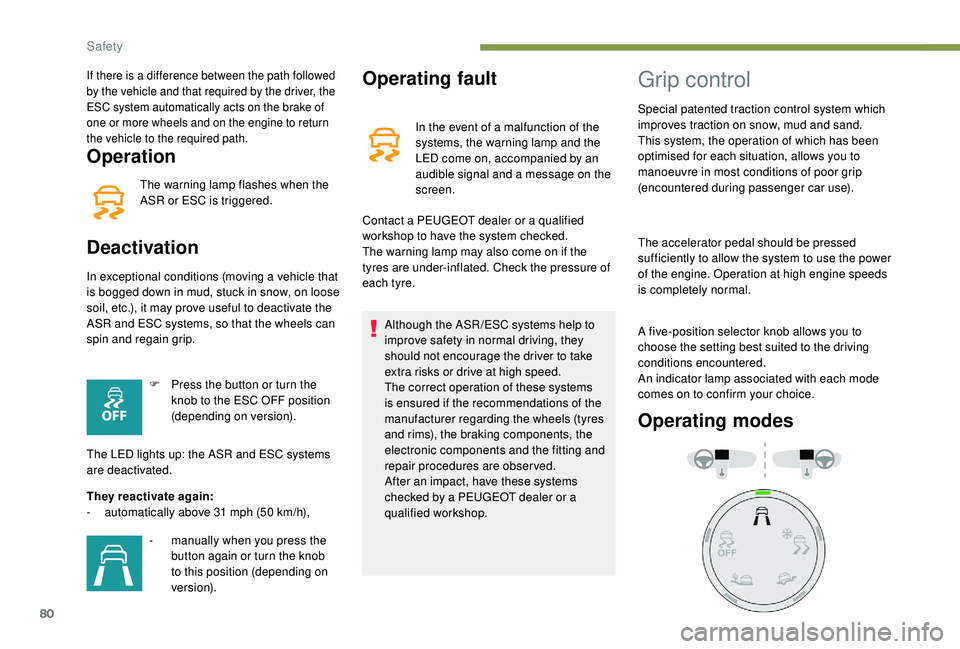
Grip control
Special patented traction control system which
improves traction on snow, mud and sand.
This system, the operation of which has been
optimised for each situation, allows you to
manoeuvre in most conditions of poor grip
(encountered during passenger car use).
The accelerator pedal should be pressed
sufficiently to allow the system to use the power
of the engine. Operation at high engine speeds
is completely normal.
A five-position selector knob allows you to
choose the setting best suited to the driving
conditions encountered.
An indicator lamp associated with each mode
comes on to confirm your choice.
Operating modes
Safety
Page 141 of 252
103
Driving recommendations
Obser ve the Highway Code and remain vigilant
whatever the traffic conditions.
Pay close attention to the traffic and keep your
hands on the wheel so that you are ready to
react at any time to any eventuality.
As a safety measure, the driver should only
carry out any operations that require close
attention when the vehicle is stationary.
On a long journey, a break every two hours is
strongly recommended.
In bad weather, drive smoothly, anticipate the
need to brake and increase the safety distance.
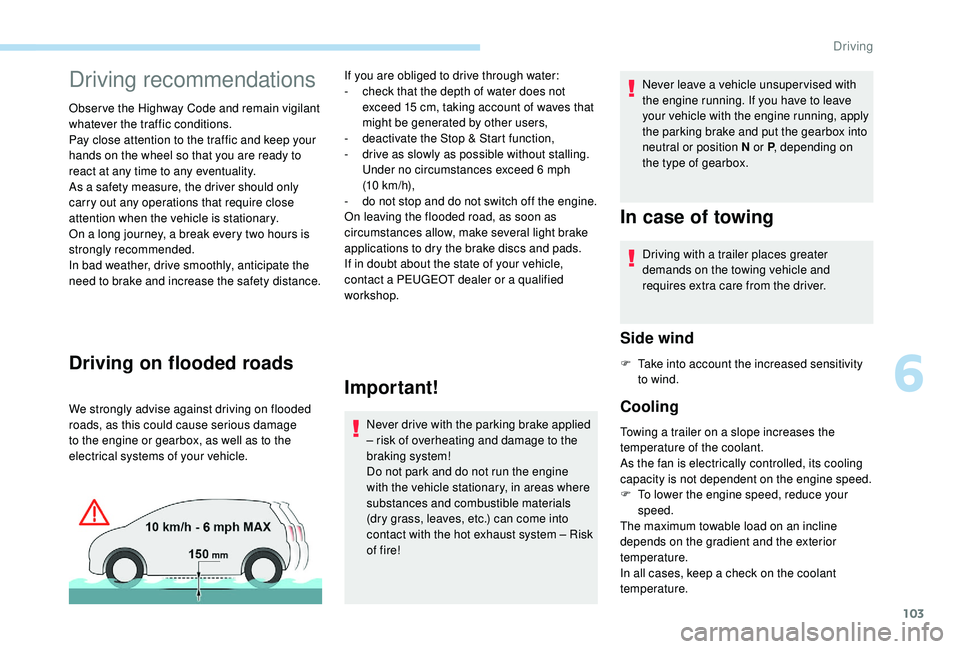
Driving on flooded roads
We strongly advise against driving on flooded
roads, as this could cause serious damage
to the engine or gearbox, as well as to the
electrical systems of your vehicle.
Important!
Never drive with the parking brake applied
– risk of overheating and damage to the
braking system!
Do not park and do not run the engine
with the vehicle stationary, in areas where
substances and combustible materials
(dry grass, leaves, etc.) can come into
contact with the hot exhaust system – Risk
of fire!Never leave a vehicle unsuper vised with
the engine running. If you have to leave
your vehicle with the engine running, apply
the parking brake and put the gearbox into
neutral or position N or P
, depending on
the type of gearbox.
In case of towing
If you are obliged to drive through water:
- c heck that the depth of water does not
exceed 15
cm, taking account of waves that
might be generated by other users,
-
d
eactivate the Stop & Start function,
-
d
rive as slowly as possible without stalling.
Under no circumstances exceed 6
mph
(10
km/h),
-
d
o not stop and do not switch off the engine.
On leaving the flooded road, as soon as
circumstances allow, make several light brake
applications to dry the brake discs and pads.
If in doubt about the state of your vehicle,
contact a PEUGEOT dealer or a qualified
workshop. Driving with a trailer places greater
demands on the towing vehicle and
requires extra care from the driver.
Side wind
F Take into account the increased sensitivity
to wind.
Cooling
Towing a trailer on a slope increases the
temperature of the coolant.
As the fan is electrically controlled, its cooling
capacity is not dependent on the engine speed.
F
T
o lower the engine speed, reduce your
speed.
The maximum towable load on an incline
depends on the gradient and the exterior
temperature.
In all cases, keep a check on the coolant
temperature.
6
Driving
Page 142 of 252
104
In some cases of particularly demanding use
(when towing the maximum load on a steep
gradient in high temperatures), the engine
power is automatically limited. In such a case,
the air conditioning is automatically switched
off to increase the available engine power.F
I
f this warning lamp and the
STOP warning lamp come on,
stop the vehicle and switch off
the engine as soon as possible.
New vehicle
Do not pull a trailer before having driven at
least 620
miles (1,000 kilometres).
Braking
Towing a trailer increases the braking distance.
To avoid overheating of the brakes, the use of
engine braking is recommended.
Ty r e s
F Check the tyre pressures of the towing vehicle and of the trailer, observing the
recommended pressures.
Lighting
F Check the electrical lighting and signalling on the trailer and the headlamp beam height
of your vehicle. For more information on adjusting
the Headlamp beam
, refer to the
corresponding section.
The rear parking sensors will be
deactivated automatically to avoid the
audible signal if a genuine PEUGEOT
towbar is used.
Starting and stopping
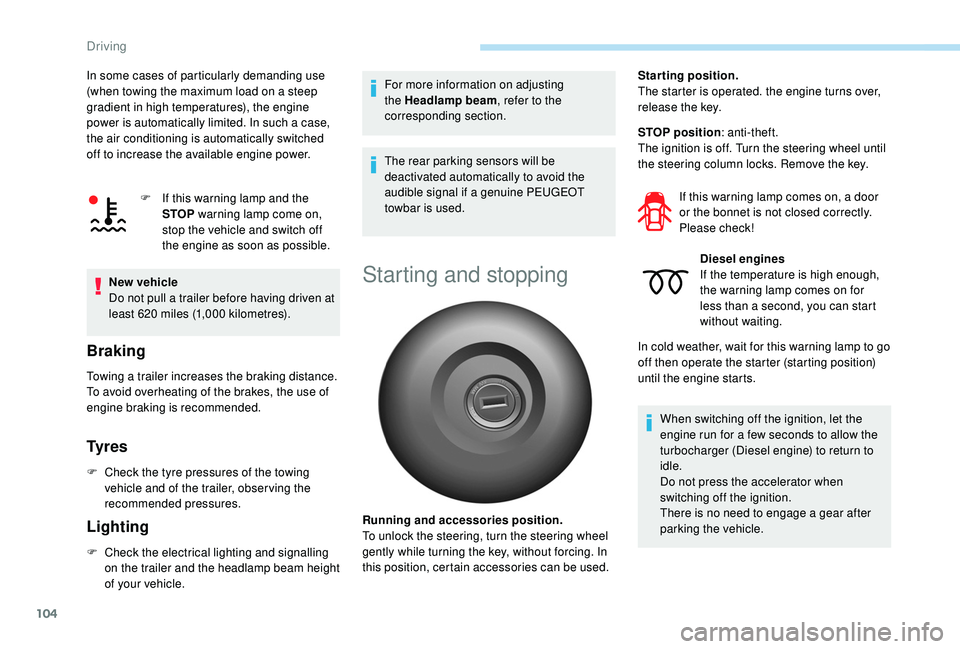
Running and accessories position.
To unlock the steering, turn the steering wheel
gently while turning the key, without forcing. In
this position, certain accessories can be used. Starting position.
The starter is operated. the engine turns over,
release the key.
STOP position
: anti-theft.
The ignition is off. Turn the steering wheel until
the steering column locks. Remove the key.
If this warning lamp comes on, a door
or the bonnet is not closed correctly.
Please check!Diesel engines
If the temperature is high enough,
the warning lamp comes on for
less than a second, you can start
without waiting.
In cold weather, wait for this warning lamp to go
off then operate the starter (starting position)
until the engine starts.
When switching off the ignition, let the
engine run for a few seconds to allow the
turbocharger (Diesel engine) to return to
idle.
Do not press the accelerator when
switching off the ignition.
There is no need to engage a gear after
parking the vehicle.
Driving
Page 143 of 252
105
Electronic engine
immobiliser
All of the keys contain an electronic immobiliser
device.
This device locks the engine supply system.
It is activated automatically when the key is
removed from the ignition.
When the ignition switch is turned on, a
dialogue is set up between the key and the
electronic immobiliser.
The metal part of the key must be correctly
unfolded to ensure a good connection.
In case of lost keys
See a PEUGEOT dealer with the vehicle
registration certificate and your ID.
A PEUGEOT dealer can retrieve the key
code and the transponder code to order the
replacement key.
When you leave the vehicle, check that the
lamps are off and do not leave valuables
visible.
As a safety precaution (with children on
board), remove the key from the ignition when
leaving the vehicle, even for a short time.
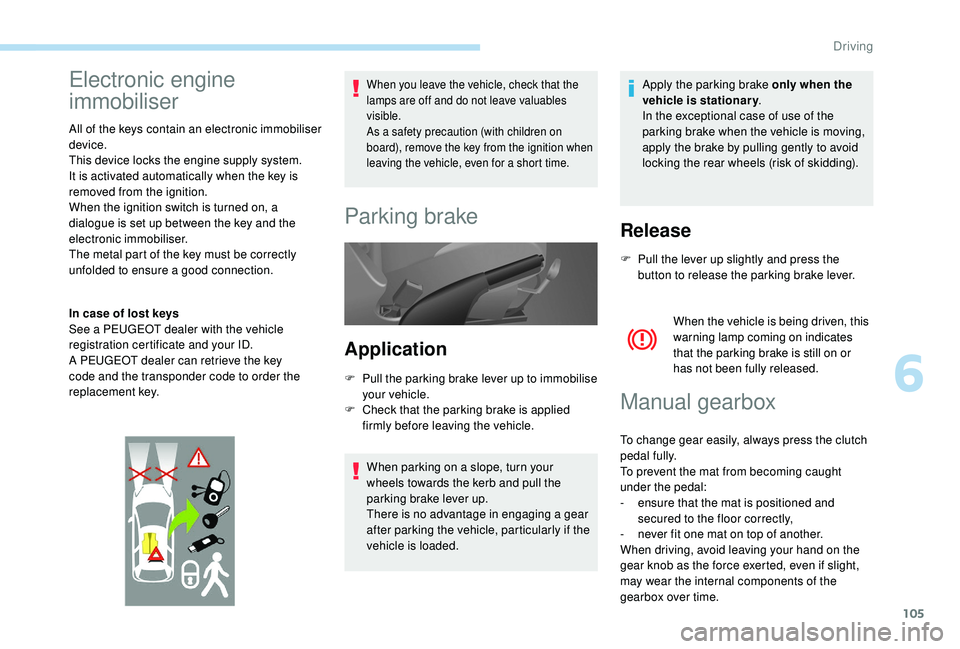
Parking brake
Application
F Pull the parking brake lever up to immobilise your vehicle.
F
C
heck that the parking brake is applied
firmly before leaving the vehicle.
When parking on a slope, turn your
wheels towards the kerb and pull the
parking brake lever up.
There is no advantage in engaging a gear
after parking the vehicle, particularly if the
vehicle is loaded. Apply the parking brake only when the
vehicle is stationary
.
In the exceptional case of use of the
parking brake when the vehicle is moving,
apply the brake by pulling gently to avoid
locking the rear wheels (risk of skidding).
Release
F Pull the lever up slightly and press the button to release the parking brake lever.
When the vehicle is being driven, this
warning lamp coming on indicates
that the parking brake is still on or
has not been fully released.
Manual gearbox
To change gear easily, always press the clutch
pedal fully.
To prevent the mat from becoming caught
under the pedal:
-
e
nsure that the mat is positioned and
secured to the floor correctly,
-
n
ever fit one mat on top of another.
When driving, avoid leaving your hand on the
gear knob as the force exerted, even if slight,
may wear the internal components of the
gearbox over time.
6
Driving
Page 148 of 252
110
Manual deactivation
In certain circumstances, such as the need
to maintain a comfortable temperature in the
passenger compartment, it may be preferable
to deactivate the Stop & Start system.
The system can be deactivated at any time,
once the ignition is switched on.
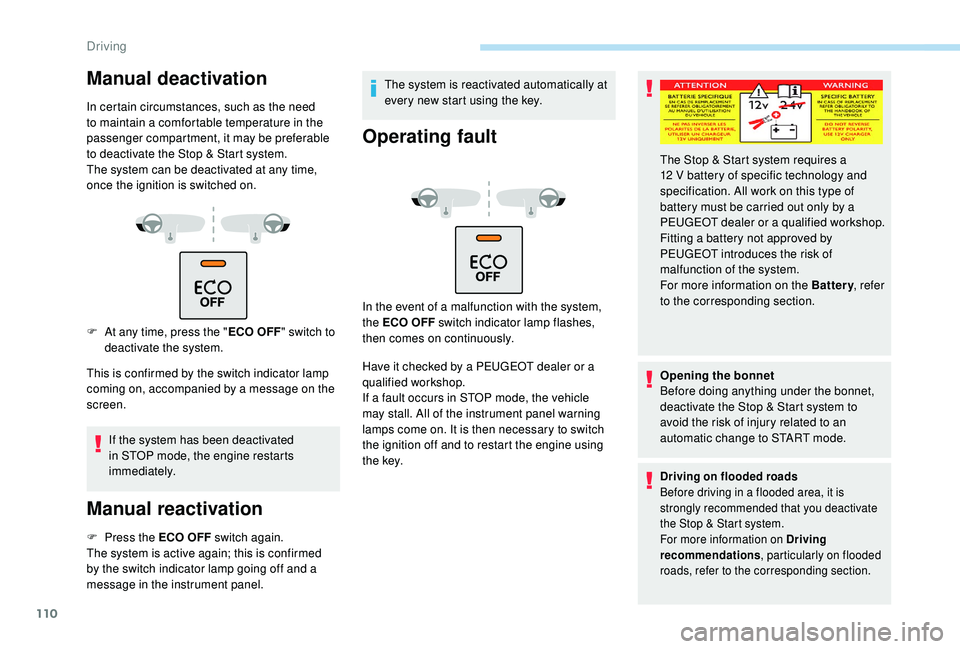
F
A
t any time, press the " ECO OFF"
switch to
deactivate the system.
This is confirmed by the switch indicator lamp
coming on, accompanied by a message on the
screen.
If the system has been deactivated
in STOP mode, the engine restarts
immediately.
Manual reactivation
F Press the ECO OFF switch again.
The system is active again; this is confirmed
by the switch indicator lamp going off and a
message in the instrument panel. The system is reactivated automatically at
every new start using the key.
Operating fault
In the event of a malfunction with the system,
the ECO OFF switch indicator lamp flashes,
then comes on continuously.
Have it checked by a PEUGEOT dealer or a
qualified workshop.
If a fault occurs in STOP mode, the vehicle
may stall. All of the instrument panel warning
lamps come on. It is then necessary to switch
the ignition off and to restart the engine using
t h e key.
Opening the bonnet
Before doing anything under the bonnet,
deactivate the Stop & Start system to
avoid the risk of injury related to an
automatic change to START mode.
Driving on flooded roads
Before driving in a flooded area, it is
strongly recommended that you deactivate
the Stop & Start system.
For more information on Driving
recommendations
, particularly on flooded
roads, refer to the corresponding section.
The Stop & Start system requires a
12 V battery of specific technology and
specification. All work on this type of
battery must be carried out only by a
PEUGEOT dealer or a qualified workshop.
Fitting a battery not approved by
PEUGEOT
introduces the risk of
malfunction of the system.
For more information on the Battery , refer
to the corresponding section.
Driving
Page 149 of 252
111
Hill start assist
This system keeps your vehicle briefly
stationary (for approximately 2 seconds) when
making a hill start, while you transfer your foot
from the brake pedal to the accelerator pedal.
This system (also called HHC – Hill Hold
Control), integrated with the dynamic stability
control system, is activated in the following
conditions:
-
t
he vehicle must be stationary, engine
running, foot on the brake,
-
t
he gradient of the road must be steeper
than 5%,
-
u
phill, the gearbox must be in neutral or in a
gear other than reverse,
-
do
wnhill, reverse gear must be engaged.
The hill start assist system is a driving
aid. It is not an automatic vehicle parking
function or an automatic parking brake.
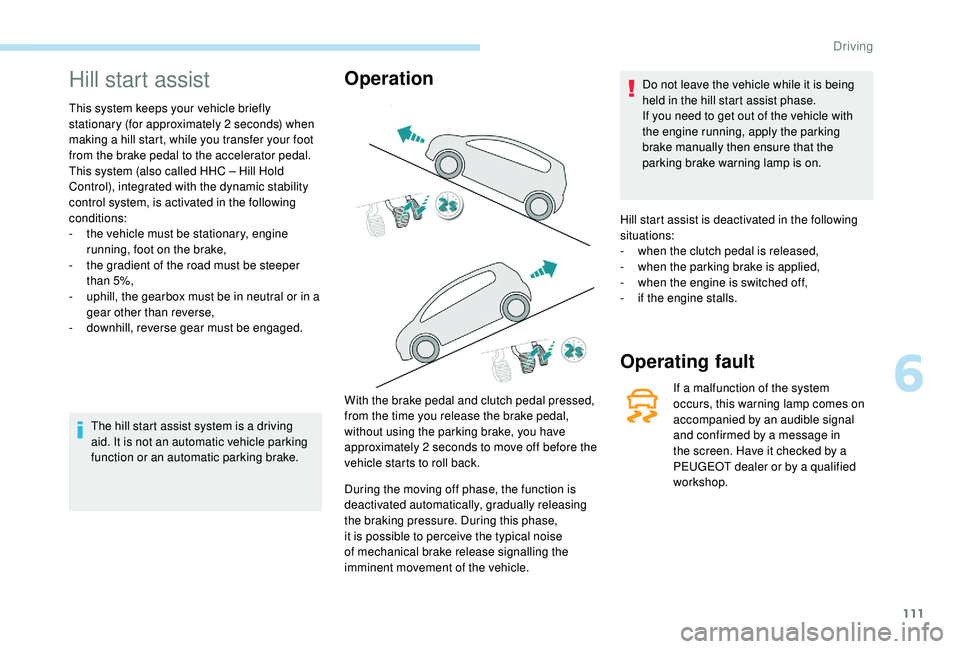
Operation
With the brake pedal and clutch pedal pressed,
from the time you release the brake pedal,
without using the parking brake, you have
approximately 2 seconds to move off before the
vehicle starts to roll back.
During the moving off phase, the function is
deactivated automatically, gradually releasing
the braking pressure. During this phase,
it is possible to perceive the typical noise
of mechanical brake release signalling the
imminent movement of the vehicle. Do not leave the vehicle while it is being
held in the hill start assist phase.
If you need to get out of the vehicle with
the engine running, apply the parking
brake manually then ensure that the
parking brake warning lamp is on.
Hill start assist is deactivated in the following
situations:
-
w
hen the clutch pedal is released,
-
w
hen the parking brake is applied,
-
w
hen the engine is switched off,
-
i
f the engine stalls.
Operating fault
If a malfunction of the system
occurs, this warning lamp comes on
accompanied by an audible signal
and confirmed by a message in
the screen. Have it checked by a
PEUGEOT dealer or by a qualified
workshop.
6
Driving
Page 153 of 252
115
Dashboard button
F Hold this button down.
Reinitialisation is confirmed by a high-pitched
audible signal.
A low-pitched audible signal indicates that
the reinitialisation operation has not been
successful.
The new pressure parameters saved are
treated as reference values by the system.The under-inflation alert can only be relied
on if the reinitialisation of the system has
been done with the pressures in the four
tyres correctly adjusted.
Snow chains
The system does not have to be
reinitialised after fitting or removing snow
chains.
Operating fault
After doing anything to the system, the
pressures of the four tyres must be
checked and the system reinitialised.
The flashing and then constant illumination of
the under-inflation warning lamp accompanied
by illumination of the Ser vice warning lamp
indicates a fault in the system.
In this case, under-inflation monitoring of the
tyres is no longer provided.
Have the system checked by a PEUGEOT
dealer or a qualified workshop.
"LIMIT" speed limiter
System preventing the vehicle
from exceeding the speed setting
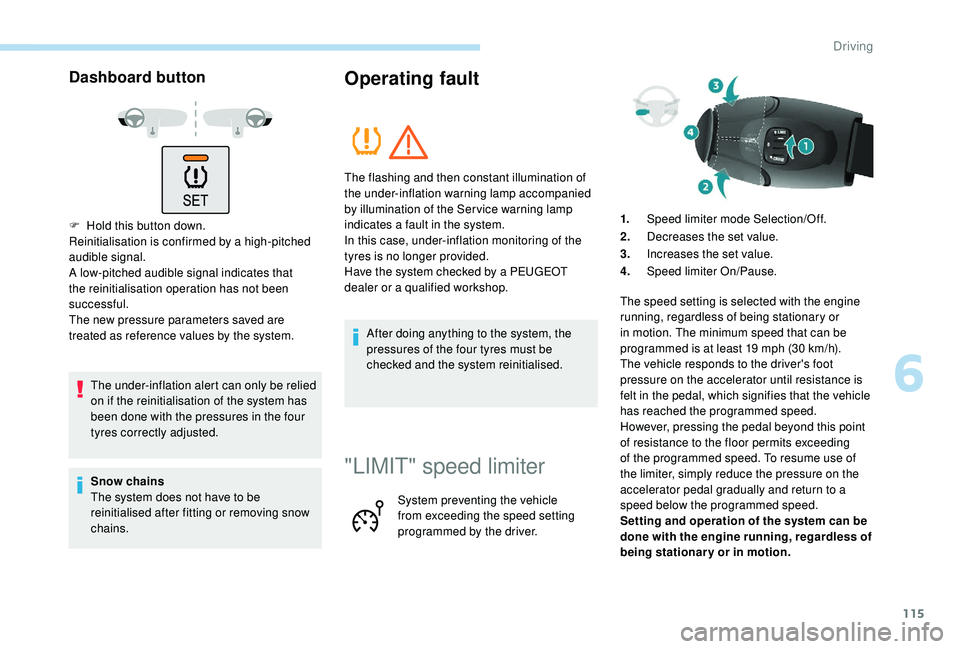
programmed by the driver. 1.
Speed limiter mode Selection/Off.
2. Decreases the set value.
3. Increases the set value.
4. Speed limiter On/Pause.
The speed setting is selected with the engine
running, regardless of being stationary or
in motion. The minimum speed that can be
programmed is at least 19 mph (30 km/h).
The vehicle responds to the driver's foot
pressure on the accelerator until resistance is
felt in the pedal, which signifies that the vehicle
has reached the programmed speed.
However, pressing the pedal beyond this point
of resistance to the floor permits exceeding
of the programmed speed. To resume use of
the limiter, simply reduce the pressure on the
accelerator pedal gradually and return to a
speed below the programmed speed.
Setting and operation of the system can be
done with the engine running, regardless of
being stationary or in motion.
6
Driving
Page 167 of 252
129
Travelling abroad
Certain fuels could damage your vehicle's
engine.
In certain countries, the use of a particular
fuel may be required (specific octane rating,
specific trade name, etc.) to ensure correct
operation of the engine.
For any additional information, contact a dealer.
Snow chains
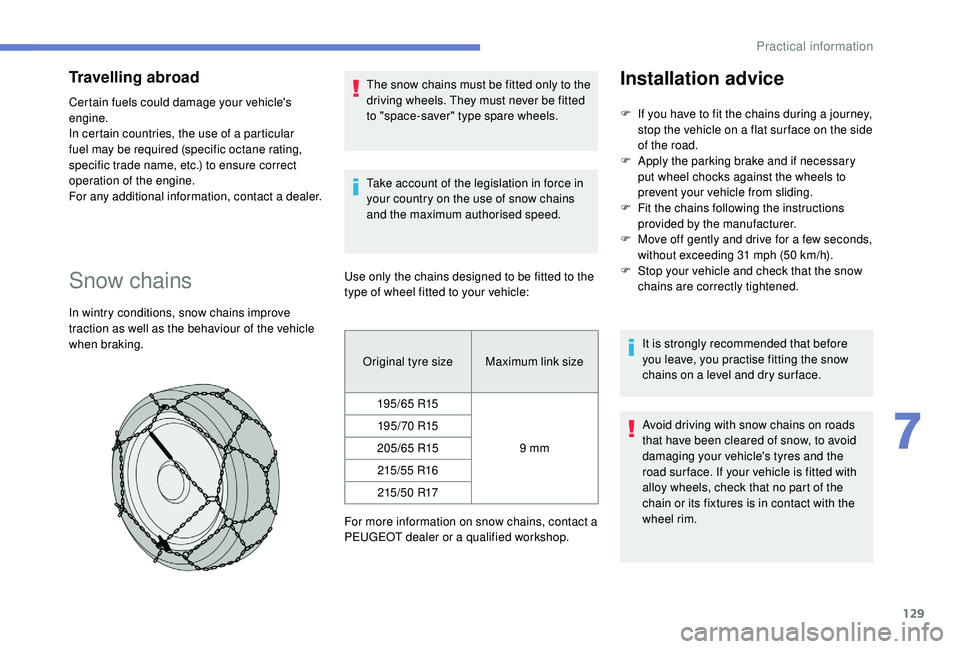
In wintry conditions, snow chains improve
traction as well as the behaviour of the vehicle
when braking.The snow chains must be fitted only to the
driving wheels. They must never be fitted
to "space-saver" type spare wheels.
Take account of the legislation in force in
your country on the use of snow chains
and the maximum authorised speed.
Use only the chains designed to be fitted to the
type of wheel fitted to your vehicle:
Original tyre size Maximum link size
195/65 R15
9
mm
19 5/ 70 R15
205/65 R15 215/5 5 R16215 / 5 0 R17
For more information on snow chains, contact a
PEUGEOT dealer or a qualified workshop. It is strongly recommended that before
you leave, you practise fitting the snow
chains on a level and dry sur face.
Avoid driving with snow chains on roads
that have been cleared of snow, to avoid
damaging your vehicle's tyres and the
road sur face. If your vehicle is fitted with
alloy wheels, check that no part of the
chain or its fixtures is in contact with the
wheel rim.
Installation advice
F If you have to fit the chains during a journey,
stop the vehicle on a flat sur face on the side
of the road.
F
A
pply the parking brake and if necessary
put wheel chocks against the wheels to
prevent your vehicle from sliding.
F
F
it the chains following the instructions
provided by the manufacturer.
F
M
ove off gently and drive for a few seconds,
without exceeding 31
mph (50 km/h).
F
S
top your vehicle and check that the snow
chains are correctly tightened.
7
Practical information
Page 174 of 252
136
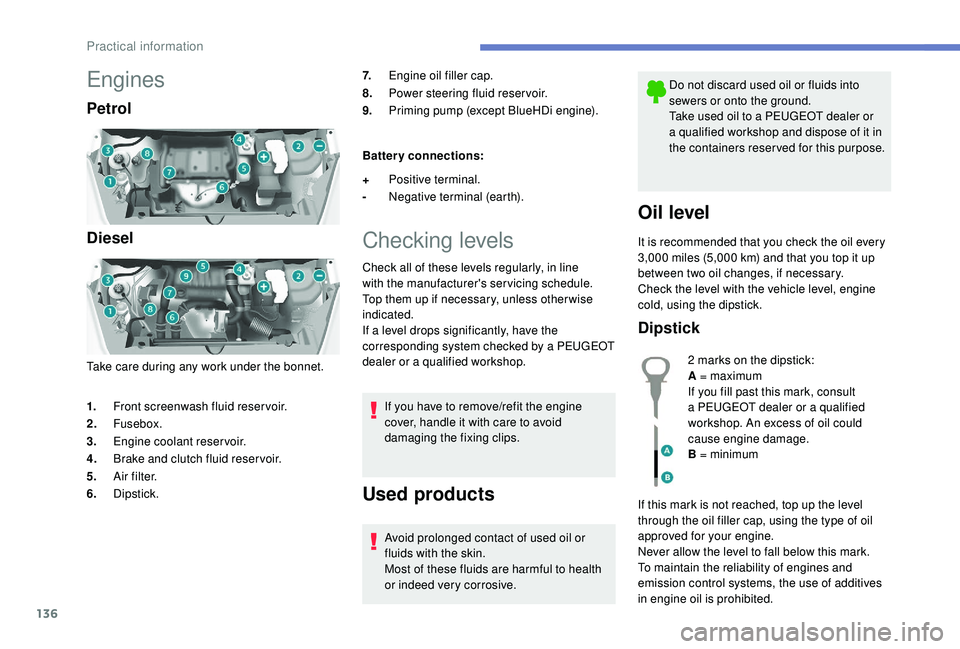
Engines
Petrol
Diesel
Take care during any work under the bonnet.7.
Engine oil filler cap.
8. Power steering fluid reservoir.
9. Priming pump (except BlueHDi engine).
Battery connections:
Checking levels
Check all of these levels regularly, in line
with the manufacturer's servicing schedule.
Top them up if necessary, unless other wise
indicated.
If a level drops significantly, have the
corresponding system checked by a PEUGEOT
dealer or a qualified workshop. If you have to remove/refit the engine
cover, handle it with care to avoid
damaging the fixing clips.
Used products
Avoid prolonged contact of used oil or
fluids with the skin.
Most of these fluids are harmful to health
or indeed very corrosive. Do not discard used oil or fluids into
sewers or onto the ground.
Take used oil to a PEUGEOT dealer or
a qualified workshop and dispose of it in
the containers reser ved for this purpose.
Oil level
It is recommended that you check the oil every
3,000
miles (5,000 km) and that you top it up
between two oil changes, if necessary.
Check the level with the vehicle level, engine
cold, using the dipstick.
Dipstick
1. Front screenwash fluid reser voir.
2. Fusebox.
3. Engine coolant reservoir.
4. Brake and clutch fluid reser voir.
5. A i r f i l t e r.
6. Dipstick. +
Positive terminal.
- Negative terminal (earth).
2 marks on the dipstick:
A = maximum
If you fill past this mark, consult
a PEUGEOT dealer or a qualified
workshop. An excess of oil could
cause engine damage.
B = minimum
If this mark is not reached, top up the level
through the oil filler cap, using the type of oil
approved for your engine.
Never allow the level to fall below this mark.
To maintain the reliability of engines and
emission control systems, the use of additives
in engine oil is prohibited.
Practical information