warning PEUGEOT PARTNER TEPEE ELECTRIC 2017 Owner's Guide
[x] Cancel search | Manufacturer: PEUGEOT, Model Year: 2017, Model line: PARTNER TEPEE ELECTRIC, Model: PEUGEOT PARTNER TEPEE ELECTRIC 2017Pages: 252, PDF Size: 9.89 MB
Page 117 of 252
79
Anti-lock braking system
(ABS/EBFD)
The ABS and EBFD (electronic brake force
distribution) systems improve the stability and
manoeuvrability of your vehicle when braking,
in particular on poor or slippery sur faces.
The ABS prevents the wheels from locking,
and the EBFD provides control of the braking
pressure wheel by wheel.
The anti-lock braking system comes into
operation automatically when there is a risk
of wheel lock. It does not reduce the braking
distance.
On very slippery sur faces (ice, oil, etc.), the
ABS may increase the braking distance. When
braking in an emergency, do not hesitate to
press the brake pedal firmly without releasing
the pressure, even on a slippery sur face; you
will then be able to continue to manoeuvre the
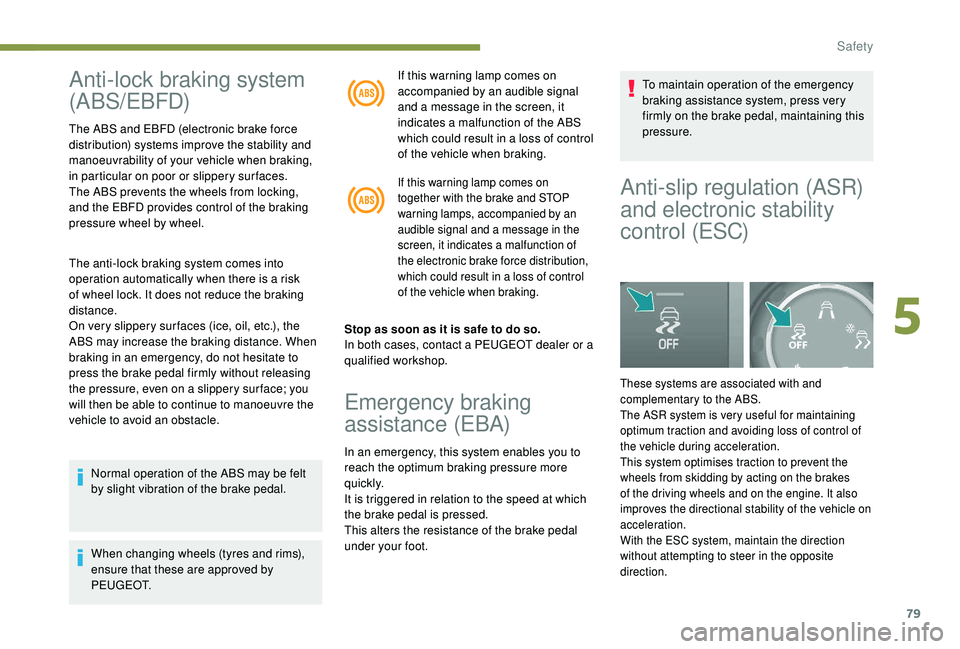
vehicle to avoid an obstacle.If this warning lamp comes on
accompanied by an audible signal
and a message in the screen, it
indicates a malfunction of the ABS
which could result in a loss of control
of the vehicle when braking.
If this warning lamp comes on
together with the brake and STOP
warning lamps, accompanied by an
audible signal and a message in the
screen, it indicates a malfunction of
the electronic brake force distribution,
which could result in a loss of control
of the vehicle when braking.
Stop as soon as it is safe to do so.
In both cases, contact a PEUGEOT dealer or a
qualified workshop.
Emergency braking
assistance (EBA)
In an emergency, this system enables you to
reach the optimum braking pressure more
quickly.
It is triggered in relation to the speed at which
the brake pedal is pressed.
This alters the resistance of the brake pedal
under your foot.To maintain operation of the emergency
braking assistance system, press very
firmly on the brake pedal, maintaining this
pressure.
Normal operation of the ABS may be felt
by slight vibration of the brake pedal.
When changing wheels (tyres and rims),
ensure that these are approved by
P E U G E O T.
Anti-slip regulation (ASR)
and electronic stability
c ont rol (ESC)
These systems are associated with and
complementary to the ABS.
The ASR system is very useful for maintaining
optimum traction and avoiding loss of control of
the vehicle during acceleration.
This system optimises traction to prevent the
wheels from skidding by acting on the brakes
of the driving wheels and on the engine. It also
improves the directional stability of the vehicle on
acceleration.
With the ESC system, maintain the direction
without attempting to steer in the opposite
direction.
5
Safety
Page 118 of 252
80
Operation
The warning lamp flashes when the
ASR or ESC is triggered.
Deactivation
In exceptional conditions (moving a vehicle that
is bogged down in mud, stuck in snow, on loose
soil, etc.), it may prove useful to deactivate the
ASR and ESC systems, so that the wheels can
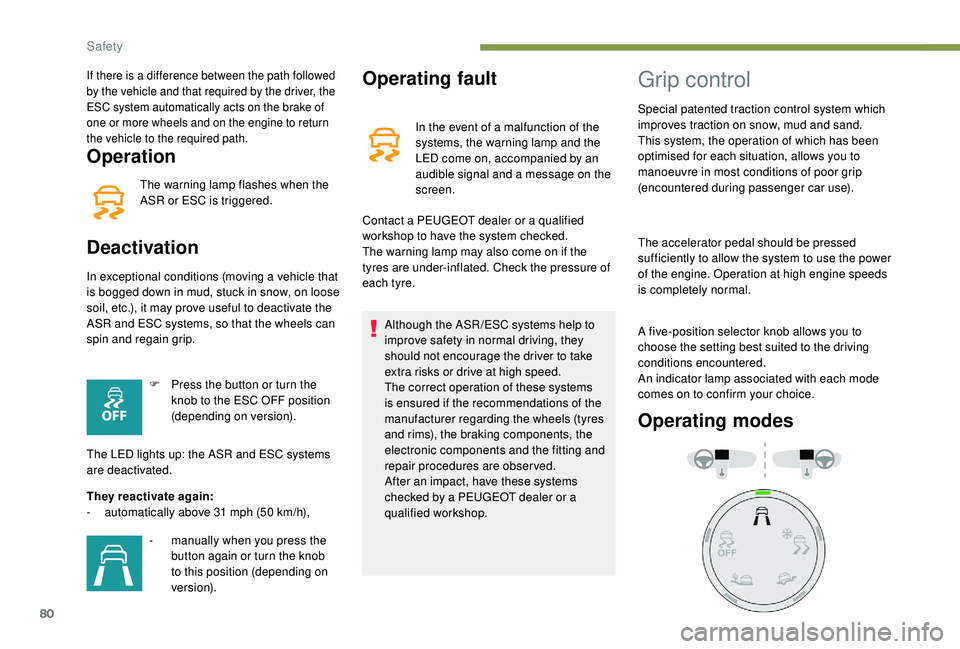
spin and regain grip.F
P
ress the button or turn the
knob to the ESC OFF position
(depending on version).
The LED lights up: the ASR and ESC systems
are deactivated.
They reactivate again:
-
a
utomatically above 31 mph (50 km/h),
If there is a difference between the path followed
by the vehicle and that required by the driver, the
ESC system automatically acts on the brake of
one or more wheels and on the engine to return
the vehicle to the required path.
- manually when you press the button again or turn the knob
to this position (depending on
ve r s i o n).
Operating fault
In the event of a malfunction of the
systems, the warning lamp and the
LED come on, accompanied by an
audible signal and a message on the
screen.
Contact a PEUGEOT dealer or a qualified
workshop to have the system checked.
The warning lamp may also come on if the
tyres are under-inflated. Check the pressure of
each tyre.
Although the ASR /ESC systems help to
improve safety in normal driving, they
should not encourage the driver to take
extra risks or drive at high speed.
The correct operation of these systems
is ensured if the recommendations of the
manufacturer regarding the wheels (tyres
and rims), the braking components, the
electronic components and the fitting and
repair procedures are observed.
After an impact, have these systems
checked by a PEUGEOT dealer or a
qualified workshop.
Grip control
Special patented traction control system which
improves traction on snow, mud and sand.
This system, the operation of which has been
optimised for each situation, allows you to
manoeuvre in most conditions of poor grip
(encountered during passenger car use).
The accelerator pedal should be pressed
sufficiently to allow the system to use the power
of the engine. Operation at high engine speeds
is completely normal.
A five-position selector knob allows you to
choose the setting best suited to the driving
conditions encountered.
An indicator lamp associated with each mode
comes on to confirm your choice.
Operating modes
Safety
Page 121 of 252
83
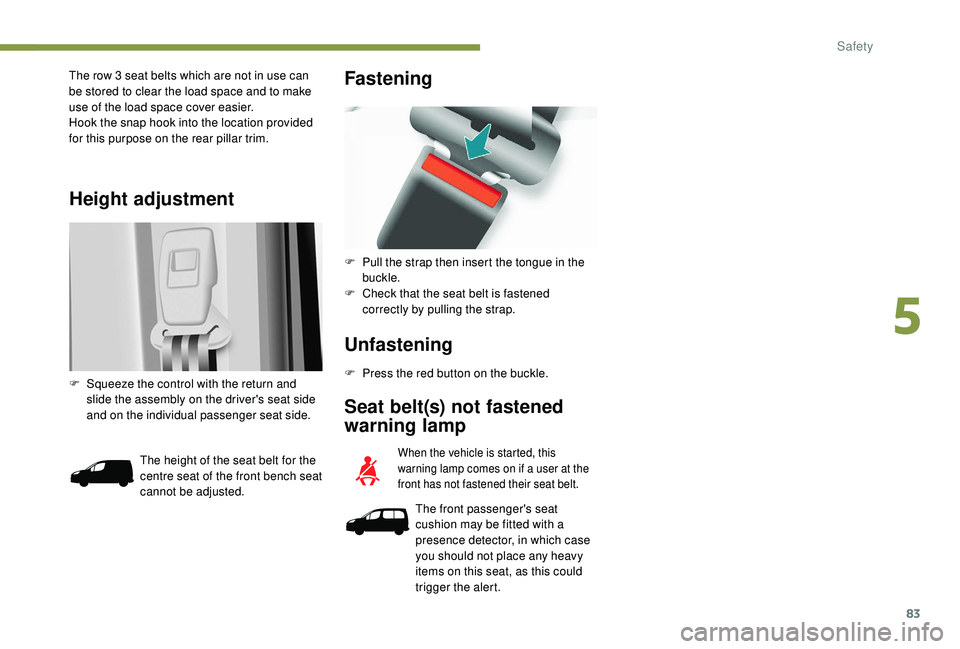
Height adjustment
The row 3 seat belts which are not in use can
be stored to clear the load space and to make
use of the load space cover easier.
Hook the snap hook into the location provided
for this purpose on the rear pillar trim.
F
S
queeze the control with the return and
slide the assembly on the driver's seat side
and on the individual passenger seat side.
Unfastening
F Press the red button on the buckle.
Seat belt(s) not fastened
warning lamp
When the vehicle is started, this
warning lamp comes on if a user at the
front has not fastened their seat belt.
The front passenger's seat
cushion may be fitted with a
presence detector, in which case
you should not place any heavy
items on this seat, as this could
trigger the alert.
Fastening
F Pull the strap then insert the tongue in the buckle.
F
C
heck that the seat belt is fastened
correctly by pulling the strap.
The height of the seat belt for the
centre seat of the front bench seat
cannot be adjusted.
5
Safety
Page 122 of 252
84
Advice
The driver must ensure that passengers use
the seat belts correctly and that they are all
fastened before setting off.
Wherever you are seated in the vehicle,
always fasten your seat belt, even for short
journeys.
Do not interchange the seat belt buckles as
they will not fulfil their role fully.
The seat belts are fitted with an inertia reel
permitting automatic adjustment of the length
of the strap to your size. The seat belt is
stowed automatically when not in use.
Before and after use, ensure that the seat belt
is reeled in correctly.
The lower part of the strap must be positioned
as low as possible on the pelvis.
The upper part must be positioned in the
hollow of the shoulder.
The inertia reels have a device for automatic
locking in the event of a collision, sudden
braking or if the vehicle turns over. You can
release the device by pulling the strap firmly
and then releasing it so that it reels in slightly.In order to be effective, a seat belt must:
-
b e tightened as close to the body as
possible,
-
b
e pulled in front of you with a smooth
movement, checking that it does not twist,
-
b
e used to restrain only one person,
-
n
ot show any signs of cuts or fraying,
-
n
ot be converted or modified to avoid
affecting its performance.
In accordance with current safety regulations,
for all repairs on your vehicle's seat belts, go
to a qualified workshop with the skills and
equipment needed, which a PEUGEOT dealer
is able to provide.
Have your seat belts checked regularly by a
PEUGEOT dealer or a qualified workshop,
particularly if the straps show signs of
damage.
Clean the seat belt straps with soapy water or
a textile cleaning product, sold by PEUGEOT
dealers.
After folding or moving a seat or rear bench
seat, ensure that the seat belt is positioned
and reeled in correctly. Recommendations for children
Use a suitable child seat if the passenger is
less than 12
years old or shorter than one and
a half metres.
Never use the same seat belt to secure more
than one person.
Never allow a child to travel on your lap.
For more information on Child seats , refer to
the corresponding section.
In the event of an impact
Depending on the nature and seriousness
of the impact , the pyrotechnic device may
be deployed before and independently of the
airbags. Deployment of the pretensioners
is accompanied by a slight discharge of
harmless smoke and a noise, due to the
activation of the pyrotechnic cartridge
incorporated in the system.
In all cases, the airbag warning lamp comes
on.
Following an impact, have the seat belts
system checked and, if necessary, replaced,
by a PEUGEOT dealer or a qualified
workshop.
Safety
Page 124 of 252
86
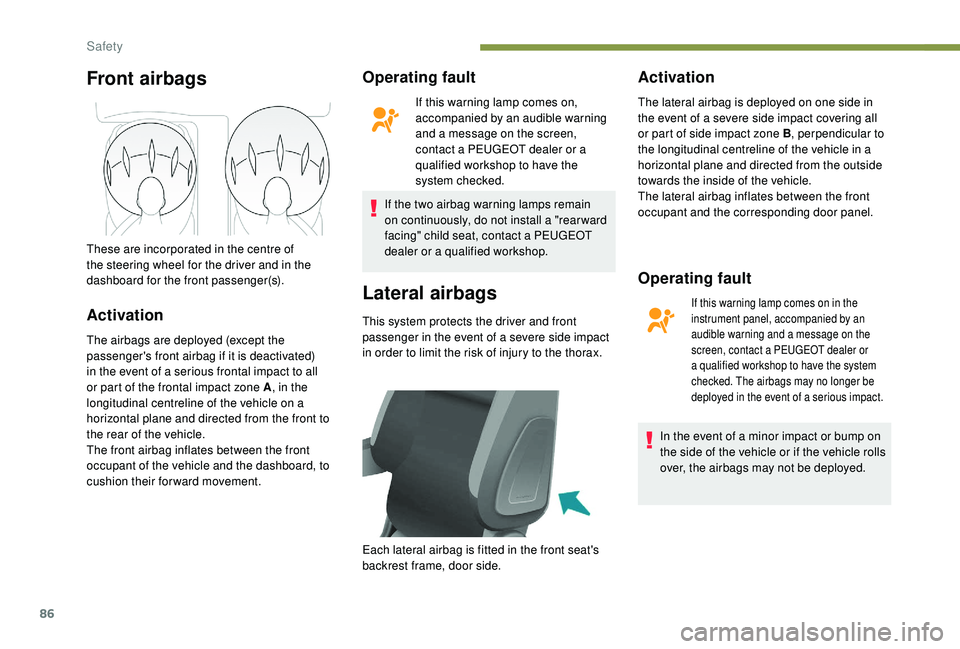
Front airbags
Activation
The airbags are deployed (except the
passenger's front airbag if it is deactivated)
in the event of a serious frontal impact to all
or part of the frontal impact zone A, in the
longitudinal centreline of the vehicle on a
horizontal plane and directed from the front to
the rear of the vehicle.
The front airbag inflates between the front
occupant of the vehicle and the dashboard, to
cushion their forward movement.
Operating fault
If this warning lamp comes on,
accompanied by an audible warning
and a message on the screen,
contact a PEUGEOT dealer or a
qualified workshop to have the
system checked.
If the two airbag warning lamps remain
on continuously, do not install a "rear ward
facing" child seat, contact a PEUGEOT
dealer or a qualified workshop.
Lateral airbags
This system protects the driver and front
passenger in the event of a severe side impact
in order to limit the risk of injury to the thorax.
These are incorporated in the centre of
the steering wheel for the driver and in the
dashboard for the front passenger(s).
Each lateral airbag is fitted in the front seat's
backrest frame, door side.
Activation
The lateral airbag is deployed on one side in
the event of a severe side impact covering all
or part of side impact zone B, perpendicular to
the longitudinal centreline of the vehicle in a
horizontal plane and directed from the outside
towards the inside of the vehicle.
The lateral airbag inflates between the front
occupant and the corresponding door panel.
Operating fault
If this warning lamp comes on in the
instrument panel, accompanied by an
audible warning and a message on the
screen, contact a PEUGEOT dealer or
a qualified workshop to have the system
checked. The airbags may no longer be
deployed in the event of a serious impact.
In the event of a minor impact or bump on
the side of the vehicle or if the vehicle rolls
over, the airbags may not be deployed.
Safety
Page 128 of 252
90
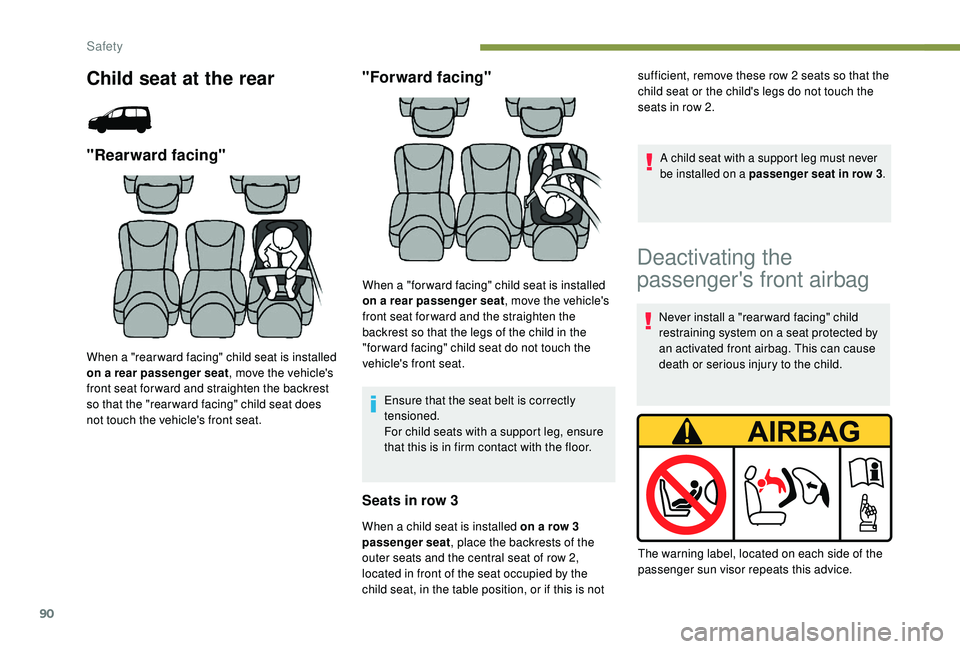
Child seat at the rear
"Rearward facing"
When a "rear ward facing" child seat is installed
on a rear passenger seat, move the vehicle's
front seat for ward and straighten the backrest
so that the "rear ward facing" child seat does
not touch the vehicle's front seat.
"Forward facing"
Ensure that the seat belt is correctly
tensioned.
For child seats with a support leg, ensure
that this is in firm contact with the floor.
Seats in row 3
When a child seat is installed on a row 3
passenger seat , place the backrests of the
outer seats and the central seat of row 2,
located in front of the seat occupied by the
child seat, in the table position, or if this is not
A child seat with a support leg must never
be installed on a passenger seat in row 3 .
When a "for ward facing" child seat is installed
on a rear passenger seat, move the vehicle's
front seat for ward and the straighten the
backrest so that the legs of the child in the
"for ward facing" child seat do not touch the
vehicle's front seat. sufficient, remove these row 2 seats so that the
child seat or the child's legs do not touch the
seats in row 2.
Deactivating the
passenger's front airbag
Never install a "rear ward facing" child
restraining system on a seat protected by
an activated front airbag. This can cause
death or serious injury to the child.
The warning label, located on each side of the
passenger sun visor repeats this advice.
Safety
Page 129 of 252
91
In line with current legislation, you will find this
warning in all the required languages in the
following tables.
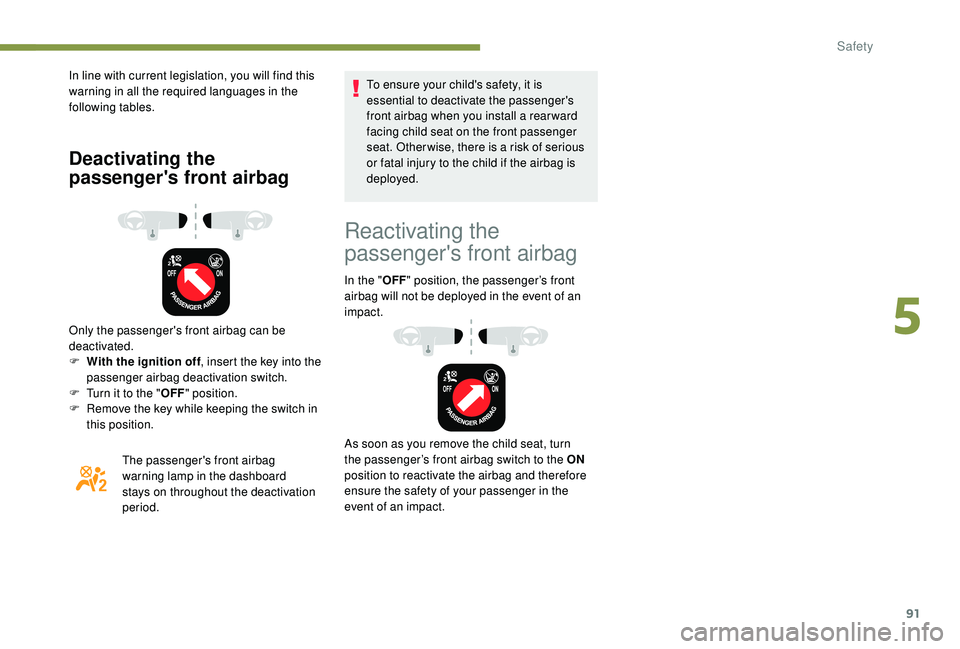
Deactivating the
passenger's front airbag
Only the passenger's front airbag can be
deactivated.
F
W
ith the ignition off , insert the key into the
passenger airbag deactivation switch.
F
T
urn it to the " OFF" position.
F
R
emove the key while keeping the switch in
this position.
The passenger's front airbag
warning lamp in the dashboard
stays on throughout the deactivation
period. To ensure your child's safety, it is
essential to deactivate the passenger's
front airbag when you install a rear ward
facing child seat on the front passenger
seat. Otherwise, there is a risk of serious
or fatal injury to the child if the airbag is
deployed.
Reactivating the
passenger's front airbag
In the "
OFF" position, the passenger’s front
airbag will not be deployed in the event of an
impact.
As soon as you remove the child seat, turn
the passenger’s front airbag switch to the ON
position to reactivate the airbag and therefore
ensure the safety of your passenger in the
event of an impact.
5
Safety
Page 142 of 252
104
In some cases of particularly demanding use
(when towing the maximum load on a steep
gradient in high temperatures), the engine
power is automatically limited. In such a case,
the air conditioning is automatically switched
off to increase the available engine power.F
I
f this warning lamp and the
STOP warning lamp come on,
stop the vehicle and switch off
the engine as soon as possible.
New vehicle
Do not pull a trailer before having driven at
least 620
miles (1,000 kilometres).
Braking
Towing a trailer increases the braking distance.
To avoid overheating of the brakes, the use of
engine braking is recommended.
Ty r e s
F Check the tyre pressures of the towing vehicle and of the trailer, observing the
recommended pressures.
Lighting
F Check the electrical lighting and signalling on the trailer and the headlamp beam height
of your vehicle. For more information on adjusting
the Headlamp beam
, refer to the
corresponding section.
The rear parking sensors will be
deactivated automatically to avoid the
audible signal if a genuine PEUGEOT
towbar is used.
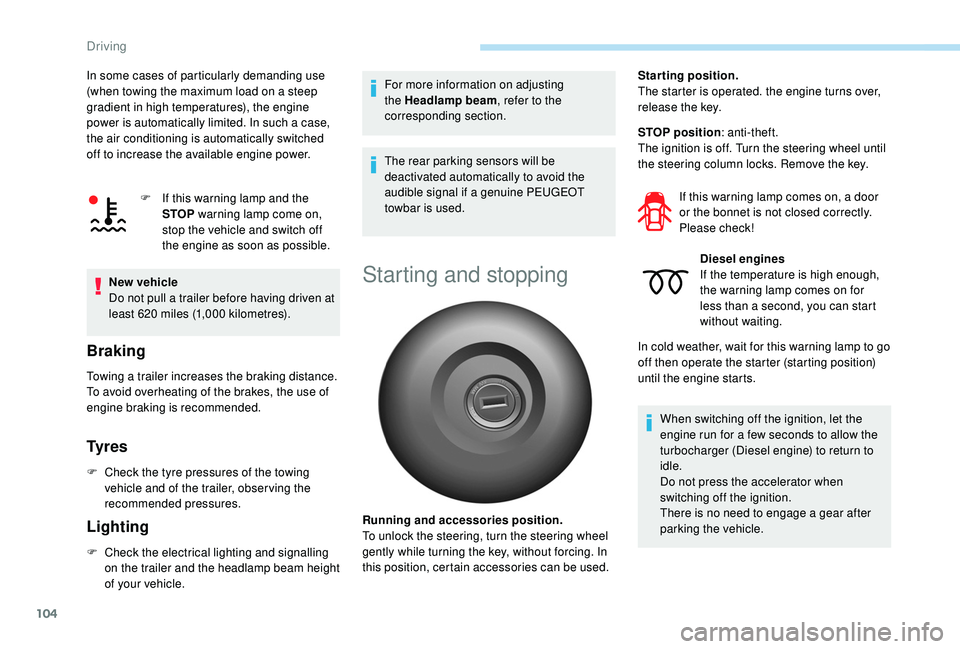
Starting and stopping
Running and accessories position.
To unlock the steering, turn the steering wheel
gently while turning the key, without forcing. In
this position, certain accessories can be used. Starting position.
The starter is operated. the engine turns over,
release the key.
STOP position
: anti-theft.
The ignition is off. Turn the steering wheel until
the steering column locks. Remove the key.
If this warning lamp comes on, a door
or the bonnet is not closed correctly.
Please check!Diesel engines
If the temperature is high enough,
the warning lamp comes on for
less than a second, you can start
without waiting.
In cold weather, wait for this warning lamp to go
off then operate the starter (starting position)
until the engine starts.
When switching off the ignition, let the
engine run for a few seconds to allow the
turbocharger (Diesel engine) to return to
idle.
Do not press the accelerator when
switching off the ignition.
There is no need to engage a gear after
parking the vehicle.
Driving
Page 143 of 252
105
Electronic engine
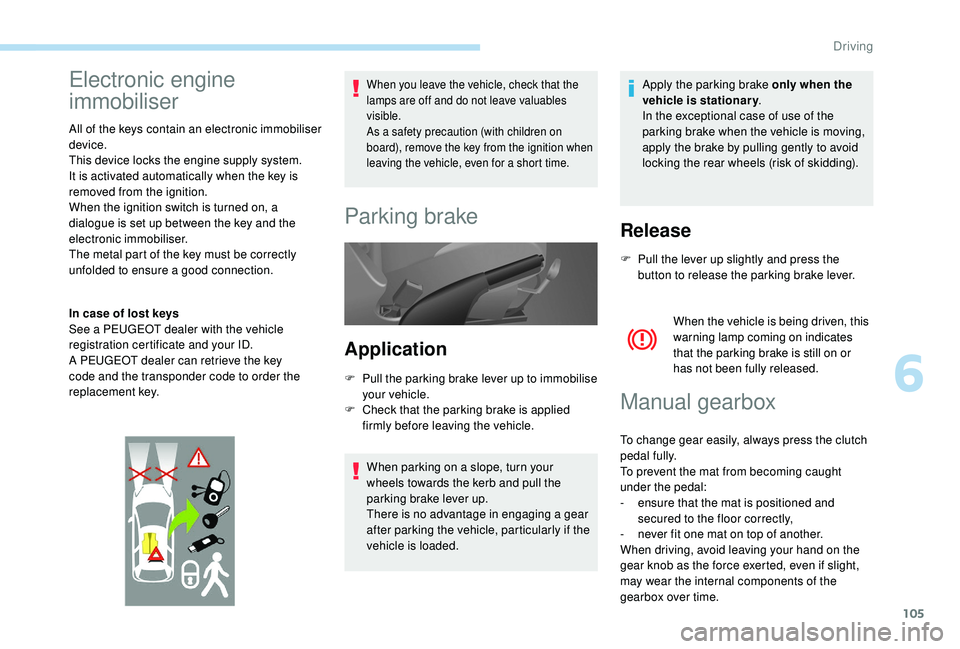
immobiliser
All of the keys contain an electronic immobiliser
device.
This device locks the engine supply system.
It is activated automatically when the key is
removed from the ignition.
When the ignition switch is turned on, a
dialogue is set up between the key and the
electronic immobiliser.
The metal part of the key must be correctly
unfolded to ensure a good connection.
In case of lost keys
See a PEUGEOT dealer with the vehicle
registration certificate and your ID.
A PEUGEOT dealer can retrieve the key
code and the transponder code to order the
replacement key.
When you leave the vehicle, check that the
lamps are off and do not leave valuables
visible.
As a safety precaution (with children on
board), remove the key from the ignition when
leaving the vehicle, even for a short time.
Parking brake
Application
F Pull the parking brake lever up to immobilise your vehicle.
F
C
heck that the parking brake is applied
firmly before leaving the vehicle.
When parking on a slope, turn your
wheels towards the kerb and pull the
parking brake lever up.
There is no advantage in engaging a gear
after parking the vehicle, particularly if the
vehicle is loaded. Apply the parking brake only when the
vehicle is stationary
.
In the exceptional case of use of the
parking brake when the vehicle is moving,
apply the brake by pulling gently to avoid
locking the rear wheels (risk of skidding).
Release
F Pull the lever up slightly and press the button to release the parking brake lever.
When the vehicle is being driven, this
warning lamp coming on indicates
that the parking brake is still on or
has not been fully released.
Manual gearbox
To change gear easily, always press the clutch
pedal fully.
To prevent the mat from becoming caught
under the pedal:
-
e
nsure that the mat is positioned and
secured to the floor correctly,
-
n
ever fit one mat on top of another.
When driving, avoid leaving your hand on the
gear knob as the force exerted, even if slight,
may wear the internal components of the
gearbox over time.
6
Driving
Page 145 of 252
107
F Move the gear selector to R.
Only engage it when the vehicle is
stationary.
Neutral
Engaging neutral
F
M
ove the gear selector to N. If the vehicle
is moving, do not select this position even
m o m e nt a r i l y.
Automatic mode
Switching to automatic mode
F
M
ove the gear selector to A .
The gearbox then operates in automatic mode,
without any inter vention on your part.
It continuously selects the most suitable gear
taking account of:
-
s
tyle of driving,
-
ro
ad profile,
-
o
ptimisation of fuel consumption.
Manual mode
Switching to manual mode
F
M
ove the gear selector to M .
Changing gear
F Press the "+" paddle to change up.
F P ress the " -" paddle to change down.
-
W
hen the vehicle is stationary, or at low
speed (approaching a stop, for example),
the gearbox changes down automatically
into 1
st g e a r.
-
I
t is not necessary to completely release the
accelerator pedal during gear changes.
-
T
he gear change commands are carried out
only if the engine speed permits.
-
F
or safety reasons, depending on the
engine speed, downward gear changes may
be made automatically.
If the engine speed is high (sharp
acceleration), the next gear will not be
engaged without the driver changing gear
manually.
Acceleration
For optimum acceleration (for example, when
overtaking another vehicle), simply press
the accelerator pedal firmly past the point of
resistance at the end of its travel.
Vehicle stationary, engine
running
In the event of a prolonged stop with the engine
running, the gearbox automatically returns to
neutral N .
Stopping the vehicle
F Before stopping the engine, move the gear
selector to position N .
In all cases, the parking brake must be applied.
Ensure that the parking brake warning lamp
lights up on the instrument panel.
Before doing any work under the bonnet
ensure that the gear selector is in
neutral
N.
6
Driving