Duct SUBARU TRIBECA 2009 1.G Service Owner's Manual
[x] Cancel search | Manufacturer: SUBARU, Model Year: 2009, Model line: TRIBECA, Model: SUBARU TRIBECA 2009 1.GPages: 2453, PDF Size: 46.32 MB
Page 992 of 2453
TC-7
Reduction Driven Gear
TRANSFER CASE
6. Reduction Driven Gear
A: NOTE
For removal, installation and inspection, refer to
“5AT” section.
Page 1134 of 2453
CO(H6DO)-15
Radiator
COOLING
6. Radiator
A: REMOVAL
WARNING:
The radiator is pressurized. Wait until engine
cools down before working on the radiator.
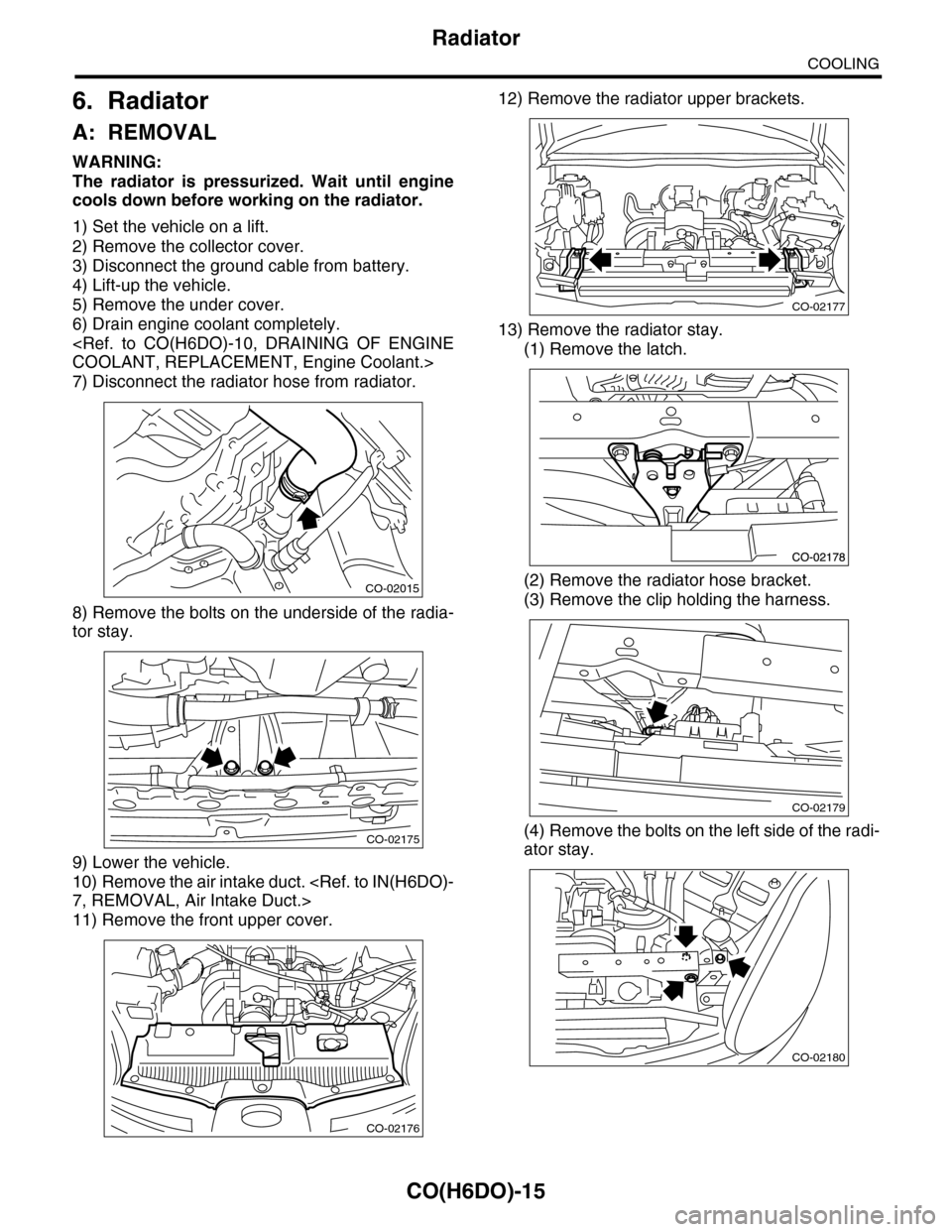
1) Set the vehicle on a lift.
2) Remove the collector cover.
3) Disconnect the ground cable from battery.
4) Lift-up the vehicle.
5) Remove the under cover.
6) Drain engine coolant completely.
7) Disconnect the radiator hose from radiator.
8) Remove the bolts on the underside of the radia-
tor stay.
9) Lower the vehicle.
10) Remove the air intake duct.
11) Remove the front upper cover.
12) Remove the radiator upper brackets.
13) Remove the radiator stay.
(1) Remove the latch.
(2) Remove the radiator hose bracket.
(3) Remove the clip holding the harness.
(4) Remove the bolts on the left side of the radi-
ator stay.
CO-02015
CO-02175
CO-02176
CO-02177
CO-02179
CO-02180
Page 1138 of 2453
CO(H6DO)-19
Radiator
COOLING
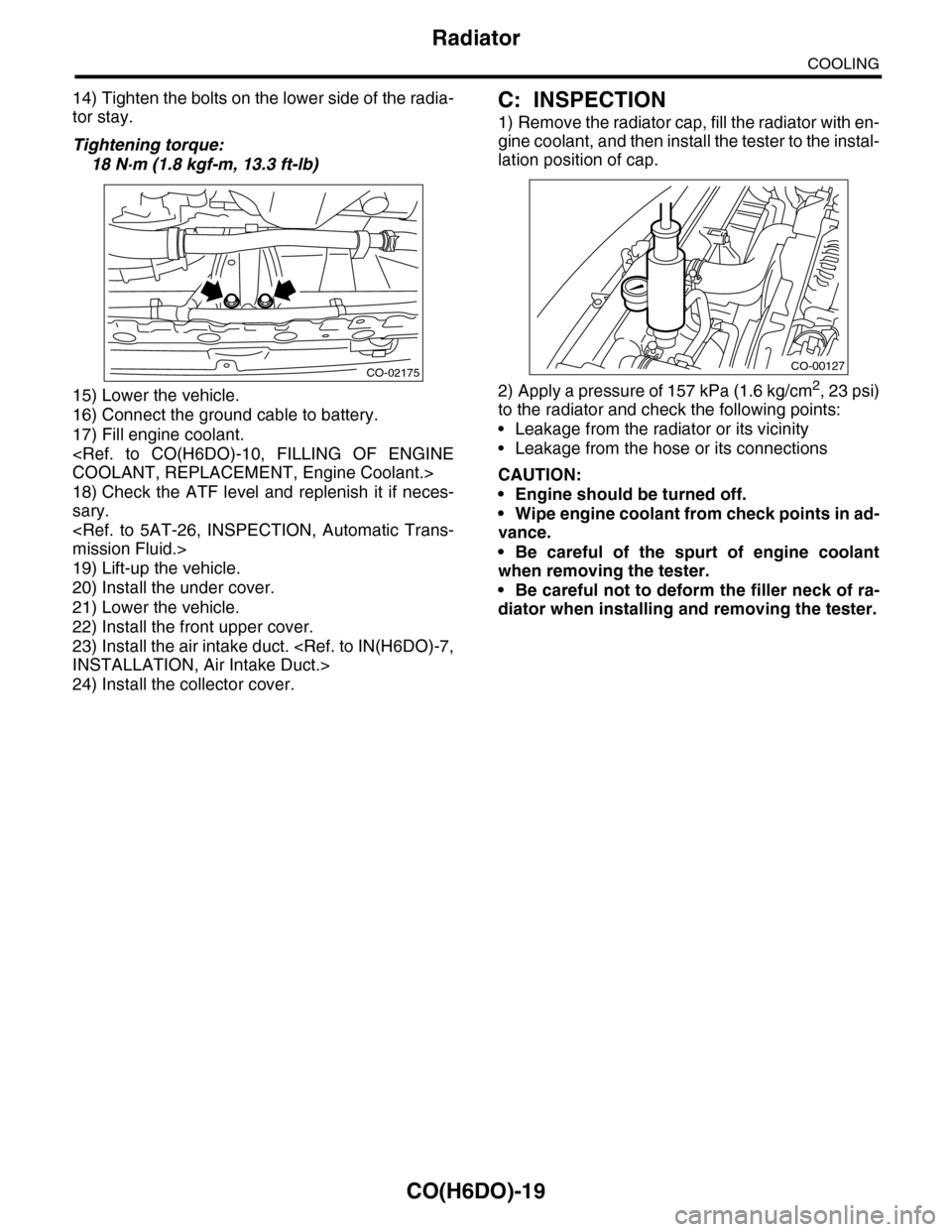
14) Tighten the bolts on the lower side of the radia-
tor stay.
Tightening torque:
18 N·m (1.8 kgf-m, 13.3 ft-lb)
15) Lower the vehicle.
16) Connect the ground cable to battery.
17) Fill engine coolant.
18) Check the ATF level and replenish it if neces-
sary.
19) Lift-up the vehicle.
20) Install the under cover.
21) Lower the vehicle.
22) Install the front upper cover.
23) Install the air intake duct.
24) Install the collector cover.
C: INSPECTION
1) Remove the radiator cap, fill the radiator with en-
gine coolant, and then install the tester to the instal-
lation position of cap.
2) Apply a pressure of 157 kPa (1.6 kg/cm2, 23 psi)
to the radiator and check the following points:
•Leakage from the radiator or its vicinity
•Leakage from the hose or its connections
CAUTION:
•Engine should be turned off.
•Wipe engine coolant from check points in ad-
vance.
•Be careful of the spurt of engine coolant
when removing the tester.
•Be careful not to deform the filler neck of ra-
diator when installing and removing the tester.
CO-02175CO-00127
Page 1140 of 2453
CO(H6DO)-21
Radiator Main Fan and Fan Motor
COOLING
8. Radiator Main Fan and Fan
Motor
A: REMOVAL
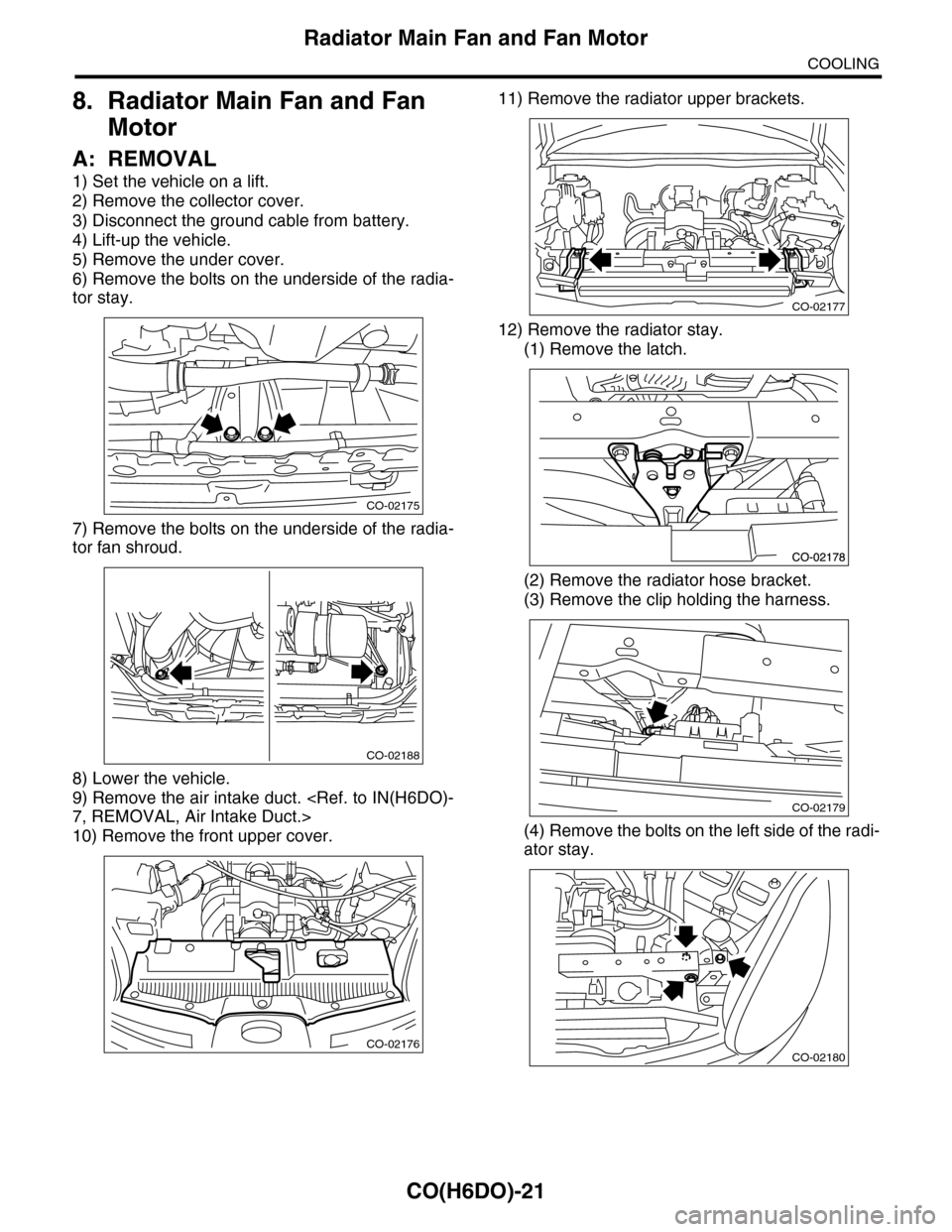
1) Set the vehicle on a lift.
2) Remove the collector cover.
3) Disconnect the ground cable from battery.
4) Lift-up the vehicle.
5) Remove the under cover.
6) Remove the bolts on the underside of the radia-
tor stay.
7) Remove the bolts on the underside of the radia-
tor fan shroud.
8) Lower the vehicle.
9) Remove the air intake duct.
10) Remove the front upper cover.
11) Remove the radiator upper brackets.
12) Remove the radiator stay.
(1) Remove the latch.
(2) Remove the radiator hose bracket.
(3) Remove the clip holding the harness.
(4) Remove the bolts on the left side of the radi-
ator stay.
CO-02175
CO-02188
CO-02176
CO-02177
CO-02179
CO-02180
Page 1142 of 2453
CO(H6DO)-23
Radiator Main Fan and Fan Motor
COOLING
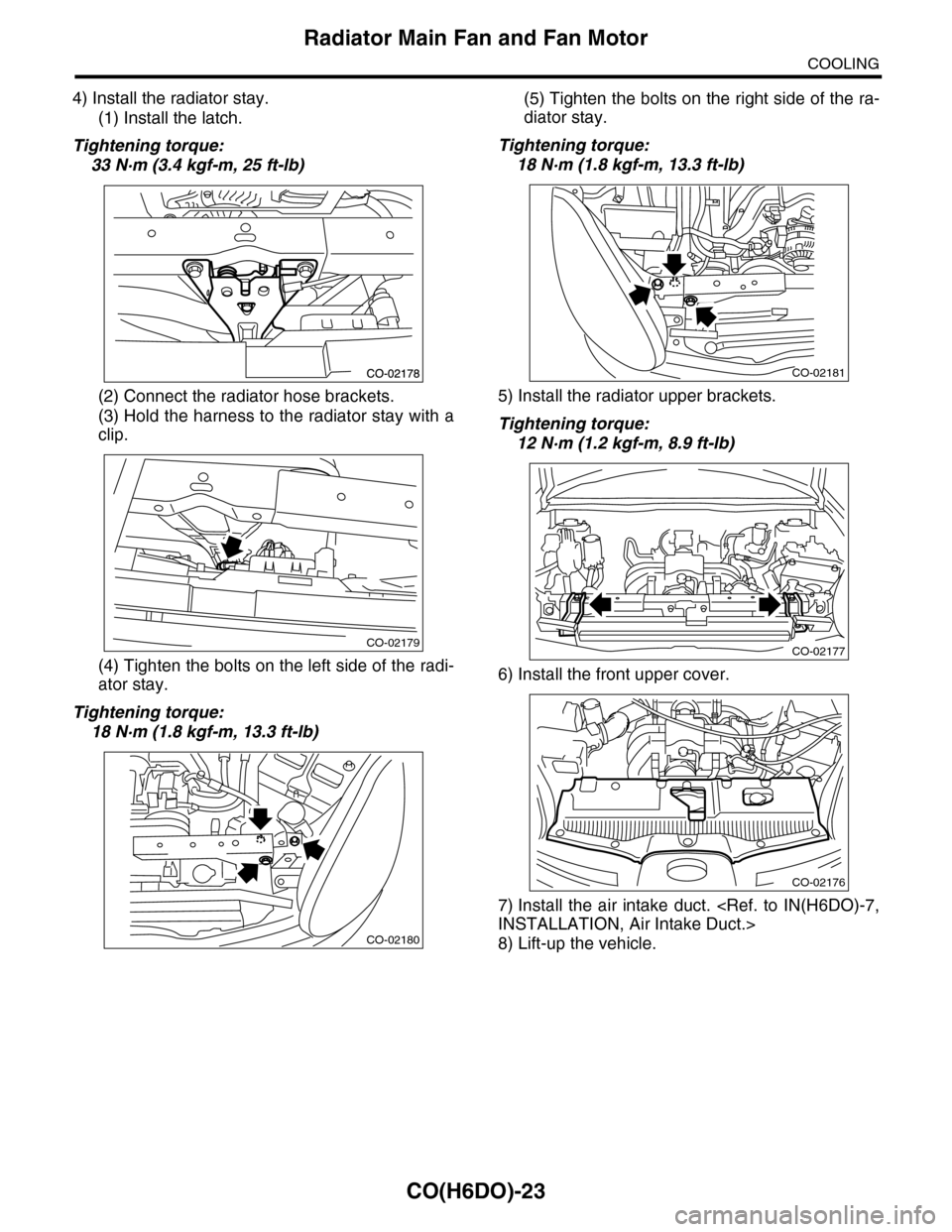
4) Install the radiator stay.
(1) Install the latch.
Tightening torque:
33 N·m (3.4 kgf-m, 25 ft-lb)
(2) Connect the radiator hose brackets.
(3) Hold the harness to the radiator stay with a
clip.
(4) Tighten the bolts on the left side of the radi-
ator stay.
Tightening torque:
18 N·m (1.8 kgf-m, 13.3 ft-lb)
(5) Tighten the bolts on the right side of the ra-
diator stay.
Tightening torque:
18 N·m (1.8 kgf-m, 13.3 ft-lb)
5) Install the radiator upper brackets.
Tightening torque:
12 N·m (1.2 kgf-m, 8.9 ft-lb)
6) Install the front upper cover.
7) Install the air intake duct.
8) Lift-up the vehicle.
CO-02179
CO-02180
CO-02181
CO-02177
CO-02176
Page 1145 of 2453
CO(H6DO)-26
Reservoir Tank
COOLING
10.Reservoir Tank
A: REMOVAL
1) Set the vehicle on a lift.
2) Remove the collector cover.
3) Lift-up the vehicle.
4) Remove the under cover.
5) Remove the bolts on the underside of the radia-
tor stay.
6) Lower the vehicle.
7) Remove the air intake duct.
8) Remove the front upper cover.
9) Remove the radiator upper brackets.
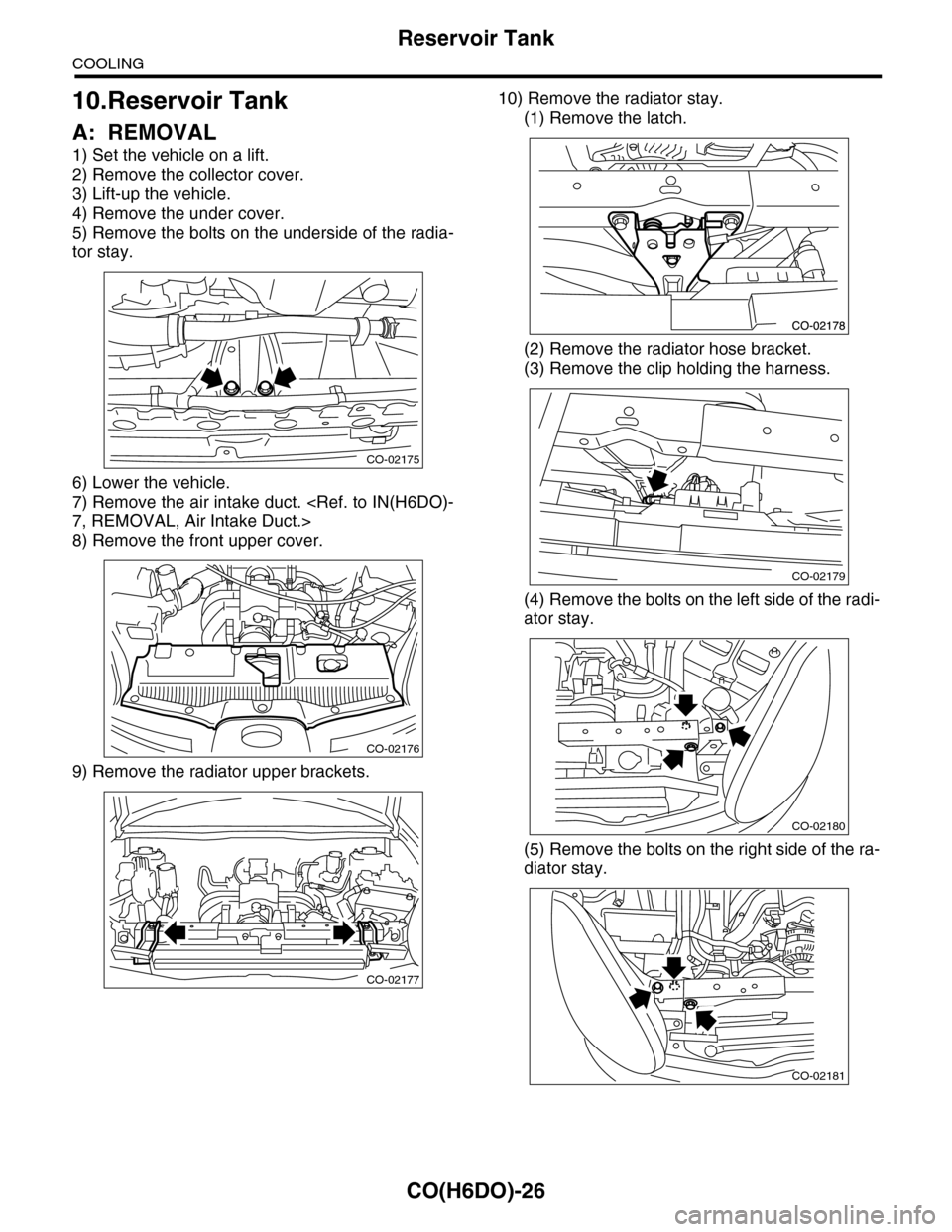
10) Remove the radiator stay.
(1) Remove the latch.
(2) Remove the radiator hose bracket.
(3) Remove the clip holding the harness.
(4) Remove the bolts on the left side of the radi-
ator stay.
(5) Remove the bolts on the right side of the ra-
diator stay.
CO-02175
CO-02176
CO-02177
CO-02179
CO-02180
CO-02181
Page 1147 of 2453
CO(H6DO)-28
Reservoir Tank
COOLING
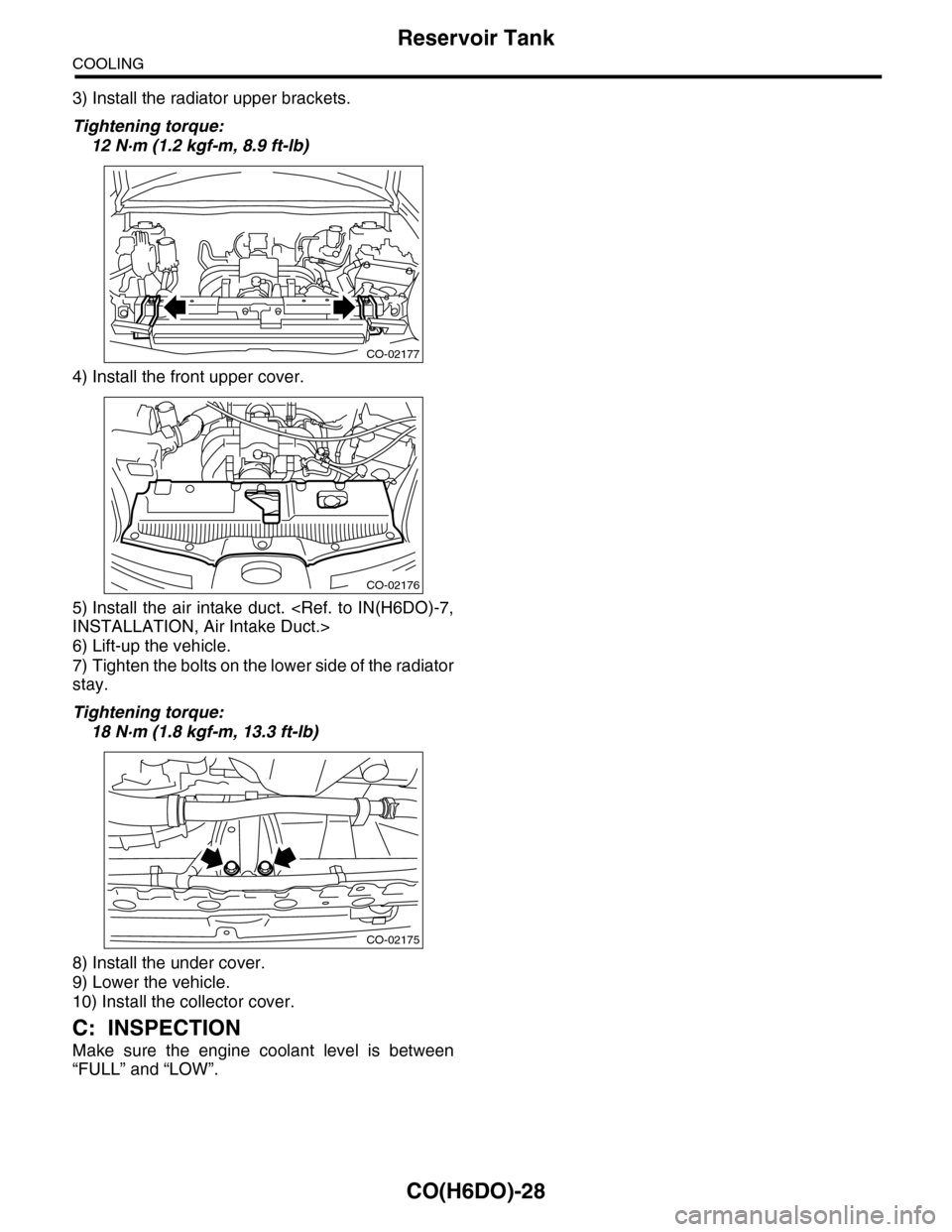
3) Install the radiator upper brackets.
Tightening torque:
12 N·m (1.2 kgf-m, 8.9 ft-lb)
4) Install the front upper cover.
5) Install the air intake duct.
6) Lift-up the vehicle.
7) Tighten the bolts on the lower side of the radiator
stay.
Tightening torque:
18 N·m (1.8 kgf-m, 13.3 ft-lb)
8) Install the under cover.
9) Lower the vehicle.
10) Install the collector cover.
C: INSPECTION
Make sure the engine coolant level is between
“FULL” and “LOW”.
CO-02177
CO-02176
CO-02175
Page 1148 of 2453
CO(H6DO)-29
Radiator Fan Control Unit
COOLING
11.Radiator Fan Control Unit
A: REMOVAL
1) Disconnect the ground cable from battery.
2) Remove the air intake duct.
3) Remove the front upper cover.
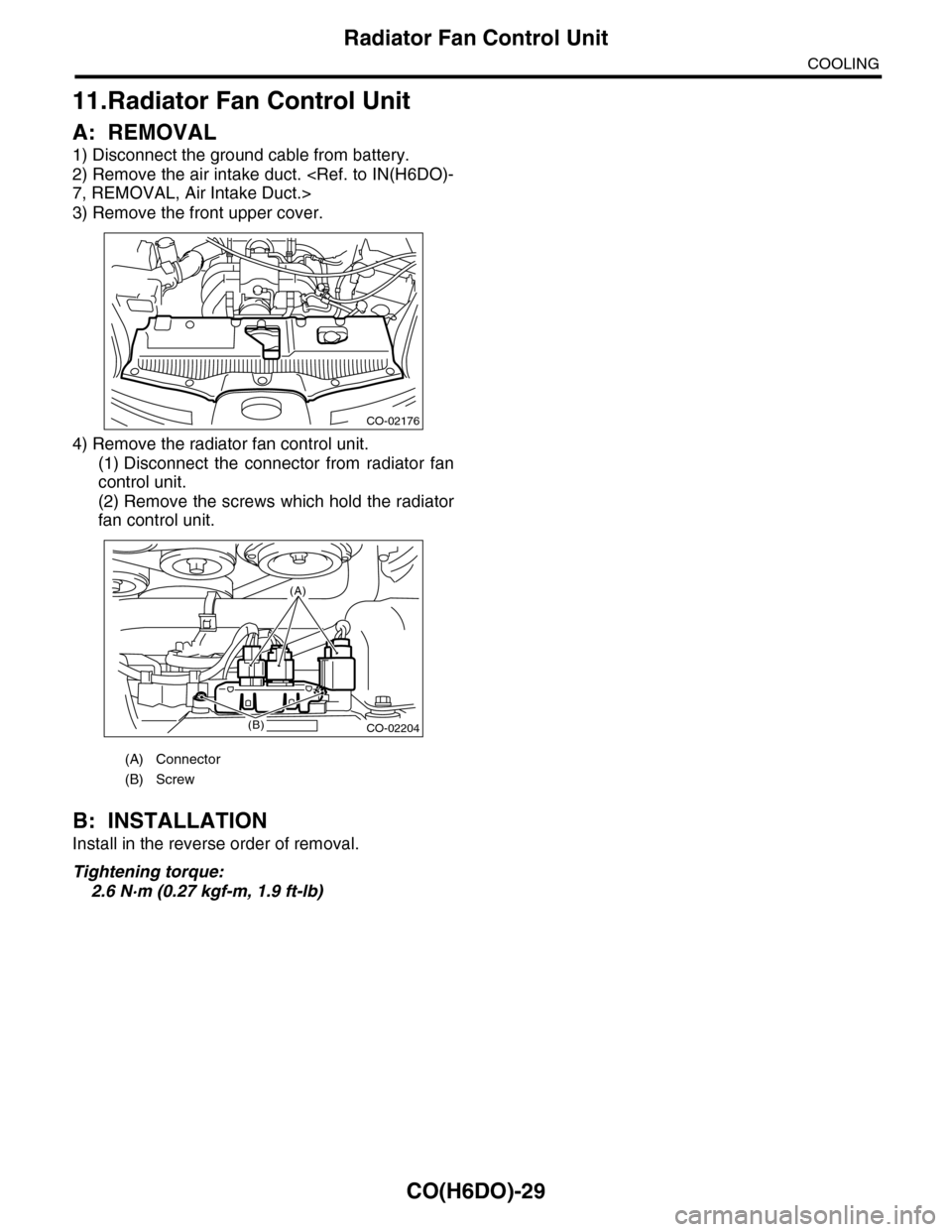
4) Remove the radiator fan control unit.
(1) Disconnect the connector from radiator fan
control unit.
(2) Remove the screws which hold the radiator
fan control unit.
B: INSTALLATION
Install in the reverse order of removal.
Tightening torque:
2.6 N·m (0.27 kgf-m, 1.9 ft-lb)
(A) Connector
(B) Screw
CO-02176
CO-02204
(A)
(B)
Page 1736 of 2453
GD(H6DO)-124
Diagnostic Trouble Code (DTC) Detecting Criteria
GENERAL DESCRIPTION
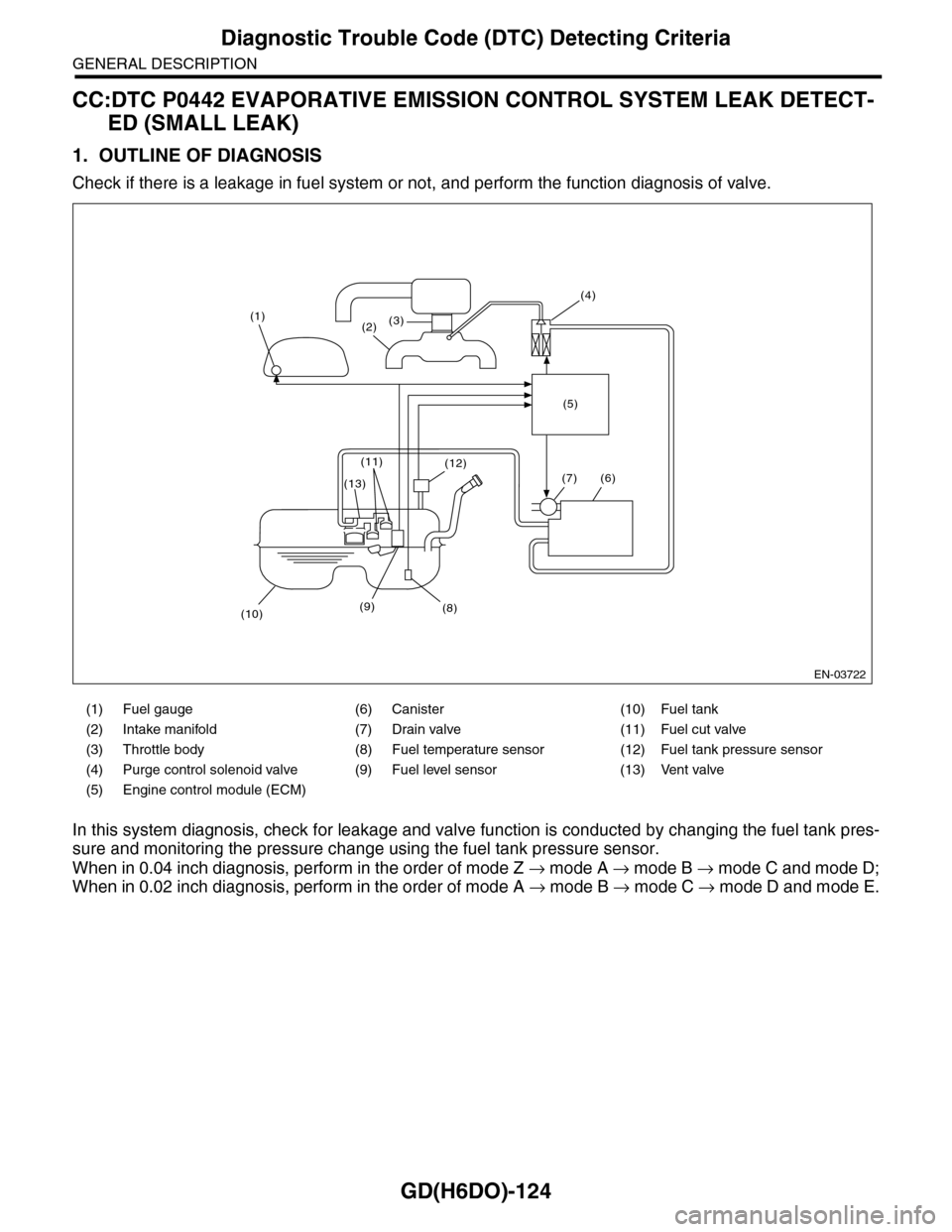
CC:DTC P0442 EVAPORATIVE EMISSION CONTROL SYSTEM LEAK DETECT-
ED (SMALL LEAK)
1. OUTLINE OF DIAGNOSIS
Check if there is a leakage in fuel system or not, and perform the function diagnosis of valve.
In this system diagnosis, check for leakage and valve function is conducted by changing the fuel tank pres-
sure and monitoring the pressure change using the fuel tank pressure sensor.
When in 0.04 inch diagnosis, perform in the order of mode Z → mode A → mode B → mode C and mode D;
When in 0.02 inch diagnosis, perform in the order of mode A → mode B → mode C → mode D and mode E.
(1) Fuel gauge (6) Canister (10) Fuel tank
(2) Intake manifold (7) Drain valve (11) Fuel cut valve
(3) Throttle body (8) Fuel temperature sensor (12) Fuel tank pressure sensor
(4) Purge control solenoid valve (9) Fuel level sensor (13) Vent valve
(5) Engine control module (ECM)
EN-03722
(1)(2)(3)
(4)
(5)
(6)
(8)
(12)
(9)(10)
(13)
(11)
(7)
Page 1744 of 2453
GD(H6DO)-132
Diagnostic Trouble Code (DTC) Detecting Criteria
GENERAL DESCRIPTION
Leak Diagnosis
DTC
P0442 Evaporative Emission Control System Leak Detected (Small Leak)
P0457 Evaporative Emission Control System Leak Detected (Fuel Cap Loose/Off)
Diagnostic method
The diagnostic method consists of creating a sealed vacuum in the fuel tank and then determining the pres-
ence of leakage from the speed at which the tank internal pressure returns to atmospheric pressure.
Mode A: (Estimated evaporation gas amount)
Calculate the tank pressure change amount (P1) when using mode A. After calculating P1, switch to mode B.
Mode B: (Negative pressure sealed)
Introduce negative pressure in the intake manifold to the tank.
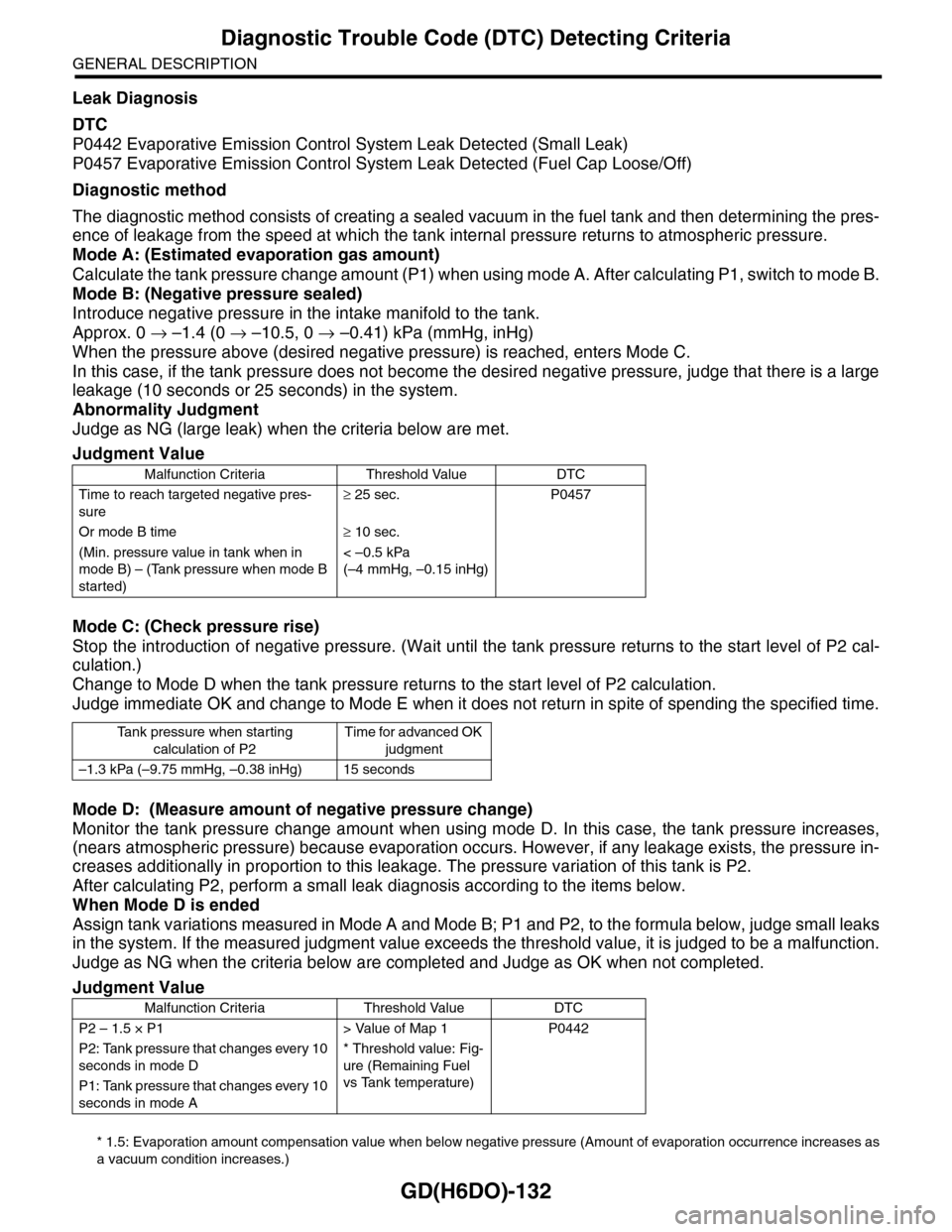
Approx. 0 → –1.4 (0 → –10.5, 0 → –0.41) kPa (mmHg, inHg)
When the pressure above (desired negative pressure) is reached, enters Mode C.
In this case, if the tank pressure does not become the desired negative pressure, judge that there is a large
leakage (10 seconds or 25 seconds) in the system.
Abnormality Judgment
Judge as NG (large leak) when the criteria below are met.
Mode C: (Check pressure rise)
Stop the introduction of negative pressure. (Wait until the tank pressure returns to the start level of P2 cal-
culation.)
Change to Mode D when the tank pressure returns to the start level of P2 calculation.
Judge immediate OK and change to Mode E when it does not return in spite of spending the specified time.
Mode D: (Measure amount of negative pressure change)
Monitor the tank pressure change amount when using mode D. In this case, the tank pressure increases,
(nears atmospheric pressure) because evaporation occurs. However, if any leakage exists, the pressure in-
creases additionally in proportion to this leakage. The pressure variation of this tank is P2.
After calculating P2, perform a small leak diagnosis according to the items below.
When Mode D is ended
Assign tank variations measured in Mode A and Mode B; P1 and P2, to the formula below, judge small leaks
in the system. If the measured judgment value exceeds the threshold value, it is judged to be a malfunction.
Judge as NG when the criteria below are completed and Judge as OK when not completed.
* 1.5: Evaporation amount compensation value when below negative pressure (Amount of evaporation occurrence increases as
a vacuum condition increases.)
Judgment Value
Malfunction Criteria Threshold Value DTC
Time to reach targeted negative pres-
sure
≥ 25 sec. P0457
Or mode B time≥ 10 sec.
(Min. pressure value in tank when in
mode B) – (Tank pressure when mode B
started)
< –0.5 kPa
(–4 mmHg, –0.15 inHg)
Ta n k p r e s s u r e w h e n s t a r t i n g
calculation of P2
Time for advanced OK
judgment
–1.3 kPa (–9.75 mmHg, –0.38 inHg) 15 seconds
Judgment Value
Malfunction Criteria Threshold Value DTC
P2 – 1.5 × P1 > Value of Map 1 P0442
P2: Tank pressure that changes every 10
seconds in mode D
* Threshold value: Fig-
ure (Remaining Fuel
vs Tank temperature)
P1: Tank pressure that changes every 10
seconds in mode A