300 SUZUKI SX4 2006 1.G Service Repair Manual
[x] Cancel search | Manufacturer: SUZUKI, Model Year: 2006, Model line: SX4, Model: SUZUKI SX4 2006 1.GPages: 1556, PDF Size: 37.31 MB
Page 596 of 1556
Downloaded from www.Manualslib.com manuals search engine 4C-1 Rear Brakes:
Brakes
Rear Brakes
Repair Instructions
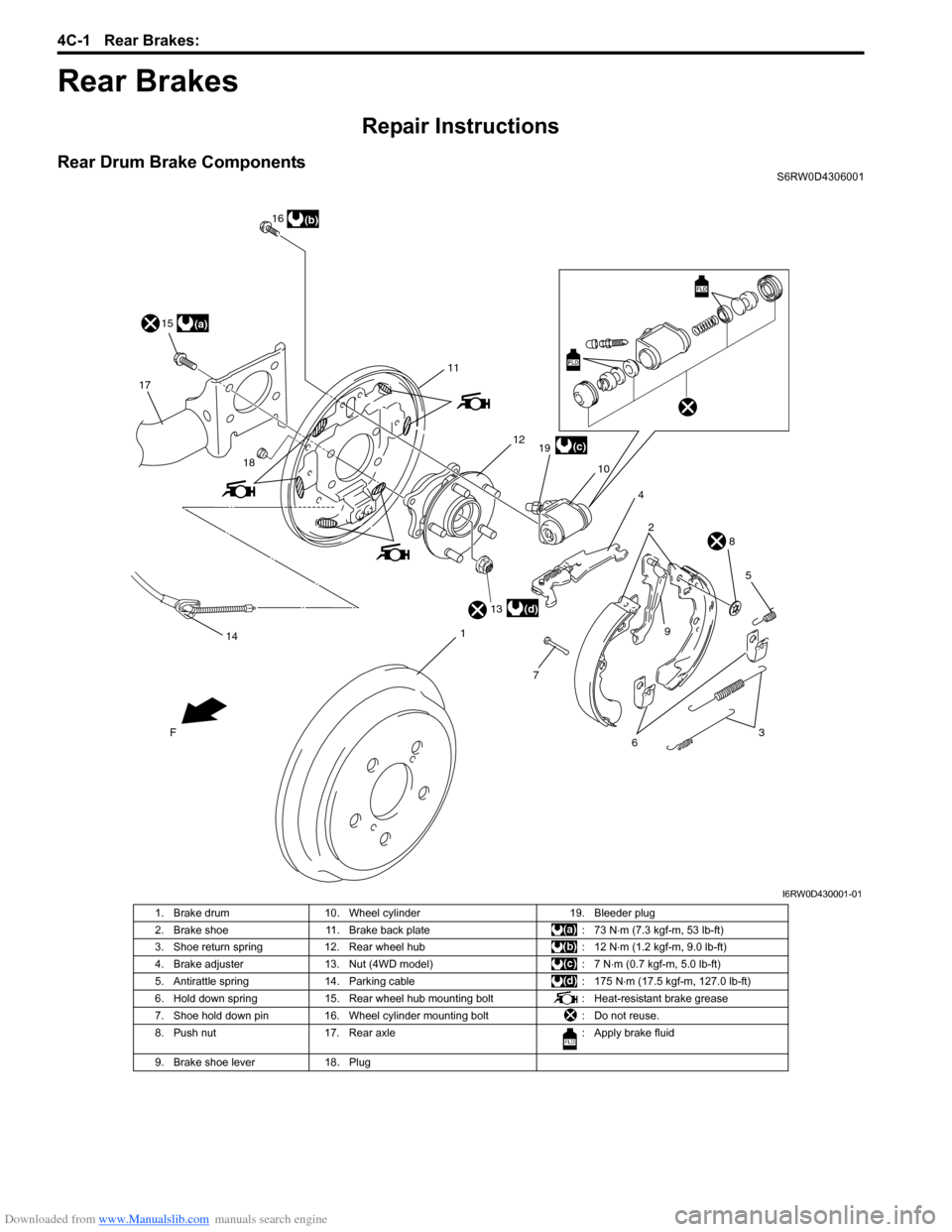
Rear Drum Brake ComponentsS6RW0D4306001
11
2
3
4
5
6 7
12
1411310 16
19 15
17
98
18
F
(a)
(b)
(c)
(d)
I6RW0D430001-01
1. Brake drum 10. Wheel cylinder 19. Bleeder plug
2. Brake shoe 11. Brake back plate : 73 N⋅m (7.3 kgf-m, 53 lb-ft)
3. Shoe return spring 12. Rear wheel hub : 12 N⋅m (1.2 kgf-m, 9.0 lb-ft)
4. Brake adjuster 13. Nut (4WD model) : 7 N⋅m (0.7 kgf-m, 5.0 lb-ft)
5. Antirattle spring 14. Parking cable : 175 N⋅m (17.5 kgf-m, 127.0 lb-ft)
6. Hold down spring 15. Rear wheel hub mounting bolt : Heat-resistant brake grease
7. Shoe hold down pin 16. Wheel cylinder mounting bolt : Do not reuse.
8. Push nut 17. Rear axle : Apply brake fluid
9. Brake shoe lever 18. Plug
Page 597 of 1556
Downloaded from www.Manualslib.com manuals search engine Rear Brakes: 4C-2
Rear Brake Drum Removal and InstallationS6RW0D4306002
Removal
1) Hoist vehicle and remove rear wheel.
2) Release parking brake lever.
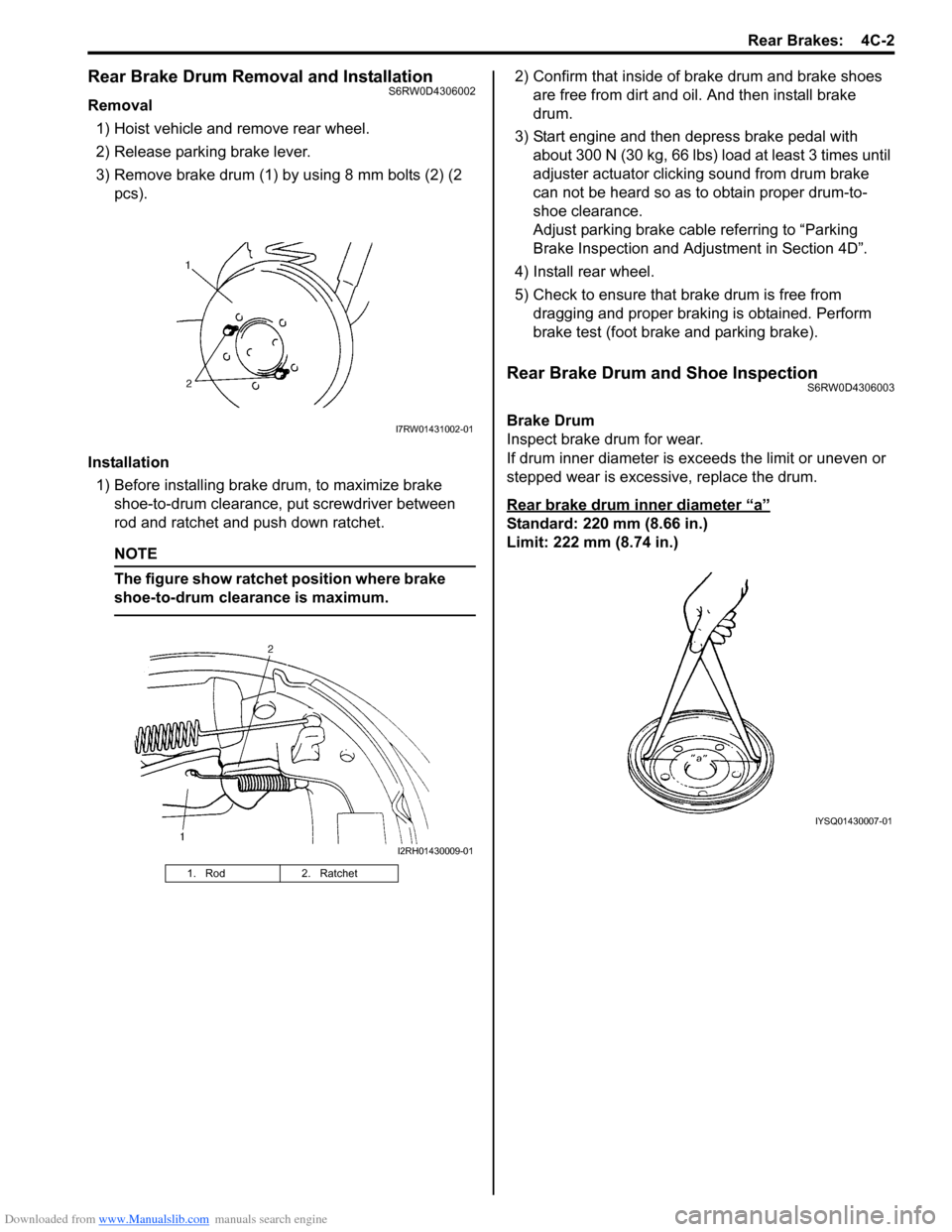
3) Remove brake drum (1) by using 8 mm bolts (2) (2
pcs).
Installation
1) Before installing brake drum, to maximize brake
shoe-to-drum clearance, put screwdriver between
rod and ratchet and push down ratchet.
NOTE
The figure show ratchet position where brake
shoe-to-drum clearance is maximum.
2) Confirm that inside of brake drum and brake shoes
are free from dirt and oil. And then install brake
drum.
3) Start engine and then depress brake pedal with
about 300 N (30 kg, 66 lbs) load at least 3 times until
adjuster actuator clicking sound from drum brake
can not be heard so as to obtain proper drum-to-
shoe clearance.
Adjust parking brake cable referring to “Parking
Brake Inspection and Adjustment in Section 4D”.
4) Install rear wheel.
5) Check to ensure that brake drum is free from
dragging and proper braking is obtained. Perform
brake test (foot brake and parking brake).
Rear Brake Drum and Shoe InspectionS6RW0D4306003
Brake Drum
Inspect brake drum for wear.
If drum inner diameter is exceeds the limit or uneven or
stepped wear is excessive, replace the drum.
Rear brake drum inner diameter
“a”
Standard: 220 mm (8.66 in.)
Limit: 222 mm (8.74 in.)
1. Rod 2. Ratchet
I7RW01431002-01
I2RH01430009-01
IYSQ01430007-01
Page 598 of 1556
Downloaded from www.Manualslib.com manuals search engine 4C-3 Rear Brakes:
Cracked, Scored or Grooved Drum
A cracked drum is unsafe for further service and must be
replaced. Do not attempt to weld a cracked drum.
Smooth up any slight scores. Heavy or extensive scoring
will cause excessive brake lining wear and it will
probably be necessary to resurface drum braking
surface.
If brake linings are slightly worn and drum is grooved,
drum should be polished with fine emery cloth in the
direction of drum depth but not circumferentially along
drum inner.
NOTE
When drum is removed, visually inspect
wheel cylinder for brake fluid leakage.
Correct leaky point, if any.
Brake Shoe
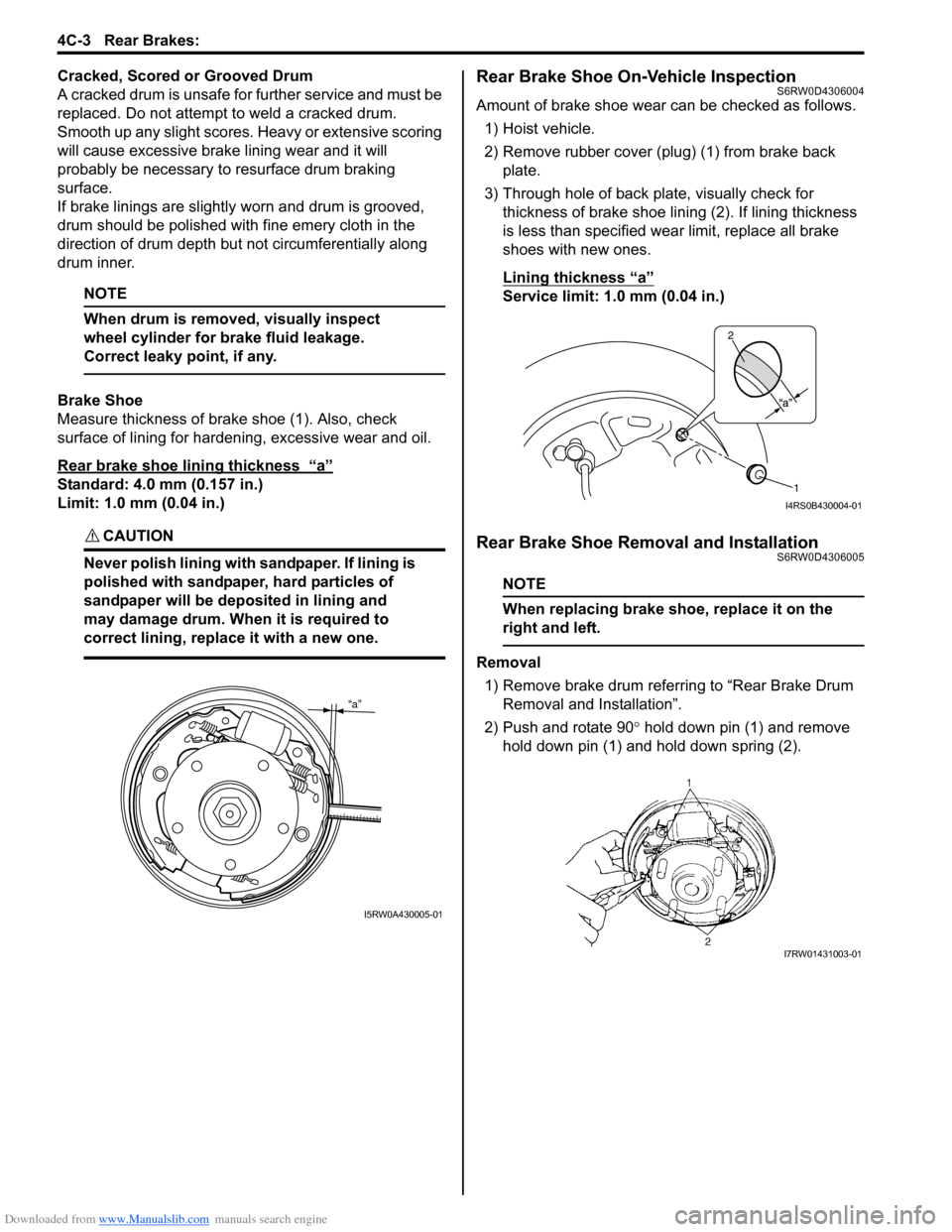
Measure thickness of brake shoe (1). Also, check
surface of lining for hardening, excessive wear and oil.
Rear brake shoe lining thickness
“a”
Standard: 4.0 mm (0.157 in.)
Limit: 1.0 mm (0.04 in.)
CAUTION!
Never polish lining with sandpaper. If lining is
polished with sandpaper, hard particles of
sandpaper will be deposited in lining and
may damage drum. When it is required to
correct lining, replace it with a new one.
Rear Brake Shoe On-Vehicle InspectionS6RW0D4306004
Amount of brake shoe wear can be checked as follows.
1) Hoist vehicle.
2) Remove rubber cover (plug) (1) from brake back
plate.
3) Through hole of back plate, visually check for
thickness of brake shoe lining (2). If lining thickness
is less than specified wear limit, replace all brake
shoes with new ones.
Lining thickness “a”
Service limit: 1.0 mm (0.04 in.)
Rear Brake Shoe Removal and InstallationS6RW0D4306005
NOTE
When replacing brake shoe, replace it on the
right and left.
Removal
1) Remove brake drum referring to “Rear Brake Drum
Removal and Installation”.
2) Push and rotate 90° hold down pin (1) and remove
hold down pin (1) and hold down spring (2).
“a”
I5RW0A430005-01
2
1
I4RS0B430004-01
I7RW01431003-01
Page 599 of 1556
Downloaded from www.Manualslib.com manuals search engine Rear Brakes: 4C-4
3) Remove return springs, brake shoes and adjuster.
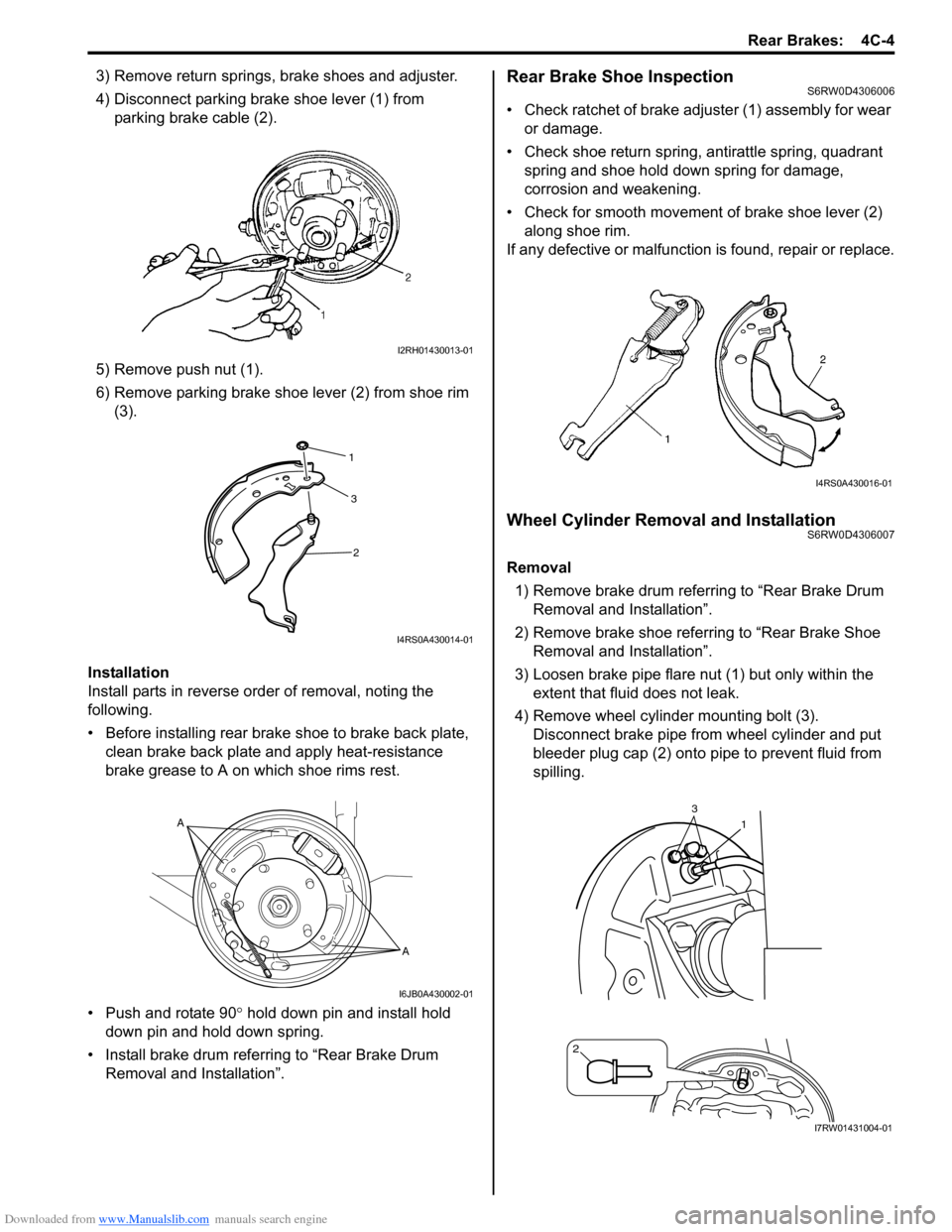
4) Disconnect parking brake shoe lever (1) from
parking brake cable (2).
5) Remove push nut (1).
6) Remove parking brake shoe lever (2) from shoe rim
(3).
Installation
Install parts in reverse order of removal, noting the
following.
• Before installing rear brake shoe to brake back plate,
clean brake back plate and apply heat-resistance
brake grease to A on which shoe rims rest.
• Push and rotate 90° hold down pin and install hold
down pin and hold down spring.
• Install brake drum referring to “Rear Brake Drum
Removal and Installation”.Rear Brake Shoe InspectionS6RW0D4306006
• Check ratchet of brake adjuster (1) assembly for wear
or damage.
• Check shoe return spring, antirattle spring, quadrant
spring and shoe hold down spring for damage,
corrosion and weakening.
• Check for smooth movement of brake shoe lever (2)
along shoe rim.
If any defective or malfunction is found, repair or replace.
Wheel Cylinder Removal and InstallationS6RW0D4306007
Removal
1) Remove brake drum referring to “Rear Brake Drum
Removal and Installation”.
2) Remove brake shoe referring to “Rear Brake Shoe
Removal and Installation”.
3) Loosen brake pipe flare nut (1) but only within the
extent that fluid does not leak.
4) Remove wheel cylinder mounting bolt (3).
Disconnect brake pipe from wheel cylinder and put
bleeder plug cap (2) onto pipe to prevent fluid from
spilling.
I2RH01430013-01
1
2 3
I4RS0A430014-01
A
A
I6JB0A430002-01
I4RS0A430016-01
1
2
3
I7RW01431004-01
Page 600 of 1556
Downloaded from www.Manualslib.com manuals search engine 4C-5 Rear Brakes:
Installation
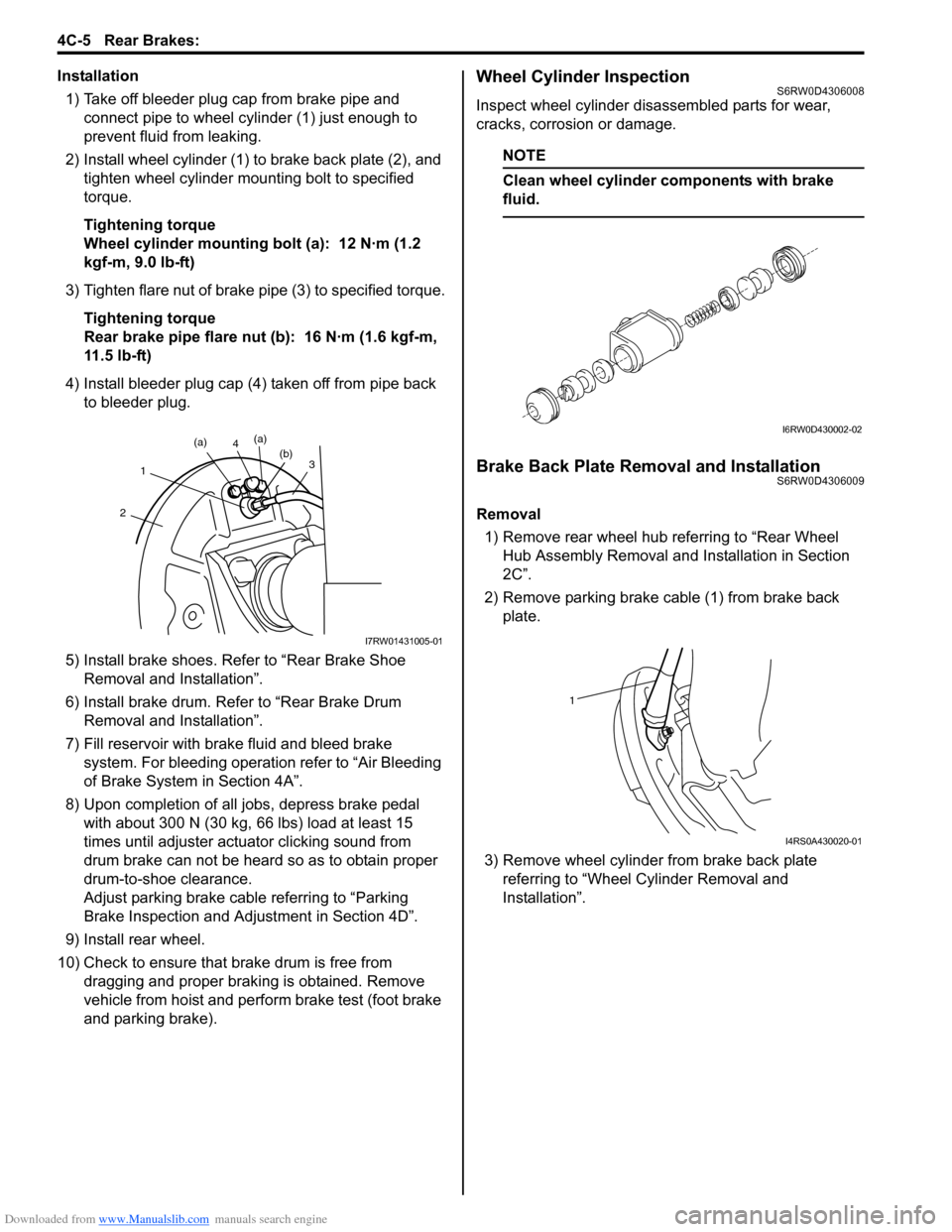
1) Take off bleeder plug cap from brake pipe and
connect pipe to wheel cylinder (1) just enough to
prevent fluid from leaking.
2) Install wheel cylinder (1) to brake back plate (2), and
tighten wheel cylinder mounting bolt to specified
torque.
Tightening torque
Wheel cylinder mounting bolt (a): 12 N·m (1.2
kgf-m, 9.0 lb-ft)
3) Tighten flare nut of brake pipe (3) to specified torque.
Tightening torque
Rear brake pipe flare nut (b): 16 N·m (1.6 kgf-m,
11.5 lb-ft)
4) Install bleeder plug cap (4) taken off from pipe back
to bleeder plug.
5) Install brake shoes. Refer to “Rear Brake Shoe
Removal and Installation”.
6) Install brake drum. Refer to “Rear Brake Drum
Removal and Installation”.
7) Fill reservoir with brake fluid and bleed brake
system. For bleeding operation refer to “Air Bleeding
of Brake System in Section 4A”.
8) Upon completion of all jobs, depress brake pedal
with about 300 N (30 kg, 66 lbs) load at least 15
times until adjuster actuator clicking sound from
drum brake can not be heard so as to obtain proper
drum-to-shoe clearance.
Adjust parking brake cable referring to “Parking
Brake Inspection and Adjustment in Section 4D”.
9) Install rear wheel.
10) Check to ensure that brake drum is free from
dragging and proper braking is obtained. Remove
vehicle from hoist and perform brake test (foot brake
and parking brake).Wheel Cylinder InspectionS6RW0D4306008
Inspect wheel cylinder disassembled parts for wear,
cracks, corrosion or damage.
NOTE
Clean wheel cylinder components with brake
fluid.
Brake Back Plate Removal and InstallationS6RW0D4306009
Removal
1) Remove rear wheel hub referring to “Rear Wheel
Hub Assembly Removal and Installation in Section
2C”.
2) Remove parking brake cable (1) from brake back
plate.
3) Remove wheel cylinder from brake back plate
referring to “Wheel Cylinder Removal and
Installation”.
(b)3
4(a)
(a)
1
2
I7RW01431005-01
I6RW0D430002-02
1
I4RS0A430020-01
Page 601 of 1556
Downloaded from www.Manualslib.com manuals search engine Rear Brakes: 4C-6
Installation
Install brake back plate by reversing removal procedure,
noting the instructions.
CAUTION!
Never reuse rear wheel hub mounting bolts.
• Install rear wheel hub and brake back plate, and then
tighten mounting bolt. Refer to “Rear Drum Brake
Components”.
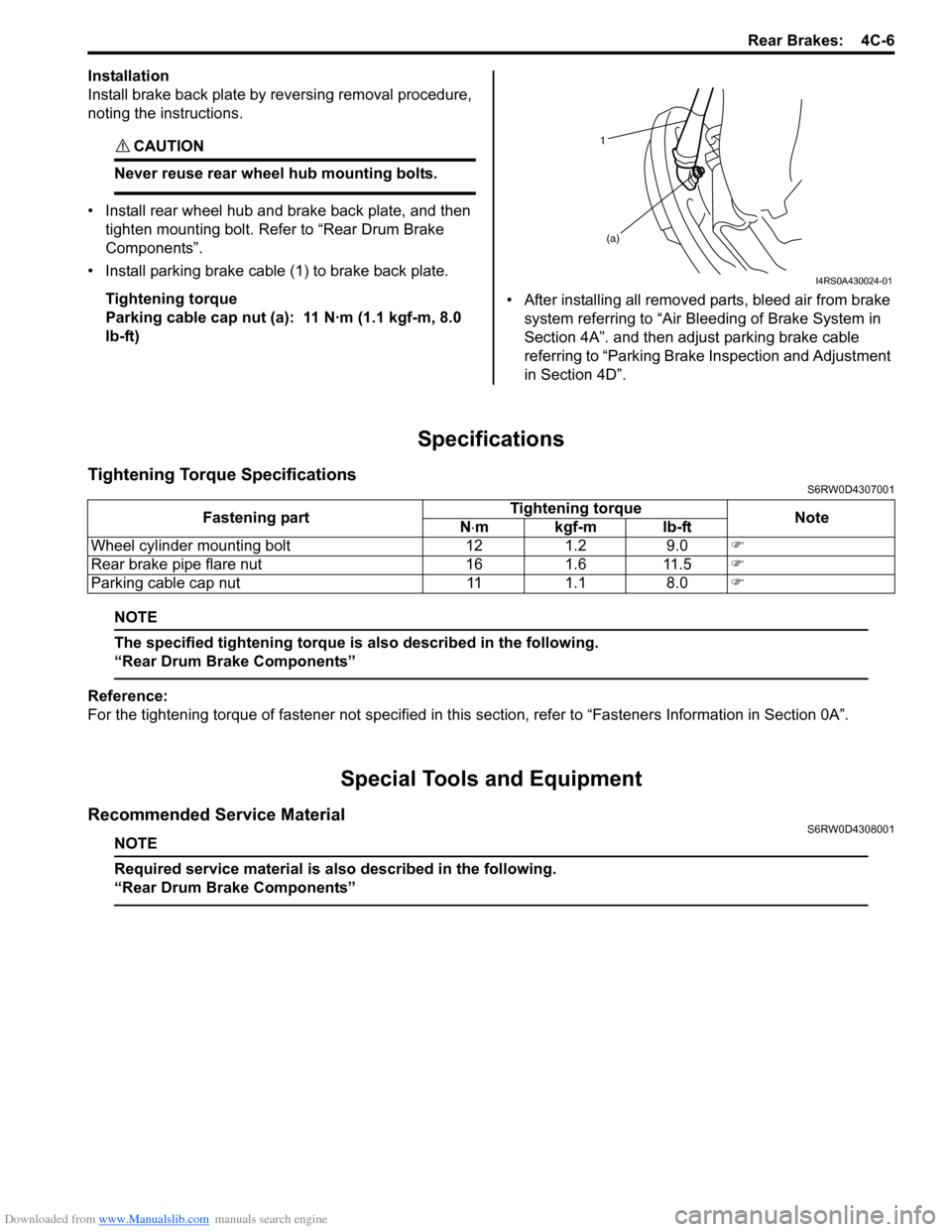
• Install parking brake cable (1) to brake back plate.
Tightening torque
Parking cable cap nut (a): 11 N·m (1.1 kgf-m, 8.0
lb-ft)• After installing all removed parts, bleed air from brake
system referring to “Air Bleeding of Brake System in
Section 4A”. and then adjust parking brake cable
referring to “Parking Brake Inspection and Adjustment
in Section 4D”.
Specifications
Tightening Torque SpecificationsS6RW0D4307001
NOTE
The specified tightening torque is also described in the following.
“Rear Drum Brake Components”
Reference:
For the tightening torque of fastener not specified in this section, refer to “Fasteners Information in Section 0A”.
Special Tools and Equipment
Recommended Service MaterialS6RW0D4308001
NOTE
Required service material is also described in the following.
“Rear Drum Brake Components”
1
(a)
I4RS0A430024-01
Fastening partTightening torque
Note
N⋅mkgf-mlb-ft
Wheel cylinder mounting bolt 12 1.2 9.0)
Rear brake pipe flare nut 16 1.6 11.5)
Parking cable cap nut 11 1.1 8.0)
Page 603 of 1556
Downloaded from www.Manualslib.com manuals search engine Parking Brake: 4D-2
Repair Instructions
Parking Brake Inspection and AdjustmentS6RW0D4406001
Inspection
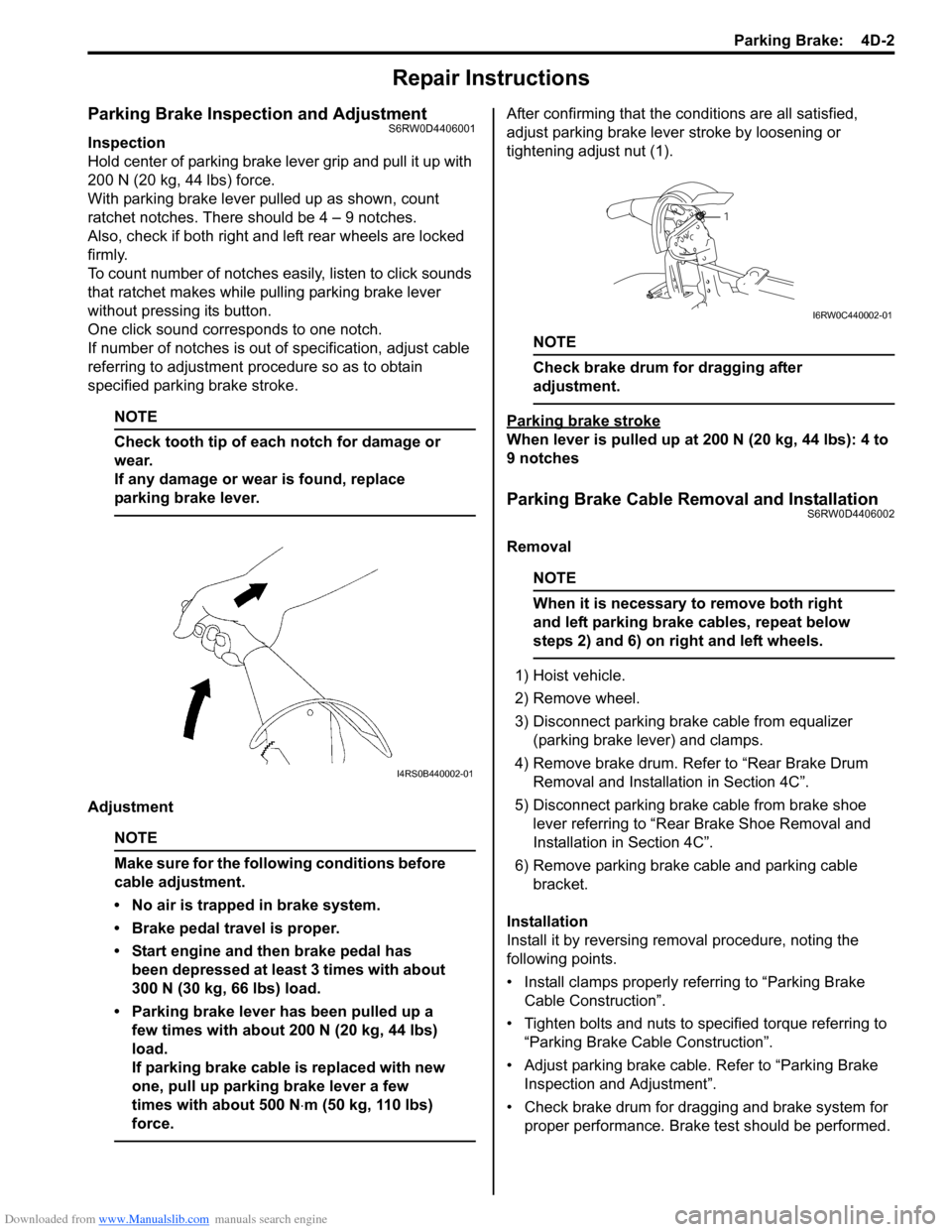
Hold center of parking brake lever grip and pull it up with
200 N (20 kg, 44 lbs) force.
With parking brake lever pulled up as shown, count
ratchet notches. There should be 4 – 9 notches.
Also, check if both right and left rear wheels are locked
firmly.
To count number of notches easily, listen to click sounds
that ratchet makes while pulling parking brake lever
without pressing its button.
One click sound corresponds to one notch.
If number of notches is out of specification, adjust cable
referring to adjustment procedure so as to obtain
specified parking brake stroke.
NOTE
Check tooth tip of each notch for damage or
wear.
If any damage or wear is found, replace
parking brake lever.
Adjustment
NOTE
Make sure for the following conditions before
cable adjustment.
• No air is trapped in brake system.
• Brake pedal travel is proper.
• Start engine and then brake pedal has
been depressed at least 3 times with about
300 N (30 kg, 66 lbs) load.
• Parking brake lever has been pulled up a
few times with about 200 N (20 kg, 44 lbs)
load.
If parking brake cable is replaced with new
one, pull up parking brake lever a few
times with about 500 N⋅m (50 kg, 110 lbs)
force.
After confirming that the conditions are all satisfied,
adjust parking brake lever stroke by loosening or
tightening adjust nut (1).
NOTE
Check brake drum for dragging after
adjustment.
Parking brake stroke
When lever is pulled up at 200 N (20 kg, 44 lbs): 4 to
9 notches
Parking Brake Cable Removal and InstallationS6RW0D4406002
Removal
NOTE
When it is necessary to remove both right
and left parking brake cables, repeat below
steps 2) and 6) on right and left wheels.
1) Hoist vehicle.
2) Remove wheel.
3) Disconnect parking brake cable from equalizer
(parking brake lever) and clamps.
4) Remove brake drum. Refer to “Rear Brake Drum
Removal and Installation in Section 4C”.
5) Disconnect parking brake cable from brake shoe
lever referring to “Rear Brake Shoe Removal and
Installation in Section 4C”.
6) Remove parking brake cable and parking cable
bracket.
Installation
Install it by reversing removal procedure, noting the
following points.
• Install clamps properly referring to “Parking Brake
Cable Construction”.
• Tighten bolts and nuts to specified torque referring to
“Parking Brake Cable Construction”.
• Adjust parking brake cable. Refer to “Parking Brake
Inspection and Adjustment”.
• Check brake drum for dragging and brake system for
proper performance. Brake test should be performed.
I4RS0B440002-01
1
I6RW0C440002-01
Page 613 of 1556
Downloaded from www.Manualslib.com manuals search engine ABS: 4E-8
Component Location
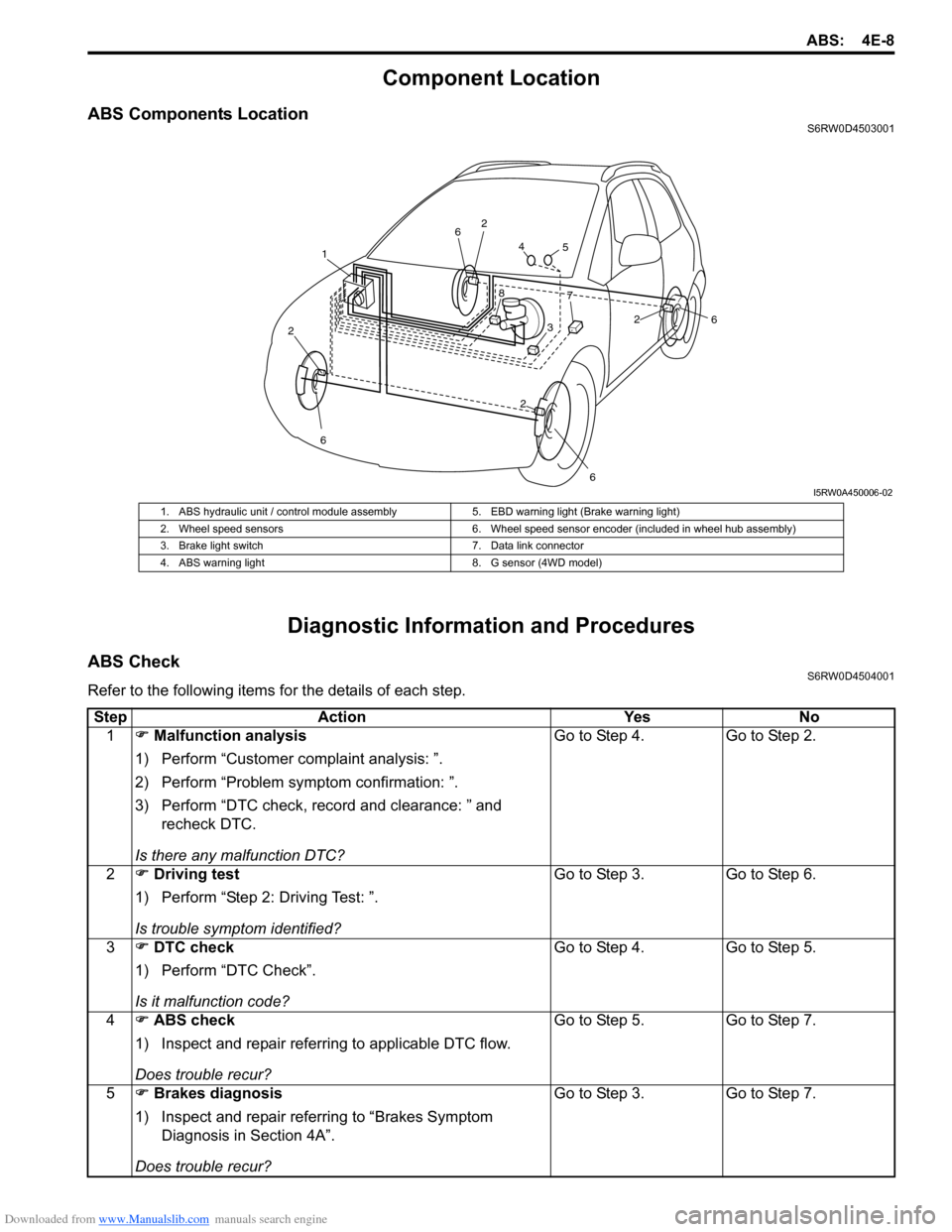
ABS Components LocationS6RW0D4503001
Diagnostic Information and Procedures
ABS CheckS6RW0D4504001
Refer to the following items for the details of each step.
1
2
6
2
6
26
264
5
7
3
8
I5RW0A450006-02
1. ABS hydraulic unit / control module assembly 5. EBD warning light (Brake warning light)
2. Wheel speed sensors 6. Wheel speed sensor encoder (included in wheel hub assembly)
3. Brake light switch 7. Data link connector
4. ABS warning light 8. G sensor (4WD model)
Step Action Yes No
1) Malfunction analysis
1) Perform “Customer complaint analysis: ”.
2) Perform “Problem symptom confirmation: ”.
3) Perform “DTC check, record and clearance: ” and
recheck DTC.
Is there any malfunction DTC?Go to Step 4. Go to Step 2.
2) Driving test
1) Perform “Step 2: Driving Test: ”.
Is trouble symptom identified?Go to Step 3. Go to Step 6.
3) DTC check
1) Perform “DTC Check”.
Is it malfunction code?Go to Step 4. Go to Step 5.
4) ABS check
1) Inspect and repair referring to applicable DTC flow.
Does trouble recur?Go to Step 5. Go to Step 7.
5) Brakes diagnosis
1) Inspect and repair referring to “Brakes Symptom
Diagnosis in Section 4A”.
Does trouble recur?Go to Step 3. Go to Step 7.
Page 632 of 1556
Downloaded from www.Manualslib.com manuals search engine 4E-27 ABS:
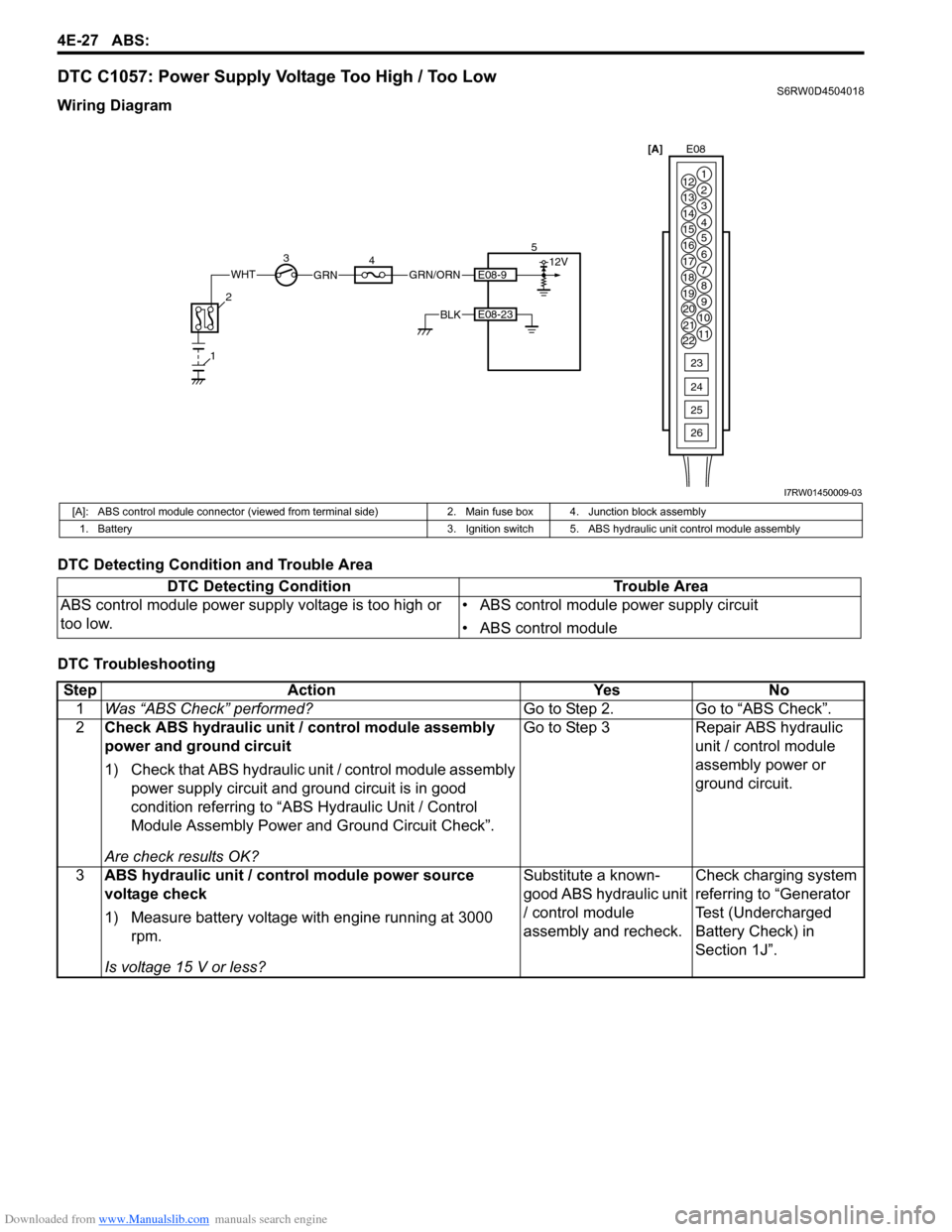
DTC C1057: Power Supply Voltage Too High / Too LowS6RW0D4504018
Wiring Diagram
DTC Detecting Condition and Trouble Area
DTC Troubleshooting
WHTGRN
34 5
E08-23BLK
12VE08-9GRN/ORN
2
1
[A]E08
1
2
3
4
5
6
7 12
13
14
15
16
17
18
19
20
21
228
9
10
11
23
24
25
26
I7RW01450009-03
[A]: ABS control module connector (viewed from terminal side) 2. Main fuse box 4. Junction block assembly
1. Battery 3. Ignition switch 5. ABS hydraulic unit control module assembly
DTC Detecting Condition Trouble Area
ABS control module power supply voltage is too high or
too low.• ABS control module power supply circuit
• ABS control module
Step Action Yes No
1Was “ABS Check” performed?Go to Step 2. Go to “ABS Check”.
2Check ABS hydraulic unit / control module assembly
power and ground circuit
1) Check that ABS hydraulic unit / control module assembly
power supply circuit and ground circuit is in good
condition referring to “ABS Hydraulic Unit / Control
Module Assembly Power and Ground Circuit Check”.
Are check results OK?Go to Step 3 Repair ABS hydraulic
unit / control module
assembly power or
ground circuit.
3ABS hydraulic unit / control module power source
voltage check
1) Measure battery voltage with engine running at 3000
rpm.
Is voltage 15 V or less?Substitute a known-
good ABS hydraulic unit
/ control module
assembly and recheck.Check charging system
referring to “Generator
Test (Undercharged
Battery Check) in
Section 1J”.
Page 653 of 1556
Downloaded from www.Manualslib.com manuals search engine Automatic Transmission/Transaxle: 5A-5
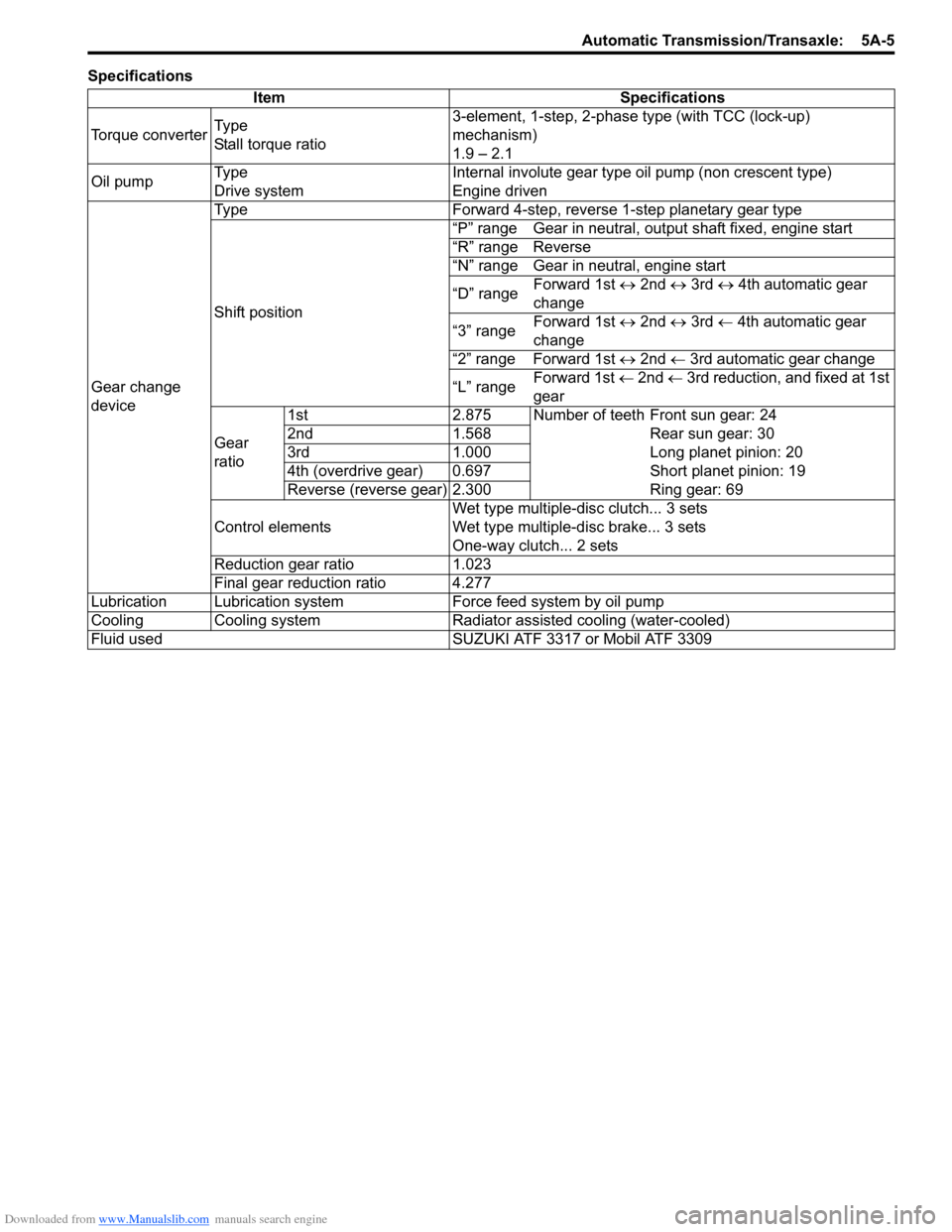
Specifications
Item Specifications
Torque converterTy p e
Stall torque ratio3-element, 1-step, 2-phase type (with TCC (lock-up)
mechanism)
1.9 – 2.1
Oil pumpTy p e
Drive systemInternal involute gear type oil pump (non crescent type)
Engine driven
Gear change
deviceType Forward 4-step, reverse 1-step planetary gear type
Shift position“P” range Gear in neutral, output shaft fixed, engine start
“R” range Reverse
“N” range Gear in neutral, engine start
“D” range Forward 1st ↔ 2nd ↔ 3rd ↔ 4th automatic gear
change
“3” rangeForward 1st ↔ 2nd ↔ 3rd ← 4th automatic gear
change
“2” range Forward 1st ↔ 2nd ← 3rd automatic gear change
“L” rangeForward 1st ← 2nd ← 3rd reduction, and fixed at 1st
gear
Gear
ratio1st 2.875 Number of teeth Front sun gear: 24
2nd 1.568 Rear sun gear: 30
3rd 1.000 Long planet pinion: 20
4th (overdrive gear) 0.697 Short planet pinion: 19
Reverse (reverse gear) 2.300 Ring gear: 69
Control elementsWet type multiple-disc clutch... 3 sets
Wet type multiple-disc brake... 3 sets
One-way clutch... 2 sets
Reduction gear ratio 1.023
Final gear reduction ratio 4.277
Lubrication Lubrication system Force feed system by oil pump
Cooling Cooling system Radiator assisted cooling (water-cooled)
Fluid used SUZUKI ATF 3317 or Mobil ATF 3309