300 SUZUKI SX4 2006 1.G Service Manual PDF
[x] Cancel search | Manufacturer: SUZUKI, Model Year: 2006, Model line: SX4, Model: SUZUKI SX4 2006 1.GPages: 1556, PDF Size: 37.31 MB
Page 662 of 1556
Downloaded from www.Manualslib.com manuals search engine 5A-14 Automatic Transmission/Transaxle:
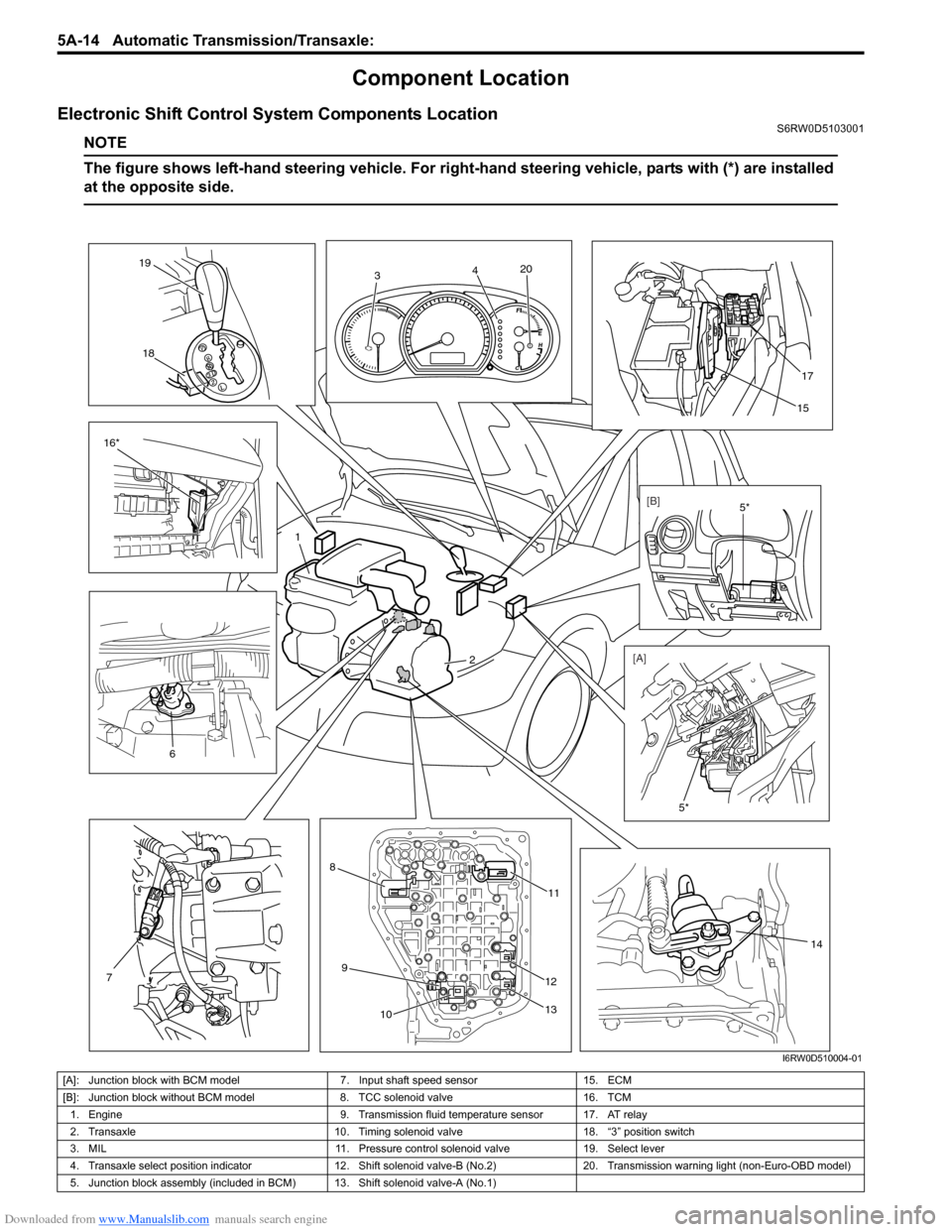
Component Location
Electronic Shift Control System Components LocationS6RW0D5103001
NOTE
The figure shows left-hand steering vehicle. For right-hand steering vehicle, parts with (*) are installed
at the opposite side.
5*
17
15
1
2
8
9
1011
12
13
16*18 19
14
7
6
3420
[B]
[A]5*
I6RW0D510004-01
[A]: Junction block with BCM model 7. Input shaft speed sensor 15. ECM
[B]: Junction block without BCM model 8. TCC solenoid valve 16. TCM
1. Engine 9. Transmission fluid temperature sensor 17. AT relay
2. Transaxle 10. Timing solenoid valve 18. “3” position switch
3. MIL 11. Pressure control solenoid valve 19. Select lever
4. Transaxle select position indicator 12. Shift solenoid valve-B (No.2) 20. Transmission warning light (non-Euro-OBD model)
5. Junction block assembly (included in BCM) 13. Shift solenoid valve-A (No.1)
Page 672 of 1556
Downloaded from www.Manualslib.com manuals search engine 5A-24 Automatic Transmission/Transaxle:
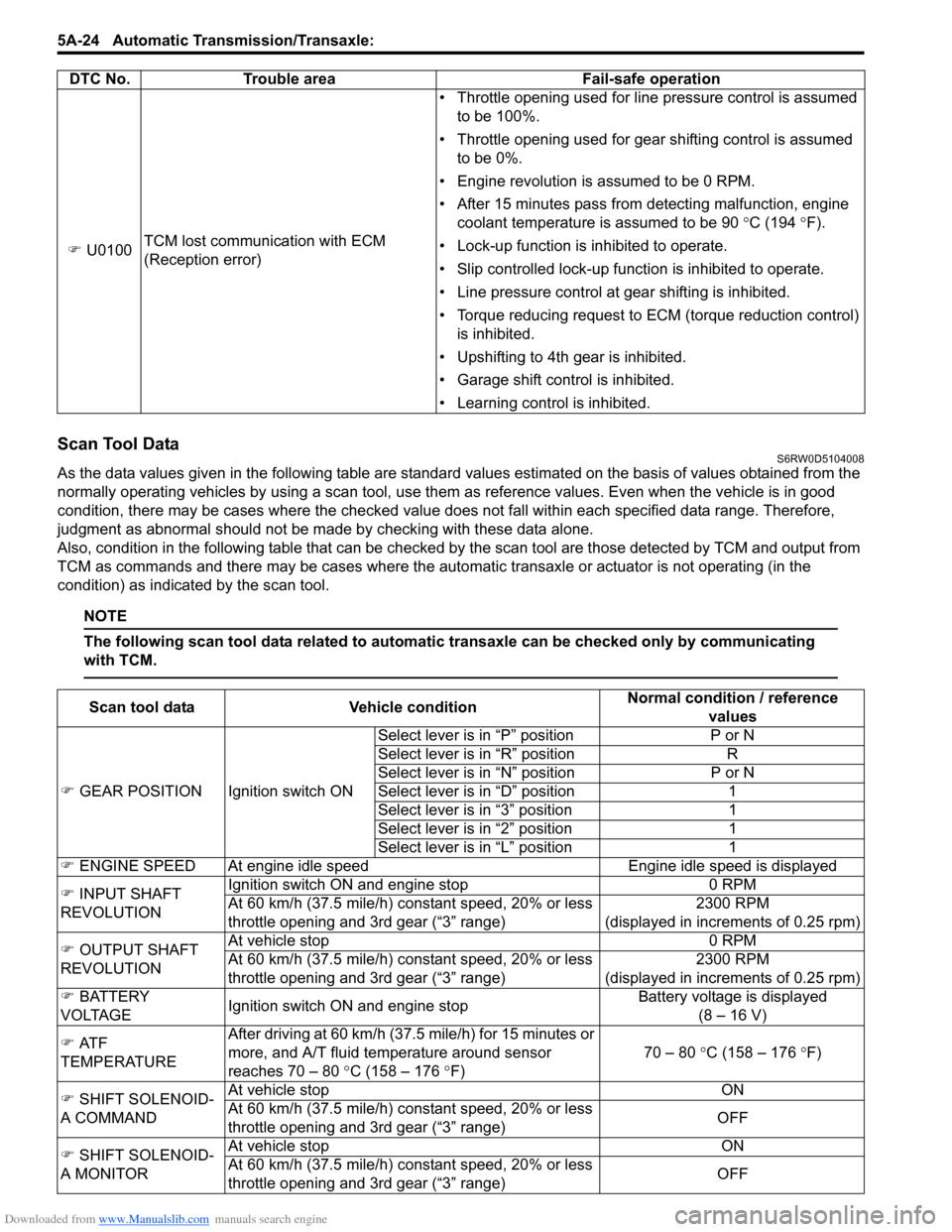
Scan Tool DataS6RW0D5104008
As the data values given in the following table are standard values estimated on the basis of values obtained from the
normally operating vehicles by using a scan tool, use them as reference values. Even when the vehicle is in good
condition, there may be cases where the checked value does not fall within each specified data range. Therefore,
judgment as abnormal should not be made by checking with these data alone.
Also, condition in the following table that can be checked by the scan tool are those detected by TCM and output from
TCM as commands and there may be cases where the automatic transaxle or actuator is not operating (in the
condition) as indicated by the scan tool.
NOTE
The following scan tool data related to automatic transaxle can be checked only by communicating
with TCM.
) U0100TCM lost communication with ECM
(Reception error)• Throttle opening used for line pressure control is assumed
to be 100%.
• Throttle opening used for gear shifting control is assumed
to be 0%.
• Engine revolution is assumed to be 0 RPM.
• After 15 minutes pass from detecting malfunction, engine
coolant temperature is assumed to be 90 °C (194 °F).
• Lock-up function is inhibited to operate.
• Slip controlled lock-up function is inhibited to operate.
• Line pressure control at gear shifting is inhibited.
• Torque reducing request to ECM (torque reduction control)
is inhibited.
• Upshifting to 4th gear is inhibited.
• Garage shift control is inhibited.
• Learning control is inhibited. DTC No. Trouble area Fail-safe operation
Scan tool data Vehicle conditionNormal condition / reference
values
) GEAR POSITION Ignition switch ONSelect lever is in “P” position P or N
Select lever is in “R” position R
Select lever is in “N” position P or N
Select lever is in “D” position 1
Select lever is in “3” position 1
Select lever is in “2” position 1
Select lever is in “L” position 1
) ENGINE SPEED At engine idle speed Engine idle speed is displayed
) INPUT SHAFT
REVOLUTIONIgnition switch ON and engine stop 0 RPM
At 60 km/h (37.5 mile/h) constant speed, 20% or less
throttle opening and 3rd gear (“3” range)2300 RPM
(displayed in increments of 0.25 rpm)
) OUTPUT SHAFT
REVOLUTIONAt vehicle stop 0 RPM
At 60 km/h (37.5 mile/h) constant speed, 20% or less
throttle opening and 3rd gear (“3” range)2300 RPM
(displayed in increments of 0.25 rpm)
) BATTERY
VOLTAGEIgnition switch ON and engine stopBattery voltage is displayed
(8 – 16 V)
) AT F
TEMPERATUREAfter driving at 60 km/h (37.5 mile/h) for 15 minutes or
more, and A/T fluid temperature around sensor
reaches 70 – 80 °C (158 – 176 °F)70 – 80 °C (158 – 176 °F)
) SHIFT SOLENOID-
A COMMANDAt vehicle stop ON
At 60 km/h (37.5 mile/h) constant speed, 20% or less
throttle opening and 3rd gear (“3” range)OFF
) SHIFT SOLENOID-
A MONITORAt vehicle stop ON
At 60 km/h (37.5 mile/h) constant speed, 20% or less
throttle opening and 3rd gear (“3” range)OFF
Page 800 of 1556

Downloaded from www.Manualslib.com manuals search engine 5A-152 Automatic Transmission/Transaxle:
43) Measure O/D and 2nd coast brake piston stroke.
• Measure dimension “a” from end face of transaxle
case to O/D and 2nd coast brake rear plate (1)
using straightedge and micrometer caliper.
• Measure dimension “b” from O/D and 2nd coast
brake piston (2) to rear cover assembly mating
surface using straightedge and micrometer
caliper.
• Calculate piston stroke from measured value of
dimensions “a” and “b”.
• Piston stroke = “a” – “b”
O/D and 2nd coast brake piston stroke
Standard: 0.65 – 1.05 mm (0.026 – 0.041 in.)
When piston stroke is out of specification, select O/D
and 2nd coast brake rear plate with proper thickness
from among the following table and replace it.
CAUTION!
When brake disc, retaining plate, separator
plate and/or rear plate of O/D and 2nd coast
brake have been replaced, all learned
contents, which have been stored in TCM
memory by executing learning control,
should be initialized referring to “Learning
Control Initialization”.
Neglecting this initialization may cause
excessive shift shock.
Available O/D and 2nd coast brake rear plate
thickness
44) After applying A/T fluid to new 2nd brake gaskets (1),
install them to transaxle case (2).
45) After applying A/T fluid to reverse clutch drum thrust
bearing (1), install it to forward and reverse clutch
assembly (2).
46) Remove sealant attached to mating surface of
transaxle rear cover (1) completely.
47) Apply sealant to mating surface of transaxle rear
cover (1) by using a nozzle (2) as shown in figure by
such amount that its section is 1.2 mm (0.047 in.) in
diameter.
“A”: Sealant 99000–31230 (SUZUKI Bond
No.1216B) Thickness Identification mark
1.8 mm (0.071 in.) 1
2.0 mm (0.079 in.) 2
2.2 mm (0.087 in.) 3
2.4 mm (0.094 in.) 4
2.6 mm (0.102 in.) 5
I2RH0B510298-01
I2RH0B510299-01
I2RH0B510300-01
“A”2
1
I2RH0B510301-01
Page 854 of 1556

Downloaded from www.Manualslib.com manuals search engine 5C-1 Clutch:
Transmission / Transaxle
Clutch
General Description
Clutch (Hydraulic Type) ConstructionS6RW0D5301001
The clutch is a diaphragm spring clutch of a dry single disc type. The diaphragm spring is of a tapering-finger type,
which is a solid ring in the outer diameter part, with a series of tapered fingers pointing inward.
The disc, carrying four torsional coil springs, is positioned on the transaxle input shaft with an involute spline fit.
The clutch cover is secured to the flywheel, and carries the diaphragm spring in such a way that the peripheral edge
part of the spring pushes on the pressure plate against the flywheel (with the disc in between), when the clutch release
bearing (incorporated in clutch operating cylinder) is held back. This is the engaged condition of the clutch.
Depressing the clutch pedal causes the release bearing (incorporated in clutch operating cylinder) to advance and
pushes on the tips of the tapered fingers of the diaphragm spring. When this happens, the diaphragm spring pulls the
pressure plate away from the flywheel, thereby interrupting the flow of drive from flywheel through clutch disc to
transaxle input shaft. Clutch fluid is supplied from brake fluid reservoir. Clutch fluid level can be checked by brake fluid
level of brake fluid reservoir.
I5RW0A530001-01
1. Crankshaft 4. Pressure plate 7. Operating cylinder assembly
2. Flywheel 5. Clutch cover 8. Input shaft bearing
3. Clutch disc 6. Diaphragm spring 9. Input shaft
Page 856 of 1556

Downloaded from www.Manualslib.com manuals search engine 5C-3 Clutch:
Repair Instructions
Clutch Pedal InspectionS6RW0D5306001
Cylinder Push Rod Play “a”
1) Press clutch pedal (1) gradually with finger, stop
when slight increase of resistance is felt and
measure how much pedal has moved (push rod
play) as represented by “a” as shown.
Push rod play
“a”: Max. 3 mm (0.12 in.)
2) If “a” is not within specification, replace master
cylinder (3) or pedal arm (2).
Clutch Pedal Free Travel “b”
1) Depress clutch pedal (1), stop the moment clutch
resistance is felt, and measure how much pedal has
moved (clutch pedal free travel) as represented by
“b” in the figure.
Clutch pedal free travel
“b”
: 2 – 8 mm (0.08 – 0.31 in.)
2) If “b” is not within specification, check pedal arm (2)
and master cylinder (3) and replace defective part.
Clutch Release Margin “c”
1) Pull up parking brake fully and block wheels.
2) Start engine and keep engine at idle with neutral
gear position.
3) Without clutch pedal (1) depressed, slightly push the
shift lever to reverse position until transaxle emits
gear contact noise. Do not shift the lever to reverse
position.
4) With emitting gear contact noise, be slow to depress
clutch pedal (1), and at gear contact noise died
position (release point) stop depressing.
5) Measure distance between release point (4) and full
stroke point (5) on clutch pedal (1) which is shown by
“c” in the figure.
Clutch release margin
“c”: 25 – 55 mm (0.98 – 2.17 in.)6) If “c” is not within specification, it is possible that air
is trapped in this system. If suspected so, bleed air
referring to “Air Bleeding of Clutch System”.Upon
completion of above inspection, start engine and
check clutch for proper operation.
Clutch Fluid Level InspectionS6RW0D5306002
Refer to “Brake Fluid Level Inspection in Section 4A”.
Clutch fluid specification
: Refer to the reservoir cap of the brake master
cylinder.
Air Bleeding of Clutch SystemS6RW0D5306003
CAUTION!
When operating the pedal stroke for air
bleeding of clutch system, after releasing the
clutch pedal, be sure to wait 1 second or
more before depressing it again. Otherwise,
the oil seal of operating cylinder will be
damaged, resulting in oil leakage.
Bleed air from clutch system.
Refer to “Air Bleeding of Brake System in Section 4A”.
I5RW0A530002-01
Page 857 of 1556

Downloaded from www.Manualslib.com manuals search engine Clutch: 5C-4
Clutch Fluid Pipe and Hose LocationS6RW0D5306004
Clutch Fluid Pipe Removal and InstallationS6RW0D5306005
Removal
CAUTION!
Do not allow fluid to get on painted surface. It
may cause painted surface damage.
1) Remove dust and dirt from each joint of pipe to be
disconnected and clean around brake master
cylinder reservoir cap.
2) Take out fluid with syringe or such from brake master
cylinder reservoir.
3) Pull clamp (1) of clutch master cylinder (3) and pull
clamp (5) of fluid pipe joint (4), and then disconnect
clutch fluid pipe (2).
4) Pull clamp (6) of damper (7), and then disconnect
damper (7) from clutch fluid pipe (2).Installation
Reverse removal procedure for installation noting the
following.
CAUTION!
• Do not allow fluid to get on painted
surface.
• Do not allow pipe to contact hard against
vehicle body or other parts.
• Install each clamp securely.
• After installation, check clutch pedal free travel and
bleed air from clutch system referring to “Clutch Pedal
Inspection” and “Air Bleeding of Clutch System”.
• Check fluid leakage.
• Add fluid to MAX level of reservoir.
Clutch Fluid Pipe InspectionS6RW0D5306006
Check pipe (1) for damage, dirt and leak. Replace if
check result is not satisfactory.
4 [A]
3131
22
4
I5RW0A530003-02
[A]: RH steering vehicle 3. Clutch reservoir hose
1. Clutch master cylinder 4. Brake master cylinder reservoir
2. Clutch fluid pipe
2
6
5 74
3
1
2
I5RW0B530002-03
[A]: LH steering vehicle
[B]: RH steering vehicle
I5RW0A530005-01
Page 858 of 1556
Downloaded from www.Manualslib.com manuals search engine 5C-5 Clutch:
Clutch Master Cylinder Removal and
Installation
S6RW0D5306007
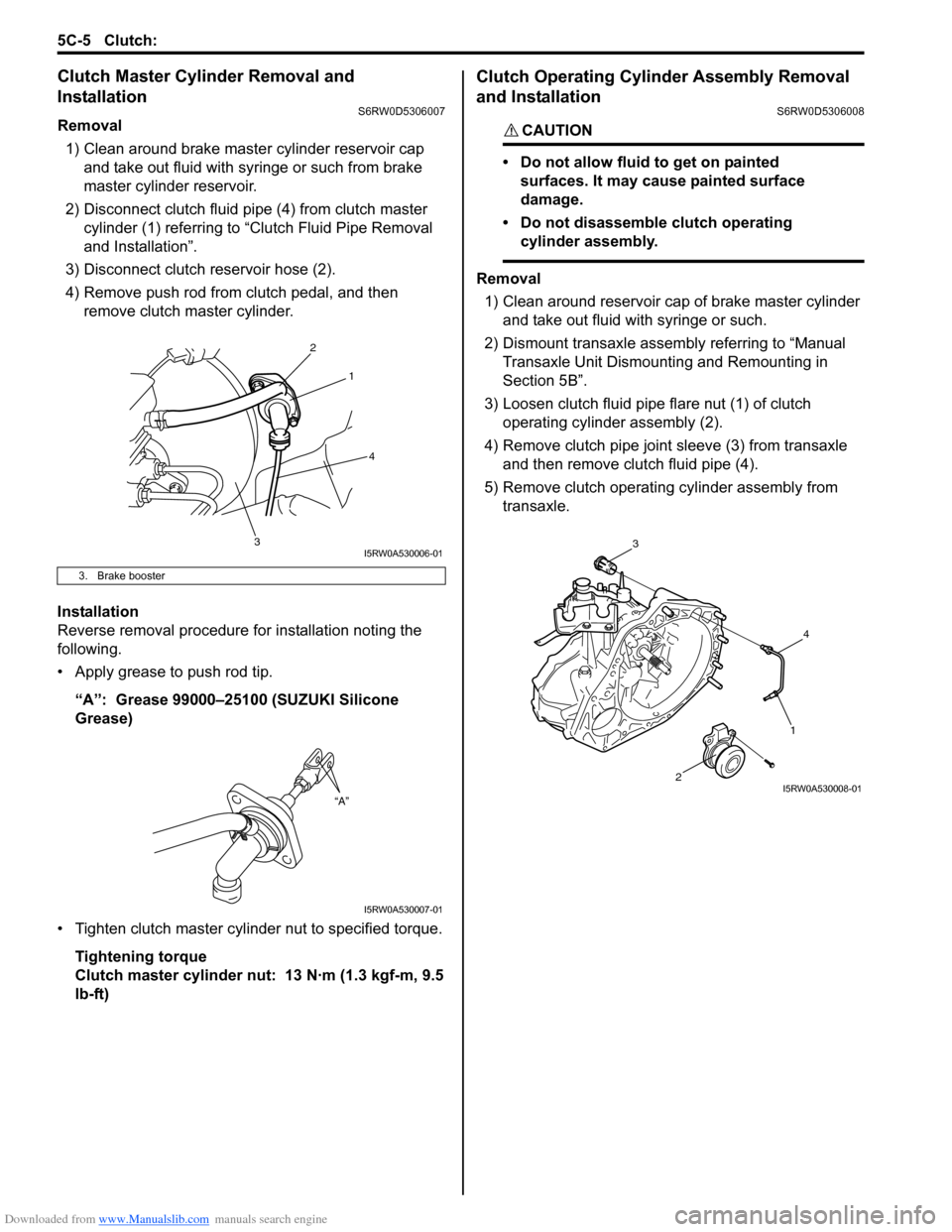
Removal
1) Clean around brake master cylinder reservoir cap
and take out fluid with syringe or such from brake
master cylinder reservoir.
2) Disconnect clutch fluid pipe (4) from clutch master
cylinder (1) referring to “Clutch Fluid Pipe Removal
and Installation”.
3) Disconnect clutch reservoir hose (2).
4) Remove push rod from clutch pedal, and then
remove clutch master cylinder.
Installation
Reverse removal procedure for installation noting the
following.
• Apply grease to push rod tip.
“A”: Grease 99000–25100 (SUZUKI Silicone
Grease)
• Tighten clutch master cylinder nut to specified torque.
Tightening torque
Clutch master cylinder nut: 13 N·m (1.3 kgf-m, 9.5
lb-ft)
Clutch Operating Cylinder Assembly Removal
and Installation
S6RW0D5306008
CAUTION!
• Do not allow fluid to get on painted
surfaces. It may cause painted surface
damage.
• Do not disassemble clutch operating
cylinder assembly.
Removal
1) Clean around reservoir cap of brake master cylinder
and take out fluid with syringe or such.
2) Dismount transaxle assembly referring to “Manual
Transaxle Unit Dismounting and Remounting in
Section 5B”.
3) Loosen clutch fluid pipe flare nut (1) of clutch
operating cylinder assembly (2).
4) Remove clutch pipe joint sleeve (3) from transaxle
and then remove clutch fluid pipe (4).
5) Remove clutch operating cylinder assembly from
transaxle.
3. Brake booster
1
3
2
4
I5RW0A530006-01
“A”
I5RW0A530007-01
3
4
2
1
I5RW0A530008-01
Page 859 of 1556

Downloaded from www.Manualslib.com manuals search engine Clutch: 5C-6
Installation
1) Install clutch operating cylinder assembly (2) to
transaxle. Tighten new mounting bolts to specified
torque.
Tightening torque
Clutch operating cylinder assembly mounting
bolt (a): 10 N·m (1.0 kgf-m, 7.5 lb-ft)
2) Connect clutch fluid pipe (4) to clutch operating
cylinder assembly temporarily.
3) Install clutch pipe joint sleeve (3) to transaxle
securely and then tighten clutch fluid pipe flare nut
(1) to specified torque.
Tightening torque
Clutch fluid pipe flare nut (b): 16 N·m (1.6 kgf-
m, 11.5 lb-ft)4) Remount transaxle assembly referring to “Manual
Transaxle Unit Dismounting and Remounting in
Section 5B”.
5) Bleed air from system and check clutch pedal free
travel. Refer to “Air Bleeding of Clutch System” and
“Clutch Pedal Inspection”.
Clutch Operating Cylinder Assembly InspectionS6RW0D5306013
Check clutch fluid leakage, spring for damage and
bearing for smooth rotation. If malfunction is found,
replace clutch operating cylinder assembly.
Clutch Cover, Clutch Disc and Flywheel ComponentsS6RW0D5306010
3
4
(a)
2
1, (b)
I5RW0A530009-01
I5RW0B530005-03
2
1
3(a)
6
4
5
(b)
I6RW0C530001-01
1. Clutch cover 4. Flywheel : 23 N⋅m (2.3 kgf-m, 17.0 lb-ft)
2. Clutch disc 5. Input shaft bearing : 70 N⋅m (7.0 kgf-m, 51.0 lb-ft)
3. Clutch cover bolt 6. Flywheel bolt : Do not reuse.
Page 860 of 1556
Downloaded from www.Manualslib.com manuals search engine 5C-7 Clutch:
Clutch Cover, Clutch Disc and Flywheel
Removal and Installation
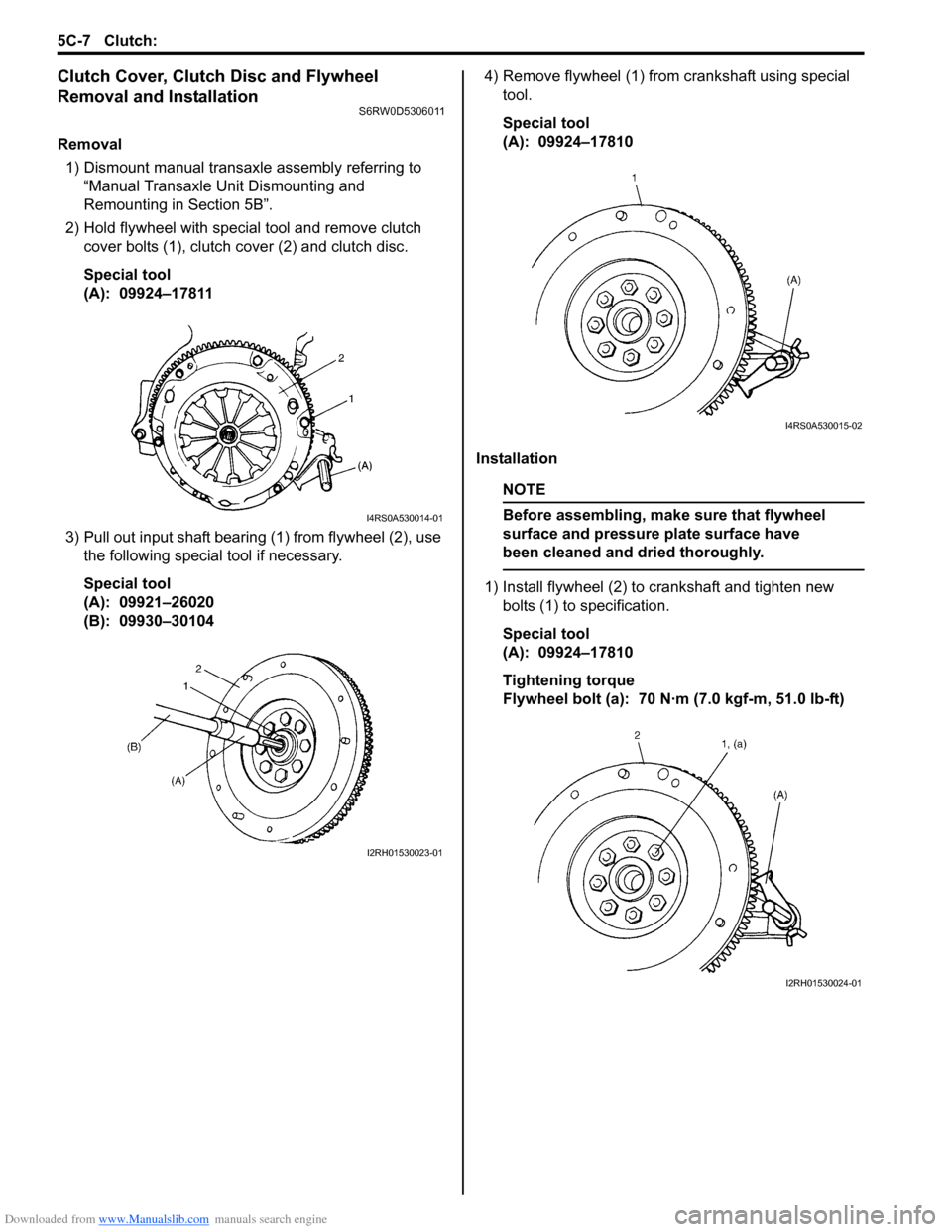
S6RW0D5306011
Removal
1) Dismount manual transaxle assembly referring to
“Manual Transaxle Unit Dismounting and
Remounting in Section 5B”.
2) Hold flywheel with special tool and remove clutch
cover bolts (1), clutch cover (2) and clutch disc.
Special tool
(A): 09924–17811
3) Pull out input shaft bearing (1) from flywheel (2), use
the following special tool if necessary.
Special tool
(A): 09921–26020
(B): 09930–301044) Remove flywheel (1) from crankshaft using special
tool.
Special tool
(A): 09924–17810
Installation
NOTE
Before assembling, make sure that flywheel
surface and pressure plate surface have
been cleaned and dried thoroughly.
1) Install flywheel (2) to crankshaft and tighten new
bolts (1) to specification.
Special tool
(A): 09924–17810
Tightening torque
Flywheel bolt (a): 70 N·m (7.0 kgf-m, 51.0 lb-ft)
I4RS0A530014-01
I2RH01530023-01
I4RS0A530015-02
I2RH01530024-01
Page 861 of 1556
Downloaded from www.Manualslib.com manuals search engine Clutch: 5C-8
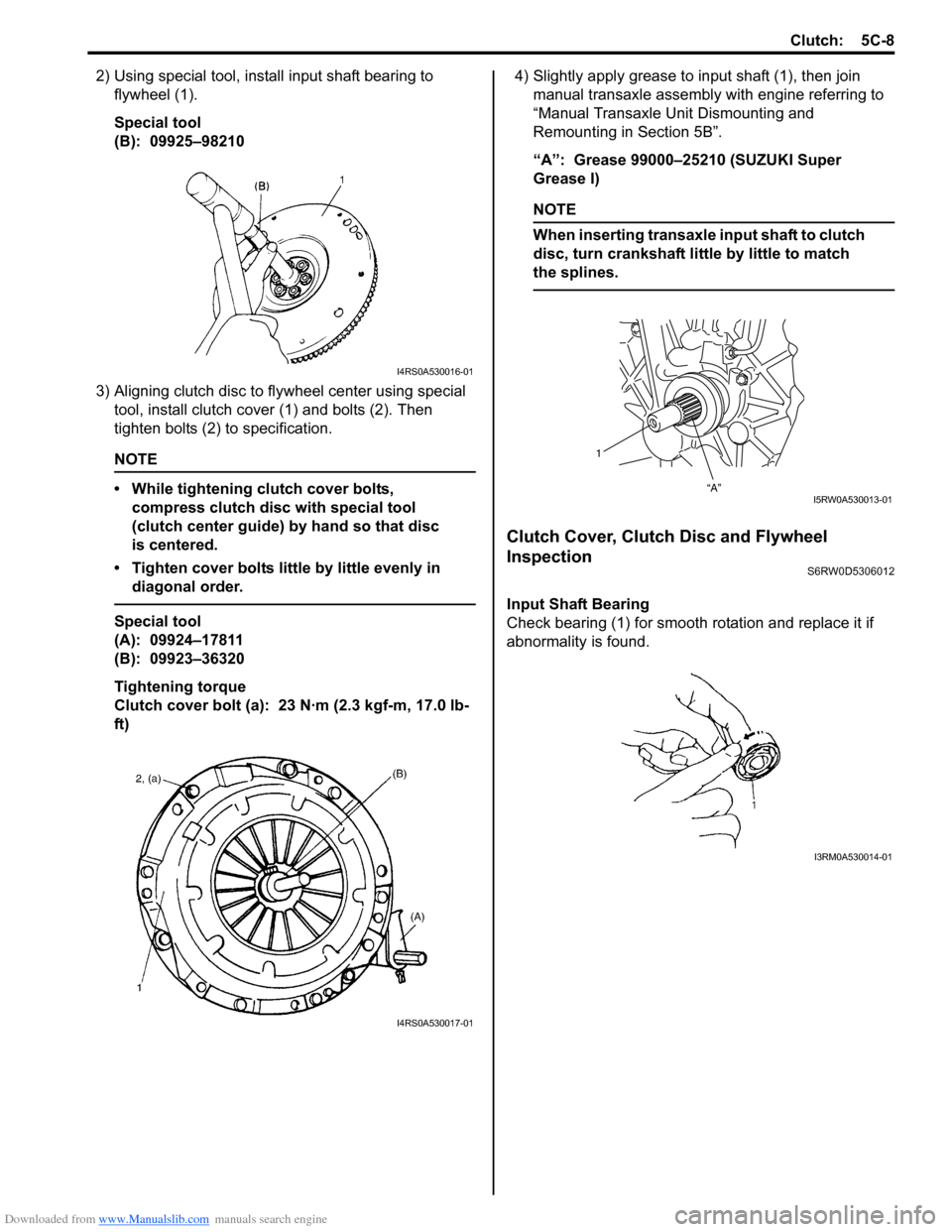
2) Using special tool, install input shaft bearing to
flywheel (1).
Special tool
(B): 09925–98210
3) Aligning clutch disc to flywheel center using special
tool, install clutch cover (1) and bolts (2). Then
tighten bolts (2) to specification.
NOTE
• While tightening clutch cover bolts,
compress clutch disc with special tool
(clutch center guide) by hand so that disc
is centered.
• Tighten cover bolts little by little evenly in
diagonal order.
Special tool
(A): 09924–17811
(B): 09923–36320
Tightening torque
Clutch cover bolt (a): 23 N·m (2.3 kgf-m, 17.0 lb-
ft)4) Slightly apply grease to input shaft (1), then join
manual transaxle assembly with engine referring to
“Manual Transaxle Unit Dismounting and
Remounting in Section 5B”.
“A”: Grease 99000–25210 (SUZUKI Super
Grease I)
NOTE
When inserting transaxle input shaft to clutch
disc, turn crankshaft little by little to match
the splines.
Clutch Cover, Clutch Disc and Flywheel
Inspection
S6RW0D5306012
Input Shaft Bearing
Check bearing (1) for smooth rotation and replace it if
abnormality is found.
I4RS0A530016-01
I4RS0A530017-01
1
“A”I5RW0A530013-01
I3RM0A530014-01