check engine TOYOTA RAV4 1996 Service Manual Online
[x] Cancel search | Manufacturer: TOYOTA, Model Year: 1996, Model line: RAV4, Model: TOYOTA RAV4 1996Pages: 1632, PDF Size: 41.64 MB
Page 826 of 1632
1. Remove front wheel. Check wheel bearing backlash and deviation (rotational free play). See WHEEL
BEARING CHECKING under ADJUSTMENTS & INSPECTION.
2. Using punch and hammer, unstake drive shaft lock nut. Apply brakes and remove lock nut. Remove 2
bolts, brake caliper and disc. Support brake caliper out of way.
3. Remove bolt, and disconnect ABS speed sensor. Remove clip and nut. Using separator, separate steering
knuckle from lower suspension arm. Remove cotter pin and nut, and using tie rod separator, disconnect
tie rod end.
4. Remove 2 nuts, bolts and steering knuckle with axle hub from shock absorber.
Installation
To install, reverse removal procedure. Use NEW snap ring after pressing in NEW wheel bearing. Use NEW
cotter pins. Tighten bolts to specifications. See TORQUE SPECIFICATIONS
.
SHOCK ABSORBER
Removal & Installation
1. Remove front wheel. Disconnect brake hose and ABS speed sensor clamp from shock absorber. On
Sienna, remove outer front cowl top panel. See Fig. 6
.
2. Remove 2 lower shock absorber nuts and bolts and disconnect shock absorber from steering knuckle.
Remove 3 upper shock absorber mounting nuts from inside engine compartment and remove shock
absorber with coil spring.
3. To install, reverse removal procedure. Tighten bolts and nuts to specification. See TORQUE
SPECIFICATIONS . NOTE: On Camry, note mounting position of curved mounting plate on shock
absorber tower. Ensure it is reinstalled in same position.
1999 Toyota RAV4
1999-2000 SUSPENSION Front - Avalon, Camry, Camry Solara, Celica, Corolla, Echo, RAV4 & Sienna
Microsoft
Sunday, November 22, 2009 10:36:34 AMPage 8 © 2005 Mitchell Repair Information Company, LLC.
Page 836 of 1632
Fig. 12: Exploded View Of Lower Control Arm & Related Components (RAV4)
Courtesy of TOYOTA MOTOR SALES, U.S.A., INC.
BALL JOINTS
Removal & Installation
1. Remove steering knuckle with axle hub. See FRONT AXLE HUB & WHEEL BEARING . Using
screwdriver, pry off dust cover. Remove cotter pin and nut. On all models except Echo, use ball joint
removal tool to remove lower ball joint from axle hub assembly. On Echo, lower control arm must be
removed and replaced to remove ball joint.
2. To install, reverse removal procedure. Check ball joint turning torque. See BALL JOINT CHECKING
under ADJUSTMENTS & INSPECTION. Install NEW cotter pin and NEW dust cover.
STABILIZER BAR
Removal & Installation
1. Remove both front wheels. Remove 4 nuts and remove both stabilizer bar links (2 nuts at each end). On
Echo, remove 2 nuts, 5 retainers, 4 cushions and stabilizer bar link. On Echo and Sienna, disconnect both
tie rod ends from steering knuckles. On all models, remove left and right stabilizer bar brackets and
bushings.
2. On Corolla, remove suspension brace. See Fig. 10
. On Sienna, remove power steering gear mounting
bolts and nuts. See Fig. 13
. On 2000 Celica, remove front suspension member with lower suspension
arm. Remove 2 bolts, bracket and bushing. Install bushing, with cut out facing toward rear, on outside of
paint line on stabilizer bar.
3. On Echo, remove clip and nut, and disconnect steering knuckle. Remove hood, and attach engine sling to
engine hangers. Remove bolt and 2 nuts, and disconnect rear engine mount. Disconnect sliding yoke and
pressure feed and return tubes. Remove bolt, and disconnect tube clamp. Support suspension member
with transmission jack. Remove 4 bolts and lower suspension member. Remove 4 bolts, 2 brackets and
bushings. On all models, remove stabilizer bar. On Avalon, Camry, Camry Solara, Celica and Sienna,
remove stabilizer bar from left side of vehicle. See Fig. 4
.
4. To install, reverse removal procedure. On Sienna, install stabilizer bar with White colored side on right
side and stabilizer bar link with Green colored side on left side. Tighten all bolts and nuts to specification.
See TORQUE SPECIFICATIONS
.
1999 Toyota RAV4
1999-2000 SUSPENSION Front - Avalon, Camry, Camry Solara, Celica, Corolla, Echo, RAV4 & Sienna
Microsoft
Sunday, November 22, 2009 10:36:34 AMPage 18 © 2005 Mitchell Repair Information Company, LLC.
Page 876 of 1632
TROUBLE SHOOTING
A/C INDICATOR BLINKS
Check for faulty compressor, A/C switch or A/C amplifier. Check for faulty wiring harness, grounds or
connectors.
BLOWER MOTOR DOES NOT OPERATE
Check for blown HTR fuse, heater main relay or blower resistor. Check for faulty A/C controls, blower switch
or blower motor. Check for faulty wiring harness, grounds or connectors.
COMPRESSOR DOES NOT OPERATE
Check for incorrect refrigerant charge. Check for blown A/C fuse. Check for faulty heater main relay,
compressor clutch, compressor, dual-pressure switch, A/C switch, blower switch, A/C amplifier, thermistor,
wiring harnesses, grounds or connectors.
COMPRESSOR OPERATES INTERMITTENTLY
Check for incorrect refrigerant charge. Check for faulty dual-pressure switch. Check for bent or dented
refrigerant lines. Check for faulty A/C amplifier, thermistor, wiring harness, grounds or connectors.
INSUFFICIENT COOLING
Check for incorrect refrigerant charge or incorrect system pressures. Check for slipping A/C drive belt. Check
for clogged condenser. Check for plugged receiver-drier. Check for bent or dented refrigerant lines. Check for
faulty compressor clutch, A/C compressor, A/C amplifier, thermistor, evaporator or expansion valve.
NO ENGINE IDLE UP WHEN A/C SWITCH IS ON
Check for faulty A/C amplifier, IAC system, wiring and/or wiring connections.
TESTING
NOTE: For control cable adjustments, see HEATER SYSTEMS - RAV4, TACOMA &
4RUNNER article.
WARNING:To avoid injury from accidental air bag deployment, read and carefully
follow all SERVICE PRECAUTIONS and DISABLING & ACTIVATING AIR
BAG SYSTEM procedures in AIR BAG SYSTEM SAFETY article in
GENERAL SERVICING.
NOTE: For testing procedures not covered in this article, see HEATER SYSTEMS -
RAV4, TACOMA & 4RUNNER article.
1999 Toyota RAV4
1999 MANUAL A/C-HEATER SYSTEMS RAV4
Microsoft
Sunday, November 22, 2009 10:29:28 AMPage 3 © 2005 Mitchell Repair Information Company, LLC.
Page 878 of 1632
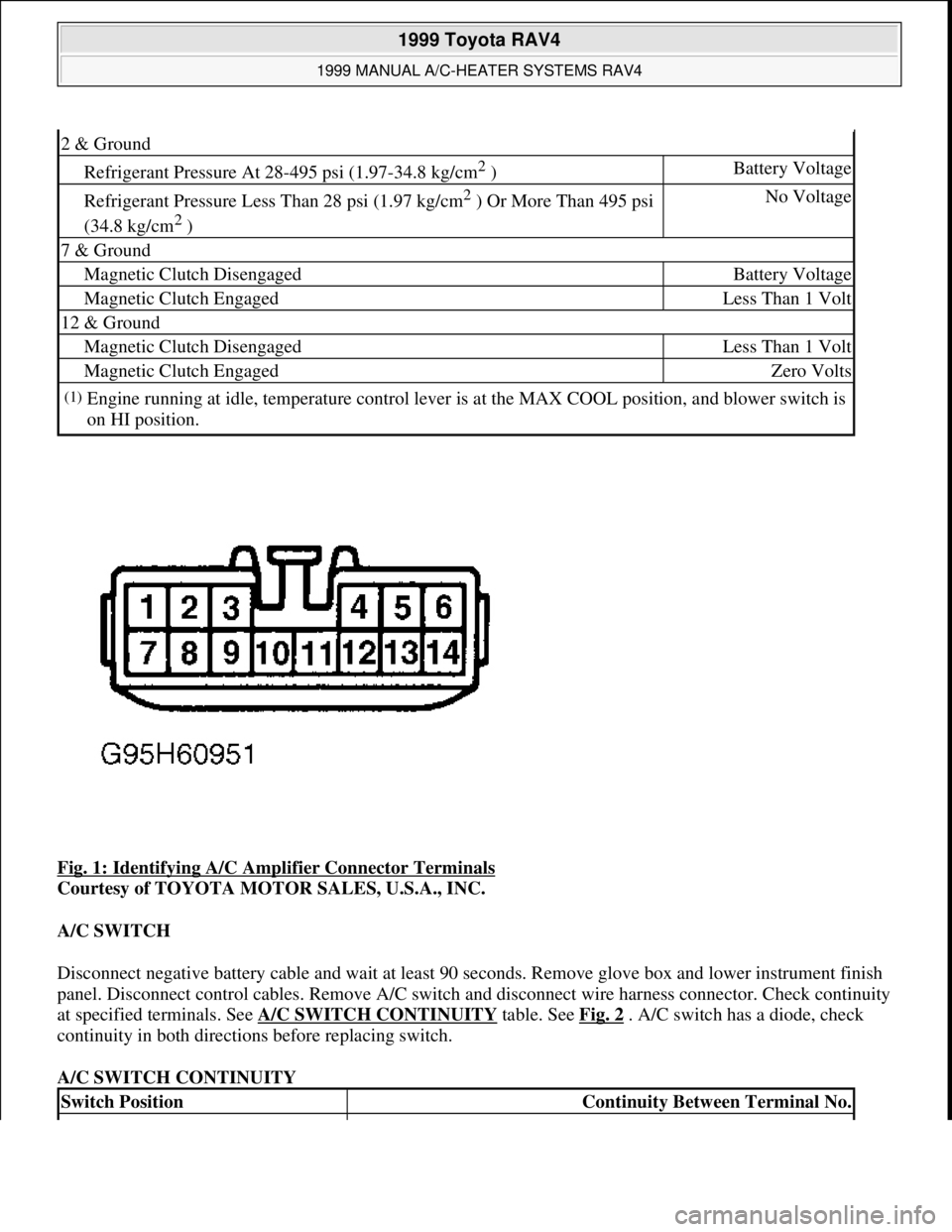
Fig. 1: Identifying A/C Amplifier Connector Terminals
Courtesy of TOYOTA MOTOR SALES, U.S.A., INC.
A/C SWITCH
Disconnect negative battery cable and wait at least 90 seconds. Remove glove box and lower instrument finish
panel. Disconnect control cables. Remove A/C switch and disconnect wire harness connector. Check continuity
at specified terminals. See A/C SWITCH CONTINUITY
table. See Fig. 2 . A/C switch has a diode, check
continuity in both directions before replacing switch.
A/C SWITCH CONTINUITY
2 & Ground
Refrigerant Pressure At 28-495 psi (1.97-34.8 kg/cm2 )Battery Voltage
Refrigerant Pressure Less Than 28 psi (1.97 kg/cm2 ) Or More Than 495 psi
(34.8 kg/cm
2 )
No Voltage
7 & Ground
Magnetic Clutch DisengagedBattery Voltage
Magnetic Clutch EngagedLess Than 1 Volt
12 & Ground
Magnetic Clutch DisengagedLess Than 1 Volt
Magnetic Clutch EngagedZero Volts
(1)Engine running at idle, temperature control lever is at the MAX COOL position, and blower switch is
on HI position.
Switch PositionContinuity Between Terminal No.
1999 Toyota RAV4
1999 MANUAL A/C-HEATER SYSTEMS RAV4
Microsoft
Sunday, November 22, 2009 10:29:28 AMPage 5 © 2005 Mitchell Repair Information Company, LLC.
Page 879 of 1632
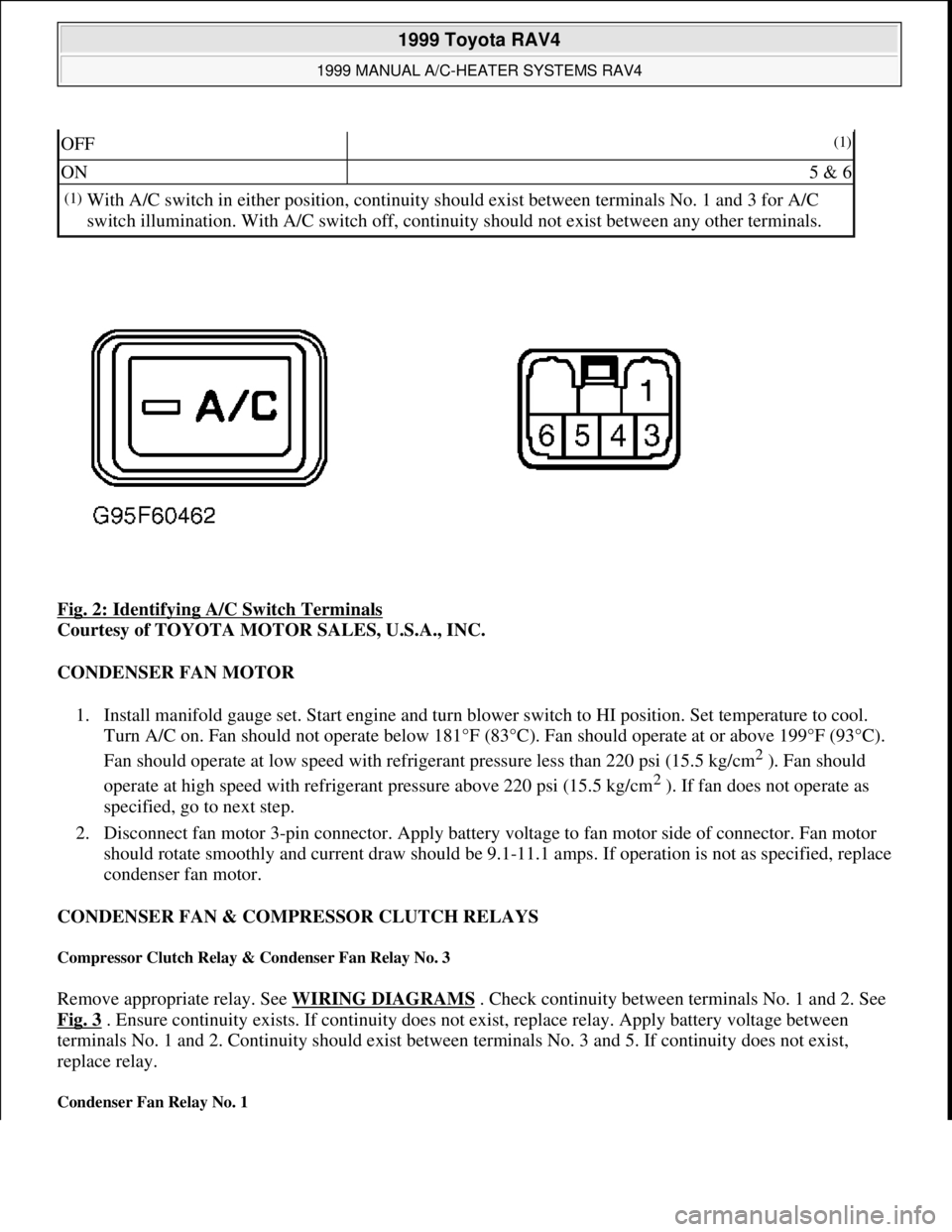
Fig. 2: Identifying A/C Switch Terminals
Courtesy of TOYOTA MOTOR SALES, U.S.A., INC.
CONDENSER FAN MOTOR
1. Install manifold gauge set. Start engine and turn blower switch to HI position. Set temperature to cool.
Turn A/C on. Fan should not operate below 181°F (83°C). Fan should operate at or above 199°F (93°C).
Fan should operate at low speed with refrigerant pressure less than 220 psi (15.5 kg/cm
2 ). Fan should
operate at high speed with refrigerant pressure above 220 psi (15.5 kg/cm
2 ). If fan does not operate as
specified, go to next step.
2. Disconnect fan motor 3-pin connector. Apply battery voltage to fan motor side of connector. Fan motor
should rotate smoothly and current draw should be 9.1-11.1 amps. If operation is not as specified, replace
condenser fan motor.
CONDENSER FAN & COMPRESSOR CLUTCH RELAYS
Compressor Clutch Relay & Condenser Fan Relay No. 3
Remove appropriate relay. See WIRING DIAGRAMS . Check continuity between terminals No. 1 and 2. See
Fig. 3
. Ensure continuity exists. If continuity does not exist, replace relay. Apply battery voltage between
terminals No. 1 and 2. Continuity should exist between terminals No. 3 and 5. If continuity does not exist,
replace relay.
Condenser Fan Relay No. 1
OFF(1)
ON5 & 6
(1)With A/C switch in either position, continuity should exist between terminals No. 1 and 3 for A/C
switch illumination. With A/C switch off, continuity should not exist between any other terminals.
1999 Toyota RAV4
1999 MANUAL A/C-HEATER SYSTEMS RAV4
Microsoft
Sunday, November 22, 2009 10:29:28 AMPage 6 © 2005 Mitchell Repair Information Company, LLC.
Page 882 of 1632
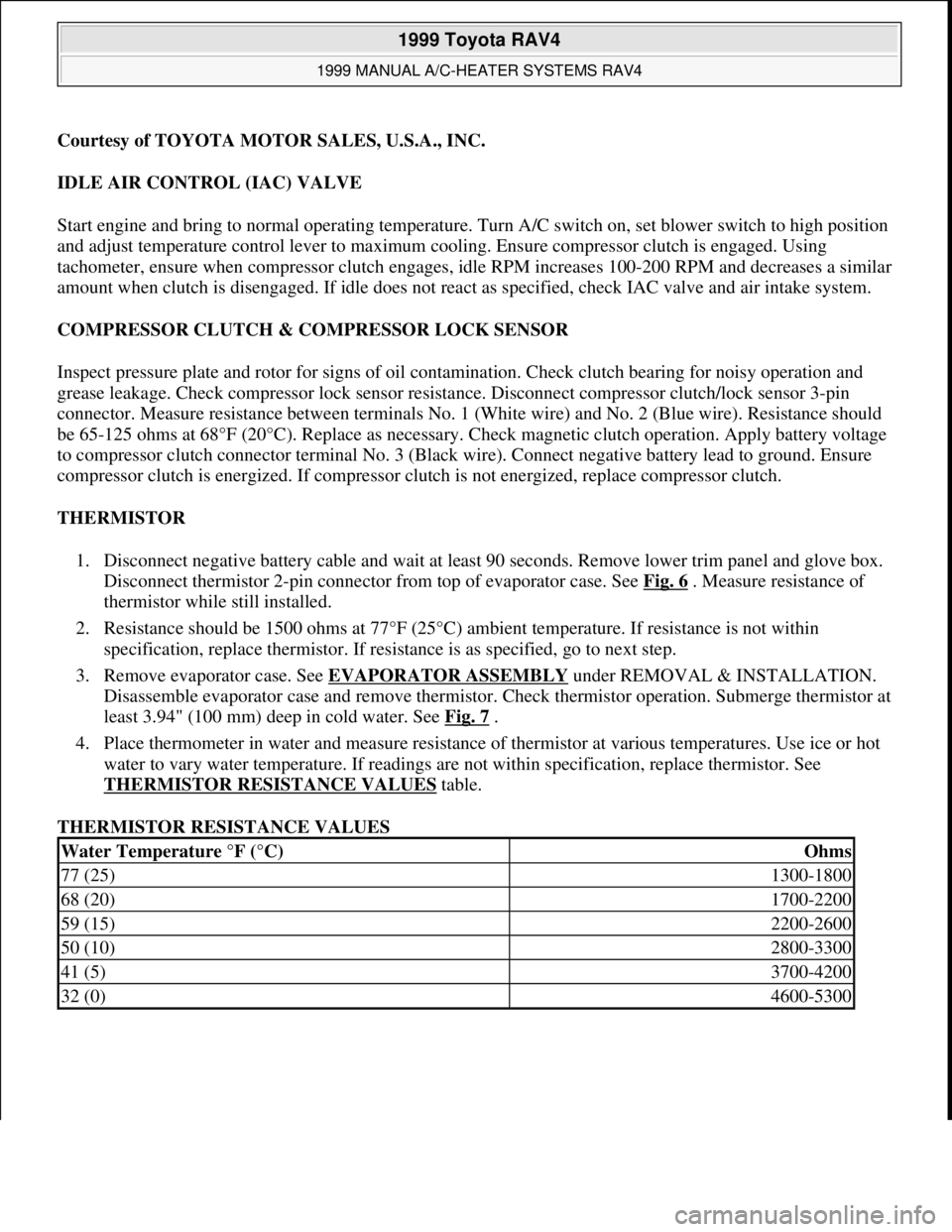
Courtesy of TOYOTA MOTOR SALES, U.S.A., INC.
IDLE AIR CONTROL (IAC) VALVE
Start engine and bring to normal operating temperature. Turn A/C switch on, set blower switch to high position
and adjust temperature control lever to maximum cooling. Ensure compressor clutch is engaged. Using
tachometer, ensure when compressor clutch engages, idle RPM increases 100-200 RPM and decreases a similar
amount when clutch is disengaged. If idle does not react as specified, check IAC valve and air intake system.
COMPRESSOR CLUTCH & COMPRESSOR LOCK SENSOR
Inspect pressure plate and rotor for signs of oil contamination. Check clutch bearing for noisy operation and
grease leakage. Check compressor lock sensor resistance. Disconnect compressor clutch/lock sensor 3-pin
connector. Measure resistance between terminals No. 1 (White wire) and No. 2 (Blue wire). Resistance should
be 65-125 ohms at 68°F (20°C). Replace as necessary. Check magnetic clutch operation. Apply battery voltage
to compressor clutch connector terminal No. 3 (Black wire). Connect negative battery lead to ground. Ensure
compressor clutch is energized. If compressor clutch is not energized, replace compressor clutch.
THERMISTOR
1. Disconnect negative battery cable and wait at least 90 seconds. Remove lower trim panel and glove box.
Disconnect thermistor 2-pin connector from top of evaporator case. See Fig. 6
. Measure resistance of
thermistor while still installed.
2. Resistance should be 1500 ohms at 77°F (25°C) ambient temperature. If resistance is not within
specification, replace thermistor. If resistance is as specified, go to next step.
3. Remove evaporator case. See EVAPORATOR ASSEMBLY
under REMOVAL & INSTALLATION.
Disassemble evaporator case and remove thermistor. Check thermistor operation. Submerge thermistor at
least 3.94" (100 mm) deep in cold water. See Fig. 7
.
4. Place thermometer in water and measure resistance of thermistor at various temperatures. Use ice or hot
water to vary water temperature. If readings are not within specification, replace thermistor. See
THERMISTOR RESISTANCE VALUES
table.
THERMISTOR RESISTANCE VALUES
Water Temperature °F (°C)Ohms
77 (25)1300-1800
68 (20)1700-2200
59 (15)2200-2600
50 (10)2800-3300
41 (5)3700-4200
32 (0)4600-5300
1999 Toyota RAV4
1999 MANUAL A/C-HEATER SYSTEMS RAV4
Microsoft
Sunday, November 22, 2009 10:29:28 AMPage 9 © 2005 Mitchell Repair Information Company, LLC.
Page 885 of 1632
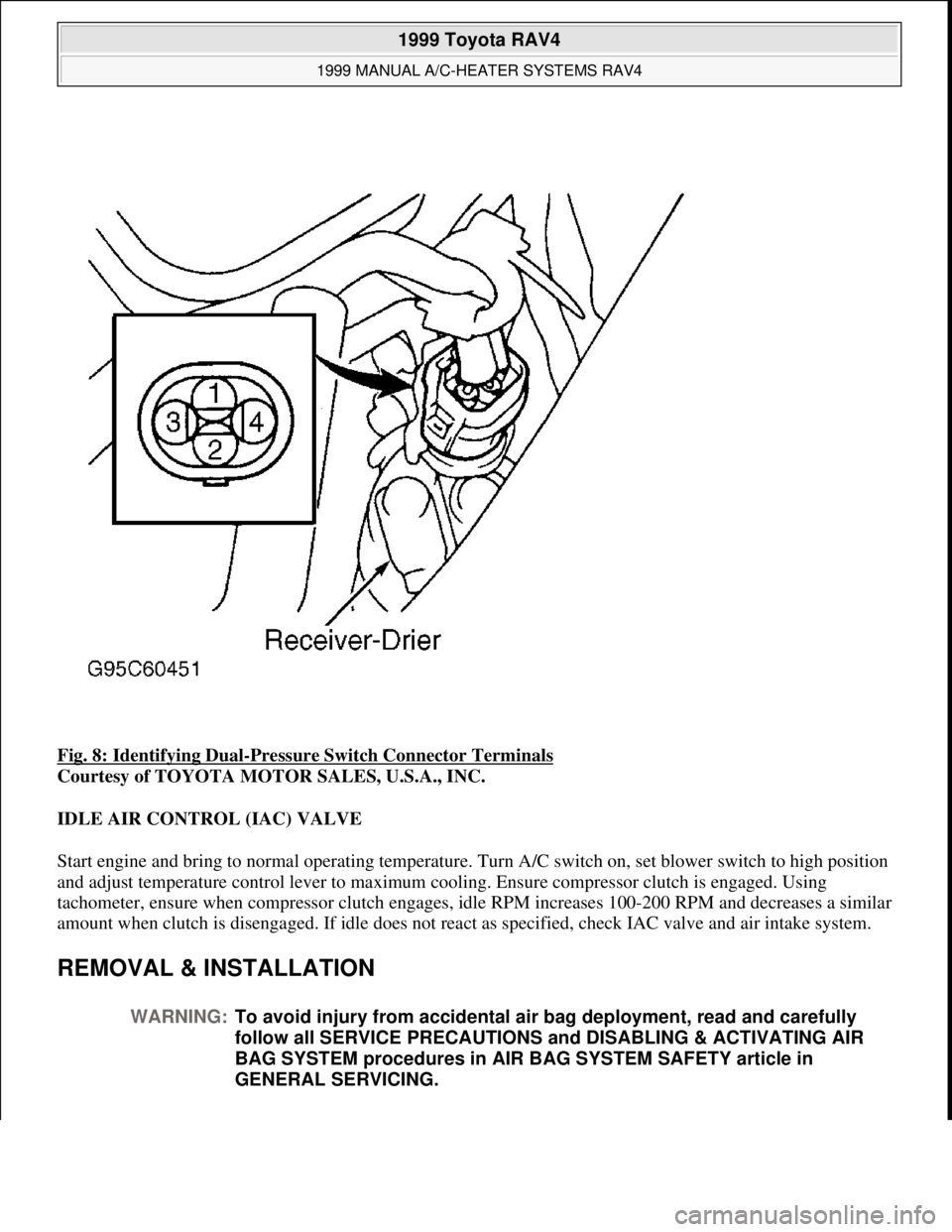
Fig. 8: Identifying Dual-Pressure Switch Connector Terminals
Courtesy of TOYOTA MOTOR SALES, U.S.A., INC.
IDLE AIR CONTROL (IAC) VALVE
Start engine and bring to normal operating temperature. Turn A/C switch on, set blower switch to high position
and adjust temperature control lever to maximum cooling. Ensure compressor clutch is engaged. Using
tachometer, ensure when compressor clutch engages, idle RPM increases 100-200 RPM and decreases a similar
amount when clutch is disengaged. If idle does not react as specified, check IAC valve and air intake system.
REMOVAL & INSTALLATION
WARNING:To avoid injury from accidental air bag deployment, read and carefully
follow all SERVICE PRECAUTIONS and DISABLING & ACTIVATING AIR
BAG SYSTEM procedures in AIR BAG SYSTEM SAFETY article in
GENERAL SERVICING.
1999 Toyota RAV4
1999 MANUAL A/C-HEATER SYSTEMS RAV4
Microsoft
Sunday, November 22, 2009 10:29:28 AMPage 12 © 2005 Mitchell Repair Information Company, LLC.
Page 893 of 1632
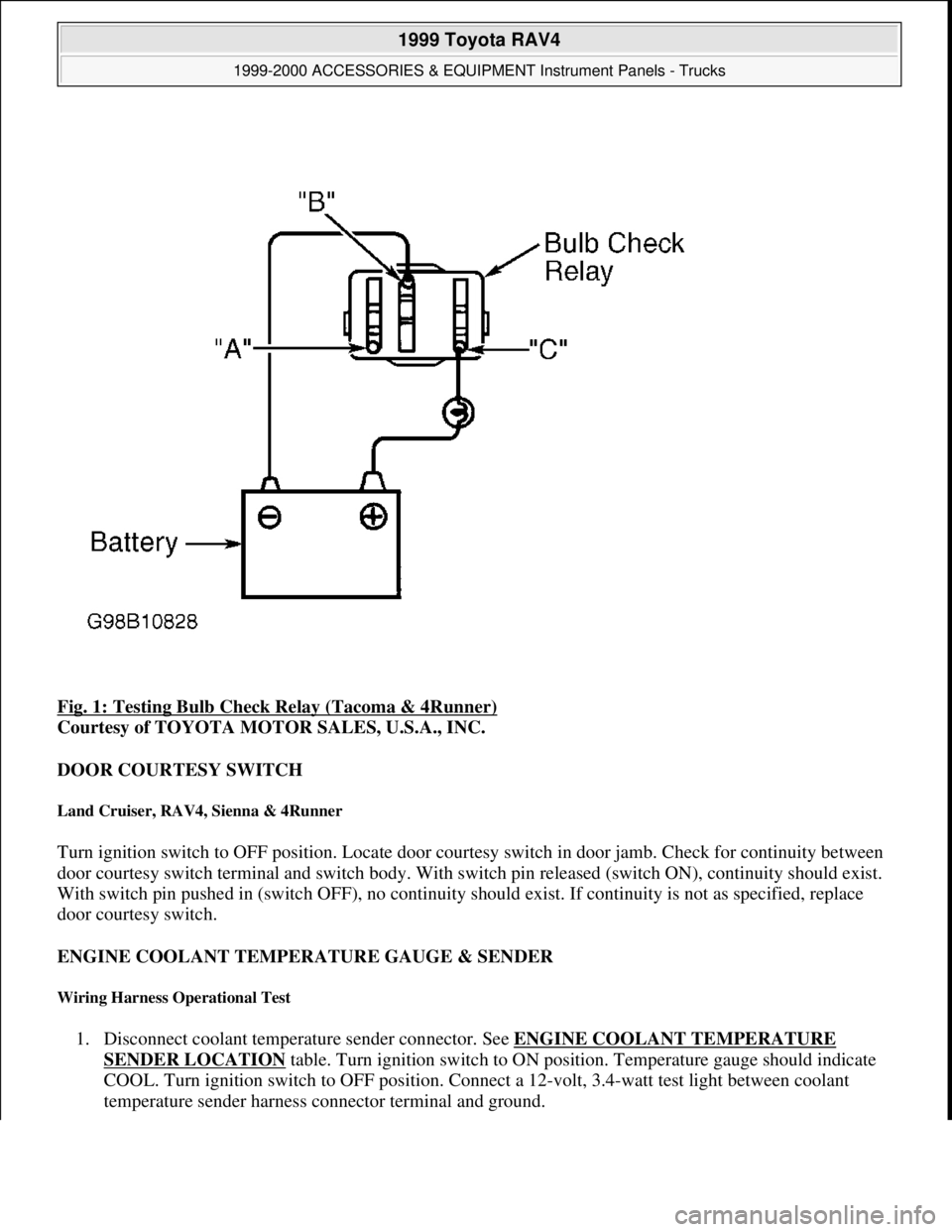
Fig. 1: Testing Bulb Check Relay (Tacoma & 4Runner)
Courtesy of TOYOTA MOTOR SALES, U.S.A., INC.
DOOR COURTESY SWITCH
Land Cruiser, RAV4, Sienna & 4Runner
Turn ignition switch to OFF position. Locate door courtesy switch in door jamb. Check for continuity between
door courtesy switch terminal and switch body. With switch pin released (switch ON), continuity should exist.
With switch pin pushed in (switch OFF), no continuity should exist. If continuity is not as specified, replace
door courtesy switch.
ENGINE COOLANT TEMPERATURE GAUGE & SENDER
Wiring Harness Operational Test
1. Disconnect coolant temperature sender connector. See ENGINE COOLANT TEMPERATURE
SENDER LOCATION table. Turn ignition switch to ON position. Temperature gauge should indicate
COOL. Turn ignition switch to OFF position. Connect a 12-volt, 3.4-watt test light between coolant
temperature sender harness connector terminal and
ground.
1999 Toyota RAV4
1999-2000 ACCESSORIES & EQUIPMENT Instrument Panels - Trucks
Microsoft
Sunday, November 22, 2009 10:54:09 AMPage 3 © 2005 Mitchell Repair Information Company, LLC.
Page 894 of 1632
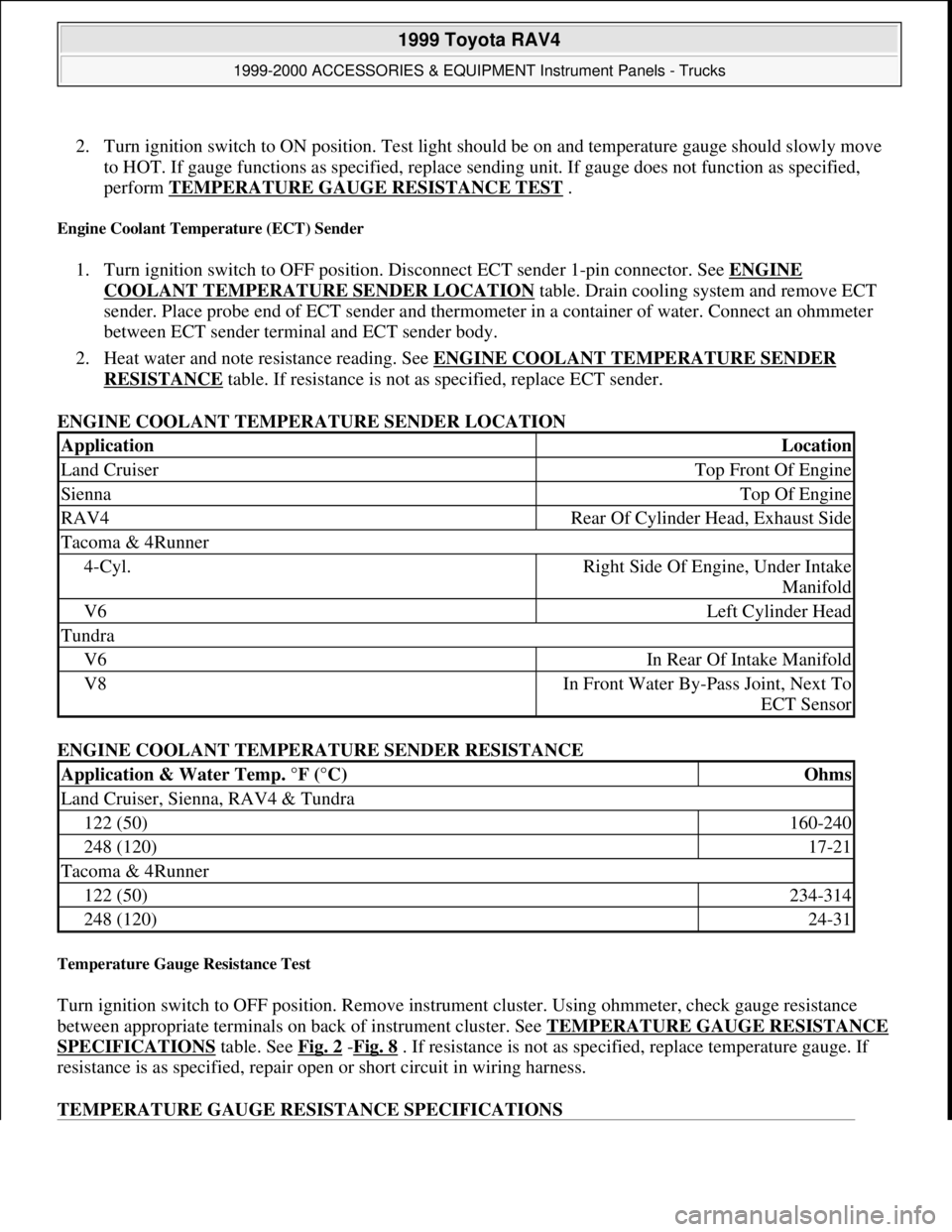
2. Turn ignition switch to ON position. Test light should be on and temperature gauge should slowly move
to HOT. If gauge functions as specified, replace sending unit. If gauge does not function as specified,
perform TEMPERATURE GAUGE RESISTANCE TEST
.
Engine Coolant Temperature (ECT) Sender
1. Turn ignition switch to OFF position. Disconnect ECT sender 1-pin connector. See ENGINE
COOLANT TEMPERATURE SENDER LOCATION table. Drain cooling system and remove ECT
sender. Place probe end of ECT sender and thermometer in a container of water. Connect an ohmmeter
between ECT sender terminal and ECT sender body.
2. Heat water and note resistance reading. See ENGINE COOLANT TEMPERATURE SENDER
RESISTANCE table. If resistance is not as specified, replace ECT sender.
ENGINE COOLANT TEMPERATURE SENDER LOCATION
ENGINE COOLANT TEMPERATURE SENDER RESISTANCE
Temperature Gauge Resistance Test
Turn ignition switch to OFF position. Remove instrument cluster. Using ohmmeter, check gauge resistance
between appropriate terminals on back of instrument cluster. See TEMPERATURE GAUGE RESISTANCE
SPECIFICATIONS table. See Fig. 2 -Fig. 8 . If resistance is not as specified, replace temperature gauge. If
resistance is as specified, repair open or short circuit in wiring harness.
TEMPERATURE GAUGE RESISTANCE SPECIFICATIONS
ApplicationLocation
Land CruiserTop Front Of Engine
SiennaTop Of Engine
RAV4Rear Of Cylinder Head, Exhaust Side
Tacoma & 4Runner
4-Cyl.Right Side Of Engine, Under Intake
Manifold
V6Left Cylinder Head
Tundra
V6In Rear Of Intake Manifold
V8In Front Water By-Pass Joint, Next To
ECT Sensor
Application & Water Temp. °F (°C)Ohms
Land Cruiser, Sienna, RAV4 & Tundra
122 (50)160-240
248 (120)17-21
Tacoma & 4Runner
122 (50)234-314
248 (120)24-31
1999 Toyota RAV4
1999-2000 ACCESSORIES & EQUIPMENT Instrument Panels - Trucks
Microsoft
Sunday, November 22, 2009 10:54:09 AMPage 4 © 2005 Mitchell Repair Information Company, LLC.
Page 913 of 1632
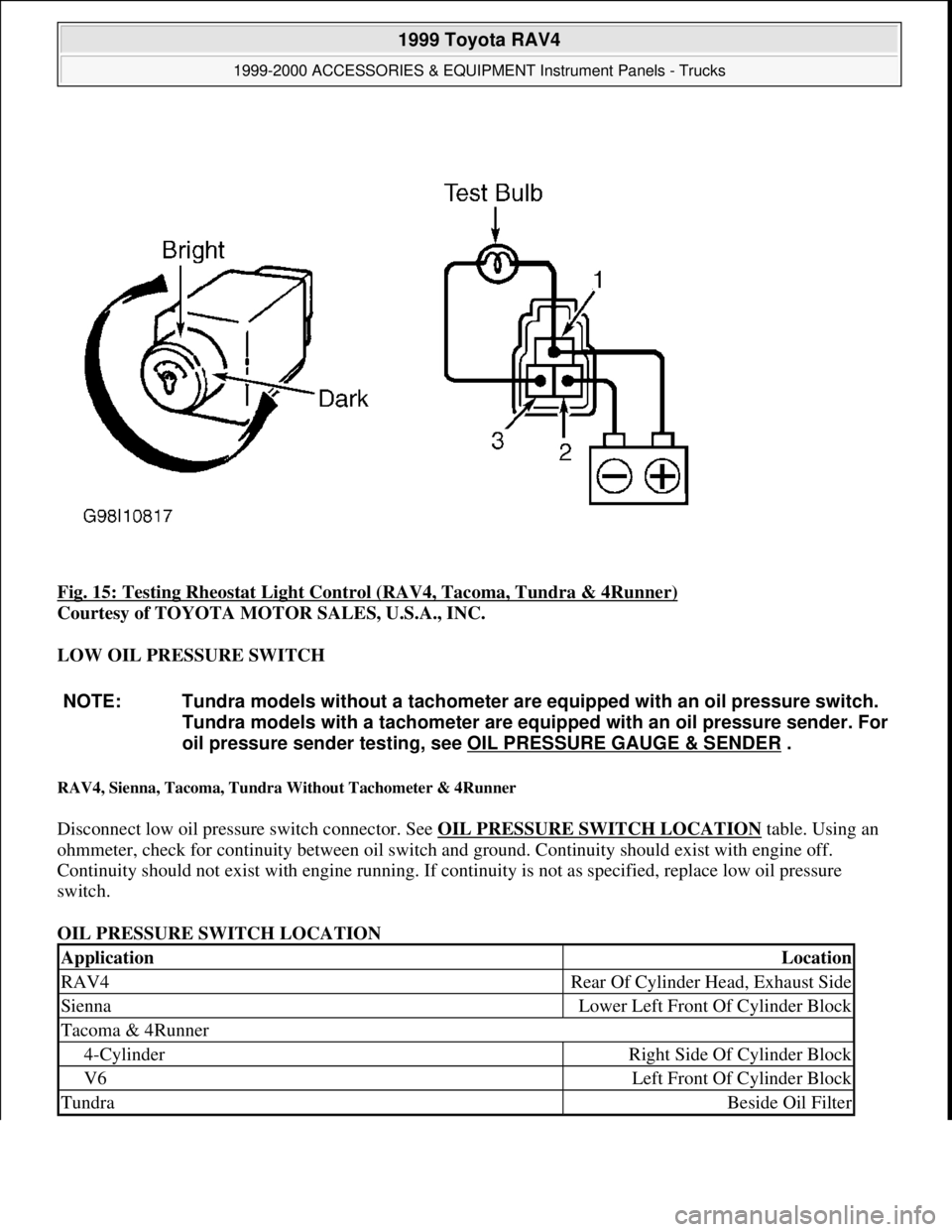
Fig. 15: Testing Rheostat Light Control (RAV4, Tacoma, Tundra & 4Runner)
Courtesy of TOYOTA MOTOR SALES, U.S.A., INC.
LOW OIL PRESSURE SWITCH
RAV4, Sienna, Tacoma, Tundra Without Tachometer & 4Runner
Disconnect low oil pressure switch connector. See OIL PRESSURE SWITCH LOCATION table. Using an
ohmmeter, check for continuity between oil switch and ground. Continuity should exist with engine off.
Continuity should not exist with engine running. If continuity is not as specified, replace low oil pressure
switch.
OIL PRESSURE SWITCH LOCATION
NOTE: Tundra models without a tachometer are equipped with an oil pressure switch.
Tundra models with a tachometer are equipped with an oil pressure sender. For
oil pressure sender testing, see OIL PRESSURE GAUGE & SENDER
.
ApplicationLocation
RAV4Rear Of Cylinder Head, Exhaust Side
SiennaLower Left Front Of Cylinder Block
Tacoma & 4Runner
4-CylinderRight Side Of Cylinder Block
V6Left Front Of Cylinder Block
TundraBeside Oil Filter
1999 Toyota RAV4
1999-2000 ACCESSORIES & EQUIPMENT Instrument Panels - Trucks
Microsoft
Sunday, November 22, 2009 10:54:10 AMPage 23 © 2005 Mitchell Repair Information Company, LLC.