air condition TOYOTA RAV4 PLUG-IN HYBRID 2023 Owners Manual
[x] Cancel search | Manufacturer: TOYOTA, Model Year: 2023, Model line: RAV4 PLUG-IN HYBRID, Model: TOYOTA RAV4 PLUG-IN HYBRID 2023Pages: 718, PDF Size: 167.55 MB
Page 3 of 718
RAV4 Plug-in Hybrid_OM_OM9A587E_(EE)
1
6
5
4
3
2
8
7
9
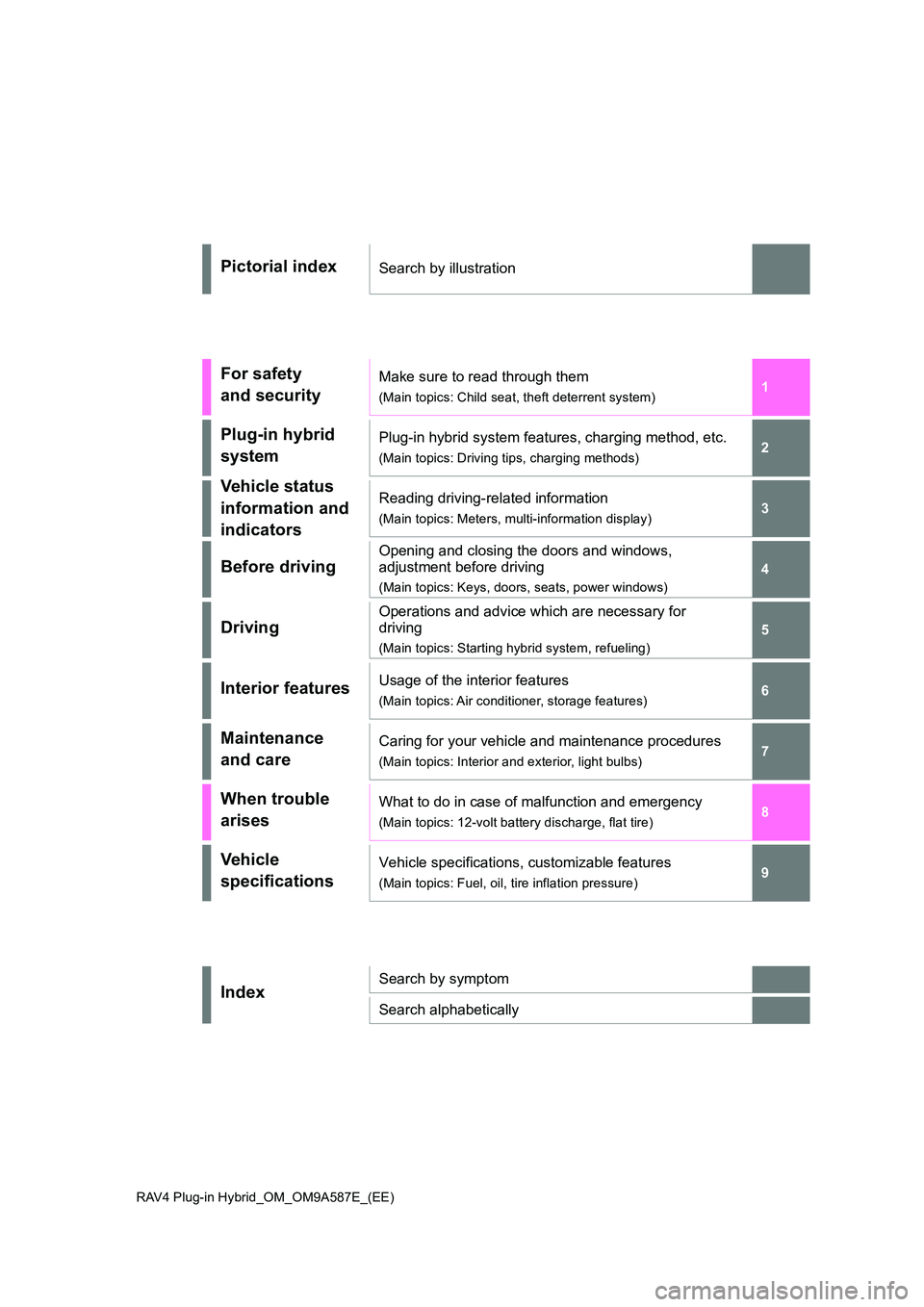
Pictorial indexSearch by illustration
For safety
and security
Make sure to read through them
(Main topics: Child seat, theft deterrent system)
Plug-in hybrid
system
Plug-in hybrid system features, charging method, etc.
(Main topics: Driving tips, charging methods)
Vehicle status
information and
indicators
Reading driving-related information
(Main topics: Meters, multi-information display)
Before driving
Opening and closing the doors and windows,
adjustment before driving
(Main topics: Keys, doors, seats, power windows)
Driving
Operations and advice which are necessary for
driving
(Main topics: Starting hybrid system, refueling)
Interior featuresUsage of the interior features
(Main topics: Air conditioner, storage features)
Maintenance
and care
Caring for your vehicle and maintenance procedures
(Main topics: Interior and exterior, light bulbs)
When trouble
arises
What to do in case of malfunction and emergency
(Main topics: 12-volt battery discharge, flat tire)
Vehicle
specifications
Vehicle specifications, customizable features
(Main topics: Fuel, oil, tire inflation pressure)
IndexSearch by symptom
Search alphabetically
Page 6 of 718
4TABLE OF CONTENTS
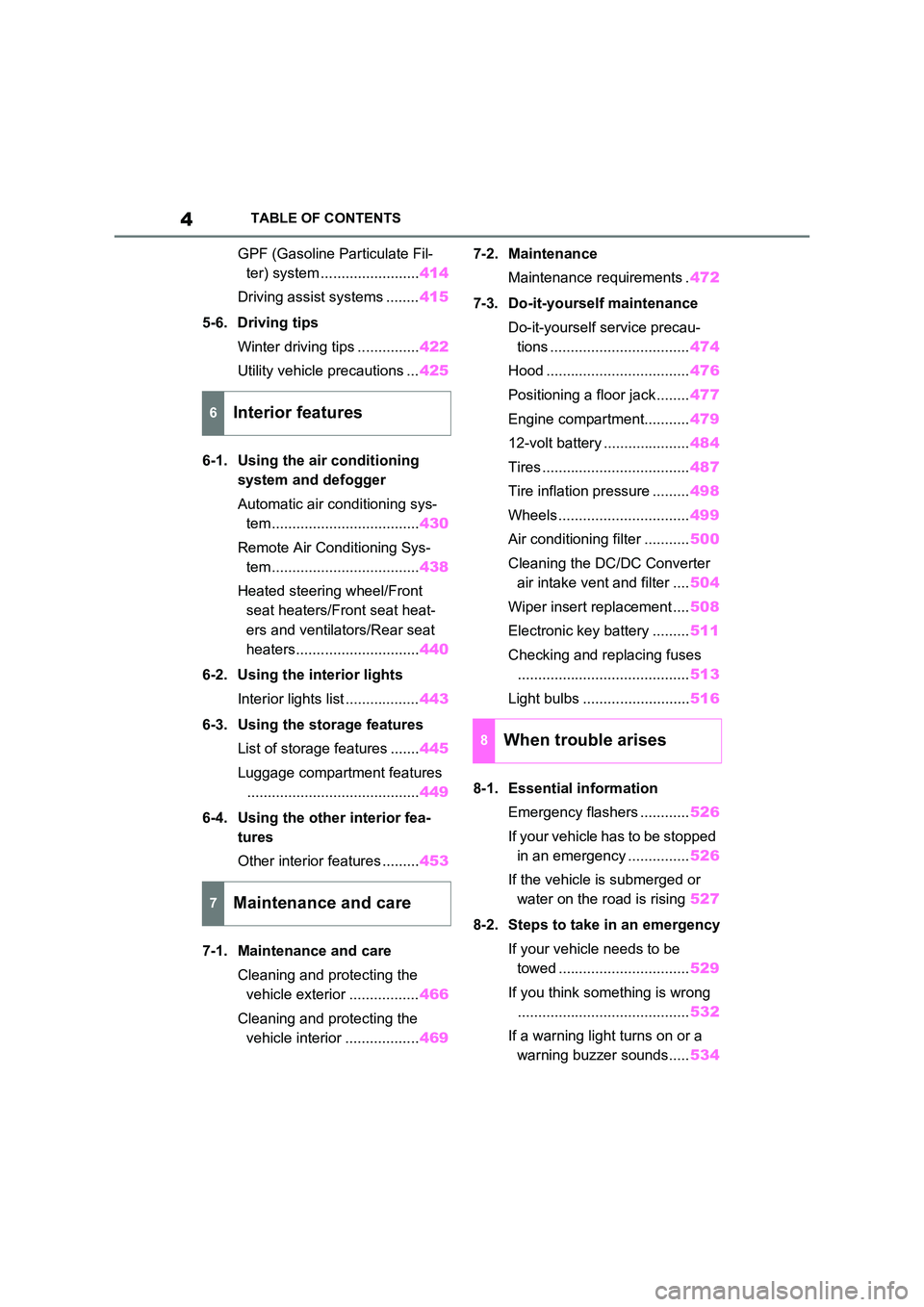
GPF (Gasoline Particulate Fil-
ter) system ........................ 414
Driving assist systems ........ 415
5-6. Driving tips
Winter driving tips ............... 422
Utility vehicle precautions ... 425
6-1. Using the air conditioning
system and defogger
Automatic air conditioning sys-
tem .................................... 430
Remote Air Conditioning Sys-
tem .................................... 438
Heated steering wheel/Front
seat heaters/Front seat heat-
ers and ventilators/Rear seat
heaters.............................. 440
6-2. Using the interior lights
Interior lights list .................. 443
6-3. Using the storage features
List of storage features ....... 445
Luggage compartment features
.......................................... 449
6-4. Using the other interior fea-
tures
Other interior features ......... 453
7-1. Maintenance and care
Cleaning and protecting the
vehicle exterior ................. 466
Cleaning and protecting the
vehicle interior .................. 469
7-2. Maintenance
Maintenance requirements . 472
7-3. Do-it-yourself maintenance
Do-it-yourself service precau-
tions .................................. 474
Hood ................................... 476
Positioning a floor jack ........ 477
Engine compartment........... 479
12-volt battery ..................... 484
Tires .................................... 487
Tire inflation pressure ......... 498
Wheels ................................ 499
Air conditioning filter ........... 500
Cleaning the DC/DC Converter
air intake vent and filter .... 504
Wiper insert replacement .... 508
Electronic key battery ......... 511
Checking and replacing fuses
.......................................... 513
Light bulbs .......................... 516
8-1. Essential information
Emergency flashers ............ 526
If your vehicle has to be stopped
in an emergency ............... 526
If the vehicle is submerged or
water on the road is rising 527
8-2. Steps to take in an emergency
If your vehicle needs to be
towed ................................ 529
If you think something is wrong
.......................................... 532
If a warning light turns on or a
warning buzzer sounds..... 534
6Interior features
7Maintenance and care
8When trouble arises
Page 18 of 718
16Pictorial index
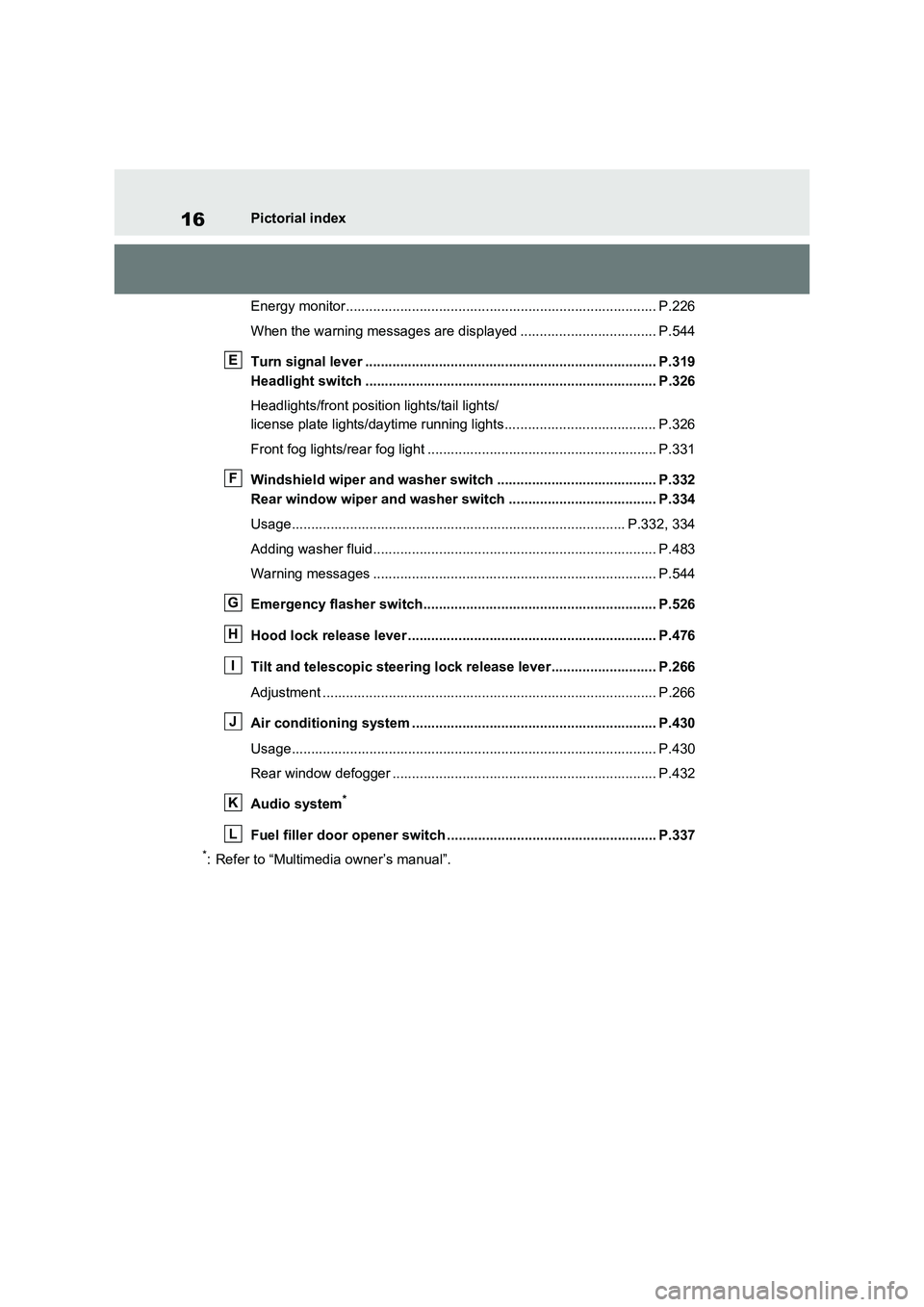
Energy monitor................................................................................ P.226
When the warning messages are displayed ................................... P.544
Turn signal lever ........................................................................... P.319
Headlight switch ........................................................................... P.326
Headlights/front position lights/tail lights/
license plate lights/daytime running lights....................................... P.326
Front fog lights/rear fog light ........................................................... P.331
Windshield wiper and washer switch ......................................... P.332
Rear window wiper and washer switch ...................................... P.334
Usage...................................................................................... P.332, 334
Adding washer fluid......................................................................... P.483
Warning messages ......................................................................... P.544
Emergency flasher switch............................................................ P.526
Hood lock release lever ................................................................ P.476
Tilt and telescopic steering lock release lever........................... P.266
Adjustment ...................................................................................... P.266
Air conditioning system ............................................................... P.430
Usage.............................................................................................. P.430
Rear window defogger .................................................................... P.432
Audio system
*
Fuel filler door opener switch ...................................................... P.337
*: Refer to “Multimedia owner’s manual”.
E
F
G
H
I
J
K
L
Page 26 of 718
24Pictorial index
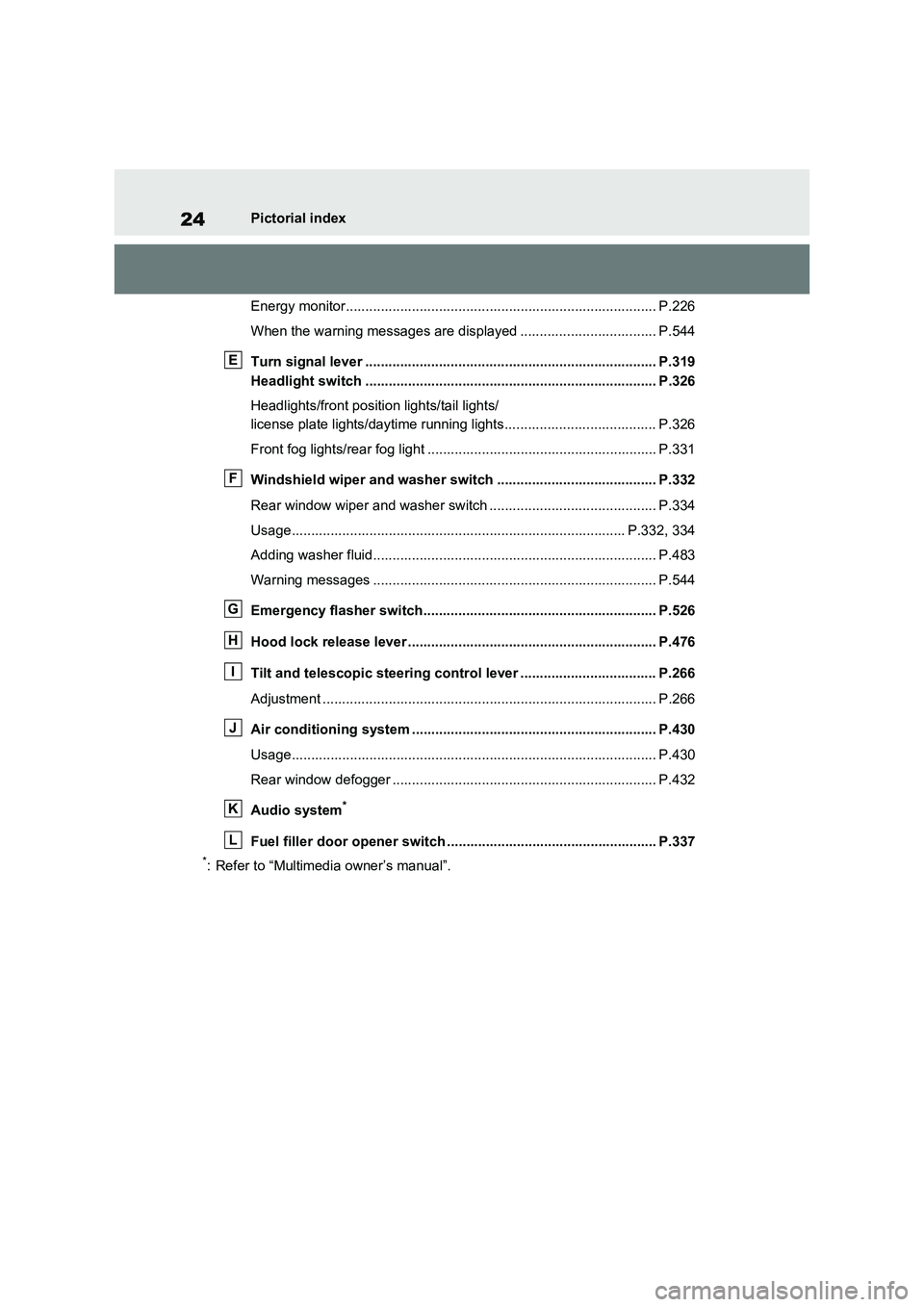
Energy monitor................................................................................ P.226
When the warning messages are displayed ................................... P.544
Turn signal lever ........................................................................... P.319
Headlight switch ........................................................................... P.326
Headlights/front position lights/tail lights/
license plate lights/daytime running lights....................................... P.326
Front fog lights/rear fog light ........................................................... P.331
Windshield wiper and washer switch ......................................... P.332
Rear window wiper and washer switch ........................................... P.334
Usage...................................................................................... P.332, 334
Adding washer fluid......................................................................... P.483
Warning messages ......................................................................... P.544
Emergency flasher switch............................................................ P.526
Hood lock release lever ................................................................ P.476
Tilt and telescopic steering control lever ................................... P.266
Adjustment ...................................................................................... P.266
Air conditioning system ............................................................... P.430
Usage.............................................................................................. P.430
Rear window defogger .................................................................... P.432
Audio system
*
Fuel filler door opener switch ...................................................... P.337
*: Refer to “Multimedia owner’s manual”.
E
F
G
H
I
J
K
L
Page 43 of 718
41
1
1-1. For safe use
For safety and security
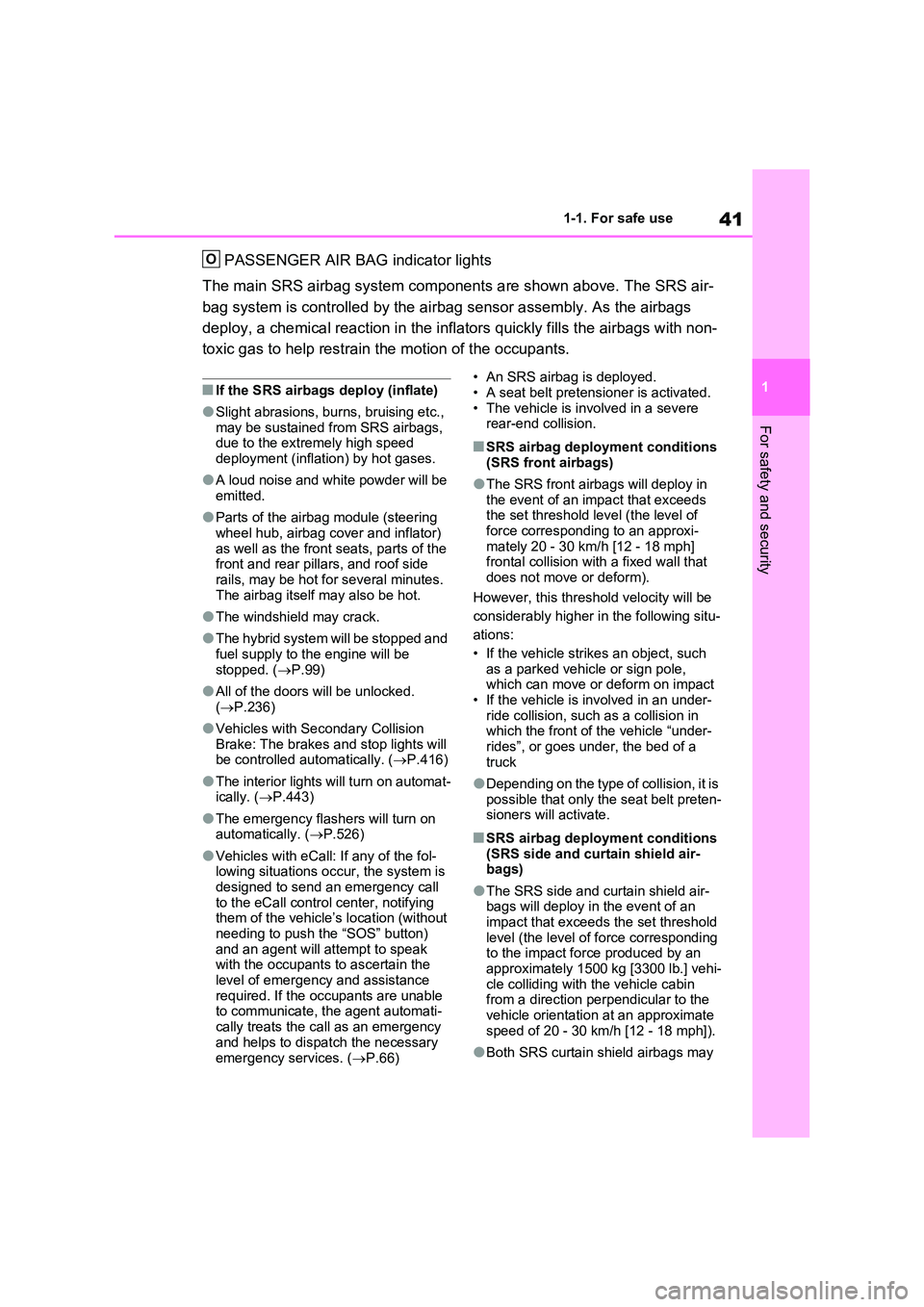
PASSENGER AIR BAG indicator lights
The main SRS airbag system components are shown above. The SRS air-
bag system is controlled by the airbag sensor assembly. As the airbags
deploy, a chemical reaction in the inflators quickly fills the airbags with non-
toxic gas to help restrain the motion of the occupants.
■If the SRS airbags deploy (inflate)
●Slight abrasions, burns, bruising etc., may be sustained from SRS airbags, due to the extremely high speed
deployment (inflation) by hot gases.
●A loud noise and white powder will be
emitted.
●Parts of the airbag module (steering
wheel hub, airbag cover and inflator) as well as the front seats, parts of the front and rear pillars, and roof side
rails, may be hot for several minutes. The airbag itself may also be hot.
●The windshield may crack.
●The hybrid system will be stopped and
fuel supply to the engine will be stopped. ( P.99)
●All of the doors will be unlocked. ( P.236)
●Vehicles with Secondary Collision Brake: The brakes and stop lights will be controlled automatically. ( P.416)
●The interior lights will turn on automat- ically. ( P.443)
●The emergency flashers will turn on automatically. ( P.526)
●Vehicles with eCall: If any of the fol- lowing situations occur, the system is
designed to send an emergency call to the eCall control center, notifying them of the vehicle’s location (without
needing to push the “SOS” button) and an agent will attempt to speak with the occupants to ascertain the
level of emergency and assistance required. If the occupants are unable to communicate, the agent automati-
cally treats the call as an emergency and helps to dispatch the necessary
emergency services. ( P.66)
• An SRS airbag is deployed. • A seat belt pretensioner is activated.
• The vehicle is involved in a severe rear-end collision.
■SRS airbag deployment conditions
(SRS front airbags)
●The SRS front airbags will deploy in
the event of an impact that exceeds the set threshold level (the level of force corresponding to an approxi-
mately 20 - 30 km/h [12 - 18 mph] frontal collision with a fixed wall that does not move or deform).
However, this threshold velocity will be
considerably higher in the following situ-
ations:
• If the vehicle strikes an object, such as a parked vehicle or sign pole, which can move or deform on impact
• If the vehicle is involved in an under- ride collision, such as a collision in which the front of the vehicle “under-
rides”, or goes under, the bed of a truck
●Depending on the type of collision, it is possible that only the seat belt preten-sioners will activate.
■SRS airbag deployment conditions
(SRS side and curtain shield air- bags)
●The SRS side and curtain shield air-bags will deploy in the event of an impact that exceeds the set threshold
level (the level of force corresponding to the impact force produced by an approximately 1500 kg [3300 lb.] vehi-
cle colliding with the vehicle cabin from a direction perpendicular to the vehicle orientation at an approximate
speed of 20 - 30 km/h [12 - 18 mph]).
●Both SRS curtain shield airbags may
O
Page 44 of 718
421-1. For safe use
also deploy in the event of a severe
frontal collision.
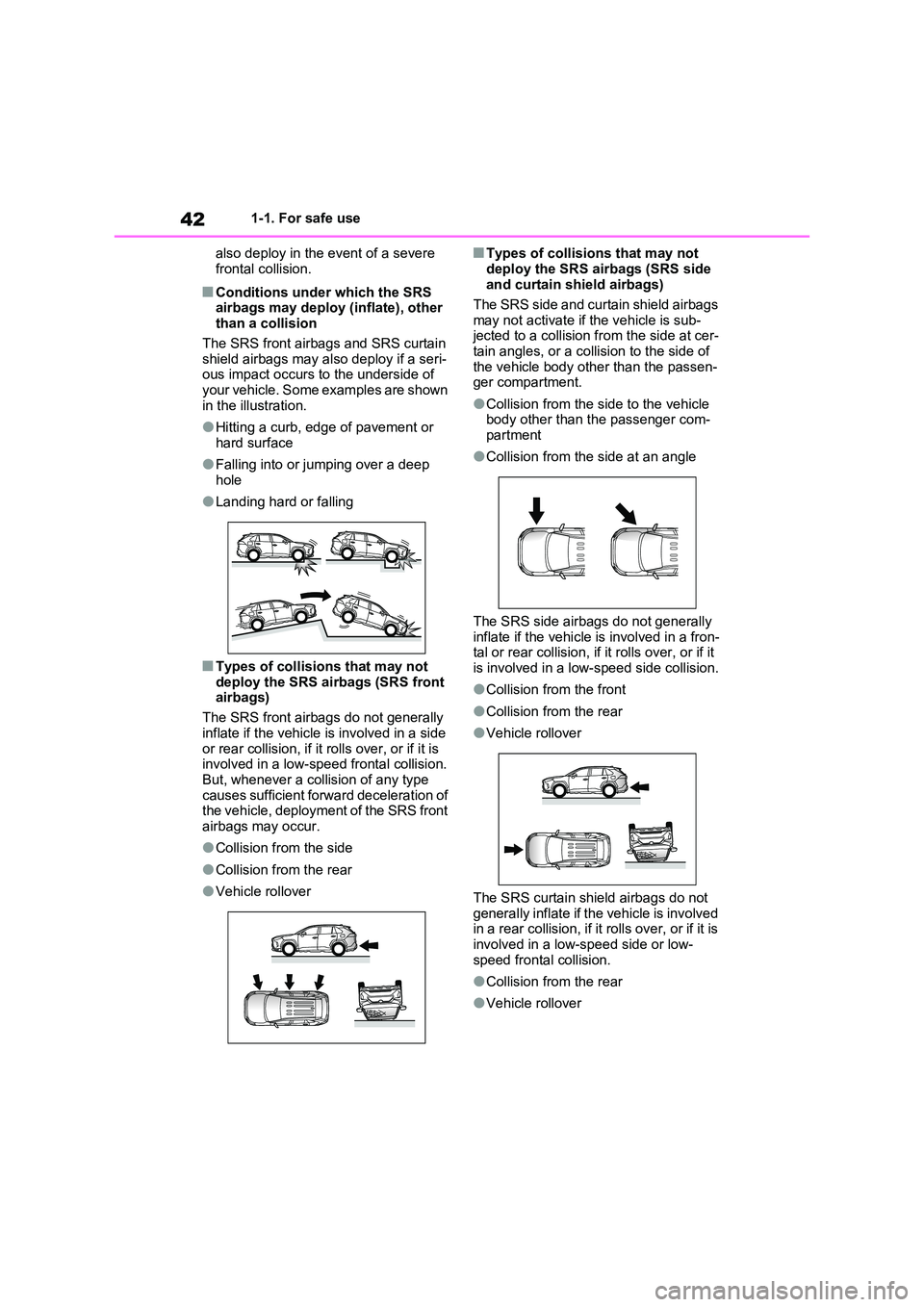
■Conditions under which the SRS airbags may deploy (inflate), other than a collision
The SRS front airbags and SRS curtain shield airbags may also deploy if a seri-ous impact occurs to the underside of
your vehicle. Some examples are shown in the illustration.
●Hitting a curb, edge of pavement or hard surface
●Falling into or jumping over a deep hole
●Landing hard or falling
■Types of collisions that may not
deploy the SRS airbags (SRS front airbags)
The SRS front airbags do not generally
inflate if the vehicle is involved in a side or rear collision, if it rolls over, or if it is involved in a low-speed frontal collision.
But, whenever a collision of any type causes sufficient forward deceleration of the vehicle, deployment of the SRS front
airbags may occur.
●Collision from the side
●Collision from the rear
●Vehicle rollover
■Types of collisions that may not
deploy the SRS airbags (SRS side and curtain shield airbags)
The SRS side and curtain shield airbags
may not activate if the vehicle is sub- jected to a collision from the side at cer-tain angles, or a collision to the side of
the vehicle body other than the passen- ger compartment.
●Collision from the side to the vehicle body other than the passenger com-partment
●Collision from the side at an angle
The SRS side airbags do not generally inflate if the vehicle is involved in a fron-tal or rear collision, if it rolls over, or if it
is involved in a low-speed side collision.
●Collision from the front
●Collision from the rear
●Vehicle rollover
The SRS curtain shield airbags do not
generally inflate if the vehicle is involved in a rear collision, if it rolls over, or if it is involved in a low-speed side or low-
speed frontal collision.
●Collision from the rear
●Vehicle rollover
Page 86 of 718
842-1. Plug-in hybrid system
2-1.Plug-in hyb rid s ystem
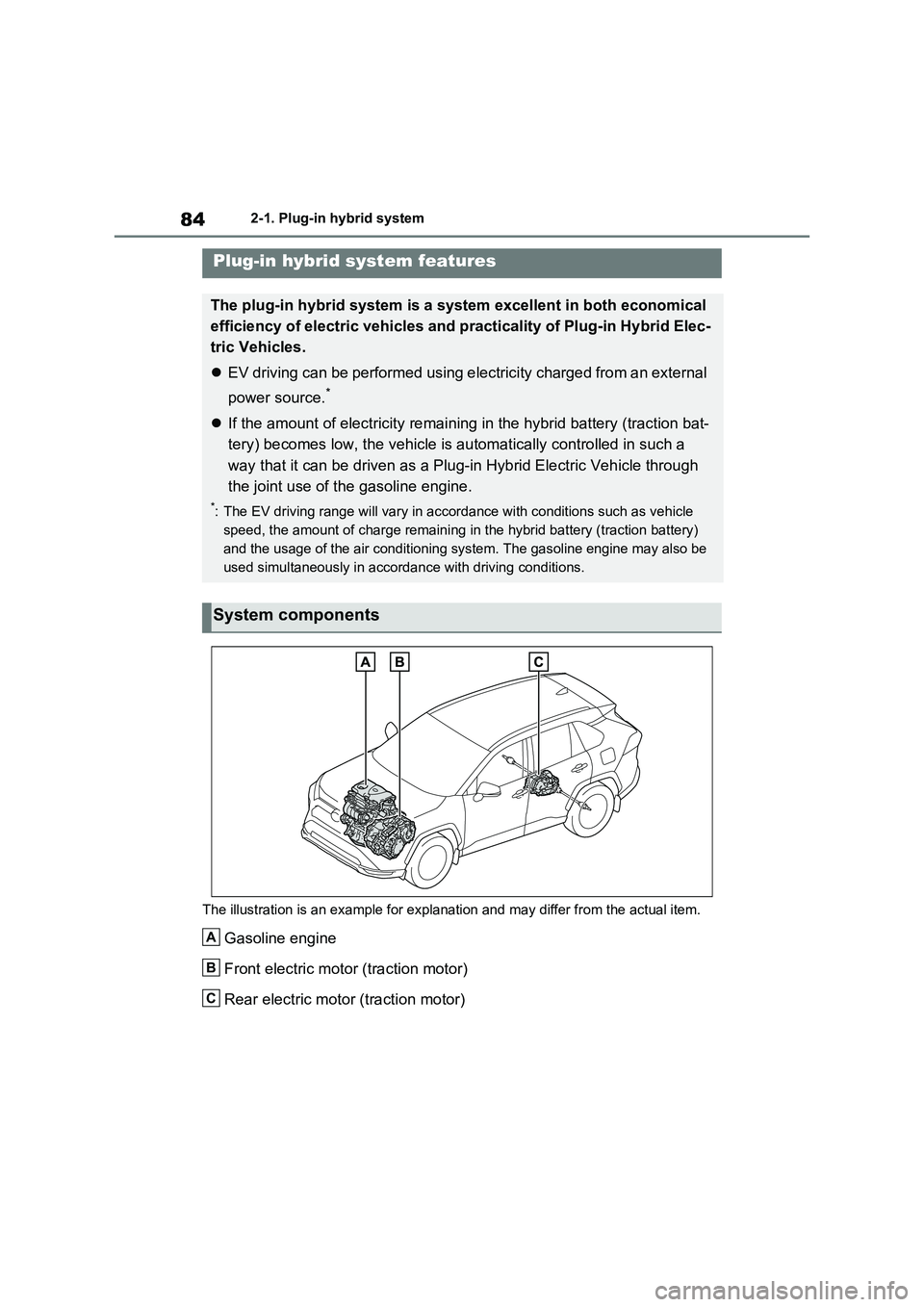
The illustration is an example for explanation and may differ from the actual item.
Gasoline engine
Front electric motor (traction motor)
Rear electric motor (traction motor)
Plug-in hybrid system features
The plug-in hybrid system is a system excellent in both economical
efficiency of electric vehicles and practicality of Plug-in Hybrid Elec-
tric Vehicles.
EV driving can be performed using electricity charged from an external
power source.
*
If the amount of electricity remaining in the hybrid battery (traction bat-
tery) becomes low, the vehicle is automatically controlled in such a
way that it can be driven as a Plug-in Hybrid Electric Vehicle through
the joint use of the gasoline engine.
*: The EV driving range will vary in accordance with conditions such as vehicle
speed, the amount of charge remaining in the hybrid battery (traction battery)
and the usage of the air conditioning system. The gasoline engine may also be
used simultaneously in accordance with driving conditions.
System components
A
B
C
Page 90 of 718
882-1. Plug-in hybrid system
hybrid system operation mode cannot
be changed even if the AUTO EV/HV mode switch or EV/HV mode selection switch is pressed. (In this case, the
warning message is displayed on the multi-information display when the switch is pressed.)
●When electricity needed for EV driving is not remaining (when in EV mode or
AUTO EV/HV mode)
●When the traction battery is almost
completely charged (hybrid battery [traction battery] charge mode)
■When switching from EV mode to another mode using the switch
●After switching from EV mode to HV
mode or hybrid battery (traction bat-
tery) charge mode and the power switch is turned off, the system returns to EV mode the next time the
vehicle is started.*
●After switching from EV mode to
AUTO EV/HV mode and the power switch is turned off, the system does
not return to EV mode the next time
the vehicle is started.*
*: If there is not enough charge remain-
ing in the hybrid battery (traction bat-
tery) to allow EV driving, the system
switches to HV mode.
■Hybrid battery (traction battery) charge mode
●The following may occur to protect the system, etc.
• Cannot switch to hybrid battery (trac- tion battery) charge mode or cannot cancel it
• Gasoline engine does not start or stops even after switching to hybrid battery (traction battery) charge mode
●If a load to the system is large, such as when the power consumption of
the air conditioning system is large or when the temperature of the engine coolant is high, it may take longer time
than usual to charge using the hybrid battery (traction battery) charge mode, or charging to the hybrid bat-
tery (traction battery) may not be per-
formed.
■When in EV mode
In EV mode, EV driving (driving
using only the electric motor)* is
possible. However, depending on
the situation, EV driving may be
canceled and both gasoline engine
and electric motor are used
( P.90). Also, if a little electricity is
remaining in the hybrid battery
(traction battery), HV mode is auto-
matically selected. To drive in EV
mode long, observe the followings.
Avoid sudden acceleration and
sudden deceleration, and be
sure to drive smoothly.
If you repeatedly accelerate, the
WARNING
■When using the hybrid battery (traction battery) charge mode
Observe the following precautions when using the hybrid battery (trac-tion battery) charge mode while park-
ing.
Failure to do so may lead to death or serious health hazard, as the gasoline
engine operates when in the hybrid battery (traction battery) charge mode.
●Do not stop the vehicle near flam-mable materials.
●Do not use the hybrid battery (trac-tion battery) charge mode in a closed area where ventilation is
insufficient, such as in a garage or area with snow buildup.
Control when driving in
each mode
Page 93 of 718
91
2 2-1. Plug-in hybrid system
Plug-in hybrid system
gasoline engine needs to be started.*1: The gasoline engine may also oper-
ate in circumstances other than those
listed above, depending on condi-
tions.
*2: When driving in AUTO EV/HV mode.
Even in EV mode, the gasoline
engine may start, depending on the
condition of the hybrid battery (trac-
tion battery).
■If “Engine Started to Protect Sys-
tem EV driving unavailable” is dis-
played on the multi-information
display
EV driving may be canceled in order to
protect the hybrid system, etc.
In this case, perform driving with the
gasoline engine until EV driving will be
returned to automatically.
■Conditions in which the gasoline
engine may not stop
The gasoline engine starts and stops
automatically. However, it may not stop
automatically in the following condi-
tions
*:
●During gasoline engine warm-up
●During hybrid battery (traction battery)
charging
●When the temperature of the hybrid
battery (traction battery) is high or low
●When the windshield defogger switch
is pressed. (P.431)
*: Depending on the circumstances, the
gasoline engine may also not stop
automatically in situations other than
those above.
■Sounds and vibrations specific to a
Plug-in Hybrid Electric Vehicle
There may be no engine sound or vibra-
tion even though the vehicle is able to
move with the “READY” indicator is illu-
minated. For safety, apply the parking
brake and make sure to shift the shift
lever to P when parked.The following sounds or vibrations may
occur when the hybrid system is operat-
ing and are not a malfunction.
●Motor sounds may be heard from the
engine compartment.
●Sounds may be heard from the hybrid
battery (traction battery) when the
hybrid system starts or stops.
●Relay operating sounds such as a
snap or soft clank will be emitted from
the hybrid battery (traction battery),
under the rear seats or under the
floor, when the hybrid system is
started or stopped.
●Sounds from the hybrid system may
be heard when the back door is open.
●Sounds may be heard from the trans-
mission when the gasoline engine
starts or stops, when driving at low
speeds, or during idling.
●Engine sounds may be heard when
accelerating sharply.
●Sounds may be heard due to regener-
ative braking when the brake pedal is
depressed or as the accelerator pedal
is released.
●Vibration may be felt when the gaso-
line engine starts or stops.
●Cooling fan sounds may be heard
from the air intake vent under the rear
seat. (P.99)
●Sounds may be heard from near the
hybrid battery (traction battery) in
accordance with the operation of the
air conditioning system or battery
cooler. (P.128)
■Maintenance, repair, recycling, and
disposal
Contact any authorized Toyota retailer
or Toyota authorized repairer, or any
reliable repairer regarding mainte-
nance, repair, recycling and disposal.
Do not dispose of the vehicle yourself.
In order to make EV mode or AUTO
Charging (P.106)
Page 95 of 718
93
2
2-1. Plug-in hybrid system
Plug-in hybrid system
●In the wind or the rain
Also, as the Acoustic Vehicle Alerting System is installed on the front of the vehicle, it may be more difficult to hear
from the rear of the vehicle compared to the front.
■When “Acoustic Vehicle Alerting System Malfunction Visit your
Dealer” is displayed on the multi- information display
The Acoustic Vehicle Alerting System
may be malfunctioning. Have the vehicle inspected by any authorized Toyota retailer or Toyota authorized repairer, or
any reliable repairer immediately.
This system operates based on the
driving situation and traffic informa-
tion to enhance fuel economy.
For details about Predictive efficient
drive, refer to “Multimedia owner’s
manual”.
■Predictive deceleration sup-
port
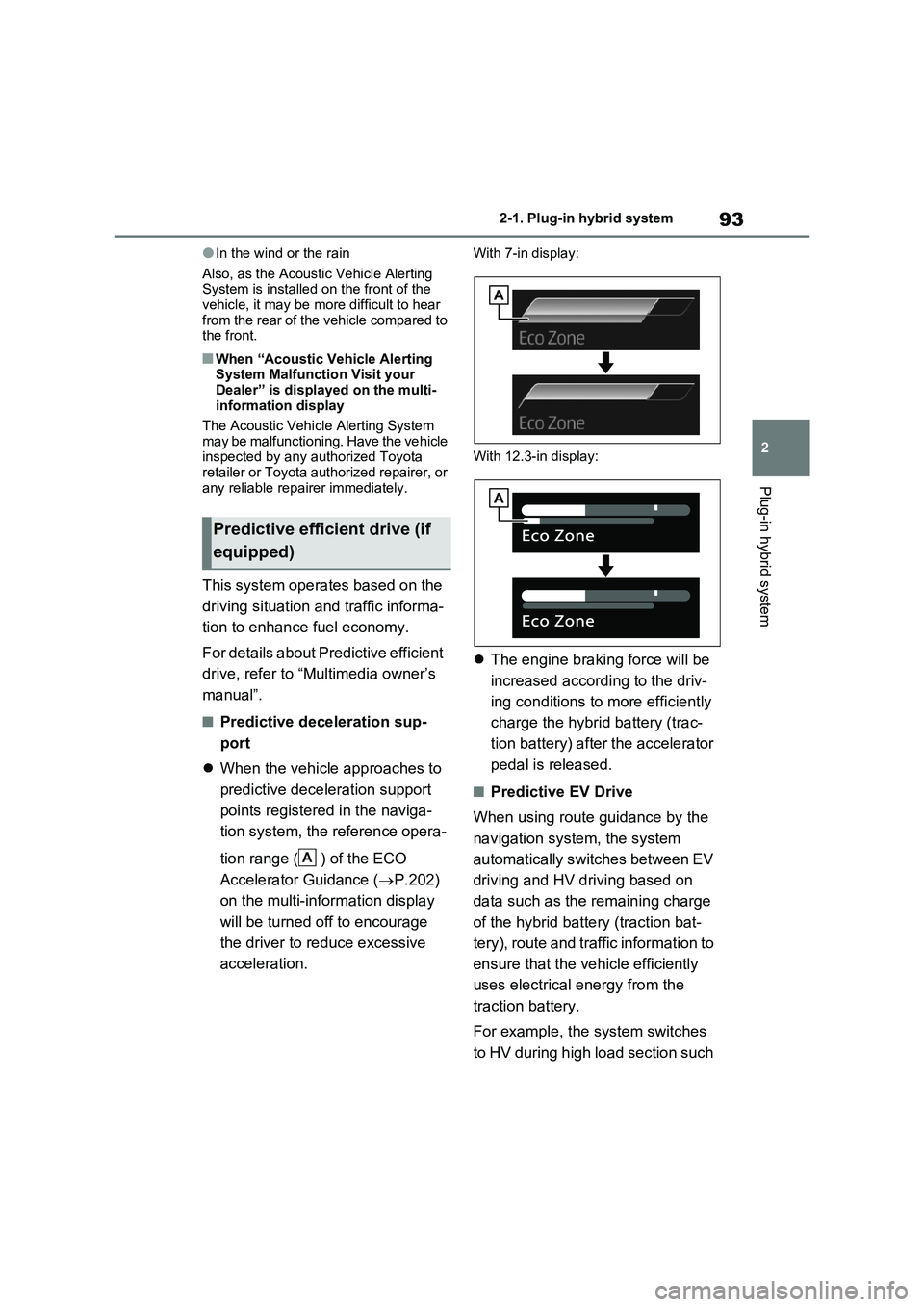
When the vehicle approaches to
predictive deceleration support
points registered in the naviga-
tion system, the reference opera-
tion range ( ) of the ECO
Accelerator Guidance ( P.202)
on the multi-information display
will be turned off to encourage
the driver to reduce excessive
acceleration.
With 7-in display:
With 12.3-in display:
The engine braking force will be
increased according to the driv-
ing conditions to more efficiently
charge the hybrid battery (trac-
tion battery) after the accelerator
pedal is released.
■Predictive EV Drive
When using route guidance by the
navigation system, the system
automatically switches between EV
driving and HV driving based on
data such as the remaining charge
of the hybrid battery (traction bat-
tery), route and traffic information to
ensure that the vehicle efficiently
uses electrical energy from the
traction battery.
For example, the system switches
to HV during high load section such
Predictive efficient drive (if
equipped)
A