sensor TOYOTA SIENNA 2007 Service Repair Manual
[x] Cancel search | Manufacturer: TOYOTA, Model Year: 2007, Model line: SIENNA, Model: TOYOTA SIENNA 2007Pages: 3000, PDF Size: 52.26 MB
Page 689 of 3000
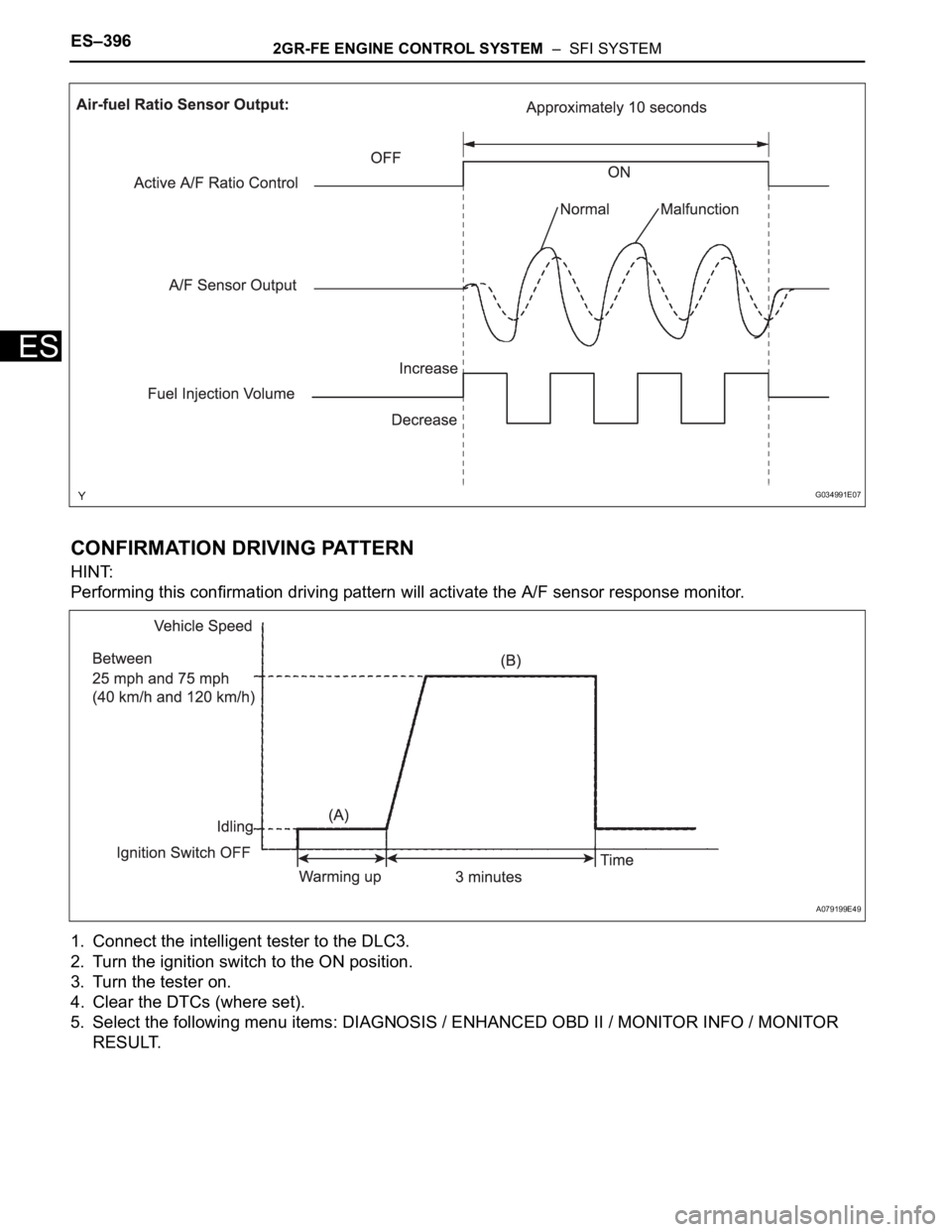
ES–3962GR-FE ENGINE CONTROL SYSTEM – SFI SYSTEM
ES
CONFIRMATION DRIVING PATTERN
HINT:
Performing this confirmation driving pattern will activate the A/F sensor response monitor.
1. Connect the intelligent tester to the DLC3.
2. Turn the ignition switch to the ON position.
3. Turn the tester on.
4. Clear the DTCs (where set).
5. Select the following menu items: DIAGNOSIS / ENHANCED OBD II / MONITOR INFO / MONITOR
RESULT.
G034991E07
A079199E49
Page 690 of 3000
2GR-FE ENGINE CONTROL SYSTEM – SFI SYSTEMES–397
ES
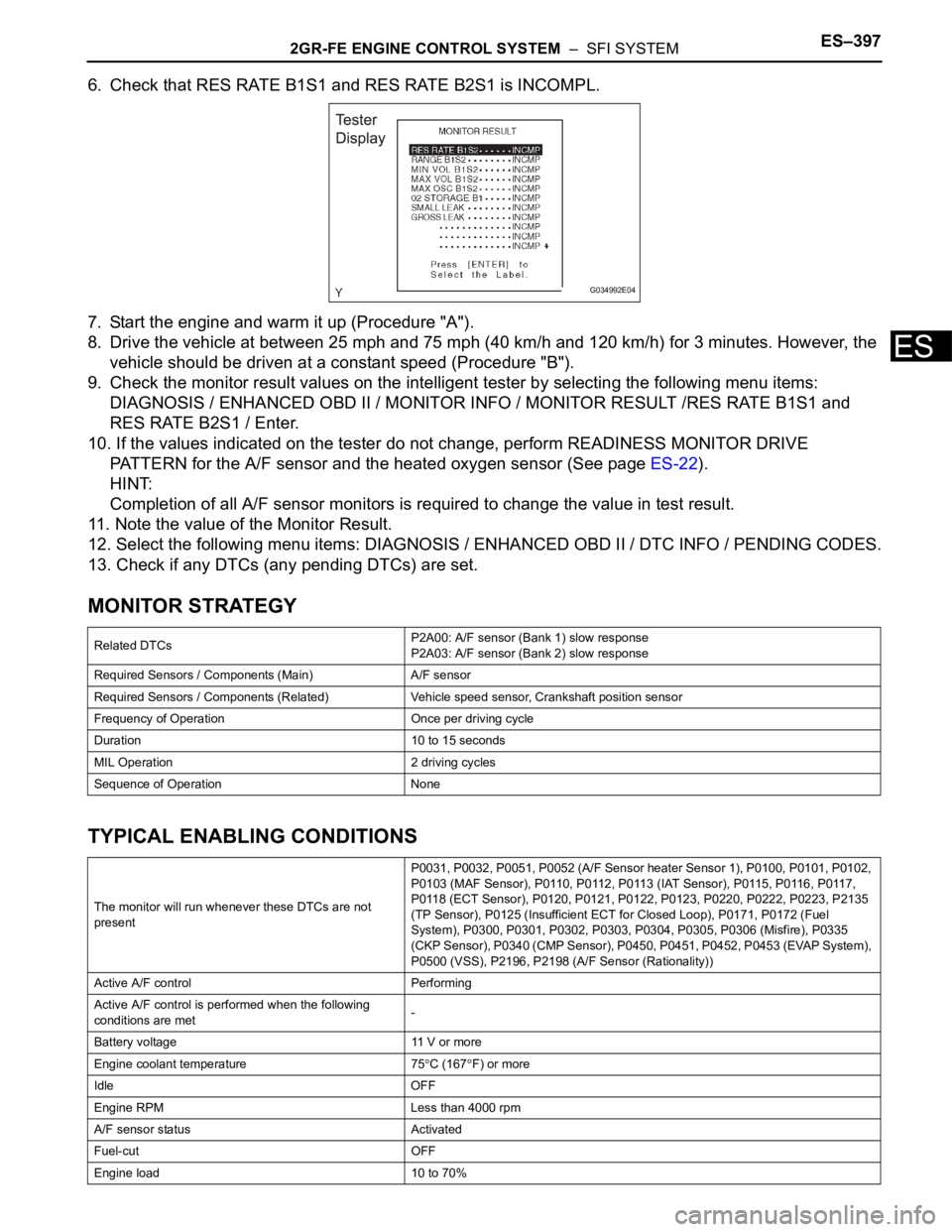
6. Check that RES RATE B1S1 and RES RATE B2S1 is INCOMPL.
7. Start the engine and warm it up (Procedure "A").
8. Drive the vehicle at between 25 mph and 75 mph (40 km/h and 120 km/h) for 3 minutes. However, the
vehicle should be driven at a constant speed (Procedure "B").
9. Check the monitor result values on the intelligent tester by selecting the following menu items:
DIAGNOSIS / ENHANCED OBD II / MONITOR INFO / MONITOR RESULT /RES RATE B1S1 and
RES RATE B2S1 / Enter.
10. If the values indicated on the tester do not change, perform READINESS MONITOR DRIVE
PATTERN for the A/F sensor and the heated oxygen sensor (See page ES-22).
HINT:
Completion of all A/F sensor monitors is required to change the value in test result.
11. Note the value of the Monitor Result.
12. Select the following menu items: DIAGNOSIS / ENHANCED OBD II / DTC INFO / PENDING CODES.
13. Check if any DTCs (any pending DTCs) are set.
MONITOR STRATEGY
TYPICAL ENABLING CONDITIONS
Related DTCsP2A00: A/F sensor (Bank 1) slow response
P2A03: A/F sensor (Bank 2) slow response
Required Sensors / Components (Main) A/F sensor
Required Sensors / Components (Related) Vehicle speed sensor, Crankshaft position sensor
Frequency of Operation Once per driving cycle
Duration 10 to 15 seconds
MIL Operation 2 driving cycles
Sequence of Operation None
The monitor will run whenever these DTCs are not
presentP0031, P0032, P0051, P0052 (A/F Sensor heater Sensor 1), P0100, P0101, P0102,
P0103 (MAF Sensor), P0110, P0112, P0113 (IAT Sensor), P0115, P0116, P0117,
P0118 (ECT Sensor), P0120, P0121, P0122, P0123, P0220, P0222, P0223, P2135
(TP Sensor), P0125 (Insufficient ECT for Closed Loop), P0171, P0172 (Fuel
System), P0300, P0301, P0302, P0303, P0304, P0305, P0306 (Misfire), P0335
(CKP Sensor), P0340 (CMP Sensor), P0450, P0451, P0452, P0453 (EVAP System),
P0500 (VSS), P2196, P2198 (A/F Sensor (Rationality))
Active A/F control Performing
Active A/F control is performed when the following
conditions are met-
Battery voltage 11 V or more
Engine coolant temperature 75
C (167F) or more
Idle OFF
Engine RPM Less than 4000 rpm
A/F sensor status Activated
Fuel-cut OFF
Engine load 10 to 70%
G034992E04
Page 691 of 3000

ES–3982GR-FE ENGINE CONTROL SYSTEM – SFI SYSTEM
ES
TYPICAL MALFUNCTION THRESHOLDS
MONITOR RESULT
Refer to CHECKING MONITOR STATUS (See page ES-19).
WIRING DIAGRAM
Refer to DTC P2195 (See page ES-359).
INSPECTION PROCEDURE
HINT:
Malfunctioning areas can be identified by performing the A/F CONTROL function provided in the ACTIVE
TEST. The A/F CONTROL function can help to determine whether the Air-Fuel Ratio (A/F) sensor, Heated
Oxygen (HO2) sensor and other potential trouble areas are malfunctioning.
The following instructions describe how to conduct the A/F CONTROL operation using an intelligent
tester.
(a) Connect the intelligent tester to the DLC3.
(b) Start the engine and turn the tester on.
(c) Warm up the engine at an engine speed of 2500 rpm for approximately 90 seconds.
(d) Select the following menu items on the tester: DIAGNOSIS / ENHANCED OBD II / ACTIVE TEST / A/
F CONTROL.
(e) Perform the A/F CONTROL operation with the engine in an idling condition (press the RIGHT or LEFT
button to change the fuel injection volume).
(f) Monitor the voltage outputs of the A/F and HO2 sensors (AFS B1S1 and O2S B1S2 or AFS B2S1 and
O2S B2S2) displayed on the tester.
HINT:
• The A/F CONTROL operation lowers the fuel injection volume by 12.5% or increases the injection
volume by 25%.
• Each sensor reacts in accordance with increases and decreases in the fuel injection volume.
Standard voltage
NOTICE:
The Air-Fuel Ratio (A/F) sensor has an output delay of a few seconds and the Heated Oxygen
(HO2) sensor has a maximum output delay of approximately 20 seconds.
Shift position 2 or more
Catalyst monitor Not yet
MAF 2.5 to 15 g/s
Response rate deterioration level Less than 0.18 V
Tester Display (Sensor) Injection Volumes Status Voltages
AFS B1S1 or AFS B2S1 (A/F) +25% Rich Less than 3.0
AFS B1S1 or AFS B2S1 (A/F) -12.5% Lean More than 3.35
O2S B1S2 or O2S B2S2 (HO2) +25% Rich More than 0.55
O2S B1S2 or O2S B2S2 (HO2) -12.5% Lean Less than 0.4
Page 692 of 3000
2GR-FE ENGINE CONTROL SYSTEM – SFI SYSTEMES–399
ES
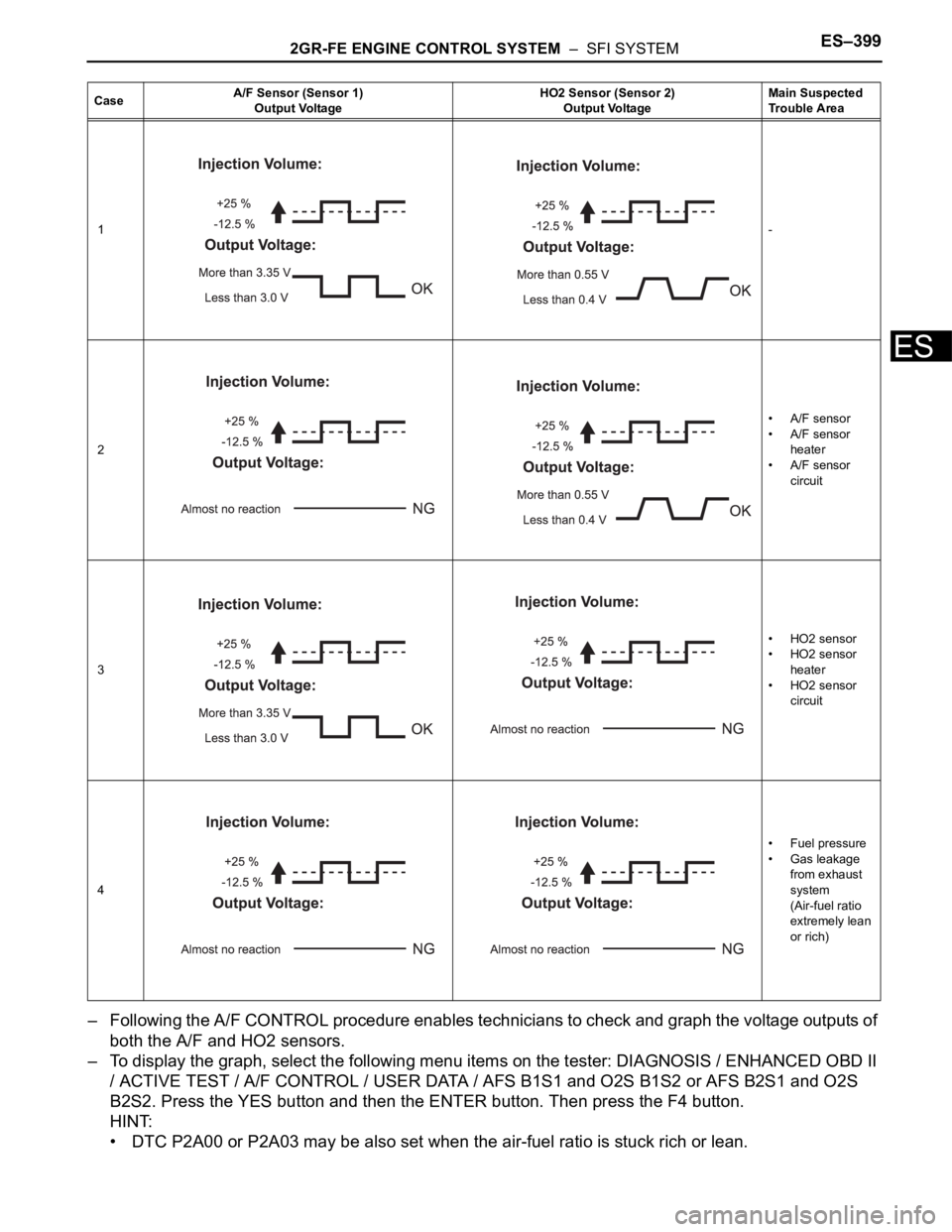
– Following the A/F CONTROL procedure enables technicians to check and graph the voltage outputs of
both the A/F and HO2 sensors.
– To display the graph, select the following menu items on the tester: DIAGNOSIS / ENHANCED OBD II
/ ACTIVE TEST / A/F CONTROL / USER DATA / AFS B1S1 and O2S B1S2 or AFS B2S1 and O2S
B2S2. Press the YES button and then the ENTER button. Then press the F4 button.
HINT:
• DTC P2A00 or P2A03 may be also set when the air-fuel ratio is stuck rich or lean.
CaseA/F Sensor (Sensor 1)
Output VoltageHO2 Sensor (Sensor 2)
Output VoltageMain Suspected
Trouble Area
1-
2•A/F sensor
•A/F sensor
heater
•A/F sensor
circuit
3•HO2 sensor
• HO2 sensor
heater
• HO2 sensor
circuit
4• Fuel pressure
• Gas leakage
from exhaust
system
(Air-fuel ratio
extremely lean
or rich)
Page 693 of 3000
ES–4002GR-FE ENGINE CONTROL SYSTEM – SFI SYSTEM
ES
• A low A/F sensor voltage could be caused by a rich air-fuel mixture. Check for conditions that would
cause the engine to run rich.
• A high A/F sensor voltage could be caused by a lean air-fuel mixture. Check for conditions that
would cause the engine to run lean.
• Read freeze frame data using the intelligent tester. The ECM records vehicle and driving condition
information as freeze frame data the moment a DTC is stored. When troubleshooting, freeze frame
data can be helpful in determining whether the vehicle was running or stopped, whether the engine
was warmed up or not, whether the air-fuel ratio was lean or rich, as well as other data recorded at
the time of a malfunction.
(a) Connect the intelligent tester to the DLC3.
(b) Turn the ignition switch to the ON position.
(c) Turn the tester on.
(d) Select the following menu items: DIAGNOSIS /
ENHANCED OBD II / DTC INFO / CURRENT CODES.
(e) Read the DTCs.
Result
HINT:
If any DTCs other than P2A00 or P2A03 are output,
troubleshoot those DTCs first.
B
A
1CHECK ANY OTHER DTCS OUTPUT (IN ADDITION TO DTC P2A00 AND/OR P2A03)
Display (DTC Output) Proceed to
P2A00 and/or P2A03 A
P2A00 and/or P2A03 and other DTCs B
GO TO DTC CHART (See page ES-56)
Page 694 of 3000
2GR-FE ENGINE CONTROL SYSTEM – SFI SYSTEMES–401
ES
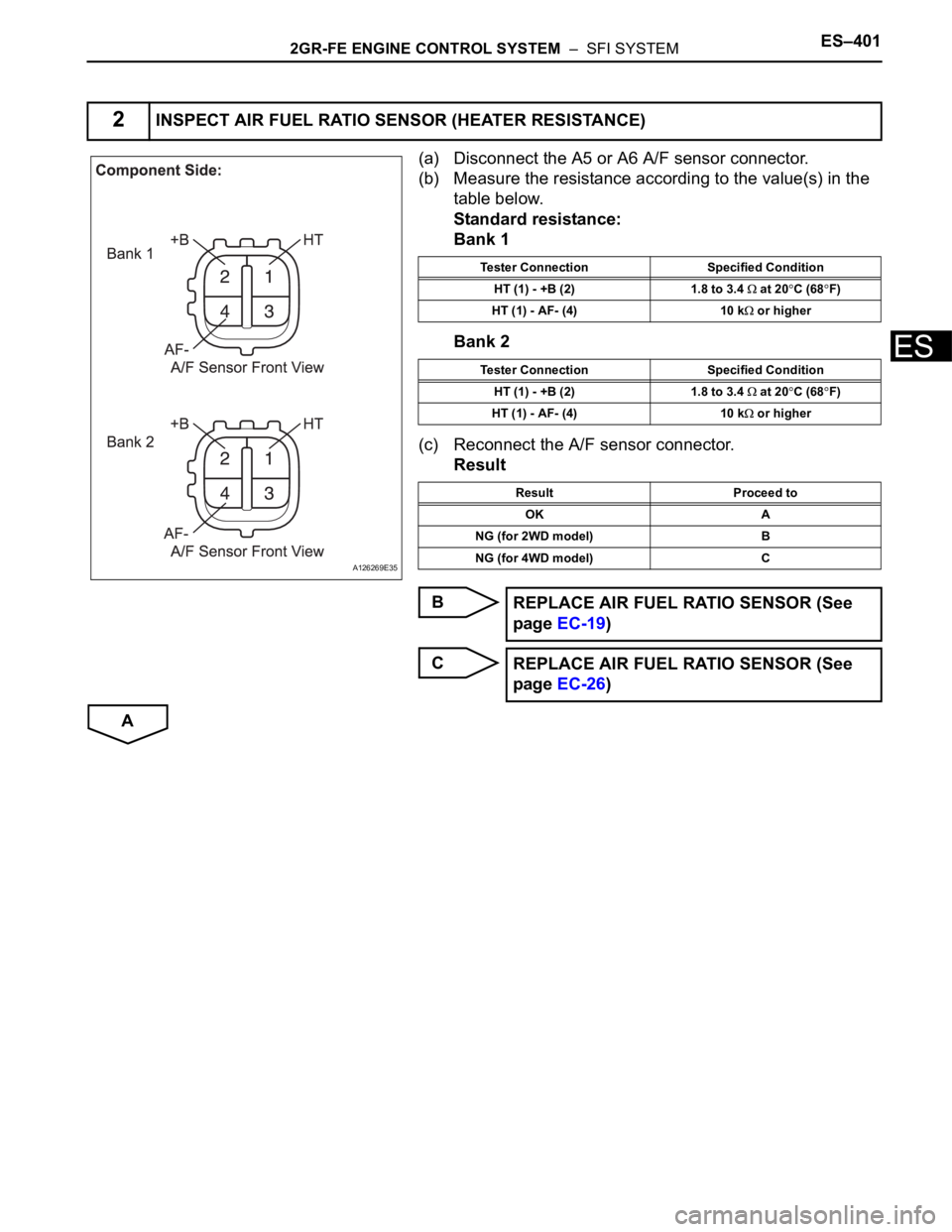
(a) Disconnect the A5 or A6 A/F sensor connector.
(b) Measure the resistance according to the value(s) in the
table below.
Standard resistance:
Bank 1
Bank 2
(c) Reconnect the A/F sensor connector.
Result
B
C
A
2INSPECT AIR FUEL RATIO SENSOR (HEATER RESISTANCE)
A126269E35
Tester Connection Specified Condition
HT (1) - +B (2) 1.8 to 3.4
at 20C (68F)
HT (1) - AF- (4) 10 k
or higher
Tester Connection Specified Condition
HT (1) - +B (2) 1.8 to 3.4
at 20C (68F)
HT (1) - AF- (4) 10 k
or higher
Result Proceed to
OK A
NG (for 2WD model) B
NG (for 4WD model) C
REPLACE AIR FUEL RATIO SENSOR (See
page EC-19)
REPLACE AIR FUEL RATIO SENSOR (See
page EC-26)
Page 695 of 3000
ES–4022GR-FE ENGINE CONTROL SYSTEM – SFI SYSTEM
ES
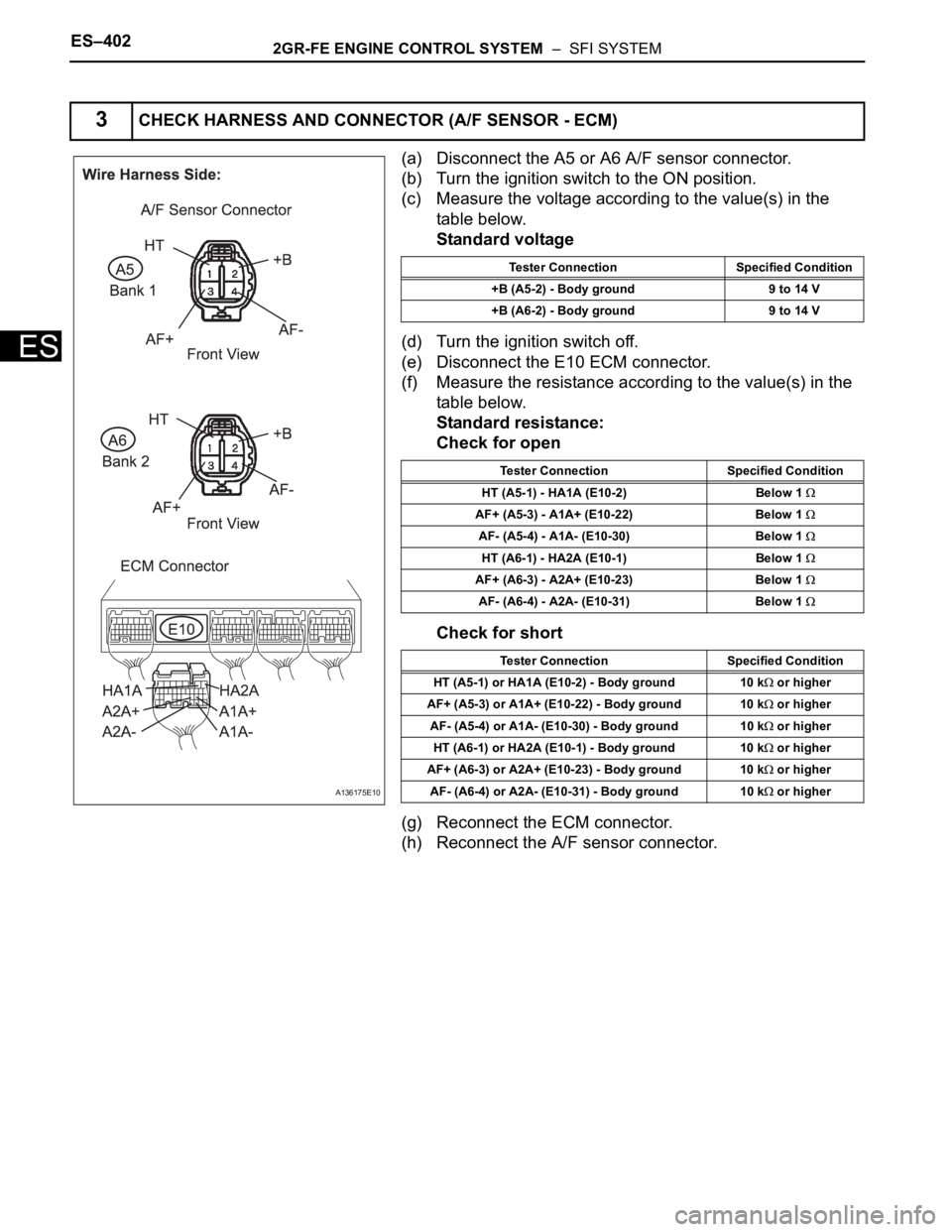
(a) Disconnect the A5 or A6 A/F sensor connector.
(b) Turn the ignition switch to the ON position.
(c) Measure the voltage according to the value(s) in the
table below.
Standard voltage
(d) Turn the ignition switch off.
(e) Disconnect the E10 ECM connector.
(f) Measure the resistance according to the value(s) in the
table below.
Standard resistance:
Check for open
Check for short
(g) Reconnect the ECM connector.
(h) Reconnect the A/F sensor connector.
3CHECK HARNESS AND CONNECTOR (A/F SENSOR - ECM)
A136175E10
Tester Connection Specified Condition
+B (A5-2) - Body ground 9 to 14 V
+B (A6-2) - Body ground 9 to 14 V
Tester Connection Specified Condition
HT (A5-1) - HA1A (E10-2) Below 1
AF+ (A5-3) - A1A+ (E10-22) Below 1
AF- (A5-4) - A1A- (E10-30) Below 1
HT (A6-1) - HA2A (E10-1) Below 1
AF+ (A6-3) - A2A+ (E10-23) Below 1
AF- (A6-4) - A2A- (E10-31) Below 1
Tester Connection Specified Condition
HT (A5-1) or HA1A (E10-2) - Body ground 10 k
or higher
AF+ (A5-3) or A1A+ (E10-22) - Body ground 10 k
or higher
AF- (A5-4) or A1A- (E10-30) - Body ground 10 k
or higher
HT (A6-1) or HA2A (E10-1) - Body ground 10 k
or higher
AF+ (A6-3) or A2A+ (E10-23) - Body ground 10 k
or higher
AF- (A6-4) or A2A- (E10-31) - Body ground 10 k
or higher
Page 696 of 3000
2GR-FE ENGINE CONTROL SYSTEM – SFI SYSTEMES–403
ES
NG
OK
NEXT
(a) Read the DTCs using the intelligent tester.
(b) Select the following menu items: DIAGNOSIS /
ENHANCED OBD II / DTC INFO / PENDING CODES.
Result
B
A
(a) Replace the air fuel ratio sensor (for 2WD model (See
page EC-19) or 4WD model (See page EC-26)).
A165205E01
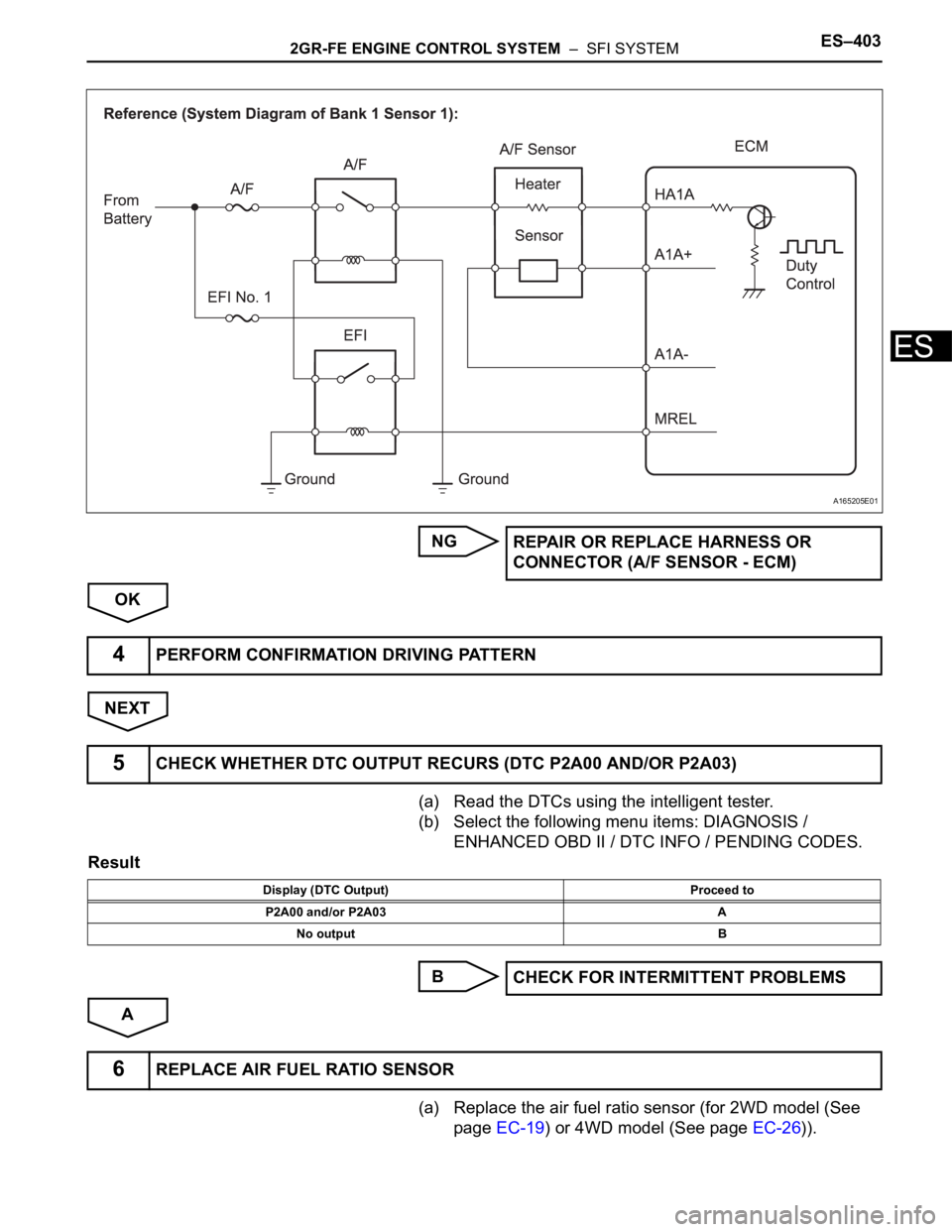
REPAIR OR REPLACE HARNESS OR
CONNECTOR (A/F SENSOR - ECM)
4PERFORM CONFIRMATION DRIVING PATTERN
5CHECK WHETHER DTC OUTPUT RECURS (DTC P2A00 AND/OR P2A03)
Display (DTC Output) Proceed to
P2A00 and/or P2A03 A
No output B
CHECK FOR INTERMITTENT PROBLEMS
6REPLACE AIR FUEL RATIO SENSOR
Page 698 of 3000
ES–4122GR-FE ENGINE CONTROL SYSTEM – SFI SYSTEM
ES
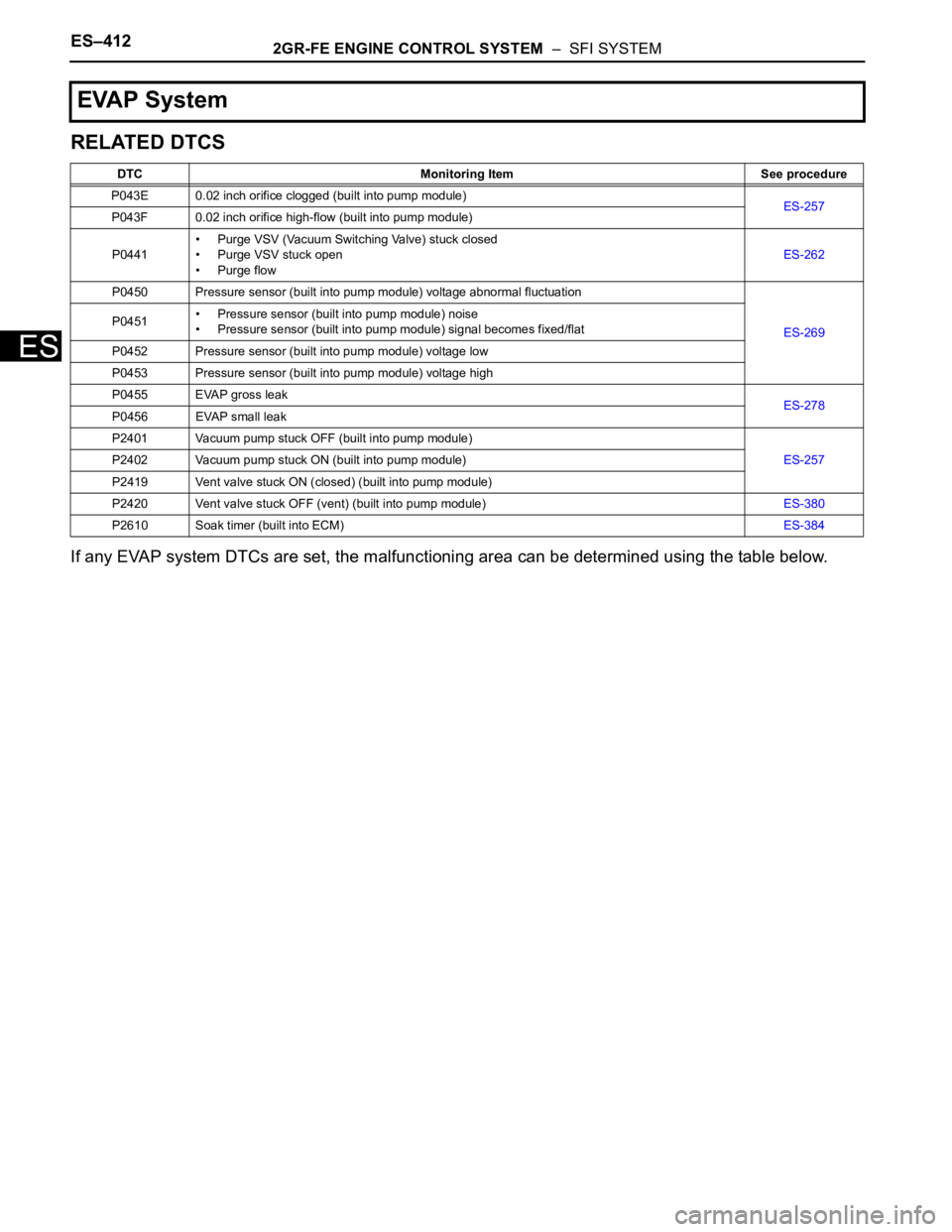
RELATED DTCS
If any EVAP system DTCs are set, the malfunctioning area can be determined using the table below.
EVAP System
DTC Monitoring Item See procedure
P043E 0.02 inch orifice clogged (built into pump module)
ES-257
P043F 0.02 inch orifice high-flow (built into pump module)
P0441• Purge VSV (Vacuum Switching Valve) stuck closed
• Purge VSV stuck open
• Purge flowES-262
P0450 Pressure sensor (built into pump module) voltage abnormal fluctuation
ES-269 P0451• Pressure sensor (built into pump module) noise
• Pressure sensor (built into pump module) signal becomes fixed/flat
P0452 Pressure sensor (built into pump module) voltage low
P0453 Pressure sensor (built into pump module) voltage high
P0455 EVAP gross leak
ES-278
P0456 EVAP small leak
P2401 Vacuum pump stuck OFF (built into pump module)
ES-257 P2402 Vacuum pump stuck ON (built into pump module)
P2419 Vent valve stuck ON (closed) (built into pump module)
P2420 Vent valve stuck OFF (vent) (built into pump module)ES-380
P2610 Soak timer (built into ECM)ES-384
Page 705 of 3000

2GR-FE ENGINE CONTROL SYSTEM – SFI SYSTEMES–419
ES
Cut-off valve Located in fuel tank. Valve floats and closes when fuel tank is 100% full.
Purge VSV (Vacuum Switching Valve)Opens or closes line between canister and intake manifold. ECM uses purge VSV to control EVAP
purge flow. In order to discharge EVAP absorbed by canister to intake manifold, ECM opens purge
VSV. EVAP discharge volume to intake manifold is controlled by purge VSV duty cycle ratio
(current-carrying time). (Open: ON, Close: OFF)
Refueling valveControls EVAP pressure from fuel tank to canister. Valve consists of diaphragm, spring and
restrictor (diameter: 0.08 inch). When fuel vapor and pressure inside fuel tank increase, valve
opens. While EVAP is purged, valve closes and restrictor prevents a large amount of vacuum from
affecting pressure in fuel tank. Valve is opened while refueling. When valve is open, adding fuel into
fuel tank is possible.
Roll-over valveLocated in fuel tank. Valve closes by its own weight when vehicle overturns to prevent fuel from
spilling out.
Service port Used for connecting vacuum gauge for inspecting EVAP system.
Soak timerBuilt into ECM. To ensure accurate EVAP monitor, measures 5 hours (+/- 15 min.) after ignition
switch is turned off. This allows fuel to cool down, stabilizing Fuel Tank Pressure (FTP). When
approx. 5 hours elapsed, ECM activates.
Canister pump module Consists of (a) to (d) below. Pump module cannot be disassembled.
(a) Vent valveVents and closes EVAP system. When ECM turns valve ON, EVAP system is closed. When ECM
turns valve OFF, EVAP system is vented. Negative pressure (vacuum) is created in EVAP system
to check for EVAP leaks by closing purge VSV and vent valve (closed), and operating vacuum
pump are turned on (refer to fig. 1).
(b) Canister pressure sensorIndicates pressure as voltages. ECM supplies regulated 5 V to pressure sensor, and uses feedback
from sensor to monitor EVAP system pressure (refer to fig 2).
(c) Vacuum pump Creates negative pressure (vacuum) in EVAP system for leak check.
(d) 0.02 inch orificeHas an opening with 0.02 inch diameter. Vacuum is produced through orifice by closing purge VSV,
turning off vent valve and operating vacuum pump, to monitor 0.02 inch leak pressure. 0.02 inch
leak pressure indicates a small leak of EVAP. Component Operation