sensor TOYOTA SIENNA 2007 Service Repair Manual
[x] Cancel search | Manufacturer: TOYOTA, Model Year: 2007, Model line: SIENNA, Model: TOYOTA SIENNA 2007Pages: 3000, PDF Size: 52.26 MB
Page 797 of 3000

2GR-FE ENGINE CONTROL SYSTEM – SFI SYSTEMES–25
ES
Rear Oxygen Sensor Heater
$A7 $0C Multiply by 1 TimeMisfire rate for cylinder 6: Misfire counts for last/current driving cycle-
To t a l
Monitor ID Test ID Scaling Unit Description
$42 $91 Multiply by 0.001 Ohm Oxygen sensor heater resistance bank 1 sensor 2
$46 $91 Multiply by 0.004 Ohm Oxygen sensor heater resistance bank 2 sensor 2 Monitor ID Test ID Scaling Unit Description
Page 803 of 3000
2GR-FE ENGINE CONTROL SYSTEM – SFI SYSTEMES–27
ES
Contents:
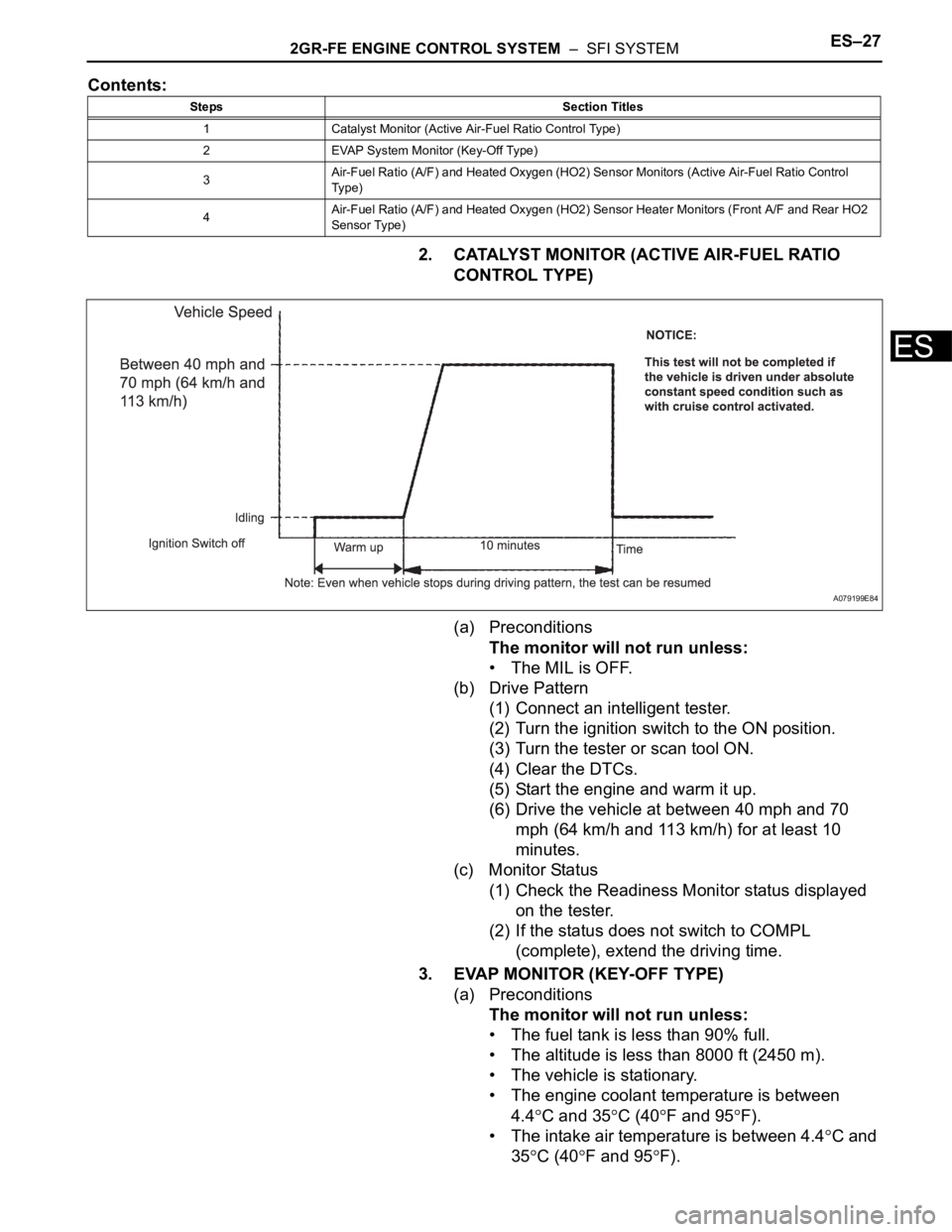
2. CATALYST MONITOR (ACTIVE AIR-FUEL RATIO
CONTROL TYPE)
(a) Preconditions
The monitor will not run unless:
• The MIL is OFF.
(b) Drive Pattern
(1) Connect an intelligent tester.
(2) Turn the ignition switch to the ON position.
(3) Turn the tester or scan tool ON.
(4) Clear the DTCs.
(5) Start the engine and warm it up.
(6) Drive the vehicle at between 40 mph and 70
mph (64 km/h and 113 km/h) for at least 10
minutes.
(c) Monitor Status
(1) Check the Readiness Monitor status displayed
on the tester.
(2) If the status does not switch to COMPL
(complete), extend the driving time.
3. EVAP MONITOR (KEY-OFF TYPE)
(a) Preconditions
The monitor will not run unless:
• The fuel tank is less than 90% full.
• The altitude is less than 8000 ft (2450 m).
• The vehicle is stationary.
• The engine coolant temperature is between
4.4
C and 35C (40F and 95F).
• The intake air temperature is between 4.4
C and
35
C (40F and 95F).
Steps Section Titles
1 Catalyst Monitor (Active Air-Fuel Ratio Control Type)
2 EVAP System Monitor (Key-Off Type)
3Air-Fuel Ratio (A/F) and Heated Oxygen (HO2) Sensor Monitors (Active Air-Fuel Ratio Control
Ty p e )
4Air-Fuel Ratio (A/F) and Heated Oxygen (HO2) Sensor Heater Monitors (Front A/F and Rear HO2
Sensor Type)
A079199E84
Page 804 of 3000

ES–282GR-FE ENGINE CONTROL SYSTEM – SFI SYSTEM
ES
• Vehicle was driven in the city area (or on free-
way) for 10 minutes or more.
(b) Monitor Conditions
(1) Turn the ignition switch off and wait for 6 hours.
HINT:
Do not start the engine until checking Readiness
Monitor status. If the engine is started, the step
described above must be repeated.
(c) Monitor Status
(1) Connect an intelligent tester to the DLC3.
(2) Turn the ignition switch to the ON position.
(3) Turn the tester or scan tool ON.
(4) Check the Readiness Monitor status displayed
on the tester or scan tool.
If the status does not switch to COMPL
(complete), restart the engine, make sure that
the preconditions have been met, and then
perform the Monitor Conditions again.
4. A/F SENSOR AND HO2S MONITORS
(a) Preconditions
The monitor will not run unless:
• 2 minutes or more have elapsed since the engine
was started.
• The Engine Coolant Temperature (ECT) is 75
C
(167
F) or more.
• Cumulative driving time at a vehicle speed of 30
mph (48 km/h) or more exceeds 6 minutes.
• Air-fuel ratio feedback control is performed.
• Fuel-cut control is performed for 8 seconds or
more (for the Rear HO2 Sensor Monitor).
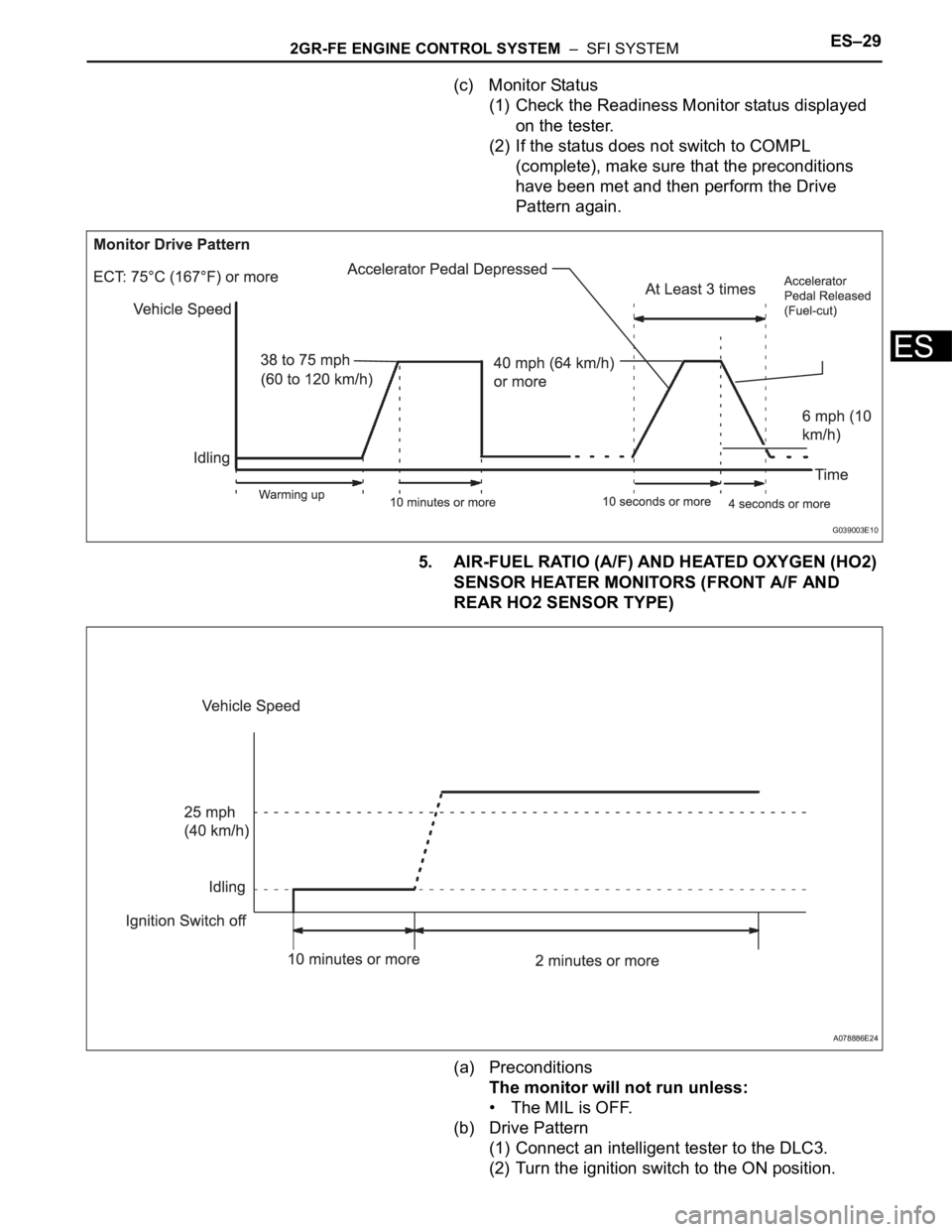
(b) Drive Pattern for front A/F sensor and HO2 sensor.
(1) Connect an intelligent tester to the DLC3.
(2) Turn the ignition switch to the ON position.
(3) Turn the tester ON.
(4) Clear the DTCs.
(5) Start the engine, and warm it up until the ECT
reaches 75
C (167F) or higher.
(6) Drive the vehicle at 38 mph (60 km/h) or more
for at least 10 minutes.
(7) Change the transmission to the 2nd gear.
(8) Accelerate the vehicle to 40 mph (64 km/h) or
more by depressing the accelerator pedal for at
least 10 seconds (Procedure "A").
(9) Soon after performing procedure "A" above,
release the accelerator pedal for at least 4
seconds without depressing the brake pedal, in
order to execute fuel-cut control (Procedure "B").
(10) Allow the vehicle to decelerate until the vehicle
speed declines to less than 6 mph (10 km/h)
(Procedure "C").
(11) Repeat procedures from "A" through "C" above
at least 3 times in one driving cycle.
Page 805 of 3000
2GR-FE ENGINE CONTROL SYSTEM – SFI SYSTEMES–29
ES
(c) Monitor Status
(1) Check the Readiness Monitor status displayed
on the tester.
(2) If the status does not switch to COMPL
(complete), make sure that the preconditions
have been met and then perform the Drive
Pattern again.
5. AIR-FUEL RATIO (A/F) AND HEATED OXYGEN (HO2)
SENSOR HEATER MONITORS (FRONT A/F AND
REAR HO2 SENSOR TYPE)
(a) Preconditions
The monitor will not run unless:
• The MIL is OFF.
(b) Drive Pattern
(1) Connect an intelligent tester to the DLC3.
(2) Turn the ignition switch to the ON position.
G039003E10
A078886E24
Page 808 of 3000
ES–5022GR-FE ENGINE CONTROL SYSTEM – ACCELERATOR PEDAL ROD
ES
ON-VEHICLE INSPECTION
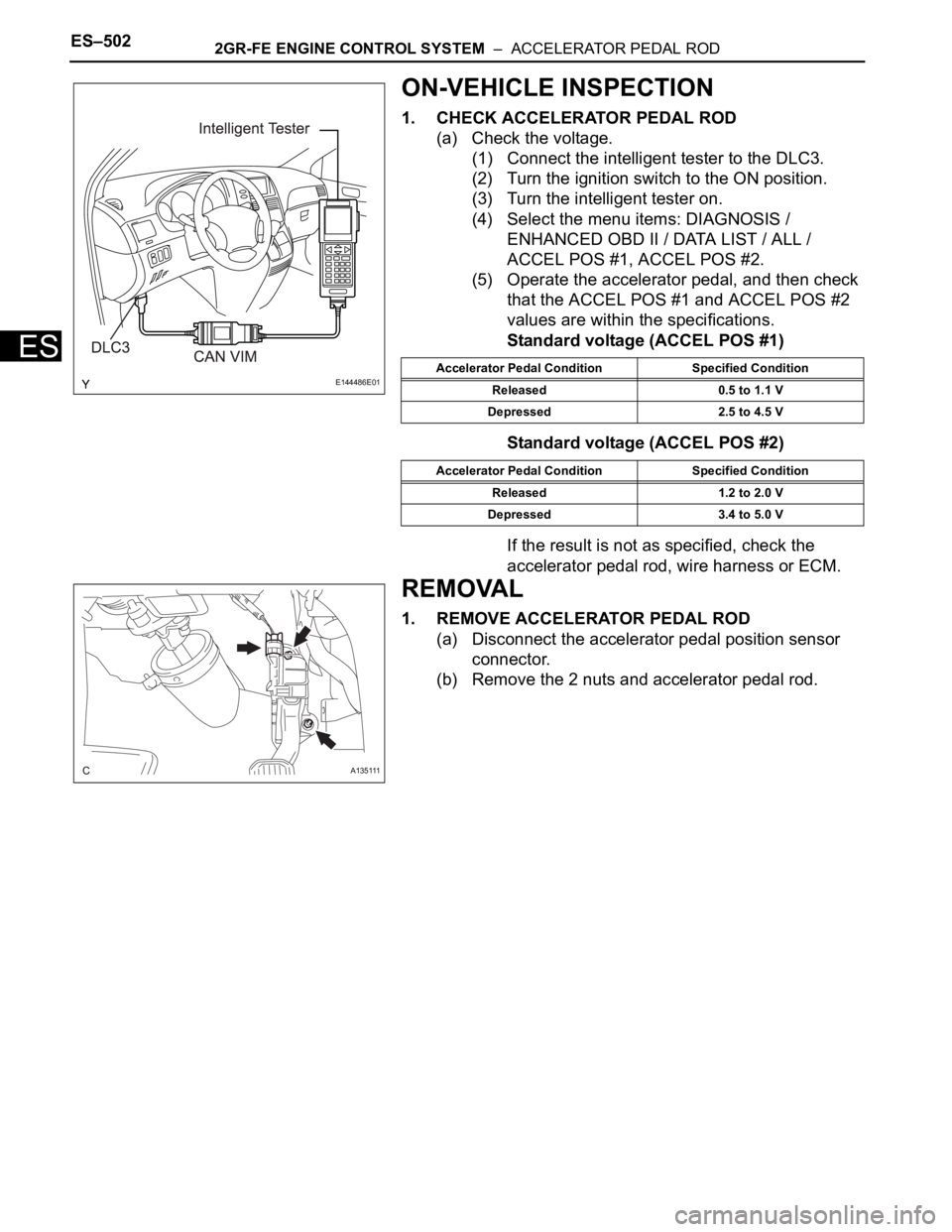
1. CHECK ACCELERATOR PEDAL ROD
(a) Check the voltage.
(1) Connect the intelligent tester to the DLC3.
(2) Turn the ignition switch to the ON position.
(3) Turn the intelligent tester on.
(4) Select the menu items: DIAGNOSIS /
ENHANCED OBD II / DATA LIST / ALL /
ACCEL POS #1, ACCEL POS #2.
(5) Operate the accelerator pedal, and then check
that the ACCEL POS #1 and ACCEL POS #2
values are within the specifications.
Standard voltage (ACCEL POS #1)
Standard voltage (ACCEL POS #2)
If the result is not as specified, check the
accelerator pedal rod, wire harness or ECM.
REMOVAL
1. REMOVE ACCELERATOR PEDAL ROD
(a) Disconnect the accelerator pedal position sensor
connector.
(b) Remove the 2 nuts and accelerator pedal rod.
E144486E01Accelerator Pedal Condition Specified Condition
Released 0.5 to 1.1 V
Depressed 2.5 to 4.5 V
Accelerator Pedal Condition Specified Condition
Released 1.2 to 2.0 V
Depressed 3.4 to 5.0 V
A135111
Page 809 of 3000
2GR-FE ENGINE CONTROL SYSTEM – SFI SYSTEMES–31
ES
PROBLEM SYMPTOMS TABLE
HINT:
When a malfunction is not confirmed by a DTC (Diagnostic
Trouble Code) check and the cause of problem cannot be
identified through a basic inspection, troubleshoot according
to the priority order indicated in the table below.
SFI SYSTEM
Symptom Suspected Area See page
Engine does not crank (does not start)1. Immobilizer systemEI-2
2. StarterST-7
3. STARTER RelayST-14
4. Cranking holding function circuitES-461
No initial combustion (does not start)1. ECM power source circuitES-437
2. Ignition systemIG-5
3. Fuel pump control circuitES-451
4. InjectorFU-16
5. VC output circuitES-444
6. ECMES-498
Difficult to start (engine cranks normally)1. Electronic Throttle Control System (ETCS)ES-329
2. Fuel pump control circuitES-451
3. Ignition systemIG-5
4. Spark plugIG-7
5. CompressionEM-3
6. InjectorFU-16
7. VC output circuitES-444
Difficult to start with cold engine1. Cranking holding function circuitES-461
2. Electronic Throttle Control System (ETCS)ES-329
3. Fuel pump control circuitES-451
4. Spark plugIG-7
5. Ignition systemIG-6
6. InjectorFU-16
7. Engine coolant temperature sensorES-516
Difficult to start with hot engine1. Cooling fan systemCO-4
2. Cranking holding function circuitES-461
3. Electronic Throttle Control System (ETCS)ES-329
4. Fuel pump control circuitES-451
5. Spark plugIG-7
6. Ignition systemIG-5
7. InjectorFU-16
8. Engine coolant temperature sensorES-516
High engine idle speed (poor idling)1. Electronic Throttle Control System (ETCS)ES-329
2. ECM power source circuitES-437
3. A/C signal circuit (Compressor circuit) -
4. Acoustic Control Induction System (ACIS)ES-470
5. PCV hoseEC-15
6. ECMES-498
Page 810 of 3000
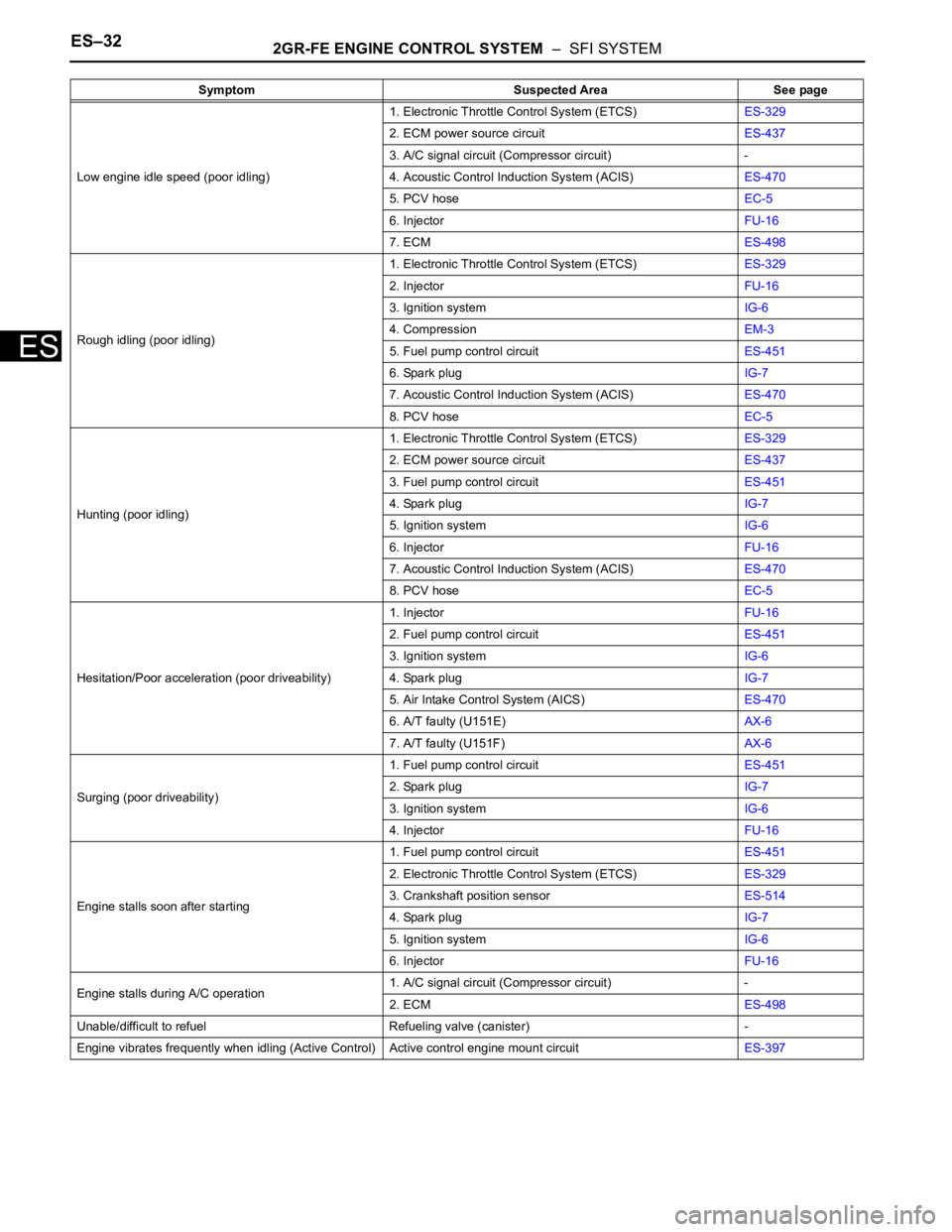
ES–322GR-FE ENGINE CONTROL SYSTEM – SFI SYSTEM
ES
Low engine idle speed (poor idling)1. Electronic Throttle Control System (ETCS)ES-329
2. ECM power source circuitES-437
3. A/C signal circuit (Compressor circuit) -
4. Acoustic Control Induction System (ACIS)ES-470
5. PCV hoseEC-5
6. InjectorFU-16
7. ECMES-498
Rough idling (poor idling)1. Electronic Throttle Control System (ETCS)ES-329
2. InjectorFU-16
3. Ignition systemIG-6
4. CompressionEM-3
5. Fuel pump control circuitES-451
6. Spark plugIG-7
7. Acoustic Control Induction System (ACIS)ES-470
8. PCV hoseEC-5
Hunting (poor idling)1. Electronic Throttle Control System (ETCS)ES-329
2. ECM power source circuitES-437
3. Fuel pump control circuitES-451
4. Spark plugIG-7
5. Ignition systemIG-6
6. InjectorFU-16
7. Acoustic Control Induction System (ACIS)ES-470
8. PCV hoseEC-5
Hesitation/Poor acceleration (poor driveability)1. InjectorFU-16
2. Fuel pump control circuitES-451
3. Ignition systemIG-6
4. Spark plugIG-7
5. Air Intake Control System (AICS)ES-470
6. A/T faulty (U151E)AX-6
7. A/T faulty (U151F)AX-6
Surging (poor driveability)1. Fuel pump control circuitES-451
2. Spark plugIG-7
3. Ignition systemIG-6
4. InjectorFU-16
Engine stalls soon after starting1. Fuel pump control circuitES-451
2. Electronic Throttle Control System (ETCS)ES-329
3. Crankshaft position sensorES-514
4. Spark plugIG-7
5. Ignition systemIG-6
6. InjectorFU-16
Engine stalls during A/C operation1. A/C signal circuit (Compressor circuit) -
2. ECMES-498
Unable/difficult to refuel Refueling valve (canister) -
Engine vibrates frequently when idling (Active Control) Active control engine mount circuitES-397 Symptom Suspected Area See page
Page 813 of 3000
2GR-FE ENGINE CONTROL SYSTEM – SFI SYSTEMES–33
ES
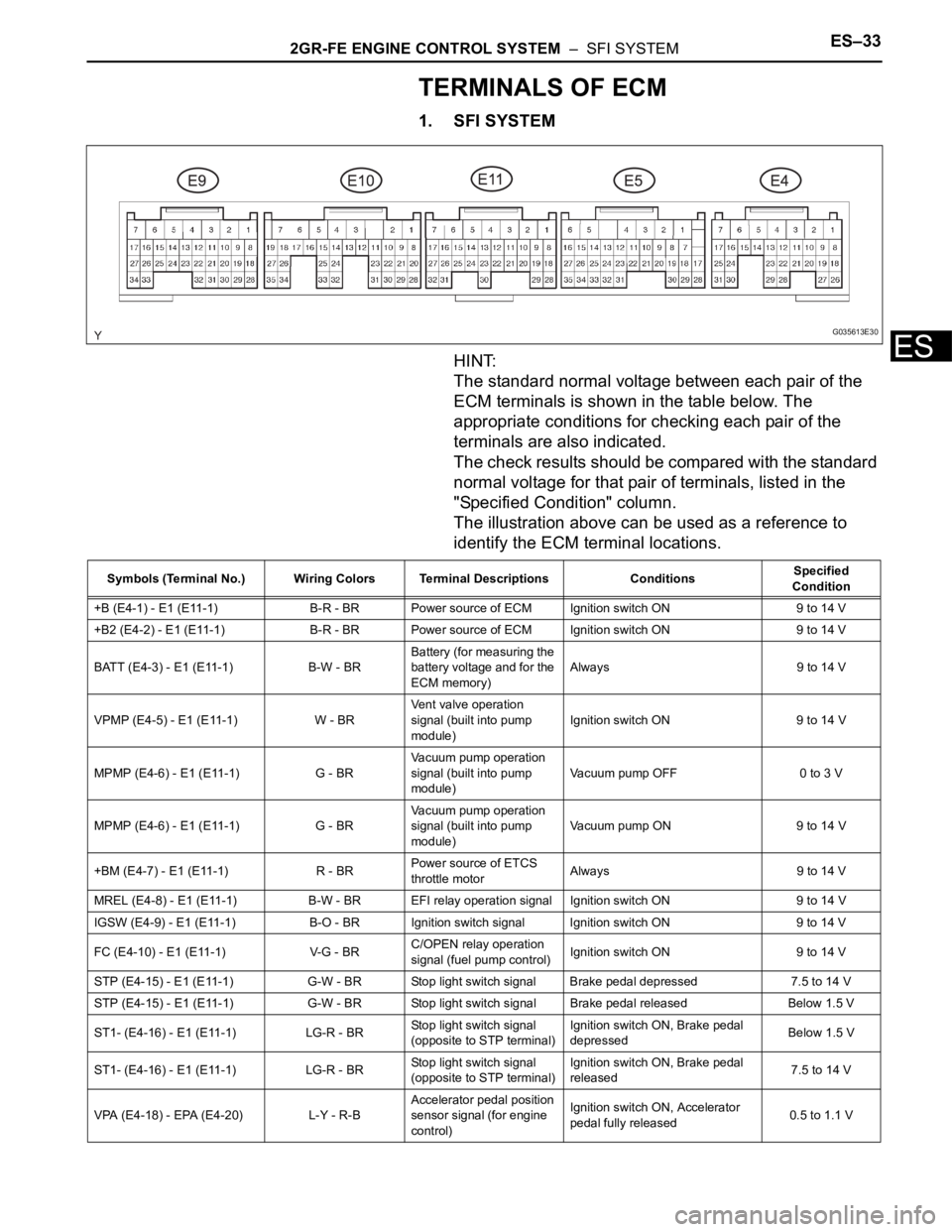
TERMINALS OF ECM
1. SFI SYSTEM
HINT:
The standard normal voltage between each pair of the
ECM terminals is shown in the table below. The
appropriate conditions for checking each pair of the
terminals are also indicated.
The check results should be compared with the standard
normal voltage for that pair of terminals, listed in the
"Specified Condition" column.
The illustration above can be used as a reference to
identify the ECM terminal locations.
G035613E30
Symbols (Terminal No.) Wiring Colors Terminal Descriptions ConditionsSpecified
Condition
+B (E4-1) - E1 (E11-1) B-R - BR Power source of ECM Ignition switch ON 9 to 14 V
+B2 (E4-2) - E1 (E11-1) B-R - BR Power source of ECM Ignition switch ON 9 to 14 V
BATT (E4-3) - E1 (E11-1) B-W - BRBattery (for measuring the
battery voltage and for the
ECM memory)Always 9 to 14 V
VPMP (E4-5) - E1 (E11-1) W - BRVent valve operation
signal (built into pump
module)Ignition switch ON 9 to 14 V
MPMP (E4-6) - E1 (E11-1) G - BRVacuum pump operation
signal (built into pump
module)Vacuum pump OFF 0 to 3 V
MPMP (E4-6) - E1 (E11-1) G - BRVacuum pump operation
signal (built into pump
module)Vacuum pump ON 9 to 14 V
+BM (E4-7) - E1 (E11-1) R - BRPower source of ETCS
throttle motorAlways 9 to 14 V
MREL (E4-8) - E1 (E11-1) B-W - BR EFI relay operation signal Ignition switch ON 9 to 14 V
IGSW (E4-9) - E1 (E11-1) B-O - BRIgnition switch signal Ignition switch ON 9 to 14 V
FC (E4-10) - E1 (E11-1) V-G - BRC/OPEN relay operation
signal (fuel pump control)Ignition switch ON 9 to 14 V
STP (E4-15) - E1 (E11-1) G-W - BR Stop light switch signal Brake pedal depressed 7.5 to 14 V
STP (E4-15) - E1 (E11-1) G-W - BR Stop light switch signal Brake pedal released Below 1.5 V
ST1- (E4-16) - E1 (E11-1) LG-R - BRStop light switch signal
(opposite to STP terminal)Ignition switch ON, Brake pedal
depressedBelow 1.5 V
ST1- (E4-16) - E1 (E11-1) LG-R - BRStop light switch signal
(opposite to STP terminal)Ignition switch ON, Brake pedal
released7.5 to 14 V
VPA (E4-18) - EPA (E4-20) L-Y - R-BAccelerator pedal position
sensor signal (for engine
control)Ignition switch ON, Accelerator
pedal fully released0.5 to 1.1 V
Page 814 of 3000

ES–342GR-FE ENGINE CONTROL SYSTEM – SFI SYSTEM
ES
VPA (E4-18) - EPA (E4-20) L-Y - R-BAccelerator pedal position
sensor signal (for engine
control)Ignition switch ON, Accelerator
pedal fully depressed2.6 to 4.5 V
VPA2 (E4-19) - EPA2 (E4-21) W-R - LGAccelerator pedal position
sensor signal (for sensor
malfunction detection)Ignition switch ON, Accelerator
pedal fully released1.2 to 2.0 V
VPA2 (E4-19) - EPA2 (E4-21) W-R - LGAccelerator pedal position
sensor signal (for sensor
malfunction detection)Ignition switch ON, Accelerator
pedal fully depressed3.4 to 5.0 V
EPA (E4-20) - VPA (E4-18) R-B - L-YAccelerator pedal position
sensor signal (for engine
control)Ignition switch ON, Accelerator
pedal fully released0.5 to 1.1 V
EPA (E4-20) - VPA (E4-18) R-B - L-YAccelerator pedal position
sensor signal (for engine
control)Ignition switch ON, Accelerator
pedal fully depressed2.6 to 4.5 V
EPA2 (E4-21) - VPA2 (E4-19) LG - W-RAccelerator pedal position
sensor signal (for sensor
malfunction detection)Ignition switch ON, Accelerator
pedal fully released1.2 to 2.0 V
EPA2 (E4-21) - VPA2 (E4-19) LG - W-RAccelerator pedal position
sensor signal (for sensor
malfunction detection)Ignition switch ON, Accelerator
pedal fully depressed3.4 to 5.0 V
PPMP (E4-22) - E2 (E9-28) B - BRPressure sensor signal
(built into pump module)Ignition switch ON 3 to 3.6 V
TC (E4-23) - E1 (E11-1) P-B - BR Terminal TC of DLC3 Ignition switch ON 9 to 14 V
VCPA (E4-26) - EPA (E4-20) GR-R - R-BPower source of
accelerator pedal position
sensor (for VPA)Ignition switch ON 4.5 to 5.0 V
VCP2 (E4-27) - EPA2 (E4-21) B-R - LGPower source of
accelerator pedal position
sensor (for VPA2)Ignition switch ON 4.5 to 5.0 V
TACH (E5-1) - E1 (E11-1) B-O - BREngine speed signal (for
combination meter)IdlingPulse generation
(see waveform 11)
SPD (E5-8) - E1 (E11-1) V-W - BRVehicle speed signal from
combination meterIgnition switch ON, driving wheel
rotated slowlyPulse generation
(see waveform 8)
W (E5-30) - E1 (E11-1) B-Y - BRMalfunction Indicator
Lamp (MIL) operation
signalIgnition switch ON Below 3.0 V
W (E5-30) - E1 (E11-1) B-Y - BRMalfunction Indicator
Lamp (MIL) operation
signalIdling 9 to 14 V
CANH (E5-33) - CANL (E5-
34)B - WCAN communication
circuitIgnition switch off 54 to 69
CANL (E5-34) - CANH (E5-
33)W - BCAN communication
circuitIgnition switch off 54 to 69
E1 (E11-1) - Body ground BR - -Earth (ground) circuit of
ECMAlways Below 1 V
#10 (E11-2) - E01 (E9-7)
#20 (E11-3) - E01 (E9-7)
#30 (E11-4) - E01 (E9-7)
#40 (E11-5) - E01 (E9-7)
#50 (E11-6) - E01 (E9-7)
#60 (E11-7) - E01 (E9-7)L - W-B
R - W-B
B - W-B
W - W-B
B-W - W-B
G - W-BFuel injector operation
signalIgnition switch ON 9 to 14 V
#10 (E11-2) - E01 (E9-7)
#20 (E11-3) - E01 (E9-7)
#30 (E11-4) - E01 (E9-7)
#40 (E11-5) - E01 (E9-7)
#50 (E11-6) - E01 (E9-7)
#60 (E11-7) - E01 (E9-7)L - W-B
R - W-B
B - W-B
W - W-B
B-W - W-B
G - W-BFuel injector operation
signalIdlingPulse generation
(see waveform 3)
PSW (E11-10) - E1 (E11-1) R-W - BR P/S pressure switch signal Ignition switch ON 9 to 14 V Symbols (Terminal No.) Wiring Colors Terminal Descriptions ConditionsSpecified
Condition
Page 815 of 3000

2GR-FE ENGINE CONTROL SYSTEM – SFI SYSTEMES–35
ES
STAR (NSW) (E10-8) - E1
(E11-1)B-Y - BRPark/Neutral position
switch signalIgnition switch ON, Shift lever
position P or N9 to 14 V
STAR (NSW) (E10-8) - E1
(E11-1)B-Y - BRPark/Neutral position
switch signalIgnition switch ON, Shift lever
position other than P or N9 to 14 V
STA (E11-11) - E1 (E11-1) B-L - BRStarter relay operation
signalCranking 9 to 14 V
OC2- (E11-14) - OC2+ (E11-
15)G-B - L-RCamshaft timing Oil
Control Valve (OCV)
operation signal (Intake
side)Ignition switch ONPulse generation
(see waveform 1)
OE2+ (E11-27) - OE2- (E11-
32)W - G-RCamshaft timing Oil
Control Valve (OCV)
operation signal (Intake
side)Ignition switch ONPulse generation
(see waveform 1)
OC1- (E11-16) - OC1+ (E11-
17)G-R - G-WCamshaft timing Oil
Control Valve (OCV)
operation signal (Intake
side)Ignition switch ONPulse generation
(see waveform 1)
OE1+ (E11-26) - OE1- (E11-
31)G - RCamshaft timing Oil
Control Valve (OCV)
operation signal (Intake
side)Ignition switch ONPulse generation
(see waveform 1)
VV2+ (E11-18) - VV2- (E11-
28)V - GVariable Valve Timing
(VVT) sensor signal
(Intake side)IdlingPulse generation
(see waveform 5)
VV1+ (E11-19) - VV1- (E11-
29)B-W - L-YVariable Valve Timing
(VVT) sensor signal
(Intake side)IdlingPulse generation
(see waveform 5)
NE- (E11-20) - NE+ (E11-21) B - WCrankshaft position sensor
signalIdlingPulse generation
(see waveform 5)
NE+ (E11-21) - NE- (E11-20) W - BCrankshaft position sensor
signalIdlingPulse generation
(see waveform 5)
EV2- (E11-22) - EV2+ (E11-
23)R - PVariable Valve Timing
(VVT) sensor signal
(Exhaust side)IdlingPulse generation
(see waveform 5)
EV2+ (E11-23) - EV2- (E11-
22)P - RVariable Valve Timing
(VVT) sensor signal
(Exhaust side)IdlingPulse generation
(see waveform 5)
EV1- (E11-24) - EV1+ (E11-
25)L-W - B-WVariable Valve Timing
(VVT) sensor signal
(Exhaust side)IdlingPulse generation
(see waveform 5)
EV1+ (E11-25) - EV1- (E11-
24)B-W - L-WVariable Valve Timing
(VVT) sensor signal
(Exhaust side)IdlingPulse generation
(see waveform 5)
VV2- (E11-28) - VV2+ (E11-
18)G - VVariable Valve Timing
(VVT) sensor signal
(Intake side)IdlingPulse generation
(see waveform 5)
VV1- (E11-29) - VV1+ (E11-
19)L-Y - B-WVariable Valve Timing
(VVT) sensor signal
(Intake side)IdlingPulse generation
(see waveform 5)
HT1B (E9-1) - E1 (E11-1)
HT2B (E10-5) - E1 (E11-1)L - BR
W-L - BRHeated oxygen sensor
heater operation signalIdling Below 3.0 V
HT1B (E9-1) - E1 (E11-1)
HT2B (E10-5) - E1 (E11-1)L - BR
W-L - BRHeated oxygen sensor
heater operation signalIgnition switch ON 9 to 14 V
ACM (E9-3) - E1 (E11-1) Y-G - BRVSV for active control
mount system operation
signalIgnition switch ON 9 to 14 V
M- (E9-4) - ME01 (E10-3) W - W-BThrottle drive motor
operation signal (negative
terminal)Idling with warm enginePulse generation
(see waveform 10) Symbols (Terminal No.) Wiring Colors Terminal Descriptions ConditionsSpecified
Condition