sensor TOYOTA SIENNA 2007 Service Repair Manual
[x] Cancel search | Manufacturer: TOYOTA, Model Year: 2007, Model line: SIENNA, Model: TOYOTA SIENNA 2007Pages: 3000, PDF Size: 52.26 MB
Page 675 of 3000

ES–3822GR-FE ENGINE CONTROL SYSTEM – SFI SYSTEM
ES
Others:
TYPICAL MALFUNCTION THRESHOLDS
P2238 and P2241 (Open circuit between AF+ and AF-):
P2238 and P2241 (Short circuit between AF+ and GND):
P2238 and P2241 (Short circuit between AF+ and AF-):
P2239 and P2242 (Short circuit between AF+ and +B):
P2252 and P2255 (Short circuit between AF- and GND):
P2253 and P2256 (Short circuit between AF- and +B):
WIRING DIAGRAM
Refer to DTC P2195 (See page ES-359).
INSPECTION PROCEDURE
HINT:
For use of the intelligent tester only:
Malfunctioning areas can be identified by performing the A/F CONTROL function provided in the ACTIVE
TEST. The A/F CONTROL function can help to determine whether the Air-Fuel Ratio (A/F) sensor, Heated
Oxygen (HO2) sensor and other potential trouble areas are malfunctioning.
The following instructions describe how to conduct the A/F CONTROL operation using the intelligent
tester.
(a) Connect the intelligent tester to the DLC3.
(b) Start the engine and turn the tester on.
(c) Warm up the engine at an engine speed of 2500 rpm for approximately 90 seconds.
(d) Select the following menu items on the tester: DIAGNOSIS / ENHANCED OBD II / ACTIVE TEST / A/
F CONTROL.
(e) Perform the A/F CONTROL operation with the engine in an idling condition (press the RIGHT or LEFT
button to change the fuel injection volume).
Engine Running
Fuel-cut OFF
Time after fuel-cut OFF 5 seconds or more
A/F sensor heater ON
Battery voltage 11 V or more
Ignition switch ON
Time after ignition switch is OFF to ON 5 seconds or more
Battery voltage 11 V or more
Ignition switch ON
Time after ignition switch is OFF to ON 5 seconds or more
A/F sensor admittance Below 0.022 1/
AF+ terminal voltage 0.5 V or less
Difference between AF+ terminal and AF- terminal
voltage0.1 V or less
AF+ terminal voltage More than 4.5 V
AF- terminal voltage 0.5 V or less
AF- terminal voltage More than 4.5 V
Page 676 of 3000
2GR-FE ENGINE CONTROL SYSTEM – SFI SYSTEMES–383
ES
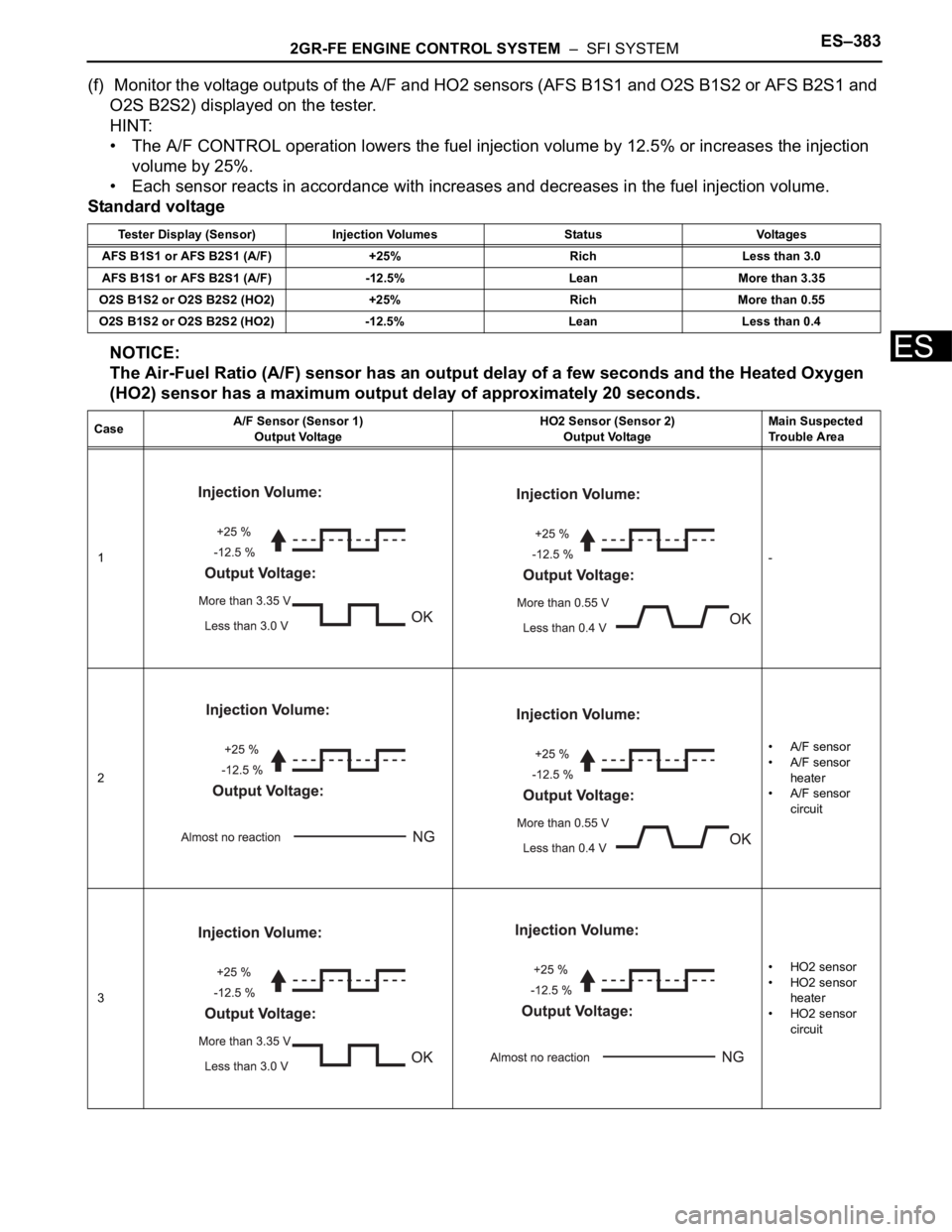
(f) Monitor the voltage outputs of the A/F and HO2 sensors (AFS B1S1 and O2S B1S2 or AFS B2S1 and
O2S B2S2) displayed on the tester.
HINT:
• The A/F CONTROL operation lowers the fuel injection volume by 12.5% or increases the injection
volume by 25%.
• Each sensor reacts in accordance with increases and decreases in the fuel injection volume.
Standard voltage
NOTICE:
The Air-Fuel Ratio (A/F) sensor has an output delay of a few seconds and the Heated Oxygen
(HO2) sensor has a maximum output delay of approximately 20 seconds.
Tester Display (Sensor) Injection Volumes Status Voltages
AFS B1S1 or AFS B2S1 (A/F) +25% Rich Less than 3.0
AFS B1S1 or AFS B2S1 (A/F) -12.5% Lean More than 3.35
O2S B1S2 or O2S B2S2 (HO2) +25% Rich More than 0.55
O2S B1S2 or O2S B2S2 (HO2) -12.5% Lean Less than 0.4
CaseA/F Sensor (Sensor 1)
Output VoltageHO2 Sensor (Sensor 2)
Output VoltageMain Suspected
Trouble Area
1-
2•A/F sensor
•A/F sensor
heater
•A/F sensor
circuit
3•HO2 sensor
• HO2 sensor
heater
• HO2 sensor
circuit
Page 677 of 3000
ES–3842GR-FE ENGINE CONTROL SYSTEM – SFI SYSTEM
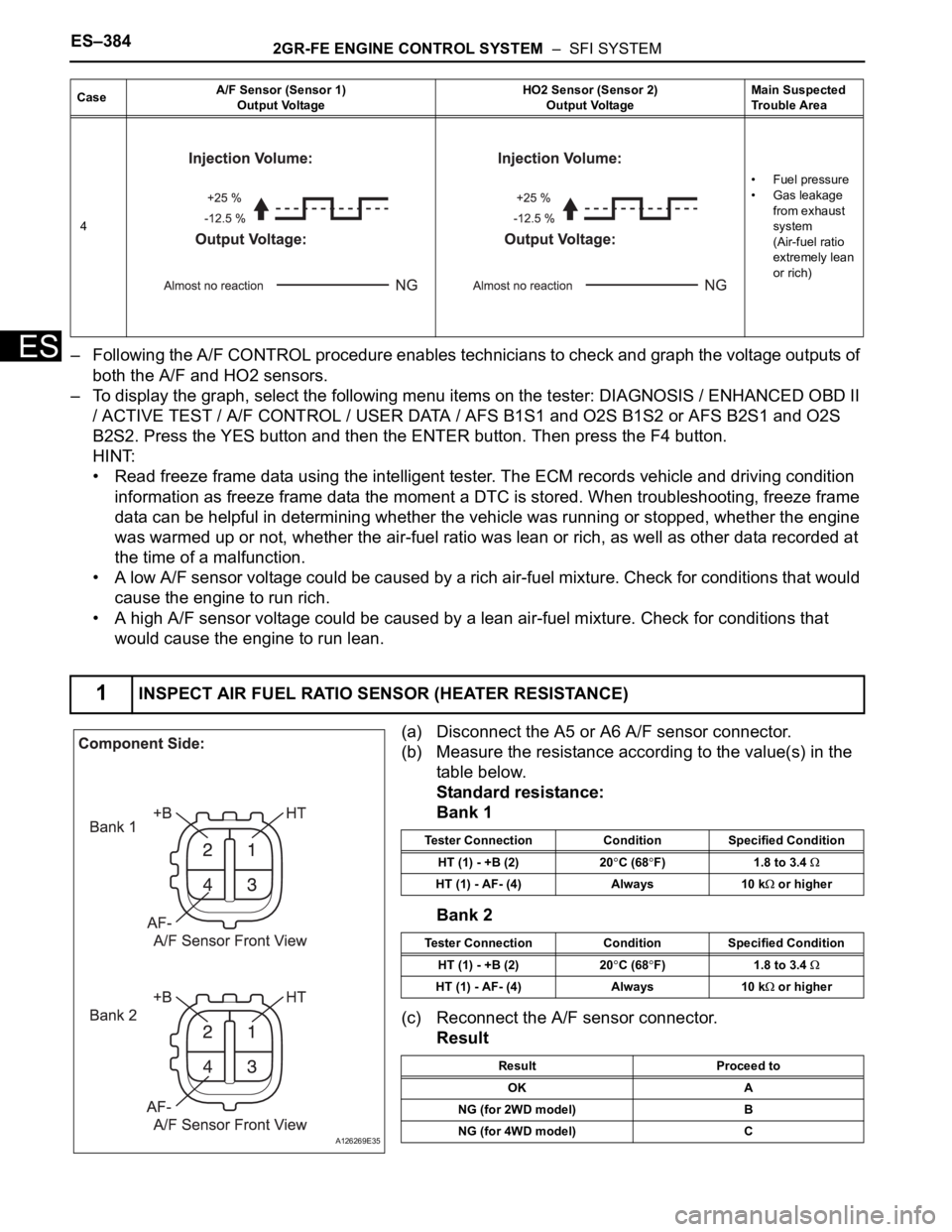
ES– Following the A/F CONTROL procedure enables technicians to check and graph the voltage outputs of
both the A/F and HO2 sensors.
– To display the graph, select the following menu items on the tester: DIAGNOSIS / ENHANCED OBD II
/ ACTIVE TEST / A/F CONTROL / USER DATA / AFS B1S1 and O2S B1S2 or AFS B2S1 and O2S
B2S2. Press the YES button and then the ENTER button. Then press the F4 button.
HINT:
• Read freeze frame data using the intelligent tester. The ECM records vehicle and driving condition
information as freeze frame data the moment a DTC is stored. When troubleshooting, freeze frame
data can be helpful in determining whether the vehicle was running or stopped, whether the engine
was warmed up or not, whether the air-fuel ratio was lean or rich, as well as other data recorded at
the time of a malfunction.
• A low A/F sensor voltage could be caused by a rich air-fuel mixture. Check for conditions that would
cause the engine to run rich.
• A high A/F sensor voltage could be caused by a lean air-fuel mixture. Check for conditions that
would cause the engine to run lean.
(a) Disconnect the A5 or A6 A/F sensor connector.
(b) Measure the resistance according to the value(s) in the
table below.
Standard resistance:
Bank 1
Bank 2
(c) Reconnect the A/F sensor connector.
Result
4•Fuel pressure
• Gas leakage
from exhaust
system
(Air-fuel ratio
extremely lean
or rich)
1INSPECT AIR FUEL RATIO SENSOR (HEATER RESISTANCE)
CaseA/F Sensor (Sensor 1)
Output VoltageHO2 Sensor (Sensor 2)
Output VoltageMain Suspected
Trouble Area
A126269E35
Tester Connection Condition Specified Condition
HT (1) - +B (2) 20
C (68F) 1.8 to 3.4
HT (1) - AF- (4) Always 10 k or higher
Tester Connection Condition Specified Condition
HT (1) - +B (2) 20
C (68F) 1.8 to 3.4
HT (1) - AF- (4) Always 10 k or higher
Result Proceed to
OK A
NG (for 2WD model) B
NG (for 4WD model) C
Page 678 of 3000
2GR-FE ENGINE CONTROL SYSTEM – SFI SYSTEMES–385
ES
B
C
A
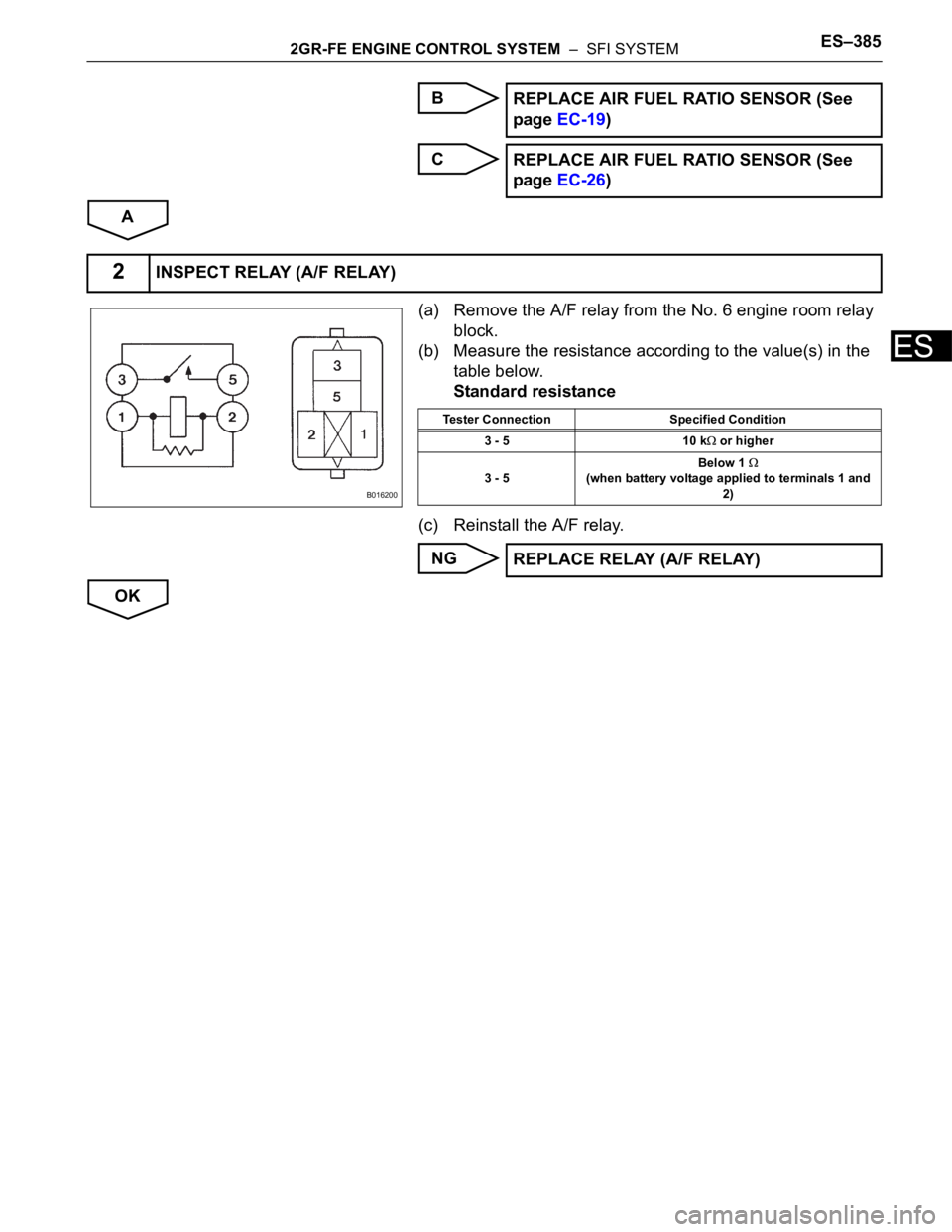
(a) Remove the A/F relay from the No. 6 engine room relay
block.
(b) Measure the resistance according to the value(s) in the
table below.
Standard resistance
(c) Reinstall the A/F relay.
NG
OKREPLACE AIR FUEL RATIO SENSOR (See
page EC-19)
REPLACE AIR FUEL RATIO SENSOR (See
page EC-26)
2INSPECT RELAY (A/F RELAY)
B016200
Tester Connection Specified Condition
3 - 5 10 k
or higher
3 - 5Below 1
(when battery voltage applied to terminals 1 and
2)
REPLACE RELAY (A/F RELAY)
Page 679 of 3000
ES–3862GR-FE ENGINE CONTROL SYSTEM – SFI SYSTEM
ES
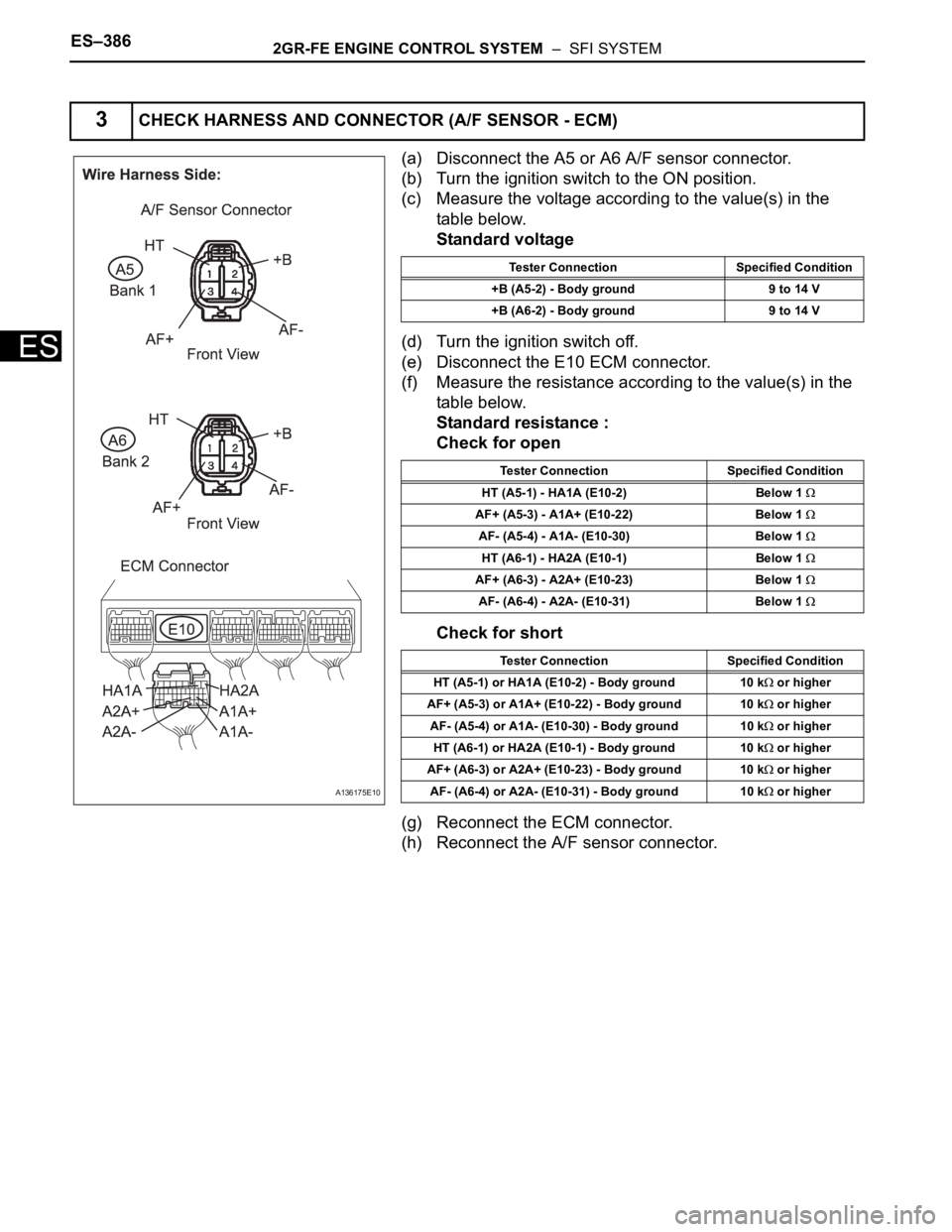
(a) Disconnect the A5 or A6 A/F sensor connector.
(b) Turn the ignition switch to the ON position.
(c) Measure the voltage according to the value(s) in the
table below.
Standard voltage
(d) Turn the ignition switch off.
(e) Disconnect the E10 ECM connector.
(f) Measure the resistance according to the value(s) in the
table below.
Standard resistance :
Check for open
Check for short
(g) Reconnect the ECM connector.
(h) Reconnect the A/F sensor connector.
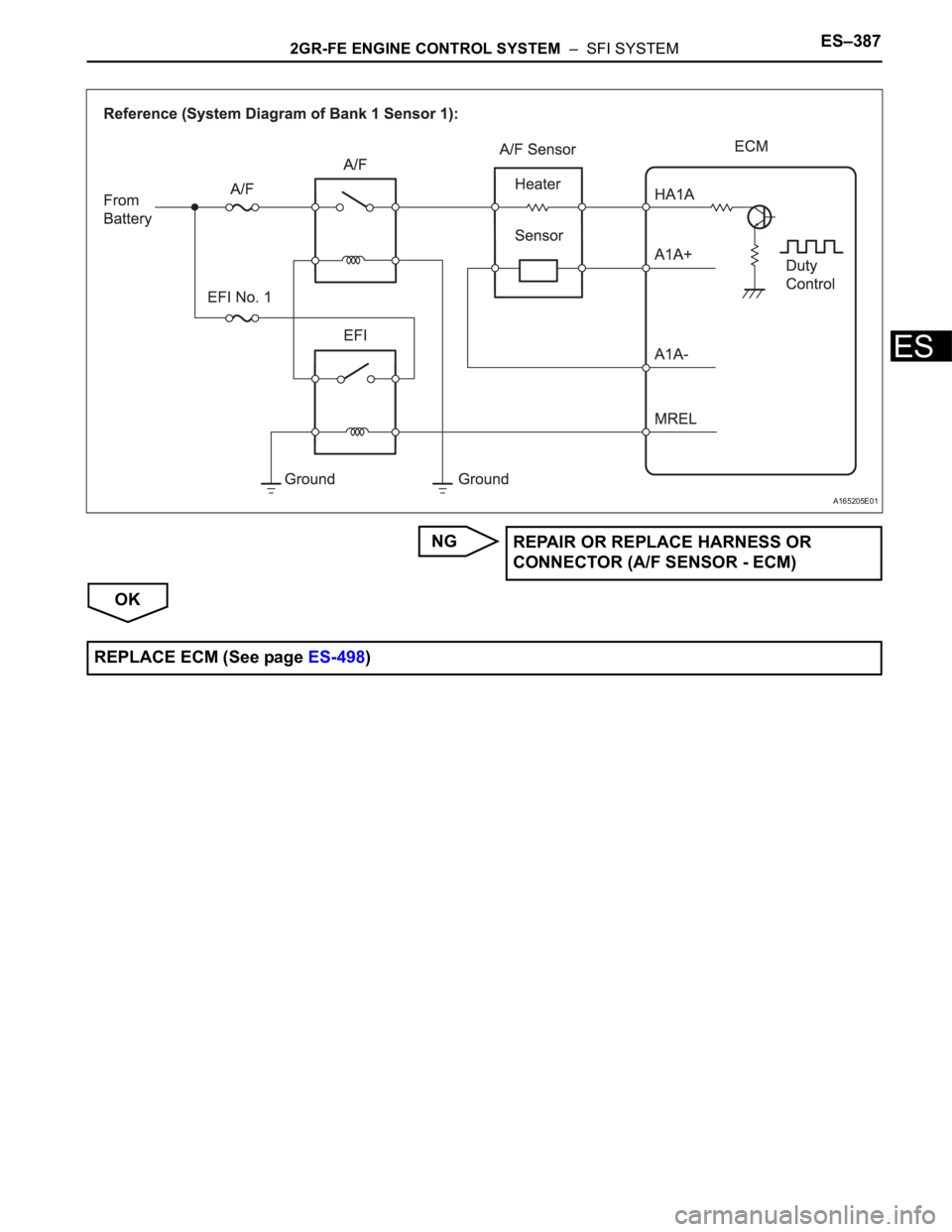
3CHECK HARNESS AND CONNECTOR (A/F SENSOR - ECM)
A136175E10
Tester Connection Specified Condition
+B (A5-2) - Body ground 9 to 14 V
+B (A6-2) - Body ground 9 to 14 V
Tester Connection Specified Condition
HT (A5-1) - HA1A (E10-2) Below 1
AF+ (A5-3) - A1A+ (E10-22) Below 1
AF- (A5-4) - A1A- (E10-30) Below 1
HT (A6-1) - HA2A (E10-1) Below 1
AF+ (A6-3) - A2A+ (E10-23) Below 1
AF- (A6-4) - A2A- (E10-31) Below 1
Tester Connection Specified Condition
HT (A5-1) or HA1A (E10-2) - Body ground 10 k
or higher
AF+ (A5-3) or A1A+ (E10-22) - Body ground 10 k
or higher
AF- (A5-4) or A1A- (E10-30) - Body ground 10 k
or higher
HT (A6-1) or HA2A (E10-1) - Body ground 10 k
or higher
AF+ (A6-3) or A2A+ (E10-23) - Body ground 10 k
or higher
AF- (A6-4) or A2A- (E10-31) - Body ground 10 k
or higher
Page 680 of 3000
2GR-FE ENGINE CONTROL SYSTEM – SFI SYSTEMES–387
ES
NG
OK
A165205E01
REPAIR OR REPLACE HARNESS OR
CONNECTOR (A/F SENSOR - ECM)
REPLACE ECM (See page ES-498)
Page 682 of 3000
2GR-FE ENGINE CONTROL SYSTEM – SFI SYSTEMES–389
ES
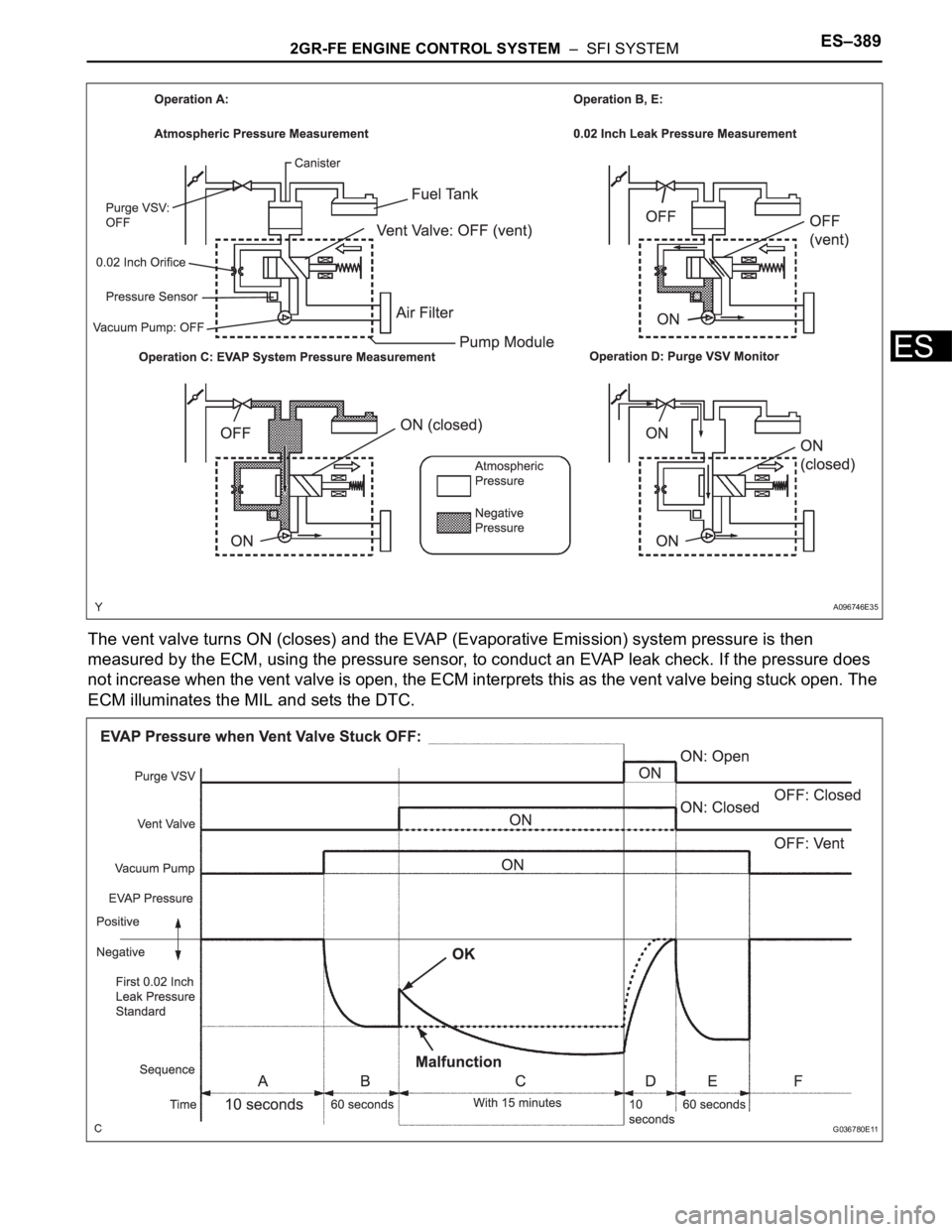
The vent valve turns ON (closes) and the EVAP (Evaporative Emission) system pressure is then
measured by the ECM, using the pressure sensor, to conduct an EVAP leak check. If the pressure does
not increase when the vent valve is open, the ECM interprets this as the vent valve being stuck open. The
ECM illuminates the MIL and sets the DTC.
A096746E35
G036780E11
Page 683 of 3000

ES–3902GR-FE ENGINE CONTROL SYSTEM – SFI SYSTEM
ES
MONITOR STRATEGY
TYPICAL ENABLING CONDITIONS
Key-off monitor sequence 1 to 8
1. Atmospheric pressure measurement
2. First reference pressure measurement
3. EVAP canister vent valve close stuck check
4. Vacuum introduction
5. EVAP canister purge valve close stuck check
6. Second reference pressure measurement
Related DTC P2420: Vent valve stuck open (vent)
Required Sensors/Components Purge VSV and pump module
Frequency of Operation Once per driving cycle
Duration Within 2 minutes
MIL Operation 2 driving cycles
Sequence of Operation None
The monitor will run whenever these DTCs are not
presentNone
Atmospheric pressure 70 to 110 kPa (525 to 825 mmHg)
Battery voltage 10.5 V or more
Vehicle speed Less than 2.5 mph (4 km/h)
Ignition switch OFF
Time after key-off 5 or 7 or 9.5 hours
EVAP pressure sensor malfunction (P0450, P0452,
P0453)Not detected
EVAP canister purge valve Not operated by scan tool
EVAP canister vent valve Not operated by scan tool
EVAP leak detection pump Not operated by scan tool
Both of the following conditions 1 and 2 are set before
key-off-
1. Duration that vehicle driven 5 minutes or more
2. EVAP purge operation Performed
ECT 4.4 to 35
C (40 to 95F)
IAT 4.4 to 35
C (40 to 95F)
Next sequence is run if the following condition is met -
Atmospheric pressure change Less than 0.3 kPa (2.25 mmHg) in 1 second
Next sequence is run if the following conditions are met Condition 1, 2 and 3
1. EVAP pressure just after reference pressure
measurement start-1 kPa (-7.5 mmHg) or less
2. Reference pressure -4.85 to -1.057 kPa (-36.384 to -7.929 mmHg)
3. Reference pressure Saturated within 1 minutes
Next sequence is run if the following condition is met -
EVAP pressure change after vent valve is ON 0.3 kPa (2.25 mmHg) or more
Next sequence is run if the following condition is met -
EVAP pressure Saturated within 15 minutes
Next sequence is run if the following condition is met -
EVAP pressure change after purge valve is open 0.3 kPa (2.25 mmHg) or more
Next sequence is run if the following conditions are met Condition 1, 2, 3 and 4
Page 686 of 3000

2GR-FE ENGINE CONTROL SYSTEM – SFI SYSTEMES–393
ES
MONITOR DESCRIPTION
5 hours after the ignition switch is turned off, the soak timer activates the ECM to begin the EVAP system
monitor. While the engine is running, the ECM monitors the synchronization of the soak timer and the
CPU clock. If these two are not synchronized, the ECM interprets this as a malfunction, illuminates the
MIL and sets the DTC (2 trip detection logic).
MONITOR STRATEGY
TYPICAL ENABLING CONDITIONS
TYPICAL MALFUNCTION THRESHOLDS
INSPECTION PROCEDURE
HINT:
• DTC P2610 is set if an internal ECM problem is detected. Diagnostic procedures are not required.
ECM replacement is required.
• Read freeze frame data using the intelligent tester. The ECM records vehicle and driving condition
information as freeze frame data the moment a DTC is stored. When troubleshooting, freeze frame
data can be helpful in determining whether the vehicle was running or stopped, whether the engine
was warmed up or not, whether the air-fuel ratio was lean or rich, as well as other data recorded at the
time of a malfunction.
(a) Replace the ECM (See page ES-498).
NEXT
(a) Connect the intelligent tester to the DLC3.
(b) Turn the ignition switch to the ON position.
(c) Clear the DTCs (See page ES-39).
(d) Start the engine and wait for 10 minutes or more.
Required Sensors / Components ECM
Frequency of Operation Once per driving cycle
Duration 10 minutes
MIL Operation 2 driving cycles
Sequence of Operation None
The monitor will run whenever these DTCs are not
presentNone
Ignition switch ON
Engine Running
Battery voltage 8 V or more
Sta r t e r OF F
Soak timer measurement when ECM CPU clock counts
10 minutesLess than 7 minutes or more than 13 minutes
1REPLACE ECM
2CHECK WHETHER DTC OUTPUT RECURS
Page 688 of 3000

2GR-FE ENGINE CONTROL SYSTEM – SFI SYSTEMES–395
ES
HINT:
• DTC P2A00 indicates malfunctions related to the bank 1 A/F sensor.
• DTC P2A03 indicates malfunctions related to the bank 2 A/F sensor.
• Bank 1 refers to the bank that includes cylinder No. 1.
• Bank 2 refers to the bank that includes cylinder No. 2.
• Sensor 1 refers to the sensor mounted in front of the Three-Way Catalytic Converter (TWC) and
located near the engine assembly.
DESCRIPTION
Refer to DTC P2195 (See page ES-355).
MONITOR DESCRIPTION
After the engine is warmed up, the ECM performs air-fuel ratio feedback control to maintain the air-fuel
ratio at the stoichiometric level. In addition, active A/F ratio control is performed for approximately 10
seconds after preconditions are met in order to measure the A/F sensor response rate. During active A/F
ratio control, the ECM forcibly increases and decreases the injection volume to a certain amount, based
on the stoichiometric air-fuel ratio learned during normal air-fuel ratio control, and measures the A/F
sensor response rate. The ECM receives a signal from the A/F sensor while performing active A/F ratio
control and uses it to calculate the A/F sensor response rate deterioration level.
If the value for A/F sensor response rate deterioration level is less than the threshold, the ECM interprets
this as a malfunction and sets the DTC.
DTC P2A00A/F Sensor Circuit Slow Response (Bank 1
Sensor 1)
DTC P2A03A/F Sensor Circuit Slow Response (Bank 2
Sensor 1)
DTC No. DTC Detection Condition Trouble Area
P2A00
P2A03Calculated value for air-fuel ratio (A/F) sensor response
rate deterioration level is less than threshold• Open or short in A/F sensor circuit
• A/F sensor
•ECM